

Researchers from the Universitat Politècnica de València (UPVCMT-Motores )’s Térmicos (Thermal Engines) group are developing new, more efficient cooling systems that use solar air conditioning, which will assist in addressing the summer increase in electricity bills Their study results made an appearance in the International Journal of Refrigeration.
“In the last month, the ‘perfect storm’ has occurred in all aspects of the electricity bill. On the one hand, there is the so-called rate change, which is divided into three segments, and on the other, there are consumption peaks in the summer during the hottest days of the year. In these days of high temperatures, air conditioning units and cooling systems consume more electricity, raising the cost of electricity significantly—without going any further, the price of electricity surpassed its annual record last Saturday. Solar air conditioning, while an oxymoron, has the potential to be a solution to this perfect storm, says “José Ramón Serrano”, a CMT researcher.
Solar air conditioning equipment
Solar air conditioning is the equipment used to cool a space with solar energy. Two main groups are involved, as explained by Serrano: on the one hand, photovoltaic panels are used to produce traditional air conditioners. The problem with these solutions is their low efficiency: barely 10 percent, which means the nearly 1,000W per sqm that we get with the most solar radiation during the summertime, generates only 100W of electricity. “This represents about 300 W of cooling power in a traditional cold unit,” Serrano describes.
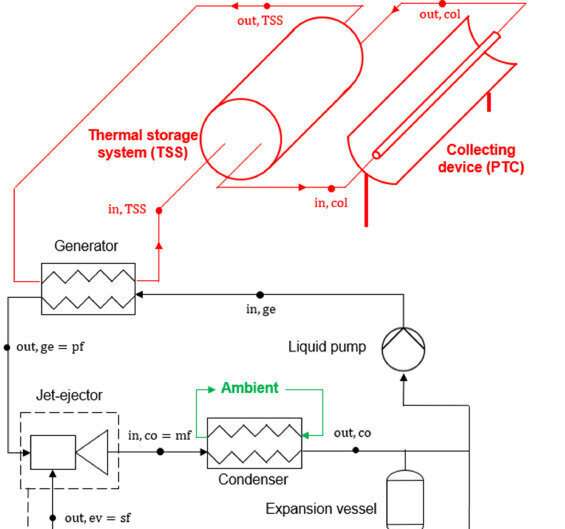
Solar thermal cooling systems, on the other hand, are more efficient and versatile. In this case, thermo-solar panels are used in place of photovoltaic panels that warm up a liquid by using surfaces that absorb or concentrate solar rays. These systems are used in the cold winter months in households to heat sanitary water and solar heating systems. The CMT-Motores Térmicos researchers concentrate their efforts on the latter to use them during the summer.
They propose coupling these panels to absorption or ejection cycles, which would allow them to cool the room using the sun’s heat as the source of energy. The 1,000 W per square meter received in these cases can be converted into 500 W of heating power using the thermal oil that flows through the thermo-solar panels. The 500 W can then be converted into 600 W of cooling power via high-efficiency absorption cycles.
“One advantage of using this equipment is that the cooling capability increases in tandem with the solar radiation, which coincides with periods of higher cooling demand,” says Vicente Dolz, UPV professor and CMT-Motores Térmicos researcher.
And how would this allow you to save money on electricity?
A typical household air conditioning unit in the living room has a cooling capacity of around 3,500 W. According to the UPV researchers, these values can be achieved with around 6 m2 of thermo-solar panels coupled to an absorption cycle during the hours of highest irradiation (midday in the summer) to completely replace the traditional air conditioning unit with the absorption cycle.
“A traditional air conditioning unit consumes approximately 1,170 W of electricity to achieve the 3,500 W of cooling power.” The technology that we propose would allow us to eliminate said consumption from our bills while enjoying the greatest level of comfort possible thanks to the combination of solar panels and absorption cycles.
CMT-Motores Térmicos proposed that solution can also be implemented as a hybrid system that provides part of the traditional system’s cooling capabilities or improves its efficiency while also reducing global electricity consumption by providing the solar air conditioning system.
 Eduindex
You must be logged in to post a comment.