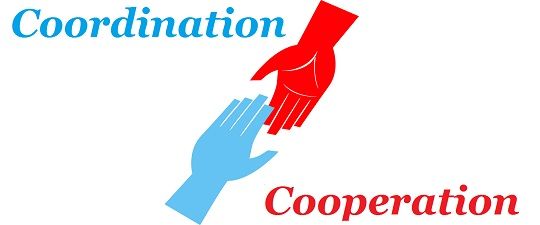
Cooperation is not always an easy thing to achieve in the workplace, but the effort is worth it because it leads to a harmonious and productive space. Cooperation can make the difference between success and failure for many businesses. When employees dedicate more time to their duties in a cooperative workplace, they are more productive and things get done more quickly and efficiently. Valuable time is not lost resolving bickering and conflict between employees and management when there is cooperation at the workplace. Teamwork is a mark of cooperation at the workplace. ‘Teamwork makes the dream work” says author John C. Maxwell. In a cooperation-rich workplace, individuals will voluntarily engage in open discussion. Management and employees work together and try to keep arguments to a minimum.
It takes empathy and skill, to bring a group of employees to cooperate and come together as a team. The basic role of a leader is to inspire. If you are a leader, in any sense, never forget the influence you have on others. As a boss, supervisor or leader, your attitude affects your employees and co-workers. Remember, that as your attitude affects your employees, in turn their attitudes affect your customers. And, as we all know, your customers are the lifeblood of your business.
A lot of people don’t know how to build a highly effective team. It is cooperation which is the pillar of teamwork. It has to be a part of any team that hopes to be successful. So what does it mean? And how do you get it? Cooperation means a group of employees working together for everyone’s benefit.
Techniques of Co-Ordination (How to Achieve Co-Ordination?):
(i) Clearly Defined Goals:–
The goals of the enterprise should be laid down clearly. Every individual in the enterprise should understand the overall objectives and the contribution of his job to these objectives.
(ii) Precise and Comprehensive Programmes and Policies:–
Laying down well defined programmes and policies is another measure for achieving effective coordination. This brings uniformity of action because everybody understands the programmes and policies which act as guides for taking decisions.
(iii) Clear Lines of Authority and Responsibility:–
An enterprise is composed of several vertical and horizontal authority relationships. Authority flows from top through various positions down to the level of operative workers. There is a line of authority in every enterprise which indicates that who is accountable to whom. This line of authority and responsibility should be clearly defined to achieve coordination.
(iv) Effective Communication:–
Effective communication is key to proper coordination. The channel of communication used in the enterprise should be reliable so that they are able to create proper understanding in the mind of the receiver. As advised by Mary Follett, personal contacts should be encouraged as it is the most effective means of communications for achieving coordination.
(v) Effective Leadership and Supervision:–
Management can achieve better coordination through effective leadership and supervision. Effective leadership ensures coordination both at the planning and the implementing stage. Effective supervision is also necessary to guide the activities of individuals in the proper direction. This will bring unity of action which is essential to co-ordination.
Ways to Gain Cooperation and Increase Engagement–
If you want to increase your employees’ engagement and commitment and encourage teamwork there are a few things you can do to make them feel valuable which will lead to committed employees.
It is easy for workers to feel like cogs in a big machine and having no real impact when they are not shown recognition. In cooperative workplaces, where employees are treated like a valuable part of the organization, management commonly reaches out to lower-leval employees seeking their input as to what should be done or how a task should be completed.
Engaging Your Employees–
If you want employee engagement you have to find a way to make them part of the process. There is a difference between commitment and compliance. Compliant employees do what is required and no more. Committed employees become part of a team, looking for ways to benefit the company with their expertise, their ideas and their energy. Employees buy in to what they help to create. Once you have built a platform of trust with them, you can go to the next level and get their active participation.
Showing Respect–
If you ever had a boss who did not show much respect, but, now being on the other side of the fence, perhaps you do understand that leaders get tired of employee complaints, and frequently talk about how drama in the workplace hampers productivity. As a leader, you must set the tone of how complaints are registered, and you must develop the wisdom to respond appropriately instead of reacting to an employee’s negativity.
Listening to your Employees–
The worst thing that a manager can do when an employee comes to him/her with a problem is to criticize or ignore. Do not make your employee feel insignificant. Pretending to listen or be sympathetic is even worse. Even if you hear what is being said, if you are distracted by checking e-mail, or looking at a message on your phone, you are unintentionally communicating that the person in front of you is not important enough to give your full attention.
Magnifying the Strengths-
The benefits of developing existing staff more than outweigh the cost of the time and money required to find new workers. The best companies make their employees even better and the least of them become better than what they thought they would ever be! In today’s competitive business economy, Managers are pushed towards minimizing labour costs rather than developing the long terms goal of increasing employees’ potential.
Conclusion:-
Co-ordination results in creation of a true whole that is larger than the sum total of its parts. The analogy of the conductor of a symphony orchestra is appropriate here. The conductor by his coordinating skills of vision, leadership and simultaneous attention to totality of the orchestra group and its individual instrument players, creates a living musical performance and not mere noise.
In any case, management has no alternative but to perform mediating, moderating and motivating roles in securing coordinated action. Mediation with external environment, moderation while controlling internal environment and motivation of individual organisational members are integral coordinating functions of management.



 Eduindex