Opportunity Cost Theory ( Assumptions , Explanation , Criticism )


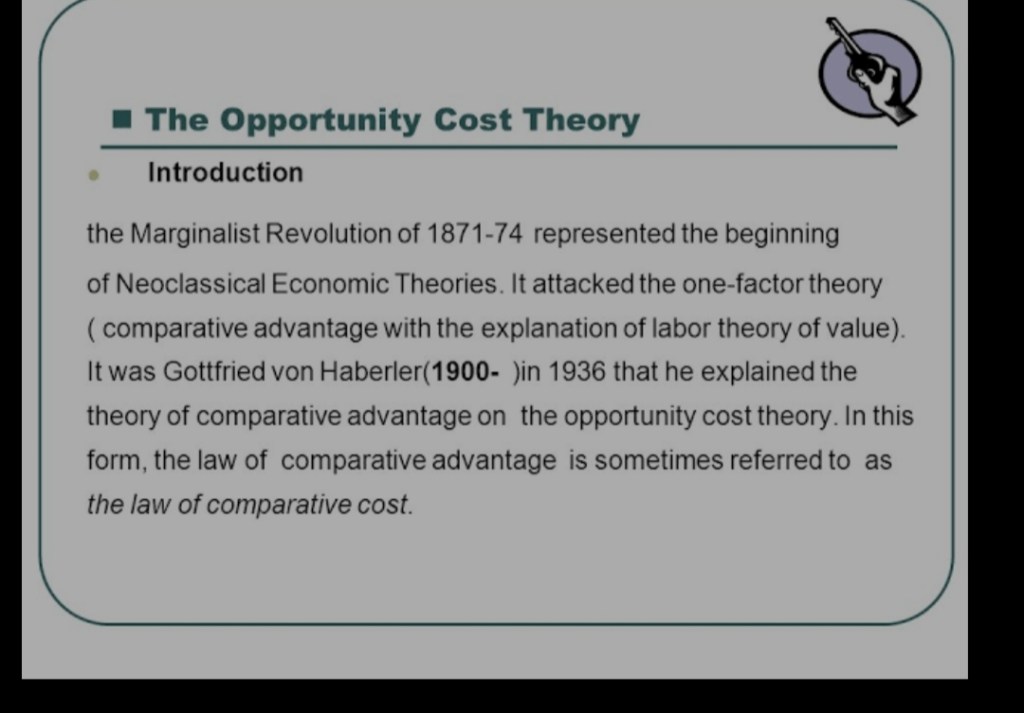
Innumerable theories are formulated by Haberler , Ohlin , Samuelson , Leontief , Hecksher and many others dealing with the macro and micro parts of international trade .

The principle of Comparative Cost theory by Ricardo, despite being the basis of international trade, has been criticized by many economists .
Ricardo’s theory of comparative cost is based on the labour theory of value which means that labour is the only factor of production and labour is homogeneous .
Such assumptions are found to be unrealistic .

Gottfired Haberler ‘ s theory of opportunity cost overcomes these shortcomings and explains the doctrine of the theory in terms of ” the substitution curve’ ‘ or as Samuelson entitled it as ” production possibility curve “or “transformation curve ” .

Lerner called it the ” production indifference curve ” or ” production frontier .”

Haberler’s theory is found to be more realistic .

The Theory of Opportunity cost


Opportunity cost is the value of loss when choosing between two or more commodities.

To elaborate more ,
The opportunity cost theory says that if a country can produce either commodity X or Y , the opportunity cost of commodity X is the amount of the other commodity Y that must be given up in order to get one additional unit of commodity X .

The exchange ratio between the two commodities is expressed in terms of their opportunity costs .
The decrease in the quantity of the second commodity represents the opportunity cost of the additional quantity of the given commodity.

Haberler used the concept of opportunity cost with production possibility curves to illustrate international trade theory.

Assumptions :-

The following assumptions are formulated by Haberler to illustrate the theory :-

• There are only two countries , (A,B)
• Each country possesses two factors of production – labour and capital.
• Each country can produce two commodities , ( X and Y ,)
• There is perfect competition in both the factor and commodity markets .
• The price of each commodity equals its marginal money costs .
• The price of each factor equals its marginal value productivity in each employment .
• The supply of each factor is fixed .
• Factors are immobile between the two countries.
•. There is no change in technology .
• Trade between the two countries is completely free and unrestricted.


Key terms :-

Production possibility curve :-

A production possibility curve or transformation curve is the curve that shows various combinations of two goods that can be produced with available amounts of resources .
Production possibility curve shows that if an economy wants to produce more of one commodity ,it will have to transfer or divert resources from the production of another commodity to produce the one .
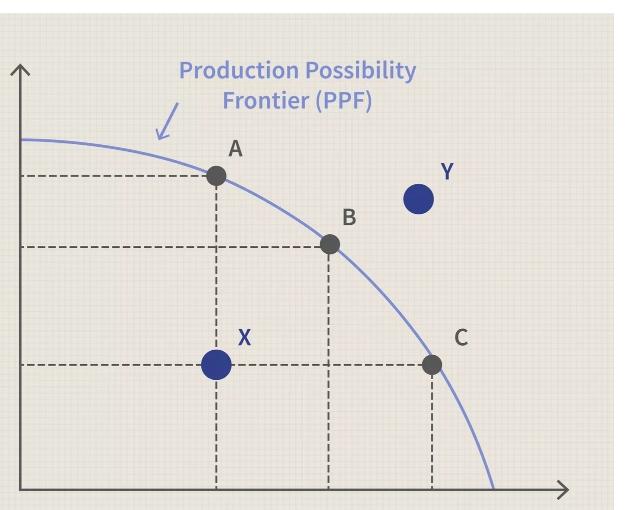


Different points on the production possibility curve show different combinations of the two goods . Points outside the curve are unattainable because of the scarce quantity of resources available.


Marginal Cost of Production :-
The marginal cost of production measures the change in the total cost of a good that arises from producing one additional unit of that good.


Marginal Rate Of Transformation :-
The marginal rate of transformation is the number of units of one product that can be increased by reducing the quantity of another product. It shows the number of goods that will be foregone to produce an additional unit of other goods while keeping the factors of production constant.


Comparative advantages: – A country can produce one commodity at a lower cost
than the other because of comparative advantages such
as favourable climate, natural resources, geographical
situation and efficiency of labour.


Explanation Of the Opportunity Cost Theory


The production possibility curve indicates such combinations of two commodities .
The shape of the production possibility curve determines the basis and the gain from international trade under the theory of opportunity curve .


The slope of the production possibility curve is determined by the ratio of units of the commodity given up in order to have one unit of the other commodity i.e by Marginal rate of transformation. (MRT)

MRT xy = ∆Y/ ∆X , where ,

X and Y are being produced by a country and some quantities of labour and capital input are used from the production of Y into the production process of commodity X.


Trade can take place only when each nation has a different MRT. The gains from trade for a particular nation depend on how much the
international exchange rates differ from that nation’s MRT. The greater the difference, the
greater is the gains from trade. The gains from trade rest further upon the amount of trade taking place. A larger volume of trade allows larger gains from trade and a greater
increase in the standard of living.


Following the assumptions , two countries say A and B enter into a trade together .


Two commodities X and Y are being produced by using various alternative combinations that a country can produce most efficiently by fully utilising it’s factor of production i.e labour and capital ,are homogeneous , with the available technology in the fixed proportion due to perfect substitutability .

Conditions :-

1:
Trade under Constant Opportunity Cost
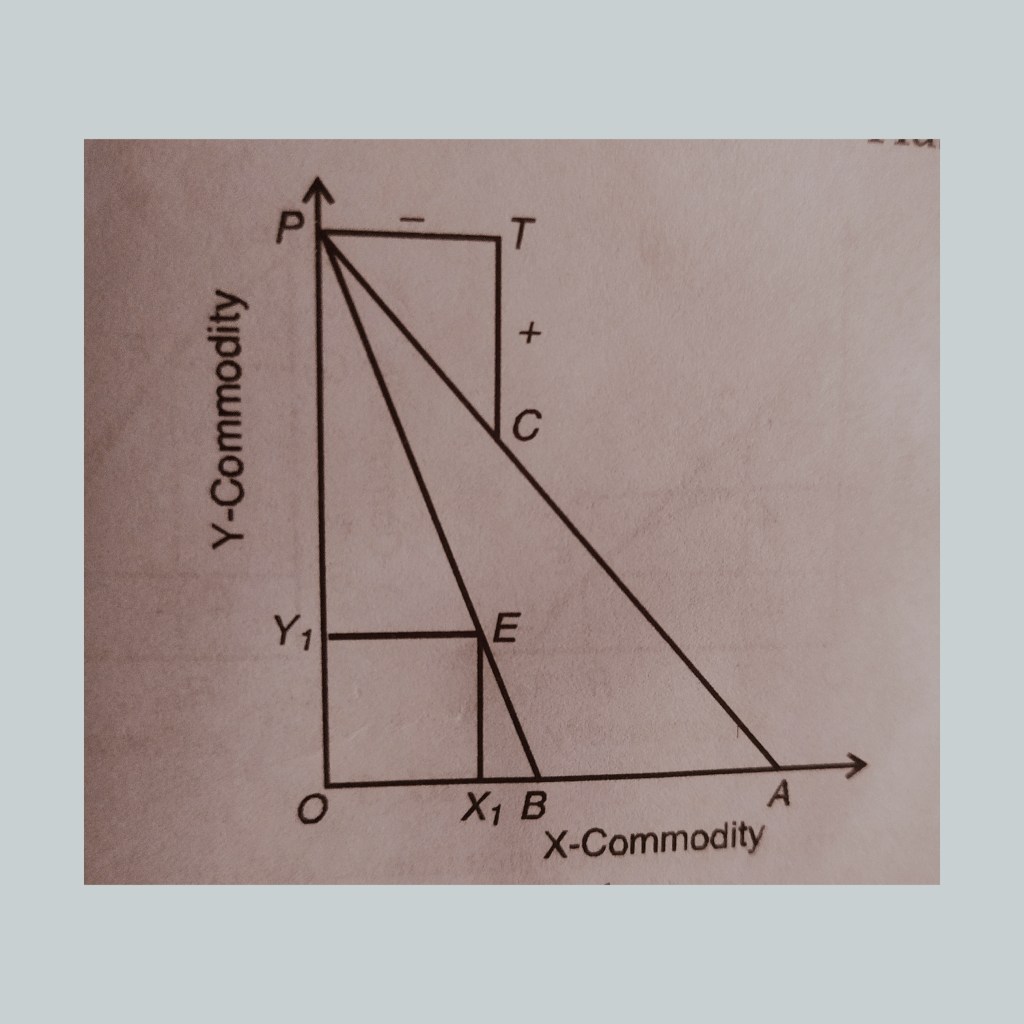


The production possibility curve under constant opportunity cost is a straight line .

In the figure ,
PA is the production possibility curve of country A ,
PB is the production possibility curve of country B .

Country A can produce either
OP of Y , or
OA of X

Similarly , Country B can produce
OP of Y
OB of X .

The slope of the production possibility curve determines the relative price of the two commodities , since the opportunity cost of leaving a unit of one commodity in order to have an additional unit of another is constant , the cost ratio ( relative price ) is the same on all the points on the production possibility curve.

Since , the MRT is constant i.e the slope of the production possibility curve is also constant, trade between the two countries is not possible as no country stands to gain through the trade .


Trade Under Increasing Opportunity Cost :-
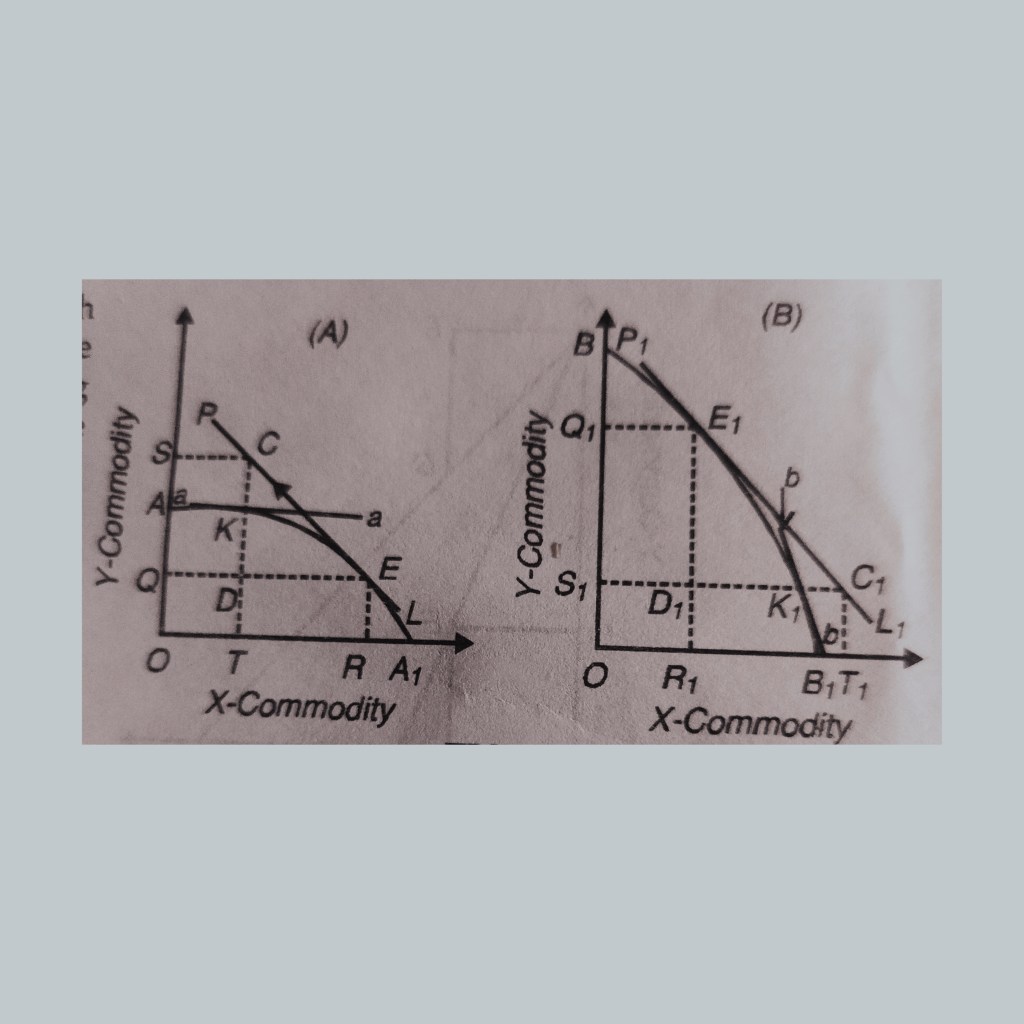


The production possibility curve under the increasing opportunity cost is concave to the origin because when a country specialises in the production of one commodity ,in which it possesses comparative advantage ,its opportunity costs increase .

In the above figure ,
AA1 is the production possibility curve of country A which is concave to the origin .
The slope of this curve shows that country A will specialise in the production of commodity X .
The larger amount of commodity Y will be given up to have additional amount of commodity X as we move from point A to A1
Thus ,the country faces increasing opportunity costs .

BB1 is the production possibility curve of a country which is concave to the origin .
The slope of this curve shows that country B will specialise in the production of commodity Y.
The larger amount of commodity Y will be given up to hsv additional amount of commodity Y as we move from B1` to B .
Thus , the country faces increasing opportunity costs.

Let us assume the international price ratio is given by the line PL in country A ,
and PL1 in country B.

The slope of line PL is greater than domestic price line aa ,making commodity X expensive in international market than in domestic market and resulting in the interest of country A to shift some factor of production from the production of commodity Y to commodity X , moving it’s production level from point K to point E.

It will export TR of X and import QS of Y ,
domestically consuming OT of X ,and OQ of Y .
The export and import can be shown by the “trade triangle ” CDE .


The slope of line PL1 is less steep than domestic price line bb ,making commodity Y expensive in international market than in domestic market and resulting in the interest of country B to shift some factor of production from the production of commodity X to commodity Y , moving it’s production level from point K1 to point E1

It will import D1C1 of X and export D1E1 of Y ,
domestically consuming OS1 of Y ,and OR1 of X.
The export and import can be shown by the “trade triangle ” C1E1D1.

Trade Under Constant Decreasing :-
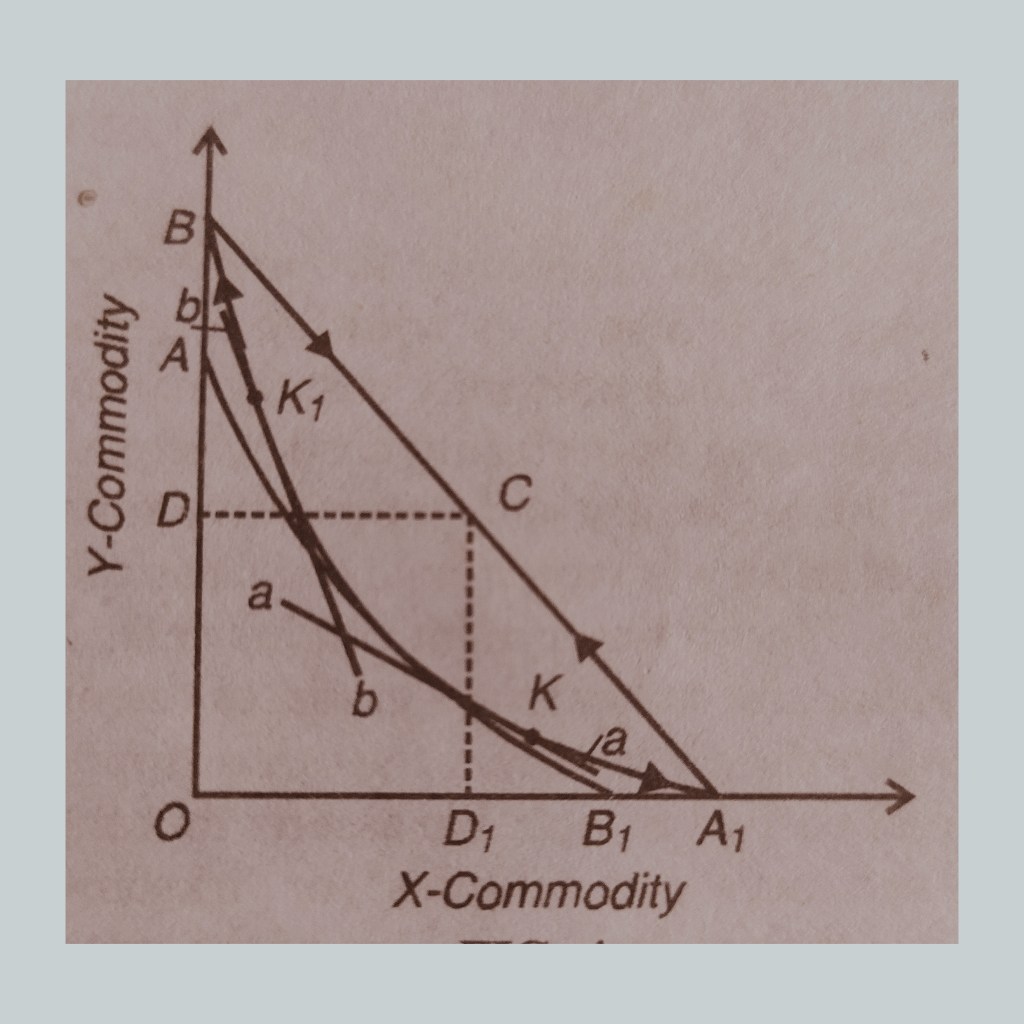


When two countries experience decreasing opportunity costs their production possibility curves are convex to the origin.
Under decreasing opportunity costs , each country completely specialises in the production of only one commodity after trade because there are increasing returns based on internal economies of production .

In the figure ,
The production possibility curve of country A is AA 1 and B is BB1.

The pre trade production and consumption point of country A is K where it’s domestic price line aa is tangent to its production possibility curve and country B is K1 , where it’s domestic price line bb is tangent to its production possibility curve.

The international price line being BA1, if both the countries enter the trade ,
BA1 is steeper than the domestic line of country A , making X more expensive in the international market and resulting in shifting of resources of production to X from K to A1 .

On the other hand , the international price line BA1 is flatter than the domestic price line bb of the country making Y commodity expensive in the international market than in the domestic market and resulting in shifting of resources of production to commodity Y and moving from K1 to B .

Thus , country A will completely specialise in commodity X and B in commodity Y .
Now both the countries will move along with the international price line BA1,
Country A from A to point A1 upward , country B from B to point B1 downward and reach point C in consumption.


Note :-

The straight line tangent represents :-

‘A straight line tangent to the transformation curve indicates the ratio of market prices
of the two commodities, and the condition of tangency expresses equilibrium in production, that is, equality between prices and marginal costs stated in opportunity terms. Domestic demand conditions enter into this construction via community indifference curves, or simply
as a consumption point determined by a given arrangement of production and income distribution.”


Finally, tangency of a line representing the equilibrium international price ratio to
both transformation function and community indifference curve indicates equilibrium in
exchange, that is:

(i) Equality domestically between the marginal rate of substitution in consumption and marginal rate of transformation in production, and

(ii) Equality of the value of exports and the value of imports.


Critical Appraisal

As an alternative to classical comparative theory , the opportunity cost theory is more realistic .

The opportunity cost theory analyses pre- trade and post – trade situations under constant , increasing and decreasing opportunity cost whereas comparative advantage theory is based on constant cost of production within a country and comparative advantage and disadvantage between two countries.

Jacob Viber in his ” Studies in The Theory of International Trade ” ( 1937) criticized the opportunity cost theory of values which is the basis of Haberler’s theory .
Some of his criticism were :-

• Neglecting of welfare
• Failure in measuring in terms of strain , sacrifice or disutility.
• Neglecting Change in Factors of Supplies .
• Unrealistic Assumptions .


Despite criticism ,the opportunity cost theory has been regarded as more fertile because it can be readily extended into a general equilibrium system .

Opportunity Cost Theory ( Assumptions , Explanation , Criticism )


Innumerable theories are formulated by Haberler , Ohlin , Samuelson , Leontief , Hecksher and many others dealing with the macro and micro parts of international trade .

The principle of Comparative Cost theory by Ricardo, despite being the basis of international trade, has been criticized by many economists .
Ricardo’s theory of comparative cost is based on the labour theory of value which means that labour is the only factor of production and labour is homogeneous .
Such assumptions are found to be unrealistic .

Gottfired Haberler ‘ s theory of opportunity cost overcomes these shortcomings and explains the doctrine of the theory in terms of ” the substitution curve’ ‘ or as Samuelson entitled it as ” production possibility curve “or “transformation curve ” .

Lerner called it the ” production indifference curve ” or ” production frontier .”

Haberler’s theory is found to be more realistic .

The Theory of Opportunity cost


Opportunity cost is the value of loss when choosing between two or more commodities.

To elaborate more ,
The opportunity cost theory says that if a country can produce either commodity X or Y , the opportunity cost of commodity X is the amount of the other commodity Y that must be given up in order to get one additional unit of commodity X .

The exchange ratio between the two commodities is expressed in terms of their opportunity costs .
The decrease in the quantity of the second commodity represents the opportunity cost of the additional quantity of the given commodity.

Haberler used the concept of opportunity cost with production possibility curves to illustrate international trade theory.

Assumptions :-

The following assumptions are formulated by Haberler to illustrate the theory :-

• There are only two countries , (A,B)
• Each country possesses two factors of production – labour and capital.
• Each country can produce two commodities , ( X and Y ,)
• There is perfect competition in both the factor and commodity markets .
• The price of each commodity equals its marginal money costs .
• The price of each factor equals its marginal value productivity in each employment .
• The supply of each factor is fixed .
• Factors are immobile between the two countries.
•. There is no change in technology .
• Trade between the two countries is completely free and unrestricted.


Key terms :-

Production possibility curve :-

A production possibility curve or transformation curve is the curve that shows various combinations of two goods that can be produced with available amounts of resources .
Production possibility curve shows that if an economy wants to produce more of one commodity ,it will have to transfer or divert resources from the production of another commodity to produce the one .


Different points on the production possibility curve show different combinations of the two goods . Points outside the curve are unattainable because of the scarce quantity of resources available.


Marginal Cost of Production :-
The marginal cost of production measures the change in the total cost of a good that arises from producing one additional unit of that good.


Marginal Rate Of Transformation :-
The marginal rate of transformation is the number of units of one product that can be increased by reducing the quantity of another product. It shows the number of goods that will be foregone to produce an additional unit of other goods while keeping the factors of production constant.


Comparative advantages: – A country can produce one commodity at a lower cost
than the other because of comparative advantages such
as favourable climate, natural resources, geographical
situation and efficiency of labour.


Explanation Of the Opportunity Cost Theory


The production possibility curve indicates such combinations of two commodities .
The shape of the production possibility curve determines the basis and the gain from international trade under the theory of opportunity curve .


The slope of the production possibility curve is determined by the ratio of units of the commodity given up in order to have one unit of the other commodity i.e by Marginal rate of transformation. (MRT)

MRT xy = ∆Y/ ∆X , where ,

X and Y are being produced by a country and some quantities of labour and capital input are used from the production of Y into the production process of commodity X.


Trade can take place only when each nation has a different MRT. The gains from trade for a particular nation depend on how much the
international exchange rates differ from that nation’s MRT. The greater the difference, the
greater is the gains from trade. The gains from trade rest further upon the amount of trade taking place. A larger volume of trade allows larger gains from trade and a greater
increase in the standard of living.


Following the assumptions , two countries say A and B enter into a trade together .


Two commodities X and Y are being produced by using various alternative combinations that a country can produce most efficiently by fully utilising it’s factor of production i.e labour and capital ,are homogeneous , with the available technology in the fixed proportion due to perfect substitutability .

Conditions :-

1:
Trade under Constant Opportunity Cost


The production possibility curve under constant opportunity cost is a straight line .

In the figure ,
PA is the production possibility curve of country A ,
PB is the production possibility curve of country B .

Country A can produce either
OP of Y , or
OA of X

Similarly , Country B can produce
OP of Y
OB of X .

The slope of the production possibility curve determines the relative price of the two commodities , since the opportunity cost of leaving a unit of one commodity in order to have an additional unit of another is constant , the cost ratio ( relative price ) is the same on all the points on the production possibility curve.

Since , the MRT is constant i.e the slope of the production possibility curve is also constant, trade between the two countries is not possible as no country stands to gain through the trade .


Trade Under Increasing Opportunity Cost :-


The production possibility curve under the increasing opportunity cost is concave to the origin because when a country specialises in the production of one commodity ,in which it possesses comparative advantage ,its opportunity costs increase .

In the above figure ,
AA1 is the production possibility curve of country A which is concave to the origin .
The slope of this curve shows that country A will specialise in the production of commodity X .
The larger amount of commodity Y will be given up to have additional amount of commodity X as we move from point A to A1
Thus ,the country faces increasing opportunity costs .

BB1 is the production possibility curve of a country which is concave to the origin .
The slope of this curve shows that country B will specialise in the production of commodity Y.
The larger amount of commodity Y will be given up to hsv additional amount of commodity Y as we move from B1` to B .
Thus , the country faces increasing opportunity costs.

Let us assume the international price ratio is given by the line PL in country A ,
and PL1 in country B.

The slope of line PL is greater than domestic price line aa ,making commodity X expensive in international market than in domestic market and resulting in the interest of country A to shift some factor of production from the production of commodity Y to commodity X , moving it’s production level from point K to point E.

It will export TR of X and import QS of Y ,
domestically consuming OT of X ,and OQ of Y .
The export and import can be shown by the “trade triangle ” CDE .


The slope of line PL1 is less steep than domestic price line bb ,making commodity Y expensive in international market than in domestic market and resulting in the interest of country B to shift some factor of production from the production of commodity X to commodity Y , moving it’s production level from point K1 to point E1

It will import D1C1 of X and export D1E1 of Y ,
domestically consuming OS1 of Y ,and OR1 of X.
The export and import can be shown by the “trade triangle ” C1E1D1.

Trade Under Constant Decreasing :-


When two countries experience decreasing opportunity costs their production possibility curves are convex to the origin.
Under decreasing opportunity costs , each country completely specialises in the production of only one commodity after trade because there are increasing returns based on internal economies of production .

In the figure ,
The production possibility curve of country A is AA 1 and B is BB1.

The pre trade production and consumption point of country A is K where it’s domestic price line aa is tangent to its production possibility curve and country B is K1 , where it’s domestic price line bb is tangent to its production possibility curve.

The international price line being BA1, if both the countries enter the trade ,
BA1 is steeper than the domestic line of country A , making X more expensive in the international market and resulting in shifting of resources of production to X from K to A1 .

On the other hand , the international price line BA1 is flatter than the domestic price line bb of the country making Y commodity expensive in the international market than in the domestic market and resulting in shifting of resources of production to commodity Y and moving from K1 to B .

Thus , country A will completely specialise in commodity X and B in commodity Y .
Now both the countries will move along with the international price line BA1,
Country A from A to point A1 upward , country B from B to point B1 downward and reach point C in consumption.


Note :-

The straight line tangent represents :-

‘A straight line tangent to the transformation curve indicates the ratio of market prices
of the two commodities, and the condition of tangency expresses equilibrium in production, that is, equality between prices and marginal costs stated in opportunity terms. Domestic demand conditions enter into this construction via community indifference curves, or simply
as a consumption point determined by a given arrangement of production and income distribution.”


Finally, tangency of a line representing the equilibrium international price ratio to
both transformation function and community indifference curve indicates equilibrium in
exchange, that is:

(i) Equality domestically between the marginal rate of substitution in consumption and marginal rate of transformation in production, and

(ii) Equality of the value of exports and the value of imports.


Critical Appraisal

As an alternative to classical comparative theory , the opportunity cost theory is more realistic .

The opportunity cost theory analyses pre- trade and post – trade situations under constant , increasing and decreasing opportunity cost whereas comparative advantage theory is based on constant cost of production within a country and comparative advantage and disadvantage between two countries.

Jacob Viber in his ” Studies in The Theory of International Trade ” ( 1937) criticized the opportunity cost theory of values which is the basis of Haberler’s theory .
Some of his criticism were :-

• Neglecting of welfare
• Failure in measuring in terms of strain , sacrifice or disutility.
• Neglecting Change in Factors of Supplies .
• Unrealistic Assumptions .


Despite criticism ,the opportunity cost theory has been regarded as more fertile because it can be readily extended into a general equilibrium system .

Clean & Clear Foaming Face Wash

Clean & Clear Foaming Face Wash For Oily Skin, 150ml https://www.amazon.in/dp/B00CI3HDMU/ref=cm_sw_r_apan_glt_fabc_HKAP31DH2V0G6FYKDJP1

A pomade-free facial cleanser that removes extra slick to help heal and avert boils. Formulated specially for gushy and combination skin types, this detergent flushes supererogatory canvas and contaminations. It helps combat papules and prevents them from returning. The detergent has a gentle formula suitable for everyday use.

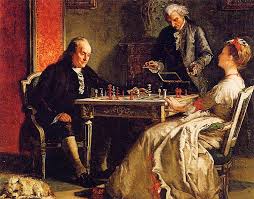
Comprehending CHESS through ‘Through the Looking Glass’

Chess was the most important indoor game of the nineteenth century in England. It enjoyed centuries-old privileged status. It was considered as a ‘rational recreation’. Chess, unlike any other game, deals more with logic and rationality rather than fun, as we know, Rationalism had taken over the Victorian era abundantly.

Alice, at once, recognizes the chess board stretched on the vast land in the Looking Glass World. It shows that although she is just seven and a half years, still familiar to the this game, which signifies the popularity of Chess in England in Victorian Era, especially among the bourgeois class(as it is also called ‘game of royals’) and Alice belonged to the same.

In life we make ‘choices’, in chess we make ‘moves’. In order to attain something valuable in life as to capture the opponent’s castle in chess, initiative has to be taken. Nobody can make decisions for me, I’ll have to play myself, it’s just suggestions that our people may put before us. Here, Alice makes a choice to participate in the game ‘imagining’ her goal where she wants to be in the end. Well, talking about imagination with reference to Victorian era, it significantly brought out a drastic change in society, though previously children along with adults were forced into realism. ‘Imagination’ is quite efficient to presume one’s position in the coming years and then working out to get there can be useful, because life makes it hard to calculate the further possibilities due to lack of information. Alice restrained herself asking the Queens about their arrival, thinking it would be obtrusive, which keeps her away from the information, also we see Alice not able to distinguish between Red Knight and White Knight and actually who’s there to save her declares her ignorance towards information.

Chess is symbolic to attributes of life, we see, there are (apparently) three stages in chess, that is, opening, middle game and the end game, similarly we have childhood, youth and adulthood in life. Alice joins the giant Chess game of life as a white pawn, that is, she holds very limited power and can move once at a time. We always need to start from the beginning, that is, from the very first ladder in order to earn it step by step. Alice has the freedom to setup her ‘goal’ to be a Queen, but she has no power over her inevitable maturation that’s leading her to womanhood. Within the framework of the chess game, Alice has almost no control over her path and she, with certain implied rules of the game, is driven by the corresponding characters in the book, as in chess, every piece moves in answer to the move of the other one. She is pushed towards her goal by the various situations occurring before her in every square, such as, the train ride, no-name forest, Humpty Dumpty and the White Knight. Thus, it can be traced from the narrative that in life, there is some invisible force that’s propelling every individual in the direction of set goal. It can be comprehended that collaboration is the biggest instrument to victory, for example, White Knight saved Alice from the attack of Red Knight without which it had been a Herculean task for her to reach to final square. We will have to rely on our people somehow, otherwise we can’t achieve our dreams just by our own self. In chess, one can take full credit for one’s victories, but in life it would be naive to say that what I achieved is all because of my sole efforts.

The game of Chess in Through The Looking Glass represents the interest of Carroll in logics and mathematics, and the agent is ‘Alice’. This game is not about luck unlike other indoor/board games, rather brainy. In the same way, Life is more about randomness, it’s not alone in the hands of fate, though life is much more unpredictable. We need statistics as well as probability in both chess and life. Also, chess possesses two different colors, that is, one is light and the other one is dark, where I suppose, they stand for logic and nonsense respectively. Based on this idea, Alice often proves to be smarter, more prudent than the so-called adults she confronts in the Looking Glass world. This might also be a reverse-reflection of actual world, I guess, where we see adults inclined towards logic and children uttering stuff and nonsense and vice-versa, here, in the world of mirror.

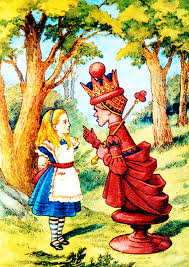
Life of the children in Victorian period was totally opposite to that of present-day children. They were considered as miniature adults and were expected to be highly sophisticated, more in the case of rich class children. Children were not allowed to shout, complain, interrupt or disagree with anyone. The children of rich parents were usually looked after by governesses, no matter humble or strict, and they only used to teach them manners and the way of living. Here, in Looking Glass world, Red Queen, the first character to guide Alice in the reverse world,

resembles very much like a governess of Alice when she teaches her how to not tweedle her fingers while speaking, how to behave, and to curtsey, and how Alice couldn’t go against her. She says, “when you’ve once said a thing, that fixes it, and you must take the consequences.”, because Alice is a Pawn and a Pawn cannot move backward, it is also allusion to the fact that once you have made the decision/choice, you can’t step back and stay committed bearing with it’s outcome, and she also asks Alice only to speak when she was asked to. Even we see TweedleDum-TweedleDee not ready to converse with Alice before she greets them. When Alice thinks that asking the Queens how they arrived would be impertinent, it shows again the social structure built for children in the real Victorian world.

When we are in a state of childhood, we want to turn into an adult soon. Similarly, Alice is excited about her lone-tour of adulthood through the Looking Glass world as she thinks she will be free of all the scolding, she says, “….no one here to scold me away from the fire….and can’t get me!” In the beginning, Alice was thrilled about her journey but as she is heading forward, she encounters the sense of loneliness in her journey to become a Queen(apparently) and acts adult herself. Though she is surrounded by different creatures many a times, but she feels alienated to their foreign ways. Hence, here Chess is a symbol of journey advancing from childhood to adulthood. She undergoes many crucial experiences, putting forward the idea of challenges one has to face in this journey of adulthood in one’s life. In the beginning, we see Alice being rude to Gnat about his jokes and later we see her kindness with White Knight that declares the change in her attitude as moving towards adulthood. When the Queen gives Alice directions as how to be a proper queen, it indicates that Alice wasn’t actually prepared to become a queen, just as it’s hard to prepare to be an adult in real world. Every square leads her to different characters and every character teaches Alice something significant, as we know, advice can come from the most unexpected places. For example, revelation of identity imposed by the situation in the woods of forgetfulness, the White Queen teaches her to believe in impossible, the fall of Humpty Dumpty symbolizes ‘the fall of man for pride’ and also ‘the fall of innocence’ proceeding towards maturity, and likewise all the other characters. These teachings help Alice to inherent the characteristics of adulthood within her. The crown here, symbolizes the transformation of Alice from childhood to adulthood.

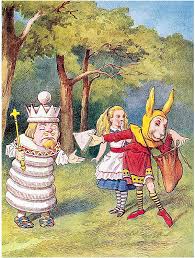
The Red King and the White King are almost doing nothing throughout the game as compared to their Queens. The Red King, as first encountered by Alice, is sleeping and his other pieces are performing their tasks to save him, whereas, the White King seems to be nervous not able to catch up with her Queen.

Now these characters resemble in moves of both as that of the White and Red King in the real chess board. These actions of Queens and Kings in the world behind the mirror, may portray the position of women in the Victorian era. Women, at that time, used to engage themselves working for their husband and family, and also middle class and the working class women were employed to earn bread for their family, in support of their husbands. Red Queen saying to Alice, “…if you want to get somewhere else, you must run at least twice as fast as that!” may ascertain the idea that in a male-dominated society, women need to work double/toil harder in comparison to men in order to attain recognition. Women in the nineteenth century were not given much of the rights and privileges. This period is named after Queen Victoria, who was in the place of power. It is strange to encounter such a frivolous situation of women at the time when a lady herself was reigning over the society. When we behold Alice as a little woman moving from actual world to Looking Glass world, it may seem as she is struggling to change her confided world. She starts her journey all by herself which reflects the essence of independence in her. The characters like Live flowers resemble the social class structure that pushes Alice to follow their rules. When she chooses to be a Queen, she establishes the path for women/girls to upgrade their status because Alice learns that she must have a powerful authority to control Looking Glass world when one of the servants at once answers her after she turns into a Queen, so is the case for women in Victorian era, for example, Queen Victoria.

We need not be afraid of our high-rated opponents and feel incapable before them and it is then only that Alice is able to shake Red Queen in frustration and raises her voice against her rather than stitching her lips out of fear as evident in the beginning, that is, crown here, symbolizes her transformation from childhood to womanhood, gives her voice and finally renovates her status from a pawn to a queen. All the exclusive pieces are placed right behind the pawns. And a Pawn in comparison to them is just an ordinary, common piece that can slowly and gradually become a Queen. Even a pawn can cut down a King, pertaining to life, a single human being, regardless of his status, is enough to bring about revolution in the society, and win the castle of life. Alice suffering through all the odds, obstructions eventually made it, checkmated the Red King and turned into a Queen.

As a Queen in the game, the Red Queen and the White Queen are able to move swiftly and effortlessly. The White Queen, as she says, “jam-tomorrow and jam-yesterday, but never jam-today.”, and screams before pricking her thumb, travels in past and future which is true for the Queen,

in general, in chess that she can freely move in every direction possible, but she is seen nervous and messy all the time here, and ultimately at two points passes up a chance to checkmate and on another occasion she missed the opportunity to capture the Red Knight. Similarly, the Red Queen said to Alice, “Speak when you’re spoken to!”, and having supporting her words, she doesn’t announce it after putting White King on the check, hence, the check is ignored. Their individual character traits restrained them from performing their duties. This also discovers their absent-mindedness and reverse effect of the mirror world.

The Knight in the chess moves very distinctively and is allowed to jump over any other pieces. Riding and falling of the White Knight in looking glass world is signifying it’s unique L-shape movement. The inventions of White Knight are here to present his powerful character trait, like in chess board Knight is an only piece imbibed with many powers, unlike other pieces, not even a Queen can move in same way as Knight, though his inventions are unprofitable disclosing the touch of the illusionary world, still it is pointing to the fact that precaution is must, so his horse wears spikes on it’s ankles to protect it from shark bites and he collects things that might be useful in the difficult situation. The White Knight is the only character that is benevolent with Alice and saves Alice from the attack of Red Knight (stopping her to be a Queen/upgrade the position of women in society), but it can be an example of gender-biased society where a man is shown as a powerful figure and woman belongs to a weaker section. Alice, here, is represented as a weak girl and this action of White Knight throws light on the concept of feminism, and make Alice learn that a woman must stand for herself and must discover her own capabilities.

Chess wasn’t just one of the themes in Carroll’s story, indeed, it was the ground for the novel’s structure. The game of chess in real world is ‘logical’ while in looking glass world it can be called as ‘maddening game of chess’. Also as an inverted image created by the mirror, this indoor game is displayed as an outer giant field of chess. The pieces are definitely running and moving under the implied rules, but the pattern is not applied evenly. This game sets the deterministic way of life. Both life and chess are, more or less, synonymous in almost every aspect.

Citation: https://www.smithsonianmag.com/arts-culture/the-64-square-grid-design-of-through-the-looking-glass-24546391/

LITERARY CRITICISM

Criticism is the branch of study concerned with defining, classifying, expounding and evaluating works of literature. Criticism deals with all branches of poetry, drama and novel and even criticism. The realm of literature consists mainly of three activities are the power to create, the power to appreciate and the power to criticise. Unlike the other two, the power to criticise may be an acquired power. The process of criticism is one of asking and answering rational questions about the literature and the study of the individual works of writers.

WHO IS A CRITIC?

A critic is who examines a work of literature and pronounces judgement upon it. It is the assessment of merit. According to Walter Pater criticism is a art of interpreting art. Carlyle also consider criticism as interpretation. This is a comprehensive view because criticism is more than interpretation or judgement. Arnold defines criticism as a disinterested endeavour to learn and propagate the best is known and thought in the world. According to Hudson the chief function of criticism is to enlighten and stimulate. Criticism helps the reader to partake in the great vision a work of literature presents. No analysis or criticism of a literary work alone can be substitute for our personal mastery of it. Criticism only help us to go forward. Bacon said, “some book may be read by deputy”. Good criticism helps the reader to penetrate into the heart of the work and to distinguish between what is permanent and what is temporary in it.

TWO MAIN FUNCTIONS OF CRITICISM:

JUDGEMENT AND INTERPRETATION – Every effort at judgement leads to appreciation. The purpose of a critic is to penetrate into the heart of the work he criticises. He should disengage its essential qualities of beauty and power. He should distinguish between different levels of values. He should elucidate the artistic principles which have controlled the work. As Pater said “To feel the virtue of the poet or the painter, to disengage it, to set it forth, these are the three stages of the critics’s duty”.

APPROACHES TO CRITICISM:

1. CLASSICAL- criticism held sway till the 18th century. Aristotle’s poetics was held as the master key to the treasure of literature by the classical critics. This type of criticism stands for judgement based on absolute standards and established conventions. It laid emphasis on the judicial function of criticism and advocated right judgement as the first step towards right appreciation. Classical criticism is severely restricted the free play of the critical faculty because it was bound by rules and standards laid down in ancient times.

2. ROMANTIC- criticism which began with wordsworth is subjective. It list down that every work of art carries with it its own rules of enjoyment and there is no need to search for rules outside the work. It also begin to prop into the view point of the writer. Romantic critic is not concerned with outside standards he expresses what he personally feels in studying a work of literature. Wordsworth who initiated romantic criticism with the preface to the Lyrical ballads, Coleridge and Shelly were the other significant Romantic critics. Romantic criticism came under attack by the modern critics like T.S. Eliot, T.E. Hulme and I.A. Richards. modern criticism is based upon sound knowledge of the past and it respects tradition as exemplified in the writings of TS Eliot.

KINDS OF CRITICISM:

1. Theoretical criticism- is in which the property is common to all literature can be set out in a system of principles and these principles can be applied to a literary work while interpreting and evaluating it.

2. Inductive criticism- is based on the assumption that there are laws of literature binding on the writers. Inductive criticism are purely scientific kind of literary criticism advocated by Professor Moulton.

3. Judicial criticism- is a contest to inductive criticism it is concerned with the question of the order of merit among literary works.

4. Impressionistic criticism- is part of romantic criticism which items to express the field qualities of a work and its impressions on The reader.

5. Practical criticism- is concerned with the study of particular works for writers on the basis of general principles.

6. Pragmatic criticism- view the literary work as something constructed in order to achieve certain effects on The reader.

7. Expressive criticism- judges the work by its sincerity or genuineness in expressing the writers vision or state of mind.

QUALIFICATIONS OF A CRITIC:

W.H. Hudson says the “True critic is one who is equipped for his task by a knowledge of a subject which in breadth and soundness, far exceeds our own and who moreover is endowed with special faculties of insight an penetration and comprehension”.

The critic must be entirely free from bias of all kinds of individual tastes, bias of education, bias of creed, sect, party, class and nation. The critic must be a person with scholarship. The critic must have proper training and technical skill to render scholarship serviceable. A critic should have thorough knowledge of one great literature besides his own. The critic must not go to the extremes. He should show a measure of celebrity and perspective in his pronouncements.