Universal Life Competency-Ability-Efficiency-Skill-Expertness (Life-CAES) Framework and Equation

How to Cite:

Mashrafi, M. (2026). Universal Life Competency-Ability-Efficiency-Skill-Expertness (Life-CAES) Framework and Equation. International Journal of Research, 13(1), 110–121. https://doi.org/10.26643/eduindex/ijr/2026/6

Author: Mokhdum Mashrafi (Mehadi Laja)
Affiliation: Research Associate, Track2Training, India | Researcher from Bangladesh
ORCID: https://orcid.org/0009-0002-1801-1130

Abstract
Living systems demonstrate substantial variability in growth, reproduction, productivity, resilience, and survival, even when exposed to broadly similar environmental resource inputs. Classical biological models attribute such variability to domain-specific mechanisms—such as metabolic rate, nutrient uptake efficiency, genetic potential, and hormonal regulation—but no existing framework quantitatively integrates these mechanisms into a unified cross-kingdom performance model. This study introduces the Universal Life Competency–Ability–Efficiency–Skill–Expertness (Life-CAES) framework as a systems-biology formulation that explains biological performance as the coupled outcome of resource acquisition and biochemical conversion efficiency. Grounded in mass conservation principles, rate-limited physiological processes, biochemical competency, and absorption capacity, the Life-CAES equation defines performance as a function of organismal mass, uptake velocity, absorption capacity, internal conversion efficiency, and time-dependent mass assimilation. The framework is biologically conservative and dimensionally interpretable, and it provides an empirically testable basis for cross-species comparison of growth and productivity. The model is applicable to plants, animals, humans, fish, insects, microorganisms, and other living systems, offering a unifying conceptual and mathematical tool for interpreting why organisms with similar external inputs can exhibit remarkably different biological outcomes. As such, the Life-CAES framework presents a novel step toward predictive, integrative, and comparable biological performance modeling across diverse life forms.

Keywords: Biological performance, Mass assimilation, Biochemical competency, Systems biology, Life-CAES model, Absorption capacity, Metabolic efficiency, Cross-kingdom framework, Growth and productivity, Thermodynamic biology

1. Introduction

Biological systems differ widely in performance-related outcomes such as biomass accumulation, fertility, yield, productivity, physiological efficiency, resilience, and survival, even when organisms experience broadly similar environmental conditions. Across ecological, agricultural, physiological, and evolutionary sciences, it is well documented that individuals or species sharing comparable access to nutrients, light, water, oxygen, and habitat often nonetheless diverge significantly in growth trajectories, reproductive success, disease resistance, and long-term viability. Such patterns appear consistently in plant science (variation in biomass and yield among crops), in animal physiology (differences in feed conversion efficiency and growth), in microbial ecology (differences in substrate utilization rates), and in human biology (variability in metabolic health and physical development), underscoring that resource availability alone does not fully explain realized biological performance.

Existing biological frameworks provide partial but domain-specific explanations for these performance gaps. Metabolic rate models quantify energetic turnover but tend to treat environmental uptake constraints and biochemical processing efficiencies as separate or implicit components. Nutrient uptake theories emphasize absorption mechanisms but frequently assume optimal or homogeneous internal biochemical conversion, ignoring enzymatic, hormonal, or cofactor limitations that influence real outcomes. Genetic and hormonal models, on the other hand, describe regulatory potentials and signaling architectures without integrating material mass-flow processes or time-dependent assimilation dynamics. Additionally, models of environmental stress physiology highlight organismal responses to heat, drought, salinity, pollutants, pathogens, or mechanical stress, but these models typically focus on stress-induced deviations rather than building a general performance metric applicable across conditions. While each theoretical domain is internally robust and empirically validated, their coexistence constitutes a fragmented conceptual landscape lacking a unified quantitative performance index capable of cross-kingdom comparison.

The need for such unification arises from a systems-science observation: all organisms behave as open thermodynamic systems that require continuous inflows of matter and energy and convert these flows into structural biomass, biochemical energy, and functional outputs over time. Organized biological systems maintain low entropy internal states by sustaining metabolic fluxes, cellular integrity, and coordinated regulatory pathways, all of which depend on both environmental supply and internal conversion competencies. Comparable framing can be seen in human and social performance research, where competence, ability, and efficiency interact to determine realized outcomes. For example, competency frameworks in education and policy describe performance as an emergent product of underlying skills, enabling conditions, and contextual factors (Caena & Punie, 2019), while entrepreneurial and organizational research emphasizes skill, efficiency, and capability as determinants of successful action under resource constraints (Chell, 2013; Johnson et al., 2006). Mandavilli (2025) further highlights how diverse life skills mediate the transformation of environmental opportunity into practical outcomes. These analogies reinforce the systems-level view that similar inputs do not guarantee similar outputs unless internal competencies are aligned with demand.

The concept of competence is particularly relevant in explaining biological variability. Competence—defined as the system’s ability to utilize inputs effectively—functions as a multiplier of performance in organizational science (Johnson et al., 2006), educational sciences (WHO, 1994), and cognitive models of expertise acquisition (Richman et al., 2014). Sociological analyses of expertness likewise emphasize how performance emerges from structured skill and contextual knowledge (Gerver & Bensman, 1954; Attridge, 2011; Feldman, 2005). Comparable patterns appear in physiology and ecology, where nutrient-use efficiency, metabolic conversion efficiency, enzymatic capacity, hormonal balance, and pigment or cofactor availability determine how effectively absorbed inputs contribute to growth, reproduction, or resilience. For example, two organisms may ingest the same quantity of nutrients, but differences in enzyme activity, vitamin and mineral cofactor availability, hormonal regulation, or mitochondrial efficiency can produce markedly divergent energy yields and biomass gains. Similarly, crops receiving identical fertilizer, light, and water often produce different yields due to variability in root absorption capacity, chlorophyll content, hormonal balance, and stress tolerance mechanisms. In animals, feed conversion efficiency varies with metabolic competence, digestive enzymatic activity, and endocrine signaling. Thus, physiological systems mirror organizational competency models: internal capacity modulates realized performance despite equal external resource presence.

These analogies motivate the development of a unified systems-biology model that treats performance as a function of both resource acquisition and biochemical conversion competence. The proposed Universal Life Competency–Ability–Efficiency–Skill–Expertness (Life-CAES) framework integrates organism mass, resource uptake velocity, absorption capacity, biochemical competency, and time-dependent mass assimilation into a single quantitative performance index. This aligns with cross-disciplinary competency research demonstrating that performance emerges from the interaction of structural capacity, skill, regulatory coherence, and efficiency (Buciuceanu-Vrabie et al., 2023; Butler, 2004; Fuertes et al., 2001). By incorporating these elements at a biological scale, the Life-CAES framework unifies biophysical, biochemical, and physiological determinants into a coherent systems model.

The present study therefore constructs, formalizes, and justifies the Life-CAES framework through a combination of biophysical reasoning, thermodynamic consistency, rate-based physiological logic, and biochemical competency theory. It derives a universal performance equation capable of cross-kingdom applicability, demonstrates its dimensional and conceptual conservatism, and situates it relative to established scientific principles without contradicting metabolic, ecological, or physiological foundations. In doing so, it provides a universal analytical structure for comparing biological performance across humans, animals, plants, fish, insects, microorganisms, and other living systems—a domain where no unified quantitative model presently exists.

2. Methods (Framework Construction and Mathematical Formulation)

This section describes the methodological construction of the Life-CAES framework through four analytical phases: (1) establishment of biological assumptions, (2) definition of core variables, (3) formulation of intermediate state variables, and (4) final synthesis of the Life-CAES performance equation.

2.1 Biological Assumptions

Four universal biological assumptions were formalized:

(a) Open Thermodynamic Systems
All organisms continuously exchange matter and energy with the environment, importing substrates (food, water, nutrients, gases, photons) and exporting heat, waste, and metabolic byproducts. This reflects non-equilibrium thermodynamics and mass-energy exchange requirements for maintaining low entropy internal order.

(b) Performance as Rate-Limited
Growth and productivity depend on uptake velocity, internal transport, metabolic throughput, and reaction kinetics rather than absolute resource availability. Rate constraints arise from transporter kinetics, enzyme turnover, and membrane diffusion processes.

(c) Absorption ≠ Utilization
Absorbed resources contribute to functional output only in the presence of intact biochemical and regulatory systems (enzymes, hormones, cofactors, pigments, and cellular structures).

(d) Competency as an Efficiency Multiplier
Biochemical competency modulates the efficiency of internal conversion, amplifying or suppressing biological performance.

2.2 Variable Definitions

Table 1: Variables were defined with physiological and dimensional clarity

SymbolVariableDescription
MBiological MassInstantaneous organism mass (kg)
VUptake VelocityMass or molar uptake rate (kg·s⁻¹ / mol·s⁻¹)
ΔmAssimilated MassNet mass retained after assimilation (kg)
ΔtTime IntervalBiological time window
AsAbsorption Surface AreaFunctional uptake interface (m²)
ρDensityDensity of absorbed medium (kg·m⁻³)
AAbsorption CapacityDimensionless biological absorptive efficiency
CRACECompetency Reaction FactorBiochemical conversion efficiency

The Life-CAES framework employs a set of clearly defined variables that enable physiological interpretation, dimensional consistency, and empirical measurability across diverse biological systems. These variables capture the essential components of biological performance, including organismal size (M), material uptake dynamics (V), net mass retention (Δm), time scaling (Δt), geometric exchange interfaces (As), physical medium characteristics (ρ), absorptive efficiency (A), and biochemical conversion competency (CRACE). By formalizing these parameters with explicit physical units and biological meanings, the framework avoids abstract or non-measurable constructs and ensures that its final performance equation remains compatible with mass conservation principles, transport theory, and metabolic scaling logic. Collectively, these standardized variables establish a foundational vocabulary for cross-kingdom comparison and experimental validation within the Life-CAES model.

2.3 Intermediate Derived Variables

Life Momentum (S)

S represents mass-weighted biological throughput capacity.

Performance Energy (E) Without Time Integration


The Life-CAES framework introduces two intermediate derived variables that bridge fundamental physiological quantities with measurable performance outcomes. The first, Life Momentum (S), defined as , represents the mass-weighted biological throughput capacity, capturing the extent to which existing biomass (M) sustains and drives material uptake and processing dynamics (V). The second variable is a preliminary performance construct, , which integrates organismal mass, uptake velocity, absorption capacity, and biochemical competency to approximate biological performance prior to accounting for time and physical transport constraints. Together, these derived variables form the conceptual and mathematical foundation upon which the final time-integrated Life-CAES performance equation is constructed.

2.4 Time-Integrated Mass Flux

Mass conservation for assimilated mass:

Thus:

Substitution yields the Life-CAES Equation:


To incorporate temporal and physical transport effects into the Life-CAES framework, mass flux is formulated using a conservation-based approach. For any living system, the net assimilated mass over a defined time interval can be expressed as , linking medium density (), functional absorption surface area (), uptake velocity (V), and biological time (). Rearranging this relation yields , providing an empirically measurable expression for uptake velocity based on observed mass assimilation. Substituting this form of into the intermediate performance expression produces the time-integrated Life-CAES equation , which formalizes biological performance as a function of organismal mass, assimilated mass, absorption efficiency, biochemical competency, and physical transport constraints over time.

3. Results (Final Framework and Analytical Outcomes)

The Life-CAES framework produces three major analytical outcomes:

Outcome 1: Universal Life-Performance Equation

The final performance index is:

Where high E indicates strong biological performance (high growth, productivity, reproduction, and resilience) and low E indicates system inefficiency or stress.

The first major analytical outcome of the Life-CAES framework is the derivation of a universal life-performance equation that quantitatively links organismal mass, resource assimilation, absorptive efficiency, biochemical competency, and time-dependent physical constraints. The final performance index is expressed as , providing a dimensionally interpretable measure of biological effectiveness. Higher values of correspond to superior biological performance manifested through greater growth rates, reproductive success, productivity, metabolic resilience, and survival potential. Conversely, lower values indicate system-level inefficiencies, stress, or impaired competency arising from physiological limitations, environmental constraints, or biochemical deficits. This universal equation thus serves as the mathematical core of the Life-CAES model, enabling standardized comparison across species, environments, and biological scales.

Outcome 2: Cross-Kingdom Applicability

The equation applies to:

  • Plants (photons, gases, nutrients → biomass/fruit/seed)
  • Animals (food, oxygen → tissue/offspring/work)
  • Insects (substrate → biomass/metamorphosis)
  • Microbes (substrate → biomass/proliferation)
  • Humans (nutrition + oxygen → growth/function/skill)

Plants:
In plants, the Life-CAES equation captures how absorbed photons, gases, and mineral nutrients are converted into structural biomass, fruits, flowers, and seeds over time. Here, reflects net assimilated carbon and nutrients, corresponds to leaf and root surface area, and CRACE reflects chlorophyll integrity, enzymatic activity, and hormonal regulation that collectively determine photosynthetic efficiency and yield.

Animals:
In animals, the framework describes how food substrates and oxygen are absorbed, metabolized, and allocated to tissue growth, reproduction, and locomotor performance. Mass assimilation depends on digestive and respiratory efficiency, while CRACE captures metabolic pathway competency, endocrine regulation, and enzyme-cofactor dynamics that influence growth rates, offspring production, and physical work capacity.

Insects:
For insects, the equation applies to substrate and oxygen assimilation during larval, pupal, and adult stages, capturing biomass gain, metamorphic transitions, and reproductive output. Variation in and CRACE reflects differences in feeding structures, respiratory spiracles, enzymes, and developmental hormones that collectively determine metamorphosis success and survival.

Microbes:
In microorganisms, the Life-CAES formulation maps substrate uptake and metabolic conversion into biomass proliferation and colony expansion. Here, corresponds to growth rate, while CRACE reflects enzyme kinetics, cofactor availability, and membrane transport efficiency that govern microbial productivity in both nutrient-rich and nutrient-limited environments.

Humans:
In humans, the model represents how nutrition and oxygen uptake contribute to physical growth, physiological function, cognitive performance, and skill development. Mass assimilation depends on gastrointestinal and respiratory efficiency, while CRACE encompasses metabolic health, hormonal balance, enzymatic capacity, and micronutrient status that shape long-term performance, resilience, and well-being.

Outcome 3: Testability & Falsifiability

The model predicts:

  1. Higher CRACE → higher growth under equal nutrient intake.
  2. Higher A → improved yield under equal environmental supply.
  3. Lower Δt (faster assimilation) → higher performance index.
  4. Higher As reduces bottlenecks in nutrient/gas exchange.

These predictions are experimentally testable via:

  • tracer uptake assays
  • respiration/photosynthesis measurements
  • enzyme/cofactor quantification
  • biomass accumulation studies

The third analytical outcome of the Life-CAES framework is its empirical testability and scientific falsifiability, supported by clear, measurable predictions about how changes in biological competency and uptake parameters affect performance. The model predicts that higher biochemical competency (CRACE) yields greater growth even under equal nutrient intake, that increased absorption capacity (A) improves yield under comparable environmental supply, that faster assimilation (lower ) elevates the performance index, and that enlarged absorption interfaces () reduce nutrient and gas exchange bottlenecks. Each of these predictions can be experimentally validated or refuted through established techniques, including tracer uptake assays, photosynthesis and respiration measurements, enzyme and cofactor quantification, and biomass accumulation studies. This alignment with standard biological methods ensures that the Life-CAES model remains grounded in empirical practice rather than theoretical abstraction, meeting core criteria for scientific robustness.

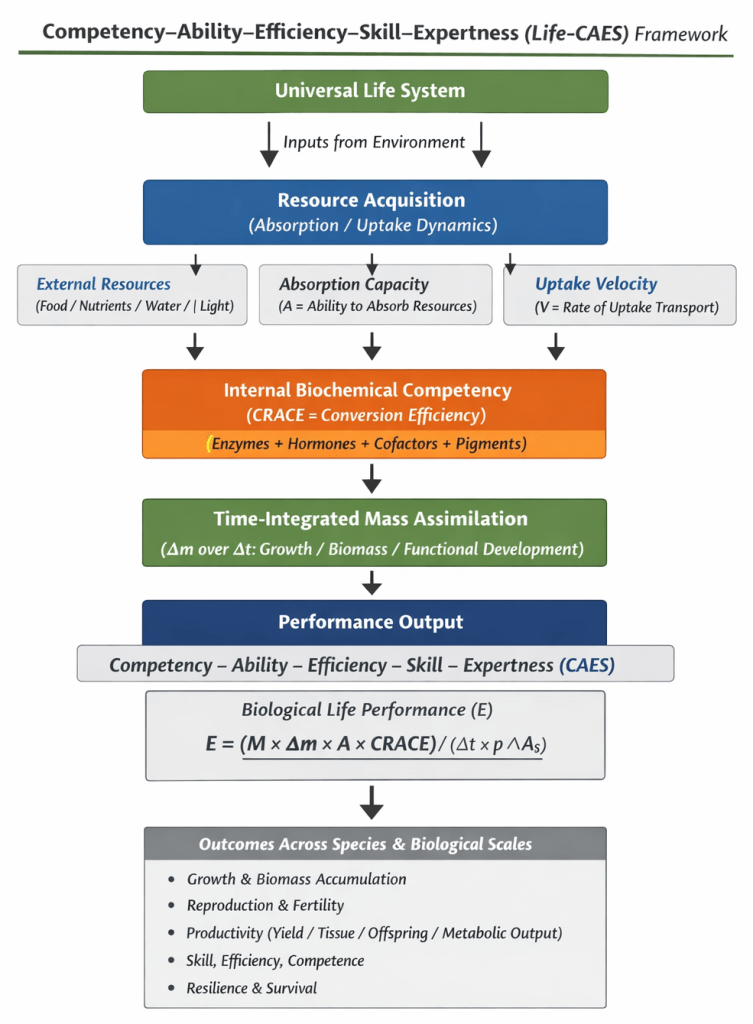
The Figure 1 presents a structured flowchart of the Universal Life Competency–Ability–Efficiency–Skill–Expertness (Life-CAES) framework, illustrating how biological performance emerges through sequential transformations of environmental inputs. At the top, a “Universal Life System” receives external resources, which enter the stage of resource acquisition defined by absorption capacity and uptake velocity. These resources then pass through internal biochemical competency—represented by enzymes, hormones, cofactors, and pigments—highlighting conversion efficiency (CRACE). The framework next depicts time-integrated mass assimilation as the growth-oriented outcome of uptake and conversion processes across Δt. Finally, the diagram shows performance output expressed as CAES traits, culminating in the Life-CAES equation for biological performance and downstream outcomes such as biomass accumulation, fertility, productivity, skill development, resilience, and survival across species and biological scales.

4. Discussion

The Life-CAES framework provides a unifying systems-biology model capable of explaining cross-kingdom variability in growth, productivity, and survival as the outcome of interactions between resource acquisition processes and internal biochemical competency. This approach is grounded in the recognition that living organisms do not merely accumulate matter and energy from their environment, but selectively convert these inputs through enzyme-mediated, hormone-regulated, and cofactor-dependent biochemical reactions. Thus, performance differences arise not only from external resource supply but from the organism’s capacity to absorb, retain, and biochemically transform those resources. In this model, competency acts as a multiplicative efficiency factor rather than a static additive parameter, which mirrors how complex biological, ecological, and social systems allocate resources and achieve functional outcomes.

The explanatory power of this approach is supported by multiple biological domains. In plant physiology, nutrient-use efficiency, pigment integrity, and enzyme activation states determine biomass accumulation and crop yield under equal fertilizer, water, and light conditions. Variation in chlorophyll content, micronutrient cofactors, and hormonal signaling can cause substantial yield differentials among genotypes grown in identical environments, demonstrating that environmental availability does not guarantee biological utilization. Similar patterns occur in animal and human physiology, where micronutrient deficiencies, endocrine disruptions, and enzyme insufficiencies reduce growth and metabolic performance despite adequate caloric intake. These effects are mechanistically parallel to a low-CRACE state in the Life-CAES model, where inputs enter the organism but are not effectively converted into functional output. In microbial and ecological studies, species with higher conversion efficiencies dominate resource-limited habitats, reflecting the adaptive value of biochemical competency in competitive environments.

Beyond biological parallels, the Life-CAES perspective exhibits striking alignment with the broader interdisciplinary concept of competence. In organizational and international business research, competence is defined as the capacity to translate resources, knowledge, and skills into effective performance (Johnson et al., 2006). Educational and policy frameworks similarly conceptualize learning-to-learn, adaptability, and self-regulation as key drivers of performance under variable conditions (Caena & Punie, 2019). Expertise and skill acquisition research shows that outputs scale with high-quality internal processing rather than raw input, meaning that individuals exposed to similar environments produce different results due to competency differences in perception, memory, or cognitive processing (Richman et al., 2014). The Life-CAES distinction between absorption (inputs) and competency (conversion) directly parallels these findings, translating a well-established social-science principle into biological terms.

This cross-domain resonance is strengthened by sociological and psychological analyses of expertness and skill, which position competence as a determinant of performance beyond mere resource possession. Sociological examinations of expertness emphasize how structured knowledge and functional capacity generate superior outcomes in contexts where access to raw materials is similar (Gerver & Bensman, 1954; Attridge, 2011). Psychological and counseling literature in multicultural competency demonstrates that identical training inputs do not yield identical practitioner effectiveness without internal attributes such as self-awareness, regulatory capacity, and context-integration (Fuertes et al., 2001; Butler, 2004). Educational and youth development frameworks further highlight that life skills—not merely information exposure—shape realized outcomes (WHO, 1994). In conceptual analyses of life skills and human values, Mandavilli (2025) shows that efficient internalization determines whether environmental opportunities translate into practical benefits. These parallels reinforce the interpretive validity of treating competency as a performance multiplier in biological systems rather than a marginal or secondary attribute.

Biologically, the CRACE construct provides a mechanistic rationale for why equal nutrient or energy inputs do not translate into equal growth, fertility, or productivity. This logic is reflected in metabolic efficiency theory, feed conversion efficiency in animal production, nutrient-use efficiency in crop science, and cellular bioenergetics, where ATP yield per unit substrate varies with enzyme kinetics, cofactor availability, and mitochondrial health. Plants with higher chlorophyll integrity, micronutrient sufficiency, and enzyme activation produce greater biomass per absorbed nutrient; animals with higher metabolic efficiency accumulate more tissue per unit feed; and microbes with superior metabolic pathways achieve faster proliferation in identical media. In all cases, competency determines the fraction of absorbed substrate that is retained, transformed, and allocated to performance-related outcomes.

The Life-CAES framework therefore advances a conservative but powerful scientific proposition: resource availability sets the theoretical upper bound of performance, but biochemical competency determines the realized outcome. This reconciles ecological observations of resource-saturated yet low-performing organisms, physiological findings of malnutrition amidst adequate caloric intake, and agricultural cases where yield gaps persist despite optimized inputs. Moreover, the framework provides a unified quantitative structure that enables comparisons across taxa, life stages, and environments by mapping absorption and competency onto a shared mathematical architecture.

Finally, the Life-CAES approach offers new pathways for predictive and comparative biology. Because the model is empirically testable and falsifiable, it can be integrated with tracer nutrient studies, photosynthesis and respiration measurements, enzyme and cofactor assays, biomass accumulation trials, and metabolic flux analyses. This provides opportunities for interdisciplinary convergence across plant science, metabolic physiology, systems ecology, and human performance studies. By situating biological variability at the intersection of acquisition and competency, the Life-CAES framework does not replace existing biological theories but consolidates them into a coherent system suitable for cross-kingdom, cross-disciplinary, and cross-environmental comparison..

5. Conclusion

The Universal Life-CAES framework provides a unified systems-biology model that characterizes biological performance as a function of organismal mass, absorption dynamics, biochemical competency, and time-dependent mass assimilation. By integrating measurable biophysical variables with biochemical conversion efficiency, the framework establishes a coherent mathematical basis for comparing performance across diverse biological systems. This formulation demonstrates that life performance is not solely determined by environmental resource availability, but by the organism’s ability to acquire, retain, and biochemically transform those resources into functional output over time. In doing so, the Life-CAES model introduces a performance-oriented perspective that aligns with empirical observations from plant physiology, animal metabolism, microbial ecology, and human biology, where equal environmental inputs frequently yield unequal biological outcomes.

Importantly, the framework is biologically conservative and does not require the abandonment or revision of established metabolic, ecological, or physiological theories. Instead, it reorganizes and synthesizes these well-validated principles—such as mass conservation, rate-limited uptake, absorption efficiency, and biochemical competency—into a single universal equation that is dimensionally interpretable, empirically testable, and cross-kingdom in scope. This integration allows the Life-CAES framework to operate as a meta-model, connecting disparate biological subfields through shared quantitative logic rather than replacing their existing explanatory mechanisms. Its emphasis on competency as a multiplicative performance factor bridges physiological and ecological findings with broader interdisciplinary concepts of efficiency, skill, and capacity observed in the social and cognitive sciences.

Finally, the Life-CAES framework satisfies essential criteria for scientific acceptability: it complies with conservation laws, employs measurable and defined variables, supports falsifiable predictions, and retains relevance across scales—from individual cells and organisms to populations and ecosystems. Its ability to quantify how absorption, competency, and time interact to govern growth, reproduction, and survival makes it valuable for predictive modeling, comparative biology, agricultural optimization, metabolic research, and life-performance assessment. By offering a standardized mathematical vocabulary and a unifying systems perspective, the Life-CAES model advances the possibility of cross-species, cross-environmental, and cross-disciplinary comparison, thereby contributing meaningfully to ongoing efforts toward integrated biological theory..

References

Attridge, J. (2011). “Human expertness”: Professionalism, Training. The Henry James Review, 32(1), 29–44.

Buciuceanu-Vrabie, M., Mešl, N., Zegarac, N., & Kodele, T. (2023). Skills in Family Support: Content Analysis of International Organizations’ Websites. Calitatea Vieții, 34(1), 15–32.

Butler, S. K. (2004). Multicultural sensitivity and competence in the clinical supervision of school counselors and school psychologists. The Clinical Supervisor, 22(1), 125–141.

Caena, F., & Punie, Y. (2019). Developing a European framework for the personal, social & learning to learn key competence (LifEComp). EUR, 29855.

Chell, E. (2013). Review of skill and the entrepreneurial process. International Journal of Entrepreneurial Behavior & Research, 19(1), 6–31.

Dupree, C. H., & Fiske, S. T. (2017). Signals: Warmth and Competence. Social Signal Processing, 23.

Feldman, I. (2005). Government without expertise? Competence, capacity, and civil-service practice in Gaza, 1917–67. International Journal of Middle East Studies, 37(4), 485–507.

Fuertes, J. N., Bartolomeo, M., & Nichols, C. M. (2001). Future Research Directions in the Study of Counselor Multicultural Competency. Journal of Multicultural Counseling and Development, 29(1), 3–12.

Gerver, I., & Bensman, J. (1954). Towards a sociology of expertness. Social Forces, 226–235.

Johnson, J. P., Lenartowicz, T., & Apud, S. (2006). Cross-cultural competence in international business: Toward a definition and a model. Journal of International Business Studies, 37(4), 525–543.

Mandavilli, S. R. (2025). A Practical Compendium of Top Life Skills and Universal Human Values from a Social Sciences Perspective. SSRN 5275186.

Mashrafi, M. (2026). Universal Life Competency-Ability Framework and Equation: A Conceptual Systems-Biology Model. International Journal of Research, 13(1), 92–109.

Mashrafi, M. (2026). Universal Life Energy–Growth Framework and Equation. International Journal of Research, 13(1), 79–91.

Richman, H. B., Gobet, F., Staszewski, J. J., & Simon, H. A. (2014). Perceptual and memory processes in the acquisition of expert performance: The EPAM model. In The Road to Excellence (pp. 167–187). Psychology Press.

World Health Organization. (1994). Life skills education for children and adolescents in schools. WHO/MNH/PSF/93.7 B. Rev. 1.

Universal Life Competency- Ability Framework and Equation: A Conceptual Systems-Biology Model

APA Reference

Mashrafi, M. (2026). Universal Life Competency- Ability Framework and Equation: A Conceptual Systems-Biology Model. International Journal of Research, 13(1), 92-109.  https://doi.org/10.26643/eduindex/ijr/2026/5

Mokhdum Mashrafi (Mehadi Laja)
Research Associate, Track2Training, India

Researcher from Bangladesh

ORCID ID: https://orcid.org/0009-0002-1801-1130

Abstract

Living organisms across biological taxa—including humans, animals, birds, fish, insects, plants, and microorganisms—can be conceptualized as open thermodynamic systems that sustain internal order through continuous exchange of matter and energy with their environments. While extensive work in physiology, ecology, and systems biology has investigated metabolic scaling, resource assimilation, and energy budgets, few integrative frameworks exist for synthesizing absorption processes, physiological losses, organismal mass, and biochemical competency into a unified comparative model that applies across taxa.

This paper presents the Universal Life Competency–Ability Framework, a conceptual systems-biology model that formalizes biological performance as the product of three core determinants: organism mass (M), net resource uptake rate (AE − TE), and a composite competency coefficient (CE) capturing biochemical and physiological efficiency. The resulting index is not proposed as a physical law but as a scalable, mass-balance-based metric that enables comparative interpretation of biological performance across life forms.


The Introduction reviews existing biological models related to mass-energy balance, metabolic scaling, ecological energetics, and plant–animal physiology, highlighting the conceptual gap addressed by this framework. The Methods section derives the model using established thermodynamic and physiological principles and defines all parameters. Results demonstrate how the model applies across major taxa through conceptual scenarios rather than numerical predictions. The Discussion interprets biological implications, examines alignment with existing theories, and identifies limitations and future research directions.

Findings suggest that organisms experiencing positive net uptake (AE > TE) and high competency (CE) exhibit greater biological performance and resilience, while those in nutrient deficiency, disease, or stress states exhibit reduced net uptake and diminished competency. Importantly, the framework aligns with empirical observations in plant physiology (photosynthesis–respiration balance), animal nutrition (intake–expenditure models), and ecological energetics (net primary productivity and trophic transfer).

This systems-level model offers a unifying conceptual lens for interpreting cross-taxonomic variation in growth, vitality, and function without overclaiming precision or universality. It complements existing detailed models by emphasizing emergent principles shared across living organisms. Future work may formalize empirical estimation of CE, integrate species-specific scaling exponents, and explore applications in agriculture, environmental physiology, conservation biology, and bioengineering.

Keywords: systems biology, mass balance, bioenergetics, metabolic scaling, competency, physiology, open systems, life processes.

1. Introduction

1.1. Background

All living organisms operate as open, nonequilibrium thermodynamic systems, continuously exchanging matter and energy with their surroundings in order to sustain their biological structure and function. In contrast to closed or isolated systems, living organisms cannot maintain internal order without importing resources and exporting waste; their survival depends on a constant flow of substrates through metabolic networks. From the perspective of classical and statistical thermodynamics, life represents a persistent reduction of local entropy, achieved by importing low-entropy inputs—such as nutrients, light, water, and oxygen—and exporting high-entropy waste outputs, including heat, carbon dioxide, and nitrogenous compounds (Schrödinger, 1944; Nelson & Cox, 2021). By doing so, organisms counteract the natural tendency toward disorder and sustain the chemical disequilibria necessary for molecular self-organisation, signalling processes, and biosynthesis.

This continuous energy–matter exchange is not merely a biochemical curiosity; it is the core mechanism underpinning all biological performance. At the cellular level, imported substrates are metabolized to produce ATP, reducing power, and precursor metabolites that fuel anabolic pathways, maintain membrane potential, enable motility, and regulate homeostasis. At the organismal level, these molecular events scale up to support development, growth, tissue repair, immune function, reproduction, and behavioral interactions. Losses in energy or matter—due to starvation, thermal stress, disease, or environmental fluctuations—directly translate into reduced performance, diminished competency, and ultimately mortality if sustained.

Despite the substantial diversity found across the tree of life, living organisms share several systemic properties that are universally required for their persistence. These include: (a) mass-energy throughput, the rate at which organisms assimilate and dissipate resources; (b) metabolic conversion efficiencies, which determine the proportion of absorbed substrates that are converted into usable biochemical forms; (c) physiological losses, such as respiration, transpiration, and excretion; (d) environmentally mediated performance, reflecting how temperature, oxygen availability, light, and nutrient supply modulate metabolic fluxes; and (e) biochemical competency thresholds, referring to the minimal enzymatic, hormonal, and structural integrity required for efficient metabolism. Although expressed differently in plants, animals, microbes, and fungi, these properties define the constraints under which all living systems operate.

Three major scientific disciplines have independently explored these principles. Physiology and biochemistry investigate cellular and molecular mechanisms, including enzymatic catalysis, respiratory pathways, and hormonal regulation, providing insight into the mechanistic basis of metabolism in plants, animals, and microorganisms. Ecological energetics examines how energy and biomass flow through populations, communities, and ecosystems, linking individual physiology to trophic interactions, carrying capacity, and ecosystem productivity. Systems biology, in contrast, focuses on multiscale modeling of networks and emergent behaviors, integrating molecular interactions with organismal phenotypes through computational and theoretical approaches.

Despite substantial progress in each field, there remains no broadly applicable conceptual framework for comparing how diverse organisms assimilate, retain, and convert resources into biological performance outcomes across taxa. Existing frameworks tend to be taxon-specific—photosynthesis models for plants, energetic balance models for animals, and growth kinetics for microbes—making cross-system comparisons difficult. A unifying conceptual perspective is therefore needed to bridge these domains and enable integrated interpretation of biological performance across the breadth of living systems.

1.2. The Problem and Knowledge Gap

Despite extensive scientific progress in physiology, ecology, and bioenergetics, existing quantitative frameworks used to evaluate biological performance tend to be domain-specific rather than integrative. For instance, in plants, performance is commonly assessed using the photosynthesis–respiration balance, which captures the net gain of assimilated carbon after accounting for respiratory losses (Taiz et al., 2015). In animals, biological performance is frequently modeled through dietary intake versus energy expenditure, a framework rooted in nutritional physiology and metabolic energetics (Blaxter, 1989). At the ecosystem scale, productivity is evaluated through net primary production (NPP) and trophic transfer efficiency, which quantify biomass accumulation and energy flow among trophic levels (Odum, 1971). Each of these models is robust within its own domain and has yielded significant empirical insight.

However, while such frameworks excel within specific biological contexts, they lack a unifying abstraction capable of representing biological performance across multiple taxa using shared principles. Specifically, there is no widely accepted framework that simultaneously: (1) spans the diversity of living organisms without relying on species-specific formulations; (2) integrates mass uptake, physiological losses, and biochemical competency into a single cohesive structure; and (3) maintains biological interpretability without overextending into unjustified claims of universal physical laws. This conceptual gap restricts our ability to compare biological performance across plants, animals, microbes, and other life forms in a standardized manner, despite the fact that all rely on similar thermodynamic and metabolic principles.

The persistence of this gap can be attributed, in part, to methodological fragmentation among subdisciplines. Plant biology focuses on carbon assimilation, water relations, and photophysiology; animal physiology emphasizes nutrient intake, respiration, and metabolic demand; microbial metabolism employs substrate kinetics and maintenance energy models; and ecological energetics scales these principles to populations and ecosystems. Although these fields each investigate aspects of mass-energy flux and metabolic efficiency, they rarely converge on a shared analytic language. Consequently, cross-taxonomic comparison of performance metrics—such as productivity, stress tolerance, or vitality—remains conceptually challenging, even though the underlying physiological processes are structurally analogous. Developing a framework that bridges these disciplinary divides would therefore enable deeper comparative insights into the general principles governing life across biological scales..

1.3. Toward a Systems-Biological Perspective

Systems biology provides an integrative framework for understanding living organisms by conceptualizing them as networks of interacting components governed by resource availability, metabolic pathways, and environmental constraints (Kitano, 2002). Rather than treating biological processes in isolation, this perspective emphasizes the emergent properties that arise from coordinated interactions among cellular, physiological, and ecological subsystems. Within this paradigm, biological performance can be understood as the result of dynamic interplay between three key dimensions: resource absorption (inputs), physiological maintenance and losses (outputs), and biochemical conversion efficiencies (internal functional states). Each of these dimensions influences how effectively organisms acquire, retain, and utilize matter and energy to support growth, reproduction, and homeostasis.

This systems-level view aligns closely with mass-balance principles commonly employed in chemical engineering, ecology, and biophysics. In these fields, the governing relationship is often expressed in the generic form:

Accumulation = Inputs − Outputs − Maintenance Losses.

Such formulations capture the fact that net change in biomass or energy content depends not only on acquisition but also on respiratory, excretory, and maintenance costs. Comparable mass-balance expressions appear across a diverse set of biological modeling traditions, including photosynthesis–respiration models in plants, metabolic flux analyses in cellular systems, microbial growth kinetics in chemostat studies, animal energy budget models, and biomass allocation models used in ecology and forestry. Although developed in different disciplinary contexts, these frameworks share the core assumption that biological performance can be quantified through net fluxes of matter and energy modulated by organismal constraints.

The Universal Life Competency–Ability Framework builds upon this mass-balance logic by proposing a biologically interpretable measure of performance grounded in three constituent components: organismal mass (M), which serves as a scaling factor reflecting total metabolic demand; net resource uptake (AE − TE), representing the balance between assimilated and lost substrates; and the competency coefficient (CE), which integrates biochemical and physiological efficiency. Together, these components yield a composite expression for biological performance that captures both the magnitude of resource flow and the quality of internal biological processing.

Importantly, unlike physical energy equations derived from thermodynamic laws, this framework does not claim to produce outputs in joules or watts. Instead, it yields a comparative biological performance index, allowing meaningful interpretation of growth potential, stress resilience, or physiological vitality across taxa without asserting universal physical dimensionality. In this way, the systems-biological perspective provides conceptual grounding for a unifying framework that integrates mass balance, metabolic efficiency, and biochemical competency within a single cross-taxonomic interpretive structure.

1.4. Objective and Scientific Contribution

The purpose of this paper is not to introduce a new universal physical law or to redefine thermodynamic principles, but rather to advance a conceptual systems-biology framework that enables integrated interpretation of biological performance across diverse taxa. Specifically, the framework aims to synthesize mass and energy throughput, unify absorption and loss processes, incorporate physiological and biochemical competency, facilitate comparison among organisms, and connect empirical observations from multiple scientific domains. By doing so, it seeks to address a gap in current biological modeling, where existing approaches are often constrained to particular organisms, metabolic pathways, or ecological contexts.

Within this scope, the central research question guiding this work can be articulated as follows:

How can organismal performance be conceptually modeled as a function of mass, net resource uptake, and biochemical competency in a manner that is scientifically grounded and taxonomically general?

This question reflects the need for a cross-domain framework capable of reconciling diverse empirical findings without relying on species-specific equations or overextending claims into physical universality.

In response to this inquiry, the paper makes four principal scientific contributions. First, it proposes a generalizable, mass-balance-based model that applies to living organisms regardless of taxonomic group, metabolic strategy, or ecological niche. Second, it introduces a competency coefficient (CE) that encapsulates biochemical and physiological efficiency, including enzymatic activity, nutrient sufficiency, hormonal regulation, and tissue integrity. Third, it provides a conceptual bridge between plant and animal physiology, enabling shared interpretation of processes such as photosynthetic assimilation, dietary intake, respiration, transpiration, and excretion. Fourth, it offers a framework for interpreting growth, vitality, and stress in terms of the interplay between mass, net resource uptake, and biochemical competency.

Importantly, these contributions are intended to complement—not replace—existing mechanistic models in plant biology, animal physiology, microbial metabolism, or ecosystem ecology. The framework is designed to operate at a conceptual and comparative level, providing a systems-oriented perspective that can interface with detailed biochemical or ecological models when necessary. In doing so, it expands the theoretical space for cross-disciplinary dialogue and sets the stage for future empirical, computational, and applied extensions in the study of biological performance.

2. Methods

2.1. Conceptual Modeling Approach

This study adopts a theoretical–conceptual modeling approach that aligns with contemporary practices in systems-biology research and scientific theory development (De Regt & Dieks, 2005). Rather than deriving conclusions from direct empirical measurement or experimental data, the framework is constructed through logical synthesis of established principles and cross-disciplinary integration. The modeling process unfolded in several structured stages. First, mass–energy principles shared across a wide range of biological taxa were identified, emphasizing the universal characteristics of living organisms as open, nonequilibrium systems that exchange matter and energy with their surroundings. Second, resource assimilation and physiological losses were formalized using mass-balance expressions, drawing on analogies from ecological energetics, metabolic physiology, and chemical engineering. Third, a competency coefficient was introduced as a conceptual mechanism for capturing biochemical and physiological efficiency, encompassing factors such as enzyme activity, nutrient sufficiency, hormonal regulation, and cellular integrity. Finally, the model was examined for conceptual coherence and alignment with established findings in physiology, plant science, animal bioenergetics, microbial metabolism, and ecological modeling.

Because the purpose of this work is to articulate a generalizable conceptual framework rather than produce numerical predictions, no empirical datasets are analyzed. Instead, the model’s scientific validity is rooted in its consistency with known biological principles, its compatibility with existing theoretical constructs, and its capacity to integrate diverse empirical observations from the literature. This approach allows the framework to operate at a level of abstraction suitable for cross-taxa comparison while avoiding overextension into claims requiring mechanistic or quantitative validation. In this respect, the methodology reflects a theory-building strategy common in systems biology, where conceptual clarity and integrative power are prioritized as precursors to subsequent empirical formalization and computational modeling.

2.2. Biological Assumptions

The development of the proposed framework relies on several biological assumptions that reflect well-established principles across multiple domains of life science. First, it is assumed that all living organisms function as open systems that continuously exchange matter and energy with their environments, a premise grounded in classical thermodynamics and widely accepted in physiology and ecology. Second, the processes of resource uptake and resource loss—denoted as AE (absorbed elements) and TE (transpired or expended elements), respectively—are treated as mass flow rates, allowing assimilation and dissipation to be conceptualized using mass-balance logic. Third, the model assumes that organismal mass (M) scales with metabolic demand, consistent with metabolic scaling theory and empirical observations that larger organisms require greater absolute energy and nutrient throughput. Fourth, it is posited that biochemical competency (CE) modulates the efficiency with which absorbed resources are converted into functional biological outcomes, such as growth, maintenance, reproduction, or stress tolerance. This competency coefficient is understood to encapsulate physiological and biochemical determinants including enzyme activity, nutrient status, hormonal balance, and cellular health. Fifth, while the competency coefficient may vary widely across taxa due to species-specific biochemistry and life-history strategies, it is treated as conceptually general, enabling comparison across organisms without imposing identical mechanistic pathways. Finally, the model explicitly refrains from asserting universal dimensional precision or physical units, acknowledging that the framework yields a comparative biological performance index rather than a physically defined energy measure.

Taken together, these assumptions provide a biologically plausible foundation for conceptual synthesis. They are compatible with established frameworks in bioenergetics, plant physiology, animal nutrition, and metabolic scaling, all of which recognize the central role of mass-energy flux, metabolic efficiency, and organismal size in shaping biological performance..

2.3. Variables and Definitions

For clarity and conceptual consistency, the framework employs a set of defined variables that characterize organismal mass, resource fluxes, and biochemical competency. In this context, M represents the organism’s total mass, expressed in kilograms (kg), and serves as a biologically meaningful scaling factor that reflects absolute metabolic demand. Resource assimilation and dissipation are captured through two mass flow rate variables: AE, denoting the rate of absorbed or assimilated elements (kg·s⁻¹), and TE, denoting the rate of transpired, respired, or excreted elements (kg·s⁻¹). The net outcome of these opposing fluxes over a specified time interval is expressed as Δm, the net mass change (kg) observed over Δt, the time interval measured in seconds (s). Central to the model is the competency coefficient (CE), a dimensionless parameter bounded between 0 and 1 that reflects the organism’s ability to convert absorbed resources into functional biological performance. Unlike purely thermodynamic or mechanistic parameters, CE integrates a range of physiological and biochemical components known to influence metabolic efficiency across taxa.

The competency coefficient aggregates determinants such as enzyme activity, hormonal regulation, vitamin and mineral sufficiency, pigment integrity (including chlorophyll in plants and hemoglobin in animals), as well as cellular and tissue health. Each of these components has been extensively documented in plant and animal physiology as a key modulator of metabolic conversion efficiency, growth potential, and stress tolerance. For example, chlorophyll content directly affects photosynthetic assimilation capacity in plants, while hemoglobin concentration influences oxygen transport efficiency in animals—both outcomes that translate into differences in biological performance. By consolidating these diverse determinants into a single coefficient, the model provides a conceptually tractable means of comparing biochemical competency without requiring species-specific mechanistic detail.

2.4. Derivation of Core Equation

2.4.1. Net Mass Uptake

Mass balance yields:

Over a time interval:

2.4.2. Competency–Ability Equation

We define:

Where C is a biological performance index.

Units are left abstract because is not a physical energy term but a comparative measure.

2.4.3. Time-Integrated Form

Substituting Δm yields:

This form aligns with biomass accumulation models and allows longitudinal comparison.

2.5. Physiological Domain Mapping

The model maps to domains as follows:

ComponentPhysiological Interpretation
AENutrition, photosynthesis, oxygen uptake
TERespiration, transpiration, excretion
MStructural mass, metabolic scaling
CEBiochemical efficiency & health status
CFunctional performance index

2.6. Scientific Non-Equivalence to Energy Laws

To avoid misinterpretation, this framework explicitly:

  • Does not assert a new physical energy law,
  • Does not define mechanical energy or joules,
  • Does not claim universal dimensional validity.

Instead, it provides a physiology-aligned comparative index compatible with systems-ecology and metabolic theory.

3. Results

Because this is a conceptual paper, results are presented as interpretive scenarios demonstrating applicability across taxa. No numerical predictions are made.

3.1. Plants

3.1.1. Mapping AE and TE

In plants:

  • AE corresponds to photosynthetic assimilation + nutrient uptake
  • TE corresponds to respiration + transpiration losses

Thus:

Where:

  • GPP = gross primary productivity
  • R = respiration
  • T = transpiration

Empirically, positive net assimilation leads to biomass growth, consistent with plant physiological literature (Taiz et al., 2015).

3.1.2. Competency Coefficient in Plants

Within plants, the competency coefficient (CE) reflects the biochemical and physiological factors that modulate the efficiency with which absorbed resources are converted into biomass, metabolic energy, and structural components. Key contributors to CE include chlorophyll concentration, which directly influences photosynthetic light capture and carbon fixation, and nitrogen availability, which constrains the synthesis of critical enzymes such as Ribulose-1,5-bisphosphate carboxylase/oxygenase (Rubisco), the most abundant protein in plant leaves and a primary determinant of photosynthetic capacity. Mineral balance also plays an essential role, as elements such as magnesium (Mg) and iron (Fe) are required cofactors for chlorophyll biosynthesis and electron transport, while other micronutrients affect enzyme activation, stomatal functioning, and cellular metabolism. Additional factors such as plant water status and overall tissue integrity further influence biochemical competency by affecting turgor pressure, stomatal conductance, vascular transport, and susceptibility to oxidative damage.

Empirical studies have demonstrated that reductions in any of these components can impair the plant’s physiological efficiency even when external resource availability remains sufficient. For instance, nitrogen deficiency leads to decreased Rubisco content and lowered chlorophyll concentration, thereby reducing carbon assimilation rates and lowering CE despite adequate sunlight and water absorption. Analogously, drought stress may reduce stomatal conductance and impair photosynthetic electron transport, decreasing conversion efficiency independently of light availability. In this way, CE captures the biological reality that resource uptake alone does not guarantee growth or high performance; rather, it is the coordinated function of pigments, enzymes, nutrients, and tissues that determines the degree to which absorbed substrates can be transformed into usable biochemical outputs.

3.2. Animals and Humans

3.2.1. Mapping AE and TE

In animals:

  • AE = dietary intake + oxygen uptake
  • TE = respiration + excretion + maintenance metabolism

This aligns with nutritional energy balance:

Positive net uptake enables growth, reproduction, and performance; negative values induce catabolism.

3.2.2. Competency Coefficient in Animals

CE corresponds to:

  • Enzyme function
  • Hormone regulation
  • Vitamin/mineral sufficiency
  • Immune competency
  • Tissue oxygenation

Iron-deficiency anemia, for example, reduces hemoglobin competency, decreasing CE.

In animals, the competency coefficient (CE) encompasses a suite of biochemical andphysiological attributes that determine how efficiently assimilated resources are converted into usable metabolic energy, structural biomass, and functional performance. These attributes include enzyme function, which governs the rate and fidelity of metabolic reactions; hormonal regulation, which mediates growth, metabolism, reproduction, and homeostasis; and vitamin and mineral sufficiency, which ensures proper cofactor availability for enzymatic pathways, mitochondrial respiration, and tissue maintenance. Additional determinants include immune competency, reflecting the organism’s ability to defend against pathogens without excessive energetic cost, and tissue oxygenation, which depends on effective respiratory gas exchange and the transport capacity of oxygen carriers such as hemoglobin. Collectively, these components influence basal metabolic rate, growth efficiency, thermoregulation, reproductive success, and overall physiological resilience.

Importantly, CE captures the biological reality that resource intake does not necessarily translate directly into growth or performance. Animals may consume adequate food and oxygen (high AE), yet exhibit reduced net biological output if internal biochemical systems are compromised. For instance, iron-deficiency anemia reduces hemoglobin concentration and impairs oxygen transport, lowering aerobic metabolic capacity even when dietary intake is sufficient. Under such conditions, CE decreases because metabolic pathways reliant on oxidative phosphorylation become less efficient, forcing greater reliance on anaerobic metabolism or reducing activity and growth altogether. Similar reductions in CE can occur due to micronutrient deficiencies (e.g., vitamin B12, zinc, selenium), endocrine disorders (e.g., hypothyroidism affecting basal metabolic rate), impaired immune function, or chronic inflammation, all of which impose metabolic costs or limit conversion efficiency.

By incorporating these physiological and biochemical determinants into a single dimensionless coefficient, CE provides a conceptually tractable means of comparing metabolic competency across animals without requiring explicit mechanistic modeling of each underlying pathway. This abstraction is particularly useful when evaluating performance across different species, life stages, or environmental contexts where metabolic efficiency varies due to differences in diet quality, physiological condition, or ecological stressors.

3.3. Fish and Aquatic Organisms

Fish and other aquatic organisms operate under physiological constraints that differ markedly from those of terrestrial species, and these constraints directly influence the balance between resource absorption and physiological losses. One major distinction lies in the oxygen acquisition process. Unlike air-breathing animals, fish rely on oxygen diffusion across gill surfaces, a mechanism that is inherently less efficient than pulmonary ventilation due to the substantially lower oxygen content and slower diffusion rates in water. As a result, oxygen uptake (a component of AE) is highly sensitive to the partial pressure of dissolved oxygen, gill surface area, water flow rates, and ventilation–perfusion matching. In hypoxic aquatic environments, oxygen uptake declines, constraining aerobic metabolism and reducing the capacity for biosynthesis, locomotion, and maintenance.

A second defining feature of aquatic physiology is temperature-dependent metabolic rate. As ectotherms, fish exhibit metabolic rates that scale with environmental temperature according to Q10 effects, wherein metabolic reactions accelerate with rising temperature and slow with cooling. Higher temperatures typically increase TE (through elevated respiratory and maintenance costs), while simultaneously raising oxygen demand. If the thermal increase is not matched by sufficient oxygen availability, the result is a mismatch between AE and TE that leads to reduced net resource uptake. Conversely, at lower temperatures metabolic losses decline, but assimilation capacity may also diminish due to reduced digestion efficiency or slowed enzymatic activity.

A third constraint involves nitrogenous waste excretion. Fish primarily excrete nitrogen in the form of ammonia, which is energetically inexpensive to produce but requires adequate water flow for diffusion across gill surfaces. Under conditions of poor water quality or reduced flow, ammonia accumulation can impair gill function and metabolic processes, indirectly reducing AE and increasing physiological stress. Collectively, these features illustrate how aquatic metabolic regulation differs from terrestrial strategies.

These physiological constraints exert strong control over the value of AE − TE, and thus over the competency index C. For instance, fish inhabiting low-oxygen environments (such as warm, eutrophic lakes or poorly aerated aquaculture systems) experience reduced oxygen uptake (lower AE) while simultaneously incurring higher metabolic costs (higher TE), which depresses the net resource balance and lowers overall performance. Similarly, abrupt thermal shifts can alter metabolic costs faster than assimilation capacities can adjust, leading to transient or sustained reductions in C even when food availability is adequate. In this way, the framework accommodates aquatic physiological reality by recognizing that environmental parameters such as temperature, dissolved oxygen, and water chemistry directly modulate both resource assimilation and metabolic expenditures in fish and aquatic organisms.

3.4. Insects

In insects:

  • AE = dietary assimilation
  • TE = respiration, excretion, molting losses

Molting significantly increases TE and temporarily decreases C due to tissue restructuring.

Insects present another example of how taxon-specific physiology can be interpreted within the competency–ability framework. In these organisms, absorbed elements (AE) correspond primarily to dietary assimilation, encompassing ingestion, digestion, and nutrient absorption through the midgut. The transpired or expended elements (TE) include respiratory gas exchange, excretory losses, and particularly molting-related tissue turnover. Insects undergo periodic molting (ecdysis) as part of their developmental cycle, during which the exoskeleton is shed and replaced. This process imposes substantial metabolic and structural costs, as old cuticular material is degraded and new cuticle is synthesized. Consequently, during molting periods TE increases markedly due to elevated metabolic rates and increased material turnover, leading to a temporary reduction in net resource balance (AE − TE) and thus a transient decrease in the performance index C. Even when food intake remains unchanged, the energetic burden of tissue restructuring and vulnerability to environmental stress can depress CE as well, emphasizing how life-history traits modulate biological performance. Once molting concludes and new tissues stabilize, TE decreases and resource assimilation resumes normal efficiency, illustrating how developmental cycles influence temporal fluctuations in C within insect life histories.

3.5. Microorganisms

For microbes, AE − TE resembles:

  • Substrate uptake (AE)
  • Maintenance and decay (TE)

This aligns with Monod and chemostat models used in microbial kinetics.

Microorganisms, including bacteria and unicellular eukaryotes, exhibit metabolic dynamics that align closely with mass-balance interpretations of AE − TE. In microbial systems, AE is dominated by substrate uptake, which typically involves transport of dissolved carbon sources, nitrogen compounds, or other nutrients across the cell membrane. Microbial growth kinetics show that substrate assimilation rates depend on external nutrient concentrations, transport system saturation, and enzymatic activity, all of which influence metabolic throughput. Conversely, TE corresponds to maintenance energy requirements, respiratory losses, and decay processes such as lysis or autophagy. These components account for the energetic and material costs required to sustain cellular homeostasis in the absence of net growth. The balance between substrate uptake and maintenance losses determines whether biomass accumulates, remains stable, or declines.

This interpretation aligns closely with established theoretical frameworks in microbial kinetics, particularly Monod models and chemostat dynamics, which describe growth as a function of substrate availability and maintenance energy demands. In these models, microbes exhibit positive growth when substrate uptake exceeds maintenance costs—analogous to AE − TE > 0—and declining biomass when maintenance costs surpass substrate assimilation—analogous to AE − TE < 0. Thus, microbial systems provide a clear example of how net mass balance governs biological performance at the cellular scale. Integrating microbial metabolism into the competency–ability framework underscores its applicability across multiple levels of biological organization, from unicellular organisms to complex multicellular taxa.

4. Discussion

The purpose of this section is to interpret the Universal Life Competency–Ability Framework within the context of established biological theories, evaluate the meaning and implications of the competency coefficient and the composite index , and articulate the advantages, limitations, and prospective research directions associated with this conceptual model. By situating the framework in relation to existing scientific paradigms, we aim to demonstrate both its novelty and its compatibility with accepted principles in physiology, ecology, and systems biology.

4.1. Alignment with Existing Biological Theory

Although the framework was developed conceptually rather than empirically, its components align closely with several well-established theoretical traditions that govern biological energetics, growth, and metabolic scaling. This alignment strengthens the argument that the model is not arbitrary but is instead grounded in widely recognized biological dynamics.

4.1.1. Net Primary Production in Plants

One of the most direct correspondences occurs within plant physiology, specifically in the context of net primary production (NPP). In plants, productivity is commonly expressed as:

where GPP (gross primary productivity) represents total photosynthetic carbon assimilation, and R (respiration) captures carbon lost through metabolic maintenance and growth processes. This formulation is conceptually equivalent to the expression in the competency framework, where AE represents assimilated carbon and nutrients, and TE represents losses due to respiration, photorespiration, transpiration-driven mass dissipation, and tissue turnover. Thus, NPP provides a direct plant-specific example of how net assimilation drives growth, consistent with the logic that biological performance emerges only when assimilation exceeds losses.

4.1.2. Metabolic Energy Budgets in Animals

Similarly, in animal physiology, energy budgets are frequently expressed in the form:

Here, dietary intake (analogous to AE) must not only cover maintenance and excretory costs (analogous to TE) but also supply surplus energy for growth and reproduction. In this framing, the framework’s performance index can be interpreted as an index of growth and reproduction potential once maintenance and loss requirements have been met. When is negative, animals enter a catabolic state, reducing performance and eventually compromising survival, which parallels the reductions in under starvation, metabolic stress, or disease.

4.1.3. Metabolic Scaling Theory

The role of organismal mass M as a scaling factor is further supported by metabolic scaling theory. The seminal work of West, Brown, and Enquist (1997) demonstrated that metabolic rate scales approximately to body mass to the three-quarter power:


This relationship indicates that larger organisms require higher absolute metabolic throughput, consistent with the use of M as a fundamental scaling variable in the competency framework. Although the current model does not explicitly incorporate allometric exponents, treating M as a proportional factor recognizes the empirical reality that metabolic demand increases with organism size.

Collectively, these alignments indicate that the competency framework does not contradict established biological theory; instead, it extends cross-taxonomic abstraction by synthesizing plant-specific, animal-specific, and universal metabolic principles into a shared representation.

4.2. Interpretation of the Competency Coefficient

The competency coefficient (CE) represents one of the most novel elements of the framework. Rather than capturing resource availability or mass flow directly, CE encodes the efficiency of biochemical conversion, integrating physiological determinants that influence how effectively absorbed materials are transformed into usable biological outputs. Conceptually, CE parallels several established metrics across domains:

  • In plants, CE is analogous to resource use efficiency (RUE), which represents the ratio of biomass accumulation to resource assimilation (e.g., carbon, nitrogen, or water).
  • In animals, CE resembles feed conversion efficiency (FCE), which measures how effectively consumed food contributes to growth or reproduction.
  • In microbes, CE aligns with metabolic yield coefficients, which describe how much biomass forms per unit of substrate consumed in batch or chemostat cultures.

By abstracting these analogous constructs into a single coefficient, CE allows biological performance to be compared independent of resource availability, highlighting internal physiological condition rather than external environmental supply. This distinction is critical, as organisms experiencing identical resource inputs may exhibit dramatically different performance due to disease, deficiency, hormonal imbalance, or tissue damage. Thus, CE captures the idea that biological “competency” is not merely a function of supply but of the capacity to utilize supply.

4.3. Biological Meaning of

The composite index should not be interpreted as a physical quantity such as joules, watts, or mechanical energy. Instead, it provides a functional biological performance index, integrating mass balance and conversion efficiency into a single interpretable measure. As such, reflects emergent organismal traits including:

  • Growth potential, as surplus mass-energy supports biosynthesis.
  • Physiological vitality, reflecting metabolic and biochemical capacity.
  • Stress resilience, indicating robustness under environmental perturbation.
  • Reproductive capacity, as reproduction typically requires positive net resource balance and high biochemical competency.

Because is dimensionally abstract, it is especially suited for comparative, diagnostic, and conceptual applications rather than quantitative bioenergetic modeling.

4.4. Stress, Deficiency, and Disease Effects

Environmental stressors typically modulate by reducing AE, increasing TE, decreasing CE, or some combination thereof. Table-like trends include:

StressorAETECE
Drought in plants
Starvation in animals
Mineral deficiency
Thermal stress
Disease

Under such conditions:

This illustrates that even without direct changes in environmental resources, physiological or biochemical damage can sharply reduce performance by lowering CE.

4.5. Advantages of the Framework

The competency–ability framework offers several conceptual advantages. First, it provides taxonomic universality, enabling discussion of plants, animals, microbes, and insects using common terminology. Second, it affords conceptual clarity by distinguishing resource availability, physiological losses, and conversion efficiency. Third, it maintains mass-balance coherence, aligning with established principles in ecology and bioenergetics. Fourth, it demonstrates compatibility with existing literature, as shown in Section 4.1. Finally, it retains non-mechanistic flexibility, facilitating cross-disciplinary interpretation without requiring detailed mechanistic modeling.

4.6. Limitations

Despite its utility, the framework has limitations that merit acknowledgment. It is currently not empirically calibrated, meaning numerical values for C lack quantitative grounding. CE remains a qualitative construct requiring operational definitions for measurement, and the model does not incorporate allometric exponents, which are essential for scaling metabolic rates precisely. Furthermore, the framework is not designed for predictive precision, limiting its utility in simulations or engineering applications. It also does not replace domain-specific models, which remain indispensable for mechanistic insight. These limitations suggest that the framework should be interpreted as a conceptual scaffold rather than a predictive model.

4.7. Future Research Directions

The conceptual nature of the model invites extensive avenues for empirical and computational development. Future work may focus on operationalizing CE through measurable biomarkers such as chlorophyll content, photosynthetic enzyme activity, blood oxygen saturation, hormonal panels, micronutrient concentrations, or immune indices. Integration of metabolic scaling laws could refine the role of mass, for example by incorporating or surface-area scaling terms. Computational modeling approaches—such as agent-based models, differential equation systems, or network simulations—could translate conceptual structure into dynamic prediction. Application domains are diverse: in agriculture, the framework could support crop stress indexing or livestock productivity assessment; in ecology, it may inform studies of climate stress resilience or invasive species performance; and in biomedicine, it could aid in analyzing metabolic disorders or nutritional deficiencies. Collectively, these directions underscore the framework’s potential for interdisciplinary extension.

5. Conclusion

This paper introduced the Universal Life Competency–Ability Framework, a conceptual systems-biology model that integrates organismal mass, net resource uptake, and biochemical competency into a biologically meaningful performance index. The model does not propose new physical laws but instead synthesizes established principles from physiology, ecological energetics, and metabolic theory into a unified comparative structure.

The resulting expression:


provides insight into how resource assimilation, physiological loss, and biochemical efficiency interact to shape growth, vitality, and resilience across diverse life forms. Conceptual analysis demonstrates alignment with classical plant and animal physiology as well as metabolic scaling and ecological production models.

The principal contribution of this work is to articulate a taxonomically general, mass-balance-grounded perspective on biological performance without overclaiming quantitative precision. Future research may focus on empirical calibration, incorporation of metabolic scaling exponents, and development of domain-specific applications in biomedicine, agriculture, ecological modeling, and bioengineering.

In conclusion, the Universal Life Competency–Ability Framework offers a scientifically defensible conceptual tool for interpreting biological performance within and across taxa, complementing existing mechanistic models and advancing systems-level understanding of life processes.

References

World Health Organization. (2022). Global competency and outcomes framework for universal health coverage. World Health Organization.

Gómez-Rey, P., Barbera, E., Fernández-Navarro, F., Zhang, J., & Teixeira, A. M. (2021). Development and validation of a life skills evaluation tool for online learning based on the framework of the capability approach. Educational Technology Research and Development69(6), 3029-3049.

Clemmons, A. W., Timbrook, J., Herron, J. C., & Crowe, A. J. (2020). BioSkills Guide: Development and national validation of a tool for interpreting the Vision and Change core competencies. CBE—Life Sciences Education19(4), ar53.

Martimianakis, M. A. T., & Hafferty, F. W. (2013). The world as the new local clinic: a critical analysis of three discourses of global medical competency. Social Science & Medicine87, 31-38.

Masaev, S. N., Dorrer, G. A., Minkin, A. N., Bogdanov, A. V., & Salal, Y. K. (2020, November). Assessment of the application of the Universal Competencies. In Journal of Physics: Conference Series (Vol. 1691, No. 1, p. 012020). IOP Publishing.

Ala-Mutka, K. (2011). Mapping digital competence: Towards a conceptual understanding. Sevilla: Institute for Prospective Technological Studies, 7-60.

Shambare, B., & Simuja, C. (2024). Mapping TPACK Competency among Life Sciences Teachers in Rural and Marginalised Secondary Schools: A Descriptive Analysis. International Journal of Technology in Education and Science8(4), 522-541.

Qiao, C., Chen, Y., Guo, Q., & Yu, Y. (2024). Understanding science data literacy: A conceptual framework and assessment tool for college students majoring in STEM. International Journal of STEM Education11(1), 25.

Zarcadoolas, C., Pleasant, A., & Greer, D. S. (2006). Advancing health literacy: A framework for understanding and action. John Wiley & Sons.

Frye, K. E., Boss, D. L., Anthony, C. J., Du, H., & Xing, W. (2024). Content analysis of the CASEL framework using K–12 state SEL standards. School Psychology Review53(3), 208-222.

Andino-González, P., Vega-Muñoz, A., Salazar-Sepúlveda, G., Contreras-Barraza, N., Lay, N., & Gil-Marín, M. (2025). Systematic review of studies using confirmatory factor analysis for measuring management skills in sustainable organizational development. Sustainability17(6), 2373.

De Regt, H. W., & Dieks, D. (2005). A contextual approach to scientific understanding. Synthese144(1), 137-170.

Green, F. (2013). Skills and skilled work: an economic and social analysis. Oxford University Press, USA.