Multidisciplinary Education and Research improvement in Technical Education (MERITE) Scheme

The Union Cabinet chaired by the Prime Minister, Shri Narendra Modi, has approved the proposal for implementation of the ‘Multidisciplinary Education and Research Improvement in Technical Education’ (MERITE) Scheme in 275 technical institutions comprising 175 engineering institutions and 100 polytechnics. The objective of the scheme is to improve the quality, equity and governance in technical education covering all States/UTs by implementing interventions aligned with the National Educational Policy-2020 (NEP-2020).

Photo by Pixabay on Pexels.com

It is a ‘Central Sector Scheme’ with total financial implication of Rs.4200 crore for a period from 2025-26 to 2029-30. Out of Rs.4200 crore, there will be an external assistance of Rs.2100 crore from World Bank as loan.

Benefits:

An estimated 275 Government/ Government-aided technical institutions are expected to be selected and supported under the scheme. This will include selected National Institutes of Technology (NITs), State Engineering Institutions, Polytechnics and Affiliating Technical Universities (ATUs). Apart from this, the State/ UT departments handling technical education sector will also be supported through MERITE scheme. Further, About 7.5 Lakh Students will be benefitted from the Scheme.

Impact, including employment generation:

The major outputs/ outcomes expected from the scheme are:

  1. Digitalization strategies in participating States/ UTs,
  2. Development of guidelines for multidisciplinary programs among technical courses,
  3. Increase in learning and employability skills of students,
  4. Increase in transition rate of students across student groups,
  5. Strengthened research and innovation environment,
  6. Better quality assurance and governance mechanisms resulting in long term benefits,
  7. Increase in accreditation and better Technical Education Institution – level Quality Assurance,
  8. Relevant, labour market-aligned curriculums and blended courses developed and rolled out and
  9. Development of future academic administrators especially women faculty.

Implementation strategy and targets

The scheme will be implemented in government engineering institutions and Polytechnics in all States/ UTs. The interventions are aligned with NEP-2020 and are aimed at enhancing the quality, equity and governance of the participating institutions. It will be implemented as a Central Sector Scheme and will have the facility of funds transfer from the Central Government to participating entities through a Central Nodal Agency.

Eminent educational institutions like the IITs and IIMs and regulatory bodies in the higher education sector such as the AICTE, NBA etc. will also play a significant role in the scheme implementation. 

Employment Generation:

The initiative emphasizes enhancing students’ skills to improve their employability through a comprehensive, multi-faceted approach. Key interventions include offering internship opportunities, updating curricula to align with industry requirements, organizing faculty development programs, and setting up research hubs. Additionally, support will be provided to incubation and innovation centers, skill and maker labs, and language workshops. These measures aim to boost the employability of fresh graduates, leading to higher placement rates and ultimately helping to reduce unemployment among engineering students in the States and Union Territories.

Background:

Sustainable and inclusive growth of the country depends largely on technological advancements which require persistent efforts to upgrade academic and research standards. Research fosters innovation which is fundamental to addressing modern day challenges and creates a long lasting positive impact. It is with this approach that MERITE scheme has been formulated in collaboration with the World Bank. The reforms envisioned in the higher education sector in the National Education Policy-2020 are the basis of interventions designed for the scheme.

The major reform areas in the policy include revamping curriculum, pedagogy, assessment, multidisciplinary programs among technical courses, strengthening research ecosystem, development of future academic administrators, faculty skill upgradation, addressing gender gaps in technical education and reducing digital divide etc.

The participating States/ UT are important stakeholders. They have a major role to play in the implementation of the scheme and their views and feedback received during several meetings and consultations have been duly considered while designing the interventions.  

***
National Task Force on Student Mental Health and Suicide Prevention Launches Website to Invite Stakeholder Inputs

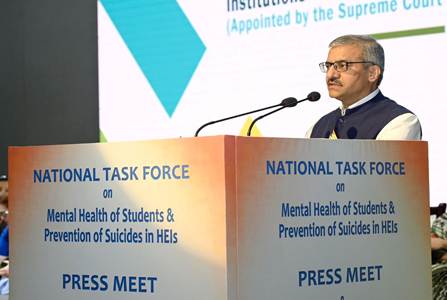
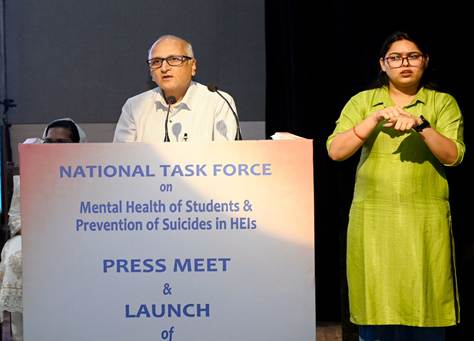
The National Task Force on Student Mental Health and Suicide Prevention in Higher Educational Institutions has officially launched its dedicated website today.

Constituted under the Chairmanship of Former Justice Shri Ravindra Bhat, the Task Force aims to develop comprehensive, recommendations to improve student wellbeing and prevent suicides in HEIs.

The Chairperson emphasized that the National Task Force, constituted by the Hon’ble Supreme Court of India, is distinct from previous committees and task forces, as it is not confined to any particular institution or category of institutions. Rather, it brings all types of Higher Education Institutions (HEIs) across the country within its purview.

He further highlighted the Task Force’s diverse composition, comprising experts from fields such as social sciences, disability rights, gender studies, clinical psychology, community medicine, and others.

Underscoring the multi-pronged strategy being adopted, he urged all stakeholder groups to extend their active support and collaboration.

Dr. Vineet Joshi highlighted that the National Task Force is engaging with a wide spectrum of institutions, ranging from central and state universities to private colleges, technical institutes, and other Higher Education Institutions (HEIs) across the country. He emphasized that this inclusive approach ensures that the concerns, challenges, and perspectives of diverse institutional settings are taken into account while formulating recommendations.

He further stated that the Department of Higher Education is extending all possible support to the Task Force, be it in terms of coordination, data sharing, policy inputs, or facilitating outreach to institutions and stakeholders. Dr. Joshi reiterated the Department’s commitment to strengthening student well-being and mental health frameworks within higher education, and affirmed that the Ministry is closely aligned with the objectives of the Task Force.

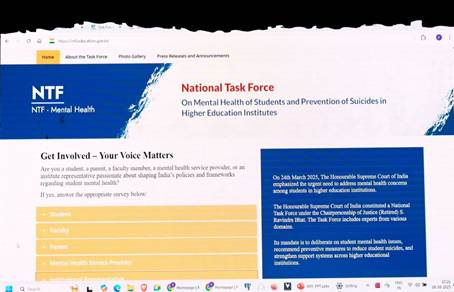
The newly launched website serves as a central platform to gather diverse perspectives from key stakeholders including:

          •        Students of Higher Education Institutions (HEIs)

          •        Parents of such students

          •        Faculty Members

          •        Mental Health Service Providers

          •        Heads of Institutions

          •        General Public, including friends or family members of students affected by suicide, alumni, NGOs, media professionals, and other concerned citizens.

The portal hosts structured online survey questionnaires, available in English and Hindi, designed to collect anonymous and confidential inputs on a wide range of themes including:

          •        Campus environment

          •        Inclusivity and belongingness

          •        Sources of distress and systemic discrimination

          •        Existing support systems and grievance redressal mechanisms

          •        Suggestions for improving student wellbeing

In addition to stakeholder surveys, a specialized Institutional Survey has been made available for Heads of HEIs to submit data on reported suicides, preventive mechanisms, and student support infrastructure in their respective institutions.

The website also includes an open space for concerned citizens to share personal insights, observations, and recommendations.

On-Ground Consultations and Institutional Visits

As part of its multi-pronged approach, the Task Force is undertaking visits to various higher education institutions across the country. These visits involve:

          •        Direct interactions with students, faculty, administrators, and grievance redressal committee members

          •        Open fora for students to voice their experiences

          •        Special focus on the needs and perspectives of students from disadvantaged and marginalised communities

          •        Assessing on-ground infrastructure and support services for student wellbeing

The Task Force is also consulting with subject matter experts, NGOs, mental health professionals, and reviewing relevant data, reports, and research to ensure a comprehensive and evidence-based approach.

The National Task Force appealed to all stakeholders and the State Nodal Officers appointed for this initiative to actively participate in the process by responding to the surveys in large numbers. The diversity of views and lived experiences collected through this participatory process will play a critical role in shaping the final recommendations of the Task Force.

For more information and to participate, please visit: ntf.education.gov.in

The event was attended by the Chairperson  of National Task Force, Shri Ravindra Bhat; Secretary, Department of Higher  Education and member Secretary of the National Task Force, Dr Vineet Joshi; Joint secretary, Department of higher education and convenor of the task force, Smt Rina Sonowal Kouli; Members of the task force, as well   Secretary, Department of Legal affairs as an  ex-officio member; officials from NIC & Ministry of Education and representatives from media.

*******