



The Vice-President, Shri Jagdeep Dhankhar today called upon everyone to resolve today to make at least one person literate. “ When we make someone literate, we liberate him or her, we help that person discover himself or herself, we make him or her feel dignity, we cut down dependence, we generate independence and interdependence. It enables a person to help himself or herself.It is a supreme facet of handholding”, he added
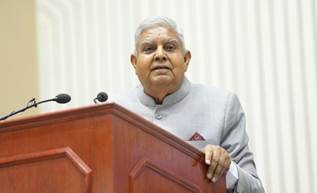
Addressing the International Literacy Day celebrations as Chief Guest at Vigyan Bhawan in New Delhi today the Vice-President underlined, “The joy and happiness you provide by educating a person, whether a man, a woman, a child, or a girl, is beyond measure. You can’t imagine the happiness it will bring you. It will spread in a positive manner. It will be the greatest affirmative action you can take in Human Resource Development”.
In his address, he called upon everyone to promote literacy.He remarked that it is time for us to be in mission mode with commitment and passion to ensure 100% literacy at the earliest but he said he was sure that this is achievable sooner than we think. Let each one make one literate, this will be a key contribution for Viksit Bharat, he said.
He further asserted that “Education is something that no thief can take away from you. No government can snatch it from you. Neither relatives, nor friends can take it away from you. There can be no reduction in it. It will grow and continue to grow as long as you keep sharing it”. He also expressed confidence that if literacy is pursued passionately, India can reclaim its ancient status as a centre of learning, like Nalanda and Takshashila.
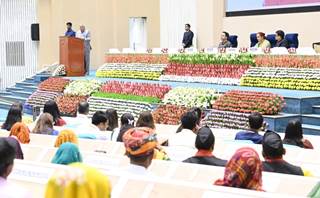
Appealing to the states that are yet to adopt the Education Policy (NEP) to rethink, revisit their stance, he emphasised that this policy is a game-changer for the nation. “This National Education Policy empowers our youth to fully exploit their talent and energy, giving due importance to all languages,” he remarked.
Highlighting the special significance of mother tongue, Shri Dhankahr stated that it is the language in which we dream. Shri Dhankhar emphasised on India’s unparalleled linguistic diversity, Shri Dhankhar stated that, “There is no country in the world like India. We are a unique nation when it comes to the richness of language, with several languages”.
Reflecting on his experiences As Chairman of the Rajya Sabha, he shared that members are given the opportunity to speak in 22 languages. “When I hear them speak in their language, I listen to the translation, but their body language itself tells me what they are saying”, he stated.
He also highlighted the profound significance of Rishi Tradition in Indian culture, and urged everyone to “take resolve to make at least one person literate within six months, so that by the end of the year, we can achieve the goal of educating two individuals.”
Lauding India’s transformative progress over the last decade, Shri Dhankhar emphasised how achievements like electrifying every household, once unimaginable, are now a reality, with future goals focused on self-sufficiency through solar power. He reflected on rural development, highlighting the significant strides like toilets in every household and the impact of widespread digital connectivity. He noted how 4G access in remote villages has revolutionised service delivery, making everyday tasks easier, and eliminating the need for long queues for essential services”.
Cautioning against the people who taint, tarnish and demean our institutions, Shri Dhankhar urged to show path to those misguided souls who are not able to acknowledge the impressive growth of Bharat and are not recognising the ground reality.
Shri Jayant Chaudhary, Minister of State for Education, Shri Sanjay Kumar, Secretary, Department of School Education & Literacy (DoSEL) and other dignitaries were also present on the occasion.
The Ministry of Education’s Department of School Education & Literacy, in collaboration with UNESCO, celebrated International Literacy Day 2024. The theme of this year’s event, “Promoting Literacy through Multilingualism,” highlighted the critical role of linguistic diversity in improving literacy levels across India’s diverse communities.
Shri Jayant Chaudhary, while delivering the inaugural address, highlighted the significance of literacy in improving the health situation, empowering women, and increasing GDP. Literacy is not just a developmental goal; it is the very foundation of our character of a developed India, he added.
The Minister highlighted the unique feature of ULLAs, which is a sense of duty, ‘Kartavyabodh’, with the spirit of volunteerism and community participation. He also expressed his gratitude to Prime Minister Shri Narendra Modi for his vision of Viksit Bharat by 2047 which emphasizes inclusive participation and the use of Indian languages to make progress in various fields. This vision is being realized through the NEP-2020, which seeks to eliminate linguistic barriers and ensure that language does not become a barrier in the educational journey of any learner, Shri Chaudhary said.
Shri Chaudhary emphasized that our efforts towards making everyone literate are part of a global mission. He mentioned, how, in collaboration with UNESCO, the work is going on towards making it in sync with international standards and goals towards a world where every individual has the right to education and the opportunity to reach their full potential. Literacy is not just a national priority; it is a global imperative that will have far-reaching implications for the future, he said.
He urged all States and Union Territories to fully embrace the ULLAAS initiative and work tirelessly towards achieving total literacy by 2030. This is not just a government effort, it is a collective responsibility, he reminded.
Shri Sanjay Kumar in his welcoming address mentioned how the literacy programme is aligned with NEP2020 which aims at achieving 100% literacy. ULLAS symbolizes our relentless pursuit of literacy for all, he said. Towards the students present at the event he highlighted the opportunity the programme presents them to contribute to the country’s literacy mission. He congratulated the UT of Ladakh on achieving full literacy (over 97%). Shri Kumar also mentioned that this year’s theme of the ILD stresses multilingualism and India’s linguistic diversity is one of the greatest assets of the country and by embracing multilingual education it can be made accessible for all. Reaffirming the unwavering determination to achieve 100% literacy he mentioned that along with enhancing literacy this mission is igniting hope, empowering individuals and shaping a bright future for India.
A special film on ULLAS – Nav Bharat Saaksharta Karyakram, was launched during the programme, which captured the journey, milestones, and success stories of the program. The film showcased the transformative impact of the initiative in promoting adult literacy across diverse linguistic regions and empowering communities through foundational literacy and digital skills.
The ULLAS DTH Channel, a significant step towards reaching learners across the nation through literacy programs in multiple languages, was also launched today. This initiative will serve as a crucial tool in bridging the literacy gap, particularly for adult learners in remote and underserved regions.
Some volunteer teachers and neo-literate individuals shared their experiences of learning through multilingual education under the ULLAS program. These stories showcased the transformative power of learning in one’s native language and its profound impact on adult learners, empowering them to participate more actively in their communities and the economy.
Cultural performances showcasing India’s linguistic richness at the event reflected the diverse heritage that is the backbone of the nation’s literacy efforts.
International Literacy Day 2024 reinforced the government’s ongoing efforts to promote literacy through multilingual education, aiming to build a more inclusive, literate, and empowered society where linguistic diversity is celebrated and embraced.
*****
 Eduindex
You must be logged in to post a comment.