



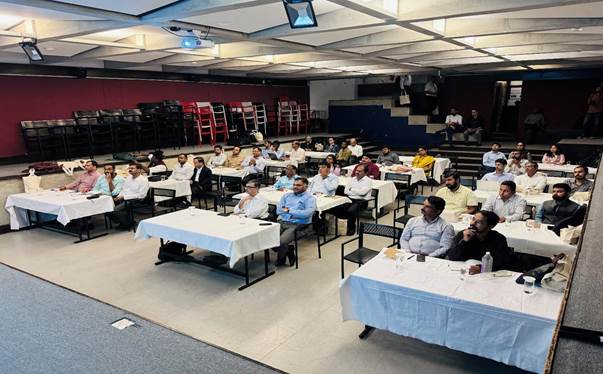
The National Industrial Corridor Development Corporation Limited (NICDC), under the administrative control of the Department for Promotion of Industry and Internal Trade (DPIIT), Ministry of Commerce and Industry, Government of India, in collaboration with the CEPT Advisory Foundation (CAF) of the Centre for Environmental Planning and Technology (CEPT) University, organised a workshop to discuss the sustainable design of administrative buildings for 12 new greenfield industrial smart cities recently approved by the Government of India. This first-of-its-kind workshop, held on October 24, 2024, at the CEPT University campus in Ahmedabad, Gujarat, focused on highlighting sustainable design concepts such as biophilic architecture, integrated and inclusive planning, energy efficiency, and climatic bio-massing.
It has been envisioned that administrative buildings in these futuristic smart cities will embody these advanced principles to create uniquely designed structures that contribute to eco-friendly urban landscapes.The workshop was held to inspire Special Purpose Vehicles (SPVs) and state officials to participate in discussions on emerging technologies and sustainable practices on both national and global levels.
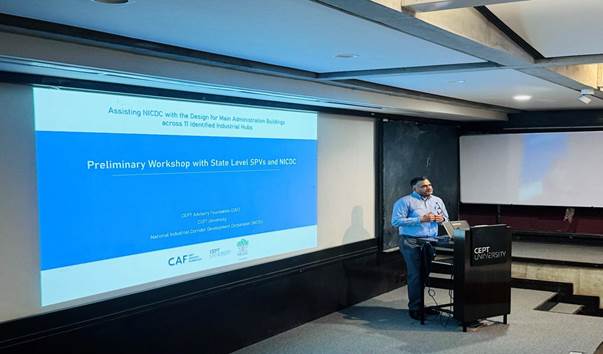
Participants engaged in two detailed sessions during the workshop. In the initial session, the emphasis was placed on the value of good design and its role in creating appealing, functional workspaces. Distinguished architects demonstrated exemplary projects to showcase the advantages of innovative designs, while open discussions were held on the latest design trends and implementation challenges. This session was led by renowned professionals, including Ms. Aparna Khemani from Gensler, Mr. Bedanta Saikia from Edifice, and Mr. Ambrish Arora from Studio Lotus.
In the second part of the workshop, the CAF team outlined a robust and transparent process for procuring architectural services. This presentation emphasized the importance of balancing quality and cost in commissioning competent designers through a reliable and thorough process. This session was facilitated by Mr. Prasad Jasti from Jacobs and Mr. Avanish Pendarkar, Center Head, CEPT Urban Planning and Design Foundation – CoE.
CEO and MD, NICDC, Shri Rajat Kumar Saini, IAS, stressed the significance of developing unique, iconic administrative buildings in the industrial smart cities being established under the National Industrial Corridor Development Programme. The aim of these industrial corridors is to create dynamic zones that stimulate industrial growth, improve logistics, and foster eco-friendly environments. Shri Saini expressed the NICDC’s vision of collaborating with CEPT University and CAF to develop resilient cities equipped to meet the needs of future generations.
CAF Director, Mr. Darshan Parikh, highlighted the importance of this collaboration with NICDC and SPVs, emphasising that CAF is committed to supporting NICDC in realising the vision of iconic buildings across designated locations. Mr. Parikh added, “Together, we aim to work collaboratively to bring the best design competencies for the development of these iconic administrative buildings”.
The workshop concluded with state officials gaining a deeper understanding of the nuances involved in designing and planning context-specific, innovative administrative buildings. This initiative represents a step toward the goal of Viksit Bharat, showcasing the pivotal role that architecture, culture, design, planning, technology, research play in building a robust and sustainable future.
NICDC, formerly known as the Delhi Mumbai Industrial Corridor Development Corporation, is responsible for developing greenfield industrial smart cities with manufacturing as the primary economic driver, as part of the National Industrial Corridor Development Programme.
CEPT Advisory Foundation (CAF) is a section 8 (non-profit) company that focuses on advisory projects, constituted in November 2023. CAF offers services across nine thematic centres, including urban planning, transport, infrastructure, and water supply and sanitation. Its portfolio includes over 200 projects, ranging from development and strategic plans to feasibility studies and development control regulations.
***
 Eduindex