DOMESTIC VIOLENCE TOWARDS MEN: THE IGNORED SUFFERING

INTRODUCTION 

The term “domestic violence” refers to all the violent acts coming from one family member against another.Besides physical abuse, its ambit also extends to verbal, psychological, and sexual abuse. A huge misconception that prevails in India is that domestic violence is always directed towards women. However, men also suffer from domestic violence. Due to gender-stereotypical assumptions, society is unable to believe that a woman can inflict violence on a man. Suffocated by the socio-cultural norms, men are unable to speak of this violence against them.

A GLANCE AT THE PROBLEM

According to the latest Indian study, almost 51.5% of couples have been into domestic violence. Society always thinks of domestic violence against women. Scarce research data on domestic violence against men are available in the scientific literature. Men are always believed to be the perpetrators. However, domestic violence is not limited to women only. Men are also subject to verbal, physical, emotional, psychological and sexual abuse. Usually, men do not raise their voices against this abuse and are silent victims of the torture.

According to a recent study, 51.5% of men have experienced domestic violence at least once in their lifetime and 10.5% in the last 12 months. Considering physical violence and threats against men by wife’s relatives almost 30 million Indian men face domestic violence. The laws in our society usually see women as victims. In such a case, men become helpless and do not get justice easily. Men are declared as culprits even before the actual decision. In the past, society has been male-dominated and we have seen heinous crimes against women. However, that does not entitle us to perceive that men can never be sufferers. 

WHAT ARE THE TYPES OF DOMESTIC VIOLENCE?

Domestic violence can affect a person’s life physically, mentally, emotionally, and psychologically. It violates basic human rights. There are many types of domestic violence.

Physical Violence

Physical violence refers to physical torture leading to bodily harm or injury. It includes slapping, pushing, hitting or throwing objects. In physical violence, slapping was identified as the most common form (98.3%). Physical violence is the most common type of violence after emotional violence. Society often pictures men to have physical strength and women to be physically weaker. Therefore it is a common misbelief that men never face physical violence.

Psychological Violence

Psychological violence exerts adverse effects on mental health. It causes emotional harm to the person. A recent study reported 85% abuse against the men by criticism, 29.7% by insult, and 3.5% by threats. It can also be exerted through constant threats to the husband under false allegations of dowry, marital rape or domestic violence.
WHY DON’T MEN RAISE VOICE?

In a patriarchal society, men are often ashamed to be beaten by a woman. Family pressure also prevents men to report the torture. The reasons for this are societal status and the fear of false accusations of dowry or marital. Also even when men report domestic abuse, people do not believe them. Additionally, when they try to complain, no one takes them seriously. Majorly men are ashamed of saying that they are beaten by their wives. A false hope that things would get better, fear of losing social respect, love toward their children stop men from raising voices. Also the fear of false accusations scares men to the core. Unfortunately, even when men complain it is perceived as “feminine behaviour” in the patriarchal society.

THE ADVERSE IMPACT OF DOMESTIC VIOLENCE ON MEN

Violence adversely affects life physically, mentally, emotionally, and psychologically. Violence is a violation of human rights. Unreported and unnoticed violence against men deteriorates mental health, can cause depression, anxiety or even suicide in extreme cases. It has been observed that suicide rates were more in married men as compared to separated or unmarried men. Besides depression men also have to live in constant fear of false allegations against them and their families. According to World Health Organisation (WHO), violence can increase the risk of getting addicted to smoking, alcohol, and drug abuse; it can also cause mental illness and suicidal tendencies. It can also cause chronic diseases like heart diseases, diabetes, and cancer; and social problems such as crime and further violence.

GENDER NEUTRAL LAWS

Adultery sees man as the ultimate culprit. We don’t have a law where a man can complain to his wife or in-laws. Divorce and child custody laws, look at women with a more sympathetic vision and consider them as a victim. The same is true in the case of maintenance after divorce. The number of false allegations on men regarding marital rape is also increasing.

We need gender-neutral laws that address the issue of false allegations. Human rights and gender equality ought to include both men and women. Domestic violence should be seen as spousal violence. It shall not be differentiated due to gender stereotypes. The domestic violence act in India pertains to women only. Studies clearly show that men are also the victims of domestic violence at the hand of women. Hence, necessary amendments addressing violence against men are required.

CONCLUSION

Society is changing, and so are the norms and values regarding domestic violence. We need to understand that men can also be physically and mentally harassed by their spouses and in-laws. Hence, their problems must be recognized and appropriate strategies and interventions should be implemented. We cannot deny that the society that we are inhabiting is male-dominated and patriarchal. However, this does not mean that every time a man is wrong and a woman is right. Real equality does not see women as the weaker sex. Rather it recognises domestic violence as spousal violence. It gives men the courage to raise their voice against violence and society, the humility to understand it.

 Laws and legislation must include domestic violence against men as a punishable offence. If we need men who understand and respect women then we also need women who do the same for men. In the end, we need to be more considerate towards both men and women. Like all women are not victims similarly all men are also not the perpetrators. Men and women are the pillars of both society and their families. Hence, laws are needed to protect both. We can flourish only when we understand gender equality in the true sense.

Domestic violence


                                                        (Photo: Bar and Bench)

Domestic violence (also named domestic abuse or family violence) is violence or other abuse in a domestic setting, such as in marriage or cohabitation.  Domestic violence may be used as a synonym for intimate partner violence, which is committed by a spouse or partner in an intimate relationship against the other spouse or partner, and can take place in heterosexual or same sex relationships, or between former spouses or partners. In the broadest sense, domestic violence can also involve violence against children, parents, or the elderly. It takes a number of forms, including physical, verbal, emotional, economic, religious, reproductive and sexual abuse, which can range from subtle, coercive forms to marital rape and to violent physical abuse such as choking, beating, female genital mutilation, and acid throwing that results in disfigurement or death. Domestic murders include stoning, bride burning, honor killing and dowry death(which sometimes involve non-cohabitating family members). 

FORMS OF DOMESTIC VIOLENCE

Physical abuse is that involving contact intended to cause fear, pain, injury, other physical suffering or bodily harm. In the context of coercive control, physical abuse is to control the victim. Physical violence can be the culmination of other abusive behavior, such as threats, intimidation, and restriction of victim self-determination through isolation, manipulation and other limitations of personal freedom. Denying medical care, sleep deprivation, and forced drug or alcohol use, are also forms of physical abuse.

Sexual abuse, is defined by World Health Organization as any sexual act, attempt to obtain a sexual act, unwanted sexual comments or advances, or acts to traffic, or otherwise directed, against a person’s sexuality using coercion. Aside from initiation of the sexual act through physical force, sexual abuse occurs if a person is verbally pressured into consenting, unable to understand the nature or condition of the act, unable to decline participation, or unable to communicate unwillingness to engage in the sexual act. This could be because of underage immaturity, illness, disability, or the influence of alcohol or other drugs, or due to intimidation or pressure.

Emotional abuse includes minimizing threats, isolation,  public humiliation, unrelenting criticism. Stalking is a common form of psychological intimidation. Victims tend to feel their partner has nearly total control over them, greatly affecting the power dynamic in a relationship, empowering the perpetrator, and disempowering the victim. Victims often suffer from depression, putting them at increased risk of eating disorders, suicide, and drug and alcohol abuse.

Economic abuse (or financial abuse) is a form of abuse when one intimate partner has control over the other partner’s access to economic resources. Marital assets are used as a means of control. Economic abuse diminishes the victim’s capacity to support themselves, increasing dependence on the perpetrator, including reduced access to education, employment, career advancement, and assets acquirement. Forcing or pressuring a family member to sign documents, to sell things, or to change a will are forms of economic abuse.

 CAUSES

A partner’s domination may take the form of emotional, physical or sexual abuse. Studies suggest that violent behavior often is caused by an interaction of situational and individual factors. That means that abusers learn violent behavior from their family, people in their community and other cultural influences as they grow up. They may have seen violence often or they may have been victims themselves. Some abusers acknowledge growing up having been abused as a child.

Children who witness or are the victims of violence may learn to believe that violence is a reasonable way to resolve conflict between people. Boys who learn that women are not to be valued or respected and who see violence directed against women are more likely to abuse women when they grow up. Girls who witness domestic violence in their families of origin are more likely to be victimized by their own husbands. Although women are most often the victim of domestic violence, the gender roles can and are reversed sometimes.

Alcohol and drugs may contribute to violent behavior. A drunk or high person will be less likely to control his or her violent impulses toward their partner, so keeping such drinking or drug use episodes to a minimum may be valuable for a person living in a domestic violence situation.

No cause of domestic violence, however, justifies the actions of the abuser, nor should it be used as a rationale for their behavior. These possible causes are only to better understand why an abuser believes it is acceptable to abuse their partner physically, sexually, psychologically or emotionally. Ultimately an abuser needs to get help for their unhealthy and destructive behavior, or find themselves living a solitary and lonely life.

 STATISTICS OF DOMESTIC VIOLENCE

        1 in 4 women and 1 in 7 men will experience severe physical violence by an intimate partner in their lifetime. (CDC, 2017)

        1 in 10 women in the United States will be raped by an intimate partner in her lifetime. (CDC, 2010)

    Approximately 16.9% of women and 8.0% of men will experience sexual violence other than rape by an intimate partner at some point in their lifetime. (CDC, 2010)

        Data on sexual violence against men may be underreported.

        An estimated 9.7% of women and 2.3% of men have been stalked by an intimate partner during their lifetime. (CDC, 2017)

        Nearly half of all women and men in the United States will experience psychological aggression by an intimate partner in their lifetime. (CDC, 2017)

GOVERNMENT SCHEMES TO CURB DOMESTIC VIOLENCE

  • Beti Bachao, Beti Padhao, meant for uplifting women in the sphere of women’s education
  • Sukanya Samriddhi Account, meant to help families’ save for their daughters
  • One Stop Center scheme meant to offer easy access for women suffering from domestic abuse or violence, and needing support
  • Pradhan Mantri Ujjwala Yojana meant to offer free LPG connections to women living below poverty line
  • Mahila Haat meant to support women entrepreneurs and women self-help groups
  • Rajiv Gandhi National Crèche Scheme for Children of Working Mothers meant to provide affordable daycare services to working women
  • Maternity Benefit Scheme meant for pregnant women and lactating mothers
  • Women’s Helpline 1091 meant to provide emergency assistance to women in trouble, especially those facing violence of any kind
WHAT CAN WE DO?

        Calling the police if you see or hear evidence of domestic violence.

        Speak out publicly against domestic violence.

        Consider reaching out to your neighbor, friends, family.

        Educating others on domestic violence.

        Organize campaigns special in rural areas.

  •   Donating to domestic violence counselling programs


THE CURIOUS CASE OF MARITAL RAPES IN INDIA

Marital rape is the act of indulging in sexual intercourse without proper consent of the partner. People often mistake marital rape as an act of domestic violence or sexual abuse, although a lack of consent is enough in itself.  The right for sexual intercourse within the marriage was considered as a naturally consigned right of the spouse, historically. Many countries around the world have rightly classified non-consensual sexual intercourse as “rape”, yet countries including India regard this intimate assault a perfectly legal crime.

Section 375 of the Indian Penal Code propounds rape as all forms of sexual assault involving non-consensual intercourse with a woman. Yet the Exception 2 to Section 375 absolves the unwilling sexual intercourse between a husband and a wife over fifteen years of age from Section 375’s definition of “rape”. Thus the atrocities and abuses within the sacredness and sacrosanctity of marriage are legalized by the government under this section. This is a clear case of discrimination against female victims by the Indian criminal laws, just because they have been raped by their own husbands.

According to the National Family Health Survey (NFHS) reports, an average Indian woman is 17 times more likely to be subjected to sexual violence from her own husband than others. Such heinous acts go unreported due to the ineffectiveness of the existing laws. Though India is striving hard to empower its female population, it fails to ensure their safety even in the very basic social structure like family. The patriarchal social structure of India is the fundamental reason for the mortifying status of women in Indian society and the persisting ineffectiveness of laws protecting them.

NGOs for the empowerment of women and Constitutional experts are of the opinion that the Exception 2 to Section 375 is a clear violation of Article 14 and Article 21 and insists that its high time India criminalize marital rape and frame new laws for protecting women from intramarital violence. The equality and liberty rights assured for all citizens in Article 14  and Article 21 of the constitution are denied in exception 2 to section 375. Even the UN General Committee has recommended the Indian government to criminalize marital rape back in 2013. A large part of the British influenced Indian laws which need timely amendments remains untouched for the past 73 years since independence. No Indian government has, however, so far shown an active interest in remedying this problem. As a result, many of such primitive practices still exist in our society. 

DOMESTIC VIOLENCE

INTRODUCTION 

Domestic violence is defined when victims including anyone, despite external identities which differ from citizen to citizen1. Domestic violence was initially known as wife abuse, Victims of domestic violence include: 

  • Spouses 
  • Sexual/Dating/Intimate partners 
  • Family members 
  • Children 
  • Cohabitants 

DATA 

The National Family Health Survey (NHFS) data shows that almost 30% of Indian women have been abused in some way or the other by their husbands at some points of their life.  

Thirty-one percent of respondents in NFHS (Round 3, 2005) – somewhat 20,000 women –complained that they were sufferers of domestic violence. Surprisingly, almost 75% did not look for assistance from anyone.2Instances of reporting to the police amplifies more than two folds when the cases of domestic violence are severe. Ergo, even then only 1.5% of women go to the police. 

The ethnographic data evinces, that of the women becoming the sufferers of severe atrocities – ranging from broken bones, bruises to burns – none approached the police to report violence except in one instance where a woman sought police help not for battery, but the abduction of her toddler son by her husband. 

Many have a sceptical attitude towards the working of police, that unless bribed they won’t work and that seeking police intervention would tarnish their reputation in the society. 

The extent to which women approached multiple sources of help is quite scanty. Of all women experiencing domestic violence, 26% seek help from at least one source, and 7% seek help from more than one sources. Many women in the rural areas continue to bear the atrocities inflicted upon them because they have nobody to rely on except for their husband, so they accept their fate and do not report to the authorities concerned. 

CONSTITUTIONAL RIGHTS 

  1. RIGHT TO BE FREE FROM VIOLENCE: 

Every citizen in the country has the right to be free from violence at any point in time. This is because everyone is equal despite age, colour, race, caste, sex. Everyone deserves a peaceful life. This right is applicable from women and children who undergo domestic violence as well. 

  1. RIGHT TO DIGNITY: 

The Constitution provides personal liberty to all persons. It includes, all the dimensions of life which makes a person’s life purposeful, complete and provides a reason for them to live.3 The human life has its reason and there is no reason why life should not be enjoyed with permitted legal pleasures. 

  1. RIGHT TO SHELTER: 

The need of human is different from that of an animal. For animals it is about the safe guarding of the body, whereas for a human being it is the residing The Constitution aims at fulfilling the development of every child.  The shelter does not have to satisfy the features of a luxurious houses, but it should be mud proof and fire proof. This is the basic shelter any being requires to run a life. The Court held that the right to shelter is a fundamental right to citizens of the nation and it was looked into Article 21 of the Constitution. The right to shelter serves as an vital right to make life function naturally.4 

WHAT REMEADY DOES THE LAW PROFFER? 

The Indian parliament was well cognisant of the quantum of atrocities faced by women. Hence, in order to put the kibosh on domestic violence, the protection of women from Domestic Violence Act 2005 was created. This act has the women and their concern in its fulcrum. Prior to the formulation of this exemplary piece of legislation, women had to approach the courts under IPC (498-A) which did not even make a mention of “domestic violence”. Further, the women had to leave the matrimonial place in fear of what might transpire out of retaliation by the husband. By the virtue of section 17 and section 19 of this act, women can continue to stay in the matrimonial house and file a complaint against the preparators, thus vanquishing the fear that the rural women had that where will they sojourn till any significant decision is taken. Fear of being homeless after filing the complaint against the husband was one of the driving forces of women not complaining the offence against the husband especially in rural areas.  Moreover, if the women decide on discontinuing to stay in her matrimonial home, then by the virtue of  section 6, the protection officer or a service provider (NGO) may request the person in charge of any shelter home and that person in charge is under an obligation to provide shelter to such aggrieved woman. The magistrate, after hearing both the parties, if comes to a conclusion that the domestic violence has taken place or is likely to take place, then he may pass orders of protection by the virtue of section 18.  

In the case of Sabita Mark Burges vs Mark Lionel Burges,5 the Bombay High Court ruled that the court may, if it deems fir, may pass orders directing the respondent from a shared household or the lone ownership  of a man, a man has no right to inflict violence on the violence he lives with and if such a misadventure occurs, he may be stalled form entering the premises to secure the person of the wife and children. However, an exception of this rule is found when the respondent is a female. 

Furthermore, unlike IPC which is oblivious of domestic violence, the DV ACT adduces an all-encompassing and exhaustive definition of the term under section 3. The definition is not limited to merely physical injury, but also sweepingly takes into account the emotional, economic, mental, verbal and sexual abuse. An important judgement comes of Gujrat HC which provided new dimensions to the definition of “domestic violence”, in Bhartiben Bipinbhai Tamboli vs State of Gujarat & others6 on 20 September, 2016. 

In the case of Smt. Haimanti Mal vs, The State of West Bengal7 on 09.07.2019. Calcutta High Court granted Rs.1,00,000/- as compensation to the wife for psychological anguish that she had gone through owing to the behaviour of the husband.  

Section 2(f) of the act defines domestic relationship. Domestic relationship relates to the relationship between two persons in which they stay in a shared household together, by the virtue of relation by marriage, blood, relation which is of similar nature to marriage, adoption or a joint family, thus the act includes but is not limited to the married woman, it also takes  into its shade the mother, sister, daughter live-in relationship etc. In the case of Sadhana V. Hemant8, Bombay High Court held that if at the time of filing of petition, the wife has already been divorced, there cannot exist any domestic relationship and, divorced wife cannot be entitled for protection under Domestic Violence Act. 

In the case of D. Veluswamy V. D. Patchaiammal9, the court recognised the status of women in live in relationships under the definition of “aggrieved person”. However, in the same case 5 key ingredients were laid down: 

  • Their demeanour must be such that they seem to be husband and wife and they must be recognized as husband and wife in the society. 
  • Both must be of valid and legal age of marriage. 
  • They must meet the qualification of entering into a matrimonial relationship. 
  • They must have cohabitated with consent for a significant time duration. 
  • They must live together in a shared household. 

Shared household has been more elaborately and unambiguously defined in the judgement of S.R. Batra And Anr vs Smt. Taruna Batra10, authored by M Katju, wife would be entitled to the possession of only a share household, a shared household, interpreted in the light of section 2(s) cannot be a property belonging to mother-in-law or father-in-law. it must be a property that the husband owns or has taken on rent of belongs to aa joint family of which the husband is a member. 

OBLIGATIONS OF THE GOVERNMENT 

Under section 8 of the herein mentioned act, the government must appoint a protection officer in each district. The number of such officers may vary in accordance with the need. Also, such an officer, preferably must be a woman 

Section 11 lays down the duties of the government. It speaks that the central and the state governments are duty bound to publicise the sections of this act in media through various conduits like T.V. radio, newspaper etc. at regular intervals in order to ensure that no woman stays oblivious to her rights. The central and state government officers must be given public sensitisation and awareness training. 

CONCLUSION 

To summarize, every citizen of our nation is equal as per the Indian Constitution, but unfortunately women and children are ill-treated. While the legislation has worked immensely well for the protection of women, extant poor implementation is still an issue. The protection officer is usually a part time officer or an incompetent officer who fails to do justice to the job. There is no provision in favour of male child. The legislation is highly women centric and is often exploited by cunning women, hence is often construed against the tenants of article 14. Providing such a superfluous definition of domestic violence can be used against men often times to persecute them. It also perceives that only women can be subject to domestic violence and turns a nelsons eye to the cases in which the men are aggrieved. 

Dowry- A curse

Dowry originated to give stress to women and made up of sthreedhanam ( Stree means woman and dhan means wealth) consisting of money,property,or gifts given solely to women by her parents in marriage in the form of dowry. But the abuse of this custom started when it became a price tag for groom. The groom demands dowry consisting of a large sum of money,furniture and other luxury things.

The price of Indian groom has increased based on his qualifications,profession and income. It is the ritual that doctors,chartered Accountants and Engineers expect a handsome dowry. Dowry has reduced the status of women in our society. The grooms have also become a saleable commodity available at such a price,earning so many amounts. Even the rate of dowry has been fixed by doctors ,bank officers,govt officers and businessmen.

In case marriage takes place where dowry is less than a new chapter of mental and physical violence takes place against the bride in order to extract more dowry. The violence started from one day taunting by inlaws and then domestic violnce by husbands.The practice of dowry has been still rising in India badly.The most severe case is when bride is burning in regard to less dowry and these incidents are given shape of accidental burns in kitchen or disguised as suicide.In india every 20 woman die as result of harassment over dowry,either murdered by their husbands or compelled to commit suicide.dowry death rose from about 19 per day to 20 per day in 2020. And many reports of dowry death are unreported in police stations. Taking or giving dowry is practice from 1961. And still now it is a significant part of Indian marriage and falling women empowerment.

In some cases,to escape from punishmenet the husband and family not only kill woman directly but harass them mentally and physically too commit suicide.We are in 2020 and still this system is prevailing. The reason for that is our old customs and patriarchal society that values men over women. The stronghold of gender inequality makes them give dowry that is too wrong . The second reason is this practice is so rooted in the Indian culture that it is seen as normal and unchangeable.Even today people get to know that they are taking dowry they use to ignore them and take it as cultural tradition. If a woman’s marriage requires dowry in return for a safe,happy life then this world is unsafe and discriminatory for women. And where women are not treated with equity then that country can’t become developed. This is a ahrsh reality that women sacrifice their life because of this single small stupid thing. Nothing is above than life.

The need of the hour is the social awareness at least among females to stand up against wrong and right. More stringent laws,more awareness ,more education is required to girls for their independence and a social awakening can curb this ever increasing evil.

Domestic Violence and Abuse

Domestic violence can be referred to as an attempt by an individual either a spouse, in a relationship or a family member to gain power or control over the other . It results in death, serious injury, and chronic medical and mental health issues for victims, their children, the elderly , their communities and is regarded as a serious social evil.

Domestic violence occurs in adult or adolescent intimate relationships where the abuser and the victim are currently or have been previously dating, cohabiting, married or divorced. They may be heterosexual, gay, or lesbian. They may have children in common or not. The relationships may be of a long or short duration. Here, the trauma faced is repeated rather than a singular event , and the effects of the trauma are emphasized due to the intimate nature of the relationship between victim and abuser. Since the victim’s daily routine is known, they can continue to exercise considerable physical and emotional control over the victim’s daily life. Also, his relationship with the victim gives him social, if not legal, permission to use such abuse. Hence the victims of domestic violence must also deal with the barriers to separation from the perpetrator created by the complexity and strength of an intimate relationship. In addition to the devastating effects, there is growing evidence that sometimes violence within the family becomes the breeding ground for other social problems such as substance abuse, violent crimes etc. In order to most effectively and efficiently respond to the individuals experiencing domestic violence, the counselors and therapists must not only understand the nature and analysis of domestic violence, but also understand how violence against intimates affects the victims, abusers, children and community as a whole.

Domestic violence is represented in form of threats, insults, sexual assaults and emotional abuse. The types of abuse or assaults endured include: Physical Abuse – (shoving, slapping, punching, kicking, throttling, biting and assault with sharp objects, guns, knives or any other dangerous weapon) , Sexual Abuse – ( Rape, attempted rape, indecent assault, on-going verbal abuse with sexual slurs such as bitch, whore, slut etc.) , Emotional, Verbal and Psychological Abuse -(the constant insults, ridicule or name calling , repeated threats of violence or death to cause emotional pain and anxiety) , Economic Abuse – ( Selling of shared property e.g. property, livestock without the consent of a victim , accessing a joint bank account for personal use without the consent of a victim) , Intimidation -(sending written or verbal death threats to a victim , sending beheaded dolls, small coffins, dead flowers or dead pets to a victim) , Harassment -(Repeatedly watching a victim outside or near his / her house, workplace, school or business premises or any place where she happens to be, repeatedly phoning a victim or causing any other person to phone his/her whether or not the caller speaks to a complainant) , Stalking – ( constantly approaching a victim and asking or demanding to talk to a victim against his/her will , damage to property may include acts of: breaking a window to gain entry into a victim’s house, cutting, breaking or damaging in any other manner shared furniture, unauthorized entry into the victim’s residence such as using a duplicate key to gain access may also constitute domestic violence.)


Despite numerous laws enacted to minimize domestic violence, the issue is still deeply rooted in the society. Hence, we must all raise our voices against this immorality and work towards eliminating domestic violence and make the world a better place to live in.

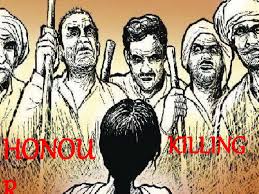
HONOR KILLINGS -not so honorable!

For ages the Indian society has been embroiled down by many social evils and many of them were pertaining to woman. Women have always been on the target ranging from female infanticide, dowry, domestic violence, prostitution, rape  etc. although with changing times people have been educated and changed their perception and these practices have been reduced in some places but till date there are certain social evils  prevalent in not only our country but many other countries , one such act is of HONOR KILLING.

According to a survey there are more than 300 cases of honor killing in last 3 years in India. It is one of the most tenacious forms of gender violence – and also the least acknowledged.

In India, women are not considered individual entity  with lives and choices of their own. Instead, they are seen as the torchbearers of family ‘honor’. The “honor (ijjat)” of a family,society or the community is so called the ‘purity of women. Hence, instead of being considered as independent individuals with their own choices, women’s lives are controlled by an honor code.

Human Rights Watch defines “honor killings” as, Honor crimes are acts of violence, usually murder, committed by male members of family against females of the family who are seemed to have brought dishonor upon the family. The mere perception that a woman has acted in a manner to bring “dishonor” to the family is enough to trigger an attack. Sometimes men can also be the victims of honor killings by members of the family of a woman with whom they are considered to have an inappropriate relationship, or by partaking in homosexual activities.

Honor killings are often a result of strongly misogynistic views towards women, and also  the position of women in society. In these traditionally patriarchal  societies women are dependent first on their father and then on their husband, whom they are expected to obey. Women are contemplated  as property and not as individuals with their own agency. Violence is seen as a way of ensuring compliance and to avert the rebellion.

The concept of ownership has turned women into a commodity that can be exchanged, bought and sold”.In such cultures, women are restricted to take control over their bodies and sexuality: these are the properties of the males of the family, the father (and other male relatives) who must ensure virginity until marriage; and then the husband to whom his wife’s sexuality is subordinated—a woman must not sabotage the ownership rights of her guardian by engaging in premarital sex or adultery.

The occurrences of honor killings are extremely  difficult to determine and estimates vary widely. In most countries data on honor killings isn’t collected systematically, and most of those killings are reported by the families as suicides or accidents.  Murder is not the only form of honor crime, other crimes such as acid attacks, abduction, mutilations, and domestic violence occur too.  The cultures in which honor killings take place are usually considered “collectivist cultures”, where the family’s pride is more important than the individuals life.

LETS TAKE FEW RECENT EXAMPLES OF THESE HIDEOUS KILLINGS IN INDIA

Couple killed in Tamil Nadu

25-year-old Nandhish from the Dalit community fell in love with Swathi, an upper caste woman. The couple got married and lived together for a few months before they were both murdered by the couple’s father. Swathi’s father has confessed to murdering them and throwing the bodies into a river in Tamil Nadu’s Krishnagiri district.

Honour killing caught on CCTV

Amrutha, who belongs to a wealthy upper caste family, fell in love with Pranay from the Dalit community and the couple got married. In September 2018, while returning after a medical check-up, Pranay was hacked to death in broad daylight in front of his pregnant wife. The gruesome murder that shook south India was caught on CCTV. Amrutha’s father confessed to have plotted the murder as he did not approve of Pranay’s caste and lack of wealth.

Minor killed allegedly by father 

In Chandigarh, a 16-year-old girl was found dead in mysterious circumstances in October. Why ??? only because The girl was reported to be in love with a 19-year-old from her village. The girl’s parents had earlier filed a rape case against him.

And recently on 6 may 2020 in Hisar, a woman died at a village near Uklana town of Hisar district on Monday. Her live in partner alleged an honour killing. The Village sarpanch said she died of electric shocks sustained while ironing clothes, in his police complaint, The man had an affair with the deceased for last 3years and said that her family was against their marriage.

Although honor killings are often linked with the Asian continent, especially the middle east  and South Asia. In 2000, the United Nations estimated that 5,000 women were victims of honor killings each year . The existence of ‘honor killings’ all over the world puts universal human rights under severe threat . It puts the agency of “individualism” and “choice” against the notion of collective social agency and strict norms. The right to marry comes under “right to life” enshrined by Article 21 of the Constitution of India. However, In India, the concept of free will in exercising the right to marry is considered more as a duty or social in nature, rather than an individual choice or opinion.


The term “honor” crime is somewhat misleading because it implicit that such crimes are “honorable”. These acts of violence, attack something more than women’s bodies: they additionally strike their challenge to oppressive patriarchy. By adding the word “honor” to killing, we use the language of those who rationalize  this loathsome crime on the basis of “honorable” motives. We use the language of their excuse. We must stop doing this. The term “honor killing” not only gives too much power to the culprit, but is offensive to survivors and women. Instead, we need to see the crime through the eyes of those assaulted.

It is true that these culprits invariably invoke their slighted “honor”. But there is a further common feature: this violence seeks to punish women for seeking to exercise independent choice, and to flout not only the wishes of their families and societal  expectation – for daring to be free. That’s the heart of the matter, and that’s the right lens to view the problem through.

India under Lockdown: Unlocking Domestic Violence

Home is the safest place for anyone to be with own family in this pandemic situation. Unfortunately it is the worst place for lot of women in the world. Domestic violence has witnessed a tremendous surge during the lockdown period. The modes vary from the physical, sexual, mental to financial abuse or assaults. The victims, most of whom are women, fall prey to chronic diseases, acute depression, trauma and so forth. The attacks are repeated on a regular basis, daily. The World Health Organisation (WHO) has warned that the risk of intimate partner violence will increase all around the world as people are encouraged to be in their homes during the lockdown. There are various domestic violence helplines from different organisations in different parts of the world to save the victims.

According to the reports of National Commission for Women (NCW) in India, issues an urgent alert on the increasing number of reported cases. The lockdown stress is intensifying mental frustration if the perpetrators of violence, who vent their anger on women and children. The anxiety of losing jobs, associated insecurities and financial problems are making the abusers more violent. To cope with this trend various hotlines are operating to enable victims to report their cases. The number of cases surprise all because no one realised before that the lockdown would lead to such unleashing of domestic violence.

Coronavirus has affected the Indian economy very badly. Alongside the economic uncertainty these cases are rising steadily. The NCW reports that this year it has received more than 250 cases of domestic violence from 23 March to 16 April which is almost 100% increase from 27 February to 22 March. The NCW apprehends that the reported cases are only a small percentage of the cases occurring. There must be more unreported cases where the victims are in constant vulnerability. The number of domestic violence cases rose from 3,287 to 3,993 during the lockdown.

West Bengal government helpline has received over seventy cases during the lockdown. A woman living in a high profile highrise in Kolkata had to file a FIR in the nearby police station alleging torture and abuse by the husband.  In another incident, the Association of Protection of Democratic Rights (APDR) reported that a twenty-six year old woman, Sona Mondol from Malda district, was strangled by her husband. In another case, a wife was killed by her husband for protesting against his extra-marital affair.

616 domestic violence cases have been reported across Tamil Nadu from 25 March to 14 May through helplines. The number is alarming considering the brief period. Telangana women are also facing the brunt of the hike in domestic violence cases. According to Sakhi One Stop Centres, around 89% cases registered in April are of domestic violence. A report from the National Legal Service Authority (NALSA) mentions a total of 144 registered cases in Uttarakhand. According to the Punjab State Commission for Women (PSCW), the helpline number is receiving minimum of thirty complaints regarding domestic violence each day since 22 March. There are some interstate cases as well. Thus, the Kerala State Women Commission received a call from Chennai. The caller reported that his sister and her daughter were hiding in the wild forest in Idukki district, Kerala, after being thrown out from home.

Police in Delhi states that over 2,500 women called their emergency helpline numbers. They have received 600 cases of abuse against women, 23 cases of rape assaults and 1612 cases of other kinds of domestic violence within second week of April. There is one case from Uttam Nagar, of a twenty-eight year old young mother, who had undergone mental and physical abuse in front of two toddlers by her spouse and his family. He beat her up severely and told her to leave the house immediately.

Coordinators of various private helpline numbers from across India report that their phones are constantly ringing with distress calls, some of which call for immediate help. Domestic violence is not going to vanish instantly. But what is important is to report these cases to the nearest police station and to make use of both the government and private helplines.