

Tag: drinking water
What is importance of public health engineering?
Public health engineering helps people to satisfy their humanitarian needs. Today’s crises occur often in urban areas. They usually last longer and have a wider regional effect. They cause widespread human misery, threaten basic services such as water supply and sanitation.
In this blog, I will show what is Public Health Engineering, its learning objectives and the role of a Public Health Engineer.
What is Public Health Engineering?
A clean and balanced Earth is a good place where everyone owns and bears responsibility for ensuring a good quality of life. It can be made possible through several ways.
Some of them are safe drinking water, proper sanitation, and best hygiene practices. This is what Public Health Engineering envisions for our society. It is a specialisation in civil engineering.
Engineers and technical specialists in the fields of water, sanitation, electricity and other related fields are critical in meeting the challenges and rising demands. They are known as public health engineers.
Water processing, purification, transmission, and distribution are all handled by the Public Health Engineering industry. Thus “Sanitary Engineering” is now referred to as “Public Health Engineering.”
Role of a Public Health Engineer

A Public Health Engineer must calculate design flow, design population, design area, and population density in order to do his job. They will play an important role in the present and future scenarios for tackling the following issues:
- Water, air, and soil contamination
- Environmental crises
- Industrial solid and liquid waste management
- Industrial and occupational safety hazardous
- Chemical hazards
REPORT THIS AD
A Public Health Engineer’s position today includes a wide range of responsibilities. This includes:
- Ensuring that water levels are controlled and managed
- Rivers are built to function with increasing populations
- Water and wastewater treatment systems are planned to meet growing demands
- Evaluating and reducing water use in domestic and industrial applications.
Now let’s move on to the learning objectives of this amazing course.
Objectives of Public Health Engineering:
The course consists of the following modules.
- Fundamentals of public health engineering
- Humanitarian contexts
- Water supply systems
- Sanitation
- Waste management and hygiene protection
Now let’s dive deeper into each of the objectives.
Fundamentals of Public Health Engineering:
- The first section explores the fundamentals of public health engineering.
- It shows how engineers can help reduce mortality and morbidity in a variety of humanitarian situations.
- Engineers must have a thorough understanding of how infectious diseases spread in order to do so.
- You will be exposed to various disease transmission routes in the area.
- You will gain awareness about steps that can be taken to prevent the spread of such diseases.
- To aid comprehension, real-life case studies will be presented.
Humanitarian contexts:
The humanitarian background in which public health engineering activities take place is presented in this section. How long-running disputes impact urban basic services like water supply and sanitation, causing public health problems are dealt in this section.
Water Supply Systems:
This section takes a look at some of the most popular water technologies used from the source to the distribution point. We address the benefits and drawbacks of various water distribution systems that can be used.
Sanitation:
The section covers an analysis of sanitation technology and excreta management. Some of the humanitarian sector’s problems and activities are highlighted with the help of case studies.
Waste management & Hygiene promotion:

The section focuses on medical waste. It is a form of solid waste that public health engineers often encounter in humanitarian crises. Finally, in humanitarian emergencies, we address the crucial problem of behaviour modification and hygiene promotion.
A career in Civil Engineering with a specialisation in Public Health offers promising prospects. Some career choices that students can explore after their specialisation include:
- Building Engineering & Services
- Water Resources Engineering
- Renewable Water Resources Management
- Facility Management
- Operations Management
- Sustainable Design & Solutions
- Clean Energy
- Research & Development
- Entrepreneurship
This Civil Engineering specialisation will place you on the right track if you want to make a difference in combating the global issues. Hope you found this article insightful.
LABORATORY FOR CHECKING THE QUALITY OF DRINKING WATER
As reported by States/UTs, so far 2021 drinking water quality testing laboratories at different levels viz. State, district, sub-division and/or block level, has been set up in the country. State-wise details of drinking water quality testing laboratories is at Annex-I.
To make provision of potable tap water supply in adequate quantity, of prescribed quality and on regular & long-term basis to every rural household by 2024, since August, 2019, Government of India in partnership with States, is implementing Jal Jeevan Mission (JJM) – Har Ghar Jal. Thus, as of date, out of 19.27 Crore rural households in the country, 8.88 Crore (46.09%) households are reported to have provision of tap water supply in their homes. State-wise details is at Annex– II.
The State/UT, district & village-wise status of tap water connection in rural households, schools and anganwadi centres as reported by States/ UTs is in public domain and available on JJM dashboard at:
Assam On Track To Become ‘Har Ghar Jal’ State By 2024
The Secretary, Department of Drinking water and Sanitation (DDWS) Smt. Vini Mahajan today reviewed the progress of Jal Jeevan Mission and Swachh Bharat Mission with Chief Secretary of Assam, Shri Jishnu Barua. Smt. Mahajan appreciated the progress made by Assam in providing tap water supply to rural homes during the review meeting on implementation of the two key missions in the State. She said “the State of Assam is well on track to achieve the target of providing clean tap water supply to every home by 2024 and the Centre is providing full assistance to the State to achieve the goal.” Shri Arun Baroka, Additional Secretary, DDWS, Shri S Abbasi, ACS in-charge SBM and JJM, Assam, Shri Samir Sinha, Finance Secretary, Assam and officers of DDWS were also present during the online review.
Smt. Mahajan in her opening remarks said, “Jal Jeevan Mission is a decentralized, demand-driven, community-managed water supply scheme which aims to improve the lives of rural people by providing clean tap water supply to every home. She appreciated the work carried out by the State in the past six months.”
Speaking on the implementation of Swachh Bharat Mission, Smt. Mahajan said, “While the districts have self-declared themselves Open Defecation Free, but this is not a one-time effort. Efforts under the programme are being made to bring about social and behaviour change for sustainability of the ODF status of villages at all times.” She also emphasized on urgent need to prioritize supply of tap water in all schools and anganwadi centres of the State.
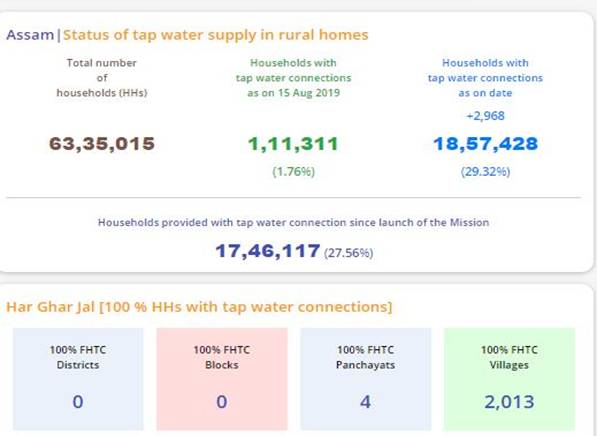
At the announcement of Jal Jeevan Mission on 15th August, 2019, only 1.11 lakh (1.76%) households out of total 63.35 lakh households in the State had access to tap water supply. In about 28 months, 17.46 lakh households have been provided with clean tap water. In last six months alone, clean tap water supply has been provided to more than 8.5 lakh households.
Shri Jishnu Barua, Chief Secretary, Assam while presenting the state performance said, “good progress has been made if we look at the point from where we started with just 1% tap water coverage in the biggest north-eastern state. We progressed well in the last six months. As the State started on a low base it took time to streamline the procedure for implementation of the programme. Now the remaining work will be carried out expeditiously.”
Working in line with ‘Sabka Sath, Sabka Vikas, Sabka Vishwas and Sabka Prayas’, Jal Jeevan Mission’s motto is ‘no one is left out’ and it aims at universal access to potable tap water supply. At the start of the mission in 2019, out of a total of 19.20 Crore rural households in the country, only 3.23 Crore (17%) had tap water supply. Despite Covid-19 pandemic and lockdowns disruptions, Jal Jeevan Mission has been implemented with speed and during the last 28 months, 5.59 Crore rural households have been provided with tap water supply. Presently, 8.83 Crore (45.88%) rural homes across the country have tap water supply. States of Goa, Telangana, Haryana and UTs of Andaman & Nicobar Islands and Puducherry, D&NH and D&D have ensured 100% household tap connection in rural areas. At present, every household in 90 districts and more than 1.31 lakh villages are receiving tap water supply in their homes.
To ensure transparency and accountability in implementation of Jal Jeevan Mission, all information about Jal Jeevan Mission is in public domain and the JJM dashboard can be accessed at https://ejalshakti.gov.in/jjmreport/JJMIndia.aspx
*******
NITI Aayog to study the feasibility of drinking water project
The Vice President of India, Shri M Venkaiah Naidu today held a meeting with Shri Amitabh Kant, CEO, NITI Aayog, Shri Parameswaran Iyer, Secretary, Drinking Water & Sanitation, and Shri U.P. Singh, Secretary, Water Resources, River Development & Ganga Rejuvenation and discussed various possible ways in which drinking water and irrigation needs of the drought-prone Udayagiri area, Nellore district, Andhra Pradesh can be met. The Vice President shared with them the concerns of the people of this area.
In the recent past, the Vice President has been talking to people of Udayagiri constituency, from where Shri Venkaiah Naidu, now The Vice President of India was elected as MLA in 1978 for the first time. While enquiring about the general well-being, they informed the Vice President that ground water levels in the area have depleted considerably, most of the tanks/borewells have dried up and various water supply schemes are not serving the water needs to the fullest. They also informed the Vice President that this is the 7th consecutive year where there are no adequate rains. Most of them requested Shri Naidu to find out ways of getting water from Krishna basin or Somasila project.
In today’s discussion with the Vice President, officials suggested that they would explore various options in consultation with the Government of Andhra Pradesh and see what might be the most feasible option.
The Vice President advised Secretary, Water Resources to discuss with Central Water Commission and find out about the technical feasibility. He also suggested that the Detailed Project Report (DPR) and the various ongoing efforts of the State Government to mitigate the water crisis including through the Water Grid project could be studied.
After a preliminary assessment is made, the Vice President advised that a delegation of senior officials from the Ministry of Jal Shakti as well as from NITI Aayog and Central Water Commission could visit the area and interact with the concerned stakeholders to understand the ground reality and suggest a way forward.
 Eduindex
You must be logged in to post a comment.