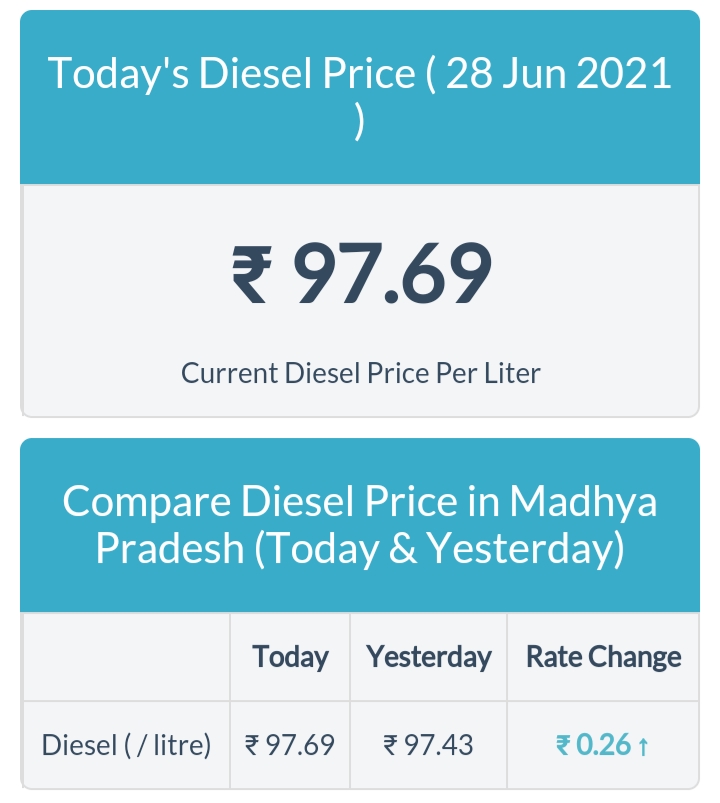
Going to hit a century : Diesel price!

Diesel fuel, in general is any liquid fuel specifically designed for use in diesel engines, whose fuel ignition takes place, without any spark, as a result of compression of the inlet air mixture and then injection of fuel. Therefore, diesel fuel needs good compression ignition characteristics.

The most common type of diesel fuel is a specific fractional distillate of petroleum fuel oil, but alternatives that are not derived from petroleum, such as biodiesel, biomass to liquid (BTL) or gas to liquid (GTL) diesel are increasingly being developed and adopted. To distinguish these types, petroleum-derived diesel is increasingly called petrodiesel in some academic circles.

In many countries, diesel fuel is standardised. For example, in the European Union, the standard for diesel fuel is EN 590. Diesel fuel has many colloquial names, most commonly, it is simply referred to as Diesel. In the UK, diesel fuel for on-road use is commonly abbreviated DERV, standing for diesel-engined road vehicle, which carries a tax premium over equivalent fuel for non-road use. In Australia, diesel fuel is also known as distillate, and in Indonesia, it is known as Solar, a trademarked name by the local oil company Pertamina.

Diesel price in Madhya Pradesh today is fixed by state-run oil marketing companies based the daily ‘Dynamic Fuel Pricing’ mechanism. Here, you can check the current diesel price in Madhya Pradesh, find todays diesel price as well as the quarterly price trend in Madhya Pradesh. New diesel prices in Madhya Pradesh are updated by oil firms daily at 6:00 am IST.

You can also find out how diesel prices in Madhya Pradesh are calculated and how prices are compared to other states. Additionally, find the current Madhya Pradesh diesel price and primary factors impacting diesel prices in India as well as the highest and lowest price recorded during a month.

SEBI: Securities and Exchange Board of India

SEBI (LOGO)

The Securities and Exchange Board of India (SEBI) is the regulatory body for securities and commodity market in India under the jurisdiction of Ministry of Finance , Government of India. It was established on 12 April 1988 and given Statutory Powers on 30 January 1992 through the SEBI Act, 1992.

Securities and Exchange Board of India (SEBI) was first established in 1988 as a non-statutory body for regulating the securities market. It became an autonomous body on 30 January 1992 and was accorded statutory powers with the passing of the SEBI Act 1992 by the Indian Parliament. SEBI has its headquarters at the business district of Bandra Kurla Complex in Mumbai and has Northern, Eastern, Southern and Western Regional Offices in New Delhi, Kolkata, Chennai, and Ahmedabad respectively. It has opened local offices at Jaipur and Bangalore and has also opened offices at Guwahati, Bhubaneshwar, Patna, Kochi and Chandigarh in Financial Year 2013–2014.

The SEBI is managed by its members, which consists of the following:

*The chairman is nominated by the Union Government of India.
*Two members, i.e., Officers from the Union Finance Ministry.
*One member from the Reserve Bank of India.
*The remaining five members are nominated by the Union Government of India, out of them at least three shall be whole-time members.

SEBI has to be responsive to the needs of three groups, which constitute the market:

*issuers of securities
*investors
*market intermediaries

SEBI has three powers rolled into one body: quasi-legislative, quasi-judicial and quasi-executive. It drafts regulations in its legislative capacity, it conducts investigation and enforcement action in its executive function and it passes rulings and orders in its judicial capacity. Though this makes it very powerful, there is an appeal process to create accountability.

Mumbai HQ (Head Quarters)

DAGMAR APPROACH

Russell Colley in the year of 1961,while proposed this advertising model said that an effective advertising strategy seeks to communicate more rather than to sell. Advertisers always focuses on the fact that the exact message which they want to convey for making the people aware of the particular product, mission or company, must be comprehended by the similar way. 
With the help of this model, the advertisers target their respective audiences to provide them with the real understandings and motive about the particular product launch by informing about the respective benefits . 
DAGMAR in other words can be termed as an efficient marketing expression which also acts as a tool to compute the outcome of any advertising campaign. 
It stands for –
D – Defining
A – Advertising
G – Goals for
M – Measured
A – Advertising
R – Results. 
 
Further this model goes through the primary four stages which defines the actual understanding of this advertising expression. 
  • Awareness
  • Comprehension
  • Conviction
  • Action

The first one i.e. Awareness about the newly launched product or any kind of services is the vital for the both the company/services and customers. Awareness has to be created, developed, refined and maintain according to the characteristics of the market and scenario of the organisation at any given point of time. Then comes the second stage of Comprehension because only awareness is not efficient for creating an urge among the consumers. So it\’s necessary to put an answer for the common consumer worries that why to purchase the specific products or how it\’s different from the other prevailing brands of the same product. So this stage aims to provide people all the required information about the product. Comprehension is followed by the stage of Conviction where the main task of advertising company is to mould the target consumers beliefs by persuade them to purchase the product even it does this by flaunting the rewards or incentives for using the product. Then comes the most important and final stage  i.e. Action where the customers after being mould their opinion positive, make themselves ready for the final purchase by implementing the optimistic views for using the product. 

Giving Back – Orlando Supports Local Ronald McDonald House

Without community service, we would not have a strong quality of life.  It’s important to the person who serves as well as the recipient.  It’s the way in which we ourselves grow and develop.” – Dorothy Height
Giving back to the community is not a special event, but rather a part of who we are here at Herzing University.
Last month, the Caring and Community Committee from Herzing’s Orlando Campus volunteered at the Ronald McDonald House Charities of Central Florida (RMHCCF). This amazing organization provides a home away from home for families receiving medical care in the local area.
We were inspired by the fact that 60% of this charity’s recipients are central Florida residents. We share their sense of responsibility to be an active, rather than reactive, member of this great community!
The Caring & Community Committee, made up of faculty and staff, purchased groceries and prepared a delicious home-cooked meal consisting of baked ziti, salad and breadsticks. It was an amazing experience to see families with such strength of character in the face of serious illnesses.
At Herzing University, community service isn’t just part of who we are, it’s how we learn and grow. So, we encourage you to find a cause that you believe in and give back.
About the Author: Heatherann Antonacci, MBA, has dedicated the past seven years living out the mission of Herzing University as Campus President of Herzing – Orlando. As a single mother of two, Heatherann went to college as an adult learner. She knows firsthand the benefits of higher education. An advocate for building self-confidence and physical strength in young girls, she serves on the Board of Directors for the Orlando Chapter of Girls on the Run, among other leadership and advocacy roles in the Orlando area.  

Stop the Nonsense – The MBA Market Is Not Flooded!

It’s hard to imagine that anyone would suggest that pursuing a better future through education is a bad thing.
Yet, there are some critics – in the media, government and even in academia – who would want people to believe that there are too many people pursuing a master’s degree in business, often referred to as an MBA.
As Dean of Graduate Programs at Herzing University, I have tracked articles written by alarmists who are questioning the continued value of obtaining an MBA degree. These articles try to scare readers into believing that the job market is saturated with MBA holders.
I acknowledge that during the “Great Recession” of 2008-2009 many people with advanced degrees became unemployed and had struggled to find that corner office job again. But it’s important to recognize that many more individuals with undergraduate degrees or no degree at all lost their jobs and are competing for jobs against those with MBAs.
The evidence today supports the value of the MBA degree across all regions of the United States, including the job demand for well educated, critical-thinking, problem-solving leaders.
In Akane Otani’s January 7, 2015, article in Bloomberg Business, “Salaries for Business School Graduates Will Go Up in 2015,” Otani reported that more-than-half of the 169 employers who responded to a survey by the Graduate Management Admission Council said that they will raise beginning salaries for newly hired MBAs to match inflation. Otani’s article also identified that almost 20 percent of the employers indicated that they would increase salaries to exceed inflation. In addition, 72 percent of the companies expect to hire MBAs in 2015, as compared with 69 percent in 2014. I may be wrong, but rising entry-level salaries and increased hiring across almost three-quarters of the economy are not on the list of supply glut indicators.
A more recent article by Andrew Eder on March 2, 2015, published by BBC about a Wisconsin business college, shared that it had seen job postings for MBA graduates increase 36 percent in 2015. One business dean quoted in that article stated, “It’s going to be a (graduating) students’ market for the next 15-plus years.” In support of Eder, during the May 2015 “Association for Talent Development (ATD) Conference” in Orlando, Fla., the sentiment about the future prospects for MBA graduates from over a dozen attending college and university representatives was optimistic.
In Eder’s article, Barbara Hewitt, Senior Associate Director of Career Services at the Wharton School, stated that its MBA graduates only had a 4.2 percent unemployment rate six months following graduation – almost the exact findings reported by Herzing University. Strong employability prospects are probably the best reason to earn an MBA.
My advice is that the next time you see an article headline questioning the value of the MBA in today’s market, don’t waste your time with alarmist rhetoric. The evidence is clear. The evidence is convincing. The opportunities for the prepared MBA graduate are here today. The economy is growing, businesses are hiring, and competition from undergraduates will increase. It is your time… your money…your career… it is time to further your career with an MBA.
Dr. Ron Kern is the Dean of Graduate Programs at Herzing University. He previously served as Dean of Graduate Programs at Kaplan University and Dean of Academic Affairs at the Fischler School of Education and Human Services at Nova Southeastern University. He is a frequent speaker in the areas of graduate business, nursing and education degrees; doctoral dissertation completion; and Hispanic attainment and success in higher education.

What is Life Insurance?

\’Life Insurance\’ is a contract between the insurer and the insured. It pledges payment of certain amount to the person who is insured on happening of any event against him. The contract fulfils on the death, maturity or specified periodic intervals.

According to the Wikipedia

Life insurance or life assurance is a contract between the policy owner and the insurer, where the insurer agrees to pay a sum of money upon the occurrence of the insured individual\’s or individuals\’ death or other event, such as terminal illness or critical illness. In return, the policy owner agrees to pay a stipulated amount called a premium at regular intervals or in lump sums.


According to the Free Dictionary

Life Insurance- Insurance that guarantees a specific sum of money to a designated beneficiary upon the death of the insured or to the insured if he or she lives beyond a certain age.


According to the Your Dictionary

Life Insurance- Insurance in which a stipulated sum is paid to the beneficiary or beneficiaries at the death of the insured, or, if specified, to the insured at a certain age.

The Top 10 Best Life Insurance Companies in The UK. Definitive Guide 2020, at https://discountlifecover.co.uk/best-life-insurance-uk/ 

1st Grade Entrepreneurs Master Media And Marketing Techniques

Source: ASIDE 2016

Our Nifty Notes first grade entrepreneur project is in its fifth year, and so is our push to educate the young learners about media literacy. This collaborative project brings together their study of economics, including wants and needs, supply and demand, and scarcity and abundance, with an understanding of the art of persuasion, marketing, and hype.

Source: ASIDE 2016

This year the goal to produce 1500 Nifty Notes was ambitious, but the first graders stepped up to the challenge, because they understood that they were raising money for charity.

It was extraordinary to watch them during their library classes grasp how marketing techniques help sell products. The media influence is so pervasive that they easily adapted commercial slogans and jingles to their product. They looked at contemporary media messages and discussed how phrases such as \”limited editions,\” \”one-of-a-kind,\” and \”handmade\” help persuade consumers to buy products.

Source: ASIDE 2016

Their ideas were so electric that they started generating their own teaser advertising techniques to sell Nifty Notes. One student came up with the idea just to put images around the school of the ladybug and bumblebee, the two new designs for 2016.

A few of days later, they added hot pink notes that began with, “Wanna know what the buzz is all about?” It goes to show how when educators empowered learners, they take ownership of their ideas. It also demonstrates just how much they see in the media.

Source: ASIDE 2016

Their promotion of the Nifty Notes sale did not stop there. Another first grader designed fliers advertising, “Nifty Notes Coming Soon.” We can only imagine what this Tuesday will bring to help promote the sale.

These first grade entrepreneurs got the point, big time!

Source: ASIDE 2016

How to Self Publish a Book That Earns

Want to know how to publish a book that earns big?
That’s the dream for a lot of freelancers. Right? Figure out how to self publish a book. List it on Amazon. And piles of money start rolling in.
Here’s the brutal truth about making money with your book…it usually doesn’t work like that.
There’s far too many writers with great ideas who think: “If I self-publish a book, lots of people will buy it.”
I wish it were that easy. If you want to learn how to self publish a book that earns big, a great idea and great writing are just the beginning.
When I self published my first book, I made a couple thousand dollars, and gained a small following of fans. But then something happened that helped me turn my book into a revenue-generating machine that earned $125K in one night.
Want to learn how to self publish a book that earns big? Let me pull back the curtain to show you how it’s done.

5 book-marketing strategies to earn big

When you’re ready to jump in and learn how to self publish a book, writing is the easy part for most freelancers.
After that, there’s lots of easy-to-use resources to format your book and get it on Amazon and other sites that sell books.
It’s the steps that come after publishing that can make all the difference in how much money you make.
Come up with a marketing plan that generates buzz, sells copies, and opens the door to more writing opportunities, and you can make a lot.
It’s hard work, but it’s worth it. Here’s how I did it:

1. Personally thank people who helped you

This should be part of your book…the Acknowledgements page. Thank all the people who inspired you, helped you, or played a part in the process of getting your book published (family, friends, teachers, co-workers, mentors, and your publishing team). Then:
  • Reach out with a phone call, email, or letter and personally thank each person.
  • Invite them as special guests to your book launch
  • Ask them to pre-order, and send a signed copy, or sign it in person
Note: I sold 215 books this way and earned $3,225 from pre-sales.

2. Host a book signing event

Connect with a bookstore in your area and coordinate a book signing party. The traditional book-reading and signing event works. But you could also get a little more creative. 
I hosted a catered event and sold tickets at different price points for a signed copy of the book, VIP time with me, gift bags, and hand-written thank-you notes.

3. Attend book fairs and festivals

You’ll have to adjust your schedule to make this work, but it’s worth it. You’ll sell books, meet lots of people, and keep adding to your growing list of fans. I got people to stop by my table by playing a short trailer about my book, then striking up a conversation.

4. Market your book everywhere you go

I made T-shirts with three conversation-starter messages:
  • Ask Me About My Book!
  • My BOOK is awesome!
  • Guess what? I wrote a book!
I wore them everywhere, and sold books from my back pack and the trunk of my car at the mall, gas stations, and parking lots.

5. Turn your book into a play or speaking event

If you’ve totaled my earnings from books sales so far, it’s a whopping $8,325. Not bad for a self-published novel. But those aren’t the kind of earnings that deserve a standing ovation. I wanted more.
I got sucked into reading Amazon reviews and comments about my book, Dark Clouds: A Charm City Family’s Struggle. Comments like: “You painted such a vivid picture of the characters in the book, I felt like I knew them and could see them.”
And that’s when I had the light-bulb moment to take my characters from page to stage.
This wasn’t an easy undertaking. But by the time the curtain closed, my book earned $125K in one night. Here’s how I did it:
  • Hire a consultant. I hired the godfather of urban theater, Shelly Garrett, to help me turn my book into a play. Find a writing coach or mentor you can trust, who knows the ropes, maybe has connections in your niche. It’s an investment you won’t regret.
  • Write and rewrite. I turned my 211-page novel into a 90-page script. Write a book, then consider ways to turn it into another revenue source as a class, course, play, or speaking event.
  • Use crowdfunding sites to test your idea and pre-sell tickets. 
  • Document the process. When auditions began, we documented the process in reality-TV style on YouTube to generate buzz. If you’re not producing a play, document the process you write about in your book, and share it on social platforms.
  • Buy traditional advertising time (radio and TV). Ads for the play aired on radio stations and TV stations in select cities where the play would be performed. This makes sense as long as you predict you’ll make a profit after advertising costs.
  • Coordinate radio and TV appearances. You could hire an agent to do this for you, or just get on the phone and make some calls. Put yourself out there, and see what happens.
  • Purchase billboard advertising in select cities where the play would be performed. (Same as buying traditional advertising time.)
  • Sell Tickets on Groupon and Ticketmaster. It’s one more way to get in front of more people.
  • Buy Facebook ads to promote the play to your target audience. I spent $500 on Facebook ads.
  • Sell T-shirts, books, and playbills. This was easy, because it was a lot like my book launch.
  • Sell VIP after-party tickets. Have an interesting story to tell, unique perspective, or mad skills? People will pay to spend time with you.

Marketing: The secret to earning big from self publishing

Book sales went up. And offers for interviews, TV-show appearances, and business opportunities came rolling in.
Got an idea for a book? Start there. Write and self publish. Market your book, and look for other ways to monetize it. Turn it into a play, a speaking event, a class, or a course. If I can do it, so can you.


Development of Strategic Interpretive Structure Modeling Linkages in Himalayan Tourism Industry

The Himalayan region is a popular tourist destination. It attracts massive inflows of tourist in this region round the year. Most of the tourist comes here either for adventures or pilgrimage purpose. Tourism is a multidimensional crucial development parameter of the world economy. Travel & Tourisms impact on the economic and social development of a country can be enormous: opening it up for business, trade and capital investment, creating jobs and entrepreneurialism for the workforce and protecting heritage and cultural values. For the purpose of present study we have chosen the complete Himalayan Region which consists of Western Himalayas of Kashmir and Punjab Region, Central Himalayas of Kumaon and Nepal Region and Eastern Himalayas of Sikkim, Arunachal Pradesh and Eastern part of Tibet as it provides both adventures and pilgrimage tourism along with educational tourism. Tourism here is a source of employment opportunity which provide source of living to local people. Therefore there is a need to understand the factors influencing or impacting on tourism industry in Himalaya. For that purpose we utilized the Interpretive Structure Model for development of Hierarchical relationship among factors identified. This model helped us to understand the situations and problems associated to Himalayan tourism industry, which further get improved and rectified by partially utilizing flowing stream strategy.

Achieving Sustainable Strategic Advantage through Inclusive Business: Reflections from Selected Cases

The inclusive business concept has significantly influenced the way companies operate and do business in emerging and developing markets over the last few years. Inclusive business fundamental assumption is that it contributes to solving global development issues and helps improve company profitability. The current article, which is based on an analysis of three inclusive business cases in emerging and developing markets, aims to identify how an inclusive business can contribute to a companys sustainable strategic advantage. The paper verifies that innovative, inclusive business interventions have, by solving development problems, helped companies successfully develop a strategic advantage.

Residents Perceptions of Spring Break Tourism: The Involvement or Empowerment Perspective

This study examined the attitudes towards Spring Break niche tourism that has developed over the past 40 years in the United States, especially given popular perceptions and associations. Insights from numerous tourism studies concerned with local attitudes imply that residents interest in travel and tourism is likely to moderate their attitudes toward niche tourism in their own community. In reference to both conventional and niche tourism markets, several scholars have recognized shifts in community perceptions of tourism benefits or costs in relation to their own potential authority or power in tourism matters. However, as research on niche tourism products and markets is limited, equally limited is the understanding of the role of residents general interest with tourism or travel and empowerment in tourism decision-making. An important contribution of this paper to the body of literature on tourism attitudes is that it brings to attention the importance of residents Involvement with travel or tourism in perceptions of niche markets. To enrich the findings, this study examined differences in attitudes toward Spring Break tourism associated with perceived empowerment.

Effect of Quality of Work Life on Job Satisfaction and Organizational Performance: A Structural Equation Analysis

All the organizations are in a position to retain their employees happy and satisfied for the continuous work flow towards success. By ensuring the quality of work life at the work place, the employers can retain their talents and tends towards the job satisfaction and organizational performance. These two positive outcomes along with quality of work life needed to be treated positively to keep the employees motivated to provide their contributions to the organizational effectiveness. With this background the purpose of this study is to find out the degree of relationship among quality of work life, job satisfaction and organizational performance among the bank employees. In total 357 employees were selected from both public and private sector banks. Explorative Factor Analysis was adopted for the validation and Structural Equation Modeling was used to test the extent of relationship among the variables. The results of the study shows that there is positive significant relationships among quality of work life, job satisfaction and organizational performance.

Testing the Long Memory Feature in Indian Equity Market

The Present paper examined the long memory behavior in Indian equity market. This paper uses the data from January 2000 to March 2018 of Sensex, Nifty-50 and VIX. By using the Rescaled range analysis as proposed by Lo (1951) ‘Hurst Exponent’, this indicates that there is significant long memory in Sensex and Nifty-50 returns series. However, volatility does not show any persistence but exhibit clustering. The study conclude that there is not persistence behavior with respect to long memory effect on Nifty-50 returns subject to occurrence of structural breaks(demonization).The study concludes with managerial relevance and issued for futures research. Findings would be beneficial for the investors, practitioners, academics and policy makers etc. To the best of our knowledge, there is dearth of literature on the subject in Indian equity market. Therefore the present study is an attempt to plug this gap.

Business Turnaround in the Technological Era: The Study of Selected Manufacturing Industries in Nigeria

Obsolesces has taking many products un-aware and as such, been wiped out of the market by their competitors who are environmental scanner, creative and innovators. However, this study examined the relationship between product change and the performance of manufacturing industries in Nigeria.The study employed a descriptive survey design methods of sample size technique to determine the study sample from thirty (30) selected manufacturing industries in Nigeria. This makes the study sample size to be twenty-two (22). The collected data were analyzed using an inferential and statistical equation with the aid of statistical packages for social sciences (SPSS). The findings reviewed that the inferential results indicates a significant correlation between independent and dependent variables of R-Square (R2) which is computed as 95% of the variations in return on assets (ROA) which can be explained by firm size (FSZ), Leverage (LEV), Tangible assets (TGA), Liquidity (LIQ) and Growth (GRTH). It inculcate that turnaround nature in business through technological advancement has called on organizations to go for deep environmental scanning and be up to date in consumer taste.It recommends that organizations are to streamline their processes so as to reduce costs, lead time and improve performance. Finally, it also called for originality inculcation for organizational survival.

Equity and Efficiency of Foreign Direct Investment in Indian States

The two relevant criteria for evaluating the performance of the Indian economy in regional terms, in respect of FDI flows, according to our understanding are efficiency and equity. Since FDI is primarily a relocation of international production it is based on the principle of optimal resource allocation. The notion of efficiency, in this context, refers to the tendency of FDI to flow to those regions or States which have efficient production. The other side of the coin is that an efficient State deserves to get a greater share of FDI. This spells out the notion of equity. The paper uses set of new indices, including index of rank dominance, which shows that the most dominant centre is Mumbai. The paper also uses a 2-Stage Least Square (2SLS) estimation procedure, with two panel regression fixed effects models. There is a very high elasticity of FDI flows w.r.t. SDP growth. Also the results show that there is an extremely high negative correlation (-0.996) between equity and efficiency. The states that are more efficient receive less of FDI flows. This points towards non-economic forces in operation that influence FDI flows and regional development.