New Education Policy of India 2020

 The New Education Policy (NEP) of India was launched in 2020 with the aim of revamping the education system in the country and bringing about significant changes in the way education is imparted. The NEP is the first education policy in India to be launched in the 21st century, and it replaces the earlier National Policy on Education, which was launched in 1986 and revised in 1992.

The NEP is based on the principles of access, equity, quality, affordability, and accountability, and it aims to provide a holistic and multidisciplinary education to students from all backgrounds. The policy is designed to promote lifelong learning and to equip students with the skills and knowledge they need to succeed in a rapidly changing world.
One of the major goals of the NEP is to provide universal access to education from preschool to secondary school. The policy aims to increase enrollment rates and reduce dropout rates by providing free and compulsory education to all children between the ages of 3 and 18 years. It also emphasizes the importance of early childhood education and aims to provide high-quality preschool education to all children.
The NEP also seeks to bring about a significant shift in the curriculum and pedagogy of schools and colleges. It emphasizes the importance of multidisciplinary learning and encourages the integration of vocational and academic education. The policy aims to reduce the emphasis on rote learning and memorization and promote critical thinking, creativity, and problem-solving skills.
Another significant feature of the NEP is its focus on the use of technology in education. The policy aims to promote the use of technology to enhance learning outcomes and make education more accessible and affordable. It also emphasizes the importance of digital literacy and aims to provide students with the skills they need to use technology effectively.
The NEP also seeks to promote the internationalization of education and encourage greater collaboration between Indian and foreign educational institutions. The policy aims to attract foreign students to study in India and encourage Indian students to study abroad.
The NEP also addresses the issue of teacher training and professional development. It emphasizes the importance of continuous learning and aims to provide teachers with the skills and knowledge they need to deliver high-quality education. The policy also encourages the use of technology in teacher training and aims to provide teachers with access to high-quality online resources.
The NEP also addresses the issue of funding for education. The policy aims to increase public investment in education and encourage private investment in the sector. It also proposes the establishment of a National Research Foundation to fund research and innovation in education.
The NEP has received mixed reactions from stakeholders in the education sector. While some have praised the policy for its focus on access, equity, and quality, others have criticized it for being too ambitious and lacking in detail. Some critics have also raised concerns about the implementation of the policy, particularly in terms of funding and teacher training.
In conclusion, the New Education Policy of India is a comprehensive and ambitious policy that seeks to bring about significant changes in the education system of the country. The policy has the potential to transform the education sector and provide students with the skills and knowledge they need to succeed in a rapidly changing world. However, its success will depend on the effective implementation of the policy and the commitment of all stakeholders to work towards its goals.

Education Policy of USA

 The education policy of the United States is a complex and multifaceted issue, as education is primarily a responsibility of the individual states. However, there are some overarching policies and initiatives at the federal level that impact education in the country.

One of the key federal policies is the No Child Left Behind Act (NCLB), which was signed into law in 2002. This law aimed to improve student achievement by requiring states to implement annual standardized testing to measure student progress in reading and math, and by holding schools accountable for their students’ performance.
In 2015, the NCLB was replaced by the Every Student Succeeds Act (ESSA), which continued the focus on accountability and standardized testing, but gave states more flexibility in implementing their own policies to improve education.
The federal government also provides funding for education through programs like Title I, which provides financial assistance to schools with a high percentage of students from low-income families, and special education funding for students with disabilities.
Another key policy issue in education is school choice, which refers to the ability of parents to choose where their children go to school, including private and charter schools. While some argue that school choice promotes competition and improves education, others are concerned about the impact it may have on public schools and access to education for disadvantaged students.
Overall, the education policy of the United States is a complex and often contentious issue, with ongoing debates about the best approaches to improving student achievement and access to education.

Education Policy of USA

The education policy of the United States is a complex and multifaceted issue, as education is primarily a responsibility of the individual states. However, there are some overarching policies and initiatives at the federal level that impact education in the country.

One of the key federal policies is the No Child Left Behind Act (NCLB), which was signed into law in 2002. This law aimed to improve student achievement by requiring states to implement annual standardized testing to measure student progress in reading and math, and by holding schools accountable for their students’ performance.
In 2015, the NCLB was replaced by the Every Student Succeeds Act (ESSA), which continued the focus on accountability and standardized testing, but gave states more flexibility in implementing their own policies to improve education.
The federal government also provides funding for education through programs like Title I, which provides financial assistance to schools with a high percentage of students from low-income families, and special education funding for students with disabilities.
Another key policy issue in education is school choice, which refers to the ability of parents to choose where their children go to school, including private and charter schools. While some argue that school choice promotes competition and improves education, others are concerned about the impact it may have on public schools and access to education for disadvantaged students.
Overall, the education policy of the United States is a complex and often contentious issue, with ongoing debates about the best approaches to improving student achievement and access to education.

New Education Policy of India 2020

The New Education Policy (NEP) of India was launched in 2020 with the aim of revamping the education system in the country and bringing about significant changes in the way education is imparted. The NEP is the first education policy in India to be launched in the 21st century, and it replaces the earlier National Policy on Education, which was launched in 1986 and revised in 1992.

The NEP is based on the principles of access, equity, quality, affordability, and accountability, and it aims to provide a holistic and multidisciplinary education to students from all backgrounds. The policy is designed to promote lifelong learning and to equip students with the skills and knowledge they need to succeed in a rapidly changing world.
One of the major goals of the NEP is to provide universal access to education from preschool to secondary school. The policy aims to increase enrollment rates and reduce dropout rates by providing free and compulsory education to all children between the ages of 3 and 18 years. It also emphasizes the importance of early childhood education and aims to provide high-quality preschool education to all children.
The NEP also seeks to bring about a significant shift in the curriculum and pedagogy of schools and colleges. It emphasizes the importance of multidisciplinary learning and encourages the integration of vocational and academic education. The policy aims to reduce the emphasis on rote learning and memorization and promote critical thinking, creativity, and problem-solving skills.
Another significant feature of the NEP is its focus on the use of technology in education. The policy aims to promote the use of technology to enhance learning outcomes and make education more accessible and affordable. It also emphasizes the importance of digital literacy and aims to provide students with the skills they need to use technology effectively.
The NEP also seeks to promote the internationalization of education and encourage greater collaboration between Indian and foreign educational institutions. The policy aims to attract foreign students to study in India and encourage Indian students to study abroad.
The NEP also addresses the issue of teacher training and professional development. It emphasizes the importance of continuous learning and aims to provide teachers with the skills and knowledge they need to deliver high-quality education. The policy also encourages the use of technology in teacher training and aims to provide teachers with access to high-quality online resources.
The NEP also addresses the issue of funding for education. The policy aims to increase public investment in education and encourage private investment in the sector. It also proposes the establishment of a National Research Foundation to fund research and innovation in education.
The NEP has received mixed reactions from stakeholders in the education sector. While some have praised the policy for its focus on access, equity, and quality, others have criticized it for being too ambitious and lacking in detail. Some critics have also raised concerns about the implementation of the policy, particularly in terms of funding and teacher training.
In conclusion, the New Education Policy of India is a comprehensive and ambitious policy that seeks to bring about significant changes in the education system of the country. The policy has the potential to transform the education sector and provide students with the skills and knowledge they need to succeed in a rapidly changing world. However, its success will depend on the effective implementation of the policy and the commitment of all stakeholders to work towards its goals.

Samagra Shiksha Scheme has been aligned with the recommendations of the National Education Policy

 Samagra Shiksha

The Centrally sponsored scheme of Samagra Shiksha of the Department of School Education and Literacy is an overarching programme for the school education sector extending from pre-school to class XII. The scheme treats school education as a continuum and is in accordance with Sustainable Development Goal for Education (SDG-4). The Samagra Shiksha Scheme has been aligned with the recommendations of the National Education Policy: 2020 (NEP: 2020) and extended from 2021-22 to 2025-26. 


Cabinet Committee on Economic Affairs has approved continuation of Samagra Shiksha Scheme for a period of five years i.e., from 2021-22 to 2025-26 with a total financial outlay of Rs 2,94,283.04 crores which includes Central share of Rs 1,85,398.32 crores, as per EFC recommendations and approval of revised programmatic and financial norms.


ICT and smart class approvals: Under the Information & Communication Technology (ICT) component of the Samagra Shiksha Scheme, there is a provision to impart computer literacy and computer-enabled learning to children, by developing and deploying curriculum-based interactive multimedia, digital books, virtual labs etc. across the country. It supports the establishment of smart classrooms, and ICT labs in schools, including support for hardware, educational software and e-content for teaching. It envisages covering all Government/Government-aided schools with classes VI to XII. Till November 2022 (since inception), ICT Labs have been approved in 1,20,614 schools and Smart classrooms in 82,120 schools across the country.


Brief of activities undertaken from 1st January, 2022 to 31st December, 2022 is as under:

  1. Shiksha Shabdkosh – Department of School Education & Literacy has brought out Shiksha Shabdkosh, a document on glossary of various terminologies in School Education and a compilation of all the terms which have been used in the context of school education.
  2. Samagra Shiksha Framework for Implementation – Department of School Education & Literacy has issued a Samagra Shiksha Framework, which gives the Key Performance Indicators (KPI) for each component and physical and financial details of implementation of each component of Samagra Shiksha.
  3. 444531 Schools have awarded Fit India Flag, and 43074 Schools have applied for 3 Stars Rating and 13008 Schools have applied for 5 Stars rating.
  4. 4th FIT India School Week is being celebrated from 15th November 2022 till 15th January 2023. Till 19th December 2022, total 1,17,844 students participated in various activities.
  5. FIT INDIA Quiz 2022 for schools has been launched by FIT India Team. In this 1,74,473 students registered from 42,490 schools across 36 States/UTs in 2022.
  6. A Virtual event on Assistive Technology Innovations for Inclusive Education as a part of Azadi Ka Amrit Mahotsav (AKAM): As a part of Azadi Ka Amrit Mahotsav (AKAM), Department of School Education & Literacy, Ministry of Education, in collaboration with Atal Innovation Mission, NITI Aayog organized a virtual event on Assistive Technology startups for Inclusive Education showcasing innovations and startup solutions on January 17, 2022. The virtual event on ‘Assistive Technology Innovations for Inclusive Education’ focused on start-ups and their innovations that enhance or aid the learning of children with special needs.
  7. Fifth edition of Pariksha Pe Charcha, the unique interactive program of Hon’ble Prime Minister, Shri Narendra Modi with students, teachers and parents was held successfully on 1st April 2022 at Talkatora Stadium. Selection for this program was carried out through a creative writing competition for the students of classes 9 to 12, teachers and parents on MyGov.in portal from 28th December, 2021 to 3rd February, 2022.


PRASHAST Mobile App – “Pre Assessment Holistic Screening Tool”:


Department of School Education & Literacy has launched a Disabilities Screening Checklist for Schools and an Android Mobile App titled as PRASHAST Mobile App – “Pre Assessment Holistic Screening Tool” for schools during Shikshak Parv, 2022. PRASHAST App will help in screening 21 disability conditions recognized in RPwD Act, 2016, at the school level and will generate the school-wise report, for further sharing with the authorities for initiating the certification process, as per guidelines of Samagra Shiksha. PRASHAST Mobile App has been developed by CIET, NCERT.


Amendment in RTE Act, 2009 w.r.t. pupil teacher ratio for special educators in general schools:


The schedule to RTE Act, 2009 has been amended regarding pupil teacher ratio for special educators in general schools i.e. one special education teacher for every ten pupils with disabilities enrolled at primary level and one special education teacher for every fifteen pupils with disabilities enrolled at upper primary level and a notification has been published in Gazette of India vide Notification No. S.O. 4586 (E) dated 21.09.2022 (published on 29.09.2022).


Exam Accommodations to CwSN in Board Exams:

Virtual Inclusive Education Meets were organized by DoSEL on 31.01.2022 and 09.06.2022 with the IE coordinators of all states and UTs to review the status of Board Accommodations offered to CwSN. As information received from States/UTs, 32 out of 36 States/UTs have notified the exam accommodations provided to CWSN to be availed in Board Exams, 20 out of 36 States/UTs prepared Audio/ Video films on Exam Accommodations provided to CWSN in Board Exams and 27 out of 36 States/UTs conducted webinars to sensitize teachers/ principals on Exam Accommodations.


Up-gradation of Kasturba Gandhi Balika Vidvalavas (KGBVs):


KGBVs are residential schools under Samagra Shiksha, for girls from class VI to XII belonging to disadvantaged groups such as SC, ST, OBC, Minority and Below Poverty Line (BPL). Under Samagra Shiksha, provision has been made to upgrade/converge the existing KGBVs at upper primary level and Girls’ Hostels at secondary/senior secondary level, as feasible, up to Senior Secondary Level. The task of up-gradation of the KGBVs was started in the year 2018-19 and till the year 2022-23,a total of 357 KGBVs have been approved for up-gradation to Type-II (class 6-10) and 2010 KGBVs have been approved for up-gradation to Type-III (class 6-12).


PARAKH


NEP 2020 envisages a shift from summative assessment to regular and formative assessment, which is more competency-based, promotes learning and development, and tests higher-order skills, such as analysis, critical thinking, and conceptual clarity. In view of implementation of NEP 2020, a new National Assessment Centre, PARAKH (Performance Assessment, Review, and Analysis of Knowledge for Holistic Development) will be setup as a standard-setting body under Ministry of Education in NCERT. This centre will work for setting norms, standards, and guidelines for student assessment and evaluation for all recognized school boards of India, hand holding the States and undertaking the National Achievement Survey (NAS). This Centre will also advise school boards regarding new assessment patterns and latest researches, promoting collaborations between school boards. It will encourage and assist school boards to shift their assessment patterns towards meeting the skill requirements of the 21st century. PARAKH will be established as a technical organisation with knowledge of assessment standards and skills, as well as a robust understanding of policymaking and implementation.


National Achievement Survey (NAS) 2021:


The Government of India has been implementing a programme of sample based National Achievement Survey (NAS) aimed at classes III, V, VIII and X with a cycle period of three years. The NAS 2021 was held on 12.11.2021 and has covered (a) Government Schools (Central Government and State Government); (b) Government Aided Schools; and (c) Private Unaided Schools. Subjects covered are Language, Mathematics & EVS for class 3 & 5; Language, Mathematics, Science & Social Science for class 8 and Language, Mathematics, Science, Social Science and English for class 10. 


About 34,01,158 students of 1.18 lakh schools from both rural and urban areas, have appeared in NAS 2021 which was held on 12th  November, 2021. National, State/UT and District Reports for NAS 2021 have been released on 25.5.2022 and are available at http://nas.gov.in. The learning gaps identified at the district level will be used to provide feedback to the districts.


Further, a national level workshop on Post-NAS 21 interventions was organised on 28/07/2022 by Ministry of Education with representatives of all States/UTs, SCERTs, DIETS and NCERT. The purpose is to support State/UT governments in developing long term, mid-term and short-term interventions to improve learning levels and orient on differential planning based on NAS 2021 data. In addition, NCERT has conducted Post-NAS 21 regional workshops at many locations across the country. The purpose is to disseminate the findings of reports and assist states/UTs in planning strategies to bridge identified learning gaps as per NAS 21 data.


Actions initiated by the Department for implementation of NATIONAL EDUCATION POLICY (NEP):


  • NEP Implementation Plan ‘SARTHAQ’ (Students’ and Teachers’ Holistic Advancement through Quality Education) has been released on 8th April, 2021.
  • A National Foundational Literacy and Numeracy Mission named as ‘National Initiative for Proficiency in Reading with Understanding and Numeracy – (NIPUN BHARAT) was launched on 5th July 2021, for ensuring that every child in the country necessarily attains foundational literacy and numeracy in Grade 3 by 2026-27.
  • NCERT has developed a 3 Months Play Based ‘School Preparation Module’ named ‘Vidya Pravesh’ which was launched on 29thJuly 2021.
  • Foundational Learning Study (FLS) to assess the learning level of Class 3 students in Foundational Literacy and Numeracy was administered by MoE and NCERT in collaboration with States/UTs from 23rd to 26th March and 4th  to 6th  April, 2022 across all Indian States and Union Territories under the NIPUN-BHARAT Mission. The results for FLS were published on 06th September 2022 in the form of national, state and district reports. The reports can be accessed at: https://dsel.education.gov.in/fls_2022 .
  • To connect the Government and Government aided schools through a community/volunteer management program, the Department has revamped the Vidyanjali web portal. The newly introduced portal – Vidyanjali 2.0 aims to help the community/volunteers interact and connect directly with schools of their choice to share their knowledge and skills as well as contribute in the form of assets/material/equipment. 
  • The department has aligned our existing schemes i.e, Samagra Shiksha and Mid Day Meal with the recommendation of NEP 2020.
  • NISHTHA 4.0 (ECCE) – Online: Teacher training programme for Early Childhood Care and Education has been launched on 06th September, 2022 with 6 modules. Initiated in 36 States/UTs in 2 languages, and in 5 Autonomous Organisation under MoE, MOD &MOTA. It targets to train 25 Lakh teachers and school heads at pre-primary and primary level.


PM Schools for Rising India (PM SHRI) :


The Cabinet has been approved a newly central sponsored scheme called PM SHRI on 7 September, 2022. These schools will showcase the implementation of the National Education Policy 2020 and emerge as exemplar schools over a period of time, and also offer leadership to other schools in the neighborhood. They will provide leadership in their respective regions in providing high-quality education in an equitable, inclusive and joyful school environment that takes care of the diverse background, multilingual needs, and different academic abilities of children and makes them active participants in their own learning process as per the vision of NEP 2020.


Under the scheme there is provision of setting up of More than 14500 PM SHRI Schools (PM ScHools for Rising India) by strengthening the existing schools from amongst schools managed by Central government/State/UT Government/local bodies.


The duration of scheme is proposed to be from 2022-23 to 2026-27; after which it shall be the responsibility of the States/UTs to continue to maintain the benchmarks achieved by these schools. More than 20 lakh students are expected to be direct beneficiaries of the scheme. The total cost of the project will be Rs.27360 crore spread over a period of 5 years which includes central share of Rs.18128 crore.

PM POSHAN Scheme

The Cabinet Committee on Economic Affairs (CCEA) has approved the continuation of PM POSHAN Scheme in Schools for the five-year period 2021-22 to 2025-26 with the financial outlay of central share of Rs.54,061.73 crore for five years from 2021-22 to 2025-26. During 2022-23 the scheme covers more than 12 crore children studying in Bal Vatika and classes I-VIII in Govt. and Govt. Aided Schools.

During 2022-23 (upto December 2022), Rs 6758.84 crore had been released to States and UTs as central assistance and 29.68 lakh MT foodgrains had been allocated to them. 

PM POSHAN Scheme Guidelines have been comprehensively revised and several focus areas such as Public Financial Management System, Quality and Safety Aspects, Social Audit, Joint Review Mission, School Nutrition Gardens, Cooking Competitions, TithiBhojan, Supplementary Nutrition in Aspirational districts and districts having high burden of malnutrition, Information, Education and Communication (IEC) etc.

Material cost (earlier known as cooking cost), which includes cost of procurement of pulses, vegetables, oil, condiments and fuel has been enhanced to Rs 5.45 per child per day in primary and Rs 8.17 per child per day in upper primary w.e.f. 1st October, 2022. 

DoSE&L has decided to set up School Nutrition (Kitchen) Gardens (SNGs) and planting in an immense way. School Nutrition (kitchen) Gardens (SNGs) utilizes the schoolyard to reconnect the students to a natural world and make them aware about the true source of their food and teach them valuable gardening, agriculture concepts and skills that integrate with several subjects such as math, science, art, health and physical education and social studies etc. The vegetables and fruits grown in these kitchen gardens are being used in the preparation of hot cooked meals. This offers an opportunity for students to eat freshly grown vegetables loaded with vitamins and minerals which are essential source of their physical and mental growth & development.


Adult Education


New India Literacy Programme (NILP): Keeping in view the recommendations of NEP, 2020 and UNESCO Sustainable Development Goal (SDG) 4.6, a centrally sponsored scheme“New India Literacy Programme”(NILP)has been approved by the Government of India in this year with financial outlay of Rs.1037.90 crore (central share: Rs.700.00crore and state share: Rs.337.90 crore) for the financial years 2022-23 to 2026-27. A D.O. letter dated 21.02.2022 from Secretary (SE&L) was issued to all Chief Secretaries of all States/UTs in respect of launching NILP. The scheme has five components: (i) Foundational Literacy and Numeracy, (ii) Critical Life Skills, (iii) Vocational Skills Development, (iv) Basic Education and (v) Continuing Education. The target for Foundational Literacy and Numeracy for FYs 2022-27 is 5.00 crore learners @ 1.00 crore per year by using “Online Teaching, Learning and Assessment System (OTLAS)” in which a learner may register him/herself with essential information.


The NILP provides for (i) involvement of school students, pre-service students of Higher Education Institutions (HEIs), school teachers, Aganwadi and ASHA workers, NYKS, NSS, NCC volunteers, (ii) school to be unit for implementation of the scheme (iii) The age cohorts of 15-35 will be saturated first, followed by ages 35 and above.priority will be given to girls and women, SC/ST/OBC/Minorities, Persons with Special Needs/Divyangjans (Disabled persons), marginalized/nomadics/construction workers/labourers, etc. (iv) use of ICT and online implementation of the scheme through ‘Online Teaching Learning and Assessment System’ (OTLAS) (v) material and resources through digital modes, viz, TV, radio, cell phone-based free/open-source Apps/portals, etc. (vi) Assessment tests to be conducted in schools; Assessment on demand through OTLAS and generation of e-certificates, (vii) Sample achievement survey: Sample achievement survey will be held every year for 500-1000 randomly selected learners from each State/UT.(viii) Online MIS: Online MIS will be in place to track the progress. Monitoring of progress shall be undertaken at national, state, district and school levels through online mode.


Other Initiatives

Vidyanjali:

Vidyanjali-the school volunteer initiative is an online portal that acts as a facilitator by connecting volunteers directly to the schools.  The effort is to bridge the knowledge / skill / human resource and infrastructure gap in the schools by tapping the potential available in the civil society. This is not to substitute the government responsibility, but to compliment, supplement and strengthen government efforts to reach the last mile in the best possible way. The government has been trying to mobilise the contribution of assets or services from all segments of the society comprising of alumni of educational institutions, serving and retired teachers, scientists, government/semi-government officials, retired armed forces personnel, self-employed and salaried professionals etc. During the year upto 22nd December, 2022 3,92,488 schools have onboarded and 1,10,874 volunteers have registered on the Vidyanjali portal.  Volunteers have expressed their interest in several areas such as subject assistance, mentoring of gifted children, teaching vocational skills, sponsoring projector, ceiling fans, laptop and library for schools etc. With volunteers’ active participation, the program has successfully managed to impact 1085648 students across the country.


Ek Bharat Shreshtha Bharat Campaign (2021-22) :

  • In celebration of Rashtriya Ekta Diwas or National Unity Day-2022 over 86 lakh students participated in several suggested activities by the Dept of School Education. 
  • Bhasha Sangam programme has been held on 1st November, 2021, through launch of a mobile app and 22 booklets (QR coded with audio and Indian Sign Language) with the aim of learning of 100 sentences in the 22 scheduled Indian languages to facilitate listening, comprehension and practice speaking of these languages. Around 6 Lakh Students of KVS and JNV took Sankalp to learn 100 sentences in the 22 scheduled Indian languages
  • The international mother tongue day-2022 was celebrated in all the schools virtually. Students from across the country participated in the celebration of MatribhashaDiwas. 
  • 3.8 Lakh EBSB Clubs formed in schools in J&K, Andhra Pradesh, Goa, Uttarakhand, Tripura, Nagaland, Himachal Pradesh, Rajasthan, Odisha, Gujarat, Telangana, KendriyaVidyalayas and CBSE etc.
  • Altogether 2.5 Crore school students from across the country have participated in regular EBSB activities (suggested under guidelines) during the year 2022.
  • Over 8 crore students in Kala Utsav Programme, Band Competition, National Integration Day, “Ek Bharat Shreshtha Bharat Parv”, Mother Tongue Day, Bhasha Sangam etc.
  • All States and Union Territories have been culturally mapped under EBSB.
  • 240,73,728 students from class I to X participated in the Mandatory Art-Integrated Project”– CBSE program by submitting their reports.
  • 431503 students from 1843 schools participated in Expression Series on Art and Culture-CBSE and 4315 entries have been received by the Board
  • Student visits to the paired State/UT Programme under Azadi ka Amrit Mahotsav is going on across the country. Total 432 school students from different States/UTs have visited to their paired State/UT under the program.


Aspirational Districts:

The officials of the Ministry visited the only one aspirational district Mewat in Haryana, Jaisalmer in Rajasthan and Nabarangpur in Odisha during the year 2022. An interactive session was organized with the DEO, BRCs and CRCs implementing Aspirational District Program and on Vidyanjali the school volunteer initiative. The status of ADP implementation was also assessed through field visits to the Primary, Upper Primary, Secondary and Senior Secondary Government schools, Navodaya Vidyalaya, Kasturba Gandhi Balika Vidyalayas and Netaji Subhas Chander Bose Residential hostels in the districts.


National Informatics Centre (NIC):

  1. The achievements of NIC under UDISE+ :
  • Emerged as the One-stop shop for general citizens of the country to acquire an overview of the school education system with contemporary and credible facts
  • Drastically improving the quality and credibility of the data provided by the schools
  • Accuracy and reliability of information has helped to draw more precise inferences.
  • Enabled the States/UTs to undertake evidence-based planning and design appropriate interventions to improve the system.
  • The following Awards won by NIC for UDISE


Project Name

Award Name

Category

Position

Year

UDISE+ Ecosystem

National Award for e-Governance 2020-21

Universalizing Access including e-Services

Silver

2020-21

19th CSI SIG e-Governance awards 2021

Central Government


2021


  1. The achievements of NIC under NAS- 2021:
  • NAS is envisaged for formulating policies, planning, and pedagogical interventions to improve student learning. It is not designed to assess the individual student performance.
  • NIC has successfully designed an application platform pre-examination, core examination and developing various national, state and district level reports along with analytical dashboard.
  • Coordination with various stakeholders Ministry of Education (MoE), Central Board of Secondary Education (CBSE), National Council of Educational Research and Training (NCERT), NITI Aayog, UNICEF.
  • Sampling to select school was developed based on the Circular Systematic Sampling algorithm along with American Institute of Research (AIR) along with all the stakeholders.
  1. PM SHRI School: The Tech platform developed by NIC provides facility – PM SHRI School Selection at District/State and National Level, Monitoring & Assessment of the selected PM SHRI Schools.


Statistical Profile of School Education in India


1.         UDISE PLUS

DoSE&L collects annual data on important parameters relating to school education from all recognized schools through Unified District Information System for Education Plus (UDISE+) through online mode. UDISE+ has inbuilt validation checks and subsequent data verification at the Block, District and State level before being finalized at National level. Due to COVID-19 pandemic schools were closed during April 2020 to January 2022 in most of the States. Immediately after re-opening of schools, UDISE+ 2020-21data have been collected on a war footing and final report for 2020-21 was released on 26.4.2022. Subsequently, the data collection for UDISE+ 2021-22 was also completed in a record time and released 3.11.2022. The UDISE+ reports can be assessed online at https://dashboard.udiseplus.gov.in/#/home.   From 2022-23, UDISE+ system will capture Student wise data from all the recognised schools for which data compilation is presently underway at State/UT level.


2.         Performance Grading Index (PGI)-State :  

The Performance Grading Index (PGI) developed by Department of School Education & Literacy (DoSE&L) aims to assess the relative performance of the all the States/UTs in a uniform scale to encourage States/UTs to perform better. The PGI-State has been conceptualized as a tool to catalyze transformational change in the field of school education and introduced from 2018-19.   The PGI – State motivate States and UTs to adopt best practices followed by the top performing State and it has five domains with seventy (70) indicators carrying a score of 1000.  The PGI-State report for the year 2020-21 was released on 3.11.2022. The PGI report from 2017-18 to 2020-21 can be accessed at https://pgi.udiseplus.gov.in/#/home  To align with National Education Policy 2020 initiatives and to replace existing indicators which have achieved optimal target, the PGI – State structure for 2021-22 has been revised and renamed as PGI 2.0. The new PGI structure covers 73 indicators, focused more towards qualitative assessment besides including digital initiatives and teacher education.    The PGI report for 2021-22 is presently under advanced stage of completion by States/ UTs and will be released soon.


3. Performance Grading Index District  (PGI-D) : 

Based on the success of State PGI and to provide district level measures for effective assessments of educational attainment, DoSE&L decided to extend PGI exercise to District level by creating a new Performance Grading Index for Districts (PGI-D) for the first time ever.  The PGI-D is crafted with more focused objective of assessing districts on a common parameter with attention now shifting towards outcome measurement of educational policies. The PGI-D structure comprises of total weight age of 600 points across 83 indicators, which are grouped under 6 categories viz., Outcomes, Effective Classroom Transaction, Infrastructure Facilities & Student’s Entitlements, School Safety & Child Protection, Digital Learning and Governance Process. PGI-D grades the districts into ten grades  viz.,  highest achievable Grade is  called Daksh, which is for Districts scoring more than 90% of the total points in that category or overall. The lowest   grade in PGI-D is called Akanshi-3 which is for scores upto10% of the total points. Ultimate objective of PGI-D is to help the Districts to priorities areas for intervention in school education and thus improve to reach the highest grade. PGI-D is the tool to get insight into intra State comparison of progress of School education.


PGI-D report for 2018-19 and 2019-20 has been released on 27.06.2022 and can be accessed at https://pgi.udiseplus.gov.in/#/home. PGI-D report for 2020-21 has been finalised and will be released soon.


4. Data Governance Quality Index (DGQI):  The NITI Aayog has developed DGQI platform in 2020 for assessing the data preparedness of the Ministries/ Departments in respect of Central Sector/Centrally Sponsored Schemes. For this, 74 Ministries/ Departments for 630 plus Central Sector Schemes/ Centrally Sponsored Schemes/ Non-Schematic Interventions have been selected to assess the evidence based planning and use of technology by the Ministries. The DGQI assess the Ministries/ Departments of Government of India on a uniform scale of 0 to 5. The DoSE&L score in DGQI 1.0 (2020) was 2.95 out of 5 which was further improved in DGQI 2.0 (2021) to 4.28 and was remarkably improved to 4.62 making it fifth best performer among all Ministries/ Departments.


5. Timely submission of data for Global Indices – Being nodal department, DoSE&L has compiled upto date  enrolment data for 2021-22 from all the stakeholder viz., M/o Women & Child Development, M/o Skill Development & Entrepreneurship, D/o Higher Education and other enrolment data from UDISE+ ,  NIOS  and provided to UNESCO Institute of Statistics (UIS) on 10th November, 2022 much before the cut of date of 31st March, 2023.The latest enrolment data is expected show improvement in Country’s performance in various Global Indices.


*******

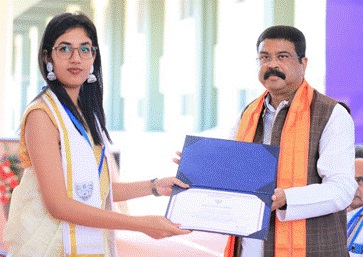
20th Annual Convocation of NITK Surathkal

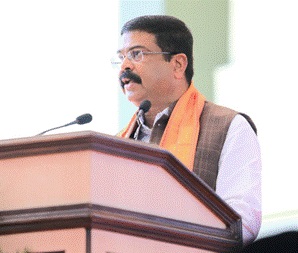
 Union Education and Skill Development Minister, Shri Dharmendra Pradhan addressed the 20th Convocation ceremony of NIT Surathkal today.

Speaking about NEP2020, he said that it is the philosophical document of the 21st century that aims to assimilate ancient with the modern and strive to produce well-rounded citizens of the world. He also made a special mention of Swami Vivekananda and his guiding philosophy.

https://static.pib.gov.in/WriteReadData/userfiles/image/image0013PMZ.jpghttps://static.pib.gov.in/WriteReadData/userfiles/image/image002J326.jpg

He recalled the Prime Minister Shri Narendra Modi’s call for “Jai Anusandhan” from his last Independence Day address to the nation. The aim is to place India among developed nation by 2047 when the country celebrates a 100 years of independence from British rule, he added.

Shri Dharmendra Pradhan encouraged NIT  Surathkal to create a full-fledged Sustainable Energy Department in order to make the technology institute a leading lighthouse in energy transition of the country within a decade.

Shri Pradhan spoke about the key areas like Artificial Intelligence, Machine Learning, data analytics, electronics, genome editing, 3 D Printing that are the way forward for Industry 4.0. He said that India will play a key role in future development of humanity and restore its glory as a Vishwa-Guru.

During this visit, the Minister inaugurated the newly constructed Central Research Facility (CRF) and School of Interdisciplinary Studies [CoEs] building” with a total area of 10,394 square meters and a cost of 48 crores and laid the foundation stone for “Construction of Lecture Hall Complex – Block -D” with the built-up area of 11,246 square meters and a cost of 54.76 crores in the presence of Shri Nalin Kumar Kateel, MP, Dakshina Kannada, Dr. Y. Bharath Shetty, MLA, Mangalore North, & Prof. Prasad Krishna, Chairperson- BOG & Director(A/C) NITK.. The Central Research Facility (CRF) is already established with a loan of 80 Crore rupees from the Higher Education Finance Agency (HEFA) of the Indian government.


This Convocation awarded degrees to a total of 1787 applicants, including 126 Ph.D., 817 PG, and 844 B.Tech candidates. 249 B.Tech students additionally received a Minor in other areas in addition to their B.Tech degrees. NITK awarded B.Tech (Honors) degrees for the very first time. In this convocation, nine B.Tech students and thirty PG students earned the Institute Gold medals and medals sponsored by other entities for achieving the best CGPA. Shri Dharmendra Pradhan presented the medals to the NITK graduands.

*****

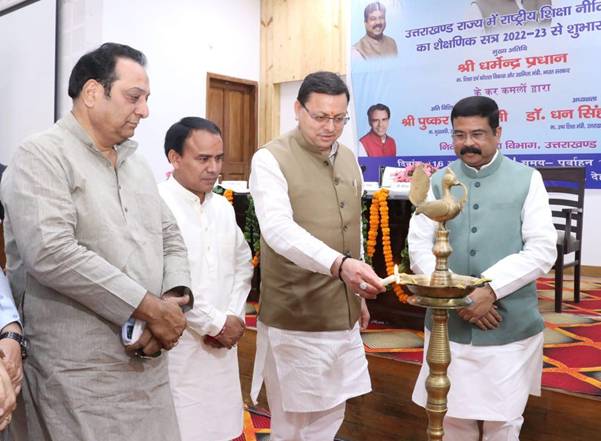
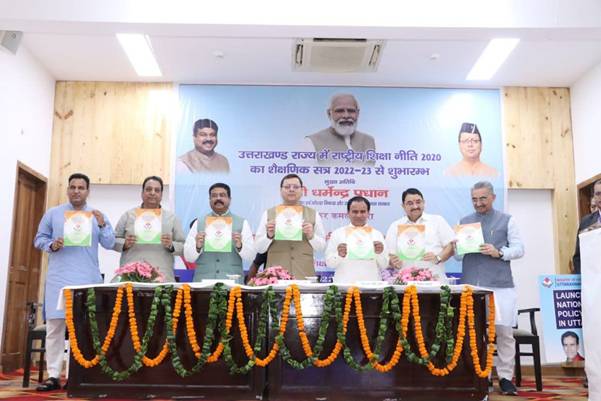
Programme for the implementation of National Education Policy 2020 in Uttarakhand

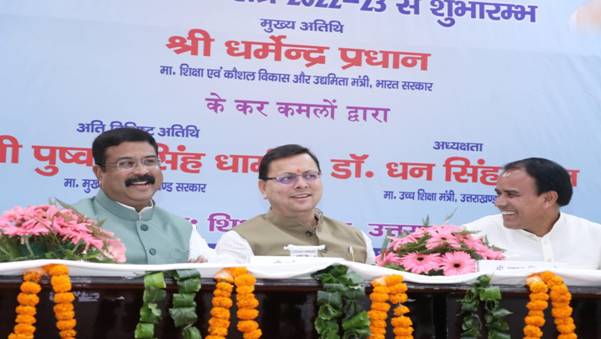
 Union Education and Skill Development and Entrepreneurship Minister Shri Dharmendra Pradhan along with CM of Uttarakhand, Shri Pushkar Singh Dhami; Minister of Health, Education and Cooperative of Uttarakhand Dr. Dhan Singh Rawat and senior officials of Government of Uttarakhand, participated in the launch of National Education Policy 2020 in Uttarakhand from the academic session 2022-23.


He said that NEP 2020 is a philosophical document to reinvigorate setting up of a knowledge-based economy and society. Uttarakhand-Devbhumi is the land of the divine. Uttarakhand is also the land of knowledge. He lauded Uttarakhand, the Devbhoomi for taking the lead in implementing NEP2020 . 

1.jfif

Shri Pradhan asserted that NEP 2020 has put emphasis on education from the age of 3 years with first three years as Balvatika and lauded Uttarakhand for being the first state in the country to adopt this. Later he added, “NEP 2020 has also put emphasis on local languages and mother tongue. We must unshackle our education system from the colonial hangover and create a more inclusive, forward-looking education system”.

4.jfif

Shri Pradhan shared that the world is changing rapidly. We are in the midst of Industrial Revolution 4.0. Uttarakhand is capable of preparing its youth for the challenges of tomorrow. Today’s launch is an important step towards that direction.  

He also added that from Gangotri to the galaxy, our youth must explore the world, embrace the future and remain rooted at the same time. Our education system must evolve and keep pace with their aspirations.

Shri Pradhan underlined the role of technology in transforming education. He also highlighted various initiatives by the Govt. of India such as 260 TV channels for education and Digital University, etc. for strengthening the digital ecosystem.    

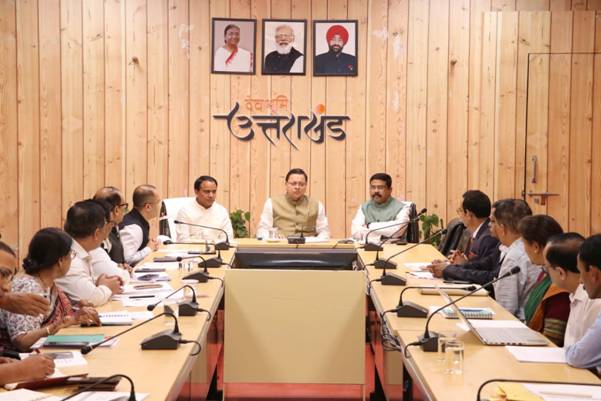
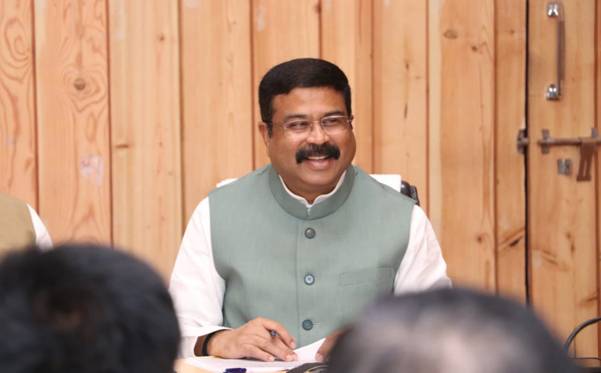
Shri Pradhan aslo reviewed the initiatives taken in the education and skill sectors in Uttarakhand and progress being made in the implementation of NEP2020.

review meet.jfif

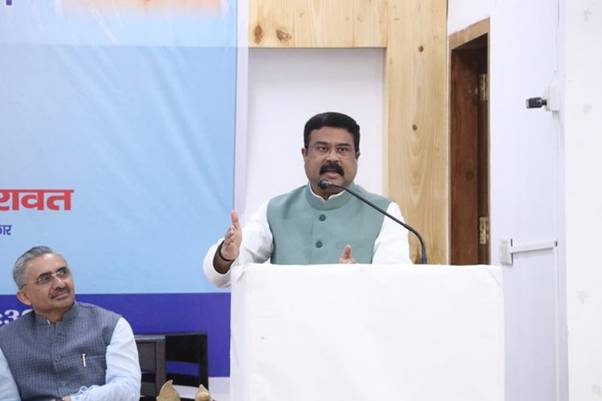
While addressing the gathering Shri Pradhan said that Uttarakhand is a land of divinity and a land of possibilities. A vibrant education and skills ecosystem will equip the youth of Uttarakhand with the necessary knowledge and skills to embrace the challenges of 21st century.

2222222.jfif

Shri Pradhan further said that Uttarakhand is taking many initiatives in this direction. From Balvatika to stress on local languages, school readiness program, skill development efforts and many other initiatives will pave way for a brighter future for the students of Uttarakhand. 

Later, he added that with the spirit of “for the students, by the teachers”, called for a more rooted and futuristic curriculum, capacity building of teachers, leveraging technology and reimagining the skills ecosystem.

*******

Salient Features of NEP, 2020

Salient Features of NEP, 2020

The National Education Policy 2020 was unveiled on July 29, 2020. The National Education Policy 2020 makes a number of changes to both higher education and secondary education, including technical education. The National Education Policy 2020 lists a number of action items/activities that should be implemented in both higher education and schooling.

The following are specifics of NEP 2020’s key features:

• Ensuring universal access at all educational levels, from preschool to grade 12;

• Ensuring that all children between the ages of 0 and 3 receive high-quality early care and education;

• New Pedagogical and Curricular Framework (5+3+3+4);

• There are no clear distinctions between the humanities and sciences, academic and extracurricular pursuits, or career paths;

• Launching a national initiative on basic literacy and numeracy;

• Promoting multilingualism and Indian languages as a priority; The home language, mother tongue, local language, or regional language will be used as the primary medium of teaching until at least Grade 5, but ideally until Grade 8 and beyond.

• Assessment reforms, including up to two Board Exams per school year, one for the main exam and one for improvement, if requested;

• The establishment of the PARAKH (Performance Assessment, Review, and Analysis of Knowledge for Holistic Development) National Assessment Center;

• Educational equity and inclusion, with a focus on Socially and Economically Disadvantaged Groups (SEDGs);

• Special Education Zones and a specific gender inclusion fund for underprivileged areas and groups;

• Effective and open procedures for hiring teachers and performance evaluations based on merit;

• Ensuring that all resources are accessible via school complexes and clusters;

•State School Standards Authority (SSSA) establishment 

• Promotion of vocational education throughout the K–12 and tertiary systems of instruction;

• raising GER to 50% in higher education;

• Multidisciplinary, all-encompassing education with numerous points of access and departure;

• NTA will conduct a Common Entrance Exam for HEI Admission;

• The founding of an academic bank of credit

•Multidisciplinary Education and Research Universities (MERUs) establishment ;

•The National Research Foundation (NRF) was established.

•”Light yet Tight” regulation 

• The Higher Education Commission of India (HECI), a single overarching umbrella organisation, with independent bodies for standard setting (the General Education Council), funding (the Higher Education Grants Council), accreditation (the National Accreditation Council [NAC]), and regulation (the National Higher Education Regulatory Council [NHERC]), is responsible for promoting the higher education sector, including teacher education but excluding medical and legal education;

• Growing open and distant education to boost the gross enrollment ratio (GER).

• Globalization in Education

• The higher education system will include professional education as a core component. The goal of institutions in these and other sectors, including independent technical universities, law schools, medical schools, and agricultural colleges, is to become multidisciplinary institutions.

• 4-year integrated stage- and subject-specific teacher education degree in education

• Creating a National Mentoring Mission.

•The establishment of the National Educational Technology Forum (NETF), an independent organisation that would serve as a forum for the unrestricted discussion of ways to use technology to improve instruction, evaluation, planning, and administration.

•The appropriate use of technology in all educational levels.

•Objectives Reaching 100% adult and juvenile literacy.

• The commercialization of higher education will be fought and stopped by a number of methods with checks and balances.

• As a “not for profit” company, all educational institutions will be held to the same standards of audit and disclosure.

• The Center and the States will collaborate to boost public spending on education so that it reaches 6% of GDP as soon as possible.

• The Central Advisory Board of Education should be strengthened to maintain coordination and to put more of an emphasis on quality education overall.

By 2030, the NEP, 2020 aims to raise the GER in preschool through secondary education to 100%, while it will rise from 26.3% in 2018 to 50% in higher education, including vocational education.

Government Initiated Educational Policies

Government Initiated Educational Policies That Are Modifying The Education Sector

Major changes have been made to India’s educational system.
Over the years, the Indian government has implemented a number of initiatives to support skill development and education. Private institutions can adopt these policies’ concepts and use them to increase their revenues.
Here are a few of the key educational policies that have lately been established.
Digital Payment
Prakash Javadekar, the Union HRD minister, promoted the advantages of digital payment by implementing cashless payment across all centrally-aided institutions.
No Detention Policy
For all students in grades 5th to 8th, the HRD Ministry amended the previous rule to allow for promotion to the following class. The new policy makes passing every exam necessary in order to advance to the following class.
Male Students can also file for sexual harassment
The number of incidents of sexual harassment against male students has significantly increased. Male students may now report instances of sexual harassment thanks to new rules established by the UGC.
Gender Education Must Be Required
Telangana’s government mandated gender education as a requirement for graduation. Along with doing so, it was the first state in India to do so, and it also brought in multilingual textbooks.
Yoga classes 
Yoga sessions are now required in all ICSE and ISC institutions, according the Council for the Indian School Certificate Examinations (CISCE).
Free higher education for students with disabilities
The government of Guwahati has established a programme that will provide these kids with free education from Class 9 to the university level in all government-run institutions of higher learning.

No homework for students of class 1st and 2nd
No homework may soon become reality. Prakash Javade, the minister of human resource development (HRD), suggested that students in grades 1 and 2 might no longer have homework.
New guidelines for girls’ education
A “modern education policy” is something the government wants to implement. The new education policy’s (NEP) main emphasis will be on females’ education. It intends to eliminate educational inequity.
Eklavya schools 
By 2022, Scheduled Caste (SC) and Schedule Tribe (ST) students will have access to Eklavya schools, which will be modelled after Navodaya schools. It will offer athletic instruction and skill development. Additionally, it will contain unique spaces for conserving regional art and culture.
Diksha scheme 
The Indian government will soon introduce the integrated B.Ed programme and develop the learning portal “DIKSHA” to improve teaching abilities.
Sports Education
The government of India is proposing to make sports education a component of the Fundamental Rights and to promote it countrywide.
Reducing the bag’s weight
For lower primary classes, the Department of Primary and Secondary Education intends to implement ideas like “no bag day” and a lighter bag requirement.

Government Initiated Educational  Policies 

Government Initiated Educational  Policies That Are Modifying The Education Sector

Major changes have been made to India’s educational system.
Over the years, the Indian government has implemented a number of initiatives to support skill development and education. Private institutions can adopt these policies’ concepts and use them to increase their revenues.
Here are a few of the key educational policies that have lately been established.
Digital Payment
Prakash Javadekar, the Union HRD minister, promoted the advantages of digital payment by implementing cashless payment across all centrally-aided institutions.
No Detention Policy
For all students in grades 5th to 8th, the HRD Ministry amended the previous rule to allow for promotion to the following class. The new policy makes passing every exam necessary in order to advance to the following class.
Male Students can also file for sexual harassment
The number of incidents of sexual harassment against male students has significantly increased. Male students may now report instances of sexual harassment thanks to new rules established by the UGC.
Gender Education Must Be Required
Telangana’s government mandated gender education as a requirement for graduation. Along with doing so, it was the first state in India to do so, and it also brought in multilingual textbooks.
Yoga classes 
Yoga sessions are now required in all ICSE and ISC institutions, according the Council for the Indian School Certificate Examinations (CISCE).
Free higher education for students with disabilities
The government of Guwahati has established a programme that will provide these kids with free education from Class 9 to the university level in all government-run institutions of higher learning.
No homework for students of class 1st and 2nd
No homework may soon become reality. Prakash Javade, the minister of human resource development (HRD), suggested that students in grades 1 and 2 might no longer have homework.
New guidelines for girls’ education
A “modern education policy” is something the government wants to implement. The new education policy’s (NEP) main emphasis will be on females’ education. It intends to eliminate educational inequity.
Eklavya schools 
By 2022, Scheduled Caste (SC) and Schedule Tribe (ST) students will have access to Eklavya schools, which will be modelled after Navodaya schools. It will offer athletic instruction and skill development. Additionally, it will contain unique spaces for conserving regional art and culture.
Diksha scheme 
The Indian government will soon introduce the integrated B.Ed programme and develop the learning portal “DIKSHA” to improve teaching abilities.
Sports Education
The government of India is proposing to make sports education a component of the Fundamental Rights and to promote it countrywide.
 Reducing the bag’s weight
For lower primary classes, the Department of Primary and Secondary Education intends to implement ideas like “no bag day” and a lighter bag requirement.

A Dialogue on National Education Policy 2020 at Nehru Centre, London

 A dialogue on the “New Education Policy 2020 – NEP Outreach”, was organized by the Nehru Centre, London with National Book Trust, India (under Ministry of Education) on 18 January, 2021.

Speaking on the occasion, Union of Education Shri Ramesh Pokhriyal ‘Nishank’, Minister said that under the leadership of Prime Minister Shri Narendra Modi, the NEP-2020 has been implemented with a futuristic mindset, thereby turning the challenges into opportunities. It will equip India to hold a position in the global knowledge system while maintaining and developing its traditional knowledge system. “Through the policy, we are hoping to transform education and putting a significant thrust on learning about how to think critically and solve problems, how to be creative and multidisciplinary, and how to innovate, adapt, and absorb new material in the novel and changing fields. Pedagogy is expected to evolve to make education more experiential, holistic, integrated, inquiry-driven, discovery-oriented, learner-centred, discussion-based, flexible, and, of course, enjoyable,” the Minister added.

Shri Vinay Sahastrabuddhe, President, ICCR, in his opening remarks said that the NEP-2020 is one of the greatest reforms presented by the Prime Minister Shri Narendra Modi.

Rt. Hon Jo Johnson, Educationist, Former Minister for Universities, Science, Research & Innovation, United Kingdom, lauded India’s NEP-2020 as an event of global significance and as a policy that will turn India into a global knowledge superpower, emphasizing its strong focus on early years, teachers, universal numeracy & literacy, etc. He also mentioned that the exciting fact about NEP-2020 is that it proposes to shift the mode of assessment from summative to formative, testing higher order skills like critical thinking, analysis and conceptual clarity.

Rt. Hon Jo Johnson and Shri Ramesh Pokhriyal ‘Nishank’ also engaged in a dialogue on various provisions of the NEP-2020, such as teacher training, entry of top 100 foreign universities in India, and education in Indian HEIs.

The engaging and enlightening event was moderated by Shri Amish Tripathi, Minister (Culture), High Commission of India, UK and Director, The Nehru Centre.

National Education Policy (NEP) 2020: Implementation Plan for School Education


  1. The National Education Policy, 2020 is the third in the series of National Education Policies (1968 and 1986 modified in 1992) in India and is the first education policy of the 21st century. NEP 2020 covers wider spectrum of school education from pre-primary to senior secondary.
  2. The recommendations given have varied timelines as the policy is made for next 20 years. Therefore, the implementation of NEP is being carried out in a phased manner.
  3. ShikshakParv was organised from 8th to 25th September 2020 for discussing various recommendations of NEP 2020 and its implementation strategies. Around 15 lakh suggestions were received from the stakeholders, which are being examined.
  4. To achieve the goals and objectives of NEP 2020, DoSEL has prepared a draft implementation plan with Task lists linking each recommendation with tasks, responsible agencies to carry out the task, timelines and outputs. This task list was shared with the States/UTs/Autonomous Bodies on 10th September, 2020, to provide their feedback/suggestions till 12th October, 2020. Autonomous Bodies of this Department and 31 States and UTs provided 7177 suggestions/ feedback on the task list. These have been analysed by expert groups and important suggestions have been incorporated in the final version of implementation planIn addition to above, a series of national workshops on Implementation of NEP 2020 and revision of Samagra Shiksha was held under the chairpersonship of Secretary (SE&L) on 10th November, 27th November and 2nd December, 2020 covering all States and UTs. The document is being finalised and will be released shortly.
  5. Appropriate care is being taken to make this implementation plan realistic, flexible and collaborative by inviting suggestions from all corners of the society. It is hoped that this implementation plan so finalised with the inputs of all associates will be able to translate the vision of the policy in the field and will reach to grass root level creating adequate awareness and motivation and competencies among concerned stakeholders, thereby transforming the school education in the country.  
  6. The major portions of NEP will be covered under the new National Curriculum Framework (NCF) and centrally sponsored schemes. Groundwork for NCF is initiated and it is likely to be developed in the next academic session, that is 2021-22.
  7. The department has initiated implementation of NEP by undertaking following activities in accordance with the recommendations of the policy :
  1. To undertake 50 hours of mandatory Continuous Professional development of teachers, 18 modules of 4-5 hours each comprehensively covering all aspects of elementary education have been launched under NISHTHA on 6.10.20 for in service teacher training (CPD) in the online mode on DIKSHA platform. This has so far seen more than 3.4 cr course wise registrations and 2.8 cr completions from more than 23 lakh teachers.
  2. In-principle approval has been given for setting up the National Mission on Foundational Literacy and Numeracy Mission. A Committee has been formed for preparing framework on FL&N, codification of learning outcomes etc.
  3. E-learning has been expanded through DIKSHA. DIKSHA provides access to a large number of curriculum linked e-content through several solutions such as QR coded Energized Textbooks (ETBs), courses for teachers, quizzes etc. Till date DIKSHA houses over 3600 QR coded textbooks (tagged with e-content) from 29 states, 1.44 lakh e Contents and more than 300 courses.
  4. The department has launched an initiative called ‘Manodarpan’ for mental health and wellbeing of students. It aims to provide emotional support and counselling to the students under distress. Issuance of advisory guidelines, web page and national toll-free number, interactive online chat options and, national-level database and directory of counsellorsare part of the initiative. 
  5. MoU has been signed between Indian Sign Language Research and Training Centre (ISLRTC) and NCERT to develop Indian Sign Language dictionary for school education.
  6. CBSE exam reforms have been initiated; CBSE will introduce improvement examination from the year 2021 and will introduce English and Sanskrit in 2 levels from the session 2021-22 (already offers Mathematics and Hindi at two levels). Competency based questions have been introduced in the Board exams for class X and XII in a phased manner, increasing by 10% every year.
  7. Learning Outcomes upto Secondary level have been notified and draft of learning outcomes for senior secondary level have been released for inviting suggestions.
  8. The department is also aligning its existing schemes i.e, Samagra Shiksha, Mid Day Meal and Padhna Likhna Abhiyan with the recommendations of NEP 2020. 86 paras of NEP have been proposed to be covered/integrated under the revised scheme of Samagra Shiksha which includes phased introduction of:  1 year of Balvatika and TLMs to all children, Launch of National Mission of Foundational Literacy and Numeracy, upgradation of schools upto senior secondary level including residential schools and KGBVs, Holistic Progress Card (HPC) and tracking of learning outcomes as well as transition of children, appointment of Hindi and Urdu Language Teachers, Capacity building of teachers (50 Hrs CPD), Bagless days and internships, Support for OOSC, Activities of PARAKH, Separate stipend for CWSN girl child; provision for identification of CWSN and Resource Centre at block level, Provision for Hub and Spoke model in vocational education, Provision for Smart classroom and DIKSHA, Support for Assessment Cells in SCERT etc., etc.
  9. States and UTs are also constituting their own Task Force to steer implementation of the NEP provisions in their respective jurisdiction.

******


Implementation of National Education Policy-2020

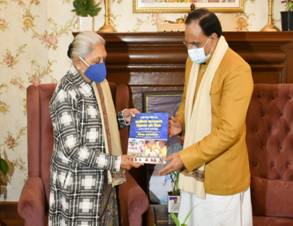
 The Governor of Uttar Pradesh Smt. Anandiben Patel called on Union Education Minister Shri Ramesh Pokhriyal ‘Nishank’ here today. Implementation of National Education Policy-2020 and other issues relating to Education sector were discussed during the meeting. Senior officials of the Ministry also attended the meeting.


During the meeting Smt. Anandiben Patel highlighted the initiatives taken by the State Education Department, Uttar Pradesh such as providing training to Anganwadi workers, teachers training, etc to ensure the academic welfare of the students. She also presented a copy of the book ‘Teacher’s guide’ for students of Pre-primary level and Primary level, to the Union Minister. The guide will help teachers to develop a better understanding of student centric teaching practices covering various subjects of environment, value education, etc in a joyful manner.

Shri Pokhriyal informed that as outlined in New Education policy, the foundation literacy and numeracy mission will be extended to Early Childhood Care Education for which a framework will be prepared on learning outcomes, teachers training, etc. He also informed that NCERT is developing a new National Curriculum Framework (NCF). He added that the suggestions given in the Teacher’s Guide will be examined and suitably incorporated in the NCF.

*****

Implementation of New Education Policy

 A number of action points/activities for implementation in school education as well as higher education are mentioned in the National Education Policy 2020 which inter-alia include following:-

  1. Ensuring Universal Access at All Levels of schooling from pre-primary school to Grade 12;
  2. Ensuring quality early childhood care and education for all children between 3-6 years;
  3. Introducing New Curricular and Pedagogical Structure (5+3+3+4);
  4. Ensuring no hard separations between arts and sciences, between curricular and extra-curricular activities, between vocational and academic streams;
  5. Establishing National Mission on Foundational Literacy and Numeracy;
  6. Emphasis on promoting multilingualism and Indian languages; The medium of instruction until at least Grade 5, but preferably till Grade 8 and beyond, will be the home language/mother tongue/local language/regional language.
  7. Assessment reforms – Introducing Board Exams on up to two occasions during any given school year, one main examination and one for improvement, if desired;
  8. Setting up of a new National Assessment Centre, PARAKH (Performance Assessment, Review, and Analysis of Knowledge for Holistic Development);
  9. Equitable and inclusive education – Ensuring special emphasis to be given on Socially and Economically Disadvantaged Groups(SEDGs);
  10. Establishing a separate Gender Inclusion fund and Special Education Zones for disadvantaged regions and groups;
  11. Robust and transparent processes for recruitment of teachers and merit based performance;
  12. Ensuring availability of all resources through school complexes and clusters;
  13. Setting up of State School Standards Authority (SSSA);
  14. Providing Exposure of vocational education  in school and higher education system;
  15. Increasing GER in higher education to 50%;
  16. Introducing Holistic Multidisciplinary Education with multiple entry/exit options;
  17. Introducing Common Entrance Exam for Admission to HEIs to be offered by NTA;
  18. Establishment of Academic Bank of Credit;
  19. Setting up of Multidisciplinary Education and Research Universities(MERUs);
  20. Setting up of National Research Foundation(NRF);
  21. Framing ‘Light but Tight’ regulation;
  22. Setting up of single overarching umbrella body for promotion of higher education sector including teacher education and excluding medical and legal education- the Higher Education Commission of India (HECI)-with independent bodies for standard setting- the General Education Council; funding-Higher Education Grants Council (HEGC); accreditation- National Accreditation Council (NAC); and regulation- National Higher Education Regulatory Council (NHERC);
  23. Expansion of open and distance learning to increase GER.
  24. Internationalization of Education.
  25. Professional Education will be an integral part of the higher education system. Stand-alone technical universities, health science universities, legal and agricultural universities, or institutions in these or other fields, will aim to become multi-disciplinary institutions.
  26. Teacher Education – Introduction of 4-year integrated stage-specific, subject- specific Bachelor of Education.
  27. Establishing a National Mission for Mentoring.
  28.  Creation of an autonomous body, the National Educational Technology Forum (NETF) to provide a platform for the free exchange of ideas on the use of technology to enhance learning, assessment, planning, administration. Appropriate integration of technology into all levels of education.
  29. Achieving 100% youth and adult literacy.
  30. Introducing multiple mechanisms with checks and balances to combat and stop the commercialization of higher education.
  31. All education institutions will be held to similar standards of audit and disclosure as a ‘not for profit’ entity.
  32. The Centre and the States will work together to increase the public investment in Education sector to reach 6% of GDP at the earliest.
  33.  Strengthening of the Central Advisory Board of Education to ensure coordination to bring overall focus on quality education.
  34.  Ministry of Education: In order to bring the focus back on education and learning, it may be desirable to re-designate MHRD as the Ministry of Education (MoE).

A detailed consultation process with various stakeholders including educationists have been held before and after announcement of National Education Policy 2020. Suggestions have been invited from States / UTs Government and also from other stakeholders through MyGov platform. Department of School Education & Literacy has constituted subject-wise/theme-wise implementation committees of experts for implementation of National Education Policy 2020. Similarly, UGC and AICTE have also constituted Expert Groups on various themes of higher education sector for formulation of Implementation Plan of National Education Policy.

As per National Education Policy 2020, implementation of the Policy requires multiple initiatives and actions, which will have to be taken by multiple bodies in a synchronized and systematic manner. Therefore, the implementation of this Policy will be led by various bodies including Ministry of Education, CABE, Union and State Governments, education-related Ministries, State Departments of Education, Boards, NTA, the regulatory bodies of school and higher education, NCERT, SCERTs, schools, and HEIs. Since Education is in the concurrent list of Constitution of India, hence, State/UT Government will play a vital role in the implementation of the National Education Policy. Ministry of Education has communicated to all States/UT Governments for taking steps for implementation of NEP 2020. In this direction, Ministry of Education had organised ‘Shikshak Parv’ from 8th September to 25th September, 2020 to deliberate on various themes and implementation of NEP 2020 aimed at eliciting suggestions. Ministry had also organised a Conference of Governors on “Role of National Education Policy in Transforming Higher Education”. In the conference, Governors and Lt. Governors of State and Union Territories, Education Minister of State and UTs, Vice Chancellors of State Universities and other dignitaries participated. Majority of states have taken steps toward implementation of NEP 2020. Further, Ministry and other implementing agencies under its purview have started taking initiatives towards implementation of NEP 2020.

NEP to revolutionize the educational sector in India

 Union Minister of Education Shri Dharmendra Pradhan conferred AICTE- Visvesvaraya Best Teacher Award to 17 faculty members in Engineering and Technology whereas 3 faculty members were awarded the AICTE-Dr. Pritam Singh Best Teacher Award in Management Education. He also conferred Chhatra Vishwakarma Award Clean and Smart Campus Award, 2020 to the winners today.


Minister of State for Education, Dr. Rajkumar Ranjan Singh also graced the occasion. Secretary, Higher Education Shri Amit Khare; Chairman, AICTE, Prof. Anil D Sahasrabudhe, Vice Chairman, AICTE, Prof. MP Poonia and Member Secretary, AICTE Prof. Rajive Kumar also complimented the awardees during the event and highlighted the importance of teachers in nation building.

Speaking on the occasion, Union Minister said that as we complete 75 Years of Independence, the citizens finally have the will to shape India. He stated that the new National Education Policy is expected to revolutionize the educational sector in India and lay the path for the next 25 years as per the Vision 2047 of Prime Minister Shri Narendra Modi. He stressed that the education has to make each one of us more responsible and become Global Citizen. The Minister congratulated AICTE for instituting these 4 awards. Apart from recognizing the efforts of the Teachers, these awards have also brought the spark for innovation, he said.

Shri Pradhan said that the aim of AICTE Visvesvaraya awards is to honour meritorious faculties and encourage them to update themselves to the ever changing needs of higher education at global level and thereby becoming an effective contributor to the knowledge society. Dr. Pritam Singh Best Teacher Award introduced this year only and is conferred on the faculty members for demonstrating teaching excellence and institutional leadership in management education, he added.

Shri Pradhan highlighted that Chhatra Vishwakarma Award provides a platform for our students to look at the societal challenges, with an aim to provide innovative and low-cost solutions. This year again, the council announced the Chhatra Vishwakarma Award 2020, with the theme of “INDIA’S ECONOMIC RECOVERY POST COVID: Reverse migration and rehabilitation plan to support “Atmanirbhar Bharat”. The Minister informed that 24 teams of students who developed very useful and creative solutions for various socio-economic issues have been awarded. The zeal, enthusiasm, innovativeness and hard work of these students will make India a focal point to generate innovative ideas in the near future, he added.

The Minister interacted with all the awardees and appreciated their contribution to the society. While visiting the displayed projects of students, he admired the innovativeness and efforts of winning teams of Chhatra Vishwakarma Award and expressed confidence in India’s bright future. 

Minister of State for Education, Dr. Rajkumar Ranjan Singh motivated the students & all other stakeholders. He encouraged them to enhance their respective activities so that tangible social outcomes are achieved.

Clean and Smart Campus Award, 2020 has also been conferred to selected technical institutes. The award aims to seek engagement with all stakeholders, primarily the student community, to draw their attention towards the immense scope and potential that the technology offers on abstract objectives such as cleanliness, sustainability and environment etc. in line with Swachh Bharat Abhiyan. Winning institutions have displayed great concern and commitment for the environment. All institutions must align their activities with sustainable, clean, and green environmental Policy.