
India is building global competencies to fulfill 21st century aspirations

 ‘India is building global competencies to fulfill 21st century aspirations’, said Shri Dharmendra Pradhan, Union Minister for Education and Skill Development at 5th East Asia Summit (EAS) Education Ministers Meeting. Shri Rajkumar Ranjan Singh, Minister of State for Education and senior officials of the Ministry also attended the meeting.   

Speaking on the occasion, Shri Pradhan reaffirmed India’s commitment foster long-term and mutually beneficial educational cooperation in sync with the complementarities outlined in the Manila Action Plan.
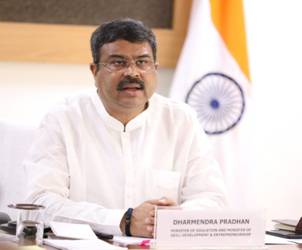
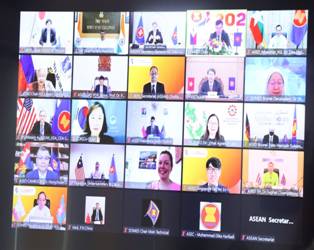


The Minister shared the objectives of India’s National Education Policy, including universalisation of education, ensuring equity, quality, affordability & flexibility, technology-based learning and several others which uphold the principles of the Manila Action Plan on Education.

Shri Pradhan spoke about the multi-modal digital interventions, like PM-eVidya, Swayam, Diksha, etc which ensured continuity of learning during the pandemic and also on the continuous efforts to ramp up the digital infrastructure to facilitate on demand learning and bridge the digital divide.

The Minister said that in line with the vision of Prime Minister Shri Narendra Modi, India remains committed to forge meaningful partnerships in making education and skills more inclusive, affordable, equitable, vibrant and aspirational.

Shri Pradhan also reaffirmed India’s support to strengthening research and academic collaborations, including in TVET, promoting student & academic exchanges for fulfilling aspirations of the students.

*****

Indian sign language dictionary policy under the new education policy

 The National Education Policy 2020 at para 4.22, inter-alia,recommends for standardization of the Indian Sign Language (ISL) across the country and development of National and State curriculum materials for use by students with hearing impairment.  The National Council of Educational Research and Training (NCERT) has signed a Memorandum of Understanding (MoU) with the Indian Sign Language Research and Training Centre (ISLRTC) for developing NCERT textbook based videos in Indian Sign Language.ISLRTC has prepared and launched 10,000 words ISL Dictionary in video format. The dictionary is available on DIKSHA Portal for wider access and dissemination among stakeholders. NCERT is strengthening this dictionary by embedding audio and sub titles in the videos so that the reach of 10,000 words dictionary is not restricted to the hearing impaired only. In addition, NCERT is also collaborating with ISLRTC to add new terms and words based on school curriculum to the existing ISL Dictionary of 10,000 words.  So far, NCERT has developed 800 plus ISL videos from classes I to VI and uploaded on DIKSHA for its use by hearing impaired (HI) persons. These videos are also disseminated through PM eVidya (One Class, One Channel), DTH TV Channels, on regular basis to ensure coherent access of these e-contents.

Training to teachers on new education policy

 A teacher’s fest ‘ShikshakParv’ was organized from8thto 25thSeptember 2020for discussing various recommendations of National Education Policy (NEP) 2020 and its implementation strategies. This year also ShikshakParv was organized from 5th to 17th September, 2021 through virtual mode. Policy makers, administrators, academicians, experts, school principals, head-teachers and teachers participated in the ShikshakParv to share their experiences, learnings and discuss the way forward to realise the aspirations of NEP-2020.

In addition, the National Mission to improve learning outcomes at the Elementary level through an Integrated Teacher Training Programme called NISHTHA – National Initiative for School Heads and Teachers Holistic Advancement was launched by the Department of School Education and Literacy.The teacher training modules of NISHTHA have been aligned with the recommendations of NEP 2020.

Further, an online consultation process to invite suggestions from teachers to implement NEP 2020 was initiated at http://www.MyGov.in portal. Around 15 lakh suggestions were received from teachers which were forwarded to NCERT, CBSE and States/UTs.