Public Health Student Weighs in on the Challenges of Wiping Out Malaria

As malaria claims hundreds of thousands of lives each year in sub-Saharan Africa and South Asia, there are fears that efforts to eradicate the disease are being undermined by funding shortfalls and fragile health care systems.
While there has been progress to prevent the spread of malaria, the World Health Organization says more needs to happen to eliminate the disease. According to the 2016 World Malaria Report, children and pregnant women in sub-Saharan Africa have greater access to tools that stop the transmission of malaria. Diagnostic testing for children and preventive treatment for pregnant women has risen dramatically across the region over the last five years, and the use of bed nets treated with insecticide has expanded rapidly.
Still, significant gaps in the number of people with access to preventative measures and the fragile health systems that exist in many countries are stymying progress, according to the World Health Organization.
Malaria causes flu-like symptoms that can lead to severe complications and death. In 2015, there were 212 million new cases of malaria and 429,000 deaths worldwide, mostly children in the African region.
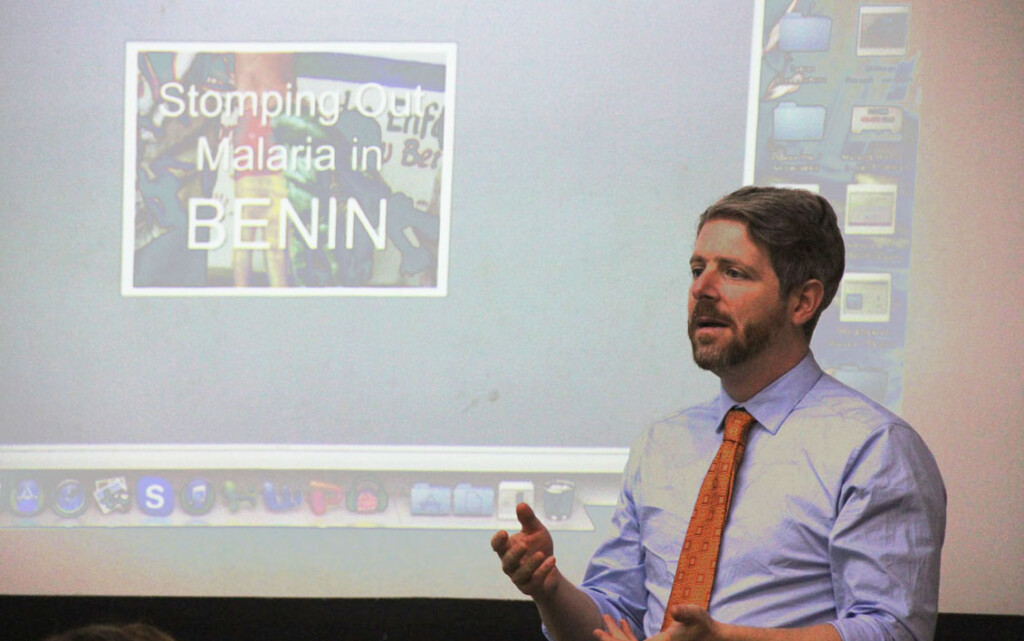
We talked with Matt McLaughlin, a UVM Master of Public Health student and program manager of Stomping Out Malaria in Africa, a Peace Corps program that aims to support the international malaria eradication program, about the challenges to eliminate malaria.
Matt has worked for a decade on bed net distribution. Consistent use of bed nets can reduce malaria transmissions by as much as 90 percent, according to the Nothing But Nets organization. However, according to WHO, a fifth of households in sub-Saharan Africa did not have access to bed nets in 2015, and fewer than half the households had sufficient insecticide-treated nets.

Why are bed nets not consistently used?

Of the people not using a net, the vast majority of them, the reason is that they just don’t have one. This is not to dismiss the issue of under utilization by those who do have a net. Some of that happens, too. But despite lots and lots of work on net distribution and lots and lots of progress we remain far short of a scenario where everyone who needs one has one.

What are the obstacles to getting nets to people?

One strategy for net distribution is the mass campaign where you distribute them all at once across a country. It is a devil is in the details kind of challenge. Senegal—which where I work the most, so I’ll use that as an example—when I last did a mass distribution there they had 13 million people, and there is an average of two people per sleeping space. So, you’re talking about distributing 6.5 million nets, which is just a huge logistical challenge with lots of devilish details. Nets have to be warehoused at the national level, shipped to regions and warehoused there, loaded on smaller trucks to get to clinics. Sometimes it’s putting nets in canoes or on the backs of bikes or—and I’ve done this—climbing up a mountain with a bale of nets on your head because there is no actual road to a village. And before all this can happen you need an accurate count of how many people actually need nets in these communities and that means a comprehensive census. You do all this work and after about a year, some nets get ripped or burned by candles and then they’re no longer effective. Another year goes by and more nets taken out of commission.

What is the life span of a bed net?

Two years and change is the consensus of how long bed nets last. The insecticide on the nets will last through 20 washings.

How else are the nets distributed?

If you’re pregnant, you can get a free net at a clinic. Children at a certain grade level will get a free net at school. There are some community organizations that distribute small numbers of nets on an ongoing basis. Those ancillary channels are good, but I don’t think they’re sufficient.

What are some ways to educate people about using bed nets?

There is more that we can do with utilization. For example, there is a belief that if it is the dry season, there are no mosquitos and therefore no risk of malaria and people are less likely to use the net. Yet, we know that people are getting malaria even in the dry season. And net care and repair is important, too. You need to wash them with regular soap not detergent and make sure they hang in the shade to dry. You can also sew bed nets if they get holes for longevity. Educate people around these issues and we might see better net longevity.

Can you tell us about some other projects you are working on?

I also help identify and evangelize flagship projects. The current most important project is called PECADOM+. It’s a French acronym for home-based care, and the “plus” is a unique addition that Peace Corps and our partners have identified—weekly door to door sweeps by community health workers looking for malaria cases.
We’re now doing a variant of the PECADOM+ projects in schools because schools are such a natural place for low effort and high impact. One of the pilot programs in Senegal provided the same basic training to school administrators that a community health worker would receive for the door-to-door program. As a result, administrators were finding many malaria cases, even in places where there were existing community efforts to eradicate malaria. The school officials also identified many malaria cases in the dry season, disproving the belief that there is no malaria at that time.

In your work, do you find that the world is becoming complacent because of the many gains in fighting malaria?

Total donations have flat-lined over the past five years. That is worrying. When you’re making progress, everyone is excited and they want to push hard and take part. But when your progress slows—because the end is always harder than the beginning—it’s harder to muster that same excitement from political leaders. The funding growth is slowing down, and with that, so are the gains—that’s the first warning sign of complacency. That said, the funding level donations have plateaued at is quite high. The U.S. and others are still donating billions to this cause and that is heartening. Also I am convinced that we can make bigger gains with the money we have if we’re smart about it. There is room to make improvement

Women in Craft Beer: Bailey Spaulding on Opening a Brewery

By Tera Dacek
What does a jackalope, Montpelier, Vt., Harvard University, and brewing kettles all have in common? Bailey Spaulding.
Spaulding was born and raised in Montpelier, graduated from Harvard in 2004, and opened up Jackalope Brewing Company in Nashville in 2011. For our second profile in a series of four women in craft beer, we chatted with Spaulding about her adventures in brewing.

After graduating from Harvard University and enrolling at Vanderbilt Law School in Nashville, how did you decide to open a brewery?

I started home brewing while I was in law school and really loved it. I would spend most of my time thinking about what kind of brewery I would start, rather than what kind of lawyer I would be, so when I graduated, I decided to take the plunge.

Setting up a brewery: nightmares or dreams?

Both! There are really exciting times, like brewing for the first time on your new equipment, and there are really terrifying ones as well. Learning how to deal with the scary times and keep your cool is what I think makes you a real entrepreneur.

What was your ah-ha moment?

I was spending the summer after my first year of law school working for the Natural Resources Defense Council in New York and sitting with my fellow interns. We all talked about what we would do if we could do anything, and one of my friends (not me!) said she would open a brewery. A light bulb went off in my head. I think that’s when I realized that starting a brewery was actually something that people could do.

What’s the real story behind the jackalope?

I believed in jackalopes growing up, so it became a little joke about me with some of my friends. One friend gave me a shirt with a jackalope on it and the text, “Believe in Yourself.” When most people thought I was nuts to be graduating law school and brewing beer, that became our little unofficial motto.

What got you through (and perhaps still does) the long days on a concrete floor and all the hard work?

Yes, the days can still be long sometimes. I would say passion and an undying will to succeed. I really love what I do and what our team has created.

In the craft beer industry, do you feel pressure to come up with new beers, or is this the fun part?

Oh, that’s part of the fun! You can’t spend too much time worrying about what other people want you to do. There aren’t enough hours in the day for that. When we get to come up with new beers, it’s typically a reward for working hard enough to get a little bit of time.

Did you find that being a woman affects who you are in the craft beer industry?

I think it may get me a little bit more attention from the consumer standpoint, but I don’t feel like my colleagues treat me any differently. I’m thrilled that more women are starting to get into brewing.
opening-a-brewery

The brewery production team from left to right: Will Hadley, Bailey, Steve Wright (Bailey’s business partner), and Sally Cooper.

Working in a brewery must feel a bit like a second family. Any funny stories from the floor?

We have an amazing team. It’s hard to pick one story, from karaoke battles to the guys setting up a t-ball station (that has since been removed after too many whiffle balls ended up in the rafters). It is always an adventure.

What advice would you give to someone starting up his or her own brewery?

Be patient, and raise more money than you think you need.
Editor’s note: This is our second post in a four-post blog series introducing you to just a few of the amazing women in the beer industry right now. Cheers to these women and their accomplishments, with hopes that all beer lovers who have been considering a career shift into the beer industry will follow their passion.
Tera Dacek is a consultant and freelance writer. She most recently worked as Marketing Manager for Alchemy and Science. When she unplugs, she can be found at her local mountain or one of the many wonderful breweries in her home state of Vermont

From UVM to WebMD: Alumna Deb Mignucci Offers Career Advice

Photo: Deb Mignucci and her husband, Alberto, graduated from UVM in 1982.
UVM alumna Deb Mignucci started her college career with a focus on pre-med. But after taking a physics class during her sophomore year, she decided the career path wasn’t for her. Instead, she chose to pursue a liberal arts education as a psychology major and graduated from UVM in 1982.
That liberal arts focus served Mignucci well. She went on to earn her MBA at New York University and rose through the ranks in advertising sales, working for Time Inc., American Media, Meredith, BabyCenter.com, and Disney Publishing.

Getting started with a WebMD career

After 25 years in the business, Mignucci was named in 2014 Executive Director of WebMD, the leading source for online medical news and information. According to a recent article in the Wall Street Journal, WebMD reached an average 210 million unique users a month in 2015, generating 4.25 billion page views.
uvm-alumni-adviceMignucci’s job as Executive Director involves working with high-profile consumer accounts and leading a team of strategic advertising sales professionals.
In this first post in our new Alumni Advice series, we talked to Mignucci about what it takes to get hired in a competitive market, how to work through discouraging days on the job, and why experience waiting tables is a strong indicator of success in the sales industry.

When you were a UVM psychology major, did you have any idea you wanted to get into publishing?

Back then, I had no idea about publishing. I was a pre-med student, and I was thinking about working in psychiatry. That ended in my sophomore year, when I took physics, which is not my forte. When I was changing my focus in college, I thought, Do I really want to be in school throughout my 20s? I didn’t. So I decided I would get a good liberal arts education and see what happens from there.

What are some of your roles and responsibilities as Executive Director at WebMD?

becoming-an-executiveMy role is to lead a team of strategic ad sales professionals. We have large consumer sales accounts, including Nestle and Procter and Gamble, as well clients in the pet category, as many of our readers are pet owners. We figure out how we can build something that will meet our clients’ needs and figure out what our clients are trying to accomplish. We do a lot of entertaining – there are many dinners, events, and cocktail parties. Relationships build trust, which is key to earning your clients’ respect and confidence.
I also need to be fluent in “health” and understand current issues. I need to know who the consumers are and why they are coming to our website. I need to have a thorough understanding of healthcare, medical products, and health regulations. I need to be knowledgeable about how things like Medicaid reimbursement and the Affordable Care Act are directly affecting my clients.

What do you look for in a job applicant?

I have hired hundreds of people in my career and conducted thousands of interviews. The core things I always look for are a high energy level and an ability to connect. In sales in particular, you really need to have energy. It’s hard work, it pays well, but you have to work really hard.
If I’m interviewing you, I need to see that you have done your homework and can ask compelling questions. I want you to show me how experiences from your past connect to the job you’re applying for now. You also have to be personable, make good eye contact, and have a strong handshake. I want to feel respected and I want to respect the person I’m hiring. I want to know I can put them in front of my clients.

What are some questions you ask during a job interview?

webmd-careerI might ask you what gets you excited on Sunday night for the coming work week. Likewise, I want to hear what you look forward to on a Friday afternoon. Are you positive or negative? I look for people who will share something about themselves, who will tell me they look forward to hiking with friends on weekends or spending time with their family. I want to see authenticity.
If you’re coming in for an interview, do some homework beforehand. I would love for a job candidate to say, “I was on your website, and something struck me as odd. I saw an ad for dog food. Can you tell me more?”
I want to see that curiosity. I need to see that someone is thoughtful and curious because that’s something an employee is going to have to be working for me every day.

What do you look for on a resume or LinkedIn profile?

When I review a resume, the first thing I’ll do is double check the person’s LinkedIn profile. If there are inconsistencies, I will call the applicant on it or just pass on them. For obvious reasons, it’s really important that your public LinkedIn profile matches your resume.
webmd-career

(Flickr/Creative Commons)
I want to see your education and relevant experience, and on LinkedIn, I want to see your connections. I want to see that you’re connected to clients and not just sales people. If you’re fresh out of college, I want to know what you’ve done outside of the classroom, whether it be internships or working at various jobs.
As funny as it might sound, one of the strongest indicators for success in sales is having experience waiting tables. Having this work experience tells me you’ve been in a client-facing job and understand how to listen, be personable, and connect with people. If you don’t list waiting tables on your resume or other experience that you can show is relevant, I would suggest putting it in your cover letter. The ability to turn a potential negative into a positive is very valuable.

What do you say to recent graduates or young professionals who are feeling discouraged? What can they feel optimistic about?

I think people always have moments of being discouraged. There are often times that I wish I said something or did something differently. Someone told me a long time ago that if you have a bad day, go home, go for a bike ride, or do something that makes you happy. I have often done that. If I’ve had a string of bad phone calls, I go out for a walk or go down the street to get a frozen yogurt. You need to make your own happiness to get through those tough days. A change in perspective or just clearing your head will often help

Women in Craft Beer: Kristen Sykes on the Craft Beer Community

Photo: Kristen Sykes, left, along with other BABES members, take a break at a hop farm in Western Massachusetts during the Pedal to Pints brewery bike ride.
By Tera Dacek
Kristen Sykes knows a thing or two about beer. She is the former Executive Director of the Massachusetts Beer Guild and currently works on trails and land conservation during the day, while managing a women’s beer club BABES (Boston Area Beer Enthusiasts Society).
We all know some of the best movements and communities start at ground level and are consumer driven. So for our third post in a four-part blog series on Women in Beer, we wanted to learn more about what drives Kristen and what a group like BABES can contribute to the craft-beer industry.

Building a Craft Beer Community:

We understand that you have visited quite a few breweries. What was your most memorable visit and why?

My most memorable visit to a brewery was a super-cool brewery called The Ale Apothecary, which I discovered on the Bend Beer Trail in Bend, Oregon. The brewery, described as a “wilderness brewery” in the beer-trail brochure, is located in a National Forest on the outskirts of Bend. The brewer, Paul Arney, a veteran of Deschutes, is brewing some pretty wild stuff, using a blend of old and new methods. While we were there, Paul pointed to a log lying on the ground of his property that he planned to use to make a Sahati [beer brewed by The Ale Apothecary] the way they were originally made, open-fermented and using juniper branches. I really like unusual beers and have made quite a few weird beers myself, such as a Japanese Knotweed beer, so this really appealed to me. After talking with Paul for quite a while, we also discovered that I worked with his wife, Stacey, years ago, when I was doing an environmental education program.

We noticed BABES was recently in Vermont. What was the purpose of the trip, and was it a success?

There is so much good beer coming out of New England that the BABES like to travel to different beer destinations to sample the local libations. This was our second trip to Vermont. We’ve also done trips to Portland, Maine, and the Seacoast of New Hampshire.
The trip was a great success due in most part to my friend Ruth Miller, the Beer and Cheese Maven. Ruth has been part of the beer and cheese scene in Vermont for many years and set up tours and meetings for the BABES, particularly with women in beer in Vermont, such as Destiny Saxon, head brewer for Zero Gravity out of the American Flatbread location, and Kate Cartwright, Manager Imagination Realization at the Beverage Warehouse of Vermont. It also helped that Burlington has so many breweries/cideries that are a quick walk from each other.

How did you start your career in the beer industry?

My first start in beer was not as a career, but as a hobby when I began home brewing more than 15 years ago. I delved even further into beer when I became a certified beer judge in 2009. My first actual gig in the beer industry was when I became the Executive Director of the Massachusetts Brewers Guild.

Did your role as Executive Director of the Massachusetts Brewers Guild motivate you to start BABES? What is the goal of this society?

I started BABES a couple of years before I joined the Massachusetts Brewers Guild. I moved to Boston from Philadelphia for a promotion. While in Philly I joined a women’s beer club called In Pursuit of Ales (IPA). This was the first time I had ever heard of a women’s beer club. When I moved up to Boston, I looked for a group similar to IPA, but none existed, so I started BABES in November 2011. The goal of BABES is to introduce women to new beer styles, food and beer pairings, beer professionals, and all things related to beer. We also support women in the beer industry and promote the positive image of women who enjoy beer. We take our beer seriously, but don’t take ourselves too seriously and overall aim to have fun! Men who support women who love beer are welcome.

Do you have chapters outside of the Boston area? What do you recommend women do in their own areas, if they are looking to connect with other women in the beer industry?

We do not have chapters outside of Boston, but we have done collaboration events with women’s beer clubs in New England, such as the Maine Beer Mavens. If you’re looking to connect with women in the beer industry, see if there’s a women’s beer club in your town. If not, start one! You can also join the Pink Boots Society (PBS) and use its database to see if there are any other PBS members in your area.

Do you think there are stereotypes around women and beer that prevent qualified women from joining the craft-beer industry?

While things are changing, there are still stereotypes that exist that women don’t like beer, and if they do, it will be something sweet or fruity. I don’t believe that these stereotypes are preventing women from joining the craft-beer industry, but they do continue to perpetuate the idea that beer is a guy thing.

What do you think beer lovers can do to open up these barriers?

Beer does not have a gender. Don’t assume that because the person ordering the beer is a woman, she would like a fruity or light beer over a hoppy beer. The best beer bars have well-trained servers who ask what flavors people like when trying to find the best beer for them and not presuming what kind of beer they might want because of their gender.
Tera Dacek is a consultant and freelance writer. She most recently worked as Marketing Manager for Alchemy and Science. When she unplugs, she can be found at her local mountain or one of the many wonderful breweries in her home state of Vermont

Why Aaron Landau Came to UVM to Broaden His Medical Career Options

The United States faces a shortage of as many as 90,000 physicians by 2025, according to the Association of American Medical Colleges.
Aaron-Landau

Aaron Landau
In 2013, there were about 767,000 doctors practicing in the United States, according to the report. Although physician supply is projected to increase modestly between 2013 and 2025, demand will surpass those projections.
The physician shortage is exactly why Aaron Landau is pursuing a medical career and planning to go to medical school. It’s also why he is more interested in family or emergency medicine than a highly specialized field. Rather than working behind the scenes doing research and seeing only a handful of patients, Landau is interested in being on the front lines of medicine.

Taking the next step in his medical career

Landau, who graduated from Boston University in 2012 with a degree in psychology and philosophy, completed the UVM Post-Baccalaureate Premedical Program in May. We talked to the New Jersey native about his desire to not become overly specialized and why he changed his original career goal of becoming a clinical psychologist.

What have you been doing since completing the Post-Bac program at UVM?

I’m working as a scribe in an emergency department in Hoboken, NJ, doing real-time charting and documentation of doctors’ interactions with patients. I’m writing down everything as it is happening, which helps free up the emergency room doctors so that they have more time with patients. I’m also applying to medical schools and was recently accepted to Rutgers New Jersey Medical School. I’ll start medical school next summer.

Why are you drawn to working in medicine?

The training I’ll receive as a student and throughout my career will provide me with a skill set that is relevant in almost any context. Doctors and healthcare professionals in general can always be of service to their communities. As long as there are sick people, there’s a need for doctors. I also like a doctor’s role as a diagnostician, his or her ability to actively apply scientific knowledge toward assessing and treating patients. It’s science in action and very exciting for a nerd like me.

What are some challenges and rewards of this type of work?

Helping people and knowing I’m making a difference is something I find very rewarding. The challenges I expect come from practicing in the context of the very complicated US healthcare system, such as defensive medicine/malpractice, rising costs of care, dealing with uninsured/under-insured patients, and poor coordination with social services. These are issues that may make healthcare a particularly volatile field, but also an exciting one. I think there will be a lot of changes and improvements happening in my lifetime, and it could be exciting to be a part of those changes.

After graduating from BU, you worked at Massachusetts General Hospital in a psychiatric neuroscience lab. What did you learn from that experience?

I have always been interested in patient care, and I initially wanted to be a clinical psychologist. What I didn’t like about the clinical psychology career path was the pressure to specialize very early on. I also started to realize that my scientific interests expanded beyond the realm of psychology, and I wanted to take the time to learn more broadly about patient care before I committed to any field. Also, a lot of clinical psychology programs are very research heavy. I enjoyed my time doing research, but I would rather my training be focused on patient care, while still considering research as a career option.

What type of medicine do you want to study?

One thing that was appealing to me about this path was the fact that I don’t have to decide until later in my education, when I’m more informed. That said, I’m not so interested in becoming super specialized. I’d like to work in a field where there is need. The US has a huge shortage of primary care doctors, internists, emergency doctors, and psychiatrists, and I see myself probably pursuing one of those fields. I’m most interested in fields where I would be on the front lines, interacting with patients on a regular basis. That’s important to me

Food Hub Management Alumna Pushes the Boundaries of Local

By Mariette Landry
Five years ago, UVM Food Hub Management program graduate Lisa Reeder worked part-time to provide sales, purchasing, and warehouse support at Local Food Hub in Charlottesville, Va. From there, she moved on to Grower Services and Purchasing, and in 2013, she became Local Food Hub’s Value Chain Coordinator. In this role, Reeder works to preserve and enhance the value of the food from farm to table and to ensure that each link in the supply chain invests in a high-quality, localized food supply.
In addition to her work at Local Food Hub, Reeder is currently serving as a Teaching Assistant in the Food Hub Management program at UVM. We asked her to tell us about some of the rewards and challenges of “pushing the boundaries of local.”

When you enrolled in the Food Hub Management program at UVM, what was your background, and why did you take the course?

I have an extensive background in food service, chef’s training, and several years under my belt in an operational role at Local Food Hub. I enrolled in the UVM program in order to broaden my own vision for local food. I wanted to extend it to include other region’s local food systems, in the hopes of learning about the common challenges and diverse solutions to a few persistent, troubling questions, like farm viability, wholesale market forces, and education and paradigm shifts around cooking and eating.

How did your fellow students educate and inspire you throughout the program?

food-hub-management

UVM Food Hub students, including Reeder, visited the Mad River Food Hub in January.
During our first residency in January 2015, we sat in a circle to introduce ourselves, our organizations, and to give ‘big questions’ that we were hoping to work on during the program. There were a lot of sighs of relief as we each heard our hopes and our challenges emerge from others’ mouths.
Throughout the online coursework, we continued to support and challenge each other by offering differing viewpoints, resources from our own work, and introductions to other practitioners with similar challenges and potential solutions.

In addition to your work at Local Food Hub in Virginia, you’re also working as a Teaching Assistant in UVM’s Food Hub Management program. What does a typical day look like for you?

For the 2016 program, I’m currently working two to four hours per week to refine the class based on my experience as a student.
Along with lead faculty members Ann Karlen and Susie Walsh-Daloz, and based on input from practitioners and subject-matter experts who actually teach the modules, I want to emphasize establishing context and common ground across diverse types of hubs.
Every food region is unique in growing season and climate conditions, not to mention that food hubs are diverse in legal structures, financial models, and operational scope. I am revisiting the content and fine-tuning it in the hopes that we provide context, instruction, and support for the full range of student experience levels.

What’s happening at your organization that’s pushing the boundaries of local, and how do you share that with your colleagues across the country and your students at UVM?

Local Food Hub is a nonprofit that is six years old and has grown very quickly, so our physical boundaries are expanding every year, and we have to hustle to stick to our mission and keep our message relevant and accurate.
As a nonprofit, we have to find the balance between investing in operational growth and programmatic growth, and make certain that our decisions are expanding food access and bolstering small farms’ viability.
Because of the yearly seasonal cycle, I try to focus on what is a logical step for the coming year–what can we do the next time around? Is it trying out new packaging, or test marketing a new product by distributing samples?
As I pass my five-year mark with this organization, I try to remind myself daily that sustainable change is not found in a spreadsheet or online; sustainable change depends on people and our evolving relationships with one another and with food.

What are some resources for people interested in creating a food hub in their area? Any advice for getting started?

The National Good Food Network (NGFN) coordinates a number of excellent resources, including a monthly newsletter, listserve for food hub practitioners, and webinar series, all based on input from numerous Study Hubs and practitioners across the country..
In terms of starting food hubs, every community has to look at the stakeholder groups that are willing to collaborate on a better solution for local food production and consumption. This must include farmers. An accurate picture of community needs and existing projects is a good starting point. And it’s imperative that these projects not rest on any single person or group’s shoulders. While individual leadership is crucial, success brings growth, and the workload quickly outpaces what an individual is capable of, so collaboration needs to be part of the solution from the very beginning

The Craft Beer Industry & Sustainability: More Than a Pint-Sized Impact

By Tera Dacek
Even though beer has withstood the test of time, the use of water in the brewing and agricultural process–growing of hops and grains–may leave some wondering if it truly is sustainable. You may have heard a friend sarcastically joke, “Thirsty? Have a beer. It’s practically 95 percent water.” Although that’s all in good fun, it turns out that on average, a brewery uses three to seven barrels of water for just one barrel of beer.
That may leave you wondering what happens to the wastewater. Also, how can breweries allow for their consumers to truly “drink responsibly” with the amount of water used and wasted for just one pint of beer?

Sustainability in the Craft Beer Industry

According to the Brewers Association, in an article for its recent Water and Wastewater Sustainability Manual from March 2015, “Craft brewers are innovative leaders in the beverage sector and take pride in developing new products and processes that give both brewery employees and customers options for sustainable living.”
However, it continues, “Despite significant improvement over the last 20 years, water consumption and wastewater disposal remain environmental and economic hurdles that directly affect breweries and the brewing process.” With a ray of light, it also advises “that brewers need to be mindful of the future risks of cost and supply, which are key staples of a growing business. While the average water use ratio for a brewery is around seven barrels of water to one, many craft brewers are world leaders, with ratios below three to one.” This may leave you feeling even more grateful for the rise of craft breweries in the US.
craft-beer-industry

Katie Wallace
Besides waste water and usage, land/soil quality and greenhouse gas emissions are also key environmental areas where brewing beer has the most impact on the environment, according to Katie Wallace, Assistant Director of Sustainability for New Belgium Brewing Company.
Wallace has been working at the brewery for 11 years, and although her focus is in sustainability, she was quick to point out that the founders and employees support sustainability. “Everybody here works in sustainability, and my job is to facilitate the conversation to keep everyone well educated, supported, and excited,” she says.

A Path for Change

Wallace believes that over time, the craft beer industry has evolved in its sophistication around sustainability. “They have embarked on benchmarking studies that help brewers identify best practices and work together to increase resource efficiencies in brewing,” she says.
Currently, New Belgium uses four gallons of water to make one gallon of beer, which is on the lower end of water usage in the production process. In the Fort Collins area in Colorado, New Belgium, along with many other breweries, are working together on a project called BreWater, whose focus is on restoring the local ecosystems and wetlands.
New Belgium’s recent beer and ice cream collaboration with fellow B-CorpBen & Jerry’s was a sweet and salty collaboration to fight climate change. “It’s about two companies coming together to raise awareness for climate change and show that businesses can be a force for good in the world. Plus, we like making yummy things with our friends,” Wallace says.
Although this is a force between beer and ice cream, Wallace explains, “Craft brewers know they can achieve sustainability faster when they work together, rather than letting competition get in the way.” She believes that if any industry can come together to inspire change, it is the beer industry.
As the US surpasses 4,000 breweries as of September 2015, perhaps the next time you belly up for one of your favorite local libations, you’ll ask about the brewery’s take on the environmental impact of brewing and what role it plays in sustainability.

Tera Dacek is a consultant and freelance writer. She most recently worked as Marketing Manager for Alchemy and Science. When she unplugs, she can be found at her local mountain or one of the many wonderful breweries in her home state of Vermont.

Alumni Advice: Bill Bright on the Art of Networking and Selling Yourself

Bill Bright’s passion for education, politics, and youth development runs in the family. His mother, Louvenia Dorsey Bright, was the first female African American to serve in the Vermont legislature. His father, William Bright, was a professor and served as interim dean of the UVM College of Education and Social Services.
uvm-alumni-adviceThe UVM alumnus, who graduated with a degree in political science in 1991, is the government relations director for the Boys and Girls Club in Washington, DC. After working for Sen. Patrick Leahy right out college and later as a lobbyist for 12 years, the South Burlington native decided to shake up his career in 2012 and move things in a new direction.
Changing his career three years ago was far from easy. We talked to Bright about the challenges he faced in finding a new job and what he learned along the way.

You studied political science at UVM and went on to work as a legislative aide and lobbyist. Did you know as an undergraduate that you wanted to do legislative and policy work?

It wasn’t necessarily a plan. My parents were active politically, but I got my first taste of politics while attending Boys State in high school, and then I interned for Senator Leahy while in college. I wasn’t sure what I was going to do, but Washington, DC, was a place I wanted to explore, and working in politics was a way to do that. I actually considered going to law school.

You then made a change in 2012 and became director of government relations for the Boys and Girls Club of America. Why did you decide to make this career transition after so many years as a lobbyist?

the-art-of-networking

Bright started his career in Washington, DC. (Photo: Flickr)
I never ended up going to law school, and without a law degree, I wasn’t seeing opportunities to move or grow up as a lobbyist at the law/lobbying firm I worked for, which was changing into a more true corporate law firm environment.
I liked what I did, and I was a good lobbyist. But I wasn’t happy with the types of clients I was working with anymore. At that point, I was sort of going through the motions, and my opportunities were dwindling. That made me step back and ask myself, What are you doing in Washington? What do you want? I had to re-evaluate what I was doing.

After working for a law/lobbying firm for a dozen years, did you feel a bit rusty when you decided to make a change?

It took me a while to re-acquaint myself with the process of the job search, from networking to interviewing. I had a career coach who helped me through some mental blocks, such as getting stuck on how to articulate concrete examples of professional successes. Once I was able to tease out key points and work through the narrative to sell myself, it became much easier.

How important was networking to finding your job at the Boys and Girls Club of America?

the-art-of-networking

Bright would cold call new contacts before emailing them.
Networking was crucial. I was moving into youth development, and it was a new area for me. I had to look at my network of contacts differently and figure out who – and how – those people were connected. You really have to work your existing network to then build your network.
For example, each time I met someone from my network, I would ask for a name of someone else I didn’t know, and I would then contact those people – sometimes with an introduction, sometimes with a cold call.
If I got their voicemail, I would leave a message and follow up by email. But I would always call first because I needed a voice and to be a real person to them.

Was that intimidating?

It was hard. For the most part, people were helpful and willing to chat. Still, not everyone wants to meet in person, and not everyone is going to respond or call back.

What advice would you give to someone looking to change careers or find a new job?

Get your resume and your narrative straight. Be ready to give specific examples of what you’ve referenced on your resume. Also, tailor your resume based on the job you’re seeking. I had five versions of the same resume.
When I was interviewing for my job at the Boys and Girls Club, I had to think about my experiences in a different way. I had to ask myself, How am I selling myself to this organization? On my resume, I would add four to five bullet points highlighting my successes that were directly relevant to the job description, and I developed narratives and examples to back them up.

How long did your job search take?

I was looking for seven months before I found the Boys and Girls Club job. My current boss was one of the first people I met with when I was building my network.

Could you share some mistakes you’ve made in your career and lessons you’ve learned along the way?

I don’t think there is necessarily a right path to a particular job or profession. My career path is not an obvious, straight thing. Sure, it looks linear and seems to all fit together. But when you look right below the surface, things are all over the place. The right career is the one that gets you to the job you’re looking for.
In addition, when you’re making a transition, be cognizant of your own professional development and how the next position helps move you forward. Companies are acting differently with employees these days, and they’re not as committed or loyal. So you have to own your professional development and build your network with an eye toward the future

Women in Craft Beer: Celine Frueh Shares 5 Ways To Land a Brewery Job

By Tera Dacek
To have great beer, one may argue that you must have a great brewer. To run a great brewery and develop a strong brand, then you would also need great employees who are the perfect blend of qualified, passionate, and hardworking, right?
To test our assumptions, and to round out our final blog post in a four-part series on women in the craft beer industry, we reached out to someone who probably sees many résumés every day: Celine Frueh, human resources director at Allagash Brewing Company, in Portland, Maine.
Celine has worked in Human Resources for 17 years and has been a craft beer enthusiast since her college days. The amazing beer and the dynamic group of people drew her to jump at the opportunity to be a part of Allagash. She has now been with the brewery for 3½ years.
We asked Celine to provide us with her top five reasons a craft brewery should hire you, as well as a few no-nos. Of course, there is never a guarantee, but we will jump at receiving a few hints anytime.

Top 5 reasons why a craft brewery should hire you:

You like to work really hard. There is nothing glamorous about working at a brewery. It is a true labor of love and team effort to make consistently high-quality beer.
You are familiar with the brewery and our beer. You have tried a few different types of our beer and can articulate what you like about them. Knowing a bit about what makes our company unique is a bonus.
You are passionate about something in your life. It could be beer, or it might be music, skiing, art, your family, or your dog. It matters less about what it is and more about your energy when you describe it. We want people who are positive and who can bring that outlook to their work.
You are humble. You love beer, but you don’t claim to know everything about it. Our brewmaster would fall into this category—he knows a ton about beer but would never try to one-up anyone in a conversation.
You have a sense of humor. Life is never perfect, here or anywhere else. The ability to laugh through the harder days is a saving grace.
As promised, here are a few ways to really spoil a first impression:
Don’t send a bad cover letter. It sounds basic, but we put a lot of stock in a good cover letter. If you don’t take the time to tell us why you want to be considered for a position at Allagash, that is an automatic disqualifier. Show you care by double-checking the spelling—especially as it relates to our brewery’s name. Also, don’t ramble on about yourself; show us that your skills and our needs line up.
Don’t dwell on your current job and how much you hate it. We get it—not every job is not the greatest. But if you choose to share how your boss is the worst and you need to get out of there, it comes across as really negative. It makes us worry that you will have trouble getting along with your co-workers or managers.
Tera Dacek is a consultant and freelance writer. She most recently worked as Marketing Manager for Alchemy and Science. When she unplugs, she can be found at her local mountain or one of the many wonderful breweries in her home state of Vermont

Business of Craft Beer Certificate Sets Sights on Industry Growth

For the first time since 1873, there are more than 4,000 breweries in the United States, making the craft brewery market more competitive than ever. To succeed in the industry, the common denominator is a high level of craft beer knowledge and business acumen.
UVM is offering a new online Business of Craft Beer Professional Certificate Program in February with three career tracks: digital marketing, sales, and business operations. These areas reflect growing job trends in the craft beer industry. Of all job openings in the industry between August 2013 and July 2014, 87 percent required skills in sales, marketing, or business operations; only three percent were in brewing, according to data from Burning Glass Labor Insight TM.
“People in the craft beer industry are more innovative and business savvy than ever,” says Gregory Dunkling, program director of the UVM Business of Beer Program. “One of the things our program will do is help professionals outside the industry gain a better understanding of what it takes to succeed in today’s competitive craft beer market. We can help those people get their foot in the door, and also help those already in the industry advance their career to the next level.”

An Option for Apprenticeships and Career Coaching

Apprenticeships and career coaching make UVM’s program unique. This is the only program in the country that incorporates industry apprenticeships to gain on-the-job experience. UVM has entered into agreements with breweries and distributors to set up apprenticeship opportunities for participants. Apprenticeship partners include von Trapp Brewing, Harpoon Brewery, Whetstone Station Brewery, Sheehan Distributors, Farrell Distributing, the Massachusetts Beverage Alliance, and Craft Brew Alliance.
The career coaching option offers a job-search strategy that translates participants’ newly acquired skills into a full-time job or apprenticeship. While securing an apprenticeship is the responsibility of each participant and is not guaranteed, the career coaching option will provide substantial support along the way.
UVM’s Business of Craft Beer Certificate Program was developed in collaboration with the Vermont Brewers Association. The program is for those looking to start a brewery, those who work in sales, marketing, or operations and who want to move into the craft beer industry, as well as craft beer industry professionals seeking career advancement.
Most students will complete Fundamentals of Craft Beer in a 12-week online course, followed by a selected career track: business operations, digital marketing, or sales in craft beer.
The program offers three entry dates per year in February, May, and September. For more information, visit learn.uvm.edu/craftbeer.
*Photo courtesy of von Trapp Brewing

Alumni Advice: Amelia Gulkis on Creating Your Own Success

A chance interaction changed the course of Amelia Gulkis’s career.
The UVM alumna, who graduated in 2001 with a degree in history, is now the chief operating officer of EnSave, an agricultural energy-efficiency company in Richmond that helps clients from around the country.
After earning her degree, Gulkis worked as a development researcher for UVM Medical Center before landing a job in 2004 at EnSave as a proposal writer. Gulkis learned about the unadvertised writing position at EnSave from a colleague in a book club. That colleague also sat on a local nonprofit board with EnSave president Craig Metz. For Gulkis, that connection changed everything.
“It’s so interesting that so much hinged on that interaction,” says Gulkis, who describes herself as an introvert. “I always think back to that, and it’s a strong lesson about what can come from networking and talking to people.”
uvm-alumni-adviceGulkis was named COO of EnSave in 2010. The company has 22 employees and more than 200 subcontracted data collectors around the country.
For our Alumni Advice series, we talked to Gulkis about what makes a good manager, questions she asks during an interview, and career lessons she has learned along the way.

As a chief operating officer, you clearly have some experience in management. What are two or three of the most important qualities a manager should have?

My job requires some personnel management, and these days I am fortunate to work with a strong team that helps me manage other staff and contractors. That said, I think a manager should be fair. You should be even-tempered and empathetic, but not let your emotions run the day. You’re not always going to be the most popular person in the office. A good manager is focused on helping others find solutions or remove roadblocks. Your job as a manager is as a facilitator to help others solve problems rather than thinking you have to solve every problem alone.

What qualities do you look for in a job candidate?

At the end of the day, someone’s attitude is more important than skills. You can always learn skills, but I look for a good attitude—someone who is committed to growing themselves and the company. How engaged is this person? Is the candidate interested in what he or she is doing and enthusiastic?

What are some questions you ask during a job interview?

One question I’ve been asking is, “If you were to come in next week and start this job, what would your approach be to learn about the position?” I ask this because as much as we have a training plan, success really depends on their ability to take ownership of their training. This question also gives me insight into their organizational approach and how much they can take on themselves.

What are some mistakes you see people make during the job search/interview process?

I’m always amazed that there are standard things about job searching that people don’t follow. For example, you need to proof your résumé, dress well for the interview, not be late, and send a thank-you note. Also, make sure you have questions for the interviewer. These are basic things you need to know for the job interview process. When I was looking to transition from UVM Medical Center to EnSave, I got plenty of rejections. Still, I always made sure to put my best foot forward.

What do you look for on a résumé?

It seems like the one-page résumé has gone by the wayside. When I see things go beyond two pages, especially with recent grads who don’t have much work experience, it begs a couple of questions. First, are they not able to edit down their work experience and highlight the most important points? Or do they think they need to use all that space because they have an inflated sense of accomplishment?

What about a cover letter?

A cover letter is more important to me than someone’s résumé. A cover letter is the creative side of the process and the person’s opportunity to tell me a story about why he or she should work with us, while a résumé is just the facts. I think people overlook the power of the cover letter.

Could you share some lessons you’ve learned in your career?

Whenever I put myself beyond my comfort zone, it’s benefited me. I always have to remind myself of this because it’s easy for me to keep doing my favorite things, but then I never grow and change. These days, I can be so busy with the day-to-day work that I have to make a conscious effort to set some goals for myself in addition to the goals I set for the company.

What would you say to a recent graduate feeling discouraged by the job market?

Before you get discouraged, do a reality check of sorts. Have people take a look at your résumé. Also, I think people are looking for the perfect fit right off the bat and coming out of school with pretty high expectations. I encourage people to focus on a job and get themselves into a company or organization. Delve into something, be as valuable as you can, and set yourself apart. In many ways, work is what you make of it.

Networking is clearly important and had a big impact on getting your foot in the door at EnSave. What advice would you give to people who might find networking difficult?

Networking can definitely be hard. It’s about getting out there and meeting people outside of your circle. For introverts, networking doesn’t have to be as forward as it sounds. Just being in the room with a professional group is a start because you’re benefiting from being around other people and making your presence known. Over time, you can build connections and start to feel more confident. Even if you don’t meet many people at an event or meeting, it’s worth it. Over time, you’ll make new connections and feel a difference

How to Be Successful in Sales

Closing the deal is what Joe Candido loves most about being in sales. The rush of signing a new prospect or selling a product makes his job feel meaningful and rewarding.
Joe_CandidoCandido, who is president of Fifth Element Associates, a Colchester-based research, marketing, and sales consultancy firm, is a seasoned sales professional with more than 30 years of experience working with multinational corporations, regional companies, and nonprofits.
His secret to success? For Candido, it’s all about time management and building relationships.
We talked to Candido, an instructor in UVM’s Collaborative Selling Professional Certificate Program, about what it takes to make it in the world of sales.

Sales is more complicated than it was 20 years ago. What kind of business sense do you need to be in sales?

Today, salespeople need to have a very strong business acumen. They need to understand finance, their customer’s business, the competition, the market, and a wide range of internal factors such as product pricing, margin, features, and value proposition. If you’re selling beer to a restaurant, for example, you can’t just go in there and say you have a great-tasting beer. You need to have a strong understanding of that restaurant’s business, their customers, and their needs.

What are some of the qualities you need to be effective in sales?

You need to be a problem solver. You have to know the problem your customer is having and work collaboratively with them and your company in finding a solution. Your customer needs to be shown the merit of what you’re recommending. You have to be smart, do your homework, and be disciplined.
I think most successful salespeople are good time managers. The average salesperson spends only about a third of his or her time selling. if you’re not vigilant, you won’t spend enough time selling, which means you won’t be successful. Compare that to the great salespeople who spend 50% or more of their time selling.

If one-third of a salesperson’s time is spent selling, what is he or she doing the rest of the time?

You’re spending your other time developing solutions and planning. You have to work internally with your company to determine things like a pricing model, credit checks, and intervals of delivery. You have to come up with a solution that works for everyone.
In order to be effective and efficient, your time should be spent on account planning and call planning. You want to look at your sales territory and accounts and make sure your level of service is appropriate. Without planning, you become highly reactionary and you’re just putting out fires. You also want to keep on learning about your product to stay current and research prospective customers.
You also want to figure out the right person to call and why, and figure out how to differentiate yourself. Ask yourself, “What do we bring to the table that no one else brings?” That’s smart selling. Otherwise, you’re basically just doing the equivalent of dialing for dollars.

Do you need to be an extrovert to be successful in sales?

I used to buy in to all those assumptions that I would be good at sales because I had an outgoing personality. I thought sales would be easy for me because I had the right personality. But I eventually learned that all kinds of personalities succeed in sales. It was a real eye-opener to see people who were on the introverted side be better at sales than me.

What do you love most about sales?

I love closing and I love getting the deal. It’s a rush. If you’ve done your job, then you know you can help the customer. Most of selling is building relationships and building trust. Customers are looking for salespeople who believe in the solution they’re proposing.

Why are relationships so important in sales?

Relationships are very important in sales because you need to establish trust and good communications. Customers buy from you because they trust you. It’s not about liking you; it’s about trusting you

How the Vermont Craft Beer Industry is Finding Success in a Crowded Market

By Emma Marc-Aurele
The craft beer industry has contributed over $271 million to the Vermont economy while the industry has added a total $55 billion to the United States’ economy. The craft beer business is growing exponentially each year. According to the Brewers Association, 1.5 breweries open every day throughout the United States. In 2011, there were 2,033 breweries open in the US and that number more than doubled by 2015 when the Brewers Association recorded 4,269 as the running total.
That same trend has occurred in Vermont: in 2011 the state had 22 established breweries and by 2015 that number doubled to 44. With 9.4 breweries per capita, Vermont is ranked first for number of breweries based on population and is recognized as a leader in this booming industry.
In 2015, Vermont produced 261,654 barrels of craft beer, ranking 20thin the US, according to the Brewers Association.
“There are no signs of a let up in demand for high flavored craft products driven by millennials who favor craft products,” said Greg Dunkling, program director of the University of Vermont’s Business of Craft Beer Program.

A Pioneer of Craft Beer

Dunkling seems to think that Vermont’s top spot in the craft beer industry can be attributed to Greg Noonan, the founder of Vermont Pub and Brewery in Burlington and author of the famous “Brewing Lager Beer” guide. Noonan’s guide to brewing was written in 1984 and became the go-to-guide for small-scale home brewers and even some larger scale professionals.
A number of today’s brewmasters in some of the most famous breweries in Vermont (Lawson’s Finest Liquids, The Alchemist Brewery and Hill Farmstead Brewery) worked under the mentorship of this great beer pioneer. These successful breweries are consistently ranked at the top of the charts by beer consumers as well as in regional and national beer awards.
In 2015, RateBeer.com announced Hill Farmstead Brewery as the number one brewery in the world. The Alchemist was also recognized by RateBeer.com in 2015, when they earned third and fourth place spots on the list of top beers in the world. Focal Banger took the third place spot while Heady Topper landed right behind its fellow brew in fourth.
Long lines in local retailers stocked with patient consumers in search of their products are a testament to not just cold suds but exceptional beer. With the help from Greg Noonan, these three breweries have helped Vermont become a leading contributor to the growing and global craft beer industry.
The state of Vermont’s regulatory support has also contributed to the rise of Vermont’s craft beer industry. Before Noonan, Vermont’s law stated that establishments could not sell alcohol in the same place it was produced. With the realization for potential in their fellow brewing community members, the Legislature changed the law to help create a craft-beer community at its finest.
High quality beer and a simple business strategy seem to be the main goal when talking to brewers. In terms of what it takes to become a successful brewery in Vermont, the CEO of 14th Star Brewery, Andrea Gagner, further emphasizes Miller’s point to make high quality products, while also having the flexibility to adapt to the changing palates of these hop-driven consumers.
Gagner says that 14th Star Brewery aims to “grow slowly and organically” and become “good corporate citizens” which seems to be the trend of most breweries in the area. This business of high quality brewing encourages breweries to grow slowly and focus on the integrity of their product, which in turn allows community involvement and the use of local ingredients.
Bill Mares, a knowledgeable craftsman of craft beer and co-author of the book “Making Beer,” is another leader in the industry.
He and business partner Todd Hair, who has worked in well-known breweries like Magic Hat and Switchback, recently opened up The House of Fermentology on Pine Street in Burlington Vermont.
They are unique in that they are a “blendery” and are producing a line of sour beers. Although their product may be distinct from the others, it seems even they have this same idea of focusing on the quality of the drink.
The obvious problem with this “staying-small” craft business strategy is ensuring that these companies can brew good beer consistently in order to keep customers happy and coming back for more.
Mares said, “We have to brew really good beers all the time. We can’t afford one bad batch.”
For a company that does not rely on volume, the small amount of beer that these partners invest their time in need to be at the same level or better than their local brewing competitors. These breweries seem to be under this same pressure to be consistent in the high quality of their batches.
Thankfully for them, over the years there have been some advancements in brewing technology that make the process a bit easier. Mobile canners have been helpful to smaller brewers in getting the product to markets outside the local community.
They allow these small businesses to package their products so they can be placed in retail establishments statewide, and across the country. Without these canners, they have to depend on only draft distribution and are at the whim of restaurant and bar owners.
Founder of Otter Creek Brewing (and current Shumlin Administration official), Lawrence Miller, is quoted in the book “Making Beer.” He puts it, “The state adapted to what we needed without blowing open the door to create an unstable market. There was a good camaraderie among all brewers, professionals, and amateurs. The home brewers were the educated consumers who could then educate the public to be more appreciative of good beer. The brewers benefited from these open-mouthed people willing to come back and say what they thought. If you were a brewer and open-minded you could adjust. Some who could not adjust, are not around anymore.”
Now with this new technology, consumers can see and become familiar with the product in stores and are able to purchase it more conveniently.

Beer Business and Strategy

So with all these new brewing inventions and flavors, where is this trending industry headed?
UVM’s Dunkling said: “As beer styles become more experimental and breweries push the envelope expanding the traditional definition of a beer style, consumers transition from other alcoholic beverages into this sector. There’s simply too much flavor to ignore.”
Dunkling and his fellow staff members provide industry specific knowledge that people require to either gain employment in the industry or to undertake their dream of someday launching their own brewery. In 2014, overall beer sales were only up 0.5 percent, while craft beer sales increased by 17.6 percent.
Along with this increase in specific craft sales and Vermont’s leading standings in number of breweries per capita, Dunkling’s UVM program seems like the perfect way to take advantage of Vermont’s brewing success and help continue the growth of the industry.
UVM’s program includes both business strategies as well as some of the fundamentals of brewing craft beer. Overall, though, this growth in the craft beer industry seems to be larger than just beer. Many industry analysts relate the craft brewing sector to the broader locavore food movement and the desire of consumers for “local, high-end artisanal products,” Dunkling said. This want for beer brewed in a consumer’s backyard is more than beer and emphasizes local, local, local.
Paul Sayler, co-owner of Zero Gravity Brewing, is quoted in “Making Beer” saying, “At its most basic, beer is a cottage industry. And Vermont is a state where cottage industries spring up. It’s Yankee craft and ingenuity at work. Add to that Vermont’s strong culture of local foods and small scale.”
Some may wonder if this explosion of craft beer in Vermont is simply just a fad and eventually some may see the state as an oversaturation of craft breweries, but most think that the demand for a quality beverage will never go away.
Darby Kitchel, manager of Switchback Brewery feels that the massive amount of breweries stands out as a tool for inspiration to brew better beer.
Kitchel said, “It creates a sense of competitive spirit, which makes for good drive to make better beer and, in the end, run a better business.”
Emma Marc-Aurele is a freelance writer from Burlington. This story first appeared in the July issue of Vermont Business Magazine

Learning the Business of Local Food in the UVM Food Hub Program

Benjamin Bartley’s career has touched many facets of the food industry, from baker, cook, and butcher to educator, advocate, and program director. The University of Florida alumnus, who graduated with degrees in religion and political science, completed UVM’s Food Hub Management Certificate Program last year.
Now a value chain specialist at La Montañita Co-op in Albuquerque, New Mexico, Benjamin is taking what he learned in the Food Hub program and applying those tools to his work.
The UVM Food Hub Management program—the first and only program of its kind in the country—offers a blend of hands-on, community-based, online and on-campus learning. Students in the program are prepared for effective management of food hubs and provide essential tools to advance their career in food systems.

The Business of Local Food

We talked to Benjamin about strengthening New Mexico’s agricultural sector, why he enjoys working in the local food movement, and what he valued most about the UVM Food Hub program.

You were the food access director of The Arcadia Center for Sustainable Food & Agriculture in Alexandria, Virginia, while you were a student in the UVM Food Hub Program. You then changed jobs and relocated to New Mexico last January. What led to making such a big change?

I had been following La Montañita Co-op for several years, as they had once sponsored a similar mobile market program to what I was managing at Arcadia. When an opportunity to work at La Montañita became available, I was thrilled to be chosen to continue—and grow—my career in local food systems at the co-op. The position was made possible by La Montañita’s participation in a new USDA program called FoodLINC, which stands for Leveraging Investment for Network Coordination.

How is working for a co-op in the southwest different from working at a food system nonprofit in the Washington, DC, area?

There are many differences between the two areas, but the main difference is the scale of the work. La Montañita’s retail stores and warehouse collectively do about $40 million in annual sales. The co-op has also been a part of its community for 40 years, working with its value chain partners throughout La Montañita’s multi-state foodshed for decades. But there are also some similarities. While the co-op is for-profit, it is also democratically run through an elected board of directors that is responsible for realizing La Montañita’s Ends, or mission. Most businesses don’t have mission statements like non-profits do. The co-op also incorporates food access into its daily work, which was core to Arcadia’s mission.

Can you tell us a little more about your work at La Montañita Co-op?

My general mandate is to help strengthen the New Mexico agricultural sector. That means creating market opportunities for New Mexico growers, which often involves leveraging the co-op’s resources and infrastructure; sometimes this results in a sale between a grower and La Montañita. But that can also mean that I’m writing grants for growers, matching them with buyers with greater purchasing power than La Montañita has, or conducting food and agriculture-related policy advocacy that doesn’t directly benefit or involve the co-op.

What is the most important skill you gained in the UVM Food Hub Program?

I like describing the program as a crash-course MBA that uses local food distribution as the case study. The most important skill I gained from the program was how to apply universal business tools to local food systems.

Would you recommend the UVM program to others?

I would recommend the UVM program to others—and have, including my successor at Arcadia—because it’s cohort driven, which allows for the sharing of experiences and best practices among peers. The subject matter experts who lead the modules and the network of professionals you gain access to through participating in the program are also invaluable, and are a resource that I continue to tap into.

You studied religion in college. Why did you decide to make the switch to food system work?

I majored in religion in college, but I also studied political science and environmental studies. Before that, I went to a culinary school. I’ve been involved with a number of fields and career paths, but I’ve always been working with food in one way or another. The switch from religion to food wasn’t that hard in the sense that both impact society through many facets, yet are ultimately a very personal thing.

What do you enjoy most about working with local food?

Food systems work is an interdisciplinary field—I like this because it requires that you draw from a similarly diverse set of tools and skills. I’m passionate about local food in particular because it’s inherently transactional—you’re constantly making relationships to get the product to market. And because it’s so perishable, you get to see the impact and fruits of your labor on a daily basis

Alumni Advice: Danielle Fleury Finds Farm to School Success in the Northeast

Burlington’s progressive values are what first attracted Danielle Fleury to UVM. It wasn’t long after she arrived on campus that she became personally interested in local food systems. While taking an environmental studies course at UVM, she first learned about food as an environmental issue. Later on, while studying abroad in France her junior year, she lived in a culture that accepted eating locally and regionally as the norm. Those two experiences resonated and continue to influence the work she does today.
AlumniAdvice_newThe UVM alumna, who graduated from UVM in 2005 with a degree in political science, is now the northeast regional farm to school lead at USDA in Boston. We talked to Danielle about her work in nutrition and food policy, the impact of farm to school programs, and how UVM prepared her for success.

What led to your interest in nutrition and food policy?

I worked on education policy after graduate school at the Massachusetts State Legislature, and I kept trying to find the root of the problems that many of our social programs are designed to address. On that path, I had worked my way to early literacy issues, but found that even then, without sound nutrition and access to healthy food, an intervention in the lives of young learners could not serve its full intended purpose. Our education and health outcomes as a nation are inextricably linked to our nutrition and food policy, and so I felt that working on those issues would make a significant impact.

How did you land your first federal job at the USDA Food and Nutrition Service?

I first joined the USDA in 2012 as a program specialist for community nutrition programs and became the regional farm to school lead in 2014. Prior to working at the USDA, I had never held a federal position. In order to open up my job search to federal government positions, I created a profile online at USA Jobs. I selected the locations in which I would be willing to work, and the agencies whose missions closely aligned with my interests. USA Jobs sends job seekers available positions when they’re open, and when I found one that required some of the experience I had in one of my desired topic areas, I applied. My master’s degree and experience working directly on related programs in state legislature proved extremely valuable in qualifying for the position.

What kind of impact have you seen nationwide with farm to school programs?

Farm to school initiatives have advanced at an incredible pace over the past decade plus. The movement has grown from a few model programs in early adopting states 15 years ago, to programs in all 50 states today. Our national census results indicate that more than 5,000 school districts nationwide participate in farm to school activities at some level. Over the past few years, the focus has grown beyond K-12 school meal programs to include preschool/early education and care, and summer. Children ages 0-5 are in daycare homes and centers that, like K-12 schools, can receive federal reimbursement to provide meals and snacks, and it makes sense to implement these strategies at the earliest stages of a child’s development when eating habits are being formed.

What are some of the challenges you face with farm to school?

There are certainly challenges, because implementing a farm to school program requires a systems change—a change in the sourcing practices of a school district, a change in the way food is prepared and presented in cafeterias and classrooms, a change in the way producers are marketing and distributing their products, and more. There are often supply chain challenges, as school districts may need food at a certain or uniform standard, packed a certain way, distributed to a central or several locations. The growing season in a particular area may not align well with the schoolyear. Each region has its own set of unique challenges but these are some common issues that programs across the country face.

What career advice would you give to someone looking to work in nutrition policy or food systems?

I would say be open to a lot of different experiences; they can all build your skill set in different ways and there’s not necessarily a recipe for securing the perfect public sector position in your desired issue area. Those working on food policy in government come from all different sectors, and that brings unique perspectives. Many had actually worked on different specialty topics in the past but have transitioned to food and nutrition; there are many interrelated areas in social programs and so experience in environmental, public health, educational programs are all valuable.
While I was a political science and public policy student, the most critical moments that sparked my interest in the work I do today occurred through environmental studies and French coursework. Cast a wide net and capture all of those valuable lessons learned as they may make unforeseen connections for you later down the road.

What did you enjoy most about your time at UVM?

A huge part of my decision to attend UVM was its location in a progressive community that I felt so aligned with, and one that was making significant strides in addressing many of the social issues I cared about. It also felt like there were endless opportunities to find and plug into your own communities on campus. I played a sport, and enjoyed staying active every day, traveling for competitive matches, being part of a close knit team, and found that experience to have a really positive impact on my academic life as well