The GIFT Box – Help Unwrap Human Trafficking In 2016

Source: London Olympics 2012 – UN

With each passing year, we see a growth in awareness of the plight of the less fortunate, particularly those suffering at the hands of human traffickers. We’ve written posts about the topic of slavery and Human Rights, but recently we came across the GIFT box project that is currently on view at The Cathedral Church of Saint John the Divine in New York City.

Source: UN GIFT

The United Nations Global Initiative to Fight Human Trafficking and STOP THE TRAFFIK worked together to create the GIFT box to raise awareness of the more than 21 million people forced into labor. The GIFT box project was launched during the London 2012 Olympics.

Since that time, STOP THE TRAFFIK partnered with other organizations and governments to build more GIFT boxes around the globe. To date, its journey has introduced over 55,000 people in approximately 100 locations across 6 countries to the issue of human trafficking.

At this time of year when gift giving is so much a part of the holiday spirit, it seemed fitting to write about it as we close out the year of 2015 to help this effort. The beautifully wrapped GIFT box on the outside reveals the horrors that plague the victims of human trafficking on the inside. The exterior promises a better life, an education, a good job, and a loving relationship, but the interior presents a very different reality.

Source: UN GIFT


Build human rights into the curricula at your school. The Youth for Human Rights website makes it easy to take any of the 30 principles all individuals are entitled to under The Universal Declaration of Human Rights and incorporate them into a learning environment. It offers teachers a wealth of resources that can be easily downloaded to use in the classroom. It also provides short video clips for each of the rights. If your school is has a 1:1 program, we encourage educators to use its free app with students.

Let’s make 2016 the year we all help to unwrap the dreadful truth about human trafficking.


For other resources, please see:

We're Big Fans: World Sketchnote Day 2016

Source: Sketchnote Army

Sketchnoting plays an integral part in our curricula, and we incorporate them whenever we can to help learners connect to content. This personal form of note-taking allows students to use the visual thinking process to design information in real-time through words and images. So it is with great pleasure that we recognize the inaugural, kick-off event for World Sketchnote Day. Follow the day on Twitter using the hashtag #SNDay2016 to see some amazing examples.

We’ve been huge fans of the process and have witnessed its extraordinary appeal to our students. While we encourage them to use sketchnotes whenever they choose, we often hear cheers of delight when we make it an active part of a lesson.

Source: ASIDE 2016


Our students understand that the visual cues in the sketchnote process help them connect to the material and enhance their recall of the content. Visually engaging with the information broadens connections and opens up the design process to think about the relationships between text and image.

We’ve watched the evolution in how students use sketchnotes to visually organize their information and to create a structural framework for the content they are learning.

There are lots of resources available to educators, and one of the most comprehensive is Kathy Shrock’s guide to using Sketchnoting In The Classroom.

For a quick reference to help our students, we developed the one-page cheat sheet in this post as a handy guide to keep in their binders. Click here to download the PDF.

For other posts about sketchnoting in the classroom, please see:

We're Big Fans: World Sketchnote Day 2016

Source: Sketchnote Army

Sketchnoting plays an integral part in our curricula, and we incorporate them whenever we can to help learners connect to content. This personal form of note-taking allows students to use the visual thinking process to design information in real-time through words and images. So it is with great pleasure that we recognize the inaugural, kick-off event for World Sketchnote Day. Follow the day on Twitter using the hashtag #SNDay2016 to see some amazing examples.

We’ve been huge fans of the process and have witnessed its extraordinary appeal to our students. While we encourage them to use sketchnotes whenever they choose, we often hear cheers of delight when we make it an active part of a lesson.

Source: ASIDE 2016


Our students understand that the visual cues in the sketchnote process help them connect to the material and enhance their recall of the content. Visually engaging with the information broadens connections and opens up the design process to think about the relationships between text and image.

We’ve watched the evolution in how students use sketchnotes to visually organize their information and to create a structural framework for the content they are learning.

There are lots of resources available to educators, and one of the most comprehensive is Kathy Shrock’s guide to using Sketchnoting In The Classroom.

For a quick reference to help our students, we developed the one-page cheat sheet in this post as a handy guide to keep in their binders. Click here to download the PDF.

For other posts about sketchnoting in the classroom, please see:

Teaching Tolerance: America's Story Is An Immigration Story

Source: ASIDE 2016

With the continual debate in our nation’s government over the immigration policy, and the political rhetoric of the current crop of presidential candidates, it is no wonder that our students have misinformation and questions about immigration. No matter how you slice it, the United States is a nation of immigrants who contributed their blood, sweat, and tears to build the country we are today. America’s story is an immigration story, of people who continue to become productive citizens, defend our country, work hard, and help this country grow.

We are increasingly alarmed by the lack of understanding of just how much immigrants have contributed to who we are as a nation. The following motion graphic, entitled “Immigration and Growth,” was produced by the George W. Bush Institute, and the statistical information brings to light just how much of an impact immigrants have made to the economy. The students are surprised to learn that immigrants account for one-third of new small business owners, or that 40 percent of Fortune 500 companies were founded by first or second generation immigrants.


The motion graphic called Just The Facts provides an additional, straightforward delivery of information about immigration in order to try to debunk some of the misinformation that leads people to make assumptions based on political alliances. It offers some enlightening statistics about who’s here, who commits crimes, and who works.


Lastly, the recent article titled “The Secret Of Immigration Genius” by Eric Weiner in The Wall Street Journal sheds further light on the geography of genius that results from the influx of foreigners. He drives home the point that having your world turned upside down sparks creative thinking. Weiner points to recent research on the role of “schema violations” in intellectual development.

Source: The Wall Street Journal

This occurs when your world is full of turmoil, causing temporal and spacial cues to be thrown off balance. People uprooted from the familiar see the world from a different angle, giving them another perspective that enables them to surpass the merely talented, including Albert Einstein, Sigmund Freud, and Marie Curie to name a few.

Weiner refers to studies based on historical analysis that support how creativity is spurred by the intermingling of cultures, and perhaps “we should be wise to view the welcome mat not as charity, but, rather, as enlightened self-interest.”

As we enter into a presidential year, which from the outset seems more combative that ever, we need to constantly provide our students with a variety of viewpoints and build a learning community that questions information by not accepting everything they hear as gospel truth. As a nation built on the contributions of immigrants, it is our responsibility.

Teaching Tolerance: America's Story Is An Immigration Story

Source: ASIDE 2016

With the continual debate in our nation’s government over the immigration policy, and the political rhetoric of the current crop of presidential candidates, it is no wonder that our students have misinformation and questions about immigration. No matter how you slice it, the United States is a nation of immigrants who contributed their blood, sweat, and tears to build the country we are today. America’s story is an immigration story, of people who continue to become productive citizens, defend our country, work hard, and help this country grow.

We are increasingly alarmed by the lack of understanding of just how much immigrants have contributed to who we are as a nation. The following motion graphic, entitled “Immigration and Growth,” was produced by the George W. Bush Institute, and the statistical information brings to light just how much of an impact immigrants have made to the economy. The students are surprised to learn that immigrants account for one-third of new small business owners, or that 40 percent of Fortune 500 companies were founded by first or second generation immigrants.


The motion graphic called Just The Facts provides an additional, straightforward delivery of information about immigration in order to try to debunk some of the misinformation that leads people to make assumptions based on political alliances. It offers some enlightening statistics about who’s here, who commits crimes, and who works.


Lastly, the recent article titled “The Secret Of Immigration Genius” by Eric Weiner in The Wall Street Journal sheds further light on the geography of genius that results from the influx of foreigners. He drives home the point that having your world turned upside down sparks creative thinking. Weiner points to recent research on the role of “schema violations” in intellectual development.

Source: The Wall Street Journal

This occurs when your world is full of turmoil, causing temporal and spacial cues to be thrown off balance. People uprooted from the familiar see the world from a different angle, giving them another perspective that enables them to surpass the merely talented, including Albert Einstein, Sigmund Freud, and Marie Curie to name a few.

Weiner refers to studies based on historical analysis that support how creativity is spurred by the intermingling of cultures, and perhaps “we should be wise to view the welcome mat not as charity, but, rather, as enlightened self-interest.”

As we enter into a presidential year, which from the outset seems more combative that ever, we need to constantly provide our students with a variety of viewpoints and build a learning community that questions information by not accepting everything they hear as gospel truth. As a nation built on the contributions of immigrants, it is our responsibility.

Powerful Visualization On Gun Violence And Why We Should Show This To Our Students

Source: Washington Post

With the continual barrage of news about gun violence in America, it’s important that we use all available resources to help students give context to content, and visualizations help us do that. This motion graphic titled, 2015: A Year In Mass Shooting and produced by The Washington Post, is a powerful tool to educate young people about this issue. The headline, “374 mass shooting in 365 days in one extraordinary graphic,” travels across the calendar year, pausing only once for the longest period without a shooting. As you watch, the headlines from newspapers around the country appear as the timeline progresses, but it is the voices from the 911 calls that capture the enormity of the human toll.


This motion graphic could easily be tied into any media or news literacy lesson using the headlines connected with the timeline of events. It is worth the watch with middle and high school students, and it is guaranteed to invite and spur discussions about the topic.

The Great Homework Debate: Where Does Authenticity Meet Redundancy?

Source: anotherplace.tv
It may seem counterintuitive, but homework doesn’t get nearly the attention it deserves. For all the well-intentioned noise, the Great Homework Debate is still one of the least publicized (and most internalized) consternations for today’s students and families.
Yes, there is a deep Lexus Nexus catalogue of articles about the pros and cons of homework in American education. And yes, Alfie Kohn has a quotable list of jeremiads against the ills of busy-work. But the real tug-of-war takes place at dinner tables each night, when school children have not yet completed their hours of worksheets.

This same push-and-pull continues in faculty meetings where educators wrestle with “how much is too much.” The rebranding of homework as “flipping the classroom” has only muddied the waters. Now instead of reading 20 pages of the textbook, kids watch 20 minutes of instructional videos. At bedtime, though, the question still lingers: where do authentic practice and independent learning meet redundant worksheets and desultory assignments?

Many institutions that have investigated the homework issue report increased learning when nightly burdens are lessened. Especially when it comes to ”studying,” the shifting of emphasis away from teacher-prescribed tasks to student-initiated review makes a world of difference in mastery and understanding.
Source: anotherplace.tv


We’ve offered ideas before about ways to teach without worksheets. This concept can hopefully apply to homework, too. Some terrific ideas come from this Jo Townsend “60 Minutes” video from Australia. It addresses the decline in time spent with friends and hobbies. It also mentions that 71 percent of parents feel they aren’t spending enough quality time with their children. They are instead worrying with homework and running the household. The video ends by referencing Finland, where students have no homework at all, and which consistently outranks other nations in its literacy achievements.


60 Minutes, ‘Homework’ infographic. from anotherplace.tv on Vim

Born Digital, Live Digital, And Our Students' Obsession With Documenting Their Lives

Source: Spencer Brown

Does our obsession with technology and documentation go too far? This powerful, short film titled “The Boy With The Camera Face” by filmmaker Spencer Brown is a satirical fairy tale about a boy born with a camera instead of a head who cannot escape the lens. From the moment of his birth, everything about his life is recorded. Does this sound like our students, or maybe you?


 The Boy with a Camera for a Face from Spencer Brown on Vimeo.


The narration by Steven Berkoff tells the story in a nursery rhyme or somewhat Seussical way. As the tale unfolds, it’s clear that the effect on people’s fixation with the daily life of the “Camera Boy” is hypnotic. They stop noticing things around them and become transfixed as if in a catatonic state — a scenario we witness on a daily basis with our students on their devices.

Perhaps even more important is the issue of privacy in the always-on world. As educators, we want to take advantage of the liminal web while still preserving the anonymity of our learners. That task is a lot harder today then it was a decade ago.

This award-winning film is worth 14 minutes of your time. It puts modern reality into focus in a beautiful, strange, and moving way.

Born Digital, Live Digital, And Our Students' Obsession With Documenting Their Lives

Source: Spencer Brown

Does our obsession with technology and documentation go too far? This powerful, short film titled “The Boy With The Camera Face” by filmmaker Spencer Brown is a satirical fairy tale about a boy born with a camera instead of a head who cannot escape the lens. From the moment of his birth, everything about his life is recorded. Does this sound like our students, or maybe you?


 The Boy with a Camera for a Face from Spencer Brown on Vimeo.


The narration by Steven Berkoff tells the story in a nursery rhyme or somewhat Seussical way. As the tale unfolds, it’s clear that the effect on people’s fixation with the daily life of the “Camera Boy” is hypnotic. They stop noticing things around them and become transfixed as if in a catatonic state — a scenario we witness on a daily basis with our students on their devices.

Perhaps even more important is the issue of privacy in the always-on world. As educators, we want to take advantage of the liminal web while still preserving the anonymity of our learners. That task is a lot harder today then it was a decade ago.

This award-winning film is worth 14 minutes of your time. It puts modern reality into focus in a beautiful, strange, and moving way.

Using Brain Science To Study Smarter, Not Harder

Source: ASIDE 2016


Finding the optimum study technique is the holy grail for educators. Parents and teachers alike are joined in their quest to discover the most effective yet the most efficient process for helping their children learn. Countless conversations in the weekly parent-teacher Twitter chat (#ptchat), one of our favorites, have been dedicated to pinpointing the ideal strategies for evening study.

Source: Benedict Carey


Several peer-reviewed scientific studies have actually conducted real-world experiments to determine which methods are the most successful. The terrific explainer video, “How to study smarter, not harder,” offers some surprising findings about what helps children retain information. This animated infographic comes from Benedict Carey’s book, How We Learn: The Surprising Truth About When, Where, and Why It Happens (Random House, 2015). An award-winning science reporter, Carey explains the benefits of daydreaming and distraction to amplify learning – both of which are anathema to the conventional thinking about nighttime study.

Source: Benedict Carey


Carey clarifies that the brain is not a muscle. It doesn’t grow simply from hard work. Most educational theorists state that the more studying, the better – the more hours of focus, the deeper the memorization. Brain-based research, though, says the opposite. Consistency is often the enemy of learning. In fact, a control-based study proved that a simple change in venue can yield a measurable increase in the internalization of material.


Parents and teachers owe it to their children to take advantage of scientific findings to aid young people’s development. If proven data points to more salient learning techniques, then the skill-and-drill mentality of flashcard homework deserves to be shuttered.

For more ideas about effective learning, check out:

Gaming The 2016 Election – Animations & Maps To Decode The Electoral College

THURSDAY, OCTOBER 13, 2016

Gaming The 2016 Election – Animations & Maps To Decode The Electoral College

Source: PBS Learning Media

As the national polls and the state-by-state predictions shake out in the final month of the 2016 campaign, the focus turns even more to the Electoral College as the actual arbiter of presidential glory. Somewhat enigmatic and certainly esoteric, the Electoral College stands as a tribute to the Founding Fathers\’ well-founded distrust of the new republic\’s voting population. It also exists as a potentially genius solution to the variations in population density across the country and the unyielding desire for fairness in the democratic process.

Some argue that the electoral vote misrepresents the true(r) popular vote. Others claim that the College instead empowers underrepresented regions. Either way, until a Constitutional Amendment changes the process, electors will meet on the first Monday after the second Wednesday in December to pick the president. Aside from a few confidence-rattling elections – such as when a Reconstruction compromise or a Congressional broker or a Supreme Court controversy determined the winner – the electoral outcome has been affirmed by both citizens and historians.

Source: PBS Learning Media

In order to explain the workings of the Electoral College to all levels of residents and students, PBS Learning Media has put together a terrific \”Electoral Decoder.\” As a part of its Election Central page, this comprehensive and visually impressive resource demystifies the process and helps anyone become more familiar with the United States\’ democratic system.

For classroom teachers, a good initial stop is the video introduction to the tool and the methodology. Clear map animations lead educators and learners through the workings of the Electoral College. There is also a teacher portal that includes lesson plans and instructional suggestions.

Source: PBS Learning Media

The 2016 Presidential Predictor is an interactive map that employs a gamification approach, in which each student becomes a pundit and picks the winner of each state to see which candidate reaches the magic number of 270 electoral votes.

Users can also view the complete roster of electoral results from past contests, displayed in clear geographic statistics. The cartogram view is another valuable lens through which historians can employ design to make the data come to life. In this view, the cartogram resizes traditional map shapes to reflect a relative input, such as population or number of electoral votes. In other words, the states with more people become larger, distorting the recognizable scheme while highlighting the crucial swing locations.

In all, PBS\’ \”Electoral Decoder\” is an informative blend of straightforward geography, time-honored civics, and forward-thinking visualizations to make American elections more accessible.

Halloween Treats To Keep Learners Focused

Source: Halloween Costumes

We work in an elementary school. So if you’re like us, Halloween always makes it difficult for kids to focus, especially with a school-wide parade at the end of the day. Our attitude toward keeping their attention is to use Halloween content to design lessons that tap the spirit of the day.

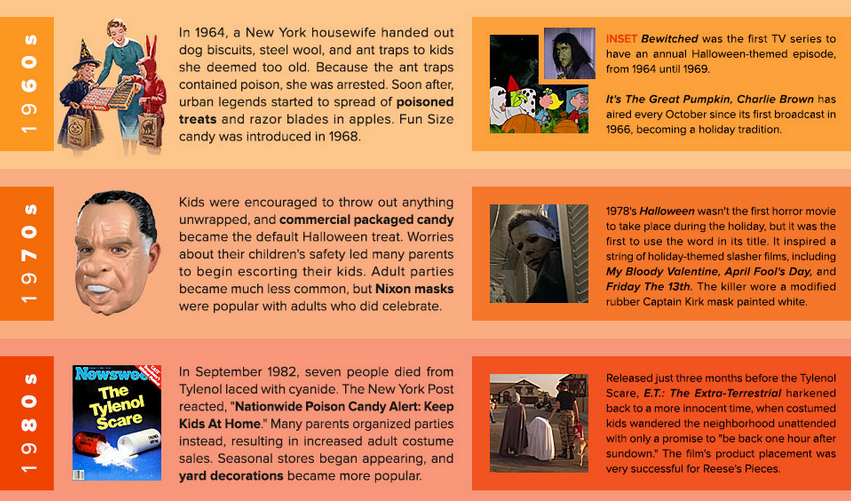
This year we found two new infographics to use with our learners. The first is The Evolution Of Halloween In North America. The timeline begins before 700 in three separate periods in history; from the 1900s to present, the timeline is arranged by decade.

Source: Halloween Costumes

The two-column layout of this infographic provides a visual connection between the history of the holiday and the literature and popular cultural aspects of the time. It’s perfect for scavenger hunts on the evolution of costumes, candy, and traditions.

Source: The Shelf

The other infographic that we thought educators would find useful is Trick Or Treat Your Way Into Halloween Sales Like A Pirate. The creator also designed \”min-fographics,\” perfect for educators to put into any presentation software. The whimsical and colorful display to illustrate the economics behind the holiday is sure to enhance any math lesson.


The different sections of this infographic also provide ideal opportunities for data analysis of charts and graphs. They are just the right mix of visually appealing graphics with real numbers to engage students in making comparisons regarding sales, percentages, popularity, and more.

Source: The Shelf

We firmly believe a little deviation away from the routine to keep students focused pays off in the long run. Using infographics reinforces graphicacy skills, incorporates a little media literacy using Halloween hype, and celebrates learning with a little fun.

New Media Literacy Skills Empower Learners

Source: MediaOcracy

Media Literacy Week just ended a little over a week ago. It could not have come at a more opportune time for our sixth- and seventh-graders to set up their Twitter accounts and participate in the KQED Do Now challenge called “How Does Social Media Influence Our Political Values.”

As part of the challenge, the students watched the video called “MediaOcracy” from the WeTheVoters, and they tweeted their responses to the guiding questions below with the hashtag #DoNowViews.

  • Does social media help or inhibit our ability to develop our own political values?
  • Are your social media networks actually shrinking your worldview?
  • What do you do now, or what can you start doing to make sure you are seeing all sides of an issue while on social media?

 MediaOcracy from We the Voters on Vimeo.

This eye-opening video made the students stop and think a good deal about how viewers could be so easily influenced through algorithms that deliver content from a single point of view, and moreover, how it often leads to a one-sided look at information. It unnerved them a little when they found out that “someone” was aggregating their search results based on likes. It also surprised many that 60% of Americans use social media to get their news.

Source: MediaOcracy

One important takeaway recommended in the video was to watch or listen to another media network that you “violently” oppose to avoid being caught up in a social media stream that feeds only what one wants to hear. With so many modern media outlets openly biased toward the right or left, it was important for these young minds to see the value in comparing information.

The media literacy program at our school has been in place for over 16 years, and it starts with the first graders. We’re fortunate, too, that our students are permitted to use social media for learning; it allows us to update our program to include new media literacy skills as part of the learning process. In an age of media bombardment, learners must be permitted to practice skills not only for today’s world, but also for their future.

The New Media Literacies video below drives this point home. In order for learners to be fully engaged with today\’s participatory culture, they need the social skills and cultural competencies to do it. It, therefore, must be integrated into the learning environment.

We witnessed first hand just how much it means for students to use their voices to express opinions in a world of shared content. Media is not just questioning the traditional types, such as newspapers, magazines, or websites. It’s participatory. They felt empowered to share their ideas with others and to follow what others had to say. Students need access to new media as it evolves in real time, their time, in order to be discerning learners.

NYSCATE 2016: Student Videos & Animations Empower Creativity


Creating videos and motion graphics nudges both students and teachers to blend a host of proficiencies. It involves visual design in colors and templates, just as it requires language skills of narration and storytelling. It supports key technological skills in manipulating online media, and it reinforces the importance of publishing in sharing child creations with peers and parents. Kids teaching kids is the purest model of learning. It is the model of the student-centered classroom, because they become the educators of their peers.


Video production allows students to stitch together a narrative and storyboard each moment in the process that combines logical reasoning, cause-and-effect, and content mastery. They also must employ their graphicacy skills to fashion compelling and appealing visual displays. These quick-cut movies and short animations combine icons and text to communicate a message. Explainer videos, for example, are perfect for the classroom. They blend voice, image, and language into compelling presentations for students to learn. Content created using app editors or motion graphics provides a way for the brain to receive information through both the eyes and ears. Learning tools that can tap into both modalities have greater effectiveness in fostering understanding. They add layers of meaning for nuanced, standards-based education.


It is important to employ interactive ways to engage and share student work that builds alternative ways for students to design content, collect feedback, and reflect on the creative process. This requires using resources that engage learners in the classroom much the way they are outside of it. The gradual spread of technology tasks is invariably shifting classroom education toward a more student-directed model. As we move more and more into the blended, flipped, and social world of learning, we need to encourage creative interactions and self-directed investigations with the knowledge that our students can be active participants in the education process.

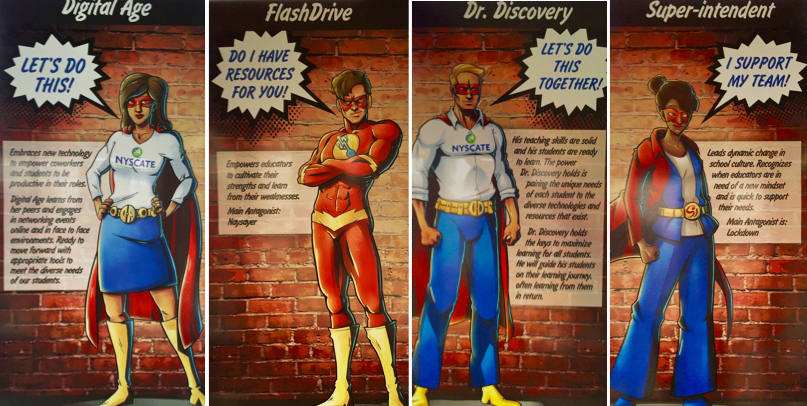
Unleash The Superhero In You – NYSCATE 2016

Source: NYSCATE


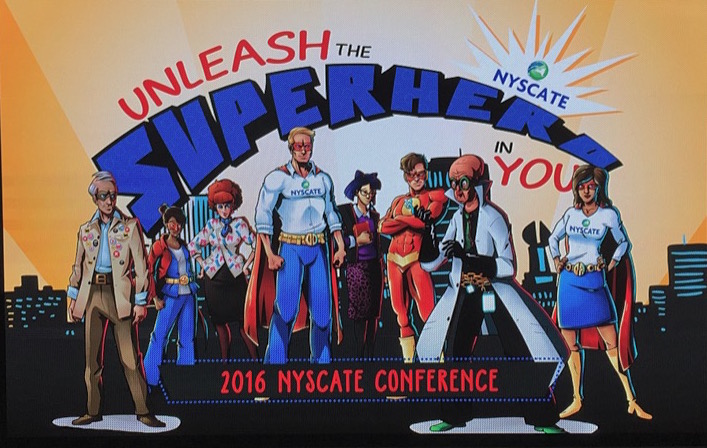
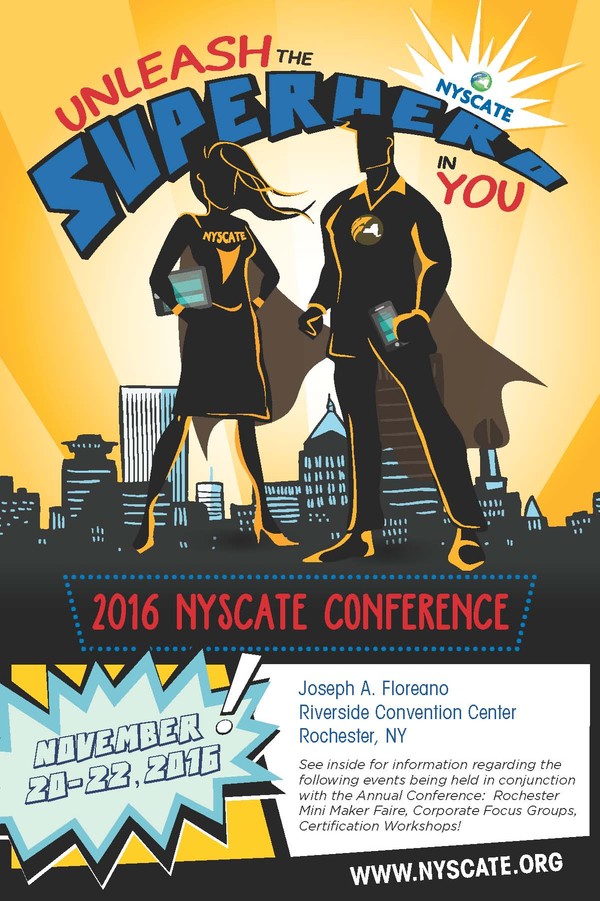
The theme for the 2016 annual conference of the New York State Association For Computers And Technologies In Education (NYSCATE) was \”Unleash The Superhero In You.\” This effective branding throughout the conference hall — and the colorful capes given to every attendee — spoke volumes to the notion of teachers as heroes in seizing opportunities and embracing technology, and often struggling against the curmudgeonly villains standing in their ways.

Source: NYSCATE

After three days of sessions and keynotes, kiosks and meet-ups, it was more clear than ever that educators are feeling they have the necessary tools to invigorate the learning potential of their students. Every teacher we met was excited to try a new web app or a backchannel to decentralize daily instruction. As Chromebooks catch up to (or surpass) iOS devices, the Google Apps For Education (GAFE) suite of tools is clearly permeating state-wide districts. As videos and online media put information squarely in the hands of learners, both children and teachers feel more empowered than ever to chart their own courses in meeting the various standards.

For our part, we are grateful to the 60+ participants who sat on the floor and stood against the walls for our presentation on Sunday, November 20, 2016, about “Student Videos & Animations Empower Creativity.” We apologize to those who were turned away for space reasons, and we have put all of our resources and slides online to share with any interested parties. Thank you to all of the attendees for the insightful questions and terrific recommendations about lessons and tools related to student projects and videos.

In hearing from the other experts in the terrific workshops during the conference, highlights that stood out included the tips on formative assessments from Steve Garton (@sgarton121) and Jeff Mao (@jmao121) of Common Sense Education, as well as the annual App Smackdown from Rich Colosi (@richardcolosi), Ryan Orilio (@ryanorilio), Mike Amante (@mamante), and Monica Burns (@classtechtips).

Other eye-opening sessions were engaging the writing process using Google Apps, WeVideo, and Recap with Megan Hugg (@Megan Hugg) and Lindsey Peet (@LindsMariePeet); liberating students from paper using ePortfolios with Betsy Hardy; and tapping the lesser-known features of Google with Carol LaRow (@larowc). Student coding, blended writing, and shared collaboration also emerged as recurring themes within the high-quality professional development. Perhaps the keynote comment by Adam Bellow (@adambellow) summed it up best, \”Technology does not drive change; it just enables it.\”

Source: ASIDE 2016


The lake-effect snowstorm that blanketed downtown may have kept some New Yorkers homebound, but it made for a tight-knit group in the warm confines of the Joseph A. Floreano Rochester Riverside Convention Center. It also meant that Dinosaur BBQ was blissfully quiet on Sunday night, as we savored our favorite fried green tomatoes and spicy pulled pork. Pane Vino on North Water Street continued to rank as one of the best restaurants anywhere in the nation. And we also recommend Starry Nites Cafe in the arts district as a short hop away for a quick latte and chicken chili after perusing handmade jewelry at Craft Company No. 6.

Finally, we want once again to give a big shout out of thanks to the NYSCATE conference organizers for all they did in staging this seamless annual get-together. The smoothy run sessions and the high-quality breakfast / lunch / dinner included in the overall fee, as well as the warm welcomes and conversations throughout the event, confirmed once again why this is the best confab of the year. See you in 2017.