Career options in India: Law as a career Option (Part 1)

The key reason that humans excelled compared to other species, or even managed to survive the harsh initial days on earth was their abilities to co-ordinate and stay in groups. For functioning of such groups, a set of rules must exist. Therefore, law is a field which is almost as ancient as the civilization. 
The first written instance of law came during the reigns of Hammurabi (18th century BC, Babylon). His laws were simple four lines, but it is a remarkable point in the history of civilization. For a long time the Kings usually kept the justice system under their thumb or let a council of his trusted ministers handle the affair.
Independent Judiciary
Needless to say, such a justice system was easily swayed by the ruling authorities or other influential few persons. Such a justice system can never be truly just. The concept of independent judiciary can be traced back to 18th Century England. One of the founding fathers of the United States Alexander Hamilton wrote in 1788 “The complete independence of the courts of justice is particularly essential in a limited constitution.” 
Such a judiciary can safeguard the people’s interests and rights and prevent any encroachment by the rulers of the country. Within this statement is the purpose and need of the judiciary system and this gives birth to various career options available in field of Law.
Career Options
The two main actors in a courtroom are the lawyers- who present various sides of the arguments in favor of their respective clients, previous precedence, constitution citations etc. and the judges who with or without assistance of a jury dwell into the arguments to decide upon a verdict so that the justice is provided.
Career as a Lawyer
Law as a profession is in great demand these days. With economic system and corporate world getting more and more complex, lawyers are required to a daily basis to interpret the law and it is no longer limited to traditional streams like civil or criminal. Now, lawyers can specialize in streams such as Criminal Justice, Civil Rights, Corporate Affairs, Taxation, Patent Law etc.
How to pursue a career in law?
Most popular way to pursue a career, one has to start with a good college. The tests can be taken post clearing 12th. The cut-off and other details can be obtained from the respective websites of the tests. The most popular Law entrance exams in India are-
i. CLAT- Common Law Admission Test. 21 national universities take admission through this test. (https://www.clat.ac.in/)
ii. AILET – All India Law Entrance Test is an exam conducted exclusively for National Law University (NLU) Delhi. (http://www.nludelhi.ac.in/)
iii. SLAT- For admission in Symbiosis Law School, Pune/Noida/Hyderabad (http://www.set-test.org/)
iv. LSAT – Law School Admission Test is conducted four times every year specially designed for LLB and LLM admissions.
 LSAT scores are accepted by more than 70 top institutes like Rajiv Gandhi School of Intellectual Property Law, IIT Kharagpur Law School, Galgotia University Law School, The Jindal Global Law School, UPES Dehradun, SRM University, Amity Law School and many more (http://www.pearsonvueindia.com/lsatindia/)
The top colleges as per the MHRD NIRF ranking (https://www.nirfindia.org/2019/LAWRanking.html) 2019 are-
1. National Law School of India University, Bangalore
2. National Law University, Delhi
3. Nalsar University of Law, Hyderabad
4. Indian Institute of Technology Kharagpur
5. The West Bengal National University of Juridical Sciences, Kolkata
6. National Law University, Jodhpur
7. Symbiosis Law School, Pune
8. Jamia Millia Islamia, Delhi
9. Gujarat National Law University, Gandhinagar
10. The Rajiv Gandhi National University of Law, Patiala
Job Opportunities
As discussed earlier, there are plenty of job opportunities in the area of Law and many more are being created as the world gets complicated. You may choose to practice on your own, join a law firm or join a corporate to advise them on daily matters. You may also choose to specialize for social issues like environment, labor laws, PLIs etc. If you give your heart and mind to a career in law, there is no way you will regret it.

NTA released UGC NET Examination Schedule

The National testing Agency (NTA) has released the UGC NET examination schedule for December 2019 and June 2020. Candidates can check the examination details on the official website of NTA, the link is nta.ac.in. This year the CSIR UGC NET examination will be conducted on 15th December 2019, while UGC NET examination will be held between 2nd to 6th December. The Online application process for December session will starts from 9th September. Aspirant will have one month time for registration as last date of registration is 9th October. Further, the hall ticket/admit cards will be available for download from November 9. 31st December will be the result day for both examination.

                      Source: Pexel

What is NTA
National Testing Agency (NTA) has been established as a premier, specialist, autonomous and self-sustained testing organization to conduct entrance examinations for admission/fellowship in higher educational institutions.The country`s top entrance/ competitive examinations such as Joint Entrance Examination (JEE)  mains, NEET (UG),  UGC NET etc  are conducted by the agency.
On behalf of UGC,  NTA conducts the National Eligibility Test (NET) for determining the eligibility of Indian nationals for the Eligibility for Assistant Professor only or Junior Research Fellowship & Eligibility for Assistant Professor Both in Indian Universities and Colleges. Earlier It was CBSE who conducted the NET in 84 subjects at 91 selected Cities of spread across the country.

Understanding NET and JRF
From Dec 2018, the UGC-NET (for Eligibility for Assistant Professor only or Junior Research Fellowship & Eligibility for Assistant Professor both), was conducted by the NTA. The award of JRF and Eligibility for Assistant Professor both OR Eligibility for Assistant Professor only depends on the performance of the candidate in both the papers of NET in aggregate. However, the candidates qualifying exclusively for Assistant Professor are not to be considered for award of JRF. Candidates who qualify the Test for eligibility for Assistant Professor are governed by the rules and regulations for recruitment of Assistant Professor of the concerned universities/colleges/state governments, as the case may be.


Examination Module
Mode: The Examination shall be conducted as Computer Based Test (CBT) only. 
Pattern: The test will consist of two papers. Both the papers will consist of objective type questions. There will be no break between papers. 

Paper 1
Marks- 100
Number of Questions- 50 
MCQ     — The questions will be generic in nature, intending to assess the teaching/ research aptitude of the candidate. It will primarily be designed to test reasoning ability, comprehension, divergent thinking and general awareness of the candidate.

Paper 2
Marks- 200
Number of Questions- 100
MCQ  —  This will be based on the subject selected by the candidate. 
Total duration–  03 hours without any break
Syllabi for all NET subjects can be downloaded from the UGC website: https://www.ugcnetonline.in/syllabus-new.php

What Are The Latest Advancement In Gaming Technology?

The gaming industry has seen a magnificent
development in technology over the decade. There have been some technologies in
3D and AI from the beginning and then there are others which have been
introduced in the past few years. These recent years have been really great for
the gaming industry. 
 

The video games industry has been with us from
the 1980s and some amazing advances have made the future of gaming even better.
The more you think about it, the more the people are getting crazier outside.
40 years ago, the people were playing pong but now is the time of virtual and
augmented reality. This jump is enormous for a very small amount of time. This
advancement explains how many users are interested in playing games all around
the world. 
Addicting games has led to this sudden
and fast advancement in the world of gaming. It used to be a kid thing when the
idea of gaming was introduced. But now, even the adults are showing their
interest in playing games. The difference between the graphics of the games on
the 80s and the games of today is just phenomenal. Nowadays, games are made in
a way that they feel so real and close to the real world. 
This has all been possible due to various latest
advancements in gaming technology.
Here are some of the latest advancement in
gaming technology:
Virtual reality:
If you are a dedicated gamer and looking for a
fully immersive experience, then you must allow yourself to enjoy the VR (Virtual
Reality). This technology has made gamers to experience something which was not
at all possible before. Although Virtual reality has been with us for many
years, recently it has been more collaborative. It is not one of those
experiences now as it used to be when players had no idea about it. 
It is no longer an experience of isolation. This
technology has added more fun to the actual gaming experience. You become a
part of the game and this way you experience something which had never been
experienced by you. 
Augmented Reality:
Well, what take things one step further than the
Virtual reality? The answer is Augmented reality. It allows gamers to interact
with their environment in real-time. AR makes it possible that you can play the
game in your physical environment. For example, there are car games which
allows you to play the game on roads in the real environment while overcoming
the obstacles and people in it. There are shooting games as well which allows
you to shoot the target with your smartphone. The latest example of such a game
is Wizards unite, which allows the users to throw magic spells on the wizards
using the smartphones. 
The latest advancement in this technology is the
wearable UI that can need to eliminate the need to point the objects using a
device.  
Amazing graphics:
The world of gaming has come a long way as
compared to the days of basic 8-bit graphics. The cutting-edge advancements
have made it possible for the new gamers to experience the games in the
completely restored worlds with realistic textures. This makes you feel like
you are inside the game and experience something mind-blowing. 
You are going to feel what the character is
feeling at that point of time or might even become the character itself. All
this has been possible due to amazing and real-time graphics.

High- definition displays:
The graphics of the game indeed needs to be good,
but you need to have some genuine way to show them off. Nowadays, there are
TV’s with 4K capabilities which means that it supports at 4000 pixels. The
price of this technology has dropped eventually as more and more people have
been using it. 
These televisions are providing the unbeatable
crispness and colors that there else which can come close. 8K Television sets
have also captured the markets and are changing the world of image
quality. 
Mobile gaming:
Smartphones are now what has become a necessity.
With the advent of smartphone technology, the gaming experience has been out of
the living room and arcade and has been into your hands. People commuting
through trains and buses in the morning are seen playing games in the morning
on their smartphone devices. 
People are no-more sitting in their living room
and playing console games or online games but are enjoying the digital gaming
in their hands. 
Gesture control:
Do you want to play the first-person shooter
games with real experience? Well, with the advancement in gaming technology,
this is now even possible. Just with a wave of a hand, you can play the games.
The
two
player games
of tennis and other racing games can be played with this
technology. 
The gesture control allows you to control the
natural movements being made in the game so that you can actually feel like the
part of the game and experience it closely. 
Conclusion:
The gaming is an industry which will evolve with
time and will continue to evolve in the future as well. The gaming industry is
taking big steps towards an unconquered territory, exploring and pushing the
limits. Let’s just sit back and take pleasure in experiencing the advancement
in the gaming industry. 

Why are there stones on railway tracks?

The train journey can be a very soothing and wonderful travel experience. However, most of us must have wondered at least once in our lives why there are stones on railway tracks. These crushed stones are called track ballast and they help keep the train tracks in place.

What is track ballast?

Track ballast is the collective term for the crushed stones on railway tracks. They form the trackbed and are packed around railway tracks. They form the ground for the railway sleepers which are used to keep the railway tracks upright and properly spaced.
Railway sleepers are the rectangular support piece kept perpendicular to the tracks. A railway sleeper is also called a railroad tie or a crosstie.
Sleepers used to be made of wood earlier but now they are mainly created with pre-stressed concrete.

Why is only a certain type of stone used on railway tracks?

Track ballast cannot be made with any kind of stone. If smooth, round pebbles like the ones on river beds or used for decoration were used on railway tracks, they might roll over or slide against one another when a train passed on the railway lines.
Thus, the wrong type of stone wouldn’t fulfil the main function of track ballast to provide support to the railway tracks. Only stones which wouldn’t move around much would suit the job.
That is why sharp edges stones are used on railway tracks for track ballast.

Other functions of track ballast

Apart from holding the railway lines in place and providing support for heavy trains to pass on, here are the other functions of the stones called track ballast:
1. The stones don’t allow vegetation to grow on railway tracks which could weaken the ground on which the railway lines run.
2. Track ballast also keeps water from reaching the track on a regular basis and softening the ground. It doesn’t completely seal off water from the railway tracks but it facilitates proper drainage beneath or around the tracks to ensure that the water doesn’t stay on it.

Technique used to minimise railway vibrations

The immense vibration of a passing train is a threat to nearby buildings apart from the loud noise which is a problem too.
Railways use a clamping technique to minimise vibrations consisting of EPDM or Ethylene Propylene Diene Monomer rubber which is highly resistance to heat, water and other mechanical strains. This helps noise and vibration to be reduced to a great extent.
Now that you know the crucial function of track ballast and why there are stones on railway tracks, make sure you don’t keep picking stones from the tracks to chuck them outside!

Filing Of Criminal Complaint For Settling Civil Dispute Is Abuse Of Process Of Law: SC

It must be mentioned explicitly right at the outset that in a latest, landmark and laudable judgment delivered by the Supreme Court in The Commissioner of Police & Ors Vs Devender Anand & Ors in Criminal Appeal No. 834 of 2017, a three Judge Bench of the Supreme Court comprising of Justice MR Shah, Justice Arun Mishra and Justice S Abdul Nazeer have held categorically and convincingly that filing of criminal complaint for settling a dispute of civil nature is abuse of process of law. This was held so while setting aside a High Court order issuing directions in a writ petition filed by the complainant. Very rightly so!
                               To start with, the ball is set rolling in para 1 of this noteworthy judgment authored by Justice MR Shah for himself, Justice Arun Mishra and Justice S Abdul Nazeer wherein it is observed that, “Feeling aggrieved and dissatisfied with the impugned judgment and order dated 13.01.2017 passed by the High Court of Delhi in Writ Petition (Cri.) No. 299 of 2016, the original respondents – appellants – Commissioner of Police and Others have preferred the present appeal.”
                                  While elaborating in detail, it is then pointed out in para 2 that, “That respondent No. 1 herein – original complainant entered into an agreement to sell in respect of house situated at WZ-179, Plot No. 11, Rani Bagh, Shakur Basti, Delhi with respondent Nos. 2 to 3 herein for a consideration of Rs. 54 lakhs. That the agreement to sell, general power of attorney etc. were executed and the entire amount of consideration of Rs. 54 lakhs was paid to the agreement sellers. According to respondent No. 1 – original complainant No. 1, subsequently on 31.07.2013, he learnt that the said property had been mortgaged to Andhra Bank when a notice by the said bank was affixed on the property. According to respondent No. 1 – original complainant, thereafter he was compelled to settle the claim of Andhra Bank to the tune of Rs. 16,93,059/- for release of the mortgaged documents. Respondent No. 1 – original complainant also paid the registration charges of Rs. 7,81,941/- for registration of the sale deed in his favour. That, thereafter he lodged a complaint with the Karol Bagh police station against respondent Nos. 2 and 3 herein for the offence under Section 420/34 of the Indian Penal Code alleging, inter alia, that though the property was put as a mortgage with the Andhra Bank, the same was not disclosed to him and without disclosing the same the property in question was sold. Therefore, it was the case of respondent No. 1 – original complainant that he was cheated by respondent Nos. 2 and 3 herein. That a preliminary inquiry was conducted on the said complaint by the Sub-Inspector of the Police posted at the Karol Bagh police station. According to the complainant, on 20.05.2015, the Sub-Inspector submitted his report that a prima facie offence under Section 420/34 IPC is made out. He sought permission to register a case under Section 420/34 IPC for further investigation. According to the complainant, the SHO concurred with the aforesaid conclusion in his noting dated 21.05.2015 and put up the matter before the ACP concerned. According to the complainant, the ACP also concurred with the said conclusion in his noting dated 25.05.2015. According to the complainant, despite the above, the FIR was not registered and the same Sub-Inspector Yogender Kumar of Karol Bagh police station started a fresh process of preliminary inquiry on the same set of facts. He concluded that since the complainant had given his consent to the registration of the sale deed and discharge of the liability of the bank, even though the said mortgage as revealed to him on 31.07.2013, therefore, no police action is required. The said file noting was concurred by the SHO with the diametrically opposite view taken by the Sub-Inspector Yogender Kumar earlier. The ACP also concurred with the view that only a dispute of civil nature has arisen and that a complaint be filed. It appears that thereafter the matter was placed before the Additional DCP who also concurred with the subsequent view that no case is made out against the accused, vide his noting dated 07.08.2015. That the said view was carried by the DCP/C and JCP/CR as well.”    
                                  Be it noted, it is then envisaged in para 2.1 that, “As the FIR was not registered against the accused for the offence under Section 420/34 IPC as alleged, respondent No. 1 herein approached the High Court by way of writ petition and prayed for the following reliefs:
‘1. Pass appropriate writ/order/direction thereby ordering appropriate action to be taken against the erring police officers, including but not limited to respondents No. 2 to 5, who are responsible for non-registration of the FIR in spite of a preliminary enquiry dated 20.05.2015 clearly submitting a finding that a cognizable offence under Section 420/34 of IPC was made out against respondents no. 6 and 7.
2. Pass appropriate writ/order/direction thereby quashing and declaring to be null and void the so-called second/subsequent undated report of preliminary enquiry, and the subsequent endorsements of the SHO. PS Karol Bagh dated 16 July 2015, the undated endorsement of the ACP (Karol Bagh Sub-Division) and the endorsement of DCP (Central) dated 7 August 2015 as the same are without any legal sanctity and have been created and brought into existence against the settled provisions of law and without following due process of law and in contravention of the procedure laid down by the Hon’ble Supreme Court in its judgment Lalita Kumari vs Government of U.P.
3.       xxx             xxx            xxx
4. Pass appropriate writ/order/direction thereby calling upon the office of the Commissioner of Police, New Delhi, to submit a report with respect to the relevant provisions of law under which his office has empowered the area ACP and DCP to approve registration of FIR, and upon submission of such a report, the vires and legality of the same be scrutinised as the same is in violation of the provisions of the Code of Criminal Procedure and the procedural guidelines laid down by the Hon’ble Supreme Court in the case Lalita Kumari vs. Government of U.P.
5. Pass appropriate writ/order/direction thereby directing the respondent no. 1 to hold an appropriate enquiry/investigation into the said circumstances under which the illegal and uncalled for second line of preliminary enquiry was initiated and carried out by the same officers, on the same facts and he may further be directed to submit a report of the said enquiry before this Hon’ble Court and take appropriate action by way of registration of cases, if required, and take all other necessary and proper actions in the matter against the officials found guilty in the matter.’”
                                      Do note, it is then also observed in para 2.2 that, “That the aforesaid prayers/reliefs were opposed by the appellants herein and respondent Nos. 2 and 3 herein. It was submitted that the original complainant had earlier preferred an application under Section 156(3) of the Cr.P.C. which came to be rejected by the learned Magistrate, vide order dated 27.03.2015 and that the said order was not assailed by the complainant and thereafter a fresh private complaint under Section 200 Cr.P.C. has been preferred which is pending before the learned Magistrate. It was also submitted on behalf of the original accused that the dispute is of a civil nature which is tried to be converted into criminal, which is nothing but an abuse of the process of law. It was submitted that despite having the knowledge of the mortgage of the property with the Andhra Bank, thereafter the complainant himself had paid the mortgage money to the Andhra Bank and even got the sale deed executed in his favour. It was submitted that if the complainant was aggrieved, in that case, he would not have got the sale deed executed in his favour.”    
                            Furthermore, it is then observed in para 2.3 that, “That, by the impugned judgment and order, the High Court has allowed the said writ petition and has directed that the case be placed before the Commissioner of Police for taking an action against respondent Nos. 3 to 5 therein (who are appellant Nos. 3 to 5 herein) for taking a diametrically opposite view. The High Court has also directed that the Commissioner of Police would be well advised to resort to course correction by directing that the earlier preliminary inquiry be taken to its logical conclusion and the steps in that regard be taken within two weeks. The High Court has also observed that the complainant shall also be entitled to costs quantified at Rs. 25,000/- to be paid by the State.”
                         It cannot be lost on us that it is then enunciated in para 4 that, “Having heard the learned counsel appearing on behalf of the parties at length and considering the material on record, we are of the opinion that the criminal proceedings initiated by respondent No. 1 – original complainant is nothing but an abuse of the process of law for settling a civil dispute.”
                               What’s more, it is then observed in para 4.1 that, “Even considering the nature of allegations, we are of the firm opinion that no case is made out for taking cognizance of the offence under Section 420/34 IPC. The case involves a civil dispute and for settling a civil dispute, the criminal complaint has been filed, which is nothing but an abuse of the process of law.”
                                  More importantly, para 4.2 then holds that, “It is required to be noted that after having come to know that the property was mortgaged with the Andhra Bank, the original complainant himself paid the mortgage money and got the mortgage redeemed. Not only that, thereafter, he got the sale deed executed in his name. Thereafter also, he filed the complaint with the learned Magistrate, being an application under Section 156(3) of the Cr.P.C., which came to be rejected by the learned Magistrate, vide order dated 27.03.2015. The said order was not assailed by the complainant. It appears that thereafter he filed a private complaint under Section 200 Cr.P.C. which was pending before the learned Magistrate. Despite the above, he filed a writ petition before the High Court, which is nothing but an abuse of the process of law. The criminal proceedings have been initiated by the original complainant to settle the civil dispute. Therefore, in the facts and circumstances of the case, the Investigating Officer and other police officers were justified in not registering the FIR and in coming to the conclusion that the complaint be filed. The earlier opinion on preliminary inquiry was never placed before the DCP. Thereafter, on thorough investigation/inquiry and considering the facts and circumstances of the case narrated hereinabove, when it was opined that the dispute between the parties is of a civil nature, the High Court ought to have closed the proceedings. Not only the High Court has issued further directions, but even has imposed costs and an action against the appellants 3 to 5 herein which, in the facts and circumstances of the case, is not sustainable.”  
                               Finally and perhaps most importantly, it is then held in the last para 4.3 that, “In view of the above and for the reasons stated above and as observed hereinabove, the initiation of the criminal proceedings by the original complainant is nothing but an abuse of the process of law, we not only quash and set aside the impugned judgment and order, but also quash the criminal proceedings pending before the learned Magistrate in respect of the transaction in question. Consequently, the present appeal is allowed, the impugned judgment and order dated 13.01.2017 passed by the High Court is hereby quashed and set aside. Even the criminal proceedings initiated by the original complainant pending before the learned Magistrate in respect of the transaction in question are hereby quashed and set aside.”
                                   In essence, we thus see that the three Judge Bench of the Apex Court in this latest, landmark and laudable judgment minces just no words to convey clearly that filing of criminal complaint for settling civil dispute is abuse of process of law! In doing so, it set aside the directions issued by the High Court! It held that no case was made out for taking cognizance of the offence under Section 420/34 IPC! Very rightly so! This should always be kept in mind by the litigants while they approach the courts! There can be just no denying it!
Sanjeev Sirohi, Advocate,
s/o Col BPS Sirohi,
A 82, Defence Enclave,
Sardhana Road, Kankerkhera,
Meerut – 250001, Uttar Pradesh.

Judge Can Recuse From A Case At His Own Volition, But Not At The Mere Asking Of Litigant: SC

In a significant development, it has to be mentioned right at the outset that the Supreme Court has in a latest, landmark and extremely laudable judgment titled Seema Sapra Vs Court On Its Own Motion in Criminal Appeal No(S). 1238 of 2019 (Diary No. 10342 of 2016) With (Interlocutory Application Nos. 128666/2017, 123144/2017, 122625/2017, 127773/2017, 30030/2018, 112422/2018 and 110313 of 2019) With Writ Petition (C) No. 13 of 2018 (alongwith C.M.P. No. 4015 of 2018 and Interlocutory Application Nos. 62789 of 2019, 99303 of 2019 and 61232 of 2019) & Writ Petition (C) No. 1027 of 2018 (alongwith C.M.P. Nos. 122904 of 2018 and 97450 of 2018) while rejecting a prayer seeking recusal of a Judge who is part of the Bench hearing an appeal explicitly held on August 14, 2019 that a Judge can recuse at his own volition, but need not at the mere asking of a litigating party. The concerned Judge has thus the discretion to grant or refuse the request of a litigating party seeking recusal and it is thus the prerogative of the concerned Judge on whether to heed or not to heed to such plea of recusal. Very rightly so!

To be sure, it was also clarified by the two Judge Bench of Apex Court comprising of Justice AM Khanwilkar and Justice Ajay Rastogi that recusal, at the asking of a litigating party cannot be countenanced unless it deserves due consideration and is justified. To arrive at this conclusion the Judges drew support from the exposition of the Constitution Bench in Supreme Court Advocates-On-Record Association Vs. Union of India. Very rightly so!
Be it noted, before the Supreme Court Bench hearing the appeal, a submission was made by Seema Sapra that she may not get justice from the Bench as Justice Khanwilkar is well acquainted with the Advocates who incidentally are members of the Supreme Court Bar Association against whom personal allegations have been made by her in the accompanying writ petition. It must be noted that the Bench of Justice Rastogi and Justice Khanwilkar were considering an appeal filed by Seema Sapra against the Delhi High Court judgment holding her guilty of having committed contempt of court. The Delhi High Court had imposed a punishment of imprisonment for a period of one month with a further direction restraining her to argue as an advocate or in-person, except in her defence, before any Bench of the High Court of Delhi or any Court or Tribunal subordinate to the High Court for a period of two years from the date of passing of the judgment. 
To start with, the ball is set rolling in para 1 of this noteworthy judgment wherein it is observed that, “The instant criminal appeal has been preferred under Section 19(1) of the Contempt of Courts Act, 1971 assailing the judgment of the High Court of Delhi dated 17th December, 2015 holding the appellant guilty of having committed contempt of Court and imposing punishment of imprisonment for a period of one month and a fine of Rs. 2,000/- (Rupees Two Thousand Only) to be deposited within a period of three months from the date of the order, failing which undergo a further term of imprisonment of one month with a further direction restraining the appellant to argue as an advocate or in-person, except in her defence, before any Bench of the High Court of Delhi or any Court or Tribunal subordinate to the High Court of Delhi for a period of two years from the date of passing of the impugned judgment dated 17th December, 2015.” Para 2 then states that, “The appellant had been exempted from surrendering vide order of the Chamber Judge dated 9th October, 2017. Notice was issued on the applications as well as on the appeal vide order dated 26th march, 2018, which has been duly served.”
As things stand, it is then brought out in para 3 that, “We have heard the parties. During the course of hearing, the appellant-in-person made an oral request that this Bench ought to recuse from hearing the matter which fact has been noted in our order dated 11th April, 2019 while reserving the order. The same reads thus:
“We have heard the petitioner in-person.
She is at liberty to file additional documents, which were referred to during the course of argument or any further document(s) which she intends to file.
She prays for four weeks’ time to do so.
Appropriate order will be passed after the additional document(s) are filed.
After hearing the petitioner in-person for almost two hours and this order being dictated, the petitioner submits that this Bench should not hear these matters.
Even this submission will be considered in the order that we may pass after considering the document(s).
Orders reserved.””
To put things in perspective, it is then envisaged in para 4 that, “Instead of filing additional documents in terms of the liberty given to the appellant in the aforementioned order, she moved an I.A. No. 62789 of 2019 in Writ Petition (C) No. 13 of 2018 on 12th April, 2019. We will take it up for consideration while dealing with the main writ petition in which the same has been filed. For the present, suffice to point out that one of the reliefs claimed in the said application is that the cases be listed before a Bench not comprising of one of us (A.M. Khanwilkar, J.). The appellant, however, mentioned the matter on 6th May 2019 to inform the Court about filing of the said application. Since the mentioning was done before a different Bench, the application could not be taken up for hearing and was directed to be listed on 2nd July, 2019. Again, on 2nd July, 2019, the cases were listed before a different Bench and not the same combination which had heard the matters on 11th April, 2019. It was, therefore, ordered that the cases be listed before the same Bench which had heard the matter on 11th April, 2019 and reserved order therein. Accordingly, the cases were listed on 12th July, 2019 before the specially constituted Bench. After hearing the appellant-in-person, the Court passed the following order:
“We have heard the petitioner-in-person on the applications for issue of appropriate directions/order and for modification of previous Court order, for over one hour.
After hearing the petitioner-in-person for quite some time, we asked her to confine her arguments to the issues which may require our consideration. She submitted that one of us (A.M. Khanwilkar, J.) should recuse. For that, she invited our attention to the averment made in I.A. No. 62789 of 2019 in particular. Such request cannot be accepted merely for asking by the petitioner-in-person. Reasons for not accepting that prayer will be elaborated in the order to be passed as noted in our previous order dated 11.04.2019.
It is open to the petitioner to file list of dates and/or any other relevant document(s), if she so desires. That be filed within two weeks.
We reiterate that all aspects will be considered and appropriate orders passed on the concerned proceedings, to be pronounced later.””
To say the least, it is then pointed out in para 5 that, “We must, at the outset, deal with the gravamen of the apprehension of the appellant as to why she has insisted for recusal of one of us (A.M. Khanwilkar, J.). Even on a liberal reading of the averments in the stated application, the apprehension of the appellant is founded on the allegation that she may not get justice from the Bench as Justice A.M. Khanwilkar is well acquainted with the Advocates who incidentally are members of the Supreme Court Bar Association against whom personal allegations have been made by her in the accompanying writ petition.”
What’s more, it is then pointed out in para 6 that, “We may usefully refer to Court On Its Own Motion Vs. State [MANU/DE/2758/2007] (paragraph 28), in which it has been observed as follows:
“The path of recuse is very often a convenient and soft option. This is especially so since a Judge really has no vested interest in doing a particular matter. However, the oath of office taken under Article 219 of the Constitution of India enjoins the Judge to duly and faithfully and to the best of his knowledge and judgment, perform the duties of office without fear or favor, affection or ill will while upholding the constitution and the laws. In a case, where unfounded and motivated allegations of bias are sought to be made with a view of forum hunting/Bench preference or brow-beating the Court, then, succumbing to such a pressure would tantamount to not fulfilling the oath of office.”
It is also pertinent to remind ourselves of the dictum of Lord Denning who observed in R. Vs. Metropolitan Police Commissioner ex p. Blackburn (1968) 2 All ER 319 as under:
“All we would ask is that those who criticize us will remember that, from the nature of our office, we cannot reply to their criticism. We cannot enter into public controversy. Still less into political controversy. We must rely on our conduct itself to be its own vindication. Exposed as we are to the winds of criticism, nothing which is said by this person or that nothing which is written by this pen or that, will deter us from doing what we believe is right; nor, I would add, from saying what the occasion requires provided that it is pertinent to the matter in hand. Silence is not an option when things are ill done.”” 
It cannot be lost on us that it is then pointed out in para 7 that, “Reverting to the present cases, it is noticed from the impugned judgment that around 28 Judges of the High Court of Delhi, who had heard the writ petition filed by the appellant, had to recuse by the time the writ petition was finally decided on 2nd March, 2015. Even after filing of the instant criminal appeal at least three Judges of this Court have recused themselves, for one reason or the other. Not only that, the appellant had moved a formal application being the present appeal to recall the order passed on 7th February, 2018 appointing Senior Advocate Mr. Vikas Singh as Amicus Curiae, as she had strong objection to his appointment. Similarly, the appellant had filed I.A. No. 111244 of 2017 for recall of order dated 27th October, 2017 appointing Ms. Pinky Anand, learned Additional Solicitor General to assist the Court as Amicus Curiae. That application was also allowed by this Court vide order dated 4th December, 2017.”
As it turned out, it is then unfolded in para 8 that, “Be that as it may, after the matter was assigned to this Bench during the hearing, which lasted for more than two hours on 11th April, 2019, the appellant had orally suggested that this Bench should not hear the cases as has been noted in the said order. On that day, the Court reserved its order giving liberty to the appellant to file additional documents to reinforce her arguments on the merits of the contempt proceedings, as insisted by her during the oral submission. Instead of availing of that liberty, the appellant chose to file I.A. No. 62789 of 2019 in Writ Petition (C) No. 13 of 2018 praying for recusal of one of us (A.M. Khanwilkar, J.). However, keeping in mind the totality of the situation, the Court declined her prayer as recorded in the order dated 12th July, 2019.”
More importantly, it is then very rightly pointed out in para 9 that, “Indubitably, it is always open for a Judge to recuse at his own volition from a case entrusted to him by the Chief Justice. But, that may be a matter of his own choosing. Recusal, at the asking of the litigating party, cannot be countenanced unless it deserves due consideration and is justified. We draw support from the exposition of the Constitution Bench in Supreme Court Advocates-On-Record Association and Another Vs. Union of India [(2016) 5 SCC 808]. It must never be forgotten that an impartial Judge is the quintessence for a fair trial and one should not hesitate to recuse if there are just and reasonable grounds. At the same time, one cannot be oblivious of the duty of a Judge which is to discharge his responsibility with absolute earnestness, sincerity and being true to the oath of his/her office. After perusal of the assertions made in the stated I.A.s, we have no hesitation in observing that the same are devoid of merit and without any substance. To observe sobriety, however, we say no more.” 
In essence, what is stated in para 9 is the crux of this extremely laudable and noteworthy judgment! It sends an unmistakable message to one and all that a Judge can recuse from a case at his own volition but not at the mere asking of a litigant. It also sends a loud and clear message that a Judge should not hesitate to recuse if there are just and reasonable grounds! Very rightly so! It is for the Judge and not the litigant who has to decide whether the Judge should recuse in a particular case or not!
Sanjeev Sirohi, Advocate,
s/o Col BPS Sirohi,
A 82, Defence Enclave,
Sardhana Road, Kankerkhera,
Meerut – 250001, Uttar Pradesh.

Second Appeal Not To Be Dismissed Merely On The Ground Of ‘Concurrent Findings’: SC

It would be imperative to mention right at the outset that the Supreme Court has just recently on August 14, 2019 in State of Rajasthan & Ors. Vs Shiv Dayal & Anr. in Civil Appeal No. 7363 of 2000 With Civil Appeal No. 7364 of 2000 And Civil Appeal No. 7365 of 2000 has laid down in no uncertain terms that a High Court cannot dismiss a second appeal merely on the ground that there is a concurrent finding of two Courts (whether of dismissal or decreeing of the suit), and thus such finding becomes unassailable. It must be pointed out that in this case, the Rajasthan High Court Bench at Jaipur dismissed a second appeal filed by the State on the ground that since two Courts have decreed the suit, resulting in passing of the decree against the State, there arises no substantial question of law in the appeals. But the Supreme Court differed with this approach!
                                To start with, this latest, landmark and laudable judgment authored by Justice Abhay Manohar Sapre for himself and Justice R Subhash Reddy sets the ball rolling by first and foremost pointing out in para 1 wherein it is pointed out that, “These appeals are directed against the final judgment and order dated 23.03.1999 passed by the High Court of Judicature for Rajasthan Bench at Jaipur in S.B. Civil Second Appeal Nos. 83, 84 and 85 of 1999 whereby the High Court dismissed the second appeals filed by the appellants herein.”
                               Briefly stated, para 2 then points out that, “A few facts need mention hereinbelow for the disposal of these appeals, which involve a short point.” Para 3 then discloses that, “The appellants are the defendants and respondent No. 1 is the plaintiff in the civil suit out of which these appeals arise.” Para 4 further discloses that, “The appellant No. 1 is the State of Rajasthan and respondent No. 1 claims to be the mining lessee in relation to the suit land under the Mines and Minerals (Development & Regulation) Act (hereinafter referred to as “MMRD Act”).”
                                      Truth be told, it is then unravelled in para 5 that, “The respondent No. 1 filed a civil suit against the appellant – State and its authorities and claimed therein a relief of grant of permanent injunction restraining the State and its authorities from interfering in carrying out the mining operations on the suit land by respondent No. 1.” Para 6 then further elaborates saying that, “Respondent No. 1 claimed this relief inter alia on the averments that the suit land was not the part of any protected Forest area as claimed by the State authorities but it was a part of the Revenue area. It was averred that since the suit land did not fall in the protected forest area, the respondent No. 1 (plaintiff) had a right to carry out mining operation on the suit land without any interference of the State and its authorities.”  
                                  Be it noted, para 7 then clearly states that, “The State contested the suit by denying the averments made in the plaint. The Trial Court frmaed issues. Parties led their evidence. By Judgment and decree dated 10.05.1998, the Trial Court decreed in favour of the plaintiff in the suit and granted an injunction against the State and its authorities in relation to the suit land, as prayed in the plaint.”
                             As a consequence, we then find palpably what is stated in para 8 that, “The State felt aggrieved and filed first appeal before the District Judge. By Judgment dated 03.09.1998, the first Appellate Court dismissed the appeal and affirmed the judgment/decree of the Trial Court giving rise to filing of the second appeals by the State in the High Court.”     
                                   What follows next is elaborated in para 9 which reveals that, “By impugned order, the High Court dismissed the second appeals holding that the appeals did not involve any substantial question of law. It is against this order, the State felt aggrieved and has filed the present appeals by way of special leave before this Court.”
                         Shortly put, it is then asked in para 10 that, “So, the short question, which arises for consideration in these appeals, is whether the High Court was justified in dismissing the State’s second appeals on the ground that these appeals did not involve any substantial question of law.”
                            Do note, para 12 then illustrates stating that, “Having heard the learned counsel for the parties and on perusal of the record of the case, we are constrained to allow the appeals, set aside the impugned order and remand the case to the High Court for deciding the second appeals afresh on merits in accordance with law.”   
                      While elaborating further, it is then observed in para 13 that, “In our opinion, the need to remand the case to the High Court has arisen because we find that the second appeals did involve several substantial questions of law for being answered on merits in accordance with law. The High Court was, therefore, not right in so holding.”
                                 Going forward, it is then stipulated in para 14 that, “Indeed, we find that the High Court dismissed the second appeals essentially on the ground that since the two Courts have decreed the suit, no substantial question of law arises in the appeals. In other words, the High Court was mostly swayed away with the consideration that since two Courts have decreed the suit, resulting in passing of the decree against the State, there arises no substantial question of law in the appeals. It is clear from the last paragraph of the impugned order, which reads as under:
         “Under these circumstances, when both the Ld. Courts have arrived at the conclusion that the disputed area is outside the forest area. Therefore, the principles laid down in T.N. GODAWARAN vs. U.O.I. (above-quoted) cannot be enforced in this appeal.”
                                                 (Emphasis supplied).” 
                                       What’s more, it is then made amply clear in para 15 that, “We do not agree with the aforementioned reasoning and the conclusion arrived at by the High Court.” Also, the Apex Court then seeks to make it clear in para 16 that, “It is not the principle of law that where the High Court finds that there is a concurrent finding of two Courts (whether of dismissal or decreeing of the suit), such finding becomes unassailable in the second appeal.”
                                       Not stopping here, it is then further clarified in para 17 that, “True it is as has been laid down by this Court in several decisions that “concurrent finding of fact” is usually binding on the High Court while hearing the second appeal under Section 100 of the Code of Civil Procedure, 1908 (hereinafter referred to as “the Code). However, this rule of law is subject to certain well known exceptions mentioned infra.”
                                       Needless to say, para 18 then holds that, “It is a trite law that in order to record any finding on the facts, the Trial Court is required to appreciate the entire evidence (oral and documentary) in the light of the pleadings of the parties.” In a similar vein, para 19 too holds that, “Similarly, it is also a trite law that the Appellate Court also has the jurisdiction to appreciate the evidence de novo while hearing the first appeal and either affirm the finding of the Trial Court or reverse it.”
                                 Moving on, para 20 then says, “If the Appellate Court affirms the finding, it is called “concurrent finding of fact” whereas if the finding is reversed, it is called “reversing finding”. These expressions are well known in the legal parlance.”
                                  It would be pertinent to mention here that the Apex Court then observes in para 21 that, “When any concurrent finding of fact is assailed in second appeal, the appellant is entitled to point out that it is bad in law because it was recorded de hors the pleadings or it was based on no evidence or it was based on misreading of material documentary evidence or it was recorded against any provision of law and lastly, the decision is one which no Judge acting judicially could reasonably have reached. (see observation made by learned Judge – Vivian Bose, J. – as his Lordship then was a Judge of the Nagpur High Court in Rajeshwar Vishwanath Mamidwar & Ors. vs. Dashrath Narayan Chilwelkar & Ors., AIR 1943 Nagpur 117 – Para 43).”
                                 Frankly speaking, it is then made clear in para 22 that, “In our opinion, if any one or more ground, as mentioned above, is made out in an appropriate case on the basis of the pleading and evidence, such ground will constitute substantial question of law within the meaning of Section 100 of the Code.”
                            To put things in perspective, it is then held in para 23 that, “Coming to the facts of the case, we are of the view that the following are the questions which do arise for consideration in the suit/appeal for proper adjudication of the rights of the parties to the suit and are in the nature of substantial questions within the meaning of Section 100 of the Code.”
                               To be sure, let us now discuss them turn by turn. To begin with, para 24 while laying the groundwork points out that, “First, whether the suit land was a part of a protected Forest area, i.e., Forest land and, if so, whether the parties satisfied all the statutory provisions of the Forest Laws enacted by the Center and the State?” Para 25 then further states that, “Second, whether the suit land was a part of a Revenue land and, if so, whether the parties to the suit satisfied all the statutory provisions of the State Revenue Laws.”
                                     Furthermore, para 26 then envisages that, “Third, whether a mining lease of the suit land could be granted by the State to the plaintiff for carrying out the mining operation in accordance with the provisions of the MMRD Act and, if so, whether it satisfied all the statutory provisions of the MMRD Act read with relevant Forest and Revenue Laws.” Para 27 then says that, “Fourth, whether a suit is hit by any provision of Forest Laws or MMRD Act or/and Revenue Laws expressly or by implication.”
                                            Now turning to the last question, it is then postulated in para 28 that, “Lastly, whether the plaintiff on facts/evidence has proved that the suit land is a part of Revenue land and, therefore, it does not fall in the protected forest area and, if so, whether any prima facie case, balance of convenience and irreparable loss is made out for grant of permanent injunction in plaintiff’s favour?”
                      To put it succinctly, it is then held by the Apex Court in para 29 that, “In our opinion, all the five questions enumerated above did arise in the suit. As a matter of fact, the suit could not have been tried properly without deciding these questions in the light of the pleadings, evidence and the applicable laws mentioned above.”
                                  Suffice it to say, it is then very rightly held in para 30 that, “In our view, the High Court, therefore should have admitted the second appeal by framing appropriate substantial question(s) of law arising in the case and answered them on their respective merits rather than to dismiss the appeals without considering any of the aforementioned questions.”
                                  As a corollary, it is then aptly said in para 31 that, “It is for this reason, we are of the view that the interference in the impugned order is called for to enable the High Court to decide the controversy in its proper perspective.”
                                       In a nutshell, it is then held in para 32 that, “In the light of the foregoing discussion, the appeals succeed and are accordingly allowed. The impugned order is set aside. The case is remanded to the High Court for deciding the second appeals afresh on merits after framing appropriate substantial questions of law(s) arising in the case.”
                                 Interestingly enough, it is then clarified in para 33 that, “Needless to say, the High Court will frame proper questions keeping in view the pleadings/evidence and the findings of two Courts in the context of relevant provisions of the specific Forest Acts (Centre and State), MMRD Act and State Revenue Laws.” It is also then clarified further in para 34 that, “We, however, make it clear that we have not expressed any opinion on the merits of the case having formed an opinion to remand the case to the High Court for deciding afresh.”
                                More significantly, the Apex Court then makes it clear in para 35 that, “It was, however, brought to our notice that during pendency of the appeals Shiv Dayal-plaintiff/respondent No. 1 in civil suit has expired. We, however, find that his wife – Smt. Kasturi Devi is already on record in two connected appeals/civil suits; Second, all the three suits/appeals, i.e., the one filed by Shiv Dayal and two filed by his wife Kasturi Devi were clubbed together for their analogues disposal; Third, when one legal representative of the deceased is already on record, the appeal would not abate; and lastly, when the remand of the case is directed, consequential steps to bring remaining legal representative of the deceased on record, if there are, can always be taken before the High Court in pending appeals. It is for these four reasons, we are of the view that the appeals filed against Shiv Dayal have not abated.”
                                         It cannot be lost on us that para 36 then makes it clear that, “The parties are, however, granted liberty to make necessary amendments in the cause title of the second appeals after remand of the case to the High Court by deleting the name of Shiv Dayal and substitute in his place the name of his wife-Kasturi Devi and his other legal representatives, if there are, before hearing of the second appeals.” Lastly, it is then held in para 37 that, “We request the High Court to expedite the hearing of the appeals preferably within 6 months.”
                           All said and done, this latest, landmark and laudable judgment leaves no one in doubt that second appeal is not to be dismissed merely on the ground of concurrent findings of two Courts (whether of dismissal or decreeing of the suit). All the courts must always keep this in mind while deciding on such cases! This would be certainly the right approach also! This would save them also from getting a rap on the knuckles by the top court!
                                  While disagreeing with the Rajasthan High Court Bench at Jaipur for dismissing the second appeal filed by the appellant on the ground of concurrent findings, the Apex Court set aside the Rajasthan High Court Jaipur Bench order and remanded the matter to consider it afresh. Very rightly so! There can be no denying it!      
Sanjeev Sirohi, Advocate,
s/o Col BPS Sirohi,
A 82, Defence Enclave,
Sardhana Road, Kankerkhera,
Meerut – 250001, Uttar Pradesh.  

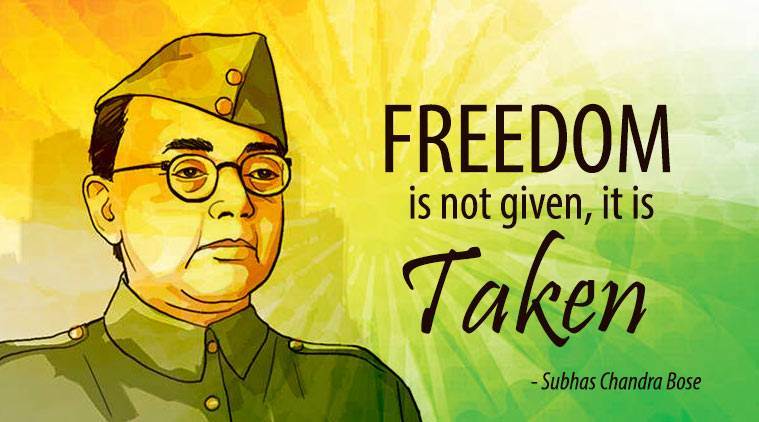
Death of Netaji Subhas Chandra Bose

 One of the
greatest selfless leaders with vision during freedom movement was Netaji Subhas
Chandra Bose. It is believed that he died on 18 August 1945 (today’s date) after
his Japanese plane crashed in Japanese-occupied Formosa (now Taiwan). However,
many Indians refused to believe the circumstances of his death.
 Conspiracy theories appeared within hours of
his death and have persisted since then, keeping alive various myths. Whether
he died in plane crash or not but considering his date of birth, 23 January
1897 now his chance of survival is bleak.

Netaji Subhas with heart and soul was
Indian and he never tolerated any foreigner talking against Indians. In this
context an incident may be mentioned. He beat a British Professor E.F. Otten in
the Presidency College of Calcutta in 1916 for Prof Otten’s racist remark
against Indians and for this Subhas Chandra had to suffer also, however with
the intervention of Indian scholars and others, the matter was resolved. Subhas
Chandra was a brilliant student and his brilliancy may be assumed when he went
to England in 1919 to compete Indian Civil Service (as desired by his parents)
and subsequently in 1920, he came out fourth in order of merit with highest
mark in English but he was deeply disturbed by the Jallianwalla Bagh massacre
and left his Civil Service probation in midway and returned India. After
returning, Subhas Chandra joined Indian National Congress subsequently, he started
working under Deshbandhu Chittaranjan Das, whom he always respected as
political mentor. In those days Netaji and other youth leaders were in favour
of complete freedom but other  leaders
were in favour of
  “dominion status
for India within the British rule” and this difference sharply cropped up
in
  1928 Gauhati (now Guwahati) Session
of the Congress.

    While Subhas Chandra Bose was Congress President
many admired him for his vibrant role and that is why he was elected President
of Indian National Congress for two consecutive terms but had to resign in the
mid of second term due to ideological difference with Gandhiji as Mahatma
Gandhi’s preferred candidate Pattabhi Sitaramaiah was defeated.  Total votes pulled by Subhas Chandra were
1580 against 1375 by Sitaramaiah. Gandhiji was upset for his candidate’s defeat
and openly ventilated his dissatisfaction albeit
Subhas Chandra was democratically elected. It is believed that albeit Pattabhi Sitaramaiah was a Telugu person
hailing from southern part of India but many persons of southern region of
India voted in favour of Netaji Subhas. Anyhow, while Netaji was Congress
President many remarkable works were carried out under his leadership – one was
his initiative to keep Assam with India as then Muslim League leaders’ had
different game plan. In 1938, Assam was passing through a great political
turmoil as there was a serious political problem – Muslim League vs. Congress.
During that time, Gopinath Bordoloi invited Subhas Chandra Bose (President of
Congress that time) to visit Assam so that chaotic political situation is
settled. Subhas Chandra immediately rushed to Assam and strongly advocated the
formation of the ministry under the leadership of Gopinath Bordoloi.  As a sequel, Assamese youths were happy and a
booklet on Subhas Chandra was published by some enthusiastic students of Cotton
College in 1939, under the umbrella of All Assam Progressive Youth Association
(AAPYA, formed that time). Further, they decided to invite Subhas Chandra Bose
to inaugurate the association, which he gladly accepted.
   While Netaji Subhas Chandra Bose was Head of
Indian National Army (INA) or Azad Hind Fauj, Dr. (Mrs.) LakshmiSwaminathan met
him in Singapore and decided to join in the freedom movement as she was
impressed with the charismatic speech of Netaji Subhas. She as   Captain Lakshmi    headed a regiment called Jhansi Rani Laxmi
Bai Regiment.  It was the first regiment
headed by a lady in Asia. Later on, she married to Colonel Prem Kumar Sahgal
(leading personality of INA) and subsequently known as Dr. Lakshmi Sahgal.  From historical documents etc. it is evident
that Netaji’s contribution in freedom movement is immense. In this context Clement
Richard Attlee, who was the Prime Minister of the United Kingdom from 1945 to
1951 and the Leader of the Labour Party from 1935 to 1955 may be quoted, “Netaji
was the toughest challenge to the British Empire faced”.
Open Editorial Article contributed by 
Dr. Shankar Chatterjee

Former Prof &Head (CPME)
NIRD &PR, Hyderabad-500 030, Telangana, India
E-mail: <shankarjagu@gmail.com>

‘India’s participation at WorldSkills International Competition must be seen as big as the Olympics’

The 48-member Indian Team representing the country at WorldSkills Kazan 2019 was given a grand send-off at a ceremony in the capital today, organized by National Skill Development Corporation (NSDC) under the aegis of Ministry of Skill Development and Entrepreneurship (MSDE), to motivate the participants as they gear up to pit their skills against the best in the world. India is the sixth largest team that will take part in the competition.

Nearly 1,500 competitors from 60 countries will compete in 56 skill competitions at this mega event in Kazan, Russia on August 22-27. The 48-member Indian team will participate in 44 skills, including mobile robotics, prototype modelling, hairdressing, baking, confectionary & patisserie, welding, brick laying, car painting, floristry, etc. Forty-four experts and 14 interpreters are also accompanying the participants to Kazan. In 2017, a 28-strong contingent took part in the WorldSkills International at Abu Dhabi, winning one silver, one bronze and nine Medallions of Excellence.
Addressing the candidates Dr. Mahendra Nath Pandey, Minister for Skill Development and Entrepreneurship, said, “My heartiest congratulations to the 48 of you who have proven your mark at the national level. You all will now represent the country at the world’s biggest skill competition in Russia. My advice to you is to compete in the true spirit of participation and make India proud on the global platform and at the same time learn from your international peers competing with you. You are the brand ambassadors of India and your victory will be an inspiration for every Indian youth who aspires to make it big in their life. Participating at events of such scale adds to the larger cause of skill development which is integral to Prime Minister, Shri Narendra Modi’s vision of a Skilled India.”
“I am happy to learn that we have six young girls also bearing the flag of the country at Kazan. I am positive you will inspire many more and we will see increased female participation in the years to come. I also hope with Team India’s participation at WorldSkills, the event will gain the same level of popularity in the country, as the Olympics and the Asian Games,” he added.
The desire to excel in the trades of their choice has played a crucial part in the candidates realising their dream of performing at a global stage. Mohammed Rabith from Malappuram, Kerala is one such example of grit and determination. The 22-year-old whose father works as a coolie and mother is a homemaker, aims to make his parents and his country proud by winning the gold medal in Wall & Floor Tiling Skill at the WorldSkills. Stories like Rabith are abound in the Indian team, where the spirit of youth is motivated by aspiration and the desire to excel.
Himanshu Vohra, a final-year civil engineering student from Chitkara University in Punjab, is representing India in Plumbing and Heating Trade. Himanshu’s passion and interest in plumbing has taken him to multiple competitions, including Global Skills Competition in Australia, before he found himself as a contender for the WorldSkills in Russia.
About 75% participants come from tier II and tier III cities, with 25% from rural areas. Most belong to humble backgrounds, parents work as farmers, coolie, daily wage laborers and security guards. Among states/UTs, Maharashtra tops the chart with seven contestants participating in the competition, followed by five from Karnataka and four from Uttar Pradesh. Over 50,000 youth had registered for the IndiaSkills Competitions that was organized across several legs last year.
Participants spoke about their experiences at the send-off. Present among the audience were proud parents who greeted them with loud cheers as the Minister felicitated all 48 contestants.
The 48 contestants have been shortlisted through a series of contests conducted at district, state, regional and national levels over the past year. These candidates were provided extensive training in skills ranging from Wall and Floor Tiling, Brick Laying, Cabinet Making, Car Painting, CNC Turning, Hair Dressing, Welding, Restaurant Service, Beauty Therapy, Auto-body Repair to Mobile Robotics, Mechatronics, Prototype Modelling, Visual Merchandising, etc, by leading corporate entities with NSDC acting as a facilitator and have been gained extensive support from Sector Skill Councils, Industry and Corporates.
Candidates have been exposed to international training with industry support from over 100 companies. More than 100 companies have Renowned experts such as Vinesh Johny – Chef/Trainer, winner of Forbes 30-under-30; Samantha Kochhar, renowned beauty expert and director of Aroma Magic; JP Shroff, Chairman of Kushal Credai; Seema Jhaveri, Director of IFD and Vaishali Shah, Principal of LTA Beauty School came together to prepare the contestants for the mega-event. Leading organisations such as Maruti, Mahindra, Toyota, Daikin, Saint Gobain, Tata Motors are among the 100+ partners which have extended support via infrastructure, equipment, expert trainers, facilities, training and more.
Aimed at promoting world-class standards in technical education and vocational training, NSDC, under the aegis for MSDE, is working to make skills aspirational and create a pathway for a career in vocational trades. 

Abolition of Triple Talaq will ensure dignity and equality to crores of Muslim women

Union Minister of Home Affairs Shri Amit Shah addressed an audience on “Abolition of Triple Talaq – correction of a historic wrong” at the Constitution Club of India earlier today.
Tracing the journey of the Act, Shri Shah said that he had spoken on the issue of Triple Talaq when it was in the ordinance format and when it was a bill. He said that it was a proud moment for him to speak of the issue of Triple Talaq when it had finally been enacted by the Parliament.

Blaming the policy of appeasement for the opposition to the removal of Triple Talaq, he said that while removal of social evils is generally welcomed by society, it was appeasement that led to some opposition to the move.
Shri Shah asserted that social unity and holistic development are hampered because of appeasement. He said that development of an entire society takes hard work and rigorous planning, and requires dedication, commitment and empathy. Calling appeasement a “shortcut”, he said that appeasement never leads to development.
Shri Shah said that those who are left behind in the journey of development must be empowered, and that holistic, all-encompassing, last-mile development is the philosophy of the government under the leadership of Prime Minister Shri Narendra Modi.
Giving the examples of nations that had abolished Triple Talaq, Shri Shah said that several Islamic nations had already taken the step decades ago, and this proves that such a barbaric practice is not part of Islamic culture.
Praising the tenacity and decisiveness of the government, Shri Shah said that the road to ending Triple Talaq was not easy, as the Bill was not able to pass through Rajya Sabha multiple times. However, the government persisted with the passage of the Bill and was ultimately successful.
Commenting on the Constitutional Status of the issue, Shri Shah said that a five judge Constitution Bench had pronounced with a majority of 3-2 that the practice of Triple Talaq violates Article 14 of the Constitution – Equality before the law and equal protection of the law. Thus, Supreme Court itself has declared the practice of Triple Talaq to be illegal, unconstitutional, arbitrary and void.
Shri Shah said that a soicety must progress with time, otherwise it becomes stale. He also said that the abolition of Triple Talaq would ensure dignity and equality for crores of Muslim women.
Commenting on the aspect of imprisonment for the violation of the Act, Shri Shah remarked that the correction of many social evils required the application of criminal laws – from Sati Pratha and child marriages to polygamy and dowry.
Regarding the maintenance of the aggrieved wife and children, Shri Shah said that the husband will be required to provide for the wife he divorces through Triple Talaq, as well as their children.
Shri Shah said that the law stipulates 3 years of imprisonment for violators, and bail is possible only after the aggrieved woman has had a chance to present her side to the court. Thus, this law empowers Muslim women in the truest sense of the word. Commenting on the results of a survey, Shri Shah said that 92.1% Muslim women wanted Triple Talaq gone.
He said that he was proud of having voted against ending the social evil of Triple Talaq.
Shri Shah observed that nepotism, casteism and appeasement have collectively damaged the nation’s polity, and emphasized that under the leadership of Prime Minister Shri Narendra Modi, the government had taken steps to remove all three from India’s polity.
Shri Shah stated that with the passage of the Act, the Prime Minister’s promise to the nation stands fulfilled. He also said that the world looks up to India with respect because of this move.
He remarked that great social reformers like Raja Rammohan Roy, Jyotiba Phule, Kavi Narmad Mahatma Gandhi, Veer savarkar and Dr Ambedkar have all contributed to uplifting our society and removing social evils. He said that Prime Minister Shri Narendra Modi’s name would find a place in the list of great social reformers because of his leadership in the quest for abolishing the practice of Triple Talaq.
Hailing the Prime Minister for the decision, Shri Shah said that the journey of the nation towards development must not stop here. He emphasized that the nation must function not on nepotism, casteism or appeasement, but on merit.

Text of PM’s Address at the Royal University of Bhutan, Thimpu

Anyone visiting Bhutan is struck as much by its natural beauty as by the warmth, compassion and simplicity of its people. Yesterday, I was at Semtokha Dzong, the fore-most example of the richness of Bhutan’s past and the greatness of its spiritual heritage. During this visit, I have had the opportunity to interact closely with the present leadership of Bhutan. I once again received their guidance for the India-Bhutan relationship, which has always benefitted from their close and personal attention.
Now, today, I am here, with the future of Bhutan. I can see the dynamism, and feel the energy. I am confident that these will shape the future of this great nation and its citizens. Whether I look at Bhutan’s past, present or future, the common and constant threads are – deep spirituality, and youthful vigour. These are also the strengths of our bilateral relationship.
Friends,
It is natural that the people of Bhutan and India experience great attachment to each other.  After all, we are close not just due to our geography. Our history, culture and spiritual traditions have created unique and deep bonds between our peoples and nations. India is fortunate to be the land where Prince Siddhartha became Gautam Buddha. And from where the light of his spiritual message, the light of Buddhism, spread all over the world. Generations of monks, spiritual leaders, scholars and seekers have burnt that flame bright in Bhutan. They have also nurtured the special bond between India and Bhutan.
As a result, our shared values have shaped a common world-view. This is visible in Varanasi and Bodh Gaya. And also in Dzong and Chorten. And as people, we are fortunate to be the living vehicle of this great legacy. No other two countries in the world understand each other so well or share so much. And no two countries are such natural partners in bringing prosperity to their peoples.
Friends,
Today, India is witnessing historic transformations in a wide range of sectors.
India is eliminating poverty faster than ever before. The pace of infrastructure construction has doubled in the last five years. We have just pledged about 15 billion dollars for next-generation infrastructure. India is home to the world’s largest health-care programme, Ayushman Bharat that offers health assurance to 500 million Indians.
India has among the cheapest data connectivity in the world, which is directly and indirectly empowering millions. India is also home to among the biggest start-up eco-systems in the world. This is indeed a great time to innovate in India!  These, and many other transformations have the dreams and aspirations of the youth of India at their core.
Friends,
Today, I stand here among the best and brightest youth of Bhutan. His Majesty told me yesterday that he interacts with you regularly and had addressed the last convocation.  It is from you all that Bhutan’s future leaders, innovators, business persons, sports persons, artists and scientists will emerge.
A few days back, my good friend, Prime Minister Doctor Tshering wrote a Facebook post that touched my heart. In that post he mentioned about Exam Warriors, and just now also a student mentioned about that book. Exam Warriors, a book I wrote about how to face exams without stress. Everyone faces exams in schools and colleges and also in the larger class-room of life. Can I tell you something? Much of what I wrote in Exam Warriors is influenced by the teachings of Lord Buddha. Particularly, the importance of positivity, over-coming fear and living in oneness, be it with the present moment or with Mother Nature. You are born in this great land.
Therefore, these traits come naturally to you and shape your personality. When I was young, the search of these traits took me all the way to the Himalayas! As children of this blessed soil, I am confident that you will contribute to finding solutions to the problems of our world.
Yes, we have challenges. But for every challenge, we have young minds to find innovative solutions to over-come them. Let no limitation constrain you.
I want to tell you all- there is no better time to be young than now! The world today offers more opportunities than ever before. You have the power and potential to do extra-ordinary things, which will impact generations to come. Find your real calling and pursue it with full passion.
Friends,
India-Bhutan cooperation in hydro-power and energy is exemplary. But the real source of power and energy of this relationship are our people. So, it is people first, and people will always be at the centre of this relationship. This spirit is clearly seen in the outcomes of this visit. Going beyond the traditional sectors of cooperation, we are seeking to cooperate extensively in new frontiers, from schools to space, digital payments to disaster management. Our cooperation in all these sectors will have a direct impact on young friends like you. Let me give some examples. In this day and age, it is crucial to connect scholars and academics beyond borders, so that creativity and talent of our students bring them at par with the best in the world. Cooperation between India’s National Knowledge Network and Bhutan’s DrukREN, which became a reality yesterday, will serve this purpose.
It will provide secure and fast connectivity between our universities, research institutions, libraries, health-care and agricultural institutions. I urge you all to make full use of this facility.
Friends, Another example is the frontiers of space. At this very moment, India’s second Moon mission, Chandrayaan-2 is on the way to the moon. By 2022 we intend to place an Indian in space, on an Indian space-craft. All these are the results of India’s own achievements. For us, the space programme is not just a matter of national pride. It is a vital instrument of national development and global cooperation.
Friends,
Yesterday, Prime Minister Tshering and I also inaugurated the Thimphu Ground Station of the South Asia Satellite and expanded our space cooperation. Through satellites, benefits of tele-medicine, distance education, resource mapping, weather fore-cast and even warning of natural disasters will reach even remote areas. It is even a matter of great happiness that young Bhutanese scientists will travel to India to work on designing and launching Bhutan’s own small satellite. I hope that someday soon, many of you will be scientists, engineers and innovators.
Friends,
For centuries, education and learning have been central to the ties between India and Bhutan. In ancient times, Buddhist teachers and scholars formed the bridge of learning between our peoples. This is a price-less heritage, which we wish to preserve and promote. Therefore, we welcome more students of Buddhism from Bhutan in institutions such as Nalanda University – a historical global seat of learning and Buddhist traditions, which is revived at the very place where it existed fifteen hundred years ago. The bond of learning between us is as modern as it is ancient. In the 20th century, many Indians came to Bhutan as teachers. Most Bhutanese citizens of older generations would have had at least one Indian teacher during their education. Some of them were honoured by His Majesty last year. And we are grateful for this generous and kind gesture.
Friends,
At any point, over four thousand students from Bhutan are engaged in studies in India. This number can and should grow. As we march forward to develop our countries, we also need to keep pace with ever-changing technological landscape. It is, therefore, Important that we collaborate in all areas of emerging technologies and education.
I am happy that yesterday we have begun new chapters of engagement between India’s premier IITs and this prestigious University. We hope that these will lead to more collaborative learning and research.
Friends,
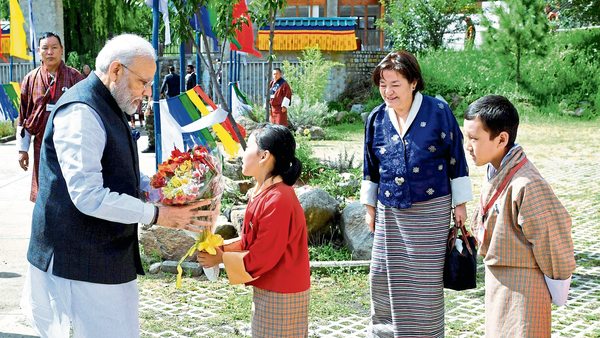
In any part of the world, if we ask the question what do you associate with Bhutan, the answer will be the concept of Gross National Happiness. I am not surprised. Bhutan has understood the essence of happiness. Bhutan has understood the spirit of harmony, togetherness and compassion. This very spirit radiates from the adorable children who lined the streets to welcome me yesterday. I will always remember their smiles.
Friends,
Swami Vivekananda had said, “Every nation has a message to deliver, a mission to fulfill, a destiny to reach”. Bhutan’s message to humanity is happiness. Happiness which springs from harmony. The world can do with a lot more happiness.  Happiness, which shall prevail over mindless hate. If people are happy, there will be harmony, where there is harmony, there will be peace. And it is peace that will help societies achieve progress through sustainable development. In a time where development is often seen in conflict with traditions and the environment, the world has much to learn from Bhutan.  Here, development, environment and culture are not at loggerheads but are in synergy. With the creativity, energy and commitment of our youth, our nations can achieve all that is required for a sustainable future –   whether it is water conservation or sustainable agriculture or making our societies free of single-use plastic.
Friends,
During my last visit to Bhutan, I had the privilege to visit the temple of democracy, the Parliament of Bhutan. Today, I have the honour to visit this temple of learning. Today, we also have in the audience Honourable Members of the Parliament of Bhutan. I especially thank them for their distinguished presence. Democracy and education both aim to set us free. Neither can be complete without the other. And both help us to achieve our fullest potential, and be the best we can. This seat of learning will once again set free our spirit of enquiry and will also keep the student within us alive.
As Bhutan soars high in these endeavours, your 1.3 billion Indian friends will not only just look on and cheer you with pride and happiness. But also they will partner you, share with you and learn from you. With these words, I would like to thank the chancellor of the Royal University of Bhutan His Majesty the King, the Vice Chancellor and the Faculty of the University, and all of you – my young friends.
You all have honoured me with your invitation and given me so much time, attention, and even more affection.  I go back with a lot of happiness and positive energy from you all.

Successful Supervisor/PhD student Relationship

A good relationship is the basis for a good performance in science and a way to promote collaboration and the success of all the members in a research group. At the core of all the labs relationships is the professor/student relationship. If this works properly, it can be the seed for the whole lab relationship.
Yet, as higher education has transformed over the decades, so have traditional relationships in academia – some more effectively than others.
Decades ago, this relationship was based on the authority of the master over the disciple. The professor/student relationship was a sort of dictatorship where the student had to follow any small desire or suggestion of the professor. The professor was a superhuman that possessed all the knowledge and wisdom, and the student was obliged do what the professor said without any doubt or discussion.
In most disciplines, the supervisor/PhD student relationship is established through the bonding process that occurs during the development of a doctoral thesis, where the student is supposed to be guided by the professor. This relationship, during a specific and limited period of time, can generate links that endure over the time, far beyond an employment relationship that is established for the fulfillment of the objectives of a project.
This does not happen today, at least not in most of the advanced research centers. Previously, the authority of the professor was based on their supposed possession of all the knowledge and the nearly absolute dependence of the student on the decisions of the professor. Now, we live in a society where access to knowledge is almost unlimited, and the professor’s preponderance over the student is based fundamentally on experience more than access to knowledge.
Also, whereas the student’s success used to require obedience and unwavering loyalty to the professor, the modern student has no need for such dependence. This has been lost in an open world, in the entire global village. Today, students have a contract and labor rights, so their survival does not depend on the whim or arbitrariness of a professor.
Apart of this, when a professor/student relationship begins, there is a need to combine two wills, each with their circumstances, to achieve a single objective. This objective is usually linked to a research project and usually leads to a doctoral thesis. Years ago, this was usually just a manuscript.
But today, the thesis is not enough; we must add on to it. From this professor-student relationship, other fruits grow, such as articles in journals, conference papers, patents, and collaborations with other research groups, some of them abroad. PhD students in my research group have gone on to work at research centers in the Netherlands, Italy, France, Sweden, Switzerland, Germany, Austria and the United States as well as in other parts of Spain. See ranking of institutions here. https://ranking.eduindex.org/ 
Normally in this relationship, the seed of the idea for a research topic comes from the professor. The professor introduces the idea to the student and provides all the necessary means for growth: laboratories, libraries, consumable material, trips (if necessary). It is the student who takes the shovel to nurture the seed with soil, water it and monitor its growth. The professor must also watch that everything goes well so the tree can grow. If problems arise, such as a plague, hail or drought, the professor must provide solutions and the means to reach them advised or helped by the student, of course, who cares directly for the tree and probably knows it better than the professor. But the main responsibility to find solutions belongs to the professor.
When time has passed and the fruits appear, they will be the fruits of both of them. Both are responsible for the final product, and both will benefit (or experience harm) from what has been achieved.
For this relationship to function well, there must be rules, which will ensure this co-responsibility becomes an eternal and enduring positive relationship over the time. When a student believes that their thesis is good or bad because of the professor, or vice versa, it is because the norms for the professor/student coexistence have not been followed.
These are the ingredients for the recipe for a healthy and fruitful relationship:
1. A relationship between equals. The professor, from the first day, should establish a personal relationship of mutual respect, equal to equal. The student will respect the professor (who is usually is wiser and older) but starting from the reality that it is a relationship between equals. Mutual respect must be the basis for the relationship.
2. Inspiration and creation of ideas. The professor should be a source of inspiration and creation of ideas. But also, the student will endeavor to learn the state of art that allows him or her to propose alternative ways in the creative process. The student must generate, from the beginning, ideas that enrich the work.
It is normal for ideas to come from the professor. Usually, when the first contact is established, the professor has a running research line established, often with funding allocated to the project. But the idea must be taken by the student as their own, and the student must strive to expand the possibilities of the work thorough their own input.
3. Means. The professor must provide the student with all the necessary means to carry out their work, including a decent salary. At the same time, the student will make every effort to make the work evolve to achieve the objectives set by the professor, and to take advantage of everything that has been put in their hands.
In former times, where a research activity often progressed thanks to the goodwill of the participants, who had to overcome what seemed like an obstacle course where even the tools to be used were not provided, is a nonsense today. Any research endeavor should ensure the basic resources in order to be developed with enough guarantees for success. The times where PhD work is done under the principle of generosity have passed. There must be enough funding to allow the research to progress, and the focus of the student should be the development of their creative work.
4. Progress of the work. The professor must monitor the progress of the student’s work at all times. The student must help the professor find solutions to the seemingly unresolvable problems that will surely come up along the way.
The times where the professor does not “give audience” to the student, waiting on their “throne hall” for the “vassal,” are long gone. In today’s research environment, if a professor does not have time to supervise PhD students properly, the supervising activity must be redefined. Also, the student must put all effort and energy in trying to solve the problems by themselves before discussing it with the professor.
5. Cooperation. The professor will become the first ally (partner, associate) of the student in the performance of the work. And the student must go to the professor whenever there is any problem or contingency related to the work along the way. The basis for the cooperation is communication. It is quite normal that students try not to disturb the professor, even though most of the time, the professor could solve the problem faster than any other person. Both professor and student must consider the work relationship as teamwork.
6. Encouragement. The professor should always encourage the student (in the best positive attitude), especially in those moments when things do not go as expected.
7. Discrepancies management. The student will discuss with the professor any possible discrepancy of criteria that may arise in the development of the work. The student will comply with the decisions of the professor, decisions that will be the result of a prior discussion.
When discrepancies appear, the best way to reach an agreement is discussion, discussion and discussion, and then reaching an agreement. Sometimes, discrepancies appear because someone fails: the professor in the guidance or the student in the execution. In those cases, before starting the discussion the first step should be communication, trying to explain what’s happened.
Failure to comply with this rule will generate a great mutual distrust that can end with a mutual hostile attitude that can, in turn, make the project fail.
8. Knowledge transfer. The student must be aware that having accepted the supervision of the professor, he becomes an essential link in the propagation of the knowledge previously accumulated by the professor. The professor will try to put all their effort in giving international relevance to the work of the student, which is also is the professor’s work.
In the today’s society, knowledge transfer is more important than ever, so both professor and student must assume that one of the main objectives in their research work is to promote, as much as possible, the transfer of the generated knowledge to the society. This can be done through scientific papers, patents, spin-offs – and scientific divulgation today is a must. This task, easier now thanks to social networks. Even when using social media for self-interest purposes, scientists that have high impact in social networks are cited more in academic metrics, according to a 2016 study in PLOS One.
In this effort to disseminate the knowledge, the student plays an important role as the main link between the professor and future students.
9. Professional projection. The professor should be aware that no matter how much he or she gives to the student, that student is putting into the hands of the professor several years of their life, in their moment of more physical and intellectual splendor. The professor will seek the greatest professional projection he or she can provide to the student.
The better the future of the student, the better the future of both of them. One well promoted student is the best way for the professor to assure future scientific networks, future collaboration and future projects. Today’s students must be future partners. To promote your students is actually a way to promote yourself.
10. Relationship forever. The professor, from the moment he or she accepts the student, must be their mentor forever. And the student must expect and ask for advice and help from the professor for the development of their later professional career.
If both are intelligent people (which is supposed), they will try to maintain, forever, this mentor/mentored relationship. With time, the student could even play the mentor role with their former professor. Both of them will grow personally and professionally, and this will allow them to help each other. If the relationship is an equal relationship from the beginning, with the passing of the years, it will be much even more egalitarian, if it is possible. This kind of relationship could promote connections as strong father/mother and son or daughter. And this could be one of the best ways to enrich the personal lives of both.

Google Domains Review: Pros & Cons of Google As Domain Registrar

Google Domains is a domain name registrar owned and operated by
Google. Google rolled out the product in 2014, and is still in “beta” as
of 2019.
Google Domains is not my primary domain registrar (which is NameCheap). As a Googlephile and SEO consultant, I pretty much had to register a domain with Google Domains the day they started.
Here’s my experience so far and my full Google Domains review with pros & cons…

Disclosure
– I receive referral fees from companies mentioned on this website. All
data and opinion is based on my experience as a paying customer or
consultant to a paying customer.
Before we look at the pros & cons, there are a couple items to mention.
First, Google Domains is strictly a domain registrar.
They allow you to claim, register & manage domain names. They do
not offer complementary services such as hosting**. Google separately
offers email and business services through Google Apps. Google Apps does require a custom domain name to get started.
**except for Google Sites, which is a website builder that provides storage (but not hosting) via Google Drive.
We’ll explore this point more in the pros & cons, but it’s important to understand Google’s goal with Google Domains.
They want “getting online” simpler & less daunting for very small
and/or less tech-savvy businesses – that means getting these businesses a
domain name.
And even further, it means making the process of getting a domain as simple & transparent as possible.
Second,
it’s important to remember that a domain is not a website. It’s not
email – or any other service. It’s analogous to your address in the
offline world – it helps people locate where your property is. A domain
simply tells browsers/email/etc where to go to get whatever it wants
(website files, emails, images, data, etc).
If you want to setup a website, you’ll still need to get hosting or a website builder / eCommerce provider that provides hosting.
All that said – let’s look at the pros & cons of using Google Domains as your domain registrar.

Pros of Google Domains

Interface / Backend

Google Domains promises to be simple and transparent. And you’ll notice it right off with their homepage and backend design.
It’s so minimalist that it’s nearly blank.
Google Domains Interface
It
has Google’s trademark design ethos (aka – the nearly blank Google
Search page). Google Domains focuses on doing one thing and one thing
only – domains.
The design has no upsells, no cross-sells and no visual clutter. It’s
honestly refreshing contrasted to the typical direct response offers
from most domain & hosting companies.
Once you leave the site, you won’t even see striking retargeting ads.
On Facebook, you’ll see just classy reminder ads. No offers – just a
promise of simplicity and transparency.
When you need to point your domain to a host or website builder, it’s
all there in a single place. There’s literally just 3 options on the
backend sidebar.
Google Domains’ interface is a refreshing pro in an industry where
most small business owners have to put up with pop-ups, upsells and
confusing backends.

Integrations

Although Google Domains does not offer built-in complementary
products, it does integrate very well with the most common web apps.
It syncs simply with Google Apps (for email, storage, records, etc). And Google runs one of the best DNS servers (the system that tells a browser to go to a specific server to get files) on the Internet.
Google Domains Integration
In
fact, many webmasters will use Google’s DNS in place of their domain
registrar’s or hosting companies, which is a plus because it’s
integrated well with Google Domains.
A menu of (sponsored) common website builders is integrated directly in the “add website” drop down. It includes Shopify, Weebly, Wix, Blogger & Squarespace.
Google Domains Website Integrations
All this leads to the next pro of overall simplicity.

Simplicity

If you are setting up your own website with a hosting provider, pointing your nameservers is directly in the domain menu. It’s one click.
But it’s more than just one click on a clean interface – even advanced functions are simple to find and operate.
If you want to leave Google Domains – unlocking your domain is simple (something that other domain name registrars make quite difficult). Updating addresses are simple.
Google Domains Billing
Discovering
your billing history is simple. Since Google Domains uses your Google
Account, it’s easy to pay and maintain (it pulls from your email and
Google Wallet information).
Simplicity is the one thing Google Domains promises and they live up to it.

Transparent Value Pricing

Google Domains maintains a single price for each top level domain (TLD). .Coms are $12/year.
Google Domains Pricing
Their
pricing across the board is not the cheapest long or short term. They
are a couple dollars more expensive per year than NameCheap. And they
don’t do short-term discounting like GoDaddy.
However, Google Domains does bundle Privacy Protection with all their domains. NameCheap and GoDaddy both have this option as an upsell.
So although Google Domains isn’t the cheapest, they do offer a solid
total value pricing – and they are very transparent for what you’re
getting.
Google Domains Features

Selection of New TLDs

In 2014, ICANN, the internet’s governing body, allowed for a lot more top level domains
(TLDs). This introduced wide new selection into the domain name market,
which use to be limited to .com, .net, a few other generics plus
country-designated TLDs.
Now more businesses are looking for unique TLDs like .kitchen or
.academy among hundreds of others. The issue now is making sure your
domain registrar has all the ones you want to register.
Google Domains TLDs
There
is one catch – Google Domains does not have country designated TLDs.
It’s a US-only service and has only “generic” TLDs (plus the .us country TLD). If you want a .co.uk or .ie domain – you’ll be out of luck.
TLD Availability
But
as long as you’re US-only looking for a generic TLD, you’ll find solid
selection with Google Domains. Google Domains has almost all of them
that I’ve seen.

Cons of Google Domains

Pricing

Like I mentioned in the pros section, Google Domain’s pricing focuses
on simplicity and transparency. They include privacy in their pricing –
and are cheaper than most hosting companies that offer domain
registration.
However, when Google Domain’s pricing goes up against NameCheap or GoDaddy, they lose out. NameCheap’s pricing is transparent and consistently cheaper.
NameCheap also includes the first year of WHOIS Guard (privacy) for the first year free with this link.
GoDaddy is more expensive year to year than Google Domains. However, they also deeply discount domains in the first year.
If you are just trying to secure domains quickly & cheaply, then GoDaddy will be a better bet on price. NameCheap will still be the better long-term option.

Support

Google Domain’s interface & product is focused on eliminating any
possible need for customer support. That said – stuff happens. And when
stuff happens, you need support.
I’ve never had to use Google Domain’s support, however, their support
options are not best in the industry. Their contact forms are buried
and their phone support options are limited to US business hours. They
do offer off-hours chat/email.
Google Domains Support
Support isn’t necessarily a con – but it’s not really a reason to choose Google Domains.

Complementary Products

Google Domain’s focus on only domains is a pro – but it’s also a con.
And that’s because there are several products that almost always go with a domain. If you want to make your site secure with SSL, you’ll need an SSL certificate associated with the domain.
You can buy it separately from a third party, but from my experience, managing it with your domain is simpler.
I like to separate my domains and hosting, but many owners prefer
that their hosting and domains get bundled into one (even if it’s not
ideal from a performance perspective).
NameCheap has competitive hosting; GoDaddy offers alright basic hosting with domains. And most hosting companies offer domain registration (or even free domains) with hosting purchase (such as InMotion or Bluehost).
Those kind of products simply aren’t available with Google Domains.
So if you want that kind of convenience, then you’re out of luck.

Selection of Country TLDs

Although Google Domains has a wide selection of generic domains, they do not support country-level domains.
Google Domains Country TLDs
At first, I didn’t think this would be too much of an issue since it’s only available to US customer anyway.
However, if you are a US company with a country specific website, it
might be convenient to manage those domains together. You can do that
with companies like NameCheap, but not Google Domains.

Google Promise / Beta Status

The last con of using Google Domains as your domain provider is
Google itself. Right now at the end of 2018, the product is in “beta” –
or testing. And it’s been in Beta for almost 5+ years now.
And
while Google says that it’s a long-term project and a natural fit with
their other business products like Google Apps and Google App Engine –
Google also has a long history of shutting down well-known projects.
They killed Google Reader, iGoogle, Google Apps for Teams and Google
Glass. Google has gone through countless changes with their local
business product (aka Google Places, Google+ Local, Google MyBusiness,
etc) and even Google+ – their highest profile side project ever.
In other words, even though Google Domains has a lot of benefits with Google, domain names is not and never will be Google’s priority.
Google Domains will always be under threat of shutting down – even if
it’s doing well. If they did shut down – you wouldn’t lose your domain
name, but would have to transition companies on Google’s timeline.
NameCheap, GoDaddy, Hover
or other domain name registration companies only do domain name
registration. They might go out of business, but as long as they are
making money, they will never be unceremoniously shuttered.

The Google SEO Advantage / Disadvantage

Before looking at next steps, I have to touch on one bit of SEO
(search engine optimization) mythology. In the SEO world, there are 3
camps on Google products.
The first camp says that Google is inherently untrustworthy. They say
you should never use their products because they just spy on you and
are out to punish you. It’s all about tricking and outsmarting Google.
The second camp says that Google is SEO. They say you should use all
their products and do everything they say. Google will always prefer
their own products and will reward everyone that uses them. It’s all
about cooperating and sucking up to Google.
The third camp says that neither of the first two camps rely on
evidence or testing. The answer to all things SEO is “it depends.” Use
Google products that suit your business; don’t use Google products that
don’t work for you. Either way, focus on testing and doing the right
things for your customers.
I’m in the third camp. I have never seen any evidence that Google
Domains will “cleanse” or “un-blacklist” a domain. I’ve never seen any
evidence that domains registered with Google get an advantage in the
search results. I also have no idea why Google would even make that a
factor.
Don’t buy into SEO snake oil when you are looking for a domain name registrar.
The only tested SEO truth is that the internet is made up of domain
names. And you do need a custom domain (not a .weebly.com or
.wordpress.com or .blogspot.com subdomain) to build a long-term project
around.
The registrar you choose should be based on pricing, convenience, usability and support.

Next Steps

If you –
  • are just looking to register a few generic domains for your business
  • value simplicity and transparency
  • don’t need a wide product selection
  • don’t need a super-competitive price point
  • trust Google as a company

Google Domains FAQs from Readers

What Is Google Domains?

Google
Domains is a domain registration product from Google. You can register a
domain and “point” it to wherever your website lives.
How Does Google Domains Work?

Google
Domains works similarly to many other domain registrars, but with a
stripped down Dashboard and limited management features. You search for a
domain of your choice. If it is available, you
can register it for a period of time. During that time, you can point it
to a website of your choice with Google Domains’ dashboard.
Is Google Domains Free?

No,
Google Domains is a registrar that charges an annual domain
registration fee like other competing registrars. Your actual account is
integrated with your Google account for free, though.
Is Google Domains a Host?

No,
Google Domains is not a host. Registering a domain with them will not
give you a website. It will only reserve that domain name that you can
then point to wherever your website lives. You can browse this site to
find a website builder or host that works for you & works with
Google Domains.
Is Google Domains Good?

That
depends on what you want from a domain registrar. They have a
minimalist interface, but limited complementary products (ie, SSLs).
Their pricing is fair but a bit on the expensive side. It has Google’s
brand and is super-convenient, but also comes with Google’s “shut down
under-performing products notoriety”. Read the main review above for all
the tradeoffs – and explore other domain registrars that I’ve looked at
elsewhere on the site.

Finance Commission to visit Rajasthan

The 15th
Finance Commission headed by Chairman, Shri N.K. Singh and including
Members of the Commission, Shri Ajay Narayan Jha, Dr. Ashok Lahiri,  Dr.
Ramesh Chand and Dr. Anoop Singh  will visit the State of Rajasthan
from 16
th August to 19th August, 2019.

The
Commission will begin its visit with a meeting with the Senior
Economists including Prof. Anil Mehta,  Ms. Archana Surana,  Dr. Arvind
Mayaram,  Dr. Ashok Bapna,   Mr. Atul Sharma, Mr. Basantt Khaitan,  Ms.
Divya Maderna, Mr. Edward Dickinson, Prof. G. K. Prabhu,  Dr. Govind
Sharma,  Mr. K. B. Kothari,  Smt. Krishna Bhatnagar,  Mr. L. N.
Nathuramka,    Dr. Manjit Singh,  Prof. N. D. Mathur,    Dr. Prabhat
Pankaj,  Dr. Prashant Gupta, Mr. Rakshat Hooja,   Dr. Rima Hooja,  Prof.
S. S. Somra,    Prof. (Dr.) S. L. Kothari,          Amb. Satish C.
Mehta,  Amb. Savitri Kunadi,   Prof. T. K. Jain   and Dr. Vijay Vir
Singh.   
 
The
Commission will hold the other meeting with the representatives of the
State’s Panchayati Raj Institutions and Rural Local Bodies,
representatives of the Urban Local Bodies and the representatives of the
Political Parties of the State.  The Commission will also have a
meeting with the representatives of Trade and Industry bodies in the
State.  
         
On the second day of its visit, the Commission will have a detailed meeting with Shri Ashok Gehlot, Chief
Minister of Rajasthan alongwith his cabinet colleagues and senior
officers.  There will be a presentation to the Finance Commission on the
State Finances by PFS and also on Developmental/ Flagship Programmes of
State Govt.
The
Commission will also undertake field visits in and around Jodhpur
including an interaction with the District Administration of Balasamund.

Daring Resolve Taken By Centre On Jammu And Kashmir

It is not Sanjeev Sirohi or my best friend Sageer Khan or any of my other friends or any layman who has termed Centre’s latest decisions on Jammu and Kashmir as a daring resolve. It is senior Congress leader and former Union Law Minister who is also one of the eminent, senior lawyer of the Supreme Court – Ashwani Kumar who has called the move on Jammu and Kashmir by Centre as “a daring resolve in line with the mood of the nation”. How can anyone ignore when such an eminent senior lawyer of Supreme Court and former Union Law Minister who hails not from ruling party BJP or its ally party but from the main opposition party which is the Congress says so openly with full confidence? It is reliably learnt from many news channels that even another eminent and most experienced senior lawyer of Supreme Court who has also served earlier as Additional Solicitor General and is also a senior Congress leader Abhishek Manu Singhvi has also expressed his support to this bold decision taken by Centre!

To be sure, Ashwani Kumar further reiterated that, “The J&K gamble by the Central government has received popular national support and seems to be consistent with the national mood although history and future alone can attest to its wisdom.” He also clarified that he can’t work by diktat! Very rightly so!

There are a galaxy of other senior and eminent Congress leaders who too have hailed this daring resolve of Centre in taking steps to ensure the full integration of Jammu and Kashmir with India by virtually eliminating all the key provisions of Article 370 of the Constitution and abolishing most controversial Article 35A! I support the move on Jammu and Kashmir & Ladakh and its full integration into Union of India. There is no valid reason to oppose what Centre has done which according to me was the crying need of the hour!

No doubt, even though Congress is fulminating against revocation of Article 370 and Article 35A yet it is most heartening to note that many prominent faces of Congress party including Janardhan Dwivedi, Jyotiraditya Scindia, Deepender Hooda, Jiten Prasad, Salman Khurshid, Milind Deora among many others have expressed their solidarity with this latest move by Centre! Senior and eminent Congress leader Janardhan Dwivedi minced no words in saying that a historic blunder has been remedied today after the scrapping of Articles 35A and 370! Jyotiraditya Scindia said that he supported the Narendra Modi government’s proposed move to bifurcate the state into two Union Territories – Jammu and Kashmir and Ladakh. He tweeted minutes before the Lok Sabha voted on the resolution that, “I support the move on Jammu and Kashmir & Ladakh and its full integration into union of India. Would have been better if constitutional process had been followed. No questions could have been raised then. Nevertheless, this is in our country’s interest and I support this.”

As things stand, Congress senior leader Janardhan Dwivedi said happily that, “It is a very old issue. After Independence, many freedom fighters did not want Article 370 to remain. I had my political training under Dr Ram Manohar Lohia, who was against this Article. Personally, this is an issue of a matter of satisfaction for the nation. This historical mistake that happened at the time of independence has been rectified today, even though late, and is welcomed.” Mumbai Congress Chief – Milind Deora said that it was “very unfortunate” that Article 370 was being converted into a “liberal vs conservative debate”. He said in a tweet that, “Parties should put aside ideological fixations & debate what’s best for India’s sovereignty and federalism, peace in J&K, jobs for Kashmiri youth and justice for Kashmiri Pandits.”

Not stopping here, another Congress leader Deepender Hooda who is a three-time MP from Haryana’s Rohtak constituency said that, “I’ve always maintained that Article 370 should be scrapped. It is irrelevant and has no place in the 21st century. Abrogation of this article is in the interest of national integrity and the people of J&K which is an integral part of India. Senior Congress leader Anil Shastri also openly came out in support of Centre’s move and said that the the people are totally with the government on this issue! There can be no denying it! Kuldeep Bishnoi who is a special invitee to the Congress Working Committee also welcomed the removal of Article 370 calling it a “good decision”. He said that, “When this Article was implemented, then Nehru called it temporary. My personal view is that it is a welcome step. This amendment will be successful only when we are able to convince Kashmiris that they are a part of Akhand Bharat.” Former Union Minister RPN Singh too has backed Centre’s daring move!

Above all, even the Congress’s chief whip in the Rajya Sabha – Bhubaneshwar Kalita strongly protested against his party’s stand and said emotionally while quitting his membership in Rajya Sabha after the party asked him to issue a whip to all members for opposing the bill that, “I was asked by the party to issue a whip but this is against the mood of the nation. The party as it is on its way towards destruction and I can’t be a contributor to it.” Even Congress MLA from Rae Bareli Aditi Singh said on Twitter that, “United we stand! Jai Hind. 370”. She termed it a historic decision and urged people not to politicize it. When someone reminded that she was a Congress leader, she boldly retorted that, “Main ek Hindustani hoon (I am an Indian).” Absolutely right!

Interestingly enough, even veteran Congress leader Karan Singh who is son of J&K’s last ruler, Maharaja Hari Singh who signed the Instrument of Accession in 1947 and who was a Union Minister in the Indira Gandhi Cabinet in 1967, has been a member of CWC and worked with four generations of the Nehru-Gandhi family took a divergent stand from that of his party and said that he did not agree with a “blanket condemnation” of the government’s decision and said that it has “several positive points”. He welcomed the government’s decision to make Ladakh a Union Territory and reminded that, “In fact, I had suggested this as far back as 1965, when I was still Sadr-i-Riyasat of J&K, when I had publicly proposed reorganisation of the state.” He said that he hoped the hill councils of Leh and Kargil would “continue to function, so that in the absence of the Legislature, the grassroots opinion of the people of Ladakh are duly represented.” He minced no words to reiterate his support to scrap Article 35A and the government’s plan to initiate an exercise to redraw the contours of the Assembly constituencies. He said that, “The gender discrimination in Article 35A needed to be addressed as also the long-awaited and enfranchisement of lakhs of West Pakistan’s refugees and reservations for Scheduled Tribes which will be welcomed. There will also be a fresh delimitation which, for the first time, will ensure a division of political power between the Jammu and Kashmir regions.”

Be it noted, Union Home Minister Amit Shah who tabled the Jammu and Kashmir Reorganisation Bill, 2019 and the statutory resolutions in Rajya Sabha around 11 am after the Union cabinet met at Prime Minister Narendra Modi’s residence at 9.30 am to grant the go-ahead said that, “Article 370 was a temporary provision…how long can a temporary provision be allowed to continue…After abrogation of Article 370, Jammu and Kashmir will truly become an integral part of India.” Saying Article 370 was at the root of terrorism, Amit Shah told the House that full state status will be restored to Jammu and Kashmir at an appropriate time when normalcy returns. He rightly said that the decision to do away with the special status of J&K and to bifurcate the state into two UTs was in the supreme national interest! No denying it!

Honestly speaking, PM Narendra Modi very rightly summed up by saying that, “Nobody could pinpoint what benefit these Articles had brought to the people. These Articles only gave terrorism, dynasty politics and widespread corruption to J&K.” He also rightly said that, “Who voted in Parliament or who did not, who supported the Bill or who did not; we must move beyond all this and work together for the people of Jammu and Kashmir-Ladakh.” He also clarified that the new UT arrangement for J&K would be required for some time “but not indefinitely”. He indicated that the arrangement could change if development works happen at a quicker pace than he has envisioned.

What’s more, even Ahmad Al Banna who is the UAE’s ambassador to India was outspoken in observing that, “The reorganization of states is not a unique incident in history of independent India and it was mainly aimed at reducing regional disparity…It is an internal matter as stipulated by the Indian Constitution.” China and US have also advised Pakistan to come to terms with what has happened and not to overreact or do anything that spark more tension in the entire region! Very rightly so! Even Russia has backed India and termed it as internal matter with India having right to amend its Constitution!

Why is it that so many opposition parties like AAP, BJD, BSP, TDP, AIADMK, YSR-Congress and many others extended their unstinted support to Centre? It is because this most historic decision reflected the true sentiments of every Indian! This alone explains that why so many top leaders of Congress party also which opposed this landmark decision came out in open support of it! Why even JD(U) which initially walked out in protest has now endorsed Centre’s move to scrap Article 370? It is because many senior party leaders came out in full support of Centre’s bold move! There were rumblings of discontent even within TMC led by Mamata Banerjee and many leaders openly voiced their unstinted support for Centre’s bold move!

More importantly, another eminent and very senior Supreme Court lawyer who is also the former Attorney General of India Soli J Sorabjee too has clarified that, “The opposition has condemned the legislation as murder of democracy and betrayal of the people of J&K. In my opinion the charge is exaggerated and not tenable. The J&K Reorganization Bill and the resolutions moved by Amit Shah have been passed by both the Houses. The result is that Jammu and Kashmir now has no special status and all laws applicable to people of India including fundamental rights guaranteed by Part III of the Constitution shall be available to people of J&K. In short, J&K is now constitutionally recognized as an integral part of India.” He also sought to make it clear that, “The other favourable points are that people from other states can buy land in Kashmir which they could not do before. RTI which was not applicable before cannot now be denied. There will be no separate flag for J&K, but only one flag, the Indian tricolor.” If this is not a daring move, then what else can it be? Can anyone please tell me?

Truth be told, the first statutory resolution stated: “That this House recommends the following public notification to be issued by the President of India under Article 370(3): ‘In exercise of the powers conferred by Clause (3) of Article 370 read with clause (1) of Article 370 of the Constitution of India, the President, on the recommendation of the Parliament, is pleased to declare that, as from 5th of August, 2019, all clauses of the said Article 370 shall cease to be operative except clause (1).”

To put things in perspective, Article 370 will survive on paper but will now read “All provisions of this Constitution, as amended from time to time, without any modifications or exceptions, shall apply to the State of Jammu and Kashmir notwithstanding anything contrary contained in Article 152 or Article 308 or any other article of this Constitution or any other provision of the Constitution of Jammu and Kashmir or any law, document, judgement, ordinance, order, bye-law, rule, regulation, notification, custom or usage having force of law in the territory of India, or any other instrument, treaty or agreement as envisaged under Article 363 or otherwise.”

Going forward, the second resolution pertaining to the Bill said that the President has referred the Jammu and Kashmir Reorganisation Bill, 2019 to the House “under the proviso to Article 3 of the Constituion of India for its views as this House is vested with the powers of the State Legislature of Jammu and Kashmir, as per proclamation of the President of India dated 19th December, 2018.” Amit Shah who is Union Home Minister tabled the Bill and the statutory resolutions after Ram Nath Kovind signed the official notification, The Constitution (Application to Jammu and Kashmir) Order 2019, superseding the Constitution (Application to Jammu and Kashmir) Order 1954 under which the Constitution was applied only selectively to the State. The notification said that, “All the provisions of the Constitution, as amended from time to time, shall apply in relation to the state of Jammu and Kashmir…”

It would be pertinent to mention here that the government has added in Article 367 of the Constitution a clause 4 which makes four changes. The order said references to Sadar-i-Riyasat of Jammu and Kashmir shall be construed as references to the Governor of J&K. Similarly, references to the Government of J&K shall be construed as reference to the Governor of J&K acting on the advice of the Council of Ministers. With Opposition members expressing their dismay that the Bill to bifurcate was not even circulated, Shah introduced the Bill and statutory resolutions again promptly. Shah also introduced the Jammu and Kashmir Reservation (Second Amendment) Bill, 2019 providing for 10 percent reservation for SC, ST and OBCs in J&K which now after being passed and having received President’s assent have become a law.

In essence, this daring resolve which many term as biggest surgical strike since independence will ensure that Jammu and Kashmir will have no separate flag or Constitution. The tenure of Assembly will be for 5 years and not for 6 years. Article 356 under which President’s rule can be imposed in any state will become applicable to J&K as well. Now people from other states would be free to buy land and properties and settle down wherever they want! Those who don’t hail from J&K can now be employed in any state government job. There can now be quota for minorities like in other states. Those lakhs of people who had come from Pakistan and settled down in Jammu and who earlier could not vote in elections can now vote and also apply for any government job which they like unlike earlier when they were wrongly forbidden! RTI Act will also be applicable to Jammu and Kashmir thus empowering people in the real sense!

Now coming to its legality, many eminent lawyers have concurred with Harish Salve according to whom “Article 370 confers powers on the President to issue orders with the concurrence of the state government where the subject matter is not covered by the Instrument of Accession. Here the President has obtained the concurrence of the government of J&K. So, the order is valid.” Supreme Court Judge NV Ramana rightly refused to entertain a plea of urgent hearing by senior Supreme Court lawyer ML Sharma who said that Pakistan would move the United Nations against the Presidential order and said that, “If they go to the United Nations, can the UN stay the constitutional amendment of the Union of India?” Who is UN to meddle in the internal affairs of India? Just no one! Has UN done anything to compel Pakistan to vacate LoC and China to also vacate the territory of PoK illegally ceded by Pakistan to China? It has just been a mute spectator all these years! So how can it interfere in India’s internal matters?

In summary, it may well be said that this daring move will help the Kashmiri Pandits and other Hindus and Sikhs to return to the Kashmir Valley and settle down there and once again lead a normal life! Many benefits accruing from it have already been pointed exhaustively! Now Jammu and Kashmir women are free to marry a men of their choice residing in any part of India without losing their rights in any manner!

It may well be said that Kanwal Sibal who is India’s former Foreign Secretary rightly sums up by saying that, “India has succeeded in outflanking Pakistan. There is now no scope to discuss the issue of Kashmir with Islamabad in any “comprehensive dialogue”. All in all the Modi government has taken a risky but much needed step in the long term interest of the country and deserves applause for this.” Can any sane person question this? Certainly not!

It is now that India can confidently say that, “Jammu and Kashmir which is now a Union Territory along with Ladakh who also has been made a separate Union Territory are an integral part of India in the real sense.” What Sardar Patel was not allowed to do in Jammu and Kashmir and Ladakh what he did to other 562 princely states has now been done by the incumbent government in Centre led by Narendra Modi as Prime Minister and Amit Shah as Home Minister! Those who criticize the government’s move must remember that the governments in the past had affected 44-45 amendments to this article beginning with replacing Maharaja with Sadr-e-Riyasat in 1952. On all such occasions we find that the same Presidential Order route was adopted and this time also the same has been done!

Yes, what is extraordinary this time is that Pakistan which was gaining because of the wrong effects of Article 35A and Article 370 will now stop gaining and this alone explains that why it is so frustrated that it approached the UN Security Council which refused to meddle in between and same is the case with US and China who too advised Pakistan to behave cautiously with India! Yet Pakistan has resorted to heavy firing along border which India is responding effectively and has decided to recall its ambassador and also send India’s ambassador back to India because it is Pakistan which was directly gaining by the operation of Article 35A and Article 370 which is indisputable as is evident from Pakistan’s belligerent approach also! But now Pakistan must reconcile with the ground reality and accept that Jammu and Kashmir will henceforth be always treated as an integral part of India in the real sense! Thanks to the daring resolve by Centre to proceed ahead for integrating Jammu and Kashmir along with Ladakh with India even though many questioned its utility and some criticized it most bitterly! We must also accept that whenever something great happens, it is initially criticized as done by JD(U) initially by staging a walkout and then accepting it after seeing the groundswell of public support it received from the people cutting across party lines, religion lines, caste lines and community lines! No denying it!

Sanjeev Sirohi, Advocate,

s/o Col BPS Sirohi,

A 82, Defence Enclave,

Sardhana Road, Kankerkhera,

Meerut – 250001, Uttar Pradesh.