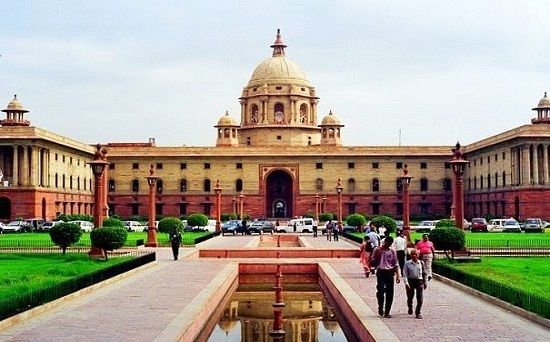
Breaking News! New UGC scheme for Higher Education launched

In a bid to promote quality assurance in Higher Education, Union HRD
Minister Ramesh Pokhriyal ‘Nishank’ today launched  University Grants
Commission (UGC) Scheme of ‘Paramarsh.’

The scheme is aimed at mentoring National Accreditation and Assessment
Council (NAAC) Accreditation Aspirant Institutions to promote Quality
Assurance in Higher Education.

Initially 71 universities and 391 colleges with NAAC score of 3.26 and above will mentor five colleges each.
Under
the Paramarsh scheme, the leading institutions will provide regular
mentoring to help colleges achieve high quality standards. The scheme
also proposes to provide financial assistance to the mentoring
institutions and the option of appointing an expert, who can be paid a
fellowship amount of Rs 31,000 per month.
“The scheme will be a
paradigm shift in the concept of mentoring of institution by another
well performing institution to upgrade their academic performance and
enable them to get accredited by focusing in the area of curricular
aspects, teaching-learning & evaluation, research, innovation,
institutional values & practices etc,” Speaking on the occasion,”
the Minister said.
The
scheme is expected to have a major impact in addressing a national
challenge of improving the quality of Higher Education in India.
Sharing
information about the scheme, the Minister said the Scheme will be
operationalized through a “Hub & Spoke” model wherein the Mentor
Institution, called the “Hub” is centralized and will have the
responsibility of guiding the Mentee institution through the secondary
branches the “Spoke” through the services provided to the mentee for
self improvement. This allows a centralized control over operational
efficiency, resource utilization to attain overall development of the
mentee institution.
The scheme aims at enhancement of overall
quality of the Mentee Institutions and its profile as a result of
improved quality of research, teaching and learning methodologies.
Mentee Institution will also have increased exposure and speedier
adaptation to best practices. “Paramarsh” scheme will also facilitate
sharing of knowledge, information and opportunities for research
collaboration and faculty development in Mentee Institutions.
The
eligibility guidelines laid down by UGC say the mentor and the mentee
can be government, aided, private or self-financing institution. “The
mentor institution should be NAAC accredited with an A grade, having an
overall score of 3.26 and above. Any such institution recognised under
2(f) & 12B of the UGC Act 1956 will be eligible to receive UGC
grants for the purpose.
Since these grants will be used for
mentoring the institution and not for creation of any infrastructure,
the private institution can also receive funding as they do for student
teacher centric schemes,” the guidelines stated.
The “Paramarsh”
scheme will target 1000 Higher Education Institutions for mentoring with
a specific focus on quality as enumerated in the UGC “Quality Mandate”.
Mentor-Mentee relationship will not only benefit both the institutions
but also provide quality education to the 3.6 crore students who are
enrolling to Indian Higher Education system at present.

Lok Sabha passes Central Universities Bill

New Delhi:
The Lok Sabha on Friday passed the Central Universities (Amendment)
Bill, 2019 with a voice vote to establish a central university and a
tribal university in Andhra Pradesh.
The bill, which also seeks an
amendment to the Central Universities Act, 2009, was introduced by
Minister for Human Resource Development Ramesh Pokhriyal on Monday.

Participating
in the debate on the Bill, Congress MP K. Suresh claimed that
percentage of expenditure on education had been reduced under the NDA
government while YSR Congress Party’s L.S. Krishna Devarayalu urged that
more funds be allocated towards building of Central universities and
research programmes in these universities.
Biju Janata Dal’s
Bhartruhari Mahatab enquired about the problem of shortage of faculty in
new higher educational institutions. “What is the reason for this?” he
asked.

UGC, AICTE initiate steps to curb caste based discrimination

Nearly 72 cases of caste based discrimination against Scheduled
Castes and Scheduled Tribes students were reported by University Grants
Commission (UGC) in various universities and colleges across the country
during 2017-18. Most of the cases are handled and disposed off by the
authorities of concerned Universities and Colleges, as empowered under
their respective Acts and Statutes under the Higher Education.

Apart
from UGC, All India Council for Technical Education (AICTE) reported
that no such complaints were received by them from AICTE approved
Institutions during the same period.
Union Minister for Human
Resource Development, Dr. Ramesh Pokhriyal ‘Nishank’ in a written reply
in the Lok Sabha on July 8, informed that the Central Government as well
as UGC have issued several instructions from time to time to all State
Governments and Centrally Funded Education Institutions to curb
discrimination of any kind in higher educational institutions.
UGC
on June 26, 2019 advised all the Vice-Chancellor of all Universities to
constitute a committee to look into the discrimination complaints
received from the SC/ST/OBC Students/Teachers and non-teaching staff.
Besides, the other major initiatives undertaken in this regard are:-
(i)
In order to check discrimination and harassment of any section of
students and to strengthen the grievance redressal mechanism, the
University Grants Commission (Promotion of Equity in Higher Education
Institutions) Regulations, 2012 was implemented.
(ii) University
Grants Commission (Grievance Redressal) Regulations, 2012 has been
formulated. These Regulations intend to give effect in letter and spirit
to the provisions of the Constitution and other statutory provisions
and policies for prevention of discrimination on the grounds of caste
and to safeguards the interests of the students belonging to the
Scheduled Castes and Scheduled Tribes. The Regulations also seek to
provide for advancement of Scheduled Caste and Scheduled Tribe students
through setting up of Equal Opportunity Cells in each Higher Educational
Institution.
(iii) In order to make the universities/colleges
more responsive to the needs and constraints of the disadvantaged social
groups, UGC is giving financial assistance to all eligible
Colleges/Universities to establish Equal Opportunity Centres. The aim
and objective of this Scheme is to oversee the effective implementation
of policies and programmes for disadvantaged groups, to provide guidance
and counselling with respect to academic, financial, social and other
matters and to enhance the diversity within the campus.

Indian Education System Needs Reformation

Introduction –

Education is an essential to humans and one cannot imagine a
life without it. Human civilization has expanded due Education. It is education
that has given birth to culture, ethos, art and a social values in which human
prevails. Learning is elementary to education and a skill that allows a person
to improve his personality.  Apart from
being a basic necessity, a good education skill can overcome many personal and
professional barriers. Learning being central and basic to education and lack
of education can create disturbance in society. Education and learning and its
development are important for a person who desires to exchange information
meaningfully to the person and places required. 
We as a human being started developing knowledge as a proper source to
learn something as it also helped in self-control and to develop a character
for better development as an individual as well as the society. We as an individual
made ourselves to learn about many different things about social, awareness,
grooming personality and foremost are the preservation of culture for the
coming generation. However, with changing time education has become integral
part of human.  Especially in many developed
and developing countries it is now termed as a basic human right.

Education in modern India

Macaulay was the man behind the start of education in India
(as per internet suggestion) introduced education in India, especially through
his famous minute of February 1835. He called for an educational system that
would create a class of Anglicized Indians who would serve as cultural
intermediaries between the British and the Indians.

Current education system in India

Education is always an integral part of life students’ life.
Despite being a nest to many education universities, colleges and varsity,
India still lacks the quality education it needs to have. According to a survey
India will be ranking 3rd among all countries by 2020 in education. Though if
the quality of overall ranking of relevant institutions is seen clearly, out of
500 there were 2 Indian Universities and varsities were featured in the list
along with one institution from China as per a survey by education group done
in year 2000. Education system in India including other developing countries
like India needs substantial expansion. The percentage of students taking
higher education is hardly about 13 % whereas the same is varying between 28 to
90 %, across the world. The lowest % being 28 % and the same is as high as 90 %
in developed countries (As per a news report)

Why India lacks

·        
Over Population: Too many people and limited seats makes student worried
of career.  Concerned over future and
aspiration to get ion a good college is the main reason of brain drain.  
·        
Course choice: mainstream subjects like math science are being taught by
world class teachers but good institute for off-bit courses like music and
painting is tough to find.
·        
 Lack of quality higher education
in India

The benefits of an education abroad

Studying
abroad has always been associated with improving the chances for a
distinguished career prospects. Indians willing to study abroad has seen a
sheer increase in the past few years According to recent estimates by RBI
(reserve bank of India) latest figures in its monthly bulletin, outlays on
education and maintenance of close relatives grew 88% to $334 million and 21%
to $300 million, respectively.

Few reforms need to be done.

·        
Career oriented learning program: There is need
to have courses that could guarantee job placement.
·        
Job opportunities –the basic need of a student is to have a secure future
that can only be achieved by acquiring a good position in their dream
organization.
·        
Research based courses is another need to provide quality education.
·        
Focus on recruiting, training and supporting teachers.

Flood Related Hazards -Things to Know about Flooding

Flooding typically occurs when prolonged rain falls over several days,
when intense rain falls over a short period of time, or when an ice or
debris jam causes a river or stream to overflow onto the surrounding
area. Flooding can also result from the failure of a water control
structure, such as a levee or dam. The most common cause of flooding is
water due to rain and/or snowmelt that accumulates faster than soils can
absorb it or rivers can carry it away. 
Flood Related Hazards -Things to Know about Flooding
River flooding occurs when river  levels rise and overflow their banks
or the edges of their main channel and  inundate areas that are normally
dry. River flooding can be caused by heavy  rainfall, dam failures,
rapid snowmelt and ice jams. 
River flooding is classified as  Minor, Moderate, or Major based on
water height and impacts along the river. Minor river flooding means that
low-lying  areas adjacent to the stream or river, mainly rural areas and
farmland and  secondary roadways near the river flood. Moderate
flooding means water levels  rise high enough to impact homes and
businesses near the river and some  evacuations may be needed. Larger
roads and highways may also be impacted. Major flooding means that
extensive rural  and/or urban flooding is expected. Towns may become
isolated and major traffic  routes may be flooded. Evacuation of
numerous homes and business may be  required.
  
Snowmelt flooding occurs when the major source of water involved in a
flood is caused by melting snow. Unlike rainfall that can reach the soil almost immediately,
the snowpack can store the water for an extended amount of time until
temperatures rise above freezing and the snow melts. This frozen storage
delays the arrival of water to the soil for days, weeks, or even
months. Once it begins to melt and does reach the soil, water from
snowmelt behaves much as it would if it had come from rain instead of
snow by either infiltrating into the soil, running off, or both.
Flooding can occur when there is more water than the soil can absorb or
can be contained in storage capacities in the soil, rivers, lakes and
reservoirs.

Areas Most Likely to Flood During Heavy Rains

While any area can flood with enough rainfall, some areas are more
prone to flooding. It should come as little surprise that all of these
areas are either near bodies or water or are on lower ground than the
surrounding area.
  • Floodplains – The areas surrounding ocean, lakes, rivers, and streams are most prone to flooding during heavy rains.
  • Valleys and Lowlands – Any area that slopes
    downward, like a valley or gully, is more likely to flood during heavy
    rains. This includes areas that are at or below sea level.
  • Near Mountains – Even if the area is flat, water from heavy rains will flow down mountains or hills.

What areas are at risk from flash floods?

Densely populated areas are at a high risk for
flash floods. The construction of buildings, highways, driveways, and
parking lots increases runoff by reducing the amount of rain absorbed by
the ground. This runoff increases the flash flood potential.

Sometimes, streams through cities and towns are routed underground into storm drains. During heavy rain, the storm drains can become overwhelmed and flood roads and buildings. Low spots, such as underpasses, underground parking garages, and basements can become death traps.

Areas near rivers are at risk from flash floods.
Embankments, known as levees, are often built along rivers and are used
to prevent high water from flooding bordering land.

Dam failures can send a sudden destructive wall of
water downstream.

How are we Destroying our Environment

By dumping huge quantities of polythene at tourist places we are directly affecting our present and future generations

Kashmir known as Paradise on Earth bestowed with scenic beauty attracts people at local, national and international levels to gain peace of mind. Recreational activities have gained impetus at local level; Kashmirs. especially on holidays, plan outings with friends and family to hill stations.

 
Unfortunately the visit to any scenic spot begins by spending on junk food. People visiting the places start routine behavior by purchasing soft drinks, chips and ice-cream, without noticing the small silent killers behind them. The aforementioned items are consumed without taking care of environment. After reaching the destination the routine exercise starts by finding a neat and clean spot to spread the carpet bought from home by arranging the items and leaving the place filthy.

 The process is followed by purchasing “Bag of Happiness” either from home or local markets. The People consume junk food and dispose off plastic waste without using dustbins installed by the concerned authorities. Silent killers are spread on ground everywhere. In comparison we use to maintain a hygienic atmosphere at our homes by cleaning surroundings, using dustbins. Outside people dispose off household waste even in water bodies. Traditionally canals provided drinking water and now they have become dumping yards.

  As sun starts to set the hill stations start crying: “please take your belongings back”. But visitors leave the place without reflecting any sense of social responsibility. Consuming junk foods may have health issues, but they are directly affecting our present and future generations. Small plastic covers and plastic bottles remain littered over ground.

On inquiring about the negligence, local shopkeepers blame concerned departments by saying that from last 4 to 5 days nobody has cleaned the place, official in charge talks about outsourcing of cleanliness drive. But the fact is that nothing moves and the place is still covered with plastic waste. We, the people of Kashmir have lost the sense of social responsibility, enjoying nature is everybody’s right but we as humans forget about our responsibilities in keeping our surroundings neat and clean.

The problem needs an immediate attention from authorities. This can be done by banning sale of plastic items at hill stations. People can resort to native cuisine. We all need to encourage sustainable tourism.

UGC Proposes Initiative for Inter-varsity Degrees

The University Grants Commission (UGC) is proposing a ‘National
Academic Credit Bank’ in higher education and if the proposal comes
through, inter-university degrees can be a reality soon, a senior UGC
official said Thursday.
UGC vice-chairman professor BhushanPatwardhan, speaking on
the sidelines of the ongoing three-day Training of Teachers (ToT) for Student
Induction Programme (SIP)here, said the proposal was similar to that existing
in some foreign universities. The initiative proposed in the place of the
current ystem of CBCS (credit-based choice system) would allow students to join
in one university, pursue it in another university and earn a degree from a
different university, a press release quoted Patwardhan as saying.
This would give a lot of flexibility to the students, the
release further quoted him as saying.
The UGC has appointed a committee which met a couple of
times to study the proposal, the release said.
The proposal was made recently in Pune and was still in
deliberation stage, he said adding with the National Academic Credit Bank,
inter-university degrees can be a reality in the near future in India.

UGC Notification For Mid-Career Award, BSR Faculty Fellowship

Check out the notification for the UGC Notification For Mid-Career
Award, BSR Faculty Fellowship & Start-Up Research Grant, that is
open and available for this year. Interested and eligible candidates
check out all of the details on the same below, this scheme is available
throughout the year:
Introduction
Creation
of knowledge through research, and dissemination of a better
understanding through teaching, are the primary objectives of a
University. While both teaching and research are central to the
realization of the objectives of these places of higher learning,
research is often neglected in the University, particularly in India.
Taking
note of steep decline in the research environment in Indian
Universities, the Government of India, through the University Grants
Commission, has taken several initiatives to arrest this trend and
strengthen Basic Scientific Research in Indian Universities.
The
Faculty Research Promotion Programme is one such innovative program,
under which research support is provided at three levels to the
faculties of the science departments (including medical and engineering
sciences) at Indian Universities, which are eligible to receive
developmental grants from the UGC.
Schemes
The Programme comprises 3 different Schemes. Entry-level faculty is supported by a Start-Up Research Grant; active, research-oriented mid-career faculty by a Mid-Career Award; and active, talented senior faculty nearing superannuation by a BSR Faculty Fellowship.
While the Start-Up Research Grant provides seed money for research to
new faculty members at the time of commencement of their career, and
benefits the fresh faculty members of a University; the Mid-Career Award
aims to augment the research efforts of active mid-career faculty
members and support them with this research incentive;The BSR Faculty
Fellowship is meant for successful (with proven track record) and active
senior faculty nearing superannuation. It enables continuance of their
productive research career and mentorship role in Universities for a
longer period.
he
Empowered Committee selects the candidates after scrutiny and
evaluation of the applications by the National Coordinator of this
Programme.
Eligible Categories of Research
This
support is available only to faculty members in the Basic Sciences,
including Medical and Engineering Sciences. The following disciplines
are eligible:
  • Physical Sciences
  • Chemical Sciences
  • Mathematical Sciences
  • Biological Sciences
  • Engineering Sciences
  • Earth Sciences
  • Medical Sciences
Nature of Assistance
Start-Up Grant
A grant of Rs. 10.00 lakhs is provided, which can be utilised for items like minor equipment, consumables, contingencies (maximum Rs. 50,000/-pa), fieldwork (maximum Rs. 50,000/- pa), travel, etc.
The quantum of funds under each head can be decided by the PI depending
on his/her need maintaining the maximum limit prescribed above for
contingencies & fieldwork.
No Research Fellow, Project
Assistant etc. can be appointed using this grant, as it is expected that
the Assistant Professor, as a young researcher, will initially conduct
the bench work by himself/herself. The grant cannot be utilized for
foreign travel.
The grant will be released in 2 installments.
Initially, 80% of the grant will be released. The remaining grant will
be released after the receipt of the UC of first installment. The grant
is to be utilized within two years from the date of issue of sanction
letter of the first installment.

Apply here for Start-Up Grant

Mid-Career Award
A grant of of Rs. 10.00 lakhs
is provided, which can be utilized towards minor equipment,
consumables, chemicals, glasswares, contingencies, fieldwork, travel,
etc.
The grant cannot be used for international travel, purchasing
furniture items and appointing project assistant or research fellow.
The quantum of funds under these heads is flexible and the same can be decided by the recipient depending on his/her needs.
The
grant will be released in 2 installments. Initially, 80% of the grant
will be released. The remaining grant will be released after the receipt
of the UC of first installment. However, the entire grant must be
utilized within 2 years from the date of issue of sanction letter of the
first installment.

Apply here for Mid-Career Award

BSR Faculty Fellowship
Under this Scheme, a Research Grant of Rs. 5.00 lakhs per annum, and a Fellowship of Rs. 50,000 per month (exclusive of the pension and/or other retirement benefits), is provided for a maximum duration of 3 years.
The
Research grant can be utilized for purchase of equipment,
computer/laptop, printer, chemicals, glasswares, consumables,
contingency, hiring project/technical assistant, field work, travel
(within India), etc.
The grant cannot be utilized for International travel and purchase of furniture.
The recipient can decide the quantum of funds under these heads depending on his/her needs.

Non-Appointment Of Judges Affects Speedy Justice: Youth Bar Association Of India

It is most heartening and most satisfying to learn that in a daring and diligent initiative, the Youth Bar Association of India has filed a writ petition in the Supreme Court praying for issuance of writ in nature of mandamus, appropriate order or directives to be issued for filling up the judicial vacancies in the High Courts as per their sanctioned strength as expeditiously as possible and also to decide their representation seeking increase in the sanctioned strength. This writ petition which has been filed by the President of the Youth Bar Association of India – Advocate Sanpreet Singh Ajmani cogently points out that, “That though some appointments have been made in the various High Courts as well as in this Hon’ble Court but still about 39% of the sanctioned strength of the Judges of the High Courts are lying vacant as on 01.06.2019”. The petition alleges that the fundamental rights of the citizens under Article 14, 19 and 21 of the Constitution have been violated by denying them the right to speedy justice due to non-appointment of Judges in Courts. 

What’s more, it is then pointed out by the Youth Bar Association of India in para 8 of its petition that, “That it is of utmost necessity that present situation may be addressed and meaningful directions may be issued for interest of justice in large public interest.” More importantly, para 8 then mentions the grounds which justify the issuance of directions by the Supreme Court for filling up the judicial vacancies. The numerous grounds which have been mentioned are as follows:-

1. Because ‘judiciary’ is the part of basic structure of the Constitution and also considered to be a pillar of democracy. Interference, by any means, affecting its smooth functioning amounts to interference in the independence of judiciary. Causing delay in appointing the judges might not be the expressive way of interfering with the independence of judiciary but it might be an indirect way of hampering its independence. For rule of law to prevail, judicial independence is of prime necessity.

2. Because judiciary is a limb of the democracy. It should not be left bare handed to cause its own work done. Not providing adequate human resource to cause its function perform is nothing less than impeding dispensation of justice. Justice, socio-economic or political are the constitutional goals aspired by the founding fathers. Preamble of the Constitution containing the collective aspirations of the framers of the Constitution forms part of a basic structure. It provides that ‘justice’ as the basic features for democracy to survive. Any obstruction in the dispensation of justice shall amount to deviation from the aspirations of Constitution makers. Wait for long to get justice in the want of sufficient strength of judges is impliedly an impediment in the dispensation of justice.

3. Because while filling up the vacancies in the Council of the States and the House of the People a statutory time limit has been prescribed under Section-151A of THE REPRESENTATION OF THE PEOPLE ACT, 1951 as well as under ARTICLE 62(1) AND (2) OF THE CONSTITUTION OF INDIA, which deals with the specific time of the appointment to be done in case of the President of India and that is being strictly observed while making appointment but while in appointment of judges although having prior information regarding the retirement of the Hon’ble Judges still no effective steps are taken to fill up those vacancies.

4. Because speedy trial is a part of reasonable, fair and just procedure guaranteed under Article 21. This constitutional right cannot be denied even on the plea of non-availability of adequate judges or financial resources. The state may have its financial constraints and expenditure but the law does not permit any government to deprive its citizens of the constitutional rights on plea of poverty.

5. Because the Right to Speedy Trial is considered as a Fundamental right of the citizen of this country which has been explicitly dealt by this Hon’ble Court in Hussainara Khatoon Vs State of Bihar AIR 1979 SC 1377 in the year 1979 and this right is implicit in ARTICLE 14 AND 21 OF THE CONSTITUTION OF INDIA. It is the constitutional obligation of the government to devise such procedures as would ensure and implement speedy trial. This Hon’ble court being majestic authority has to act as guardian of Fundamental rights of the citizens.

6. Because Timely delivery of justice is a part of human rights. Denial of speedy justice is a threat to public confidence in the administration of justice.

7. Because ‘Justice delayed is justice denied’. If the process of administration of justice is so time consuming, laborious, indolent and frustrating for those who seek justice that it dissuades or deters them from even considering resort to that process as an option, it would tantamount to denial of not only access to justice but justice itself.

8. Because the leniency shown by the Government by the way of withholding the recommended names from this Hon’ble court for the appointment of judges in High Court for a long period of time without any justification increases the vacancy at its peak. It is important to maintain the ratio of judges to the population for the fast as well as timely disposal of cases.

9. Because in Supreme Court Advocates-On-Record Association vs. Union of India (1993) 4 SCC 441 in its para 486(2) it is stated that “initiation of the proposal for appointment in the case of the Supreme Court must be by the Chief Justice Of India and in the case of High Court by the Chief Justice of that High Court…..”. Thus, duty is cast upon the Chief Justice of the concerned High Court to fill up the vacancies but despite a huge number of vacancies, the Hon’ble High Court is not proposing enough names to fill up the vacancies.

10. Because the constitutional task assigned to the judiciary is in no way less than that of other functionaries i.e. legislature and executive.

11. Because primacy to be accorded to Hon’ble Chief Justice of India’s views amongst the consultees mentioned in Articles 124(2), 217(1) and (c) primacy in the sense that the opinion of the Chief Justice of India would be binding on the President, i.e., the executive. Therefore, the government cannot sit idle over the recommended names by this Hon’ble Court.

12. Because as per the Article 50 of the Constitution of India for the very specific purpose of independence of judiciary, a direction is given to take steps to separate the judiciary from the executive in the public services of the State.

13. Because the citizens of this country being frustrated due to the long pendency of the cases and dates after dates started losing faith on judiciary and it may lead to the worst situation in the upcoming time that the society will start taking law in their own hands and the ultimate sufferer in whatever situation may be are the common and poor people of this country.

14. Because the main intention of the framers of the constitution in regard to judiciary was to carry out the constitutional message, and it is its responsibility to keep a vigilant watch over the functioning of democracy in accordance with the dictates, directives and imperative commands of the constitution by checking excessive authority of other constitutional functionaries beyond the ken of the constitution. In that sense the judiciary has to act as a sentinel on the qui vive. But the intention of the framers of the constitution is not adhered to at its inception by not appointing judges as per the sanctioned strength.

15. Because the young lawyers who have opted law and litigation as means to live with the dignity are on the verge of extinction due to prolong delay in disposal of the cases. The inordinate delay caused in conclusion of the cases hampering, on the one hand, entire justice administration, on the other hand, affecting adversely the young lawyers striving for a securing career.

16. Because the reputation of the institution is at the stake. Unexplained delay in filling up the vacancies and delayed disposal of cases consequent thereto impeding the trust and the faith of not only the sufferer but also the common people in this institution.

17. Because ‘judiciary’ is the part of basic structure of the Constitution and also considered to be a pillar of democracy. Interference, by any means, affecting its smooth functioning amounts to interference in the independence of judiciary. Causing delay in appointing the judges might not be the expressive way of interfering with the independence of judiciary but it might be an indirect way of hampering its independence. For rule of law to prevail, judicial independence is of prime necessity.

18. Because while filling up the vacancies in the Council of the States and the House of the People a statutory time limit has been prescribed in Section-15A of THE REPRESENTATION OF THE PEOPLE ACT, 1951. The above said section states as follows-

‘151A. Time limit for filling vacancies referred to in sections 147, 149, 150 and 151. – Notwithstanding anything contained in section 147, section 149, section 150 and section 151, a bye-election for filling any vacancy referred to in any of the said sections shall be held within a period of six months from the date of the occurrence of the vacancy: Provided that nothing contained in this section shall apply if-

(a) the remainder of the term of a member in relation to a vacancy is less than one year; or

(b) the Election Commission in consultation with the Central Government certifies that it is difficult to hold the bye-election within the said period’.”

19. Because it is further stated that even in the case of filling up the vacancies in the office of the President Article 62(1) of the Constitution of India has clearly stated that “an election to fill a vacancy caused by the expiration of the term of office of President shall be completed before the expiration of the term” and Article 62(2) of the Constitution of India states that “an election to fill a vacancy in the office of President occurring by reason of his death, resignation or removal, or otherwise shall be held as soon as possible after, and in no case later than six months from, the date of the occurrence of the vacancy; and the person elected to fill the vacancy shall subject to the provisions of Article 56 be entitled to hold the office for the full term of 5 years from the date on which he enters upon his office”.”

20. Because it is an admitted fact that judiciary, in this country is the last resort and faith left to a victim as well as to an aggrieved person. The citizen of this country comes before the judiciary with a hope to get justice and justice within time. Even the same was also the intention of the maker of the Constitution of India, but unfortunately the interest of that intention is not taken care of. It is further submitted that in case of vacancy of legislative bodies, by-election is being conducted and the vacancy is filled up but in case of judiciary it is being given a step motherly treatment.

21. Because for instance it may be mentioned here that the Calcutta High Court has a total strength of 72 but there has been no appointments as per the sanctioned strength, which resulted into huge protest. The question arises here that who is responsible for such a huge vacancy? The answer of this question is very well enumerated in the case of ‘Supreme Court Advocates-on-record Association vs. Union of India’ (1993) 4 SCC 441. In para 486(2) it is stated that “initiation of the proposal for appointment in the case of the Supreme Court must be by the Chief Justice of India and in the case of High Court by the Chief Justice of that High Court…..”.

22. Because the constitutional task assigned to the judiciary is in no way less than that of other functionaries – legislature and executive. Indeed, it is role of the judiciary in carrying out the constitutional message, and it is its responsibility to keep a vigilant watch over the functioning of democracy in accordance with the dictates, directives and imperative commands of the constitution by checking excessive authority of other constitutional functionaries beyond the ken of the constitution.

23. Because the delay in appointment of the judges is not only destroying the functioning of democracy but also leading towards the lawless society which also violates the main intention of the maker of the constitution.

24. Because this Hon’ble Court in Supreme Court Advocates-On-Record Assn. Vs Union of India (1993) 4 SCC 441, it has been explicit in giving primacy to the opinion of Hon’ble Chief Justice of India. It is pertinent to mention herein that in para 478(8) it is clearly stated about the instances of non-appointment which are permissible and justified.

25. Because due to the non-appointment of judges increases the huge backlog of pending matters awaiting disposal at the High Court. It is pertinent to mention herein that disposal of cases is a “must” and should mean ‘disposal with a decision’ and not merely “striking out” from the list of pending matters. The non-appointment of judges is more than painful for the judiciary which universally professes that “delayed justice almost amounts to denial of justice”.

26. Because the central government is sitting idle over the subject matter neither paying any heed to the representation submitted by the Bar Association nor giving any valid reasons in writing for withholding the clearance of names of the judges which are already cleared by the Hon’ble Chief Justice of India.

27. Because the concept of separation of powers is a well-known fundamental political maxim which many modern democracies have adopted. Our Constitution has not strictly adhered to that doctrine but it does provide for distribution of powers to ensure the one organ of the Government does not trench on the constitutional powers of other organs. This is evident from Part V and Part VI of the Constitution. There is and can be no dispute that the distribution of powers concept assumes the existence of a judicial system free from external as well as internal pressures. Under our constitutional scheme, the judiciary has been assigned the onerous task of safeguarding the fundamental rights of our citizens and of upholding the rule of law. Since the Courts are entrusted the duty to uphold the Constitution and the laws, it very often comes in conflict with the State when it tries to enforce its orders by exacting from recalcitrant or indifferent State agencies. Therefore, the need for an independent and impartial judiciary manned by persons of sterling quality and character and determination and resolute impartiality and independence who would dispense justice without fear or favour, ill-will or affection. Justice without fear or favour, ill-will or affection, is the cardinal creed of our Constitution and a solemn assurance of every judge to the people of third great country. There can be no two opinion at the Bar that an independent and impartial judiciary is the most essential characteristic of a free society. Even though on the question that our judiciary should be independent of the executive and the legislature there is no divergence of views at the Bar, there was some difference of opinion on the actual content of the concept.

28. Because the Constitution makers strived to ensure that justice promised in the Preamble of the Constitution is pure and is not in any manner polluted by executive or political interference as is wrtit large on the face of the Constitution. Extraordinary powers have been conferred on the Supreme Court and the High Courts under Articles 32 and 226, respectively, manifesting the confidence of the people in the court’s ability to do justice. By Article 50 of the Constitution of India a direction is given to take steps to separate the judiciary from the executive in the public services of the State. The offices of the Attorney General and Advocates General have been given constitutional status with a view to making quality legal advice available to the Union and the States so that they function consistently with the rule of law and safeguard public interest.

29. Because the concept of primacy to be accorded to the views of the Chief Justice of India has three elements, namely, (a) primacy as ‘pater families’ of Indian Judiciary, (b) primacy to be accorded to his views amongst the consultees mentioned in Articles 124(2), 217(1) and (c) primacy in the sense that the opinion of the Chief Justice of India would be binding on the President, i.e., the executive. The position of the Chief Justice of India under the Constitution is unique, in that, on the judicial side he is primus inter pares, i.e., first among equals, while on the administrative side he enjoys limited privacy in regard to managing of the court business. As regards primacy to be accorded to his views vis-à-vis the President, i.e. the executive, although his views may be entitled to great weight he does not enjoy a right of veto, in the sense that the President is not bound to act according to his views. However, his views would be of higher value vis-à-vis the views of his colleagues, more so if he has expressed them after assessing the views of his colleagues but his view will not eclipse the views of his colleagues forbidding the President, i.e. the executive, from relying of them. The weight to be attached to his views would be much greater as compared to the weight to be accorded to the views of the other consultees under Article 217(1) since he has had the advantage of filtering their views and ordinarily his views should prevail except for strong and cogent reasons to the contrary but that does not mean that the views of the other consultees would be rendered irrelevant or non-est forbidding the President, i.e. executive, from noticing or relying on them. The views of the Chief Justice of India would be entitled to even greater weight when he is the sole consultee under the constitution, e.g. Article 222(1), more so when it concerns a member of the judicial family and ordinarily his view should be accepted and acted upon by the President, i.e. the executive, unless there are compelling reasons to act otherwise to be recorded in writing so that the apprehension of the executive having acted in a manner tantamounting to interference with judicial independence is dispelled.

30. Because the Framers of the Constitution placed a limitation on the power of the Executive in the matter of appointment of Judges to the Supreme Court and the High Courts. The requirement of prior ‘consultation’ with the superior Judiciary is a logical consequence of having an “independent Judiciary” as basic feature of the Constitution. If the Executive is left to ignore the advice tendered by the Chief Justice of India in the process of consultation, the very purpose and object of providing consultation with the Judiciary is defeated. Therefore, there should not be any doubt regarding the basic intention of the constitution makers that the Executive is bound by the advice/recommendation of the Chief Justice of India in the process of consultation under Articles 124(2) and 217(1) of the Constitution.

Frankly speaking, there is no reason why the Supreme Court should not issue writ as prayed by the petitioner in the nature of mandamus, orders or directions to the respondents to immediately appoint Judges as per sanctioned strength in Hon’ble High Courts and Subordinate Courts functioning in the country in the interest of justice. We all know fully well how the former CJI TS Thakur had publicly wept over the state of affairs in judiciary especially the huge vacancies in courts all across the country while requesting the Centre to take steps to fill them up! Even the incumbent CJI Ranjan Gogoi had himself immediately on assuming office had suo motu taken cognizance of the huge vacancies in lower courts and High Courts. Not just this, he has also ensured that all the vacancies of Judges in the Supreme Court are filled up fully which has happened after a long time! Similarly in big courts like Allahabad High Court also earlier we used to see how more than half of the Judges post kept lying vacant but now under CJI Ranjan Gogoi things have changed a lot even though still a lot remains to be done and he has directed all the High Courts as also the Public Service Commissions to fill up the vacancies at the earliest and keeps reminding them at regular intervals!

One fondly hopes that the petitioner’s legitimate prayer is accepted by the Apex Court as it is in the public interest and not in interest of the petitioner or any other private individual! The petitioner has very remarkably pointed out that just like seats of MLAs and MPs are filled up at the earliest similarly why the same we don’t see in case of Judges? Not just this, he has also pointed out so many other strong points which I have already illustrated above which are certainly commendable and deserve to be accepted in totality!

No doubt, we have to keep our fingers crossed till the Apex Court finally delivers its judgment on it! But there can be no two opinions that the petitioner has really put across his valid point that “non-appointment of Judges affects speedy justice” with strong and cogent reasons which cannot be disputed! When MPs and MLAs can be appointed in time and not even one seat is left vacant and as soon as it becomes vacant, bye-elections are held at the earliest then why the same yardstick is not applied to appointment of Judges also who play the pivotal role of dispensing justice which directly affects the law and order situation in our country which in turn affects our global standing and international reputation?

Sanjeev Sirohi, Advocate,

s/o Col BPS Sirohi,

A 82, Defence Enclave,

Sardhana Road, Kankerkhera,

Meerut – 250001, Uttar Pradesh.

Autonomy to Educational Institutions in India – National Education Policy 2019

The draft national education policy of 2019 (DNEP-2019) is a
comprehensive initiative aimed at revamping the Indian higher education sector,
create world class multidisciplinary institutions, and increase the gross enrollment ratio to at least 50% by 2035 to match with China and Brazil. It is
presently in public domain for views, opinion and suggestions.
In this write-up, I shall deal only with the policy
initiative of DNEP-2019 for creating autonomous colleges removing the concept
of an affiliated college from the Indian universities. Removing the burden of
affiliation from the universities will set them free to concentrate on teaching
and research for their on-campus students rather than as affiliating and
examination conducting bodies for the college sector country wide. Therefore,
the concept of affiliating universities and affiliated colleges will go from
Indian higher education system. Every HEI will be either a full-fledged
research or academic university or an independent degree awarding autonomous college.
Therefore, there will be no college to be called as affiliated college. All
previously affiliated colleges will function as autonomous colleges by 2032 and
will be empowered with degree awarding authorities in their own names. There is
also the provision that if any college can’t sustain itself as an autonomous
college, then it has to merge completely with the current affiliating
university and become part of it. However, this will prove quite challenging
for the universities to broaden their campus beyond boundary limits
particularly for the colleges who lack on multiple fronts.

The policy basically plans for whole institutional
restructuring and consolidation of existing 800 universities and 4000 colleges
into three types of higher education institutions labelled as type 1 (research
universities), type 2 (teaching universities), type 3 (autonomous colleges)
with equitable roles in multidisciplinary teaching, research and service.
However, what is more surprising is that these type 1 and type 2 universities
will also be required to run undergraduate courses across all subjects. It will
create confusions among the minds of student community regarding relevance of
type 3 institutes. Under this plan the centrally funded HEI’s will
automatically transform as type 1 institutions, however, this is also a major
drawback as all centrally funded universities are not having quality mandate of
excellence in research. Some state institutions have done remarkable
progression in teaching and research, therefore, there must be lateral entry
for good and quality state institutions to type 1 category also.
In DNEP-2019, the thrust is on faculty autonomy also which
is a welcome and laudable initiative, however full of challenges for teaching
community. Providing autonomy to faculty will in real sense help and motivate
the teachers to use their own and innovative ideas and ways to enrich the
curriculum in tune with societal needs, improve teaching methods and pedagogy,
developing a healthy and liberal relationship with student community and
motivate them towards quality learning. Overall, this initiative will provide
teachers scope for continuous improvement of teaching-learning in HEI’s.
Providing academic and administrative autonomy including
financial autonomy to HEI’s is a remarkable initiative of DNEP-2019. This will
fulfil a long pending demand of granting autonomy to academic institutions to
put themselves in the path of imminence or excellence without undue
interference in administrative and academic matters from outside and will also
prove quite healthy for the efficient work culture, faculty promotions, timely
updating of curriculum, introduction of new courses and programmes in tune with
institutional vision and mission. The autonomous colleges are expected to emerge
as centres of excellence to contribute to the overall development of the Indian
higher education sector.

Under a UGC scheme hundreds of colleges are already
functioning as an autonomous institutions in India. Pertinently, Islamia
College of Science and Commerce, Srinagar also functions as the only UGC
autonomous institution in the valley since 2015. Therefore, the functioning of
existing autonomous colleges is also expected to get changed and have the every
opportunity to get converted as type 2 universities. Similarly, the existing
top ranked universities and centrally funded universities will be eligible to
move into type 1 universities. However, for that purpose they will have to
approach national research foundation (NRF) for funding under the Mission
Nalanda and Mission Takshashila.
State governments will have to prepare plans for creation of
new institutional architecture and consideration for framing the different
types of institutions: one each of type 1, 2, and 3 for 50 lakhs, 5 lakhs, and
2 lakhs of population, respectively with due consideration for geographic
boundaries. At least one type of institution will be established for every
district the policy reads and that is a healthy initiative to eliminate the
concept of parity vis-à-vis imparting quality education with no rural city
divide. The matter of concern is however, that whole higher educational system
in the state will get revamped and consolidation of existing HEI’s into a fewer
number of type 1, 2 & 3 HEI’s will prove an uphill task for policy makers
and administrators. States will be required to prepare ten year educational
plans and emphasize on using the college campuses effectively for the
development of school complexes and extension centres for vocational education,
however, this again seems to prove as a messy situation for the states.
The challenging aspect for the state governments is that
colleges that fail to develop as type 3 (autonomous colleges) by 2032 will have
to be closed by the respective governments and instead will be used as adult
education centres, public libraries, vocational educational facilities, etc. by
the concerned states. This will definitely put state governments under
tremendous pressure to see them converting as autonomous colleges in absence of
quality infrastructure, deficit teaching-learning initiatives, incompetent
leadership, etc. Therefore, focus of our policy makers must be on strengthening
the existing colleges, develop research oriented infrastructure, initiate
faculty development and enrichment initiatives, create more physical
infrastructure, establish adequate laboratory and library facilities, and
enrichment of teaching faculty, adequate funding and state-of-the-art
technologies for innovative teaching learning processes to enable them to qualify
for type 3 category institutions (autonomous colleges) and sustain as an
autonomous institutions.
To conclude, formulating and implementing a policy or a plan
is the core of the institutional progress and relies finally on the leadership.
Therefore, colleges should get able and competent leadership to enlighten them
with the goals of autonomy and prosperity in the coming years to grow as type 3
institutions.

National Education Commission Of NEP 2019


After decades, now the newly and second time elected BJP led
NDA government has brought a New Education Policy 2019 just after their
swearing ceremony. There have been two National Education Policies, in 1968,
during the respective regimes of Indira Gandhi and Rajiv Gandhi. The NEP of
1986 was revised in 1992 when P V Narasimha Rao was the Prime Minister. Now it
has been proved that the NEP of 1986 had opened the flood gate of privatization
and commercialization of education and had converted the entire education
system into the market commodity. The Bharatiya Jana Sangh, or the BJP in its
original form, was part of the 1977-79 Janata Party Government, which attempted
to draw up a policy in 1979, but it was not approved by the Central Advisory
Board for Education. In a way this is the BJP’s second attempt of drafting the
education policy.
And now after getting full majority in the General Election
of 2019, BJP has taken up the education first. The draft of NEP 2019 has 23
chapters with 478 pages. The government wants to change the entire education
system but the time provided for submitting suggestions is very less. Just in a
one month, how the grass root level discussions among all the section of common
people and all stakeholders is possible? It shows the real intension of the
government! New Education Policy – 2019 submitted by the nine-membered K
Kasturinangan Committee to HRD ministry will create a disastrous effect on
Indian education and social system, if implemented. Why so much hurry if the
government really wants to provide quality education to all?

All the provisions of the draft will lead to the
commercialization and privatization of education. Here I just want to discuss
the core point of NEP 2019. And it is about the Chapter 23 titled ‘Rashtriya
Shiksha Ayog’. It aims synergistic functioning of India’s education system, to
deliver equity and excellence at all levels, from vision to implementation, led
by a new Rashtriya Shiksha Aayog. The Rashtriya Shiksha Ayog or National
Education Commission will be an apex body and it will be headed by the Prime
Minister. And this is the most dangerous and objectionable thing. It clearly
means that the entire education system will come under the total government
control. The NEP has suggested that the Ministry of Human Resources and
Development will be converted into the Ministry Education. But by formation of
National Education Commission, there will be no independent role of the
Education Department as our all educational institutions starting from school
education to higher education will come under the PMO as PM is heading the
chair of National Education Commission. The Vice Chairperson of the NEC will be
the Union Minister of Education. It means that our ministers but not teachers, educationists,
students, parents will decide our education.
Structure of NEC
•             20-30
members includes Union Ministers, in rotation, whose ministries impact
education directly (e.g. health, woman and child development, finance), as well
as a few Chief Ministers of states, in rotation, the Principal Secretary to the
PM, the Cabinet Secretary, Vice Chairperson of the Niti Ayog, the senior most
secretary in the Ministry of education and other such senior
bureaucrats/administrators as the government may deem appropriate.
•             At least
50% of the members will be eminent educationists, researchers and leading
professionals from various fields such as arts, business, health, agriculture
and social work. Well, there is no mention of science’s field in above
mentioned list!
•             There
will be National Education Commission Appointment Committee consisting of the
PM, The Chief Justice of India, the Speaker of the LS, the leader of the
opposition in the parliament and the UME.
There are so many different provisions and sub committees
under the NEC. Same provisions under the name of Higher Education Council have
been already introduced in different states where the Education Ministers are
heading the chair and controlling education in their respective states.
As per the draft, the NEC will be responsible for
developing, articulating, implementing, evaluating and revising the vision of
education in the country. If this draft will be finalized, then our educational
institutions and our syllabus will be full of irrationality, intolerance
towards other communities and unscientific thoughts. It will push our future
generation towards darkness. Already the BJP government has introduced
books  in primary education which has so
many myths about scientific inventions in ancient India like plastic surgery,
test tube babies, aero planes and what not! 
We have witnessed the Prime Minister propagating publicly unscientific
ideas, even in the forum of Indian Science Congress which had formed to fight
out unscientific thoughts prevailing in common people. Eventually this will
lead to a fascistic centralisation of the education.
The educationists from entire world have dreamt for
democratic, secular and scientific education. “The University must be free from
external control over the range of subjects of study and methods of teaching
and research. We have to keep it equally free from trammels in other directions
So there may be many golden words in NEP 2019 which can
attract us. But it can never be tolerated that our universities and education
system will be caged by reactionary forces. Our education system must be
decided by educationists, professors, teachers, students, parents and neither
by any Prime Minister nor by any bureaucrats!
In that situation we are affected into different ways.
Firstly, it is our duty to put historical truths in front of the people and
secondly criticize the history made up with political ideological intensions.”
So let us come forward before our schools and colleges get converted into the
place of spreading political agenda of hatred and thus save our society and
future generations. It is the prime need of the hour.
-Editorial Team, Eduindex News

Plea For Anticipatory Bail Not Maintainable Before High Court Without Approaching Sessions Court, Unless There Are Special Reasons: Allahabad High Court


It must be said right at the outset that in a latest, landmark and laudable judgment titled Harendra Singh @ Harendra Bahadur Vs The State Of U.P. in Criminal Misc. Application No. 6478 of 2019 (Bail) delivered on July 8, 2019 by the Allahabad High Court, it has been held that plea for anticipatory bail is not maintainable before High Court without approaching Sessions Court unless there are special reasons. Justice Chandra Dhari Singh of Allahabad High Court has authored this noteworthy and commendable judgment. This noteworthy judgment makes it absolutely clear that the party has to explain why it has come to the High Court directly without approaching first the Sessions Court and anticipatory bail application filed under Section 438 of the Code of Criminal Procedure is not maintainable before the High Court without exhausting remedy before the Court of Sessions, unless there are ‘extraneous or special reasons’. 

First and foremost, after stating that, “Heard learned Counsel for the applicant and learned A.G.A.” in para 1, it is then clearly pointed out in para 2 that, “By means of instant application filed under Section 438 of Cr.P.C., the applicant has sought anticipatory bail in Case Crime No. 476 of 2019, under Sections 419, 420, 467, 468, 471 IPC lodged at Police Station, Kotwali Nagar, District Raebareli.”

It would be pertinent to mention here that it is then pointed out in para 3 that, “Before adverting to the factual matrix of this case and to ascertain as to whether the applicant is entitled for grant of anticipatory bail or not; a serious legal question has been raised before this Court by the learned A.G.A. that the applicant without exhausting the remedy under Section 438 of Cr.P.C. before the jurisdiction Sessions Court, has directly approached this Court. Therefore, this application is not maintainable and the applicant has to be relegated to the Court of Sessions first and then he can approach this Court. In this background, the legal question that arises for consideration of this Court is that-

‘Whether the application filed under Section 438 of the Cr.P.C. is maintained before the High Court without exhausting remedy under the said provision before the Court of Sessions which has concurrent jurisdiction with that of the High Court?’”

What’s more, it is then rightly pointed out in para 6 that, “On plain and meaningful reading of the abovesaid provision, it is crystal clear that it confers concurrent jurisdiction on the High Court as well as the Court of Sessions. The wide discretion has been entrusted on the Court of Sessions as well as on the High Court to enlarge such person who comes to the Court, on anticipatory bail. Both the courts have got jurisdiction to enlarge the applicant on anticipatory bail, considering the relevant guidelines in the said provision.”

To be sure, it is then rightly pointed out in para 16 that, “In a decision reported in 1983 (2) KLJ 8 in the case of K.C. Iyya Vs. State of Karnataka, the High Court of Karnataka has observed as follows:

‘7. Since both the Courts, the Court of Sessions and this Court have concurrent powers in the matter, it appears desirable, for more than one reason, that the Sessions Court should be approached first in the matter’.”

In a similar vein, it is then also rightly stated in para 17 that, “In the case of Shivasubramanyam Vs. State of Karnataka and another; 2002 CRI.L.J 1998, the Karnataka High Court has reiterated the abovesaid principles and ultimately held that the application filed under Section 438 of Cr.P.C. directly to the High Court is maintainable only under exceptional and under special circumstances, but not as a routine and the party cannot come before the Court as a matter of right.”

In totality, it is then observed in para 18 that, “By looking into the abovesaid discussions, I am of the opinion that the party has to approach the Sessions Court first and then he has to approach the High Court which is the normal course. But the courts have also observed that in extraordinary circumstances with special reasons, the party can also approach the High Court. The High Court cannot entertain Section 438 of Cr.P.C. as a matter of routine without examining whether there are any special reasons or special circumstances to entertain the said application.”

It also cannot be lost on us that it is then observed in para 19 that, “In the case of Sri Kwmia Gwra Brahma Vs. State of Assam (Bail No. 3024 of 2014), the Gauhati High Court has also expressed similar view and held that the party has to approach the Court of Sessions first under Section 438 of Cr.P.C. and he can later approach the High Court.”

Needless to say, para 20 then leaves no stone unturned to make it absolutely clear that, “The intention of bringing out Section 438 of Cr.P.C. is enabling each and every person in the country if under extraordinary circumstances under exigencies either to approach the Court of Sessions or the High Court which can be concurrently exercised by both the courts. Though such remedy, cannot be riddled down by imposing any extraordinary condition but still the Court can refuse to entertain the bail petition and direct the party to approach the Court of Sessions first because Section 438 of Cr.P.C. shall not be exercised as a matter of right by the party, though it can be invoked either before the Sessions Court or before the High Court. It is purely the discretionary power of the Court to exercise power depending upon the facts and circumstances of each case. Therefore, the High Court can direct the party to go first before the Court of Sessions and then come to the High Court though there is no embargo under the statute itself, but the Court can do so on the basis of various factors.”

Be it noted, it is then illustrated in para 21 why the party should first approach the lower court by stating that, “It is worth to note here that whenever the concurrent jurisdiction is vested under the statute simultaneously in two courts of one is superior to the other, then it is appropriate that the party should apply to the subordinate Court first, because the higher Court would have the advantage of considering the opinion of the Sessions Court. Moreover, the party will get two opportunities to get the remedy either before the Sessions Court or before the High Court but if once he approaches the High Court, he would run the risk that, the other remedy is not available to him if he failed to get the order in the High Court, he cannot go before the Sessions Court for the same remedy. However, vice versa is possible.”

While continuing in the same vein as to why the parties should first approach the lower court, it is then further noted in para 22 that, “It is also to be notable that the Sessions Court will always be nearest and accessible Court to the parties. Moreover, considering the work load of the courts in the country, the High Courts are flooded with heavy pendency of cases. In order to facilitate the other parties who come before the Court with other cases before the High Court (which has got exclusive Jurisdiction) and also in order to provide alternative remedy to the parties, it is just and necessary that the party shall first approach the Sessions Court under Section 438 of Cr.P.C. so that the High Court can bestow its precious time to deal with other pending cases which requires serious attention and expeditious disposal, where the parties who have come to the High Court after exhausting remedy before the Magistrate Court or the Sessions Court for grant of bail and for other reliefs.”

Not stopping here, it is then further observed in para 23 that, “The grant of anticipatory bail or regular bail requires appreciation, scrutiny of facts and after going through the entire materials on record. In that context, if the Sessions Court has already applied its mind and passed the appropriate order, it would be easy for the High Court to look into or have a cursory glance of the observation made by the Sessions Court and dispose of the case, with expedition.”

Going forward, it is then stipulated in para 24 that, “It is also worth to note here that the Sessions Court and the High Court arte concurrently empowered to grant bail under Section 438 of Cr.P.C. The object is that if the party who is residing in the remote area can directly approach the Sessions Court which is easily accessible. In order to obviate the very object and purpose, the party has to explain why he did not go to that Court. Otherwise, it amounts to making that provision redundant, so far as the Sessions Courts are concerned. Even once again re-looking into structure of Section 438 of Cr.P.C., it is purely the discretionary power given to the Court to entertain the Petition. It is the discretion given to the Courts to exercise that power. When discretion vests with Court, the party has to explain why he has come to the High Court directly, for the discretionary relief under the said provision.”

To say the least, it is then summed up in para 25 by holding that, “Therefore, looking to the abovesaid rulings of different High Courts, I do not find any strong reason to deviate from the said view taken by the other High Courts. Hence, I am of the opinion, the point formulated by me noted above has to be answered accordingly.”

While proceeding ahead on a sure wicket, it is then envisaged in para 26 that, “Hence, I answer the point raised as follows:

“The bail application filed under Section 438 of Cr.P.C. is not maintainable before the High Court without exhausting remedy before the Court of Sessions, which has got concurrent jurisdiction. However, for extraneous or special reasons, the High Court can also exercise such power for grant of the remedy under the said provision”.”

Interestingly enough, it is then observed in para 27 that, “Having held in such manner, now let me see whether the petitioner has approached this Court with any such extraneous or special reason.”

Briefly stated, it is then recapitulated in para 28 that, “Factual matrix of the case is that an FIR was lodged by informant Sri Atul Kumar Singh, Officer In-charge of Police Station Kotwali Nagar, District Rae bareli in Case Crime No. 476 of 2019, under Sections 419, 420, 467, 468, 471 IPC against the applicant. It is alleged in the FIR that the complainant along with S.I. Pawan Pratap Singh, S.I. Umesh Chandra, S.I. Vivek Tripathi and some police constables were engaged in checking of the vehicles. In the meantime, they received an information through “Mukhbir” that a Bolero vehicle is on the way in which 7-8 persons are seated and they are in possession of Ganja. It is also alleged that the Bolero was stopped and five persons were arrested. The arrested persons were disclosed their identity as Jitreya Tarabdar, Radheshyam Viswas, Jayant Sardar, Brojoshish Viswas and Bobby Halder.”

Moving on, para 29 then discloses that, “It has been averred by the applicant in the bail application that he is a member of Gram Sabha and due to difference in opinion between him and the Gram Pradhan, he has been falsely implicated in the present case by the local police. In the earlier occasion also, the son of the applicant, namely, Vikas Kumar was falsely implicated in a case at the instance of the same Gram Pradhan. It is also disclosed in the application that against the present applicant, a criminal case is pending before the court of Additional District Judge VIth, Raebareli arising out of Case Crime No. 71 of 2018, under Section 8/20 of N.D.P.S. Act but in the entire application, the applicant has not disclosed the urgency for filing the instant application before this Court directly.”

As it turned out, para 30 then sums up saying that, “In view of the above facts and circumstances the learned Counsel for the applicant also failed to explain as to why he has rushed to this Court directly for seeking said discretionary relief under the provisions of Section 438 of Cr.P.C. He has also failed to disclose any extraneous or special reason.” Para 31 then states that, “Lastly, learned Counsel for the applicant has sought permission to withdraw the bail application with liberty to approach the concerned Sessions Court.”

Finally and most crucially, it is then held in para 32 that, “Considering the abovesaid circumstances and the request made by the learned Counsel for the applicant for withdrawing the bail application with liberty to approach the concerned Sessions Court and also in the interest of justice, the instant bail application is dismissed as withdrawn with liberty to the applicant to approach the concerned sessions court and file an application under Section 438 of Cr.P.C.”

In a nutshell, this extremely laudable, latest and landmark judgment which has been delivered recently by the Allahabad High Court has served to send an unmistakable message to all litigants that they should first approach the Sessions Court only and only then should they knock the doors of the High Court. The benefits of doing so has already been pointed out in detail above. It is only under exceptional circumstances that the litigant can approach the High Court directly without approaching the Sessions Court which has to be explained also. Such permission also cannot be granted as a matter of routine unless there are “extraneous or special reasons” to do so! In this present case, the applicant clearly failed to prove any such “extraneous or special reasons” and so had no option but to withdraw the plea and the Allahabad High Court was magnanimous enough to grant the permission to do so accordingly with liberty to approach the Sessions Court! Very rightly so!

Sanjeev Sirohi, Advocate,

s/o Col BPS Sirohi,

A 82, Defence Enclave,

Sardhana Road, Kankerkhera,

Meerut – 250001, Uttar Pradesh.

UGC Issues Important Guidelines for Recruitment of Faculty

New Delhi:
The University Grants Commission (UGC) has issued guidelines for
recruitment of faculty members in institutes of higher education to
address the issue of shortage of quality teaching staff in such
institutions.

The UGC (Minimum Qualifications for Appointment of
Teachers and other Academic Staff in Universities and Colleges and other
measures for the maintenance of standards in Higher Education)
Regulations, 2018 provides for minimum qualifications for appointment
and other service conditions of University and College teachers and
cadres of Librarians, Directors of Physical Education and Sports for
maintenance of standards in higher education and revision of pay-scales.
The
Commission has the mandate to take steps for the promotion and
co-ordination of university education and for determination and
maintenance of standards of teaching, examination and research in
Universities, Colleges and Institutions deemed to be Universities (i.e.
in Higher Educational Institutions or HEIs).
Shortage of quality
teaching faculty in HEIs is one amongst the many issues presently
confronting the higher education system in the country. This is also
affecting the quality of higher education.Therefore, these guidelines
should be followed by HEIs to ensure timely filling up of vacant faculty
posts with appropriately eligible and competent candidates.


Selection Procedure:
HEIs
should follow the selection process as per their Acts, Statutes or
constituent documents and in accordance with the University Grants
Commission (Minimum Qualifications for Appointment of Teachers and other
Academic Staff in Universities and Colleges and other Measures for the
Maintenance of Standards in Higher Education) Regulations, 2018.
HEIs
should, however, ensure that all the vacant posts, along with the
reservations details, are uploaded on the online portal at https://nherc.in. The monitoring of the filling up of the
vacancies would be done by the MHRD and UGC through this portal.
HEIs should initiate and complete the selection process within a period of 6 months.
Click here to read the complete guidelines

SAHAJ SABHARWAL OF DPS JAMMU WINS STAR PROUD AWARD-2019

Sahaj Sabharwal (XII-B), a budding poet from Delhi Public School, Jammu
brought laurels to the school and his parents by winning ‘Star Proud
Award-2019 for his appreciable work in Poetry and Literature. The
competition was held online on 1st June, 2019 where millions of people
across the country took part. Further, 100 people were selected for the
final event in which Sahaj was awarded ‘Star Proud Award-2019’. 
He was
also facilitated with an appreciation certificate and a medal.  He was
also selected to be invited for the International Writers Meeting to be
held in Tarija, Bolivia and Hungary. He was awarded with the
International Diploma in writing and International Merit Certificate in
writing and was published by the Young Writers Association in UK and
received Certificate of Publication from UK. Principal, DPS Jammu, Ms.
Ruchi Chabra congratulated Sahaj and his parents for the achievement.
She also blessed him for the future events. Hon’ble President, RCT, Sh.
Sh. M.K Ajatshatru Singh Ji, Hon’ble PVC, Kunwrani Ritu Singh Ji and
Hon’ble Director, Sh. S.S Sodhi Ji extended their best wishes to Sahaj
and his parents.

Fall In Line Or Be Ready To Face Action: FATF To Pakistan


It is most heartening to learn that in a clear, loud and unequivocal message, the Financial Action Task Force (FATF) has sought to send out a blunt message to Pakistan on the issue of curbing terror financing: Either fall in line or be ready to face action. The FATF on June 22 has clearly held out the possibility of placing Pakistan on its “black list”, saying Islamabad had failed for the second consecutive time to implement an action plan to counter terror financing. Pakistan cannot any longer now continue “running with the hare and hunting with the hound”! It has to take decisive action now against all terror related activities that are carried on with impunity from its soil till now!

Before proceeding ahead, it would be instructive to briefly state the background about FATF. The FATF was established in July 1989 by a G-7 summit in Paris to examine and develop measures to combat money laundering. In October 2001, it expanded its mandate to also incorporate efforts to combat terrorist financing as well.

It must be specifically mentioned here that the FATF’s objectives are “to set standards and promote effective implementation of legal, regulatory and operational measures for combating money laundering, terrorist financing and other related threats to the integrity of the international financial system”. It would not be out of context to mention here that the FATF monitors the progress of members and non-members in implementing the FATF Recommendations stipulating “a comprehensive and consistent framework of measures which countries should implement in order to combat money laundering and terrorist financing as well as the financing of proliferation of weapons of mass destruction”. Also, it identifies jurisdictions with “weak measures to combat money laundering and terrorist financing (AML/CFT) in two FATF public documents that are issued three times a year”.

Interestingly enough, the FATF’s decision-making body , the FATF Plenary, meets three times in Paris between July and June. The FATF’s 38 members (36 member jurisdictions and two regional organizations, the European Commission and Gulf Cooperation Council), two observer jurisdictions (Indonesia and Saudi Arabia), and multiple observer organizations (mainly international banks and law enforcement bodies) attend the Plenary meet. India is a FATF member but Pakistan is not.

It would be pertinent to mention here that the multilateral international watchdog against money laundering and financing of terrorism – the FATF had placed Pakistan on a list of “jurisdictions with strategic deficiencies”, also known as the “grey list” last June that is in June 2018 for failing to counter fund-raising by terror groups such as Lashkar-e-Taiba (LeT) and Jaish-e-Mohammad (JeM). FATF’s reasoning is Pakistan’s “structural deficiencies” in anti-money laundering (AML) and combating financing of terrorism (CFT). Who does not know Pakistan’s leading role in fomenting terrorism in Jammu and Kashmir and other parts of India?

Interestingly enough, this is not the first time that Pakistan has found itself on one of FATF’s list of not-so-good guys. Pakistan was there earlier also in 2008 and then again from 2012 to 2015 for its direct role in fomenting terrorism and promoting various terror groups. The other countries that are on the FATF list, in alphabetical order, are Ethiopia, Serbia, Sri Lanka, Syria, Trinidad and Tobago, Tunisia and Yemen.

During an assessment in February, FATF said pointblank that, “Pakistan made ‘limited progress’ in curbing terror financing and failed to show proper understanding of risks posed by banned groups such as Islamic State and al Qaeda.” It must be brought out here that following an assessment at its June 19-21 plenary meeting in Orlando, Florida, FATF expressed “concern that not only did Pakistan fail to complete its action plan items with January deadlines, it also failed to complete its action plan items due May 2019”.

Be it noted, the international watchdog FATF said in a statement issued on June 22 that, “The FATF strongly urges Pakistan to swiftly complete its action plan by October 2019 when the last set of action plan items are set to expire. Otherwise, the FATF will decide the next step at that time for insufficient progress.” It is quite ostensible that though the statement didn’t specifically mention the “black list”, which entails harsher financial sanctions, people familiar with developments said the tacit threat was an indication FATF could downgrade Pakistan from the grey list. Pakistan has every reason to feel most worried on this key issue which directly affects its economy and its reputation on the international forum!

Needless to say, after Pakistan was placed in the grey list, it was asked to implement a 27-point action plan and a 15-month deadline to curb terror financing and money laundering in order to avoid being downgraded to a worse “black list” which could lead to strict sanctions which could impact imports, exports, remittances and access to international lending. It could lose potential loans and foreign investment which it badly needs now as its economy is in dire straits, be shunned by the IMF, the World Bank, the ADB and the EU and also suffer a downgrade by credit rating agencies such as Moody’s, S&P and Fitch which will further harm its economy! Pakistan has to now show that it has taken action in concrete terms and lip service just won’t work in its favour! Following inspections by FATF and Asia Pacific Group (APG) earlier this year, experts had clearly concluded that Pakistan had done a lot to align its domestic laws with international counter-terror obligations but had failed to do enough on the ground to curb fund-raising or freeze assets of eight terror groups, including LeT, JeM, Jamaat-ud-Dawah, Falah-e-Insaniyat Foundation, al Qaeda, Islamic State, Haqqani Network and the Taliban.

Furthermore, at the meeting in Florida, the participants agreed to keep the pressure on Pakistan to act tough against terror groups operating from its soil. It was disclosed by diplomatic sources that contrary to media reports, there was no voting at this meeting. The voting will be part of the October plenary when Pakistan’s fate is decided. For the second time, FATF crtiticised Pakistan for its failure to “demonstrate a proper understanding of Pakistan’s transnational TF (terror financing) risk”.

More significantly, it will be at the October plenary in Paris that Pakistan will need 15 countries to support it to stay out of the grey list. Whether Pakistan will remain in the grey list or is placed in the black list will be pretty clear by October 2019. Pakistan can draw some comfort from the fact that China which is its traditional partner and a close ally will take over the presidency of FATF and it will be in a position to help Islamabad to stay out of the grey list or at least block it from being placed in the black list. In front of global pressure we saw how China had to relent and endorse declaring Masood Azhar as a global terrorist! How things pan out ultimately will be clear only in October!

While making its stand clear on Pakistan, India said that it expects Pakistan to take all necessary steps to effectively implement the FATF action plan fully by September and take credible, verifiable and irreversible measures to address global concerns to terrorism and terrorist financing emanating directly or indirectly from its soil. In response to a media query pertaining to the FATF report, Minister of External Affairs Spokesperson Raveesh Kumar said that the FATF has decided to continue to keep Pakistan on its compliance document (i.e. Grey List) for the International Cooperation Review Group (ICRG) monitoring for its failure to complete the action plan items due in January and May 2019. FATF which is a Paris-based global body is arduously and relentlessly working to curb terrorist financing and money laundering and has asked Pakistan to reassess the operation of banned terrorist outfits in the country.

To put things in perspective, the FATF in a statement issued at the conclusion of its plenary meeting in Orlando, Florida said that Pakistan should also demonstrate that “facilities and services owned or controlled by designated persons are deprived of their resources and the usage of the resources” – a reference to UN-designated terrorists such as LeT founder Hafiz Saeed and JeM chief Masood Azhar allegedly having access to the financial assets of their groups. The watchdog also asked Pakistan to take action to “identify and take enforcement action against illegal money or value transfer services” and to improve “inter-agency coordination including between provincial and federal authorities on combating” terror financing. The statement by FATF also said that, “Law enforcement agencies should identify and investigate the “widest range of TF activity” and investigations and prosecutions should “target designated persons and entities”.”

Not stopping here, FATF also further added that, “Pakistan should also demonstrate effective implementation of targeted financial sanctions (supported by a comprehensive legal obligation) against all 1267 and 1373 designated terrorists.” So far, Pakistan has seized 800 properties belonging to JuD, FIF, JeM and arrested some of their leaders. But it needs to do a lot more and act against other terror groups also operating from its soil like Hizbul Mujahideen etc. FATF had also questioned Pakistan on the funding of these terror groups-run schools. It asked that, “Where is the investigation about the source of funds for these bodies?” Pakistan has itself assessed that it takes $14 million (about Rs 180 crore) a year to run all of them.

It would be worthwhile to mention here that Pakistan has narrowly managed to avoid being placed on the FATF blacklist for now following support from all-weather friend ally China, traditional ally Turkey and Malaysia. It would also be useful to mention here that the FATF charter mandates support of at least three member states to avoid the blacklisting. Pakistan may have got a temporary respite but the black clouds looming on the horizon are still intact as a formal decision of the FATF on blacklisting is to be announced in October 2019.

As things stand, in a statement after the end of the plenary, FATF urged Pakistan to complete its action plan by October 2019 when the last set of ‘action plan’ items is set to expire.” If Pakistan still does not comply by October, FATF will decide the next step at that time for insufficient progress which could refer to a possible blacklisting. The Indian delegation headed by Financial Intelligence Unit chief PK Mishra had pressed for Pakistan’s blacklisting and provided fresh evidence on the role of Hafiz Saeed’s Falah-e-Insaniyat Foundation (FIF) and its deputy Shahid Mahmood in the June 16-21 meet in Orlando, US. Citing investigations into FIF, Delhi vehemently argued that Pakistan based terror groups continue to create unrest in other Indian states too besides Jammu and Kashmir.

It must be reiterated here that Pakistan which has been on the global money laundering and terror financing watchdog FATF’s “grey list” since June 2018 after it was placed in the list of terrorist financing and money laundering risks following a thorough assessment by the Asia Pacific group (APG) of the country’s security mechanism and its financial systems has been under scanner since a long time and cannot run away from its dubious role in fomenting terrorism in India, Afghanistan and other countries! It cannot be lost on us that India which is the co-chair of the joint group of FATF and the Asia Pacific group (APG) along with other global powers, has been pushing vocally for blacklisting of Islamabad as the country has clearly failed to meet international standards in combating financial crimes and terror financing. APG which functions under the FATF is the largest of nine FATF-Style Regional Bodies (FSRBs) whose 41 members include both India and Pakistan. 11 of these members are members of FATF as well. India became a member of the APG in March 1998 and Pakistan in May 2010.

To say the least, Pakistan has not been able to implement the action plan which was assigned to it by the APG and FATF, deadline of which ended in January 2019, but was given breather of sorts till May 2019. FATF has also demanded that Pakistan should work on implementing its 10-point action plan to address its strategic deficiencies. Pakistan must act now decisively against terror groups and terror support emanating from its soil if it wants to escape being blacklisted in October 2019! Pakistan is left with no option now but to either fall in line or be ready to face action. FATF has made this crystal clear to Pakistan. Now the choice is of Pakistan as to what does it want to do!

Time is clearly running out for Pakistan. It has been unable to complete 25 action points. It has one last chance, till its 15-month deadline ends in October, when the FATF plenary will be held! It cannot just escape its responsibility by blaming India for everything! The four countries which originally named Pakistan in the grey list last year – US, UK, Germany and France said that they want “sustained and irreversible” action against its terror infrastructure. Pakistan should now shut down its terror factories operating from its soil and should stop day dreaming that just lobbying with China and other countries like Malaysia will save it from being black listed! It should not forget how China ditched Masood Azhar from being labelled a global terrorist after international pressure mounted even though earlier it kept saving him repeatedly! Pakistan should stop blaming India as it has got accustomed to for everything and act decisively against terror groups and terror support emanating from its soil! If it fails to do so, it will face sanctions. Now it is for Pakistan to decide what it wants to do! The ball is now clearly in Pakistan’s court!

Sanjeev Sirohi, Advocate,

s/o Col BPS Sirohi,

A 82, Defence Enclave,

Sardhana Road, Kankerkhera,

Meerut – 250001, Uttar Pradesh.