Biography of Mother Teresa


By: Astha Raghav 

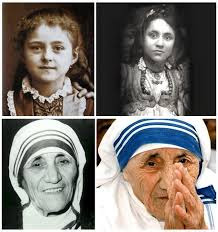
Mother Teresa is also known as “Blessed Teresa of Calcutta”. Her earlier name was Anjeza Gonxha Bojaxhiu. She was born on 26th August 1910 at the then Yugoslavia [ Non Republic of Macedonian]. She cameto India in 1926. Mother Teresa was Roman Ca6nun moved to Calcutta slum to serve God among the poorest of the poor.
In 1950, she established the Missionaries of Charity to help the poor, helpless, disabled, diseased, refugees and lepers. Today, the  Missionary is present in more than 100 countries. She was awarded the title of Padam Shri in 1962. She received the Novel peace prize in 1979. Later in 1980, she received the title of  “Bharat Ratna” the highest civilian award in India.  She is the first citizen of India to win Novel Peace Prize. 
She had once said, “Love cannot remain by itself – it has no meaning. Love has to be put into action, and that action is service.” Her work transcended geo-political borders and she encompassed the whole of humanity in her healing embrace. Her work was recognised through numerous international and national awards and recognitions. She was canonised at a ceremony in St. Peter’s Square at the Vatican by Pope Francis on September 4, 2016 and came to be known as Saint Teresa of Calcutta.In 1928, she left Skopje to join the Institute of the Blessed Virgin Mary, at Loreto Abbey in Rathfarnham, Ireland, a Catholic institution, which was popularly known as Sisters of Loreto. There, she was inducted into nunnery. She was given the name Sister Mary Teresa after the Saint Thérèse of Lisieux. After a training of around six months in Dublin, the capital of Ireland, Teresa was sent to Darjeeling, India to complete the novitiate period. 

On 24 May, 1931 she took her initial vows as a nun, the First Profession of Vows. She was sent to Calcutta by the Sisterhood. For around next 15 years, Mother Teresa taught at St. Mary’s High School in Calcutta, now Kolkata. The school run by the Sisters of Loreto provided free education to girls hailing from poor families. Here, Teresa became well versed in Bengali, and improved her English. She also became the principal of the school in 1944.

During her Final Profession of Vows on May 24, 1937, she took a vow of poverty, chastity and obedience. She took on the customary title of Mother and came to be known as Mother Teresa.

Call for Serving Humanity

Although Mother loved teaching and enjoyed shaping young minds at St. Mary’s, she was immensely disturbed by the plight of people around her. She was witness to the Bengal Famine in 1943, and experienced the pitiful condition of the poor during the trying times. Sufferings and desperation of the hungry tugged at the chords of her heart. The Hindu-Muslim Riots of 1946 prior to partition of India tore the nation apart. These two traumatic events drove Mother Teresa to contemplate what she could do to alleviate the sufferings of the people around her. 

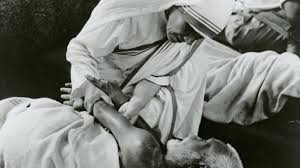
On 10 September, 1946, while traveling to Darjeeling, North-Bengal, for the annual retreat of the Convent, Mother heard “the call within call”. She felt as if the Jesus was asking her to come out of the walls and serve the down-trodden of the society. Following the Call, on August 17, 1947, Mother left the Convent. Out of reverence towards the Indian culture she adopted white sari with a blue border. He applied for Indian Citizenship and took basic medical training from Holy Family Hospital in Patna. For the next few years, Mother Teresa lived among the poor, in the slums of Calcutta. She, along with a few fellow nuns, went door to door, begging for food and financial help. They survived on the bare minimum and used the excess to help people around them. Gradually, her tireless efforts were recognised and help started pouring in from various sources.

<

p style=”background-color: white;color: #4c4a4a;font-family: Arial, Helvetica, sans-serif;font-size: 18px;line-height: 24px;margin: 0px 10px 10px;text-align: justify”>Thank You!
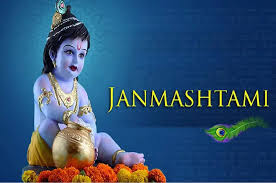
JANMASHTAMI

By: Astha Raghav.

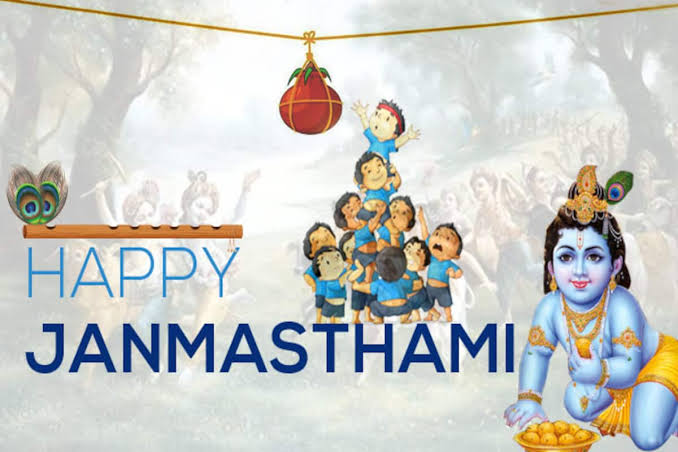
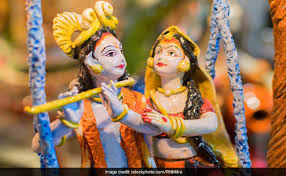
 Krishna Janmashtami, also known simply as Janmashtami or Gokulashtami, is an annual Hindhu festival that celebrates the birth of Krishna, the eighth avatar of Vishnu. It is observed according to the Hindhu lunisolar calendar, on the eighth day (Ashtami) of the Krishna Paksha (dark fortnight) in Shraavana or Bhadrapad (depending on whether the calendar chooses the new moon or full moon day as the last day of the month), which overlaps with August or September of the Gregorian Calendar.

It is an important festival, particularly in the Vaishnavism tradition of Hinduism. Dance-drama enactments of the life of Krishna according to the Bhagavata Purana (such as Rasa Lila or Krishna Lila), devotional singing through the midnight when Krishna was born, fasting (upavasa), a night vigil (Ratri Jagaran), and a festival (Mahotsav) on the following day are a part of the Janmashtami celebrations. It is celebrated particularly in Mathura and Vrindavan, along with major Vaishnava and non-sectarian communities found in Manipur, Assam, Bihar, West Bengal, Odisha, Madhya Pradesh, Rajasthan, Gujarat, Maharashtra, Karnataka, Kerala, Tamil Nadu, Andhra Pradesh and all other states of India.

Krishna Janmashtami is followed by the festival Nandotsav, which celebrates the occasion when NandaBaba distributed gifts to the community in honor of the birth.

Every year, Janmashtami is celebrated as the birthday of Lord Krishna. Though we all have nicknames, Lord Krishna has a whopping 108 names! Some of his names include Govind, Mohan, Hari, Vasudeva, Shyam, Ghanshyam, and to name a few more! These names reflect in all the bhajans and hymns which devotees sing on Janmashtami!

Janmashtami is celebrated with great enthusiasm by Hindus across the Indian subcontinent and beyond. In “A Janmashtami Journey”, we take a whistle-stop tour around the world to look at how this great festival is celebrated.

In countries like Singapore, Malaysia, Canada, and New Zealand, where there is a large community of Hindus, Janmashtami is celebrated. The day is marked with great fanfare and fervour in London, the US, and Poland and there is a unique temple in the Macau peninsula.

Thank You!

Feminism in India

A feminist is anyone who recognizes the equality and full humanity of women and men.”-Gloria SteinemSo, what is feminism? Feminism is an action of the society to bring rights to women and treat them equally regardless of their gender. Feminism is not something that should be endorsed by a woman only ,it can be carried forward by a man too. As said by G.D Anderson,” Feminism isn’t about making women strong, women are already strong, it’s about changing the way the world perceive that strength.” The fact itself is so confusing to understand the imbalance between two genders despite of any human being who is born with the same type of skin and color of blood. A woman deserves the same respect a man has without facing the question about their gender. Needless to say , patriarchy runs deep in our Indian society . A woman is forced to feel weak and small in front of a man and enforced to stay within a certain boundary. The long injustice in the name of gender has led to the topic of  feminism.
The importance of feminism in India is utmost. History has been an evident of feminism culture and its significance. The first and the foremost reason to bring this revolution is to change the mentality and to achieve a society free from male dominance. It has been a long battle for women to fight for their rights even if it’s about their decision. It is sad that till today a girl has to accept a man as her husband without her consent. A married woman is forced to do the household work and do not have the right to have a job hand in hand. Feminism plays an important part in the society because it demands equality among genders. Every year lakhs of female fetus get buried due to the burden of carrying a responsibility and the fear of giving dowry in marriage. Do you know Indian culture also discriminate working profession in regard of gender? Yes, in the past women could only do a job if that is approved by the male society and not judged by her talent. Feminism helps to remove such inequality. Today because people are giving importance to it, women like Mirabai Chanu and Lovlina Borgohain could outshine in their own field. No doubt with different kind of body framework and organs women have to undergo certain changes to meet the reproductive life. Menstruation is a big taboo, where women are considered impure during period cycle. Also there needs to have a stoppage of peoples hindering nature. Needless to say, women sometimes give rise to the inequality they once suffer from. Her mother-in-law force her to behave in a certain way, to cover her face whole life, to dress decently and ultimately it turns to be a social practice in a community.With change in generation and people advancing mindset things are changing and women are getting their rights. Topics like women empowerment, Beti bachao Beti padhao making people aware of the crucial role of a woman in balancing the atmosphere. Now a days, highly restricted states like Haryana is producing Miss world, wrestler like Geeta Phogat and Nirmala Devi. With the hope that one day the country would be free of gender inequality. Thus, people need to carry this journey forward and bring a change where both men and women could walk in the street without having the fear of getting killed or molested as a girl rather with the feeling safety to chase their dreams.

ReplyForward

Mastering One Thing at a Time

Many people have multiple areas of life they would like to improve. For example, I would like to reach more people with my writing, to lift heavier weights at the gym, and to start practicing mindfulness more consistently. Those are just a few of the goals I find desirable and you probably have a long list yourself. The problem is, even if we are committed to working hard on our goals, our natural tendency is to revert back to our old habits at some point. Making a permanent lifestyle change is really difficult. Recently, I’ve come across a few research studies that (just maybe) will make these difficult lifestyle changes a little bit easier. As you’ll see, however, the approach to mastering many areas of life is somewhat counterintuitive.

Too Many Good Intentions

If you want to master multiple habits and stick to them for good, then you need to figure out how to be consistent. How can you do that? Well, here is one of the most robust findings from psychology research on how to actually follow through on your goals: Research has shown that you are 2x to 3x more likely to stick with your habits if you make a specific plan for when, where, and how you will perform the behavior. For example, in one study scientists asked people to fill out this sentence: “During the next week, I will partake in at least 20 minutes of vigorous exercise on [DAY] at [TIME OF DAY] at/in [PLACE].” Researchers found that people who filled out this sentence were 2x to 3x more likely to actually exercise compared to a control group who did not make plans for their future behavior. Psychologists call these specific plans “implementation intentions” because they state when, where, and how you intend to implement a particular behavior. This finding is well proven and has been repeated in hundreds studies across a broad range of areas. For example, implementation intentions have been found to increase the odds that people will start exercising, begin recycling, stick with studying, and even stop smoking. However (and this is crucial to understand) follow-up research has discovered implementation intentions only work when you focus on one thing at a time. In fact, researchers found that people who tried to accomplish multiple goals were less committed and less likely to succeed than those who focused on a single goal.

What Happens When You Focus on One Thing

When you begin practicing a new habit it requires a lot of conscious effort to remember to do it. After awhile, however, the pattern of behavior becomes easier. Eventually, your new habit becomes a normal routine and the process is more or less mindless and automatic. Researchers have a fancy term for this process called “automaticity.” Automaticity is the ability to perform a behavior without thinking about each step, which allows the pattern to become automatic and habitual. But here’s the thing: automaticity only occurs as the result of lots of repetition and practice. The more reps you put in, the more automatic a behavior becomes. For example, this chart shows how long it takes for people to make a habit out of taking a 10-minute walk after breakfast. In the beginning, the degree of automaticity is very low. After 30 days, the habit is becoming fairly routine. After 60 days, the process is about as automatic as it can become.

The most important thing to note is that there is some “tipping point” at which new habits become more or less automatic. The time it takes to build a habit depends on many factors including how difficult the habit is, what your environment is like, your genetics, and more.

That said, the study cited above found the average habit takes about 66 days to become automatic.

Conclusion

  1. You are 2x to 3x more likely to follow through with a habit if you make a specific plan for when, where, and how you are going to implement it. This is known as an implementation intention.
  2. You should focus entirely on one thing. Research has found that implementation intentions do not work if you try to improve multiple habits at the same time.
  3. Research has shown that any given habit becomes more automatic with more practice. On average, it takes at least two months for new habits to become automatic behaviors.

The counterintuitive insight from all of this research is that the best way to change your entire life is by not changing your entire life. Instead, it is best to focus on one specific habit, work on it until you master it, and make it an automatic part of your daily life. Then, repeat the process for the next habit.

COPYRIGHT ACT, 1957

Copyright is a right given by the law to creators of literary, dramatic, musical and artistic works and producers of cinematograph films and sound recordings. In fact, it is a bundle of rights including, inter alia, rights of reproduction, communication to the public, adaption and translation of the work. 
Copyright ensures certain minimum safeguards of the rights of authors over their creations, thereby protecting and rewarding creativity.
Copyright in the case of literary, dramatic or musical work:
1.Reproducing the work in any material form which includes storing of it in any medium by electronic means
2.Issuing copies of the work to the public which are not already in circulation.
3.Performing the work in public or communicating it to the public
4. Making any cinematograph film or sound  recording in respect ot the work.
5.Making any translation or adaption of the work. Further any of the above mentioned acts in relation to work can be done in the case of translation or adaption of the work.
Copyright in the case of a computer programme:
1.To do any of the act specified in respect of a literary, dramatic or musical work
2.To sell or give on commercial rental or offer for sale or for commercial rental any copy of the computer programmes where the programme itself is not the essential object of the rental.

Copyright in case of artistic work:
1.To produce the work in any material form
2.Communicating the work to the public
3.Issuing copies of work to the public which are not already in existence.
4.Including work in any cinematograph film
5.Making adaption of the work, and to do any of the above acts in relation to an adaption of the work. 
Copyright in the case of cinematograph film:
1.To make a copy of film
2.To sell or give on commercial rental or offer for sale or for such rental, any copy of the film
3.To communicate the film to the public

Copyright in case of sound recording 
1. To make any other sound recording embodying it including storing of it in any medium by electronic or other means
2.To sell or give on commercial rental or offer for sale or for such rental, any copy of the sound recording
3.To communicate the sound recording to the public
Constitution of Copyright Board
1.It is constituted with minimum two and maximum fourteen members.
2.The chairman of the Copyright Board shall be a person who is or has been a Judge of a High Court or is qualified for appointment as a Judge of a High Court
3.The Copyright Board is deemed to be Civil Court and proceedings before it are deemed to be judicial proceedings.
Functions of Copyright Board 
1.Settlement of disputes as to copies of any literary, dramatic or artistic work or records are issued to the public in sufficient numbers 
2.Settlement of disputes with respect to assignment of copyright
3.Granting of compulsory licence in respect of Indian works withheld from public
4.Granting of compulsory licence in respect of Indian works withheld from public.
5.Rectification of Register of Copyright 
6.Determination of royalties payable to the owner of copyright, etc.

NATIONAL GREEN TRIBUNAL ACT, 2010

The National Green Tribunal Act,2010 is an Act which enables creation of a special Tribunal to handle the expeditious disposal  of cases pretaning to environmental issues. It was enacted under Indian Constitutional provision of Article 21.
OBJECTIVES
NGT is formed for effective disposal of cases relating to:-
1.Environmental protection
2.Conservation of forests
3.Other natural resources
4.Enforcement of any legal right relating to environment.
5.Giving relief and compensation for damages to persons and property.

Composition Of National Green Tribunal
1.The tribunal shall consist of-
– Full time chairperson
– Not less than 10 but maximum of 20 full time Judicial Member.
– Not less than 10 but maximum of 20 full time Expert Member.
2.The Chairperson of the Tribunal may invite any person having specialized knowledge and experience in a particular case before the Tribunal to assist the Tribunal in that case.
3.The Central Government by notification may specify the ordinary place of sitting of the Tribunal and the territorial jurisdiction.
4.The Central Government in consultation with the Chairperson  of the Tribunal may make rules regulating the practices and procedure of the Tribunal including-
– The rules as to the persons who shall be entitled to appear before the Tribunal.
– The rules as to procedure for hearing applications and appeals and other matters.
– Rules relating to transfer of cases by the Chairperson from one place of sitting to other place of sitting. 

POWERS OF NATIONAL GREEN TRIBUNAL
1.The Tribunal is not bound by the procedure laid down by the Code of Civil Procedure, 1908 but shall be guided by the principle of natural justice.
2.The Tribunal has power to regulate its own procedure.
3.The Tribunal shall also not be bound by the rules of evidence contained in the Indian Evidence Act,1872.
4.The tribunal shall have the same powers as are vested in a Civil Court while trying a suit, in respect of the following matters, namely:-
– Summoning and enforcing the attendance of any person and examining him on oath
– Requiring the discovery and production of documents 
– Receiving evidence on affidavits
– Requisitioning any public record or documents or copy of such record or document
– Issuing commissions for the examination of witness or documents
– Reviewing its decision.
– Dismissing an application for default or deciding it ex-parte.
– Setting aside any order of dismissal of any application
– Pass an interim order including granting an injuction or stay
– Any other prescribed matter 
COMPENSATION FOR DAMAGES
Heads under which compensation for damages can be claimed are:-
1.Death
2.Permanent, temporary, total or partial disability or other injury or sickness
3.Loss of wages due to total or partial disability or permanent or temporary disability 
4.Damage to private property
5.Loss to local authority or government arising out of, or connected with, the activity causing any damage.
6.Loss of business or employment or both
7.Loss and destruction of any property other than private property 
8.Claims on account of any harm, damage or destruction to the fauna including milch and draught animals and aquatic fauna
9.Claims on account of any harm, damage or destruction to the flora including aquatic flora, crops, vegetables, trees and orchards.
10.Expenses incurred by the Government or any local authority in providing relief, aid and rehabilitation to the affected persons. 
11.Any other claim arising out of or connected with, any activity of handling of hazardous substance.

BAILMENT as per INDIAN CONTRACT ACT,1872

“Bailment”, “bailor” & “bailee” defined [Section 145]: Bailment is the delivery of goods, by one person to another, for some purpose, upon a contract that they shall, when the purpose is accomplished,be returned or otherwise disposed of, according to the instructions of the person delivering them. Bailor is the person delivering the goods. Bailee is the person to whom the goods are delivered. When a person, already in possession of goods belonging to another, contracts to hold them as bailee, he becomes the Bailee and the owner becomes Bailor, even though the goods may not have been delivered by way of bailment.
The essentials of bailment are:-
(1) Contract: Bailment may be express or implied.
(2) Delivery of the goods: Bailment involves delivery of possession of goods by bailer to bailee.
(3) Possession: Only possession in goods (and not ownership) is transferred.
(4) Modes of delivery [Section 149]: Delivery may be actual or constructive. Actual delivery is made by physically handing over the goods. Constructive or symbolic delivery means doing something which has the effect of giving delivery. e.g, delivery of railway receipt, handing over the key of car etc.
(5) Purpose: The delivery of goods must be for a certain purpose.
(6) Return of goods: The goods must be returned after the purpose in accomplished
(7) Consideration: The consideration is generally in the form of money payment either by the bailor or bailee. The detriment suffered by the bailor, in parting with possession of the goods, is a sufficient consideration to support the contract of bailment.
Duties of bailor are as follows:
(1) To disclose faults in goods [Section 150]:
In case of gratuitous bailment: Bailor is bound to disclose known faults to bailee. If do not disclose then he may liable to bailee for damages from such non-disclosure.
In case of non-gratuitous bailment: Bailor is liable for damages whether or not he was aware of the existence of faults.
(2) To bear expenses:
-In case of gratuitous bailment: Bailor shall repay all necessary expenses incurred by bailee for the purpose of bailment.
-In case of non-gratuitous bailment: Bailor is liable only extraordinary expenses, and not the ordinary expenses.
(3) Indemnify bailee for loss in case of premature termination of gratuitous bailment [Section 159]:
Bailor has the right to terminate the gratuitous bailment even it is for particular period. In such a case, Bailor has to indemnify the bailee the excess of loss over benefit.
(4) Indemnify bailee for loss when bailor’s title is defective [Section 164]: Bailor is responsible to the Bailee for any loss which the Bailee may sustain by reason that the Bailor was not entitled to make bailment.
Example: A lends an old discarded motor cycle to B gratuitously for 3 months. B incurs 500 on its repairs. If A asks for the return of the motor cycle after 1 month, he will have to compensate B for expenses incurred by B in excess of the benefit derived by him.
(5) Receipt of goods back on termination of bailment: When bailee returns the goods in accordance with the terms, the bailor should receive them. If the bailor refuses to accept goods tendered by
bailee, he shall compensate the bailee for all necessary and incidental expenses incurred by him in keeping the things in good condition.

Duties of bailee are as follows:
(1) To take care of goods (Sections 151 & 152): The bailee is bound to take care of the goods bailed to him as a man of ordinary prudence. If bailee takes care of goods bailed as man of ordinary prudence then he will not be liable if there is loss to goods.
(2) Not to make unauthorized use of goods [Section 153]: Bailee shall act in conformity with the terms of contract of bailment. Where he does any act with regard to the goods bailed, inconsistent
with the terms, the contract becomes voidable at the option of bailor. The bailee  cannot set up an adverse title against the bailor.
(3) Compensation for damage to goods [Section 154]: Bailee shall use the goods according to terms and conditions of bailment. Where he does not use so and as a result, the goods suffer damage, he
shall duly compensate the bailor.
(a) Not to mix goods bailed with his own goods 
(b) With bailor’s consent (Section 155): Where the bailee, mixes the goods bailed with his own goods, with the bailor’s consent, both of them shall have interest in proportion to their shares in the mixture produced.
(c) Without bailor’s consent: If the goods in the mixture:
-Can be separated [Section 156]: Property in the goods remains with the respective parties. Bailee bound to bear the expenses of separation or division, and also of any damage arising from the mixture.
-Cannot be separated [Section 157]: Bailee shall compensate the bailor for the loss of his goods.
(4) Return of the goods bailed [Section 160]: Bailee shall, without demand, return the goods bailed to the bailor, or deliver it according to his instructions. Such delivery shall be made as soon as the time for which they were bailed expires, or the purpose for which it had been bailed is accomplished.
(5) Compensation for failure to return [Section 161]: Where by the fault of the bailee, goods are not returned at the proper time and place. Bailee shall compensate bailor for any loss, destruction or deterioration of such goods from that time.
(6) To return any accretion to goods [Section 163]: If there is any profit or increase from goods bailed shall be delivered by the bailee to the bailor.
Example: A gives a cow to B. Cow has calf. B should deliver cow as well as calf.
(7) Delivery of goods to joint bailors [Section 165]: When goods are owned and bailed by joint owners, and in the absence of contract to the contrary, the bailee shall deliver them back to one of join owners, or according to the directions of one joint owners without the consent of all.

SWEAT EQUITY SHARES

Sweat Equity Shares [Section 2(88)]: Sweat equity shares means equity shares issued by a company to its directors or employees at a discount or for consideration, other than cash for providing know-how or making available rights in the nature of intellectual property rights or value additions, by whatever name called.
Issue of sweat equity shares [Section 54]: A company can issue sweat equity shares, of a class of shares already issued, if the following conditions are satisfied:
(1) The issue has been authorized by a special resolution passed by the company in the general meeting.
(2) Such special resolution should clearly specify:
-Number of shares
-Current market price
-Consideration and
-Classes of directors or employees to whom such equity shares are to be issued.
(3) At least 1 year should have elapsed from the date on which the company was entitled to commence business.
(4) A company whose shares are listed on a recognized stock exchange issuing sweat equity shares should comply with the SEBI (Issue of Sweat Equity) Regulations, 2002.
(5) A company whose shares are not so listed should comply with the Companies (Share Capital & Debentures) Rules, 2014. The rights, limitations, restrictions and provisions as are for the time being applicable to equity shares shall be applicable to the sweat equity shares issued and the holders of sweat equity shares shall rank pari passu (on an equal footing) with other equity shareholders. (Section 54 (2)). Register of Sweat Equity Shares [Rule 8 (14) of the Companies (Share Capital & Debentures) Rules, 2014]: The company shall maintain a Register of Sweat Equity Shares in Form No. SH. 3 and shall forthwith enter therein the particulars of issue of sweat equity shares. The Register of Sweat Equity Shares shall be maintained at the registered office of the company or such other place as the Board may decide. The entries in the register shall be authenticated by the Company Secretary of the company or by any other person authorized by the Board for the purpose.
Provisions of the Companies (Share Capital & Debentures) Rules, 2014 relating to sweat equity shares are as follows:
(1) Explanatory statement to contain certain particulars [Rule 8(2)]: The explanatory statement to be annexed to the notice of the general meeting shall contain the prescribed content like the date of the board meeting reasons or justification for the issue: the class of shares under which sweat equity shares are intended to be issued; total number of
shares, etc.
(2) Validity of special resolution [Rule 8(3)]: The special resolution shall be valid for making the allotment up to period of 12 months.
(3) Limits on issue of sweat equity shares [Rule 8(4)]: The company shall not issue sweat equity shares for more than 15% of the existing paid up equity share capital in a year or shares of the issue value of 5 Crores, whichever is higher. The issuance of sweat equity shall not exceed 25% of the paid up equity capital at any time.
(4) Lock-in-period [Rule 8(5)]: The sweat equity shares issued to directors or employees shall be locked in for a period of 3 years from the date of allotment and this fact shall be stamped in bold on the share certificate.
(5) Valuation Aspects [Rule 8(6) & (7) & (81] The sweat equity shares to be issued shall be valued at a price determined by a registered valuer as the fair price giving justification for such valuation. The valuation of intellectual property rights or of know how or value additions shall be carried out by a registered valuer. A copy of the valuation report shall be sent to the shareholders with the notice of the
general meeting.
(6) Sweat equity shares and compensation aspects [Rule 8(11) & (12)]:
(i) If the sweat equity shares issued pursuant to no acquisition of an asset. The accounting value (fair value) of sweat equity shares shall be treated as a form of compensation to the employee or the director in the financial statements.
(ii) If the shares are issued pursuant to acquisition of an asset: The value up to valuation report shall be carried in the balance sheet as per the Accounting Standards and such excess value over the value as per valuation report shall be treated as a form of compensation to the employee or the director in the financial statements of the company.
(7) Disclosure in Board’s Report [Rule 8(13)]: The details of issue of sweat equity shares shall be disclosed in the Directors Report for the year.
(8) Maintenance of Register [Rule 8(14)]: The company shall maintain a Register of Sweat Equity Shares in Form No. SH. 3. The Register shall be maintained at the registered office of the company or such other place as the Board may decide. The entries in the register shall be authenticated by the Company Secretary or by any other person authorized by the Board.

LIFTING OF CORPORATE VIEL

When seven or more person in case of public company and two or more person in case of private company forms a company as per provisions of Companies Act, 2013 they are clothed with corporate personality and there association known by the name of the company. However, sometime this veil of corporate personality is used for some dishonest and fraudulent purpose in that case Court will look into reality and remove the corporate veil.
In the following case the courts have lifted the corporate veil-
(1) Prevention of fraud and misconduct: Where the medium of a company has been used for committing fraud or improper conduct, the Courts have lifted the veil and looked at the realities of the situation. Gilford Motor Co. vs. Horne [1933] Ch 935: In this case ‘Horne’ had been employed by the company under an agreement that he shall not solicit the customers of the company or compete with it for a certain period of time after having its employment. After ceasing to be employed by the plaintiff, ‘Horne’ formed a company which carried on a competing business and allotted whole of its shares to his wife and an employee of the company, who were appointed to be its directors. It was held that since the defendant (Horne) in fact controlled the company, its formation was a mere ‘cloak or sham’ to enable him to break his agreement with the plaintiff. Accordingly, an injunction was issued against him and against the company he had formed restraining them from soliciting the plaintiff’s customers.
(2) Company acting as agent: Where the company is in reality an agency or trust for someone else and the corporate facade is used to cover up that agency or trust. Re. FG Films Ltd. (1953) 1 All E.R. 615: FG films wanted Monsoon registered as a British film. It applied to be declared as the ‘maker’ under the Cinematography Films Act 1936-1948. The Board of Trade refused because it was made by the American Film Group Inc. The American company had promised to finance and provide facilities to the UK company for making the film. 90 shares were held by an American director and 10 by a British one. No shares were held by the third director, who was British. The film was made in India. It was held that the film could not be considered British made, even though the company owning the
rights was a UK company.
(3) Protection of public policy: Where the doctrine conflicts with public policy, Courts have lifted the corporation veil for protecting the public policy. Connors vs. Connors Ltd. (1940) 4 All E.R. 179: In this case the principle was applied against the managing directors he made use of his position contrary to public policy. In this case house of Lord determined the character of company as enemy company, since the person who de facto in control of its affairs where resident of Germany, which was at war with England at that time.
(4) Enemy character of company: Court will lift the corporate veil if the company has enemy character. Daimler Co. Ltd. vs. Continental Tyre & Rubber Co. Ltd. AIR 1927 Bombay 371: A Company was incorporated in London for the purpose of selling tyres manufactured in Germany by a German Company. Its majority shareholder and all the directors were Germans. On declaration of war between England and Germany in 1914, it was held that since both the decision making bodies, the Board of Directors and the general body of shareholders were controlled by Germans, the company was a German company and hence, an enemy company. Accordingly, the suit filed by the company to recover a trade debt was dismissed on the ground that such payment would amount to travelling with enemy.

(5) Evasion of taxes: Where the veil has been used for evasion of taxes and duties, the court upheld the piercing of the veil to look at the real transaction. [Re. Dinshaw Maneckjee Petit A.I.R. 1927 Bombay 371]

(6) To protect labour welfare legislation: Where the purpose of company formation was to avoid the welfare legislation, the Court will lift the corporate veil. Where it was found that the sole purpose for the formation of new company was to use it as a device to reduce the amount to be paid by way of bonus to workman the Supreme Court upheld the piercing of the veil to look at the transaction. [Workmen of Associated Rubber Industries Ltd. vs. Associated Rubber Industries Ltd. A.LR. 1986 SC 1]

(7) Use of corporate veil for hiding criminal activities: Where the defendant used the corporate structure as a device to conceal his criminal activities (evasion of customs and excise duties), the Court could lift the corporate veil and treat the assets of the company as the realizable property of the shareholder.

(8) To punish for contempt of Court: [Jyoti Limited vs. Kamwaljit Kaur Bhasin 32 (1987) DLT 198].

NATIONAL EDUCATION POLICY 2021- SALIENT FEATURES

BY DAKSHITA NAITHANI

Who created NEP (National Education Policy)?

The challenges that would occur in the Indian education system – from school to college to work – were examined by a panel of experts chaired by former ISRO chairman K Kasturirangan. 

NEP- National Education Policy

The “New Education Policy 2020-2021” was recently adopted by the Central Government Cabinet Committee. 2 crore schoolchildren would be reintegrated into the mainstream under the NEP 2020. With 12 years of schooling and 3 years of Anganwadi/Preschool, a new 5 + 3 + 3 + 4 curriculum was launched.

Anganwadi will provide pre-school education to children for the first three years. The students will then be educated in first and second grades for the following two years. First five years of study will be completed by a new curriculum which will be developed. Activity-based learning will be the main focus. It will be available to youngsters aged three to eight. 

Preparatory stage – Classes three through five will be covered at this time. Children will be taught science, mathematics, the arts, and other subjects through experiments during this period. Children between the ages of 8 to 11 will be covered.

 Middle Stage – These subject-based workshops will include grades 6-8, as well as students aged 11-14. Courses in skill development will begin in sixth grade.

The secondary stage- From ninth through twelfth grade, students will be divided into two groups for intense study of the topics. There will also be the option of picking and choosing subjects. Previously, this system did not exist in government pre-schools. From first grade through tenth grade, there was a general education programme. 

With no clear distinction between academic streams, schools will focus a greater emphasis on extracurricular activities, professional development, reading, and numeracy. In accordance with the new policy 2020, vocational education will begin in the sixth grade. It will be mandatory to teach in the mother tongue / regional language till the fifth grade. Improvement of evaluation and tracking progress of students to accomplish learning goals, among other things, is covered with a full 360-degree progress card.

Other important changes in school education – Salient Features of #NEP2020

According to Dr. Kasturirangan, vocational education, led the committee created to approve the new education policy, and now the kid will get vocational education and skills beginning in the sixth grade. Internships will be available on a local level as well. Vocational education and skill development will be prioritised.

There will be no job losses as a result of the new education approach. The youngsters will receive the essential education in school for professional environment. The 10th and 12th grade Board examinations will be straightforward. The Board examinations for classes 10th and 12th will undergo modifications.

Exams conducted by the council will be undervalued. There are a lot of good ideas in this article. Exams, for example, should be given twice a year and divided into two portions, one objective and the other explanatory. When it comes to council examinations, students are always under pressure and rely on training to improve their grades. According to the education strategy, various councils will create a realistic model for board exams in the near future. Exams and units at the yearly and quarterly levels, for instance.

Changes will be made to children’s report cards, which will be used to evaluate their school achievement and performance. They will be graded on three different levels. The first will be a student, the second will be a classmate, and the third will be his teacher.

In 2019, the rough draft of NEP was introduced, and it received much praise as well as harsh criticism. The idea to declare Hindi one of the essential languages was quickly shot down. After that, the document was made public, and individuals and other stakeholders were asked to submit policy ideas for improvement.

Changes Made in Higher Education

50% Increase in GER

By 2035, the NEP intends to raise the existing GER (Gross Enrolment Ratio) from 26.3 – 50 percent. 3.5 Crore additional places in higher education would be added.

Interdisciplinary general education

The strategy aims to provide a complete, multidisciplinary, and broad-based college education with flexible plans, additional topic options, a greater emphasis on vocational education, and the ability to enrol and exit the programme with a recognised degree. For example, Certificate after 1 year, Advanced Diploma after 2 years, Degree after 3 years, License for research after 4 years.

India’s educational system is at a critical crossroads. On the one hand, it is expected to replace an out-of-date paradigm with the NEP 2020. New digital learning platforms and creative teaching approaches, on the other hand, are driving it to global standards and setting new milestones.

Any country’s education is judged by the quality of its human capital. A well-educated population with a high literacy rate is better prepared to take on social, economic, and political responsibilities responsibly while maintaining a broad understanding of global concerns. This is the goal embodied in the NEP 2020, which, if implemented well, would make education more comprehensive and enjoyable.

With the announcement to qualitatively improve 15,000 schools across India to adopt NEP in the Union Budget 2021-22 and these will act as role models for other schools to emulate. To maximise the benefits of the NEP, the education sector must harness the powers of technology in the future. This will result in a rising curve in the standard of education in India.

As we emerge from the coronavirus epidemic and begin a new academic year, it is critical to recognise the potential for change in Indian education as a consequence of these 3 forces: the National Education Policy (NEP) and the accompanying new platforms and teaching and learning methodologies.

.

DOCTORINE OF HOLDING OUT &amp;amp; DOCTRINE OF FEEDING THE GRANT BY ESTOPPLE

DOCTRINE OF HOLDING OUT
General rule regarding the transfer of property is that no one can transfer a better title than what he himself possesses. However, Section 41 of the Transfer of Property Act, 1882 makes an exception to this rule. Thus, transfer made by the ostensible owner of the property is valid subject to condition specified in Section 41. This Section is a statutory application of the law of estoppel. An ostensible owner is one who has all the indicia of ownership without being the real owner.
Transfer by ostensible owner [Section 41]: Where, with the consent, express or implied, of the persons interested in immovable property, a person is the ostensible owner of such property and transfers the same for consideration, the transfer shall not be voidable on the ground that the transferor was not authorized to make it, provided that the transferee, after taking reasonable care to ascertain that the transferor had power to make the transfer, has acted in good faith
In simple words, if sale is made by ostensible owner for a consideration, then such sale is valid if transferee has taken reasonable care to see that transferor has power to make such sale.
Essential Conditions:
(1) Transferor is the ostensible owner.
(2) He is so by the consent, express or implied, of the real owner. 
(3) Transfer is for consideration, and
(4) Transferee has acted in good faith taking reasonable care to ascertain that the transferor had power to transfer.
Examples:
(a) A made a gift of property to B but continued in possession of the gifted property. He purported to
exercise a power of revocation and then transferred the property to the defendant. The gift, however, was not revocable as it was an unconditional gift. B seeks to recover possession from the defendant. The defendant invoked protection under Section 41. In the given example, the donor is not an “ostensible owner” holding the property with the consent of the real owner. The defendant cannot, therefore, invoke the protection of Section 41.
(2) The manager of a point Hindu family consisting of some minor members alienated the ancestral house to P without any necessity and the alienee transferred it to the defendants. The minors challenged the alienation. The defendants sought protection under Section 41.
Here Section 41 has no application for “P was not the ostensible owner of the ancestral family house with the consent, express or implied, of the persons interested in the said ancestral house in as much as the plaintiff, had an interest in the said house, did not and could not by reason of the disability of infancy give their consent”.

DOCTRINE OF FEEDING THE GRANT BY ESTOPPLE
Transfer by unauthorized person who subsequently acquires (Section 43): Where, a person fraudulently or erroneously represents that he is authorized to transfer certain immovable property and professes to transfer such property for consideration, such transfer shall, at the option of the transferee, operate on any interest which the transferor may acquire in such property at any time during which the contract of transfer subsists.
In simple words. If a transferor transfer the property of other which is is not entitled, then subsequently when he acquires the property, he will have to transfer the property to the transferee
.
Example: A, a Hindu who has separated from his father B, sells to C three fields, X Y ,Z representing that A is authorized to transfer the same. Of these fields Z does not belong to A, it having been retained by B on the partition, but on B’s dying A as heir obtains Z. C, not having rescinded the contract of sale, may require A to deliver Z to him.

DOCTORINE OF HOLDING OUT &amp; DOCTRINE OF FEEDING THE GRANT BY ESTOPPLE

DOCTRINE OF HOLDING OUT
General rule regarding the transfer of property is that no one can transfer a better title than what he himself possesses. However, Section 41 of the Transfer of Property Act, 1882 makes an exception to this rule. Thus, transfer made by the ostensible owner of the property is valid subject to condition specified in Section 41. This Section is a statutory application of the law of estoppel. An ostensible owner is one who has all the indicia of ownership without being the real owner.
Transfer by ostensible owner [Section 41]: Where, with the consent, express or implied, of the persons interested in immovable property, a person is the ostensible owner of such property and transfers the same for consideration, the transfer shall not be voidable on the ground that the transferor was not authorized to make it, provided that the transferee, after taking reasonable care to ascertain that the transferor had power to make the transfer, has acted in good faith
In simple words, if sale is made by ostensible owner for a consideration, then such sale is valid if transferee has taken reasonable care to see that transferor has power to make such sale.
Essential Conditions:
(1) Transferor is the ostensible owner.
(2) He is so by the consent, express or implied, of the real owner. 
(3) Transfer is for consideration, and
(4) Transferee has acted in good faith taking reasonable care to ascertain that the transferor had power to transfer.
Examples:
(a) A made a gift of property to B but continued in possession of the gifted property. He purported to
exercise a power of revocation and then transferred the property to the defendant. The gift, however, was not revocable as it was an unconditional gift. B seeks to recover possession from the defendant. The defendant invoked protection under Section 41. In the given example, the donor is not an “ostensible owner” holding the property with the consent of the real owner. The defendant cannot, therefore, invoke the protection of Section 41.
(2) The manager of a point Hindu family consisting of some minor members alienated the ancestral house to P without any necessity and the alienee transferred it to the defendants. The minors challenged the alienation. The defendants sought protection under Section 41.
Here Section 41 has no application for “P was not the ostensible owner of the ancestral family house with the consent, express or implied, of the persons interested in the said ancestral house in as much as the plaintiff, had an interest in the said house, did not and could not by reason of the disability of infancy give their consent”.

DOCTRINE OF FEEDING THE GRANT BY ESTOPPLE
Transfer by unauthorized person who subsequently acquires (Section 43): Where, a person fraudulently or erroneously represents that he is authorized to transfer certain immovable property and professes to transfer such property for consideration, such transfer shall, at the option of the transferee, operate on any interest which the transferor may acquire in such property at any time during which the contract of transfer subsists.
In simple words. If a transferor transfer the property of other which is is not entitled, then subsequently when he acquires the property, he will have to transfer the property to the transferee
.
Example: A, a Hindu who has separated from his father B, sells to C three fields, X Y ,Z representing that A is authorized to transfer the same. Of these fields Z does not belong to A, it having been retained by B on the partition, but on B’s dying A as heir obtains Z. C, not having rescinded the contract of sale, may require A to deliver Z to him.

Difference between Private Company, Public Company and One Person Company

PRIVATE COMPANIES 

1.Private company requires minimum number of two members and maximum number of 200 members.
2.The liability of each member or shareholders is limited. It means individual assets of the shareholders are not at risk.
3.The company keeps on existing in the eyes of law even in the case of death, insolvency, the bankruptcy of any of its members.
4.The maintenance of index of members is not necessary in case the number of members of the company is less than fifty.
5.Private company needs minimum of two directors, to come into existence and start its operations.
6.There is no minimum capital requirement.
7.In private company there is no need to issue prospectus, as the prohibits any invitation to the public to subscribe for any securities of the company. 
8. It is mandatory for every private company to use the word “private limited” after its name.

PUBLIC COMPANY 
1.The board of the Public company comprises of a minimum number of three members and maximum of 15. The company may appoint more than 15 directors after passing special resolution.
2.Shareholder liability for the loses of the company is limited to their share contribution only. This is what makes it a separate legal entity from its shareholders.
3.A public company has a minimum of seven members and maximum has no limit.
4.The shares of listed public company are easily  transferable between its members and people trading in the stock exchange.
5.A public limited company is not affected by death of one of its shareholders, but the shares are transferred to the next kin of such deceased shareholder and the company continues to run its business as usual.
6.Public companies are strictly regulated and are required to publish their complete financial statements annually. 
7.Public limited companies enjoy an increased ability to raise capital since they can issue shares to the public through the stock market. They can also raise additional capital by issuing debentures and bonds through the same market from the public 
8.The public company should have word limited in its name. 

ONE PERSON COMPANY 
1.It is a company which has only one person as member.
2.It is type of a private company 
3.To incorporate one person company the natural person should be an Indian citizen and  resident in India.
4.Natural person who is an Indian citizen and  resident in India shall be a nominee for the sole member of a One Person Company.
5.A natural person shall not be a member of more than One person Company at any point of time and the said person shall not be a nominee of more than a One Person Company.
6.Where a natural person being  member in One person Company in accordance with this rule becomes a member in another such company by virtue of his being a nominee in that One Person Company, such person shall meet the eligibility criteria specified in sub rule (2) within a period of 180 days.
7.No minor shall become member or nominee of the One Person Company or can hold share with beneficial interest.
8.Such company cannot be incorporated or converted into a company under section 8 of the Act.
9.Such company cannot carry out Non-Banking Financial Investment activities including investment in securities of any body corporate.

WHY DIAMONDS ARE SO EXPENSIVE ?

Diamonds are allotropes of carbon like graphite. But, the difference between them is tremendous. What makes diamonds so costly ? Well some might say that the extraordinariness, challenges in mining, toughness, cut, clearness, shading, and carat of diamonds make them costly and popular. Gold and silver are likewise uncommon, mining them is additionally troublesome however why just diamond is so costly ? Why people give diamond ring when they propose one another ?

Why Are Diamonds So Expensive? – EVEVIC JEWELRY

A few years ago it was not a trend to give diamond rings while proposing. There are many stones rarer than diamonds. They are costly as a result of a company called De Beers. Each diamond you find in this world comes from this company not because diamonds are very rare to find. There are numerous diamond mines in this world however this organization don’t let those diamonds to arrive at the market.

At the point when supply of a specific item is less however demand is high, this outcomes in making that item more costly. This company made the stock of diamonds exceptionally less. But, how ? Few years back diamonds were found only in India and Brazil. But then it was also found in Africa and that too in very large quantity. De beers was also one of the company which found a lot of diamonds in Africa. But the other mines company started selling diamonds because the supply of diamonds were increasing which can make them less expensive. They were in loss. De beers would have also done that but instead it started buying those diamonds by taking loans and because of that it became the owner of all mines in Africa. It became a monopoly and a monopoly does what it wants. Soon when other mines company discovered diamonds in Serbia and other countries De beers bought all of them. It became owner of all the diamonds in the world.

Yet, De beers never let people to realize that they have diamonds in exceptionally huge amount because then people won’t buy it. They restricted the stock of diamonds which made them uncommon. They further began promoting diamonds by giving statements like “A diamond is forever”. Because of this, the interest of people towards diamonds increased and they became expensive.

RESOURCES:

2. https://francisalukkas.com/why-are-diamonds-so-expensive-5-reasons/

3 Most important time management techniques

Everyone gets 24 hours a day but those who have ability to get maximum out of these 24 hours are classified as successful. Time management is the key to convert 24 hours into 25 hours. In simple words time management is process of organizing and dividing your time into various activities.

It’s about simplifying how you work and getting things done better and faster. It’s about working smarter. It is a game of choices. You have to make a choice about how you want to use your precious time. So if you are interested in improving your time management skills, check out these cool techniques.

Eat that frog

Brian Tracy says “You cannot eat every tadpole and frog in the pond. But you can eat the biggest and ugliest one, and that will be enough, at least for the time being.”

Identify your most important task of the day, this is your frog. It is the most impactful task of your day so begin your day by tackling this frog. Start this work and do this without any interruptions. This will bring an early win in your day which will build the momentum and sense of accomplishment.

But what if you have multiple frogs? Eat the biggest frog first. So instead of doing easy tasks first, do the difficult ones.

The Pomodoro technique

It is one of the most simple yet effective time management technique. This technique forces you to do single task so that your brain can focus on only one thing at a time as switching between tasks reduces productivity.

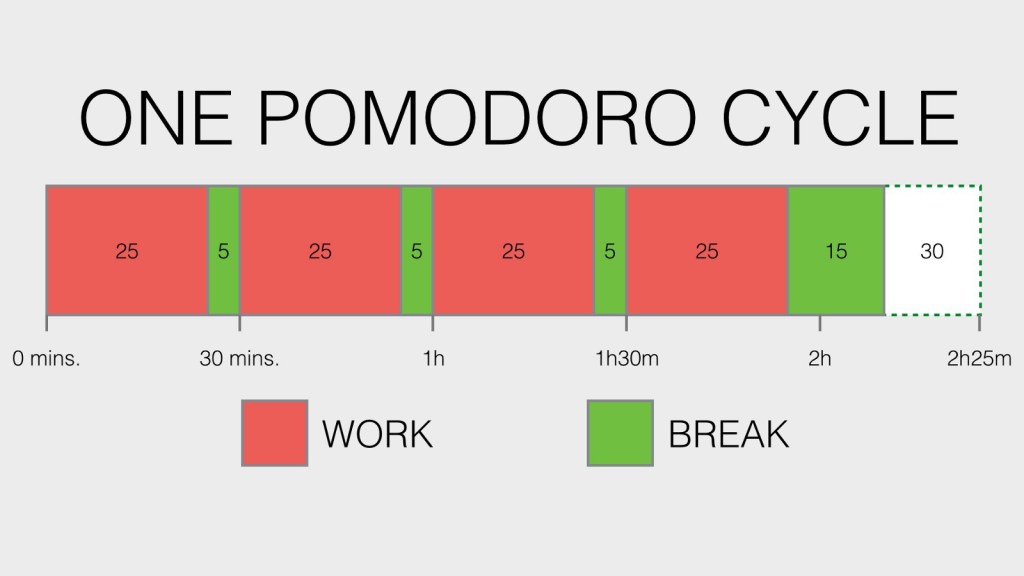
According to this technique turn off all distractions and set a timer for 25 minutes. During that time you will only focus on that work. After 25 minutes take a break of 5 minutes. After repeating this process for 4 times, take a long break.

The reason why it is successful is that it creates a sense of urgency as you have only 25 minutes to make as much progress as you can. Also it forces you to take a break which keeps you fresh throughout the day.

The Eisenhower Matrix

Prioritizing your tasks is a crucial part of time management as you may be spending hours doing useless things. The Eisenhower Matrix( urgent-important matrix) helps you in discovering your important tasks.

This matrix divides all your tasks into 4 quadrants:

  1. Urgent and important: These are the most important tasks of your day. You have to do these tasks at any cost. This quadrant include crisis and deadline driven tasks.
  2. Not urgent and important: These are important tasks but can be delegated like business planning, building relationships. As these tasks are not urgent you can schedule them in near future.
  3. Urgent and not important: These are tasks like interruptions, non important email etc. As these tasks are not important delegate them instead of completing them now.
  4. Non important and non urgent: These tasks are distractions and time wasters like playing video games. Just eliminate these tasks and focus on important ones.

To make this matrix, write down all your task and insert each task in respective quadrant. To be more productive spend more time on Not urgent but important activities as these tasks are meaningful to you but not urgent.

So these are some time management techniques, try to implement them every morning and get the best out of your precious time.