NSF to reach out to unrepresented education institutions

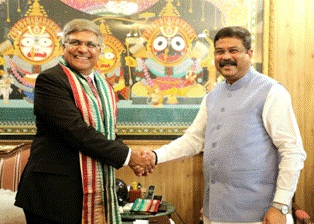
 The US National Science  Foundation has expressed keenness to deepen and widen its collaborations with India in the education and skilling sectors. NSF Director Shri  Sethuraman Panchanathan met the Union Minister of Education Shri Dharmendra Pradhan in New Delhi today, to discuss mutual areas of interest and India’s plans for STEM studies under the National Education Policy 2020. 

2022-08-09 15:59:31.677000

Speaking at the meeting Shri Pradhan emphasized that India’s strength lies in its young demographics and strong knowledge base. He said a wealth of  talent is available in various institutions across different regions of the  country, waiting to be nurtured. NSF should therefore  look at increasing its engagement with lesser known and hitherto unrepresented institutions  like NITs, Central Universities and State Universities in addition to the premier  institutions in the country.  Referring to the education- skill continuum that is being created in accordance with NEP 2020, Shri Pradhan also emphasized the necessity of  bringing the  skill sector within the ambit of such collaboration by reaching out to institutions like polytechnics, ITIs and community colleges. He said it was top priority and responsibility of his Government to ensure that all youth, whether in  mainstream academics or in the formal or informal skill sector, get equal opportunity to quality education and skilling so that they are equipped to face the twenty first century challenges. 

NSF is an independent federal agency with the responsibility of promoting  scientific discovery, technological innovation and STEM education. With a budget of  US$8.8 billion, NSF is the major source of federal funding in fields such as mathematics, computer science and the social sciences . India’s engagements with the NSF include six Technology Innovation Hubs under which 8 institutions like IITs, IISc Bangalore and others are collaborating in 30 projects and some projects on Cyber Security. Director NSF is in India to explore ways to enhance these engagements.

Echoing India’s priorities Shri Panchanathan said that like India, inclusivity and accessibility of quality education are  a priority with the US Government too. He assured that NSA would reach out for collaboration with unrepresented institutions including those involved in skilling, so that talent in these places can also be nurtured.

Shri Pradhan has asked the Ministry of Education, led by AICTE, to prepare a framework for further engagement with the NSF, also consulting other relevant Ministries  in this regard.

*****


ROLE OF FAMILY,SOCIETY AND EDUCATIONAL INSTITUTIONS IN INCULCATIONG VALUES

Family, society, and educational institutions play a very major role in building one’s character or personality. These institutions impart value to an individual and help them become a better person in society. One learns what one listens. Young children very much learn what they see around them. If they see good they learn good and if they see bad they will learn that as well. The role of family is important because an individual lives there and learns from there, society influences an individual’s behaviour and educational institutions are where an individual learns. Now we’ll see how these factors help in inculcating values in an individual.

ROLE OF FAMILY

Family is a place where one grows, and learns the most. Just like the saying charity begins at home similarly an individual’s education starts from home. It is like a foundation where values are built. Values like respecting elders, honesty, justice, respect for both genders all taught at home. If within a family there are differences or if the home environment is not healthy then this also affects the individual. The values practised by the other members of the family also shapes the child’s attitude towards other people or towards the society. Values like love, care, protection all these start from family. If a child experiences love, care, comfort then he/she will have a positive attitude toward others and will behave the same with others and will inspire others as well. Family’s environment will help a child to socialise and progress in the society.

The system of joint family that is the presence of elder family members also has a great influence on an individual. It helps in developing social and moral values. They learn human values and respecting elders and this will help in eradicating negative mental tendencies when they are among elders. In a family an individual not only learns about values but also about their customs and culture and enhancing one’s culture proudly is also a very good value. The attitude of one family member towards another also affects individual behaviour. For example if child see his father not respecting his mother then he may feel that this is how it is supposed to be and he may also do the same thing with his wife but if he sees his father respecting her mother, giving her importance which she deserves the he will also treat his wife in respective manner so it is very important for a family to not just inculcate good values to the younger generation but they themselves should have good value so the future generation could learn from them.

The values that are taught in the family helps a child to learn, grow and progress in the society. Family values enhance a child’s personality and character and help them in becoming a better human being.

ROLE OF SOCIETY

When we grow older our social world also expands, now not only family but we become a part of society. Society also plays an important role in inculcating values. When a child grows it goes outside to make friends and share each other’s thoughts. Society also shapes an individual’s character. Societies follow certain traditions and customs and being a part of the society, we are also a part of these customs and traditions. These customs and traditions are being followed from generations and these are based on values such as loyalty, courage, love and brotherhood. We celebrate different festivals together which portray love and happiness and we not only celebrate festivals of one tradition or religion, but being part of such a diverse country we get to enjoy festivals and customs of different religions which shows mutual respect towards each other and toward different individuals in a society. Religion is a very important social institution in our Indian society and these religions are embedded with cultural values. Society creates social order, the diversity present in our society teaches mutual love, respect and inculcates a variety of values and holistic development of individuals. The social influence and the urge to become an inspiring personality in a society helps in developing good values in an individual. The great inspiring personalities, influencer leaders and celebrities also have a great influence in society. Young individuals learn and get inspired by them so it is also an important job for these powerful personalities to set a good example for the younger generation.

ROLE OF EDUCATIONAL INSTITUTIONS

Apart from home, a child spends most of his/her time at school. The first formal place of socialisation and the first and foremost important value that it teaches is discipline. The educational institutions have a proper disciplined environment. In an educational institution, the day starts with the prayer which teaches gratitude. Different school activities inculcate different values such as teamwork, sportsmanship spirit, competitiveness, etc. Different programs of Community work help in inculcating values like empathy, care, unity, etc. Peer groups also play an important role, students often get feedback about their behaviour from their fellow classmates or friends. Teachers also act as role models for the students, when a teacher asks students to behave in a certain manner then they tend to take it more seriously as compared to any family member or friend. The reward and punishment system also helps as children behave in a good manner for rewards and to protect their self esteem from getting punished. Every school or educational institution has their philosophy or motto and these help in inculcation of good values.

“Intelligence plus character, that is the true goal of education”. – Martin Luther King

Value is something that is not restricted to a certain age or gender or place. It is something which is lifelong, it can be learned at any age and be practiced throughout one’s life. Good values build one character and make an individual a better human being . A man with good values is respected everywhere in the society so it is very important to inculcate good values in life. There are different characters in an individual life that add to his/her character and personality. The influence of family, society and educational institutions have the strongest influence upon an individual and thus it affects in developing an individual personality whether positively or negatively.  

Sources: diyethics.forumias.com

developing the linkage between educational institutions, Industries and R&D Institutions

 Steps taken by the Government for developing the linkage between educational institutions, Industries and R&D Institutions are as follows:

I.          Impacting Research Innovation & Technology (IMPRINT): This initiative aims at providing solutions to the most relevant engineering challenges and translating knowledge into viable technology in 10 selected technology domains, viz. Health care, energy, sustainable habitat, nano technology hardware, water resources and river systems, advanced materials, Information and communication technology, manufacturing, security and defense, and environmental science and climate change. It is a pan IITs and IISc Joint Initiative seeking to develop a roadmap for research. During 2018-2019 Rs. 46.30 crore and during 2019-2020 Rs. 47.20 crore has been released.

I.          Research Park: Research park at IIT Delhi, IIT Guwahati, IIT Kharagpur, IIT Kanpur, IIT Chennai, have been established which provide an interface between entrepreneurship and Industry to establish their R&D units in collaboration with students & faculty members of the IITs. In the year 2020-21 Rs. 144.50 crore has been released.

II.        UchhatarAvishkarYojana (UAY): This initiative promotes innovation of a higher order that directly impacts the needs of the Industry and thereby improves the competitive edge of Indian manufacturing. The project envisages collaboration between the academia and industry – within or outside India.

In order to provide impetus to vocational education the allocation in 2021-22 for National Apprenticeship Training Scheme has been kept at Rs. 500 crore. Further, UGC has already issued guidelines for Apprenticeship/Internship Embedded Degree Program.

Realize the dream of activating India 2.0, fueled with the spirit of Atmanirbhar Bharat

 National Innovation week will inspire us to work collaboratively to realize the dream of activating India 2.0, fueled with the spirit of Atmanirbhar Bharat, said Shri Subhas Sarkar, Minister of State for Education while addressing the valedictory session of  E- Symposium on ‘Building Innovation Ecosystem in Educational Institutes’ here today.

In his concluding remarks Shri Sarkar said that our goal is to promote innovation, entrepreneurship, critical thinking, and out-of-the-box thinking in our educational system, which is also reflected in the New Education Policy 2020. He further said that Government is committed to enhance the Indian economy and working tirelessly to achieve India’s goal of becoming a 5 trillion-dollar economy by 2024-25. Facilitating investment, fostering innovation, building best-in-class infrastructure, and making India a hub for manufacturing, design, and innovation will help us achieve the Atmanirbhar Bharat in the true sense. 

Click here to see Closing Ceremony of e-Symposium on Building Innovation & Entrepreneurial Ecosystem

Shri Sarkar stressed that the time has come when every Ministry, Government Department, Industry leaders, and all key stakeholders work collaboratively and support our higher education institutions so that they work on creating a holistic culture of innovation, research, and help in nurturing young talent to pursue their dreams as an Innovators and solve the problems faced by society and address upcoming challenges. 

At the occasion, Professor K. Vijay Raghavan, Principal Scientific Advisor (PSA) to the Government of India, emphasized on need of innovation for economic change and sustainability. He said that we need to expand the funding of research and innovation eco-system to position India as a favoured destination for Research and Development. He highlighted on adoption of best global practices for establishing closer linkages with national R&D institutions and academia, talent development and sourcing, strategic partnerships to bolster R&D in India and integrating with the domestic start-up ecosystem. He further added that, innovation must be linked with economic change and market and in synchronization with ongoing policy measures including Swachh Bharat, Made in India etc. etc. He urged Indian youth to come forward in sharing the ideas for country and economic development.

The opening session was followed by two panel discussion titled, “Grey Hairs not mandatory to build greater enterprises” and “Attracting Big Investment for Innovative ideas from Educational Institution” which was well attended by eminent personalities. All the panelists were enthused with such platforms which are much needed for building up the R&D and innovation eco-systems in India.

Prof. M. P. Poonia, Vice Chairman of AICTE had delivered welcome address and appreciated for the overwhelming responses and participation from student and faculty fraternity from educational institutions. The sessions were viewed by more than1.2 lakh attendees online across the globe. All panelists were enthused with e-symposium platforms which is the need of hour for building the R&D and innovation eco-systems in India.

Prof. Rajive Kumar, Member Secretary, AICTE highlighted the role of AICTE in supporting the technical institutions to excel in the field of innovation and entrepreneurship. The event concluded with vote of thanks delivered by him.

******

Restoring normalcy and vibrancy in educational institutions post-COVID

 Union Education Minister Shri Dharmendra Pradhan today reviewed the vaccination status of teachers across the country and reopening of schools. He also reviewed the vaccination status in the skilling ecosystem. Shri Rajeev Chandrasekhar, Minister of State for Skill Development and Entrepreneurship and Shri Rajkumar Ranjan Singh, Minister of State for Education were also present in the meeting.

Shri Pradhan has been regularly monitoring the vaccination of teaching staff and non teaching staff to ensure enabling environment for schools to move towards reopening. He stressed upon the need to restore normalcy and vibrancy in the educational institutions in wake of rapid vaccination at scale happening in the country.

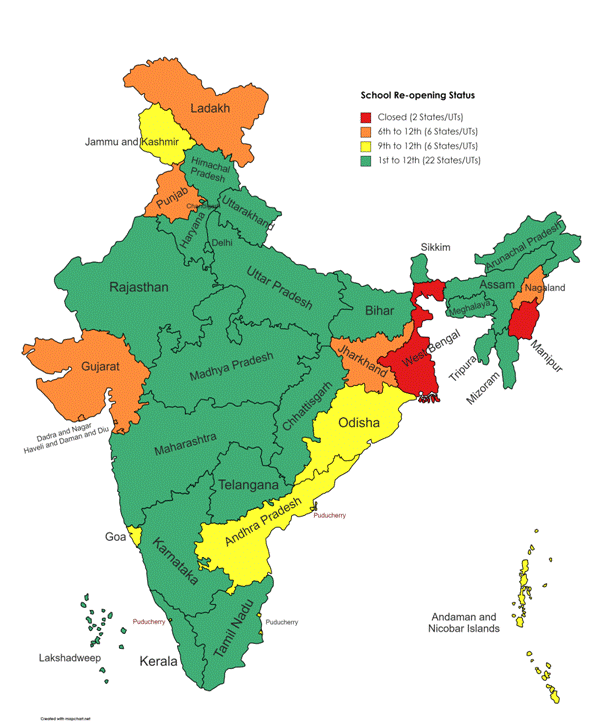
As on date, a majority of states have already opened the schools for all the classes. Over 92% of teaching staff have been vaccinated. In the institutions under Central Government, over 96 % of teaching staff have been vaccinated.


School_Re_opening_Status (2).png


  MJPS/AK