

ELASTIC AND PLASTIC BEHAVIOUR OF SOLIDS :-
By a rigid body, we generally mean a hard solid object having a definite shape and size. As we know that solid bodies are not perfectly rigid. They can be moulded or given any shape. A body may get deformed, if an external force is applied on it. When the deforming force is removed, some bodies tend to regain their original size and shape while others do not show any such tendancy.
Deforming Force :-
If a force is applied on a body which is neither free to move nor free to rotate, the molecules of the body experience a force that tends to change their relative positions. As a result, the body may undergo a change in length, volume or shape. The force responsible for it is known as a deforming force.
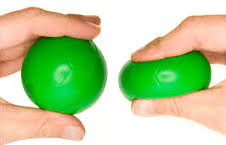
Elasticity :-
Elasticity is defined as if a body regains its original shape and size after the deforming force is applied on it. The objects and materials that follow this property are known as elastic bodies. We can call it a temporary change.
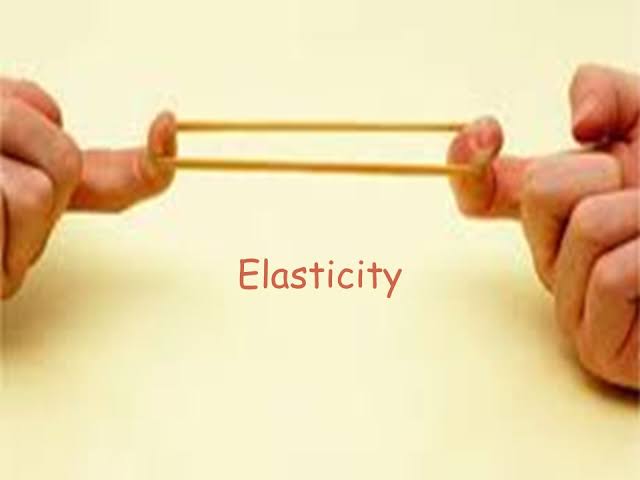
Perfectly Elastic Body :-
This is defined as the nature of an object to regain its original shape and size immediately and completely after the deforming force applied on it is removed. The objects and materials that follow this property are considered as perfectly elastic bodies. Example is rubber band, quartz filter, etc.
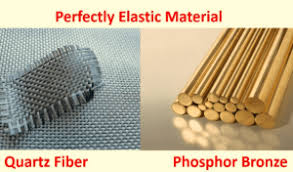
Plasticity :-
Plasticity is defined as a nature of an object or material in which it does not able to regain its original shape and size even after the deforming force applied on it is removed completely. We can call it a permanent change.
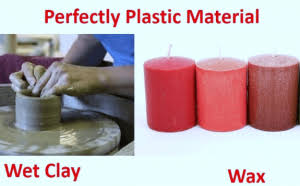
Perfectly Plastic Body :-
This is defined as the nature of an object or material in which it completely regains its original size and shape after the deforming force applied on it is completely removed. Example is mud.
STRESS :-
When a body tries to regain its original shape and size after the removal of deforming force applied on it, then an internal force is generated within the body. This internal force responsible for helping the object to gain its original shape and size is nothing but stress. Stress is the internal force of an object acting per unit area. Its SI unit is Nm2 and CGS unit is dyne cm-2 .
Types of Stress :-
- Tensile Stress – If after applying stress on a body such that the length of the body increases in the direction of the deforming force then it is considered as tensile stress. It’s other name is longitudinal stress.
- Compressional Stress – If the length of the body decreases in the direction in which the stress is applied, then it is known as Compressional stress.
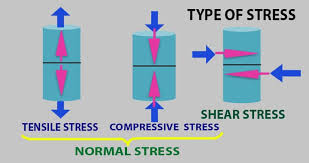
- Hydrostatic Stress – If force is applied on the body in a uniform manner, then this type of stress is commonly known as hydrostatic stress.
- Tangential or Shearing Stress – In this case, the force is applied on the body in a tangential manner such that it leads to change in the shape of the body. This stress is known as tangential or shearing stress.
 Eduindex
You must be logged in to post a comment.