SMILE: Support for Marginalised Individuals for Livelihood and Enterprise

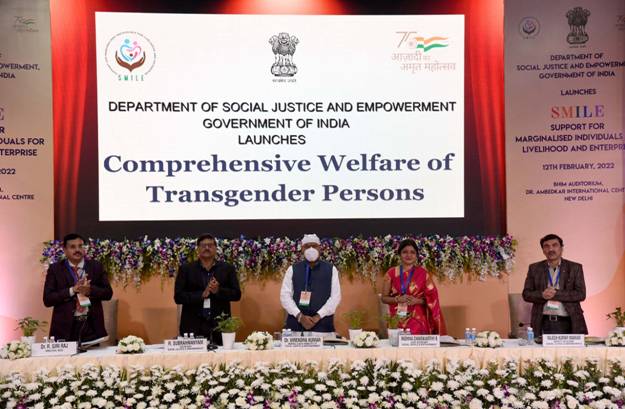
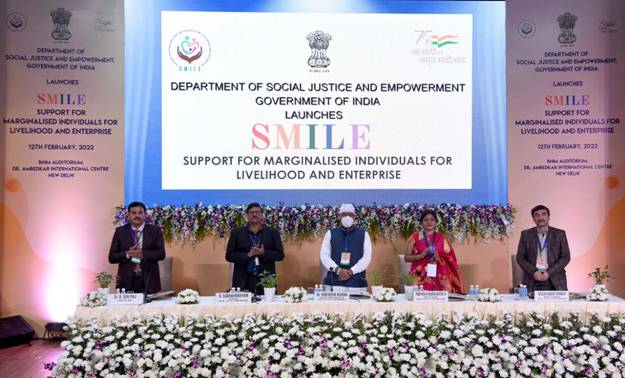
 Union Minister for Social Justice & Empowerment Dr. Virendra Kumar launched the Central Sector scheme “SMILE: Support for Marginalised Individuals for Livelihood and Enterprise” today at BHIM Auditorium, Dr. Ambedkar International Centre, 15, Janpath    Road, New Delhi. This umbrella scheme, designed by Department of Social Justice & Empowerment, is set to provide welfare and rehabilitation to the Transgender community and the people engaged in the act of begging.


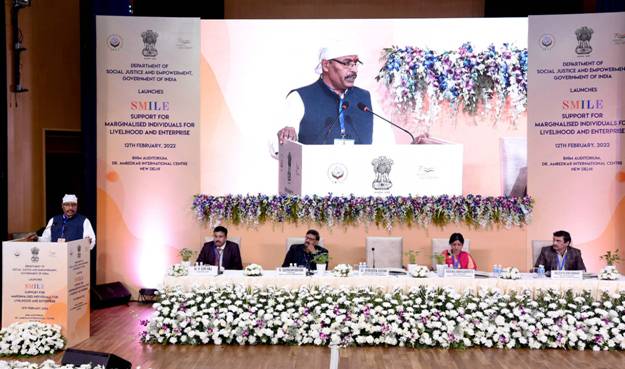
Speaking on the occasion, Dr. Virendra Kumar said, “As a progressive and developing society it is our duty to respect the identity and dignity of all sections of society. The Ministry has ensured that each and every need of Transgender community and persons engaged in the act of begging are taken care of in most professional way.”

“The provision of National Portal & Helpline will provide necessary information and solutions to the problems of the Transgender community and the people engaged in the act of begging,” the Union Minister added.


The two sub-schemes of SMILE – ‘Central Sector Scheme for Comprehensive Rehabilitation for Welfare of Transgender Persons’ and ‘Central Sector Scheme for Comprehensive Rehabilitation of engaged in the act of Begging’ – provide comprehensive welfare and rehabilitation measures to the Transgender community and the people engaged in the act of begging.

The scheme keeps in mind the social security that is needed through multiple dimensions of identity, medical care, education, occupational opportunities and shelter. The Ministry has allocated Rs. 365 Crore for the scheme from 2021-22 to 2025-26.
 

The Sub-scheme – ‘Central Sector Scheme for Comprehensive Rehabilitation for Welfare of Transgender Persons’- includes various components.  It provides Scholarships for Transgender Students studying in IX and till  post-graduation to enable them to complete their education. It has provisions for Skill Development and Livelihood under PM-DAKSH scheme. Through Composite Medical Health it provides a comprehensive package in convergence with PM-JAY supporting Gender-Reaffirmation surgeries through selected hospitals. The Housing facility in the form of ‘Garima Greh’ ensures food, clothing, recreational facilities, skill development opportunities, recreational activities and medical support etc. to the Transgender community and the people engaged in the act of begging. The Provision of Transgender Protection Cell in each state will monitor cases of offences and to ensure timely registration, investigation and prosecution of offences. The National Portal & Helpline will provide necessary information and solutions to the Transgender community and the people engaged in the act of begging when needed.

The sub-scheme – ‘Comprehensive Rehabilitation of persons engaged in the act of Begging’ – will focus on Survey and identification, Mobilisation, Rescue/ Shelter Home and Comprehensive resettlement.

Besides, pilot projects have been initiated on Comprehensive Rehabilitation in ten cities namely Delhi, Bangalore, Chennai, Hyderabad, Indore, Lucknow, Mumbai, Nagpur, Patna and Ahmedabad.

FINANCE-SOME BASICS

Finance is required by a business to establish and run its operations is known as Business finance. No business can function without an adequate amount of funds for undertaking various activities. The funds are required for purchasing fixed assets (fixed capital requirement), for running day-to-day operations ( working capital requirements) and for undertaking growth and expansion. Finance is a major function of any business enterprise, it deals with the arrangement of an adequate amount of capital to achieve the objectives of the enterprise and for the development of the enterprise.

SOURCES OF FINANCE FOR DIFFERENT TYPES OF BUSINESS FIRMS

No one can start a business or run an enterprise without adequate funds. Every business requires money to start which is called initial capital. In business, capital is required for both productions as well as the distribution of goods and services. The amount of capital required depends upon the nature and size of the business. The requirement of capital and sources of capital for different types of business firms are:

1. Sources of finance for sole trade

 A sole trader operates at a smallscale and requires a limited amount of capital to procure fixed assets and also for meeting day-to-day expenses. The proprietor brings in his capital to meet the above expenses. In a sole trade, owned capital consists of the owner’s contribution, and also earned profits are credited to his capital account at each financial year. In a sole trade, owned capital consists of the owner’s contribution, and also earned profits are credited to his capital account at the end of each financial year. In addition to this, a trader can raise by taking a loan from his family, friends, relatives and any known people and also can borrow money from banks and any financial institutions. Short-term finance to meet the day-to-day expenses and requirements may be obtained from commercial banks and long-term finance for the purchase of fixed assets is obtained from the state financial corporation and other financial corporations. The Central and central governments also provide financial assistance to small scale units to encourage Entrepreneurship and self-employment.


2. Sources of finance for a partnership firm

Capital requirement for a partnership firm is bigger than that of a sole trader business. The owned capital is contributed by the partners themselves in an agreed proportion. Accumulated profits of the firm credited to the accounts of partners also constitute a part of owned capital. A partnership firm can also raise loans from commercial banks and other financial institutions. In case of need, partners also advance loans to the firm.

3.Sources of finance for a joint-stock company

A joint-stock company generally requires a very large amount of capital in comparison to a sole trade and a partnership firm. A joint-stock company raises capital through the issue of shares and debentures. In addition to the issue of shares and debentures, it can utilize and retain profits in the form of reserves. It can raise borrowed capital through loans from financial institutions and commercial banks.