Secularism

Introduction

A country is divided not based on its geographical features, but its unique citizens. Even though the underlying principle of India’s success is “Unity in Diversity”, often these differences do not play well with ethnic communities. The intrusion of religion in politics can only yield unwelcoming outcomes. This is where secularism comes in, an ideology that clearly states” Civic affairs should not have any basis in religion”. In 1851, the British writer George Holyoake coined this term, in a quest to replace the aggravating word ‘Atheism’. The main objective of this ideology is to make appropriate decisions without harming the integrity of any religion. In lamen language, he did not want secularism to be misunderstood with discrimination. Not involving certain topics in a decision-making conference does not necessarily mean we deliberately excluded them or seek to prejudice them.

Types of secularism

Based on the intensity of secularism, it can be divided into two types-hard and soft. Hard secularism is a radical option, which aims to completely disavow any stance the topic takes in political decorum. It renders any form of religious knowledge illegitimate. On the other hand, soft secularism finds its roots in neutrality, tolerance, and liberalism. It argues that attaining the “absolute truth” is not possible without proper deliberation and tolerance of religious issues in civic issues.
Secularism is also divided into three different types based on its application. These are political secularism, philosophical secularism, and socio-cultural secularism. All three overlap and are related to each other, yet they exhibit divergent traits and embody discrete meanings.

Secularism in India

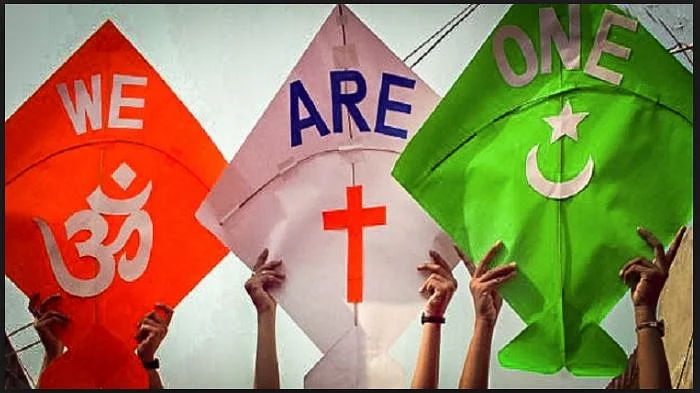
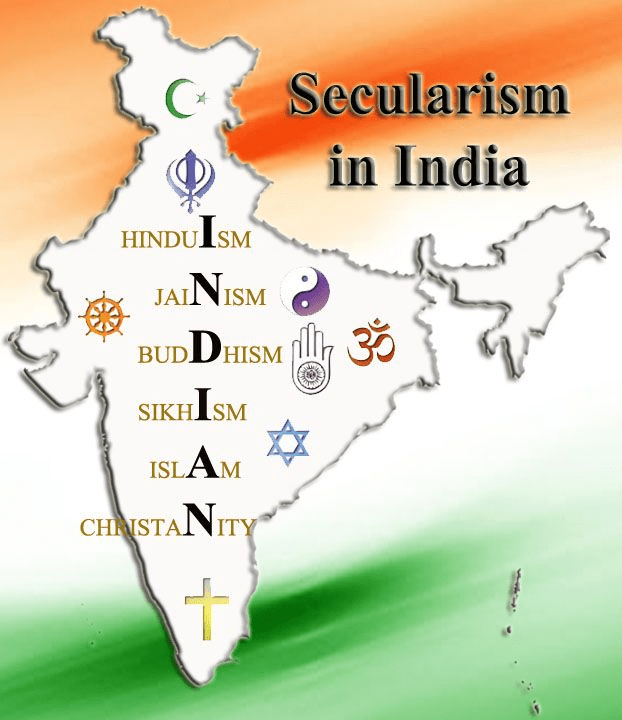
India is a multi-cultural and multi-ethnic society. From harboring Muslims, Christians, and Hindus to being the home of more than a hundred languages, our diversity is one that is marveled all over the world. Keeping in mind the conflicts of interest that might arrive with this heterogeneity, our leaders came up with an effective solution to keep the integrity of politics of this country intact. With the 42nd Amendment of the Constitution enacted in 1976, we declared ourselves a secular nation.
Secularism has always been an inspiration for modern India. We identify as a just nation that gives equal rights and opportunities to all its citizens despite their race, caste, or creed. But, the controversy surrounding Indian secularism has also had its share of attention. With many critics claiming that Indian secularism is “defrauded”, a good look at the positive changes bought about by this ideology might change the way they think about our nation.

One of the best examples of the success of the secularism amendment in India is Muslim Madrassas ( religious education schools) getting government funds. Or the fact that one of our own presidents, Dr. APJ Abdul Kalam, was a Muslim. Prime Minister Manmohan Singh was a Sikh, whilst the party leader Sonia Gandhi was a Christian(Born in Italy). Time after time we have witnessed different communities get their fair share of opportunities, and produce fruitful outcomes, all because Indian secularism was, has, and will always be a success.

The term “secular” means being “separate” from religion or having no religious basis. Religion is open to one and all and is given as a personal choice to an individual without any different treatment to the latter.This is the ideology that has done wonders for the world.

WORKING WOMEN AND THE GLASS CEILING

PROLOGUE

The discriminatory limitation is certainly not a commonplace roof made of glass! All things being equal, it is a representation addressing the upper-level labor force openings that are impervious to most ladies. It represents the theoretical hindrance that keeps ladies from making high level proficient progress. The term was first utilized during the 1980s to portray ladies’ difficulties when arriving at higher initiative or chief jobs. Albeit imperceptible and immaterial, the discriminatory limitation is valid.

A GLANCE AT SIMILAR TERMS

PINK-COLLAR GHETTO

During the 1970s, more broad conversations emerged around the compensation inconsistency among people for comparative jobs. Thereupon, the expression “pink-collar ghetto” was authored. Pink-collar occupations were paid not exactly white and blue-nabbed occupations, which were ordinarily held by men.

MATERNAL WALL

Pregnant ladies and working moms might confront a “maternal divider.” Various generalizations identified with going on vacation after kid origination ladies at a disadvantageous situation in their professions.

BAMBOO CEILING

The term Bamboo roof was instituted by Jane Hyun. It was utilized to depict the obstructions Asians and Asian Americans looked in making upper-level proficient progress.

Substantial CEILING

The term discriminatory limitation alludes to all ladies overall. Interestingly, the substantial roof portrays the more imposing obstacles ladies of shading face in getting an upper-level or top administration job. This term was begat by Jasmine Babers.

WHAT DO THE STATS SAY?

The discriminatory limitation isn’t only an illustration. It is a tragic reality.

Different insights back this reality. Chiefs are twice as prone to enlist men over ladies while selecting representatives. Incidentally, at organizations where 90% of administration is men, a big part of the men feel that the initiative well addresses ladies. Unfortunately, just 38.6% of top chief positions are held by ladies. Shockingly, ladies address just 10% of administration in the working environment. Accordingly, 34% of individuals consider male to be as better danger assessors with no rationale to back something very similar. Additionally, ladies make up just 23% of C-Suites. Ladies make up only 4.1% of Fortune 500 CEOs. Subsequently, ladies get increases in salary 5% less frequently than men.

WHAT CEMENTS THE GLASS CEILING?

GENDER ROLES

Gender jobs are extraordinary to various societies. They are characterized the second a kid is conceived.The average generalizations anticipate that girls should be ladylike, respectful and sustaining, though young men are relied upon to be manly, serious, forceful, and valiant. In the work environment, administrators and pioneers should be serious and striking to settle on imperative choices. Such contrasts in sexual orientation jobs limit ladies and take away their freedom. Moreover, ladies are characteristically expected to bring up kids and take care of family errands. Having this heap of assumptions doesn’t allow them to find some kind of harmony at a vocation, construct a family and have an individual life.

GENDER BIAS

Gender predisposition alludes to the inclination given to one sex over another. In the work environment, this predisposition influences ladies actually contrarily. As referenced before, people are twice as liable to recruit a man over a lady. The inclination doesn’t stop after the meeting. All things considered, it heightens further. As indicated by an examination, over 42% of ladies experience separation in the work environment. Those demonstrations of segregation come as inconsistent compensation for a similar obligation, ladies being treated as bumbling, passing up sufficient freedoms, not getting an advancement. Shockingly, on normal for each 100 men advanced just 79 ladies are elevated to similar levels. As referred to previously, at organizations where ladies make up 10% of authority, half men see ladies as being very much addressed.

Sexual Harassment

The U.S. Equivalent Employment Opportunity Commission (EEOC) characterizes inappropriate behavior as: “Unwanted sexual solicitations and verbal or actual behaviors of sexual nature establish inappropriate behavior when this direct influences a person’s business.” While all kinds of people experience lewd behavior, almost 75% of cases are capable by ladies. Unfortunately, practically 68% of ladies experience the ill effects of inappropriate behavior. Out of the ones who experience lewd behavior, 70% of them share it at their working environment. Shockingly, 47% of female respondents accepted that lewd behavior is endured at their working environment.

Moreover, 45% of ladies aren’t certain that administration at their association will resolve the issue. To add to the troubles, 3 out of 4 inappropriate behavior casualties experience counter in the wake of announcing the issue. Subsequently ladies secure stopping their positions simpler than announcing the provocation. 80% of ladies who experience inappropriate behavior inside the initial two years at a new position quit their positions. These frightening encounters make it practically inconceivable for ladies to arrive at more significant level jobs in their professions.

THE FINAL THOUGHT

The unreasonable impediment may not be noticeable through the unaided eye, however it is unquestionably apparent through a sympathetic brain. People are equivalent, so the chances they persuade should be indistinguishable. It is about time to comprehend that sex balance can be accomplished whenever we allow people an equivalent opportunity to vanquish their fantasies.

DOMESTIC VIOLENCE TOWARDS MEN: THE IGNORED SUFFERING

INTRODUCTION 

The term “domestic violence” refers to all the violent acts coming from one family member against another.Besides physical abuse, its ambit also extends to verbal, psychological, and sexual abuse. A huge misconception that prevails in India is that domestic violence is always directed towards women. However, men also suffer from domestic violence. Due to gender-stereotypical assumptions, society is unable to believe that a woman can inflict violence on a man. Suffocated by the socio-cultural norms, men are unable to speak of this violence against them.

A GLANCE AT THE PROBLEM

According to the latest Indian study, almost 51.5% of couples have been into domestic violence. Society always thinks of domestic violence against women. Scarce research data on domestic violence against men are available in the scientific literature. Men are always believed to be the perpetrators. However, domestic violence is not limited to women only. Men are also subject to verbal, physical, emotional, psychological and sexual abuse. Usually, men do not raise their voices against this abuse and are silent victims of the torture.

According to a recent study, 51.5% of men have experienced domestic violence at least once in their lifetime and 10.5% in the last 12 months. Considering physical violence and threats against men by wife’s relatives almost 30 million Indian men face domestic violence. The laws in our society usually see women as victims. In such a case, men become helpless and do not get justice easily. Men are declared as culprits even before the actual decision. In the past, society has been male-dominated and we have seen heinous crimes against women. However, that does not entitle us to perceive that men can never be sufferers. 

WHAT ARE THE TYPES OF DOMESTIC VIOLENCE?

Domestic violence can affect a person’s life physically, mentally, emotionally, and psychologically. It violates basic human rights. There are many types of domestic violence.

Physical Violence

Physical violence refers to physical torture leading to bodily harm or injury. It includes slapping, pushing, hitting or throwing objects. In physical violence, slapping was identified as the most common form (98.3%). Physical violence is the most common type of violence after emotional violence. Society often pictures men to have physical strength and women to be physically weaker. Therefore it is a common misbelief that men never face physical violence.

Psychological Violence

Psychological violence exerts adverse effects on mental health. It causes emotional harm to the person. A recent study reported 85% abuse against the men by criticism, 29.7% by insult, and 3.5% by threats. It can also be exerted through constant threats to the husband under false allegations of dowry, marital rape or domestic violence.

WHY DON’T MEN RAISE VOICE?

In a patriarchal society, men are often ashamed to be beaten by a woman. Family pressure also prevents men to report the torture. The reasons for this are societal status and the fear of false accusations of dowry or marital. Also even when men report domestic abuse, people do not believe them. Additionally, when they try to complain, no one takes them seriously. Majorly men are ashamed of saying that they are beaten by their wives. A false hope that things would get better, fear of losing social respect, love toward their children stop men from raising voices. Also the fear of false accusations scares men to the core. Unfortunately, even when men complain it is perceived as “feminine behaviour” in the patriarchal society.

THE ADVERSE IMPACT OF DOMESTIC VIOLENCE ON MEN

Violence adversely affects life physically, mentally, emotionally, and psychologically. Violence is a violation of human rights. Unreported and unnoticed violence against men deteriorates mental health, can cause depression, anxiety or even suicide in extreme cases. It has been observed that suicide rates were more in married men as compared to separated or unmarried men. Besides depression men also have to live in constant fear of false allegations against them and their families. According to World Health Organisation (WHO), violence can increase the risk of getting addicted to smoking, alcohol, and drug abuse; it can also cause mental illness and suicidal tendencies. It can also cause chronic diseases like heart diseases, diabetes, and cancer; and social problems such as crime and further violence.

GENDER NEUTRAL LAWS

Adultery sees man as the ultimate culprit. We don’t have a law where a man can complain to his wife or in-laws. Divorce and child custody laws, look at women with a more sympathetic vision and consider them as a victim. The same is true in the case of maintenance after divorce. The number of false allegations on men regarding marital rape is also increasing.

We need gender-neutral laws that address the issue of false allegations. Human rights and gender equality ought to include both men and women. Domestic violence should be seen as spousal violence. It shall not be differentiated due to gender stereotypes. The domestic violence act in India pertains to women only. Studies clearly show that men are also the victims of domestic violence at the hand of women. Hence, necessary amendments addressing violence against men are required.

CONCLUSION

Society is changing, and so are the norms and values regarding domestic violence. We need to understand that men can also be physically and mentally harassed by their spouses and in-laws. Hence, their problems must be recognized and appropriate strategies and interventions should be implemented. We cannot deny that the society that we are inhabiting is male-dominated and patriarchal. However, this does not mean that every time a man is wrong and a woman is right. Real equality does not see women as the weaker sex. Rather it recognises domestic violence as spousal violence. It gives men the courage to raise their voice against violence and society, the humility to understand it.

 Laws and legislation must include domestic violence against men as a punishable offence. If we need men who understand and respect women then we also need women who do the same for men. In the end, we need to be more considerate towards both men and women. Like all women are not victims similarly all men are also not the perpetrators. Men and women are the pillars of both society and their families. Hence, laws are needed to protect both. We can flourish only when we understand gender equality in the true sense.

Caste System in India

Indian society is split into several sects and classes. This is due to the existing caste structure in the nation. The origins of the caste system may be traced back to the ancient Vedas, which divided individuals based on varna, or vocation. It has brought about a slew of calamities in society. The government is continuously working to address the system’s flaws and achieve real equality among the people. The caste system is the bane for the Indian society. It divides the Indian society into sectarian groups and classes. Even today, it plays a predominant role in our society despite the growth of culture and civilization.

The official words used in government papers to designate erstwhile untouchables and tribes are ‘Scheduled Castes and Scheduled Tribes’ (SC/ST). However, after noticing that the term ‘Dalit’ was being used interchangeably with the official term ‘Scheduled Castes,’ the National Commission for Scheduled Castes asked state governments to stop using the term ‘Dalit’ in official documents, calling it ‘unconstitutional,’ and to replace it with the term ‘Scheduled Caste’ instead.

The caste system’s origins may be traced back to prehistoric times. While one school of thought distinguishes castes as higher and lower castes based on their origin, another school of thought links the origins of castes to varnas, which classify the caste system based on their roles. Since then, it has been discovered that those with an advantage and a say in the community have taken unfair advantage, resulting in discrimination and exploitation of the group’s weaker members.
People from Scheduled Castes and Scheduled Tribes, sometimes known as “untouchables,” account for one-sixth of India’s population, approximately 160 million people; they face prejudice and segregation.

Evil faces of this system:-

Untouchability:- Many communities are divided by caste, and they are not permitted to cross the line separating them from the upper castes. They may also not drink from the same wells or visit the same tea shops as higher castes.

Discrimination:- In lower caste neighbourhoods, they frequently lack access to power, sanitation, and water pumps. Higher castes are denied access to better education, housing, and medical services.

Division of labour:- They are restricted to certain occupations like sanitation work, plantation work, leather works, cleaning streets, etc.

Slavery:- They are subjected to exploitation in the name of debt, tradition, etc., to work as labourers or perform menial tasks for generations together.

Government Initiatives

The Indian government has passed legislation to abolish untouchability and has implemented several reforms to enhance the quality of life for the poorer parts of society. Among them are the following:

  • Fundamental human rights are guaranteed by the constitution.
  • In 1950, the term “untouchability” was abolished.
  • Act to Prevent Atrocities Against Scheduled Castes and Tribes, 1989.
  • Reservations in locations such as educational institutions, career possibilities, and so forth.
  • Creating social welfare ministries and national committees to look after the interests of scheduled castes and tribes.

The government’s initiatives have provided some assistance to the weakest sectors of society. The metropolitan regions have had a significant influence and have showed some progress. People in rural areas and villages, on the other hand, continue to experience severe prejudice. We still have a long way to go in terms of eradicating and abolishing prejudice based on caste and creed. It now rests on our efforts, and a shift in our attitude will almost certainly result in a permanent shift, bringing equality to all.

Right to Equality

The fundamental fights are guaranteed to protect the basic human rights of all citizens of India and are put into effect by the courts, subject to some limitations. One of such fundamental rights is the Right to Equality. Right to Equality refers to the equality in the eyes of law, discarding any unfairness on grounds of caste, race, religion, place of birth sex. It also includes equality of prospects in matters of employment, abolition of untouchability and abolition of titles. Articles 14, 15, 16, 17 and 18 of the Constitution of India highlight the Right to Equality in detail. This fundamental right is the major foundation of all other rights and privileges granted to Indian citizens. It is one of the chief guarantees of the Constitution of India. Thus, it is imperative that every citizen of India has easy access to the courts to exercise his/her Right to Equality.

Various articles under the Right to Equality are explained as follows:

Equality Before Law :- Article 14 of the Constitution clearly defines equality before the law, ensuring that all citizens are equally protected by the country’s laws. It means that the state would not discriminate against any Indian person based on their gender, caste, creed, religion, or even location of birth. The state cannot deny equality before the law and equal legal defence to any individual on Indian territory. In other words, no one or group of individuals may expect preferential treatment. This privilege pertains not only to Indian nationals, but to all individuals living on Indian territory. The right to social equality and equal access to public areas is explicitly stated in Article 15 of the Indian Constitution, which states that no one should be treated favourably on the basis of colour, caste, creed, language, or other characteristics. Everyone must have equitable access to public sites such as public wells, bathing ghats, museums, and temples. The State, on the other hand, has the authority to make special provisions for women and children, as well as for the development of any socially or educationally disadvantaged class, scheduled castes, or scheduled tribes. This article solely pertains to Indian nationals.

Equality in Matters of Public Employment:- Article 16 of the Indian Constitution states unequivocally that the state must treat all citizens equally in job concerns. In any occupation or position under the State, no citizen must be discriminated against on the grounds of race, caste, religion, creed, descent, or place of birth. Every Indian citizen is eligible to apply for government employment. There are, however, certain restrictions to this right. The Parliament may adopt legislation stating that certain positions can only be filled by individuals who live in a specified area. This qualification is mostly for positions that demand knowledge of the location and language.

Abolition of Untouchability:- Article 17 of the Constitution of India abolishes the practice of untouchability in India. Practice of untouchability is declared as a crime and anyone doing so is punishable by law. The Untouchability Offences Act of 1955 (and now Protection of Civil Rights Act in 1976) states punishments for not allowing a person to enter a place of worship or from taking water from a well or tank.

Abolition of Titles:- Article 18 of the Indian Constitution forbids the state from bestowing any titles. Citizens of India are not permitted to accept titles from other countries. The British administration also eliminated titles such as Rai Bahadurs and Khan Bahadurs. Nonetheless, academic and military awards can be bestowed to Indian nationals. The awards of ‘Bharat Ratna’ and ‘Padma Vibhushan’ cannot be used as a title by the recipient and are not forbidden under the Indian Constitution. Since December 15, 1995, the Supreme Court has upheld the legality of such rewards.

To conclude, the ‘Right to Equality’ should not only remain on papers. This right should be properly exercised; otherwise it will lose its essence if all the citizens of India, especially the weaker and backward classes do not have equal rights and equality before law.


The Cuban Struggle Of 2021

INTRODUCTION

In the past few months, the world has been made aware of the atrocities the Cuban people have endured for 62 years at the hands of their government. The content being shared is far from comfortable to view and it has been emotionally and mentally exhausting having to speak out so that the families on the island can have a chance at freedom.

I have the privilege of being able to post freely and criticize both the US and Cuban government without fear of prosecution, the people of Cuba don’t. Myself, and other Cubans as well, have been spreading imagery and stories of what is occurring to amplify their voices on a larger scale to garner international support. They don’t have a way of knowing we’re doing this because internet blackouts keep occurring, but it’s crucial to stand in solidarity with them because it’s been too long and we ask other non-Cuban friends for help.

I’ve found myself having to prove a country’s history and struggle to people who don’t have the full picture of what is going on. Having allies in this moment is crucial, the Cuban people have been screaming for years but now people are finally listening.

HOW CAN YOU HELP?

  1. Spread awareness- share photos, videos, and content about what’s going on social media.
  2. Lend your voice to the fight.
  3. Learn about the situation.
  4. Have conversations with Cubans to provide them emotional support.
  5. Find out and support the team on StudentsforafreeCuba.

Don’t let the movement die down, don’t let them keep suffering at the hands of an oppressive dictatorship.

Gender Incongruence

Introduction

When you discover your state of gender incongruence, every therapist you meet will ask you the same question – when did you know? How did you know? Now, we know what they want; they’d perhaps like to find some deeply ingrained personal hurt, some evidence of pathos, symptoms and signs pointing toward a diagnosis. But what if you first felt gender incongruent when you discerned that your father was somehow never meant to cry? The realization that the most intense emotion he ever portrayed was rage? What if you felt gender incongruent when you got into classroom fist fights you really didn’t want anything to do with? A lot of transfeminine people/trans women will tell you they feel far more emotionally labile when beginning Oestrogen.

Advocacy

Pharmacology aside, I hypothesize that much of it is a visceral disinhibition, the opening of a floodgate, a downpour of everything any human being should be able to feel – only, the privilege of being able to feel is restricted in society. Apparent masculinity comes with great privilege in a patriarchy. They try to toughen up, they hide the playground hurt, they hold sorrow in excruciating lumps in our throats, because they’d like some of that privilege, they’d like safety, they’d like not to be harassed, molested, assaulted. Eventually, they realize that the feigning comes at a cost too great, and they go about resolving the incongruence to become our truest selves. The psychiatrist wants to hear about the distress in not being able to wear pink, play with Barbie Dolls. But I think what we don’t want to hear is that we as a society create the incongruence – we disallow the natural and call it anomalous. They will never know what it is like to live in a society that teaches its men that they may feel just as intensely. That they may cry when hurt. That they may be hurt. That they may be sexually assaulted, that they may experience psychological distress. It’s possible that a less stringently gendered world would result in less intense gender dysphoria. Personalities like Laxmi Narayan Tripathi are trying to tell us exactly that. I truly believe that a less stringently gendered world would mean healthier people, families, societies, nations.

Why isn’t everyone a feminist?

It has come to my surprise that most people do not identify themselves as feminists. I have no idea what some people think feminism is. So, here is the dictionary meaning of the word feminism. 

Feminism is defined as the belief in social, political, and economic equality of sexes. 

I would like to emphasise the word equality. Feminism does not support sexism.Feminists do not put men down, nor do we support the women who put them down. Feminism is the belief in equality and not female superiority.

I was surprised to see some of the women not identifying themselves as feminists. I have come across women saying things like: 

I don’t face gender discrimination, so why should I support feminism. 

To all the women who have similar beliefs, it is the FEMINISTS that got you to a place where you can say sentences like these. 

Do you really think that without voices being raised, you got to a place where you are?

Women did not even have the right to vote, study, or work. Back in the old days, men did not even consider women. So, we have come a long way from women-only staying in the households to now becoming presidents.

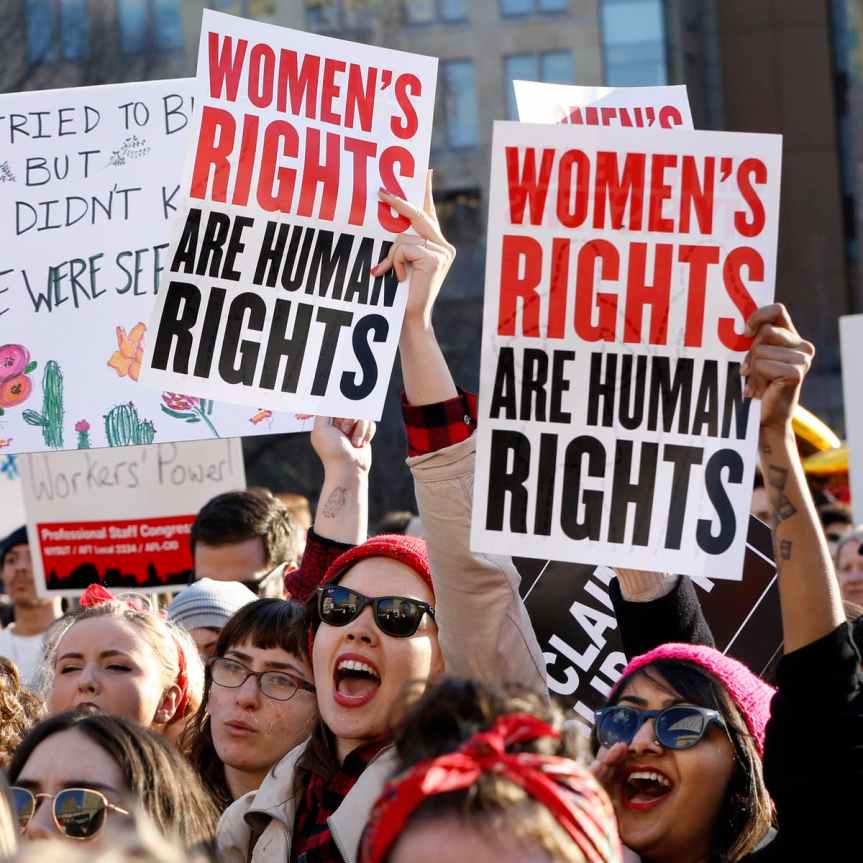
 Secondly, there are still so many issues happening against women, and we must raise voices. If you have the privilege to face no gender discrimination, that is good for you. But do you not want that for every single girl out there?

To all the people who think that feminism is unnecessary, I would like to show some of the achievements done by feminists.

  • Right to vote
  • Gain access to birth control
  • Bought women out of household
  • Calling out on rape culture
  • Fought for legal discrimination
  • Making the workplace a little more equal

These were just a few of the things done because of feminists. So, the next time you think feminism is not needed and that we are already in an equal world.

Well, open your eyes. There is still a long way to go.

  • Saudi Arabia gave women the right to drive in 2018.
  • Each minute 28 girls are married before they are ready
  • One in three women have experienced physical or sexual violence
  • 62 million girls are denied an education all over the world
  • 4 out of 5 victims of human trafficking are girls

These were just a few facts out of 100 more issues that women face today. This data is for people who think we already have achieved gender equality. We have not and, we still need feminism.

If you are one of those people who does not like being labeled but believes in equality of both sexes. What are you afraid of? It is just a label for the betterment of our society. If you think people are going to judge you for it. Those are the people who did not do their research on what feminism is.

I am a proud feminist and, I am here to fight against the injustice that women go through. If you are with me, I hope you all identify yourself as a feminist.

If you are not convinced and, women with strong opinions on achieving equality bother you. Well, you can contribute to the world of misogyny. 

DIGNITY OF LABOUR

“No work is insignificant. All labor that uplifts humanity has dignity.” Martin Luther King, Jr.

EVERY WORK MUST BE GIVEN HONOUR

The word ‘dignity’ means the ‘quality of being worthy of honour or respect So the expression ‘dignity of labour’ means honour or respect’ received through or for hard work. That is why it is said that ‘work is worship’. Every type of work need labour, physical or intellectual. But the word labour’ is generally used in the sense of physical labour which is as important as intellectual labour. The production of cereals, construction of buildings and the other constructive work require physical labour. Man cannot do without hard labour. So, he should do all types of work.

WRONG NOTION ABOUT MANUAL LABOUR

But the attitude of the educated and the gentlemen towards manual labour is wrong. They are of the opinion that manual work is fit for the illiterate men only. But they are mistaken. All intellectual work involves some sort of physical labour. Even a student has to labour hard to pass the examination. All artists, scientists and writers whose work is intellectual have to spend hours with patience. The manual work too needs the exercise of intellect. A carpenter, an ironsmith, a goldsmith, a barber, etc. whose work is physical have to exercise intellect to improve the quality of their work.

MANUAL LABOUR: THE ROOT OF ALL PROGRESS

And it is the manual labour which is at the root of all progress. It is rightly said that true labour never goes in vain. Labour has its own importance. Nothing can be achieved in the world without labour. The prosperity of a country depends on its agricultural products. So, there is no humiliation in the cultivation of land. The people of the West do their work themselves. They look upon labour as something honourable and sacred. Such is the importance of labour that its dignity is recognised by all. It is the source of health and happiness.

GENDER EQUALITY – MYTHS AND FACTS

Gender equality – When the term is said, we immediately start thinking of men and women and the differences between them in our society. Do we think of other genders? Do we know how many genders are there apart from male and female? No or maybe few. But the actuality is there are different genders of people living all over the world. Without being aware of this, we just speak only about males and females or transgender at times. When we speak about the difficulties faced by them, are we also adding the opportunities and recognition they got along with this? No. It is our responsibility to give equal importance to the good and bad in our society. So, let’s try to understand the myths and facts about the some more commonly known genders – male, female and transgender.

MALE AND FEMALE

I would like to start with the good changes in society for women that are left unrecognized most of the time. Starting with the change in family backgrounds, we had certain roles and responsibilities to be played, as men should work in the outside world, and women were stereotyped to carry out household chores in the olden times. But now we live in the era where both men and women work in the corporate world and share the household responsibilities equally. So, no longer there exists a male chauvinistic society. Still, we talk about the olden scenario rather than the reality. Talking about social development is as important as raising a voice for the differences.

Moving on to the traditional differences, I already said women are stereotyped to play certain roles which are being criticized as a major difference. But the reality is women are said to carry out household chores as they are the physical exercises a woman can do. Those days there were no corporate jobs. All the men had to do physical work which women couldn’t carry out and she shouldn’t do as it affects her uterus. This was the scientific reason behind the traditional practices. And again, this is also misinterpreted as women are made to sit in their houses.

The next one is about male-dominant domains – Women emerge and maintain their place in every field making every domain equal for both genders. They work in prominent roles in the so-called male-dominant domains such as Army, Navy, Airforce, and many more. Still, certain fields come under the dominance of men even after women laid their step into it. For example, they have already started driving autos changing the tag “male dominant domains”. But we recognize this as their special talent than treating them equally. All men and women are equally bestowed by the lord and there is nothing special when a woman does the same a man does. 

TRANSGENDERS

Coming to the transgenders, the myth is they are not given enough support and chances to prove themselves. But the fact is they are provided with opportunities to showcase their talents. The difference is between whether they utilize it effectively or not. They are persons like Kalki Subramaniam who changed her identity from transgender to an entrepreneur cum inspirational speaker and some individuals are asking alms from the people in public places instead of standing on their legs. 

So, many such good things are happening around in our society. We should feel proud and accept the changes taking place rather than complaining blindly. NGOs are working for different genders other than the above-mentioned to grant the place they deserve in society. It all depends on how we perceive them. Let us look deep into them and together build a better society.

WOMEN EMPOWERMENT

“There is nothing that can destroy a woman and her power.”

Women empowerment is explained as accepting women’s thoughts and helping them to take a stand for themselves. This has become a topic of concern in today’s society. But do we care about empowering women? The answer is probably no. We, as a part of our society, give many speeches on this. Do we indeed mean what we say? Do we follow the same with the women around us? Again, the answer will be no. Indian society is likely to appreciate empowerment when it is about others. When it comes to our own family, we start to think about society. The REAL empowerment starts when there is nothing to think about a woman taking a stand for herself. 

Women empowerment should be focused on encouraging women to fight for their rights. Whatever a woman does should be done because it is her right and not because she is allowed to do it. No one has to let her do something that she wants. A woman can do whatever she wants without seeking any permission. A man does not ask for a woman’s permission to do something. Then why should a woman get her father’s or husband’s permission? Let me cite an example. We all have men in our family. Have we seen our father or brother asking for permission to do a job? No. But we would have seen our mother or sister seeking permission to take up her job or studies and also would have come across many ‘NO’s. 

What is the need for somebody to allow us to do something when we have the right? First, women should understand this point. She must not get impressed by someone’s sympathy. From the ages, a women’s mindset is fixed that her work is to take care of the family, engage in daily chores and take care of children. We convince ourselves to do all these right from the beginning which should not be done. No woman should compromise their career, dreams in the name of family. The traditional mindset should be withdrawn from women’s minds first. She should believe that she can achieve things beyond family. She has her own identity and being one’s daughter or wife is not her true identity. We can expect the change from others, especially, men only if we become the change. 

Women empowerment doesn’t mean that women should be given higher priority. Empowerment should work towards an equal status both for men and women. If a noble thing or achievement is done by a woman, we see it in the headlines of newspapers or magazines mentioning them as woman officer, woman pilot, female poet, or female artist. But we don’t identify any male artist, male poet, man officer, or man pilot. This describes how equal society is. Equality in society will be established when there is no particular mention given to either man or woman.

In addition, we must acknowledge that society is changing practically towards equality. We have started addressing the chairman as chairperson, man-made as artificial, and mankind as humanity. A six-year-old girl raising questions on the terms coined in the patriarchal society stands as proof that this is not going to last anymore. Her questions went viral and she was answered by some of the achievers. They explain to her about our old patriarchal society and the influence of patriarchy in language as well. The world needs to change and it is changing. We must agree that this little kid has already reached halfway to create an equal society.

Designation or Profession shouldn’t be linked with genders. It should be generic. Our work towards this would be supporting and standing for all those who are ready to take a stand for themselves. “Equality is the soul of liberty” should not be ignored at any cost.