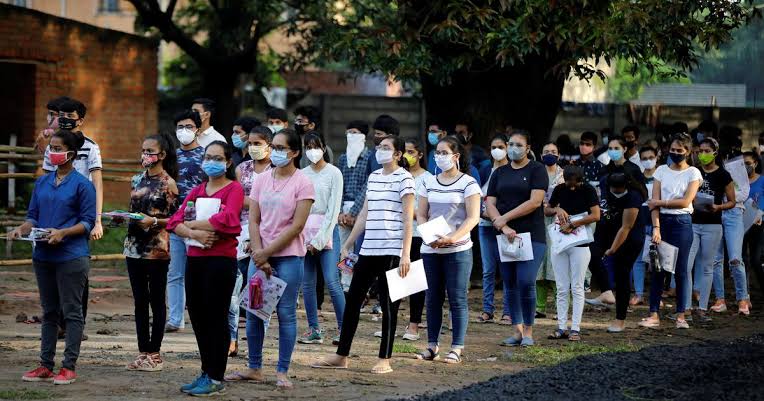
MUMBAI UNIVERSITY FINAL EXAMS, 1HOUR 50 MARKS

Photo credit: Google images

Mumbai University has decided to conduct all the final year UG and PG exams for 50 marks and the duration of the exams will be 1 hour. The decision was reached after a series of meetings conducted on Saturday.

The duration of each exam will be an hour and will carry 50 marks. The paper will be in Multiple Choice Questions (MCQs) format. The practical and viva exams will be conducted online by the colleges and all the exams can be given by the students from their home.

Apart from MU, other universities in the state are inclining to follow the lead. All the exams will be Multiple-Choice Question based. The theory exams will be conducted from October 1 to October 17.

While some autonomous colleges are talking to third party service providers, many are considering using Google forms to deliver the test. The university, though, is silent on providing technology centrally. Academicians, meanwhile, have questioned the viability of using objective-based online tests to evaluate students in a certifying exam.

“This will apply to all undergraduate and postgraduate courses that follow the 40:60 pattern. The exams will be of 50 marks, and the university is keen on administering multiple choice questionnaires. The departments, though, are waiting for a circular to appoint a panel for conducting exams and start preparations for formulating question papers,” said a member of the academic council.

Minister of Higher and Technical Education department Uday Samant had earlier said that the universities have been asked to submit their action plan on conducting exams to the government by September 7.

NEET, JEE: Supreme Court rejects review petition to postpone the exams

Photo credit: Google images

Supreme Court on Friday refused to entertain the review petition filed by ministers of six opposition-ruled states who were seeking review of the court’s August 17 order to conduct NEET-UG and JEE EXAMINATIONS.

Six ministers from Maharashtra, Punjab, West Bengal, Jharkhand, Rajasthan and Chhattisgarh had had moved to the apex court saying that if the order was not reviewed, “grave and irreparable harm and injury would befall on the student community”.

The petitioners in the case were Moloy Ghatak (minister from West Bengal), Rameshwar Oraon (Jharkhand), Raghu Sharma (Rajasthan), Amarjeet Bhagat (Chhattisgarh), Balbir Singh Sidhu (Punjab), and Uday Ravindra Samant (Maharashtra). In its review plea, stated, “not only will health, welfare and safety of students/candidates appearing for the NEET/JEE examinations stand imperilled but also the public health at large would be in severe jeopardy…”

The ministers in the plea had claimed that the top court order failed to secure students’ “right to life” and ignored “teething logistical difficulties” to be faced in conducting the exams during the COVID-19 pandemic.

The state ministers on August 28 moved SC and demanded that the examinations be postponed by at least six to eight weeks keeping in mind the surge in coronavirus cases and health concerns of students. It alleged that the government’s decision to go ahead with examinations despite the 3.3 million covid cases with over 60,000 deaths, “reveals non application of mind, and is unreasonable, arbitrary and capricious exercise of power”.

The bench of Justices Ashok Bhushan, B R Gavai and Krishna Murari, which considered the pleas in-chamber, also rejected the applications seeking listing of the review petition in the open court. “Applications seeking permission to file review petitions are allowed. We have carefully gone through the review petitions and the connected papers. We find no merit in the review petitions and the same are accordingly dismissed,” the bench said in its order.

The JEE-Main will be held from 1 to 6 September, while NEET exams for admission to undergraduate courses in medical colleges is scheduled for 13 September. JEE Advanced for the Indian Institutes of Technology (IITs) is scheduled for later in September.

JEE-Mains have already begun across the country from September 1, with guidelines for maintaining social distance minimising contact.

PTI reported that on the third day of the JEE-Mains, 82.14 percent of the registered candidates appeared for the examination, as against 54.67 percent on the first day.

EXISTENCE OR EXAMINATION

Amidst this deadly Covid-19 pandemic India is gearing up for conducting competitive examinations (JEE/NEET and final year examination) The commission has announced the dates for several competitive exams to be conducted in September and October. The real question is not if the students are prepared, but is India prepared for this? Despite imposing complete lock-down, especially in Maharashtra, the Covid-19 cases are increasing day by day and now the supreme court has given a verdict that exams should be conducted.This is totally unfair.There are lakhs of students who will appear for writing exams. It is not only putting students and teachers under risk but also their families. Is this worth taking the risk? Putting life under jeopardy to write exams.

The health minister is talking about taking precautions, but before that, what about people who have already been tested COVID positive? Many people are dying not because of the virus but because of a lack of proper health care facilities and treatment. No one can blame the people for raising their suspicion. With a public health care system is in a hodgepodge, many people are looking with doubt at the country’s attempts to battle with the pandemic. The lack of these stocks has decreased the Indian health care base, also, leading to an accelerated rise in COVID-19 crises in the country. At this time when even very advanced countries are striving to deal with this pandemic and due to a dense population, India’s incapacitated health care foundation is in many ways disadvantaged to deal with this pandemic. Today the record surged to 83,883 fresh corona-virus cases in the last 24 hours taking India’s COVID tally past the 38-lakh mark and Maharashtra continues to be the state hit hardest by the pandemic and followed by Delhi, Karnataka, Andhra Pradesh, and Tamil Nadu making India top 3rd Country affected and just some numbers behind Brazil.

The government should look for another solution or option other than making students appear for the examination in centers. What is the technology for then? Competitive exams should be conducted online with certain protocols. In that way, students will not lose their one year and they will be safe, and yes even though there can be certain technical problems in conducting exams online, but this is the better option rather than going to colleges. Offline exams may act as a great threat to health since the crowd of students in huge numbers at the examination center will make them prone to getting in contact with a corona positive person. The thermal screening of all persons entering the examination hall is no remedy. Another option is to cancel the final term exams while using the average of the marks secured in earlier terms as a substitute for the final semester examination scores. The government should realize that the situation can go out of control anytime, which is evident with the day to day spike in COVID cases despite lock down and on top of that now lakhs of students have to go and write exams. The government should reconsider this decision of giving priority to examination over life.

What is NTA and who conducts JEE-NEET and many other examinations?

National Testing Agency (NTA) conducts competitive examinations like NEET, JEE, CAT, UGC NET, G-PAT. NTA was established under the Indian Institution Registration Act-1860. It is an autonomous institution that conducts entrance examinations for admission and scholarship in higher educational institutions of the country. The objective of this agency is to be efficient, transparent and test based on international standards to assess the eligibility of candidates for admission and recruitment.

Now, academic sessions of all medical colleges, IITs, NITs, CFTIs and ICAR-AU depend on these entrance exams, know why NTA is insisting on getting these exams early. This agency conducts the examination in online medium for which it has to select such schools and universities where all basic facilities are available and the conduct of the examination does not affect their academic routine

Why this exam is very important for NTA?
This entire exercise is to save the academic calendar. It is necessary for many candidates to conduct entrance examinations to save one year. So the NTA’s is trying very hard and giving their full effort to save one year of students, even if the sessions are slightly delayed for courses.

NTA Functions
-Making question papers of all subjects with the help of state-of-the-art technology.
-To create a panel of subject matter experts for testing along with a strong R&D culture.
-Providing training and advisory services from time to time in Indian educational institutions.
-Working closely with international organizations such as Educational Testing Services.
-Conduct of an examination in case of various ministries and central government departments and state governments entrusted with the responsibility of conducting the examination.
-To ensure improvement along with training in schools, boards and other bodies and periodically check the testing standards of entrance examinations.
-The President of NTA is a noted educationist and is appointed by the Union Ministry of Education.
-Its Chief Executive Officer is a Director-General who is appointed by the Central Government.
-The establishment of a specialized testing agency like NTA has reduced the burden of conducting examinations from institutions like Central Board of Secondary Education All India Council for Technical Education.

-NTA is helping all the individual colleges and universities in the country in the field of testing, training and providing advisory services to the institutions in India. To provide quality testing services for the institutions in India.
-NTA conducts examinations at least twice every year through online medium thereby increasing the chances of admission for candidates preparing for competitive examinations.
-This agency is setting up its centers at the district level and sub-district level to increase the reach in rural areas and for the convenience of the candidates.
-The National Testing Agency has set up practice testing centers along with the introduction of a mobile app, with the help of which candidates can also conduct mock tests on their smartphones and do their pre-test evaluation.

Final year written exams to be cancelled, Delhi state Government

Vaishali Singh

In response to a petition challenging UGC guidelines mandating the conduct of final year exams by universities before September 30, Government of Delhi has informed the Supreme Court that Delhi State Universities exams have been cancelled.

In a latest decision, Deputy Chief Minister of Delhi has directed “all Delhi State Universities to cancel all written online and offline semester examinations including final year exams.

The Supreme Court had directed. all parties to file their affidavits by August 7, and for rejoinders to be filed a day after that.

Delhi government in its affidavit states that on July 11, a decision was taken by the Deputy Chief Minister/Higher and Technical Education Minister of the National Capital Territory of Delhi that all online-offline exams of universities under the state including final year exams would be cancelled in the wake of rising COVID-19 cases.

However, the affidavit notes that some vice-chancellors of certain universities were in favour of wrapping up at least the final semester exams.

However, after perusing all details including the latest UGC directive to complete final year exams by September 2020, Delhi government decided to stick to its July 11 decision and continue with not holding the exams.

Delhi Government has further stated that “in Delhi’s State universities, best efforts were made to conduct online classes, but the reality of our digital divide is that online classes are not accessible equally by all”.

“During this extremely tough period, regular physical classes got completely interrupted. The students had no access to study material and the college libraries were closed, although getting access through online mode in such peculiar circumstances, the students did not get the kind of preparation needed to attempt a full-fledged examination,” reads the plea.

As per present status, GGSIP University has around 27,000 final year students and are now devising mechanism for assessment to award marks to final year students and this is also the case for Delhi Pharmaceutical Science and Research University (DPSRU).

The other six universities have completed the final year Examination by online mode.

A total of 31 students from different universities across India had approached the Supreme Court to quash the latest University Grants Commission (UGC) circular directing universities to wrap up final year examinations by September 30.

Before Delhi Government, Maharashtra Government on August 7 informed the Supreme Court that the State Disaster Management Authority on July 13 had resolved to not conduct examinations in the state amid the COVID-19 pandemic.

The decision was taken after a majority of University Vice-Chancellors from across the state voted against conducting exams in view of the rising number of COVID-19 cases.

HBSE 12th result to be declared today

Vaishali Singh

Haryana Board of Secondary Education 12th standard results will be declared today. As per the official announcement, officials from the Board of Secondary Education, Haryana has confirmed the Haryana 12th result 2020 declaration date and time has been confirmed to media agencies. To ensure easy access to the students, Haryana 12th Result 2020 will be declared online on the official website bseh.org.in.

Around 2.2 Lakh students have been waiting for their HBSE results.  To make the process of check HBSE Class 12 Results 2020 even easier for the students, a direct link to the result checking page is provided below, which will allow them to access the same conveniently. 

https://bseh.org.in/

As per the latest media reports, the declaration date and time for Haryana Board 12th Result 2020 has been confirmed by senior board officials. Times Now Report claims that Haryana Board / BSEH Secretary Rajiv Prasad informed reporters over a call that the HBSE 12thResult 2020 will be announced on 21st July 2020, Tuesday.

Scheme for the Cancelled Exams

According to the official datesheet of Haryana Board, the HBSE 12th Exam 2020 began on 3rd March wouod last till 31st March 2020, but the declaration of nation-wide lockdown due to COVID-19 outbreak in the country lead to cancellation of a few papers for Class 12. As per the HBSE announcement, students whom papers have been cancelled, will be assessed and marked on the basis of an alternative assessment scheme. Details coming from Bhiwani office suggests that these students would be marked based on the average score they have received in the already appeared exams.

UGC guidelines on COVID-19

 The guidelines given by the University Grants Commission (UGC) have become challenge in the Supreme Court. Today 31 students from various universities in 13 states and one union territory moved the top court. Amongst them, one is a COVID-19 patient. The UGC’s decision of postponing final-year exams till the 30th September 2020 becuase of the Corona pandemic is one of the main points of problem. Using the social media, students across the country have been demanding for the revised guidelines. 

The petition has talked about the cancellation of final-year examinations for universities across the country. Results should be declared on the basis of past performance and internal assessment of a student, it says. The petitioners have also demanded that the mark sheets should be awarded and the degrees to successful students by July 31, 2020. The 31 petitioners have also demanded adoption of CBSE mechanism and providing of another chance to those dissatisfied with their marks.

Earlier on Saturday, Maharashtra Cabinet Minister and Yuva Sena President Aaditya Thackeray filed a writ petition in the court seeking relief for lakhs of students throughout the country. “Today Yuva Sena has filed a written petition in the Supreme Court with prayers to save lives of crores students, teachers, non-teaching staff and their family members by asking the UGC not to be stubborn about enforcing examinations when India has crossed the 10 lakh cases mark,” Thackeray mentioned. He further said that the academic excellence couldn’t be judged by one examination. “For academic excellence, we must calculate the aggregate marks of the past semesters. Beyond which, if students still feel the need to appear for an examination, they voluntarily may do so post COVID. The petition is for each and every student across the country, being forced to appear for an examinaton in an absolutely bizarre judgement of the situation by UGC and non-flexibility when it comes to human safety,” he said.

Exams

 Exams play a significant role in education systems worldwide, serving as tools to assess knowledge, skills, and understanding. In India, exams hold a pivotal place in the academic journey of students, shaping their learning experiences and determining their progression through various levels of education.

The Indian education system relies heavily on exams as a means of evaluation, with students facing a multitude of assessments throughout their academic years. These exams range from regular quizzes and tests conducted in schools to standardized board exams at the end of specific stages, such as the 10th-grade board exams (Secondary School Certificate) and the 12th-grade board exams (Higher Secondary Certificate).

Exams in India often follow a structured pattern, emphasizing memorization, rote learning, and the ability to reproduce information. This approach has been a subject of criticism as it tends to promote surface-level learning and places immense pressure on students to perform well academically.

The pressure surrounding exams in India is significant, with societal expectations, family aspirations, and the competitive nature of exams contributing to high-stress levels among students. The emphasis placed on securing high marks to gain entry into prestigious institutions or secure promising careers adds to the anxiety and mental health challenges faced by students.

The significance of board exams, especially the 10th and 12th-grade exams, in shaping the future academic and professional pathways of students cannot be overstated. Performance in these exams often determines college admissions, eligibility for certain career paths, and scholarships, making them high-stakes assessments.

However, there’s a growing recognition of the need to reform the examination system in India. Efforts are underway to move beyond rote learning and memorization-based assessments toward more holistic evaluation methods that measure critical thinking, creativity, problem-solving skills, and practical application of knowledge.

Alternative assessment methods like project-based assessments, open-book exams, continuous evaluation, and competency-based assessments are gaining attention as they provide a more comprehensive view of a student’s capabilities beyond their memory recall abilities.

Moreover, the recent National Education Policy 2020 in India emphasizes a shift towards a more flexible and multidisciplinary approach to assessments. It advocates for the reduction of exam-related stress, promoting a more joyful and holistic learning experience by introducing assessments that focus on understanding and application rather than just memorization.

The integration of technology has also influenced the examination landscape, with online assessments and computer-based testing becoming more prevalent. These platforms offer opportunities for adaptive testing, instant feedback, and a more personalized assessment experience.

In conclusion, exams in India hold a significant place in the education system, shaping the academic and professional trajectories of students. While they serve as crucial assessment tools, there’s a pressing need for reforms that focus on reducing stress, fostering deeper learning, and evaluating students based on a broader spectrum of skills and competencies to prepare them better for the complexities of the modern world.