SHOULD ABORTION BE BANNED WORLDWIDE ?

The discussion about whether abortion ought to be a legitimate alternative keeps on isolating individuals. Some are agreeable to it while others are against it. However, prior to going to the determination we should investigate it’s advantages and disadvantages.
ADVANTAGES:

1.There are a few contentions that one forward on the side of fetus removal. As a matter of first importance, any birth of a youngster ought to happen whenever the guardians need and not by some coincidence. This way it would go far in helping the world to have a climate where all youngsters that are brought into the world in this world have a climate favorable for legitimate turn of events.

2.There is no requirement for swelling the world with numerous kids who can’t approach essential necessities like sufficient attire, food, haven, and instruction.

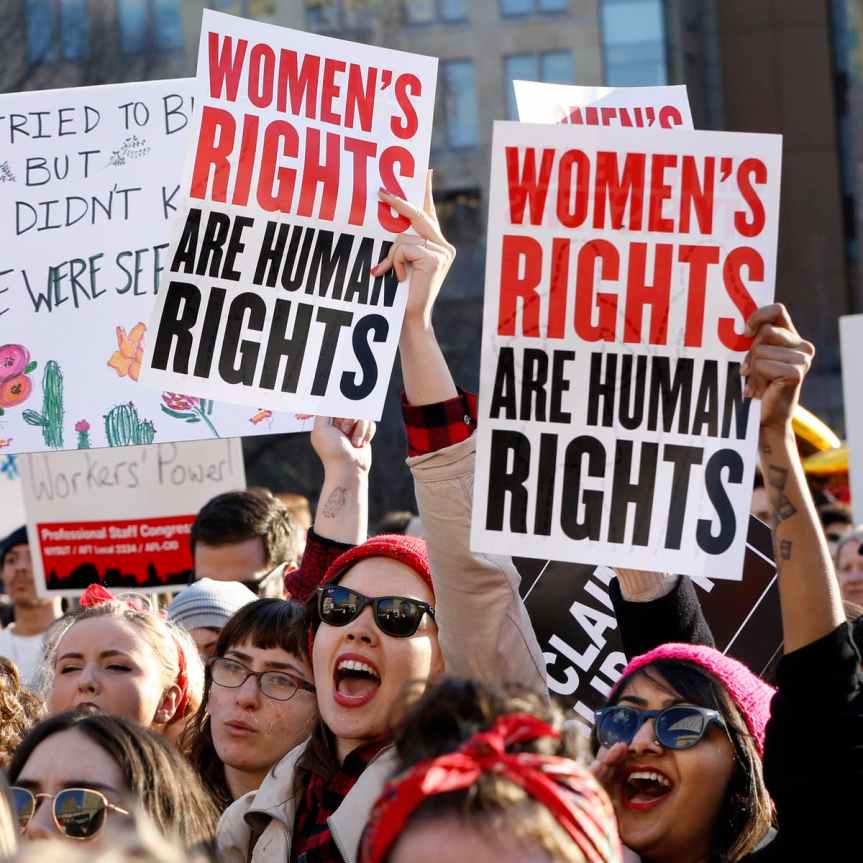
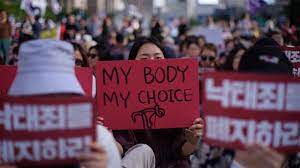
Abortion activists are ready for Justice Kennedy's retirement — Quartz

3.It ought to likewise be noticed that when an individual chooses to carry out an abortion it isn’t out of her aversion for youngsters but since she feels that it would not be an insightful choice to continue with the pregnancy as it is as yet not yet the ideal opportunity to have a child.

4.On account of assault or inbreeding, keeping a pregnancy is very damaging to the individual assaulted as nobody would wish to keep a kid that is a consequence of this, and the best answer for this issue is to abort the unborn kid.

5.At times entanglements can happen to a pregnancy that might put the existence of the mother or unborn youngster in harm’s way and surprisingly now and again every one of them. For this situation, abortion should be allowed to save the actual wellbeing of the mother.

DISADVANTAGES:

1.As indicated by Koster, abortion is just a brief and unreasonable choice that cause ladies to feel that they have gotten some help to an undesirable kid against odds of extremely durable loss of fruitlessness.

2.She further argues that although removing an unwanted pregnancy may somehow offer relief to the woman the possibility of becoming infertile especially if an unqualified person performed the operation is very significant and once you lose your fertility there is zero chance that you will regain it.

3.Even when performed by a qualified medical doctor there is a chance that complications may arise like in some medical procedures and if this happens, you could definitely lose your fertility.

4.The alleviation that one feels after procuring an abortion is typically brief, and it passes on after some time prompting a long-lasting sensation of blame and bitterness. In fact, in most of the times, this feeling of relief is just a deliberate attempt by the psychology of a person to delete the sense of guilt and shame that creeps in immediately one procures an abortion.

5.A great deal of favorable to lifers would liken early termination to murder, and it is consequently ethically off-base and ought to be prohibited. Genovesi characterizes murder as a purposeful demonstration of removing the existence of an individual. He further adds that since the baby of an individual has life, then, at that point removing it will add up to killing it, which is equivalent to kill.

India's new abortion law is progressive and has a human face | ORF

CONCLUSION:

The way things are today, it appears to be the discussion on abortion won’t reach a conclusion soon. There ought to be endeavors to give an unmistakable approach on this issue that would be worthy in the entire world through a worldwide body like the United Nations.

Apart from that the church and other organizations that are anti-abortion ought to soften their stand in some incidences like rape which are too traumatizing.

RESOURCES:

  1. https://ivypanda.com/essays/pros-and-cons-of-abortion-to-the-society/

2. https://abortion.procon.org/

Draupadi by Mahasweta Devi

Photo by Jairo David Arboleda on Pexels.com

Mahasweta Devi is a Bengali writer and activist who is known for her strikingly social and poignant stories. She wrote several works ranging from novels and plays to essays and short stories. Her most notable works include Hajar Churashir Maa, Rudali, Aranyer Adhikar etc. She has received highest literary merits in India like Jnanpith Award and Padma Vibhushan. As an activist, she has also worked towards the empowerment and rights of tribal people from West Bengal, Bihar, Madhya Pradesh, and Chhattisgarh.

Draupadi is a thought-provoking short story that deals with the underlying caste system and tribal subjugation in India. Originally written in Bengali, it follows a raw narrative that depicts the struggles of the subaltern in a vastly power-imbalanced society. Draupadi narrates the story of Dopdi Mejhen, a woman belonging to the Santal tribe in West Bengal. Dopdi and her husband Dulna are wanted by the Indian Special Forces as they were the chief instigators in the murder of Surja Sahu, an upper caste man who selfishly drew all source of water to his own wells and tube-wells even during the drought. Their bravery in questioning the authority of the upper caste is seen as a threat and battalions of officers are deployed to capture this ‘untouchable’ couple. Senanayak, the appointed head of the task force, uses the power of knowledge, tactics and violence to capture them. He is pragmatic with his ideology that ‘In order to destroy the enemy, become one.’ He is ruthless and tries everything in his power to achieve this, even going as far as to bait Dopdi with her own husband’s corpse. After her capture, his command allows multiple officers to rape her to extract information. Capturing and torturing them for information becomes a pleasurable game to Senanayak. Where the fugitives struggle for their lives, he takes joy in decoding their language and ‘countering’ them.

Draupadi in this narrative is an implicit reversal of the mythical character Draupadi from the Mahabharatha Mythology. Where the young princess is married off to five princes and leads the life as a fugitive who finally gets back their kingdom, this Dopdi does not grow up in the luxury. She has always been considered an outcast by her country for her identity and she is always on the run. Despite being nearly raped to death, she fearlessly walks out naked and confronts Senanayak, demanding him to ‘Counter’ her.

The people in power always reinforce their power by asserting dominance and by manipulating the internalised stigma against the people born in lower castes. Mahasweta Devi narrates this story of oppression without overtly emotionalising it and yet, it affects the readers in such a way that it provokes these emotions within us. To bring out maximum impact, she portrays reality as it is in all of its rawness which makes us question the power play prevalent in the society. The gradual shift of power in the end can be seen as her way of hinting at a hopeful future.

Thappad And The Volume It Speaks

Thappad: Bas Itni si Baat? Is a Hindi Movie directed by Anubhav Sinha, starring Taapsee Pannu as the main lead, Amrita. Some other cast of the movie include Pavil Gulati as Vikram Sabharwal, Amrita’s husband, Tanvi Azmi as Sulekha Sbharwal: Amrita’s mother-in-law, Kumud Mishra and Ratna Pathak Shah as Amrita’s Father and Mother and many other artists.


The movie’s main plot revolves around the orthodox Indian belief that woman should bear the responsibility of protecting her marriage and for that sake bearing any form of injustice or violence that she is faced upon with, in a silent and obedient manner. Thappad movie subtly touches the hearts and minds of the audience as it conveys a strong moral message that is highly needed in today’s world. This makes the movie stand out from the regularly entertainment-based movies that are preferred by the present generation in great demands.


The movie starts off by showing the dedicated house-wife Amrita who puts forth the needs of her husband and his family before her own wishes. Her husband Vikram, who is a workaholic is seen to prioritize himself and his needs before Amrita’s and expects Amrita to do the same. The story takes a major turn when Vikram slaps Amrita in the party organized at home, in anger and frustration due to some promotional issues in his company.
After this, the movie rolls forward with the decision of Amrita to take some time off from Vikram and his family in order to sort out her overwhelming feelings that occur after the slap incident. Thereby Amrtita deciding to return to her own home.


This whole plot raises not only a question of ethics and moral rights but also gender inequality.
The female characters in the movie are trodden and looked down upon by their own husbands and in-laws, just for the reason that they are females, thereby highlighting the thinking of Indians towards female.


The movie shows how even when a woman faces inequality in her marriage, the society and her own family expects and teaches her to bear the inequality and domestic violence all for the sake of protecting her marriage. We see the mother-in-law making comments like, “log Kya kahenge” and “Aaurto ko thoda sehna siklhna chaqhiye.” Throughout the story when Amrita suffers from the dilemma after the slap, no one comes for her comfort and neither does anyone blame or tell Vikram that he is at fault. Again, highlighting the concept of Man to be always right no matter what he does in his marriage.


Amrita’s fight doesn’t start because of a single slap, but the story perfectly weaves the injustice that she has been bearing up and moving on all along. It’s just that it takes that one slap for Amrita to realise how she has been living all along in her marriage. How she had to kill her only wish in life, which was to have respect and be happy. She realises how after her marriage all she did was become a submissive housewife. Though Vikram plays the negative role, who even after slapping his wife thinks that it was just an act due to heat of the moment and does not feel sorry for his action, is still empathised towards the end as he finally realises his mistake. This portrays how parents play a major role in the upbringing of children, as they are the first teachers from whom they learn the right and wrong in life.
Another gruesome scene that wrecks the heart of the audience is when the female lawyer is being raped by her own husband. One who does not know the definition of rape might not consider this as rape, however the definition of Rape is having sex with another person forcefully and without the consent of the other person. This applies even in relationships and to married couples. The female lawyer clearly denies the husband’s approach to have sex with him, however she finally gives up her struggle to resist when her husband forces himself upon her. The outline drawn from here is how women are expected to please and be sex objects for their men. A disgusting conventional ideology that still pertains in India is how husbands have the right to do whatever they like with their wives even when the wives do not agree to it.


The movie satisfies to a great extent and conveys a very important message that how women should stand for their own happiness and respect even if it means going against the odds. It also talks about how the preaching’s of the society are not always right. Although I liked the movie on a whole, but I was a bit disappointed by the ending of the movie. According to me, it ended on a positive note, with Vikram realising his mistakes. This may make the audience lose faith in the concept of fighting for their rights because it’s not always going to be this easy for your significant other to realise his fault. Also, the ending in a way hints the possibility of Amrita and Vikram getting back together ion future which may not always happen in every case. Apart from this, I feel the movie was great and is a really nice movie to watch and teach the present generation.

Why isn’t everyone a feminist?

It has come to my surprise that most people do not identify themselves as feminists. I have no idea what some people think feminism is. So, here is the dictionary meaning of the word feminism. 

Feminism is defined as the belief in social, political, and economic equality of sexes. 

I would like to emphasise the word equality. Feminism does not support sexism.Feminists do not put men down, nor do we support the women who put them down. Feminism is the belief in equality and not female superiority.

I was surprised to see some of the women not identifying themselves as feminists. I have come across women saying things like: 

I don’t face gender discrimination, so why should I support feminism. 

To all the women who have similar beliefs, it is the FEMINISTS that got you to a place where you can say sentences like these. 

Do you really think that without voices being raised, you got to a place where you are?

Women did not even have the right to vote, study, or work. Back in the old days, men did not even consider women. So, we have come a long way from women-only staying in the households to now becoming presidents.

 Secondly, there are still so many issues happening against women, and we must raise voices. If you have the privilege to face no gender discrimination, that is good for you. But do you not want that for every single girl out there?

To all the people who think that feminism is unnecessary, I would like to show some of the achievements done by feminists.

  • Right to vote
  • Gain access to birth control
  • Bought women out of household
  • Calling out on rape culture
  • Fought for legal discrimination
  • Making the workplace a little more equal

These were just a few of the things done because of feminists. So, the next time you think feminism is not needed and that we are already in an equal world.

Well, open your eyes. There is still a long way to go.

  • Saudi Arabia gave women the right to drive in 2018.
  • Each minute 28 girls are married before they are ready
  • One in three women have experienced physical or sexual violence
  • 62 million girls are denied an education all over the world
  • 4 out of 5 victims of human trafficking are girls

These were just a few facts out of 100 more issues that women face today. This data is for people who think we already have achieved gender equality. We have not and, we still need feminism.

If you are one of those people who does not like being labeled but believes in equality of both sexes. What are you afraid of? It is just a label for the betterment of our society. If you think people are going to judge you for it. Those are the people who did not do their research on what feminism is.

I am a proud feminist and, I am here to fight against the injustice that women go through. If you are with me, I hope you all identify yourself as a feminist.

If you are not convinced and, women with strong opinions on achieving equality bother you. Well, you can contribute to the world of misogyny. 

Language is Man-made, not “Human Made”!

This is a very simple title, yet a major loophole that our society is facing for many decades. This is not about giving rights to a specific gender but the suppressions which a language creates in the backdrop of society and makes it a center of concern. Never thought language can create such discrimination against two genders.

In colloquial context we see that every day we speak our language and communicate flawlessly yet we never recognized the ocean of problem which a language brings every day.

Profoundly, the title itself gives us the best example as to how we use the word “Manmade”, linguistically whenever a thing is made by a human it is denoted as manmade. But the question here arrives is that why don’t we spell it as human-made?

There are many endless words where the wordings are based on one gender-biased, for say: countrymen, mankind, etc and mostly these words denote men and women were often neglected or ignored since the formation of words.

“Language has always been a media through which many cultures and communities bounded and created a sense of harmony with each other”.

Whereas we can notice that Gender Discrimination has always been a core of fear since civilization. It has become one of the cliché topics when it comes to feminism and cause of this people are ignorant as they assume that the world is changed and there is no more discrimination in today’s society.

Taking back to the advent of the problem we can observe that many writers, critics have battled to always protect the women community as they are always considered the “weaker section of the society”. We can’t deny this fact but, inevitably, they are still subjected when it comes to literature and language.

  1. How Women are Neglected by Language  as Language reflects Patriarchal world:

She says, “Women can either read and choose to stay trapped in their bodies by a language that does not allow them to express themselves, or they can use the body as a way to communicate.”

Helene Cixous (in; “The Laugh of Medusa” )

This very quote is taken from the famous article written by a critic, writer, and feminist; Helene Cixous who has explained how a woman had gone through repression in history and how literature and language had given an upper hand to the men in society to suppress women.

In “The Laugh of Medusa”, she explains how women should find their voice and the Language is the symbol of how a person portrays themselves. “Writing is for you, you are for you, your body’s yours, take it”. This line highlights that it’s high time that women should raise their head and minds and be themselves by being flawlessly independent and break the walls which portray women as fragile and frail.

The author claims that there is a very close relationship between women’s bodies and their writings and both have been repressed by men for centuries. Literature, in particular, explains to us how women as a writer were hard for the audience to accept them due to cultural prejudices laid against them since ages.

Writers like Virginia Woolf show us the patriarchal world through one of her works namely “Room of one’s own” through the lens of all the women present in the world and the problems they go through.

“A Woman must have money and a room of her own if she is to write fiction”. This quote is quite relatable for the women of contemporary society, but this was a major issue which women of the 18th and 19th centuries were facing, to be independent they always needed acceptance to flourish in their fields and for that, they always needed acceptance which was a great hurdle in their lives. For their personal growth, they were bounded to be under 4 walls and do all sorts of wifely duties which gave the society that women are doing dutiful jibs under their husbands present.

But unfortunately, those women were never accepted who was unique and out of the box because society was not people’s perspective, rather it was the male perspective.

Even in “Room of one’s own”, Woolf mentions Judith Shakespeare ( was considered as Shakespeare’s real sister), her character portrays us the devastation a woman goes through while struggling for getting justice.

It also portrays us that many decades of literature didn’t accept women’s works as they were not considered as talented and rather, they were judged based on patriarchal society.

  •  Females were Disowned yet contributed best Literature:

As when we look into 18th century British literature, we can see that several female writers have given an immeasurable piece of works which is still remarkable to date.

It would be a disgrace if we forget to mention  Jane Austen, the Bronte sisters, Virginia Woolf, who were the pillars of 18th-century literature. Whether it is a broody romantic novel of wuthering heights or it is jane Eyre, every writer has spilled their hearts and provided the real situation of women in the era.

Some great writers are unforgettable like J.K Rowling who made us believe in fantasy and made childhood more fascinating by giving us Harry Potter which always provides us nostalgia going back to those days.

Unfortunately, these writers have always struggled to prove their identity to the world, that these immense writers like J.K.Rowling, Emily Bronte, had to change their names to get worldwide recognition. Even in the postmodern age, the situation didn’t change and the process of women hiding their originality, their names was like a custom they followed for ages.

But these female writers never let their readers down and always provided the best piece of art even having so many hurdles in their life.

It’s a long way to go, but still, the situation is better as women are gaining recognition and fame in society, the world, and literature through their masterpieces of works.

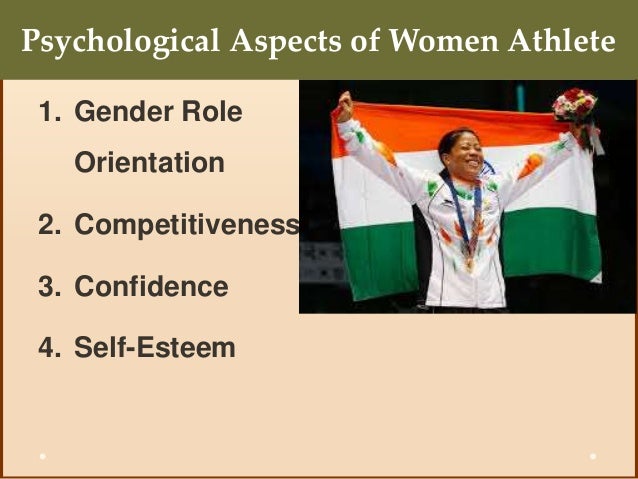
PSYCHOLOGICAL ASPECTS OF WOMEN ATHLETE

Lesson 6 women and sports

Over the past several decades , the role of women has changed drastically .However , gender beliefs and stereotypes still do exist across the world especially in sports . Most of the people in our society consider that sports are not meant for females but only for males .Social tradition , customs and cultures have great influence upon the psychology of women . In a male dominating society , males are expected to be aggressive , independent , dominating , robust and confident , whereas females are expected as well as considered to be emotional , sensitive , cooperative , sympathetic , loyal , etc. It is a well – known fact that participation of women in sports is increasing year after year .With this enhancement in female participation in sports , there is also renewed interest in the psychological characteristics of the female athletes and the effects of athletics on women . The various psychological traits of women athletes are stated below .

  1. Gender Role Orientation : It is an established fact that there has been an increase in the level of women’s participation in the types of sports that have been traditionally limited to only males , e.g., wrestling , weightlifting , kick boxing , body building , etc . However , many sports have been still considered inappropriate for women . For a long time it was considered that women should not take part in athletics because of the potentially harmful masculinising effects of sports .
  2. Competitiveness : It is evident that in the field of sports , both men and women are competitive in their own fields . In fact , women are more goal oriented and perform magnificently in artistic activities such as gymnastics . However , a number of research studies indicate that females who take part in sports are more competitive in comparison to the females who do not participate in sports .
  3. Confidence : As mentioned earlier , due to social pressures , women tend to have less confidence than men . Participation in sports , competitive environment , awards and recognitions increase confidence levels of sportspersons . However , a significant difference may exist between sportswomen and non- sportswomen .
  4. Self-esteem : Most of the research studies indicate that training plays a vital role in performance . Self -esteem improves with good performance . In the field of sports , intensive training helps in enhancing self-esteem . Research studies also show that those people who engage in sports have high self-esteem in comparison to non-participants .
  5. Aggression : Aggression is a forceful , goal- directed action that maybe verbal or physical . Participation in sports has many positive aspects which usually involve aggressive behavior . Various studies of aggression show that athletes who participate in contact sports , i.e., football players , judos or wrestlers are more aggressive than the athletes who participate in less contact sports . However , females who participate in contact sports show more aggression in comparison to females who do not participate in sports at all.

Books Written By Women For Women

Women are capable of accomplishing anything. Create great ideas, build businesses, and make a great difference in the world. Nonetheless, we don’t see enough of this message in mainstream media. However, the realm of literature has provided us with many incredible stories of women’s perseverance, knowledge, wit, boldness, and drive.As such, here are some excellent novels written by women authors for women.

I Know Why the Caged Bird Sings by Maya Angelou

The caged bird attempting to escape has long been a symbol of resistance to injustice. Maya Angelou employs this sign to express her desire to leave a life of strife, racism, and misogyny. I Know Why the Caged Bird Sings is an autobiographical novel about Angelou’s childhood in the 1930s. 

We encounter prejudice, rape, and rejection from her community, even from her own mother, as we follow this impoverished, disenfranchised black girl. Maya Angelou discovers as an adult how her own strong spirit, compassion, and generosity to others is the greatest way to be free. The book is a strong and beautiful storey of courage and breaking free from one’s captivity.

We Should All Be Feminists by Chimamanda Ngozi Adichie

We Should All Be Feminists is an interesting piece on women’s rights and equality. This book-length article discusses how the term “feminism” is sometimes connected with misunderstandings and prejudices like brainwashing.

To counterbalance this, Chimamanda Ngozi Aidchie provides the reader with a simplistic yet compelling description of feminism: equality for women in social, political, and economic terms. She confronts common feminist misconceptions front on. Even after her own friends called her a terrorist supporter, Aidchie continued to clarify that the term “feminist” has little to do with hostile, resentful, and men-hating women. The central theme of this novel is a narrative of a life-long battle to achieve equality between the sexes. 

According to the author, feminism is important since it helps to tackle women’s silence and exploitation.By how successive generations educate their children, the concepts of gender equality and feminism continue to struggle with all these terms.

The Terrible by Yrsa Daley-Ward

The Terrible is a novel about a lady attempting to manage her life on her own. Yrsa Daley-Ward recounts personal aspects of her childhood without her father and the terrible facts she had to discover in this stunning piece of painfully honest prose.

These realities are referred to as “the terrible.” As a young lady, the writer couldn’t comprehend the mental strain of having encountered tremendous pessimism and tribulations so early on in life. Having grown up as the only kid of colour in a white area, she was educated by a family of radical Christians, and witnessed her mother being devastated by several bad relationships.

Later in the book, the book relates Daley-Ward’s life as an adult, when she, too, had to deal with “the terrible.” She discovered it was continually expanding and having a much more huge psychological strain on her as she became hooked to narcotics and experienced repeated mental breakdowns.

The author reaches the climax and confronts “the terrible” after suffering all of the negative stuff that has occurred to her. She can only break free and recover if she recognises the consequences of her trauma and embraces her self-sustaining positivity.

The Girl with the Louding Voice by Abi Daré

The title of this novel hints at the main character. The tale of Adunni, a young Nigerian girl who aspires to acquire an education but ends up in an arranged marriage, is told in “The Girl with the Loud Voice.” As she escapes her violent husband and her native town, her resolve to attend school, which her mother encouraged Adunni to accomplish, triumphs.

The plot follows Adunni on her trip, which is packed with perilous, life-changing, and remarkable experiences. On her journey, she gains access to literature such as English dictionaries when she finds herself working as a maid in Lagos. Eventually, she comes upon an opportunity to learn. Her irrepressible attitude and perseverance drive her on the path to the “louding voice,” making this book a fantastic piece of how battling for your ambitions will be rewarded.

Notwithstanding the many difficulties in her journey, she never quits on her aim of escaping poverty. The end result reminds readers of the author’s message: pursue your goals, and you might just bring about change.

Wow, No Thank you: Essays by Samantha Irby

Wow, No Thank You is an essay collection in which Samanth Irby describes her life as a married woman in her forties. She compiles a fantastic series of stories in which she finds herself in situations that many people can relate to. All throughout the novel, humour is a recurring motif, as Irby makes amusing comments on her own behaviour and life choices.

The author’s inner voice, however, is at the heart of the book, pushing us to be more sensitive to things. That discourse also enables us to notice these things that no one else notices, which frequently results in pretty funny circumstances. Irby demonstrates how her internal thoughts influences her clothing and footwear, food preferences, cleansing items, and so much more.

Misogyny vs Feminism in Osborne’s ‘Look Back in Anger’

“Why don’t we have a little game? Let’s pretend that we’re human beings, and that we’re actually alive.”

John Osborne

Look Back in Anger is a realist play written by John Osborne and Published in the year 1956. Set in an economy that has been diminished by the war, it follows the story of a young couple Jimmy and Alison Porter. Being from two different social classes, Jimmy being a working- class man and Alison being an upper-class, the two have trouble navigating through the class conflict present between themselves. The play focuses largely on Jimmy’s anger against the upper-class and particularly the upper-class women.

During the time of the play’s production, The Women’s Movement had already started taking shape in Britain and hence can be read as a reaction against the growing feminist movement of the time. It is evident from the play that Jimmy hates women and has strong misogynistic views. He blames women for his lack of power and impotence even though there is no coherent logic behind that argument. His wife Alison is the main victim of his hatred. Through her, he takes out all his anger against the establishments, the upper-class, Alison’s family and all women in general. His marriage to her was in itself a statement of rebellion against the bourgeoise and he himself states that ‘he took her hostage’. His motive for the marriage was never love and it was simply his need to assert his working-class masculinity over her.

“A refined sort of butcher, a woman is.”

-John Osborne

Where Alison is an aristocrat in terms of her class status, Jimmy is an aristocrat in terms of his gender identity and the only way he can get his anger and frustration against the bourgeoise out is by sexually mastering the upper-class women. He exploits his aristocracy as a male to compensate for his lack of status in terms of class, and he translates his class hatred into a sexual hatred. Here, Femininity is associated with the upper class and masculinity to that of the lower class and this act of attributing characteristics of gender to the classes is seen throughout the play. Despite being immensely flawed himself, Jimmy’s standards for women are highly unrealistic and he needs women only for his own selfish reasons. While Alison suffers to make their relationship work, Jimmy simply complains and puts a strain on them. He contradicts himself when he lashes out against Alison for being too silent but at the same time, he complains that she is like a python that is out to devour him whole with reference to her sexual aggression. The only two women that Jimmy seems to respect are Madeline (His ex-lover) and Mrs. Tanner (A working-class woman who helped him set up his sweet shop). He holds her as an ideal working-class woman as opposed to his own and Alison’s mother who are upper-class.

Although the driving force of the story is Jimmy’s anger, both Helena and Alison have made choices of their own to leave him. Even Alison who acts like a passive pushover has had her own choices and decisions in life. It was her choice to rebel against her parents and to marry Jimmy and leave her upper-class status, it was her choice to leave him and it was also her choice to come back to him in the final scene. Even when Jimmy calls her ‘Lady Pusillanimous’, she chooses to be silent so as to not give him the satisfaction of eliciting a reaction from her. Being silent is actually her way of retaliating against his dominance. On the other hand, Helena is one of the characters who is more expressively strong and feministic. She is unfazed by his threats and slaps him which shatters his façade and brings out his vulnerability. •            Even when Alison chose to come back to Jimmy, Helena is unwilling to confirm to his demanding views on what a woman should be and boldly walks out on him because she is determined that she doesn’t want to go through pain and suffering just to be with him.

Look Back in Anger is thus riddled with undaunting and scathing misogyny and sexism. Although Osborne denied any anti-feministic overtones, we see that there’s an erasure of women I the male dominated dynamic in the play.

FEMINISM- a necessity or a drama (PART-1)

The word FEMINISM comes from the word FEMININE which means “being a woman”. How is it that out of over a million words in the English language this particular word has created an uproar in the recent times with each woman becoming a “Feminist” proclaiming about her rights under this word and is criticized by others who think this is all a show of gaining attention , popularity and superiority. Read this blog completely to understand what actually caused to the popularity of the word , its implication in Indian terms and how has it helped women.

Feminism

FEMINISM refers to social , political and economic equality to women with respect to the males. Since God has given a woman the power to create life and nurture it , she automatically has a greater emotional quotient and her motherly attributes of being considerate, polite, loving , emotional is taken to be her weakness. Further since she has the organs to produce a human being , she is termed as “delicate” or in real words “WEAK”. WEAK is the term which has led the males believe that they are stronger and more capable and this has led to them ruling a woman since ages. The irony of the situation is that it is not just the males but also few women who thinks the entire woman race to be a subordinate to men and is born just to be a frustration box for the males.

So feminism in simpler words can be termed as a movement which was started to get women equal rights in education, property and employment matters and travelled as far as to the emotional treatment a woman has to suffer. It defines that a woman should be judged on the basis of her mental strength, her capabilities, her behavior rather than being judged for just being a WOMAN. It stands for women standing up to the male dominating world to fight for their self respect .

History of Feminism

The first instance of feminism which was the earliest reported one darts all the way back to 3rd century BCE in Rome where Roman women filled the Capitoline Hill and blocked every entrance to the Forum when consul Marcus Porcius Cato resisted attempts to repeal laws limiting women’s use of expensive goods. Cato’s words “If they are victorious now, what will they not attempt? As soon as they begin to be your equals, they will have become your superiors” proves that he somewhere believed women to be capable of exceeding men and it was this fear of letting that race which was suppressed since ages to be set free without any illogical restrictions bounding them which will make them realise their worth and will subsequently be no longer a personal robotic toy for men.

There was a time when the entire world was suppressing women. Women in each part of the world were denied the rights which would ensure her success instead she was just being treated as a caged animal. Until 19th century Europe did not give the women the right to inherit their father’s property which generally goes to the first child . In the absence of mail heir the property would go to a male relative however distant or evil he maybe. Jane Austen’s novel PRIDE AND PREJUDICE is the best example to this point where the Bennet family which consisted of all females had no right to their ancestral property .

While there were many other rules for women such as they had to step out covering their head as a mark of respect for the “SUPERIOR MALES”, had no right to vote or hold an elective office, cannot participate in any sort of buisness and went as far as to a man getting right to sell of his wife in many parts of the world. These actions proved that women were treated to be a non living enity with no feelings whatsoever.

After several protests, letters addressing women concerns being published, criticism the cause faced by the chauvinists , the woman were granted their rightful rights in many places in the world but the battle is till to be won. Many countries specially the ones in Asia still are treated as the object of male plight and fury.

With different culture the take and views on feminism chnages, let us see what brought about the changes for Indian women though the Feminism here was partly inspired by the west but its meanings and implications are different for the Indian women.

Feminism in India

Women in India are oppressed not only by the males but more by the fellow females. It is like a sort of inheritance being passed from one generation to the other where a girl is told by all the females in her family be it grandmother, mother or aunts that she should always keep all the males in her family above her and sort of idolise them and they are led to believe that if something wrong happens with them then it is the result of their own actions. This is the reason that many women silently suffer all kinds of domestic violence till their last breaths because this was what they had been taught since their birth.

Feminism in India can be divided into broadly three phases.

  • The first phase was witnessed in mid 19th century when several reforms in education and customs involving women were introduced. Sati, a practice which involved a woman setting herself on the fire by sitting on her husband’s pyre incase he expires before her, was abolished by Raja Ram Mohan Roy in the British Rule. This till date is considered as a biggest step in encouraging a woman where she was told she is much more than being a wife and her life does not ends with her husbands. Rani Lakshmi Bai the woman who fought Britishers with her infant son tied on her back after her husband’s death to save her kingdom from their clutches still continues to be an inspiration for many.
  • The second phase was witnessed from 1915 till India gained its independence and it started with Mahatma Gandhi incorporating women into his non cooperation movement , a first open political gathering where females were included. After this movement there were various Independent female groups created to fight for the Independence which managed to be off radar and continue their contribution in secrecy as Britishers had no hope that Indian women can step out of their domestic roles.
  • The third phase was witnessed after independence where women were included in the formation of the world’s largest democracy, has the power to vote and hold an elective office ,get educated and be independent. This phase continues till date and has witnessed many changes along the way. From it becoming normal for girls to get educated and work, to the extension of minimum age of marriage for a girl till 18 years by the Constitution of India to prenatal sex determination and Female Infanticide being considered as a criminal offence with severe punishment it may seem that India has come a long way and the women here are treated with equality and respect which they deserve but sadly this is not the case. Though the upper surface appears to be cleared there are still many horrible trenches inside.

Present Condition of Women in India

Feminism and plight of women in India cannot be sumarised under a single term. The heterogenity of Indian cultures bring with it multiple patriarchies and multiple feminist movements but the basic plight remains the same.

India is a highly patriarchal society where even today in 2021 people claim to be modern and “allowing their women” to have privileges same as that of men but the small privileges of getting educated , working comes at a price. Price of still not be able to take stand when she is wronged , the reason being a woman is pointed every time she becomes a victim while in some case she may act to be a victim hence committing a grievance sin but this minority is turned into making independent decision taking woman being regarded as “too bold” or “unfit” for the society by the chauvinist groups.

****Since even the basic points regarding the topic are indefinitely extended and talked about, it is difficult to make all the basic points in one blog and there will be a continuation to this blog soon.

I would conclude this blog here by stating that feminism is not the superiority of females over the males rather it is about them being treated equally both physically and mentally without any prejudice about them being a woman. It takes a lot to be a woman and to every woman out there be proud of what you are!

Exploring Gender in Enid Blyton’s ‘Famous Five’

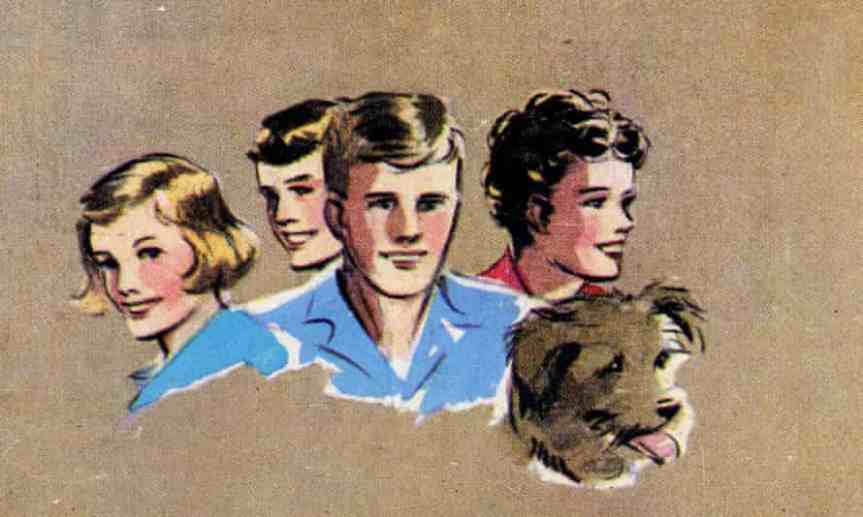
The Famous Five is a children’s adventure series written by the British author Enid Blyton. The first book The Five on a Treasure Island was published in the year (1942) after which 20 more books followed. With the sales totaling over a 100 million, it is considered to be an all-time best-seller in children’s literature. The series revolves around the lives of four children: Julian, Dick, Anne, Georgina (George), and her dog Timothy. Blyton’s portrayal of their carefree summers and adventures have always gained popularity among children. More often, Enid Blyton books are usually responsible for getting children interested in literature. Her use of simple language helps children easily understand the story. Her vibrant descriptions appeal to the readers in such a way that we long for adventures, matching the enthusiasm of the characters portrayed in her stories. Her storylines are intriguing and her peculiar way of dropping hints throughout the book which finally connects up as a shocking climax is always interesting.

“Far from being a set of fixed and stable values and roles assigned/imposed by society, gender is a performance or a role enacted by the individuals. This performance of gender is, of course, social in the sense that it is enacted, validated and accepted by the society.”

-Judith Butler (Gender Trouble)

In most cases, Blyton adheres to the dominant gender norms of her times; which is the Middle-class heteronormative British views which regulated the behaviour of women with respect to their appropriate domestic roles and activities for women like raising children and managing the household instead of careers. Blyton presents rather contradictory representation of gender roles. Mostly, she follows the dominant submissive roles of females but on the other hand, she also shows that there are alternatives where women have agency and freedom of choice. Her writing of ‘sexist’ characters are probably a result of suiting the story to the audiences of her time.

“Anne had a very happy morning. She arranged everything beautifully on the shelf… IT really was a splendid larder and dresser!… Then the little girl set to work to make the beds. She decided to make two nice big ones, one on each side of the cave.”

Five Run Away Together (1944)

Anne is described as someone who is shy and timid. She’s not as adventurous as her brothers Julian and Dick or like her cousin George. She does all the domestic chores and is often in charge their food and other domestic needs. She is referred to by her brothers as a “Very good little house keeper”. She likes playing ‘house’ and thus, voluntarily does all the chores during their quests and she likes doing it. And she is extremely happy when she’s praised for her work. She takes pride being referred to a good housekeeper. Despite being the youngest of the four, she is often portrayed as the nurturer and care-giver. She selflessly takes care of everyone’s needs and plays a mother-like figure to the rest of the group. George’s mother, Fanny is portrayed in a similar such way and serves as a role-model figure for Anne. It is a given that she’s the youngest and perhaps that’s one of the reasons why she is babied. But there’s a clear hint of patronisation when her brothers address her. Through Anne, Blyton firmly reinforces the typical female gender stereotype that women are supposed to be gentle, caring, nurturing and subservient housekeepers who are not fit for a career-based life.

“Don’t you simply hate being a girl?” asked George. 

“No, of course not,” said Anne. “You see – I like pretty frocks – and I love my dolls – and you can’t do that if you’re a boy.”

“Pooh! Fancy bothering about pretty frocks,” said George, in a scornful voice. “And dolls! Well you are a baby, that’s all I can say.”

 Anne felt offended.

-Five on a Treasure Island (1942)

Blyton was a career woman, so her portrayal of George can be seen as her personal resistance to the dominant gender stereotype of her time. Georgina prefers to be called George, and is good at everything that is traditionally masculine like climbing trees, swimming, rowing boat, drawing carriages etc. She tries very hard to not be ‘girly’ and dresses up like a ‘boy’. In anyway, she wishes to be a boy as she prefers being called ‘Master’ instead of miss, loves it when people mistake her for a boy etc. It is evident that boys were valued more in the society than girls. And her desperate need to imitate a man can be seen a cry for help in an overtly patriarchal society. She wants to be treated with the same respect and dignity that her male cousins enjoy and so, she feels that the only means to achieve that is by imitating a man. On a separate note, many readers have read into George’s tomboyishness as signs of gender dysphoria. (Gender dysphoria involves a conflict between a person’s physical gender and the gender with which he, she or they identify with.)  So, the idea of a tomboy fails to take into account the more contemporary idea of gender as a spectrum rather than a rigid binary. Considering the time that this was written in, it is unlikely that this is what Blyton meant. But nevertheless, it is empowering to interpret that perhaps George is a transman; a boy trapped in a girl’s body.

George despises any characteristic of weakness that is usually associated with women. She seeks power and respect while Anne is contented with whatever the society is willing to give her. There is an instance where George gives into something and the boys praise her for giving in gracefully or decently like a boy. At this, George becomes extremely happy for being identified as a boy and she feels that “She didn’t want to be petty and catty and bear malice as so many girls did.” This can be seen as a perfect example of gender hierarchy where having a “decent” behaviour is normal only for boys and that it’s an exception for girls. George is admired by the rest for being good at physical activities. She excels to the point that she even threatens the authority of the dominant male leader by being better. There are several instances where she’s better at swimming or rowing than the boys. This skilled behaviour empowers Anne and in those instances; she longs and hopes to be as skilled as George. George is a successful, independent girl who can do anything that a boy can do, and do it better. This can be seen as Blyton’s attempt at empowering little girls.

While Anne takes pride in fulfilling her duties as the default nurturing housekeeper, George is expected to help her out and engage in these domestic chores as well. And this internalised social norm creates a feeling of guilt within George while no such guilt exists in the minds of the boys. Now even if the boys do offer help, Anne dismisses it off as “No. That’s my job and George’s.” Anne is easily scared and is seen as a cry-baby. The group takes it for granted that she’s emotional and weak and is in need of protection. George on the other hand, suppresses all of her emotions in fear that it’d show her as a ‘girl’ which was considered inferior. She hates crying as crying is seen as something that only girls do – a sign of weakness if expressed by a boy. Aside from effecting George, this also imposes an unrealistic and unhealthy emotional and mental standard on the boys. For instance, Dick is shamed for crying or expressing any emotions that are not ‘manly’. This also reinforces toxic masculine traits on young boys.

George thus imitates traditional masculinity as an attempt to receive equal treatments. She over-compensates in this aspect to desperately hide any traces of being a girl. To an extent, it does grant her more privileges than the feminine Anne but this comes out as a positive reinforcement on her, and it proves the masculine authority over women of the time. Despite all her attempts, the fact remains that she is still ‘just a girl’ and that she only receives the freedom that her male peers allow her to enjoy. No matter how much she tries to imitate men, she’s still othered by them.

We see a contradictory portrayal of gender roles by Blyton. All the criticisms aside, we can also interpret this as her way of showing that girls can choose to be either Anne or George or a mix of both. Anne might have been typecast as the stereotypical girly girl, but even if it’s because of the inherent social norms, she loves it. She unapologetically takes pride in being herself and doing things that she enjoys, even if the others ridicule her and tease her for being ‘too weak’. On the other hand, even though it reinforces male superiority, George’s unique character proves that girls can do anything that boys can and actually be better at it. For the time that it was written in, it is clear that Blyton intended George’s character as someone who breaks away from tradition. Thus, we see that Blyton offers different perspectives on how girls can choose to be.

Reference Links:

What is Mansplaining?

Mansplaining is a portmanteau of the word ‘Man + Explain’. Mansplaining refers to the explanation of something by a man, typically to a woman, in a manner regarded as condescending or patronizing. It stems from an authoritative and privileged belief that men know better, and that women are always ready to be helped and taught. The phenomenon has happened since long but the origin of the word was inspired from an essay by Rebecca Solnit titled Men Explain Things to Me. (Published in 2008)

In her essay, Solnit describes an incident which took place while at a party. During a conversation, an older gentleman cuts her off in between and starts explaining on a topic, claiming to know more about it than her. He insists that she read a particular book which supports his evidence. What he did not know was that she was in fact the author of the very book that he was talking about. Ironically, he hadn’t even read the book and had simply read an excerpt from it.

“He was already telling me about the very important book — with that smug look I know so well in a man holding forth, eyes fixed on the fuzzy far horizon of his own authority”

Rebecca Solnit

Although it might seem trivial from the surface, on a deeper level, mansplaining is linked to a larger abuse of patriarchal power. Since knowledge is power, men having held that powerful position for so long assume that they know better and that women are incapable of handling that knowledge of power. It is an offshoot of the societal idea of gender hierarchy where women are expected to be the pleasant audience. Having an opinion for themselves is considered to be an act of ‘questioning the authority’.

A Harvard study conducted in 2004 shows that men are 50% more likely to offer an answer in class and nearly 150% more likely to speak three times or more. This gets carried on and continues from schools to colleges, to workplaces, to politics and basically to any place where expression of ideas is concerned. “….it crushes young women into silence by indicating…that this is not their world. It trains us in self-doubt and self-limitation just as it exercises men’s unsupported overconfidence.”

“Most women fight wars on two fronts, one for whatever the putative topic is and one simply for the right to speak, to have ideas, to be acknowledged to be in possession of facts and truths, to have value, to be a human being.”

Rebecca Solnit

This happens so much so that women are denied of expressing their own lived experiences. More extreme versions of mansplaining can be found in the Middle Eastern countries where women’s testimony has no legal validity. So, if a woman is raped, she cannot testify in court unless there is a male witness to testify for her. As Solnit says, “Credibility is a basic survival tool…Violence is one way to silence people, to deny their voice and their credibility, to assert your right to control over their right to exist.” Thus, on a larger context, it becomes a crime as grave as harassment or an assault.

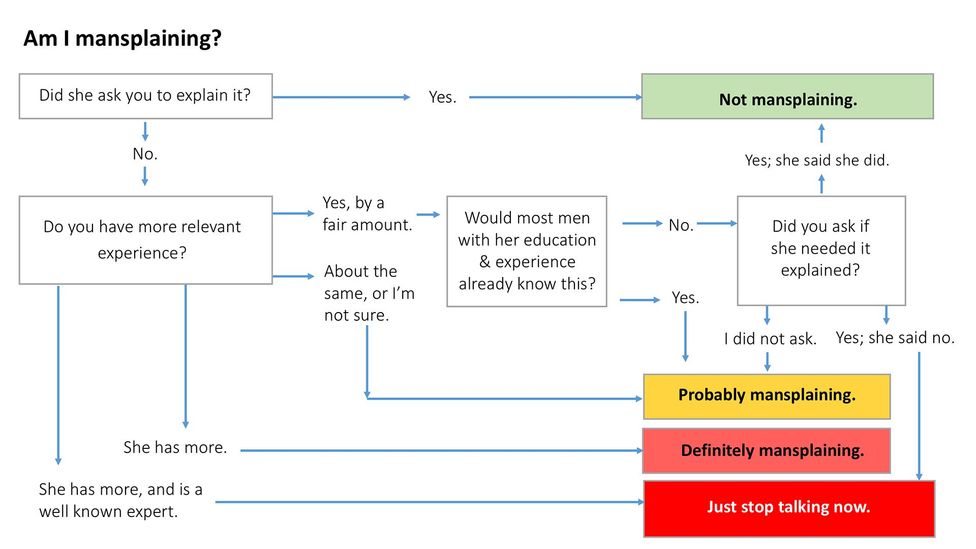
Image Credit: Kim Goodwin

As with every point raised, some would oppose this by pointing out things like “not all men do it” or “Women do this too”, and it’s true. Anyone, regardless of their gender, talking in a patronizing or condescending manner to someone else is wrong. “… a certain amount of self-doubt is a good tool for correcting, understanding, listening, and progressing — though too much is paralyzing and total self-confidence produces arrogant idiots… There’s a happy medium between these poles to which the genders have been pushed, a warm equatorial belt of give and take where we should all meet.”

This need not even be restricted to Gender. It ties into other identities like race, sexuality, class, disability and age; as terms like whitesplaining also exist. Any enlightening discussion involving mutual participation and exchange of information is good as long as it is done with respect for each other in a non-condescending and non-patronizing manner.

Reference Links: