
How India Generate Money for the Growth of Economy

Source: VectorStock

Government of India adopted mixed economy strategy after the independence from British Colonialism. A mixed economy is a system which comprehend the blending elements of market economies with the elements of planned economies with the hint of free market with state intervene such as with private enterprise and public enterprise.

A mixture of markets with state intervention referring to capitalist market economies with strong regulatory oversight, intervening policies and governmental provision of public services.”  This type of economy is apolitical in nature and holding the same substance of private and public enterprise.

In Western world, capitalist economy containing more dominance of private ownership with profit seeking enterprise and accumulation of capital as consider it fundamental driving force for the growth. In such system, markets are tend to flatulent between government and regulatory control which influence indirect macroeconomics influence through fiscal and monetary policies. India has mixed economy culture since independence. The second Five Year Plan infused the economy of socialist pattern for India. Planned Development yielded the socialist strategy for economic planning and Development of public sector. As India adopted mixed economy, Economic planning associated with capitalistic framework. Indian economy augment in Monopoly trends support mixed economy, predominance of

Source: Economic Times

markets mechanism which create the prevalence of markets for goods; this determined the demand and supply created private ownership of production.

Since the mid 1980s, India has opened up its markets through economic reform. Several industrial policies, Indian economy provided space for private sector but before 1980 the participation of private sectors in economy was very low. Indian economy started to become mixed economy in 1980s and India’s International trade started at large scale.

There are few reasons that why India inclined towards mixed economy and got the base of liberalization, pravitalisation and globalization and switching from agrarian economy. The low growth rate of the economy of India before 1980 which was stagnant from 3 to 3.5% from 1950s to 1980s while per capital income averaged 1.3%. At the same time, Pakistan grew by 5% Thailand by 9%, South Korea by 10%. Before 1990s, only four and five working license were given to steel, electrical, power and communication. License owners large enterprises.

A huge power sector emerged as state owned enterprises made large losses. Income taxes and custom department become inefficient in checking tax evasion. Infrastructure investment was poor because of the public sector monopoly. License Raj established the irresponsible bureaucracy and corruption in the enterprises and corruption flourished in this system.
Source: PaperTyari

In 1990, Prime minister PV Narasimha Rao, with Finance Minister Manmohan Singh initiated the Economic Liberalization in 1991. Reforms vanished license Raj, reduced tariffs and interest rates and ended many public monopolies, allowing Foreign investment in many sectors. Through the Economic Reform of 1991, Indian economy introduced liberalization privatization and Globalization as part of Structural Programme.

Liberalization has equated a change of reorganization of institutional space; it is a relationship of economies in the direction of market principles. Liberalization create jobs, increase competition, Private companies buys land and develop cities.

Privatization reduce the government’s political interference. It improve the efficiency of profit incentive; improve operational efficiency in order to reduce their costs and improve on profits. Produce good quality products and provide better services and reduce wastages and utilize the resources.

Globalization encourages producers and consumers to benefit from division of labor. More free market movement between countries. Gains from the sharing of ideas skills technologies across national borders. Opening up of capital markets allows developing countries to borrow money to over a domestic savings gap. Increased awareness among consumers of inequality and climate change. Competition pressure from Globalization may improved the governance.
India’s Disinvestment Policy a New Economic Policy

Source: jagranjosh

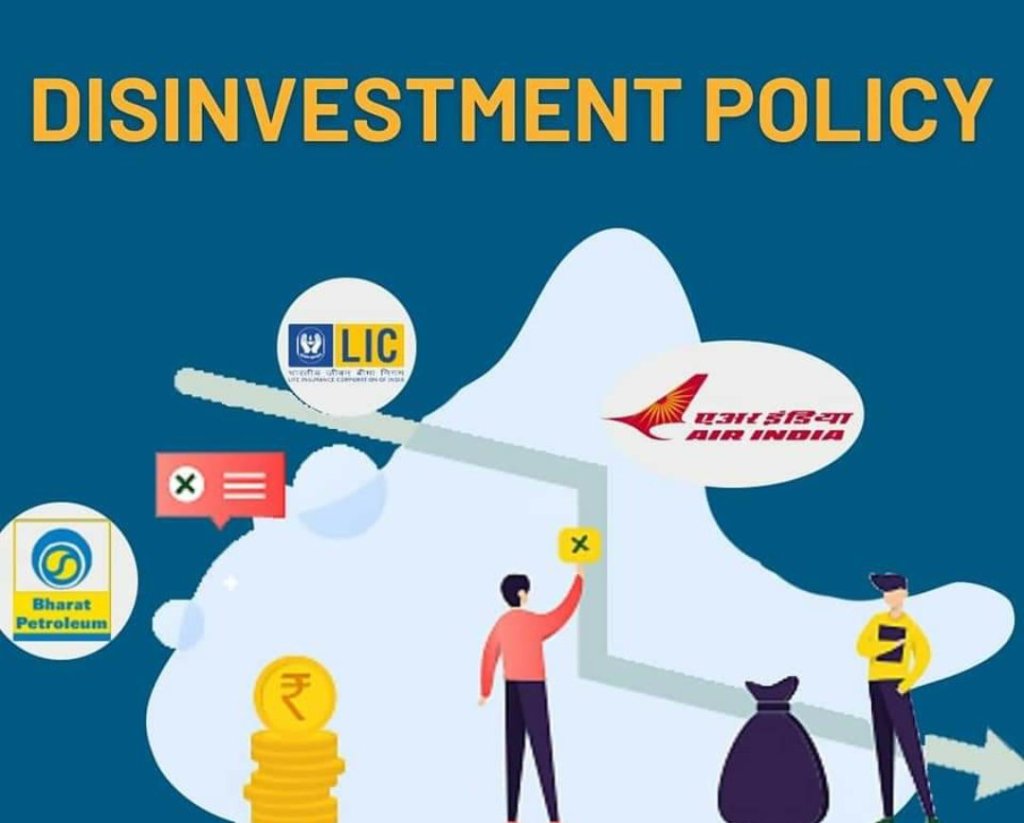
Disinvestment is a philosophy of new economic policy of India. It is complete denationalization of assets. India adopted Disinvestment of government’s equity in PSUs and the opening up of closed areas to private participation. In recent years, the issue of privatization have been brought to the forefront due to the large scale fiscal deficits that the government has been facing.

The New Industrial Policy announced on 24th July, 1991, was an attempt to meet conditionalities imposed by IMF  and World Bank in exchange of loan. The new economic policy was increasing the role and importance of the private sector in Industrial economy of the country and various measures were announced to achieve this purpose.

In August 1996, a five member Disinvestment was set up under the chairmanship of G V Ramakrishna former planning commission member and former chairman of SEBI with an aim to introduce mass ownership and promoting worker’s shareholding. The process was expected to eventually transform the existing state owned enterprises into public owned companies. Before measure the full fledged Disinvestment strategy; there are few terms of reference for the commission as to draw long term investment programme within 5 to 10 years for PSU referred it. To determine the extent Disinvestment in each PSU;prioritize PSUs referred to it by the core group terms if the overall disinvestment programme.

Source: Business Standard

To supervise the overall sale process and take decisions on the instrument as well as pricing. To select the financial advisors for the specified PSU to facilitate the investment process. Ensure the appropriate measures are taken during the investment process to Protect the interest of the affected employees.

Objectives of Disinvestment

The following objectives were stated in July 1991 are :-

• To improve overall economic efficiency

• To reduce fiscal deficit

• To diversify the ownership of PSU for enhancing efficiency of individual enterprises.

• To reduce the financial burden on the government.

• To improve public finance.

• To encourage wider share of ownership.

• To introduce, completion and market discipline.

• To raise funds for technological upgradation modernization and expansion of public sector enterprises

Rangarajan Committee on PSU Disinvestment, Krishnamurthy reconstituted in November 1992 with C Rangarajan as its chairman. To devise criteria for selection of public sector units for disinvestment during1992 – 1993. Advise on limits on the percentage of equity to be sold respect of each unit. To indicate the modus operandi of investment. Lay down criteria for valuation of equity shares of PSUs and make other recommendations related to disinvestment.

Methods of Disinvestment

The policy on Disinvestment has evolved considerably from the time of industrial policy of 24th July, 1991 stated that in order to raise resources and encourage wider public participation, a part of the government’s shareholding in the public sector would be offered to mutual fund, financial institutions, general public and workers.

When minority shareholding of the central government in 30 individual CPSEs was sold to select financial institutions. On recommendation of Rangarajan Committee in 1993 scope for investment continue to increase and evolve over the time To meet the targets traditional modes like IPO (Initial Public Offer) and FPO (Follow on Public Offer).

The government revived schemes like strategic sakes, made significant. Refinements in order to maintain sale through auction methods and over the time introduced new ideas like ETF for CPSEs to broader base choice alternatives available for Disinvestment.

Methods that adopted in 2017 – 2018 for investment

• Offer for Sale (OFS) the kind of sales shares by promoters through stock exchange mechanism adopting auction routes.

• Initial Public Offering are listed in CPSE or sales by government out of shareholding.

• Strategic Sale are substantial portion of the Government shareholding of a Central Public Sector Enterprise (CPSE) along with transfer of management control. Buy their own share by cash rich PSUs. Institutional Placement Program (IPP) only Institutions can participate.

• CPSE Exchange Traded Fund Disinvestment through ETF routes allows sale of government of India stake in various CPSEs across diverse sectors through a single product offering.