
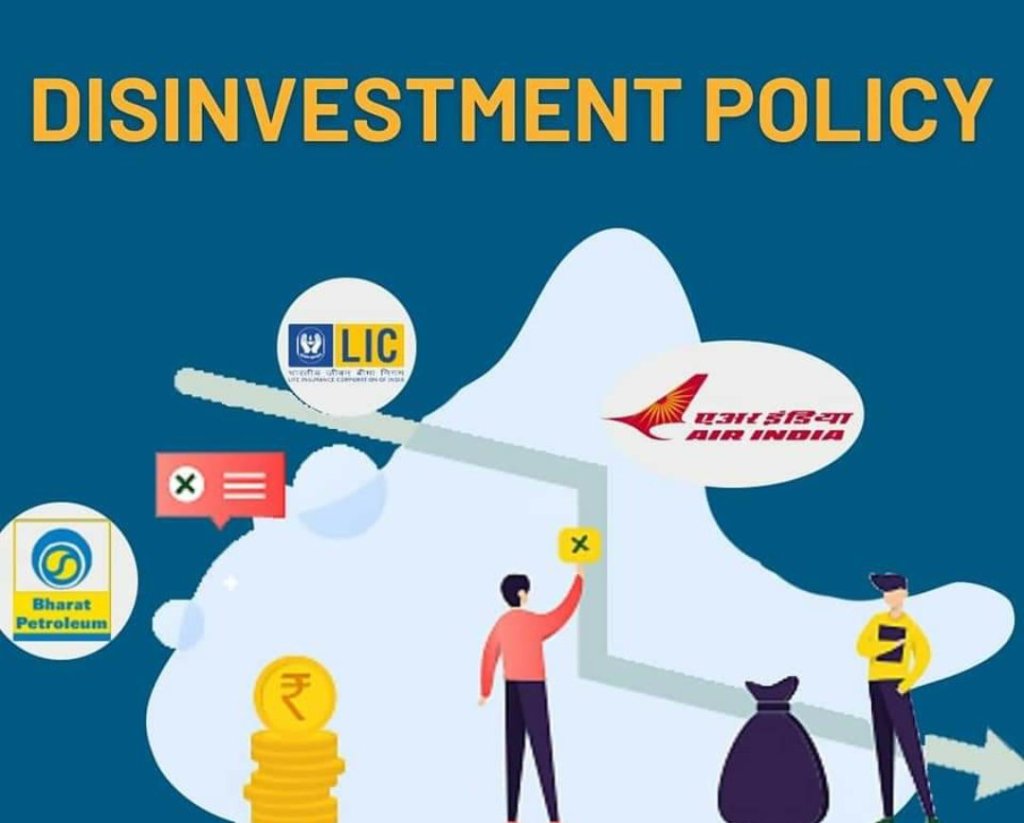
India’s Disinvestment Policy a New Economic Policy

Source: jagranjosh

Disinvestment is a philosophy of new economic policy of India. It is complete denationalization of assets. India adopted Disinvestment of government’s equity in PSUs and the opening up of closed areas to private participation. In recent years, the issue of privatization have been brought to the forefront due to the large scale fiscal deficits that the government has been facing.

The New Industrial Policy announced on 24th July, 1991, was an attempt to meet conditionalities imposed by IMF  and World Bank in exchange of loan. The new economic policy was increasing the role and importance of the private sector in Industrial economy of the country and various measures were announced to achieve this purpose.

In August 1996, a five member Disinvestment was set up under the chairmanship of G V Ramakrishna former planning commission member and former chairman of SEBI with an aim to introduce mass ownership and promoting worker’s shareholding. The process was expected to eventually transform the existing state owned enterprises into public owned companies. Before measure the full fledged Disinvestment strategy; there are few terms of reference for the commission as to draw long term investment programme within 5 to 10 years for PSU referred it. To determine the extent Disinvestment in each PSU;prioritize PSUs referred to it by the core group terms if the overall disinvestment programme.

Source: Business Standard

To supervise the overall sale process and take decisions on the instrument as well as pricing. To select the financial advisors for the specified PSU to facilitate the investment process. Ensure the appropriate measures are taken during the investment process to Protect the interest of the affected employees.

Objectives of Disinvestment

The following objectives were stated in July 1991 are :-

• To improve overall economic efficiency

• To reduce fiscal deficit

• To diversify the ownership of PSU for enhancing efficiency of individual enterprises.

• To reduce the financial burden on the government.

• To improve public finance.

• To encourage wider share of ownership.

• To introduce, completion and market discipline.

• To raise funds for technological upgradation modernization and expansion of public sector enterprises

Rangarajan Committee on PSU Disinvestment, Krishnamurthy reconstituted in November 1992 with C Rangarajan as its chairman. To devise criteria for selection of public sector units for disinvestment during1992 – 1993. Advise on limits on the percentage of equity to be sold respect of each unit. To indicate the modus operandi of investment. Lay down criteria for valuation of equity shares of PSUs and make other recommendations related to disinvestment.

Methods of Disinvestment

The policy on Disinvestment has evolved considerably from the time of industrial policy of 24th July, 1991 stated that in order to raise resources and encourage wider public participation, a part of the government’s shareholding in the public sector would be offered to mutual fund, financial institutions, general public and workers.

When minority shareholding of the central government in 30 individual CPSEs was sold to select financial institutions. On recommendation of Rangarajan Committee in 1993 scope for investment continue to increase and evolve over the time To meet the targets traditional modes like IPO (Initial Public Offer) and FPO (Follow on Public Offer).

The government revived schemes like strategic sakes, made significant. Refinements in order to maintain sale through auction methods and over the time introduced new ideas like ETF for CPSEs to broader base choice alternatives available for Disinvestment.

Methods that adopted in 2017 – 2018 for investment

• Offer for Sale (OFS) the kind of sales shares by promoters through stock exchange mechanism adopting auction routes.

• Initial Public Offering are listed in CPSE or sales by government out of shareholding.

• Strategic Sale are substantial portion of the Government shareholding of a Central Public Sector Enterprise (CPSE) along with transfer of management control. Buy their own share by cash rich PSUs. Institutional Placement Program (IPP) only Institutions can participate.

• CPSE Exchange Traded Fund Disinvestment through ETF routes allows sale of government of India stake in various CPSEs across diverse sectors through a single product offering.


Indian Economy after independence

Source: jagranjosh

Indian economy at the time of Independence was in crucial state. This situation occurred due to the British Colonialism. After independence the Government changed plan for economic growth. The area of attention was shifted from agriculture to industry.

The growth of public enterprise generate employment and reduce poverty. In 1991, a revolution came into place in terms of liberalization, privatization and globalization that shaped the face of Indian economy. The Indian have the lowest per capital income and also the lowest consumption in the world.

The low income level consequent into low saving and thus small or no investment which end with low capital formation. Therefore, the dangerous cycle of poverty running in the country. The First Five Year Plan stated that the Indian economy remained more or less stagnant during colonial regime, because the basic conditions of economy was continuously remain the same.

The impact of modern industrialism in the later half of the 19th century was emerged through import of machine made goods from abroad that impact adversely on the traditional pattern of economic life, however unable to create the spark for Development. The conditioning of state led to decline of productivity especially those engaged in agriculture, the adverse effects. The consequence was a continuously increasing of employment. Hence, there could be no economic progress.

At the time of Independence 80% of population living in rural areas were engaged in agriculture for subsistence purposes; using traditional low productive technique for agriculture. The underdevelopment of Indian economy is reflected in it’s unbalanced occupational structure. Illiteracy was 84% , Communicable disease were widespread due to the absence of a good public health services, mortality rate was very high.

Agricultural activity contributed nearly 50% to Indian’s National Income. Mines, factories and small craftsmen work contributed only one – sixth, even lower than the numbers for trade, transport and communication. After independence, the government concern in the sphere of economic policy was to control persistent and severe inflationary pressure and to alleviate shortage of essential food items, which was increased by the partition of the country.

The industrial Policy Resolution of 1948 stamped as fundamental departure from earlier policy of laissez faire. Finally, the concept of planning Development programme under the auspices of the central government, was accepted and the planning commission was set up in March 1950 to make an assessment of the material capital and human resources of the country and to formulate a plan for the most effective and balanced utilisation of the countries resources.

India embarked upon the programme of planned economic development of the country with the formulation of first year plan that covered the period of 1951 – 1956. The second plan that followed was form 1956 – 1961 and third plan from 1961 to 1966. The other plans followed there after. The Eleventh Five Year Plan has been launched from 2007 – 2012; Twelfth Five year Plan was started from 2013 – 2014.


Source: Deccanherald

The first five year plan provided an inclusive general analysis the nature of the country’s Developmental problem and various options for mobilising resources and achieving Development with more equal distribution. There was special emphasis on the role of mass mobilization of idle rural labour and land reform. The plan optimistically project that saving and investment as a proportion of National Income would rise from an estimated 5 – 6% in the early 1950 to 20% by 1968 – 69.

S Chakravarti  had mentioned some shortcomings of Indian economy. Such as

• The basis cause of development was seen as being an acute deficiency of material capital, which prevented the introduction of more productive technologies.

• The limitation on the speed of capital accumulation was seen to lie in the low capacity to save.

• It was assumed that domestic capacity to save and raised by means of suitable fiscal and monetary policies. There were structural limitations preventing conversion of saving into productive investment.

• The inequality in income distribution was considered to a bad thing, a precipitate transformation of the ownership of productive assets was held to be detrimental to the maximization of production and savings.

• Agriculture was subject to secular diminishing returns, industrialization would allow surplus labour currently under employed in agriculture to be more productively employed in industry.


Indian Fiscal System

It refers to the management of revenue and capital expenditure finances of the state.

  1. Fiscal system of a country refers to the revenue and capital resources that can be raised by government, the procedure to be observed in raising and spending funds and in case of a federation such as ours the provision that governs the relationship of the constituent unit of federation. It includes with in its purview taxation, expenditure, debt management and inter- governmental fiscal relation.
  2. Indian fiscal system is based on the constitution of India which is federal in character. The constitution envisages two layers of government: the Union of central government and the state government. Local bodies do not find a place in the constitution and the function and resources allotted to them are delegated by the state government.

Fiscal Policy:- It is how a government rectifies its spending levels and tax ratios to monitor and influence a nation’s economy. It is the sister strategy to Monetary Policy through which a Union Bank influences a nation’s money reserve. These uses can affect the following macroeconomic variable in the economy:

• Aggregate demand and the level of economic activity;

• The distribution of income;

• The pattern of resource allocation within the government sector and relative to the private sector.

Sources of Revenue:- The main sources of revenue are custom duties, excise duties, service tax, taxes on property, corporate taxes, and income taxes.

Sources of Expenditure:-

Plan Expenditure includes agriculture, rural development, irrigation, and flood conrol, energy, industry, minerals, transport, and communications, etc.

Non-Plan Expenditure:- It consists of interest payment, defence, subsidies, and general services.

Public Dept:-

Internal Debt comprises loans raised from the open market treasury bills issued to the RBI, Commercial Banks, etc.

External Debt consists of loans taken from World Bank, IMF, ADB, and individual countries.

Deficits:- In a budget statement, four types of deficits are mentioned:

• Revenue Deficit

• Fiscal Deficit

• Capital Deficit

• Primary Deficit

(1) Revenue Deficit: There are various ways to represent and interpret a government’s deficit. The simplest is the revenue deficit which is just the difference between revenue receipts and revenue expenditures.

Revenue deficit = Revenue expenditure – Revenue receipts

(2) Capital Deficit: An imbalance in a nation’s balance of payments capital account in which payments made by the country for purchasing foreign assets exceed payments received by the country for selling domestic assets.

In other words, investment by the domestic economy in foreign assets is less than foreign investment in domestic assets. This is generally not a desirable situation for a domestic economy.

Capital deficit = Capital receipts – Disbursement on Capital acoount

Fiscal Deficit: This is the sum of. revenue and capital expenditure less all revenue and capital receipts other than loans taken. This gives a more holistic view of the government’s funding situations since it gives the difference between all receipts and expenditures other than loans taken to meet such expenditures.

Fiscal Deficit = Difference between country’s expenses and earnings

Fiscal deficit = Revenue receipts (net tax revenue+non tax revenue) + Capital receipts (only recoveries of loans and other receipts) – Total expenditure ( Plan and non- plan) .

Primary Deficit: Amount by which a government’s total expenditure exceeds its total revenue, excluding interest payments on its debt.

Primary deficit = Fiscal deficit – Interest payments.