

“As we aim to become a developed nation in our Amrit Kaal, it is essential that our citizens are healthy. Swasth Nagrik creates a Swastha Rashtra, which leads to a Samruddha Rashtra.” This was stated by Union Minister for Health and Family Welfare, Dr Mansukh Mandaviya at the inauguration of the state-of-the-art National Training Centre for Food Safety and Standards Authority of India (FSSAI) at Ghaziabad, Uttar Pradesh yesterday. Prof. S.P. Singh Baghel, Minister of State (HFW) and General (Dr.) V.K. Singh, Minister of State (Civil Aviation, MoRTH) were also present at the event.
Reiterating Prime Minister Shri Narendra Modi’s focus on wellness and preventive healthcare, the Union Minister said that India’s traditional food habits and way of life should be adopted as ‘our kitchen is our hospital’. “Good quality nutritious food can go a long way in keeping diseases at bay”, he emphasized. Dr Mandaviya spoke of India’s rich heritage of health and wellness whether it was in preventive healthcare, consumption of millets, or in practicing Yoga. Highlighting the value of wellness and lifestyle as important components in health, he said, “The people who will train at the National Training Centre of FSSAI will play a significant role in creating healthy citizens in the country, as they will ensure quality standards for food are followed in the country.”
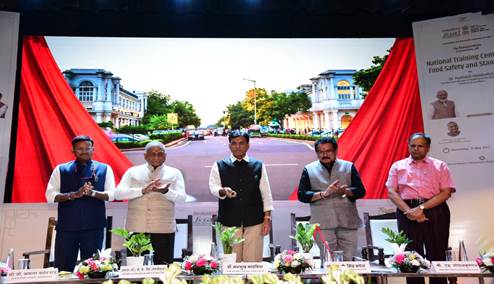
Talking about the challenge posed by food adulteration in the country, Dr Mandaviya said that FSSAI has formed a team along with State Authorities to crackdown on those who indulge in such malpractices. “There will be no tolerance to food adulteration in the country”, he stressed. He stated that large scale testing would be carried out across the country and action would be taken as per Food Safety and Standards (Act 2006) against those found guilty.
Terming the training centre as “Lok Swasth Arpan Bhawan”, Prof. S. P. Singh Baghel said that FSSAI has got a great responsibility of setting food standards in the country which touches everyone’s life. He added that it is also our responsibility to ensure that the food we eat follows these standards.
The National Training Centre of the Food Safety and Standards Authority of India (FSSAI) at Ghaziabad, Uttar Pradesh is an essential initiative aimed at providing structured instruction, practice, and learning experiences to bridge the gap between existing knowledge or skills and desired knowledge or skills in the field of food safety and standards. As mandated by the FSS Act 2006 and the Food Safety and Standards Rules, 2011, FSSAI is responsible for providing training to individuals involved in food businesses, including food business operators, employees, Food Safety Officers, and designated officers. Recognizing the importance of continuous skill upgrading for officials, food business operators, and other stakeholders, FSSAI has established the National Training Centre to offer various training programs. This dedicated center fills the void that previously existed, ensuring the development of a future-ready workforce committed to ensuring safe and wholesome food for the citizens of India.
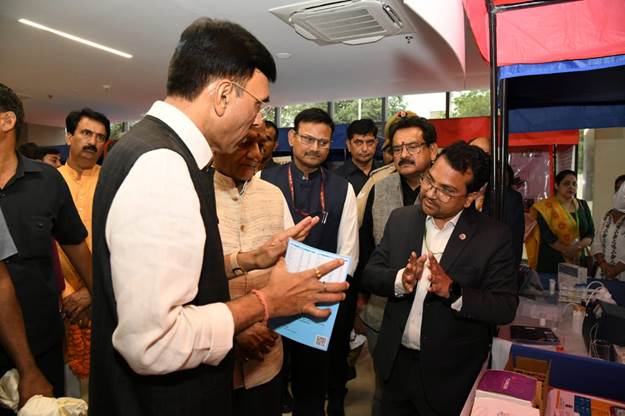
On this occasion, an e- learning app- Food Safety and Certification (FoSTaC) developed by FSSAI that contains learning and training modules about food safety guidelines, such as proper food handling, storage, and hygiene practices etc., for street vendors was also launched.
Dr. Mandaviya also released two books developed by FSSAI – Millets (Shree Anna) Recipes- A Healthy Menu for Mess/Canteens and Healthy Gut, Healthy You – Traditional recipes with potential probiotic benefits.
The event was also attended by Shri S Gopalakrishnan, Special Secretary, Ministry of Health and Family Welfare, Shri G. Kamala Vardhana Rao, CEO FSSAI and other senior officials of the Food Safety and Standards Authority of India.
******
 Eduindex