

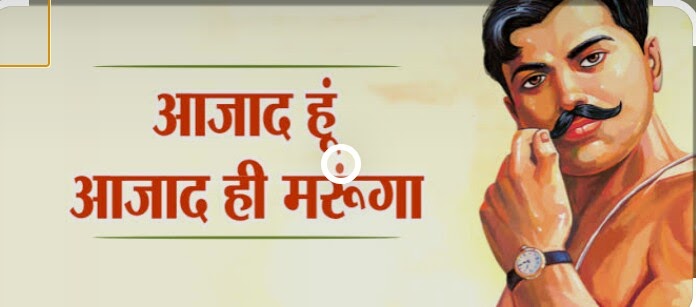
Every one calls him Chandra Shekhar Azad , but his original name was Chandra Shekhar Tiwari.
Azad was born as on 23 July 1906 in Bhabhra village , in the princely-state of Alirajpur. His forefathers were from Badarka village of Unnao District. His mother, Jagrani Devi, was the third wife of Sitaram Tiwari, whose previous wives had died young. After the birth of their first son, Sukhdev, in Badarka, the family moved to Alirajpur State.
His mother wanted her son to be a great Sanskrit scholar and persuaded his father to send him to Kashi Vidyapeeth, Banaras, to study. In 1921, when the Non-Cooperation Movement was at its height, Chandra Shekhar, then at a tender age of 15 , joined that movement . As a result, he was arrested on 20 December. On being presented before the district magistrate Justice Reverend Tomson Kregat a week later, he introduced himself as “Azad” (The Free), his father’s name as “Swatantrata” (Independence) and his residence as “Jail”. The angry magistrate ordered him to detained to jail for 23 weeks and ordered be punished with 15 lashes a day . his level of devotion towards the country can be measured by his actions , when he was getting lashes , with each lash he said “VANDE MATARAM” & “GANDHI JI KI JAI HO ” . After watching a boy of just 15 , getting lashes as punishment but still shouting VANDE MATARAM , people started recognizing him as “AZAD”
He learnt shooting at a very tender age , he was known for his shooting skills . After the suspension of the non-cooperation movement in 1922 by Gandhi, Azad was disappointed. He met a young revolutionary, Manmath Nath Gupta, who introduced him to Ram Prasad Bismil who had formed the Hindustan Republican Association (HRA), a revolutionary organization. He then became an active member of the HRA and started to collect funds for HRA. Most of the fund collection was through robberies of government property , they property which British govt snatched from Indians. British government was stunned by this behavior of Azad . He didn’t stop here , he was involved in shooting J.P Saunders , who was involved in killing Lala Lajpat Rai , Azad didn’t stop here , he pasted pamphlets on the walls of Lahore’s streets , that revenge of Lala Lajpat rai is taken.
On 27 February 1931, the CID head of the police at Allahabad, Sir J. R. H. Nott-Bower was tipped off by someone that Azad was at Alfred Park and was having a talk with his companion Sukhdev Raj. On receiving it, Bower called on the Allahabad police to accompany him to the park to arrest him. Azad’s old comrades Veer Bhadra Tiwari and Yashpal were also held responsible for tipping off two of the police constables. The police arrived at the park and surrounded it from all four sides. Some constables along with DSP Thakur Vishweshwar Singh entered the park armed with rifles and the shootout began. Sukhdev Raj escaped uninjured. Azad hid behind a tree to save himself and began to fire from behind it. The police fired back. After a long shootout, holding true to his pledge to always remain Azad (Free) and never be captured alive, he shot himself with his last bullet. In the shootout, Bower and DSP Singh were injured in the right palm and jaws respectively. The police recovered Azad’s body after the other officers arrived at the site.
The body was sent to Rasulabad Ghat for cremation without informing the general public. As it came to light, people surrounded the park where the incident had taken place. They chanted slogans against British rule and praised Azad. The park was later on named as Chandra Shekhar Azad park .
This level of love towards the country is hard to find in this era , & on the occasion of Chandra Shekhar Azad ‘s Jayanti we all should remember this great freedom fighter & should take pledge that we will also stand on our country’s side in every situation like Azad .
 Eduindex
You must be logged in to post a comment.