
2nd World Local Production Forum in Netherlands

 The Indian delegation led by Shri Bhagwant Khuba, Union Minister of State for Chemicals and Fertilizers participated in the Second World Local Production Forum (WLPF) held in Hague, Netherlands today. This meeting is being organized from 6 to 8 November 2023. The World Local Production Platform is a platform created at the initiative of WHO with the aim of increasing access to medicines and other health technologies.


Shri Khuba said in his address that this meeting provides a crucial opportunity to share experiences, challenges and successes in the development and manufacturing of diagnostic countermeasures. He said that we must collaborate further to identify innovative approaches that will enable sustainable and equitable access to these critical tools.

The Minister further said that 21st century has seen frequent epidemics and pandemics like COVID-19, revealing vulnerabilities in global supply chain and inequities in accessing quality medical countermeasures. Inadequate diagnostic tools worsened outbreaks, emphasizing the necessity of enhancing cooperation for sustainable, affordable diagnostic countermeasures to improve global access to them. Countries worldwide have realized the importance of collaboration between multiple sectors for achieving equity in providing novel solutions.

Shri Khuba informed that the pharmaceutical industry in India is one of the largest globally, earning India the title of the ‘Pharmacy of the World.’ Indian pharmaceutical companies have become reliable and affordable suppliers of high-quality drugs, significantly improving healthcare access worldwide. He said that India provides approximately 60% of the global vaccine supply, accounts for 20-22% of generic exports and serves over 200 countries through its pharmaceutical exports. Numerous Indian organizations have played a pivotal role in promoting innovation and entrepreneurship that act as a landscape for innovative mind and ultimately boosts health sector.

The minister said that the government is providing funding, mentoring, incubation space etc, and acts as a bridge between academia and industry, to ensure timely translation of innovations into commercial ventures”.

The Minister also said, “currently, local production faces significant challenges as it seeks to address the critical issue of translating research into product development. Lack of technology transfer stands out as a formidable barrier. Validation, production, and distribution are daunting hurdles, requiring efficient coordination to bring innovative healthcare technologies to market. Capacity building in regulatory systems and skilled technical manpower are necessary ingredients. The Forum must focus on marketing, upscaling regional manufacturing, efficient procurement and delivery systems, and repurposing existing infrastructure for efficient coordination during health emergencies. Last-mile delivery to ensure that the benefits of innovations reach those who need them most and guarantee equitable access to essential healthcare products”.

During his visit, Mr. Khuba also met the Minister of Public Health of Surinam Dr. Amar N. Ramadhin and discussed about quality health care. He also visited Eindhoven to take part in Kannada Rajyotsava 2023 Celebrations of Shrigandha Holland Kannada Balaga.

***
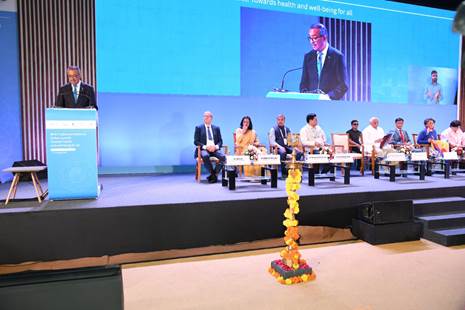
WHO Traditional Medicine Global Summit 2023

 World Health Organization (WHO) has released the outcome document of first WHO Traditional Medicine Global Summit 2023 in form of “Gujarat Declaration”. The declaration reaffirmed global commitments towards indigenous knowledges, biodiversity and traditional, complementary and integrative medicine. WHO underlined that the application of rigorous scientific methods is needed to better understand, assess and, where appropriate, apply more holistic, context-specific, complex and personalized approaches for health and well-being for all.

It reiterates that India as host of the WHO Global Traditional Medicine Centre at Jamnagar, Gujarat has an important role in scaling up WHO’s capacities to support member states and stakeholders in taking forward the summit action agenda and other relevant priorities.

The action points of two day WHO Traditional Medicine Global Summit 2023 held at Gandhinagar, Gujarat are based on the evidence, discussions and outcomes presented at the Summit. Deliberation were done on varied topics like Health and well-being of people and the planet, research and evidence, universal health coverage, primary health care and health systems, Data & routine information systems, digital health frontiers, biodiversity and sustainability, human rights, equity and ethics.

Union minister of Ayush Shri Sarbananda Sonowal had said, “Gujarat declaration is testimony of our  prime minister Shri Narendra Modi’s commitment to promote our ancient knowledge of Traditional Medicine system. Through collaborative efforts and sustainable practices, we can ensure a healthier future for generations to come.”

During the WHO traditional Medicine global Summit, Director General of the World Health Organization Dr Tedros Adhanom Ghebreyesus, had said that “Gujarat Declaration” will serve as a catalyst to harness the potential of traditional medicine through the lens of science and will focus on the integration of traditional medicines in national health systems and help unlock the power of traditional medicine.

Gujarat declaration talks about scaling up efforts to further implement evidence-based TCIM (Traditional complimentary integrative medicine) interventions and approaches in support of the goal of universal health coverage (UHC) and all health-related Sustainable Development Goals (SDGs). It states the role of multi-regional, multi-disciplinary and multi-stakeholder collaborations demonstrated at the Global Summit through the WHO GCTM that is aligned with and complementary to the work of WHO major offices, to maximize evidence based benefits of TCIM in global health.

Support the evidence-based integration in national health policies and systems based on the highest quality research. Accelerate the production, regulation, and formal utilization of scientifically proven TCIM products and practices. Advance policies that promote standardized TCIM documentation, including through expanded and accelerated use of the WHO International Classification of Diseases (ICD-11) to enable integration of evidence and data collection on TCIM in a standardized way within routine health information systems. Establish a global network of TCIM reference clinical centres that can routinely undertake standardized data collection and monitoring based on WHO ICD-11 coding of the implementation.

The highlight of summit was how to enable the appropriate development and application of digital health technologies, and artificial intelligence (AI) in particular, to advance digital health resources on TCIM for people’s health and well-being.

It mentions that actions should be promoted and taken at all levels to safeguard, restore and sustainably manage biodiversity, and to ensure the fair and equitable sharing of the benefits arising from the use of biodiversity resources, related genetic material and Indigenous knowledges. Fully recognize, respect and protect the rights of Indigenous Peoples, as provided in the UN Declaration on the Rights of Indigenous Peoples. Incorporate ethical methods and processes in TCIM research and practice.

The First global summit on Traditional Medicine was organised by the World Health Organization (WHO) and co-hosted by the Ministry of Ayush, from August 17-18, 2023, at Gandhinagar, Gujarat.