Analyzing Mid-day Meal: India’s School Lunch System

Official Logo of Mid-day Meal Scheme

Introduction

Food is a basic need of life.  And Education is important to make the life affluent. A hungry stomach cannot grasp the teachings of Education at school, there to provide better Education, schools all around the world, offer lunch to the students. In India, the system of school lunch is referred to as Mid-day Meal. In today’s editorial, we’re going to share insights about the system of Mid-day Meal in India.
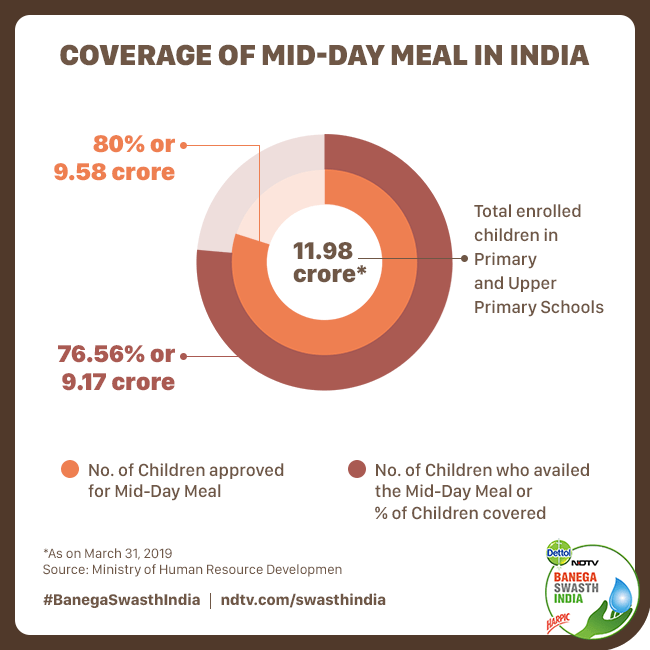
Coverage of Mid-day Meal Scheme in India

Brief Idea of What Mid-day Meal Is

The Midday Meal Scheme, launched in 1995  by former Prime Minister of India, P.V. Narsimha Rao, under the Ministry of Education, is a school meal programme in India designed to better the nutritional  standing of school-age children nationwide. The programme supplies free lunches on working days for children in primary and upper primary classes in government, government aided, local body, Education Guarantee Scheme, and alternate innovative education centres, Madarsa  and Maqtabs  supported under Sarva Shiksha Abhiyan , and National Child Labour Project schools run by the Ministry of Labour. Serving 120 million children in over 1.27 million schools and Education Guarantee Scheme centres, the Midday Meal Scheme is the largest of its kind in the world.
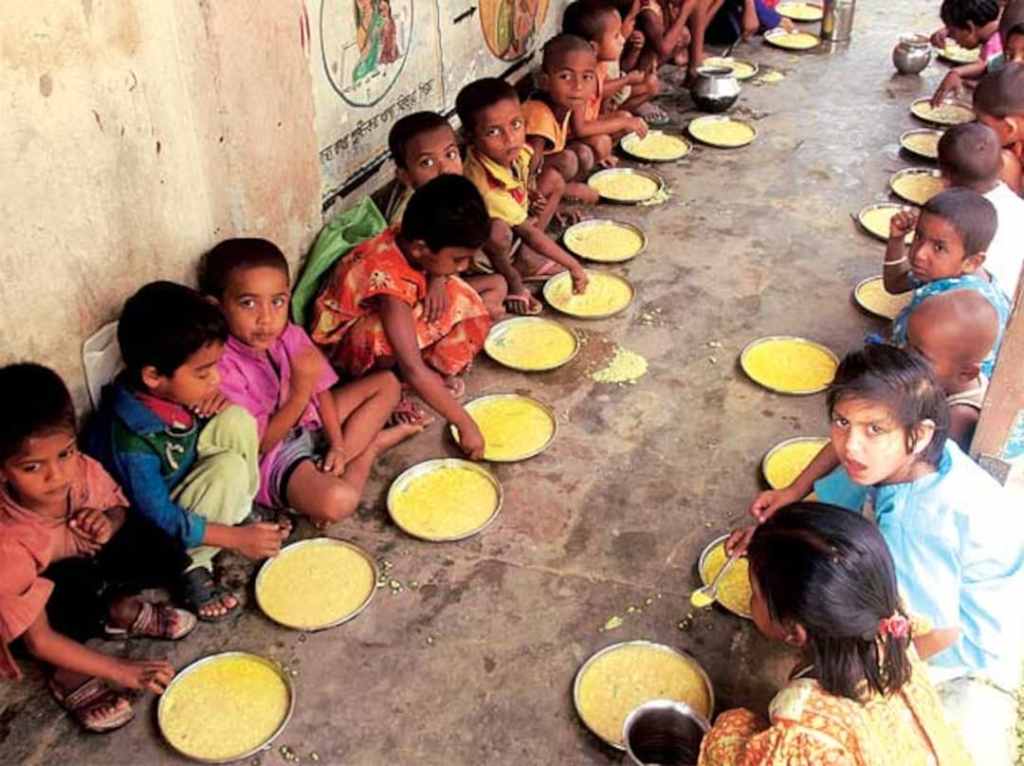
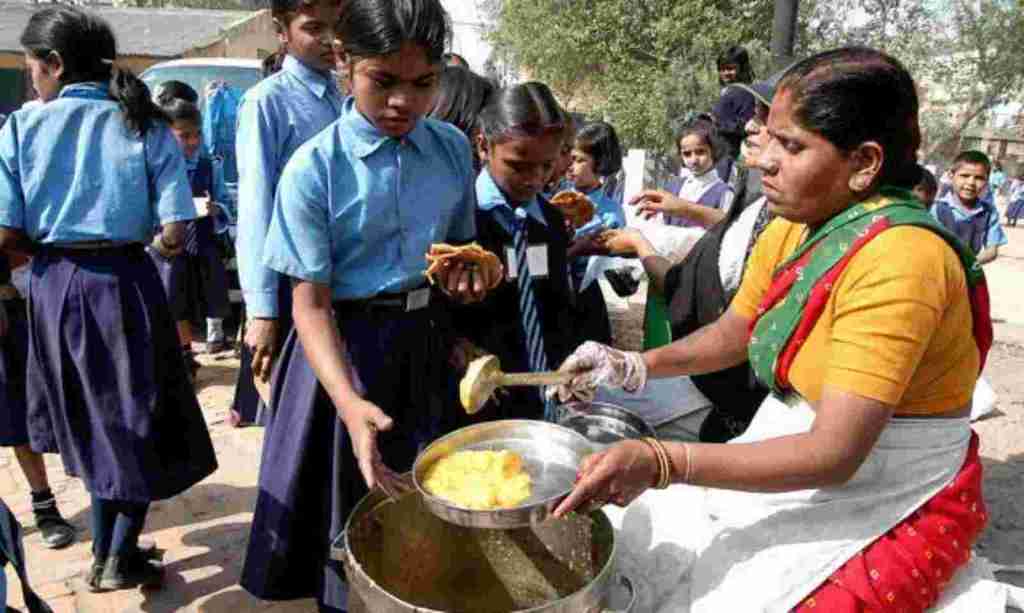
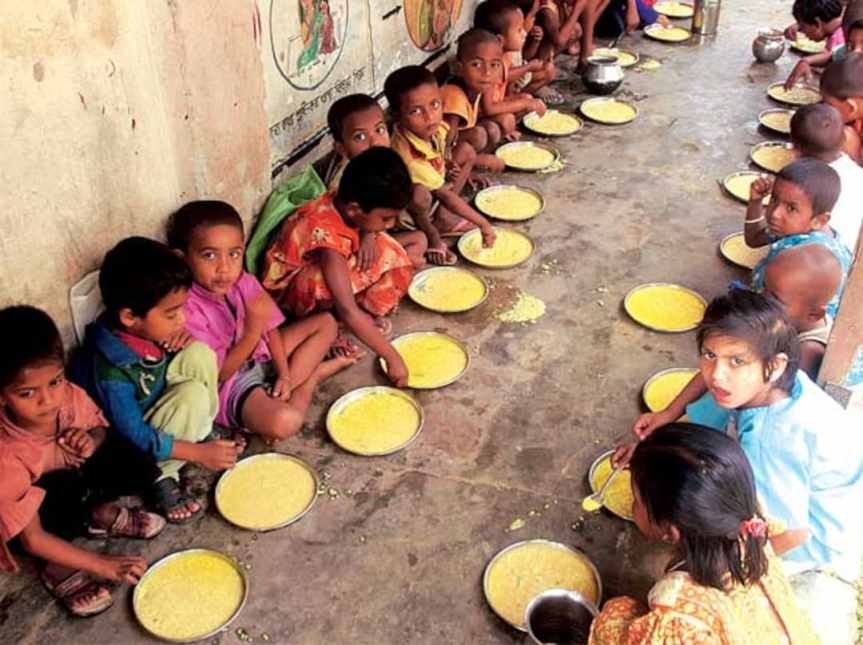
Students having Mid-day Meal at a School in India

Objectives of Mid-day Meal Scheme

  • To increase the enrolment in the schools of children who belong to disadvantaged sections of the society .
  • To increase attendance of students in Government and Government aided schools.
  • To retain the children studying in class I to VIII.
  • To give nutritional support to the children studying in the elementary level, specially in drought-prone areas.
  • To address hunger and malnutrition and increase socialization among the castes.
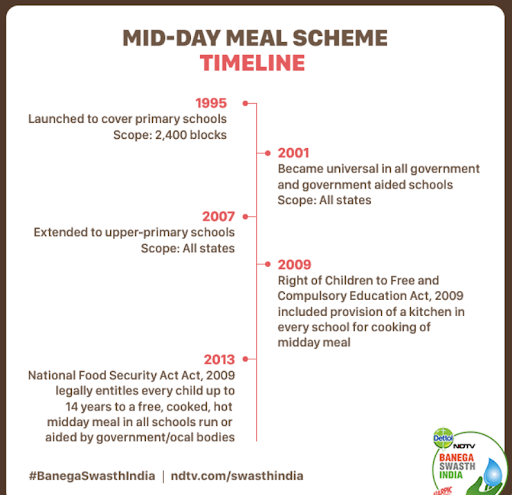
Mid-day Meal Scheme Timeline in India

Features of Mid-day Meal Scheme

  • It is one of the world’s largest school meal programs intended to achieve the goal of universalization of primary education.
  • For the implementation of the scheme, the Ministry of Human Resources and Development is the authorized body to implement the scheme.
  • It is a centre-sponsored scheme, so, the cost is shared between the states and the centre. Where the share of the centre is 60 percent.
  • The first state to implement the midday meal scheme was Kerala in 1984.
  • Till 2002, the scheme is designed especially for the government, government-aided and local body schools. But later on, the benefit of the mid-day meal scheme is extended to those children who were studying in educational guaranteed scheme centres or Alternative & Educational Centres.
  • In 2004, the scheme is again revised, and central assistance is offered for the cooking cost.  Apart from that, the transport subsidy included for all states, maximum of Rs 100 per quintal is provided to the special category states and Rs 75 per quintal for other states.
  • The provision of serving mid-day meals during summer vacation to the children in drought-affected areas was also added.
  • In 2006, the cooking cost was enhanced to Rs 1.80 per child/ school day for states in North Eastern Region and Rs 1.50 per child/ school day for other states and UTs.
  • In 2007, the scheme benefit is also extended to the children studying in the educationally Backwards Blocks.
  • Apart from the calories and food intake, for micronutrients (tablets and deworming medicines), each child is entitled to receive the amount provided for in the school health program of the National Rural Health Mission.
  • Meals provided under the Mid-day Meal Scheme
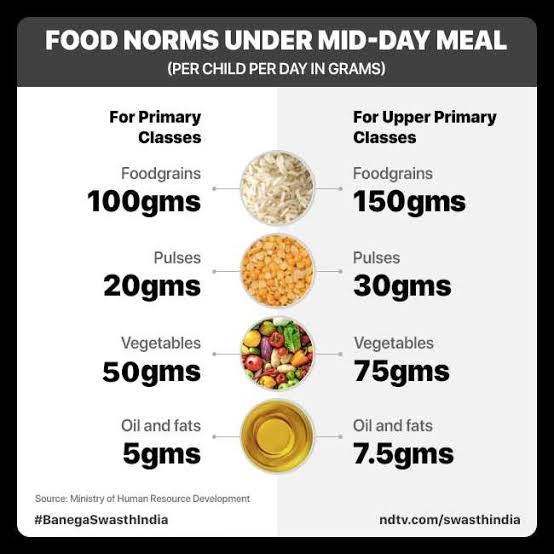
Food Norms under Mid-day Meal Scheme
  • The quantity of food items provided under this scheme per child per school day is as follows:
Food itemsPrimary level (Class I-V)Upper level (Class VI-VIII)
Food Grains100 gms150 gms
Pulses20 gms30 gms
Vegetables (leafy also)50 gms75 gms
Oil & fat5 gms7.5 gms
Salt & condimentsAs per needAs per need
Calories IntakePrimaryUpper Primary
Energy450 calories700 calories
Protein12 grams20 grams
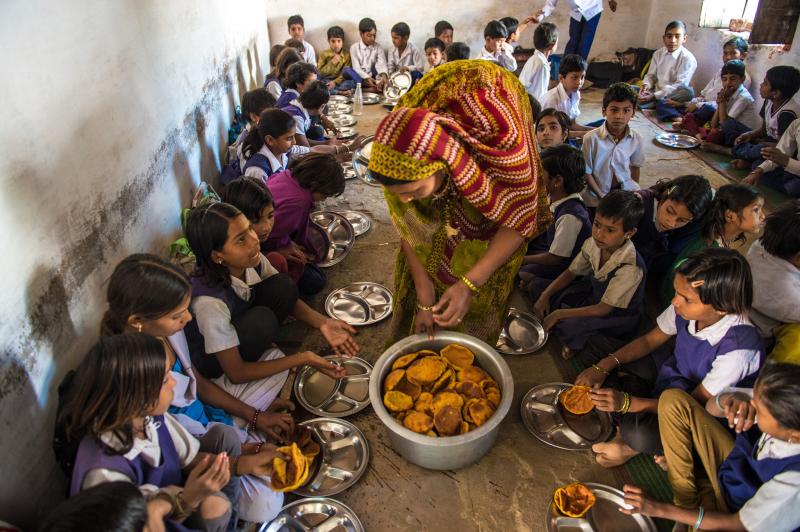
Serving of Mid-day Meal

Advantages of Mid-day Meal

  • It satisfies the hunger of many children.
  • Supplying nutrition to children of the poor section helps them in concentrating on their studies better.
  • Students come to government schools daily and won’t be asked to do labour work.
  • Addresses the issue of malnutrition.
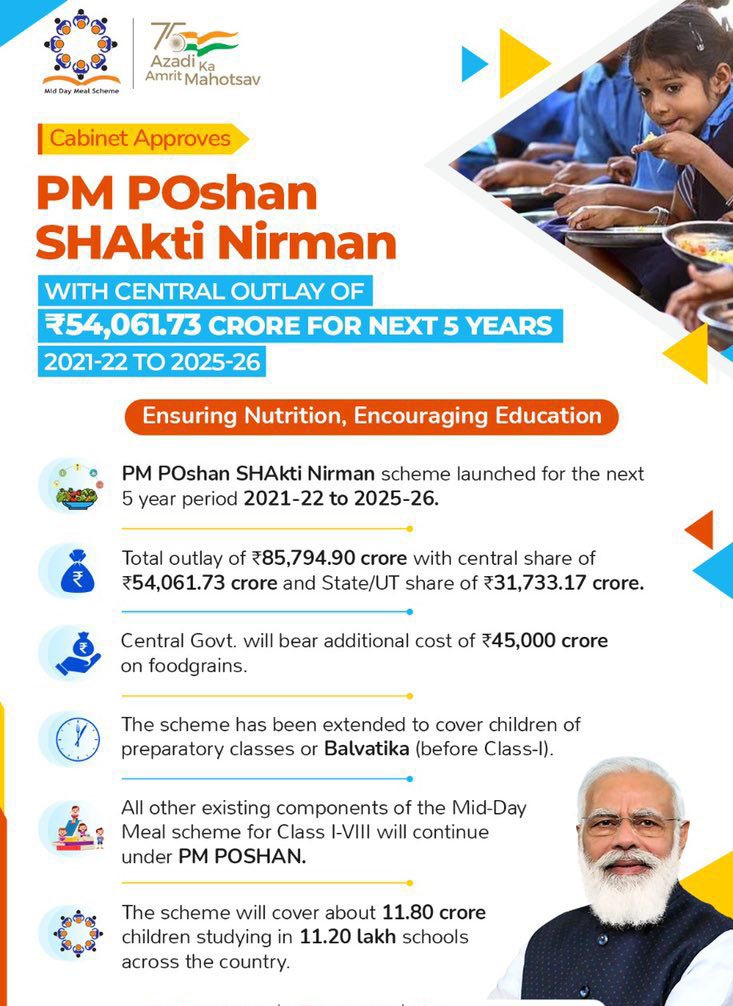
PM POSHAN SHAKTI NIRMAN

Recent Improvisation of Mid-day Meal Scheme

During the celebration of India’s 75th Independence Day as Azadi Ka Amrit Mahotsav, the Cabinet approved for the implementation of PM POSHAN SHAKTI NIRMAN for next 5 years i.e. 2021-22 to 2025-26.

Conclusion

There is no doubt that school is the only place that contributes to the socio-economic development of society. Here children from various backgrounds come together for promoting the culture of unity and brotherhood. The education they receive at school prepares them to achieve their goals and lead a successful life. When we talk about government schools, here children mostly come from economically challenged backgrounds. So, even though education schemes like Sarva Shiksha Abhiyaan are being implemented, the difficult financial conditions force these children to skip school and go on work. In such kind of circumstances,  the real potential of mid-day meal surfaces. Mid-day meal acts as an attractive incentive for parents to send their children to school with the sole hope that the young ones will receive at least one plate full of the meal for the day. 

One Nation One Ration Card

The pandemic has hit hard on the economy and disrupted the lives of many around the world. For some it is the question of health, for some it is the question of lives vs livelihood. One of the worst hit section of the society are the migrant workers for whom food, shelter and income has become the main concern.

In order to tackle the issue of food security, the Government of India introduced the One Nation One Ration Card scheme (ONORC). ONORC allows a beneficiary to access his food entitlements from anywhere in India irrespective of the place where the ration card is registered.

Presently, thirty-two States and Union territories have already completed the formalities of the scheme, which include linking beneficiaries’ ration cards with their Aadhaar numbers and installing e-Point of Sale (e-POS) machines in each FPS.

The full mobility of food subsidy under the National Food Security Act (NFSA), 2013 relies on digitisation of the public distribution system (PDS), a network of over 5,00,000 fair-price shops (FPS). This would be ensured on the basis of Aadhaar authentication and validated data.

The Integrated Management of Public Distribution System (IMPDS) portal records all purchases made under ONORC.

What are the benefits of this scheme?

  • Ensuring Right To Food: Previously, ration cardholders can avail their entitlement of subsidised food grains under the National Food Security Act, only from the designated Fair price shop (FPS) within the concerned state. However, if a beneficiary were to shift to another state, he/she would need to apply for a new ration card in the second state. Thus, ONORC envisages removing the geographical hindrance to social justice and enabling the right to food.
  • Supporting the migrant Population: Nearly, 37% of the population is that of migrant labourers. The scheme is therefore important for anyone who is going to move from one place to the other.
  • Reducing Leakages: The ONORC can reduce leakages, because the fundamental prerequisite of this scheme is deduplication. This will ensure that the same person does not figure as a beneficiary in two different locations of the country. Further, the scheme is linked with Aadhaar and biometrics, this removes most possibilities of corruption.
  • Reducing Social Discrimination: ONORC will be particularly beneficial for women and other disadvantaged groups, given how social identity (caste, class and gender) and other contextual factors (including power relations) provide a strong backdrop in accessing PDS.

What are the Roadblocks?

  • Exclusion Error: The digitisation of this PDS process, through Aadhaar-linked ration cards and smart cards, has been pushed in an effort to reduce leakages. However, there has been a rise of exclusion errors in post-Aadhaar seeding. There are many sections of society who still don’t have Aadhar Cards, thereby depriving them of food security.
  • Domicile-Based Social Sector Schemes: Not only PDS, most of the anti-poverty, rural employment, welfare and food security schemes were historically based on domicile-based access and restricted people to access government social security, welfare and food entitlements at their place of origin.
  • Disrupting Supplies At FPS: An FPS receives the monthly quota of products strictly in accordance with the number of people assigned to it. The ONORC, when fully operational, would disrupt this practice, as some FPSs may have to cater to more numbers of cards even as others cater to less, owing to migration of people.

Suggestions by some experts

  • Opening up Alternate Delivery Centres: If emergencies continue to hamper uptake at ration shops, alternate delivery channels can be considered for delivering food grains to vulnerable groups.
  • Focusing on Nutritional Security: Food security should be seen from a broader framework of nutritional security. Therefore, ONORC must allow the portability of Integrated Child Development Services, Mid-Day Meals, immunisation, health care and other facilities.
  • Replacing PDS With Food Coupons: In the longer run, the PDS system may be replaced by a fool-proof food coupon system or direct benefit transfer. Wherein, a Below Poverty Line family can buy rice, pulses, sugar and oil from any Kirana store at the market price, by either paying fully through the coupon or by cash.

Conclusion

ONORC is the far-reaching reform of the public distribution ecosystem since the Food Security Act. It will provide food security to jobless migrants and will help achieve the target set under SDG 2: Ending hunger by 2030.

Pradhan Mantri Khanij Kshetra Kalyan Yojana

The Pradhan Mantri Khanij Kshetra Kalyan Yojana was launched on 17th September 2015 for the welfare of the people and areas affected by mining operations. Funds for this scheme are generated by District Mineral Foundations (DMFs). And most of these areas are occupied and inhabited by the scheduled tribes. In all the districts that are affected by the mining, District Mineral Foundations (DMFs) under the Mines and Minerals (Development & Regulation) Amendment Act, 2015, the Central Government has fixed rates payable by miners to the District Mineral Foundations. An amount of 30% of royalty has to be paid by the miner if the lease executed dates before 12th January 2015 and for the mining leases after 12th January 2015, it is 10% of the royalty payable. These Mines and Minerals (Development & Regulation) (MMDR) funds are then used for the implementation of the Pradhan Mantri Khanij Kshetra Kalyan Yojana. The directly and indirectly affected people (as specified by the government) by such mining or excavation activities should be covered under this scheme. The list of such directly and indirectly affected people and local communities should be maintained and updated by the District Mineral Foundations (DMFs). People having legal or traditional rights over the land on which mining, excavation, or any such activity is performed come under the list of affected people or traditional communities. The families which get displaced because of these mining activities need to be rehabilitated by the authorities. At least 60% of MMDR funds are required to be utilized in the following ‘High Priority Areas’:

• Health Care – Implementation of Group Insurance Scheme for the mining-affected people should be taken care of. Primary or secondary health facilities should be provided in consideration to the existing available health facilities of the central government, state, or any local bodies to the people of the mining-affected areas. While preparing for such infrastructure the knowledge available with the ‘National Institute of Miner’s Health’ should be included for taking care of diseases and illnesses related to mining.
• Drinking Water – Water purification facilities, drinking water facilities, and water connection pipes should be taken care of.
• Education – Construction of school buildings, hostels for students as well as teachers in remote areas, classrooms, labs, toilets, transportation facilities, and such more education-related resources should be considered.
• Sanitation – Proper collection and disposal of mining waste and fecal sludge, cleaning of public places, and construction of toilets.
• Development of Women and Children – Special programs can be carried out for spreading awareness for maternity-related issues, infections, malnutrition, and child health issues.
• Skill Development – Developing skills of the willing and deserving local people by setting up centers, providing training, and to the Self-Help Groups (SHGs) for generation of economic activities among the backward.
• Safeguard of Old and Disabled – Organizing programs for the welfare of the old and people with disabilities.
• Pollution Control and Environment Preservation – Opting for environment-friendly and sustainable mining techniques, prevention of lakes, ponds, groundwater, and other water resources, prevention of air pollution due to mining, and proper drainage system for mining dump.
Utilization of up to 40% MMDR funds in the following ‘Other Priority Areas’:
• Irrigation – Opting for sustainable and advanced irrigation techniques.
• Watershed and Energy – Establishing rainwater harvesting systems and alternative sources of energy.
• Infrastructure – Developing required infrastructure such as – roads, railways, and water projects.
• And more such measures for sustainable resources and improved environmental conditions in mining districts.

The vulnerable and marginalized communities such as the tribal are empowered through this scheme. It is said, annually Rs 6000 crore is utilized for the development of people and areas affected by mining activities. According to the reports of the ministry, till now an amount of Rs 22,999 crore has been approved out of which an amount of Rs 6,944 has been utilized.

SC/ST Hub

About SC/ST Hub

As per the Public Procurement Policy for Micro and Small Enterprises, it is mandatory to procure a minimum of 25% of the total annual value of goods and services from the Micro and Small Enterprises, in which 4% of goods and services should be procured from SC / ST owned Micro and Small Enterprises and 3% of goods and services should be procured from Micro and Small Enterprises owned by women, for the Central Government Ministries, Departments, and Public – Sector Undertakings. Tenders are published by Central Public Service Enterprises (CPSEs), Public Sector Units (PSUs), and Government Organizations. These tenders are then bid upon and after the order is won, a Performance Bank Guarantee (PBG) is mandatorily required to be submitted for the CPSEs or large firm tenders, against the total value of the tender. This PBG agreement acts as a guarantee that the bank would pay the specified amount in case the Micro & Small Enterprises which is the applicant, fails to meet the ‘financial’ and ‘performance’ obligations. The bank charges an annual fee against its guarantee which generally ranges from 0.5 – 3% per annum. This application fee is paid one time, at the time of issue of the PBG. However, this charge varies based on the ‘risk profile’ of the applicant and various other aspects. Although, these charges are of small amount but somehow add a little burden on the part of entrepreneurs. To lower this burden on the Scheduled Cast / Scheduled Tribes Micro & Small Enterprises (SC / ST MSEs) the government has set the National SC-ST Hub (NSSH). This committee is chaired by Shri Milind Kamble the chairman of the Dalit Indian Chamber of Commerce and Industry (DICCI). It provides financial assistance to the SC / T MSEs by reimbursing the bank charges that any SC / ST MSE has paid for issuing PBG for government tenders. For the SC-ST Hub the Ministry of Micro, Small and Medium Enterprises, from 2016 to 2020, made an initial fund allocation of Rs 490 crore.

The objective for providing financial assistance to the ST / ST MSEs under this scheme are as follows:
• For achieving the target of 4% procurement of goods and services under the Public Procurement Policy, by the SC / ST MSEs.
• To provide exposure to the SC / ST MSEs to the global market.
• To provide a competitive platform to the MSEs and help them with their marketing skills.
• To provide exposure to large industries and buyers.
The nodal agency to look after the implementation of this scheme is the National Small Industries Corporation Ltd. (NSIC).
The financial assistance under this scheme is provided from the National SC-ST Hub (NSSH) fund and has a limit of 50% or Rs 1,00,000 whichever among the two is less. This amount is exclusive of GST and other taxes applicable. Although, in a financial year the scheme can be availed multiple times by the SC / ST MSEs the amount remains limited as mentioned above. The reimbursement s done based on valid documents or receipts showing payment details, bank statements showing debit of BG charges, GST invoice generated through the system, and a copy of PBG issued (which should be certified).
For availing the benefit under this scheme, the following criteria need to be fulfilled:
• If a proprietorship firm wants to be recognized as SC / ST MSE the proprietor should belong to SC / ST category.
• If a partnership wants to be recognized as SC / ST MSE then at least 51% of shares should be held by the SC / ST partners.
• If a private limited company wants to be recognized as SC / ST MSE then the company should have at least 51% shares held by SC / ST promoters.
• The SC / ST MSEs must have their Udyog Aadhaar Memorandum (UAM) number, PAN number and must be registered under the Goods and Service Tax (GST) to avail of the scheme benefit.

After the evaluation and approval of the reimbursement by the NSSHO and NSIC, the reimbursement amount is transferred to the bank account of the applicant from where the PBG charges are debited and this is directly transferred through the Public Financial Management System (PFMS). The claims by the applicant are required to be submitted within 45 days from the time PBG is issued.
This scheme can be availed by the PBG issued on or after 14th November 2018 till the NSSH scheme exists or there are any revisions or amendments made to this scheme.

Impact

The SC / ST Hub also provides professional support to the SC / ST MSEs and provides training and skill development programs. In 2016 – 17 it has provided for 3 capacity building training programs (skill entrepreneurship development) to 83 candidates, in 2017 – 18 64 programs with 1,311 candidates, in 2018 – 19 288 programs to 6,514 candidates and for the year 2019 – 20 provided with 513 programs to 13,362 candidates which come to a total of 868 programs to a total of 21,270 candidates. 823 crore procurements have been made from SC / ST owned MSEs by 162 CPEs and a total of 17,537 SC / ST candidates have been assisted as per the reports of the SC-ST Hub under the Ministry of Micro, Small & Medium Enterprises. This scheme is helping nurture the Micro and Small Enterprises through the involvement of the marginalized, that is the Scheduled Tribes and Scheduled Castes, giving them equal opportunities to grow and develop financially as well as socially.

Senior Citizens Welfare Fund

About the Scheme

According to the 2011 population census India has nearly 104 million senior citizens of the total population. And around 71 % of senior citizens live in rural parts and 29 % reside in urban areas of India. These senior citizens are often left out when it comes to basic amenities and requirements and have to depend on others for their living and financial support especially in urban areas, whereas the senior citizens living in rural areas are unable to get aids for their age-related impairments or disabilities due to financial weakness. For overcoming this issue in senior citizens of rural and urban areas and provide the senior citizens with financial and health stability, the government came up with the Senior Citizens Welfare Scheme and Rashtriya Vayoshri Yojana. The Senior Citizens Welfare Fund (SCWF) was included under the Finance Act, 2015 for 3 years that is till 2020. This fund is utilized for the welfare of senior citizens. It is expected that around 5,20,000 senior citizens would benefit from this scheme. The scheme also tries that at least 30 % of beneficiaries in all districts should be women as far as possible. An amount of Rs. 410.23 crore was allocated as of December 2019, as initial funding under the scheme, and is handled by the Ministry of Social Justice and Empowerment. The fund is allocated from the unclaimed money which is lying untouched (after 10 years is transferred) under the Small Savings Schemes, Public Provident Fund, Employees Provident Fund (unclaimed for 7 years), any insurance scheme (be it life or non – life), any such unclaimed policy under the insurance companies, Coal Mines Provident Fund, and Central Government Schemes such as the Savings lying in the Post Office, Post Office Time Deposit Account, Kisan Vikas Patra, Post Office Monthly Income Account, Post Office Recurring Deposit, and Senior Citizens Savings Scheme.

In 2016, the Department of Economic Affairs transferred an amount of Rs 5889.17 crore to the corpus of Senior Citizens Welfare Fund and the interest accrued from this would be utilized for the Welfare Scheme funded from the Senior Citizens Welfare Fund. The Department of Economic Affairs allocated an amount of Rs 16 crore from the Senior Citizens Welfare Fund and provided it to the Department of Social Justice and Empowerment for the implementation of the Rashtriya Vayoshri Yojana. An inter–ministerial committee is set up for the administration of the funds. This ministry comprises – Ministry of Social Justice and Empowerment as the Nodal Ministry, Ministry of Health and Family Welfare, Ministry of Rural Development, Ministry of Labour and Employment, Ministry of Housing and Urban Affairs, and Department of Financial Services.

Rashtriya Vayoshri Yojana is a scheme under the Ministry of Social Justice and Empowerment. This scheme was launched in 2017. The funds for this scheme target at providing assistive living devices and other aids to the Below Poverty Line (BPL) category belonging to senior citizens, who suffer from disabilities due to growing age. Artificial Limbs Manufacturing Corporation of India (ALIMCO) is a public sector undertaking under the Ministry of Social Justice and Empowerment by which the scheme is implemented. This public sector undertaking manufactures assistive living devices. Depending upon the disability of impairment the following assistive devices are provided to the eligible senior citizens under the scheme:

• Spectacles

• Artificial Dentures

• Hearing Aids

• Walking Sticks

• Wheelchair

• Crutches / Walkers

• Elbow Crutches

• Tripods / Quadpods

To avail of benefits under this scheme, the senior citizen must belong to Below Poverty Line (BPL) category. He/she must be suffering from age-related disabilities and those disabilities can be – Loss of teeth, hearing impairment, locomotor disability, or low vision. The assistive devices provided for these impairments try to provide near normalcy bodily functioning.

Impact  

A total of 325 districts were selected for the implementation of this scheme. 135 districts completed their assessment camps for identification of the beneficiaries as of 25/01/2019. As per the Ministry of Social Justice and Empowerment 70939 senior citizens belonging to the BPL category have benefited from 77 distribution camps organized. In the year 2017 – 18,34069 senior citizens benefited from this scheme and in the year 2018 – 19, 36870 senior citizens benefited from this scheme of Rashtriya Vayoshri Yojana.

PRADHAN MANTRI UJJWALA YOJANA

In India, around 10 crore households out of more than 24 crore households lack LPG connections and so use coal, firewood, cow dung cakes and other such fuels as primary fuels for cooking. The emission from these are extremely harmful for the human body. To save the women and children from the health risk the PMUY scheme was released.

Pradhan Mantri Ujjwala Yojana was launched on 1st May 2016, by honorable Prime Minister Narendra Modi, in Ballia, Uttar Pradesh. The scheme aims at providing safe cooking fuel- LPG. 5 crore LPG connections will be provided to the families belonging to Below Poverty Line (BPL) with a financial support which is an interest free loan for each connection, for the purchase of gas stove and refill to be provided in next 3 years. The government would bare a cost of 1600 per connection for the purchase of other support items for LPG connection such as a cylinder, regulator, safety hose, booklet, etc.

According to report of WHO, smoke generation from the burning of unclean fuel for cooking such as wood, coal, cow dung cakes, and other such unclean fuel is equally toxic to burning 400 cigarettes in an hour. Inhalation of such unclean fuel smoke affects the health adversely. WHO estimates 5 lakh deaths in India take place because of inhalation of such toxic smoke from household pollution causing several pulmonary, heart and lung diseases to the women and children.

The Pradhan Mantri Ujjwala Yojana was formulated keeping in mind the health of the women and children and to keep them away from the toil of collection firewood from unsafe areas. This scheme also took to the empowerment of women, especially the women in rural areas, by providing LPG connections in the name of the women of the household. An amount of Rs 8000 crore was allocated for this scheme, for The BPL families identified on the basis of the Socio-Economic Caste Census Data.

The Pradhan Mantri Ujjwala Yojana not only empowers the women of the rural areas and safeguard the health of women and children, but also provides business opportunity of at least Rs 10000 by providing employment to around 1 lakh people. It provided a boost in the ‘Make in India’ project as all the gas stoves, LPG cylinders, gas hose and regulators are manufactured domestically for the implementation and fulfilment of this scheme.

Impact

714 districts have been covered under this scheme an 7,19,06,812 PMUY connections have been released, as per the records of ‘pmuy.gov.in’, the official website of government of India for Pradhan Mantri Ujjwala Yojana. Against the target of 15 million for the first year of launch, 22 million connections were provided. 30 million connections were provided by 23rd October 2017. 44% of these connections were provided to the Scheduled Castes and Scheduled Tribes families. In 2018 included 80 million poor households to provide them with LPG connections. An increase of 56% in 2019 was achieved as compared to 2014. This scheme provided the women for prevention against respiratory diseases because of unclean cooking fuel and also provided for the upliftment of social status of women by making it mandatory to take LPG connection on the name of the women of the family.