NIPUN Bharat Scheme

 The Department of School Education and Literacy launched the National Mission on Foundational Literacy and Numeracy called National Initiative for Proficiency in Reading with Understanding and Numeracy (NIPUN Bharat) on 5th July 2021 under the aegis of Centrally Sponsored Scheme of Samagra Shiksha. The mission aims to achieve universal foundationalliteracy and numeracy in primary classes.The Mission Guidelines lays down priorities and actionable agendas for States and UTs to achieve the goal of proficiency in foundational literacy and numeracy for every child by grade 3. Detailed guidelines for the mission have been developed which includes the codification of development goals and learning outcomes for age 3 to 9 years and Lakshya or Targets for Foundational Literacy and Numeracy starting from Balvatikato Grade III. The guidelines for implementation of the NIPUN Bharat mission has been uploaded on the Department’s website under the link mentioned below:

https://dsel.education.gov.in/sites/default/files/NIPUN_BHARAT_GUIDELINES_EN.pdf

As per the NIPUN Bharat implementation guidelines, assessment during the foundational learning can be broadly categorized into two major areas, namely:

    1. School Based Assessment (SBA) through qualitative observation based on performance of the child in a multitude of experiences and activities. Various tools and techniques like anecdotal records, checklist, portfolio, and interactions (through a holistic 360-degree assessment with teacher, peers, family and friends) have been recommended to be used for assessment. Thus, the teachers at the foundational stage need to observe children as they play, work on their task, perform or interact among themselves, to assess children’s interests and learning.
    2. Large-scale standardised assessmentfor assessment of the processes and functioning of the educational systems (such as NAS, SAS, and Third-Party Assessments). The assessment tools commonly used in conducting large scale assessment studies are multiple choice questions (MCQ) and constructed responses are usually avoided to bring in objectivity in the process. These assessments are a mechanism to gauge how well learning is happening in their state, districts, and blocks. In this regard, the National Achievement Survey (NAS) 2021 has been carried out for assessing learning outcome of children in Grade III.

A specialized National Initiative for School Heads’ and Teachers’ Holistic Advancement (NISHTHA 3.0) for the foundational literacy and numeracy covering about 25 lakh teachers at the primary level across all states and UTs has been launched in September, 2021.

MoHUA Schemes and Missions help boost the Make in India and AtamNirbhar Bharat Initiatives

 Various schemes and Missions run by the Ministry of Housing and Urban Affairs during 2021 have helped boost the Make in India and AtamNirbharBharat initiatives in many ways. The schemes and Missions have directly influenced the AtamNirbhar Bharat and Make in India initiatives directly or indirectly. 

Under the Pradhan Mantri Awas Yojana-Urban (PMAY-U), launched to address urban housing shortage including the slum dwellers by ensuring a pucca house to eligible urban households by the year 2022, the technology used to build the houses at faster speed was innovative, specially the Light House projects as part of Global Housing Technology Challenge – India (GHTC -India) initiative, in six States .The initiative led to a new era in the construction technology in India, thus giving impetus to Make in India initiative.  Bringing people and technology together, LHPs will pave the way for a new eco- system where globally proven technologies will be adopted for cost-effective, environment friendly and speedier construction. Advantages of these LHPs are many, the primary ones being durability, climate-resilient, affordability, safety and speed.

MoHUA also launched the Enrolment Module for TECHNOGRAHIS including students from IITs, NITs, engineering, planning and architecture colleges, faculty members, academicians, and stakeholders for registering themselves to visit Live Laboratories at six LHP sites for learning, consultation, generation of ideas and solutions, experimentation, innovation, and technical awareness. This helped them in getting a first-hand account of the technologies being used and in turn, they can adapt and adopt them as per their requirements in the construction sector for a ‘Make in India’ approach.

A Technology Sub-Mission (TSM) was set up to facilitate the adoption of innovative, sustainable, eco-friendly and disaster-resilient technologies and building materials for low-cost, speedier and quality construction of houses. TSM not only aims to ensure speedier and safer delivery under PMAY-U but also has the potential to bring a paradigm shift in the overall housing construction sector in the country.

Affordable Rental Housing Complexes (ARHC) Scheme under Atmanirbhar Bharat Package addresses the vision of ‘AtmaNirbhar Bharat Abhiyan’ significantly by creating a sustainable ecosystem of affordable rental housing solutions and to achieve overall objective of “Housing for All” encompassing the need of affordable rental housing for urban migrants/poor. ARHCs will provide them dignified living with necessary civic amenities near their place of work.

Under Smart Cities Mission(SCM), the City Innovation Exchange (CiX) platform was launched for   innovative practices in cities. The platform was a significant addition to the growing innovation ecosystem of India and focuses on fostering innovative practices in cities. CiX, through an ‘open innovation’ process, engages with innovators to design-test-deliver on solutions to pressing urban challenges. This initiative is among the ongoing efforts of the Government to realise Prime Minister’s vision of New and AtmaNirbhar Bharat, by making cities more self-reliant and enabled to meet the needs of and provide services to their citizens. Another step towards making the SCM targets easier, a SmartCode is a platform was launched by MoHUA that enables all ecosystem stakeholders to contribute to a repository of open-source code for various solutions and applications for urban governance. It is designed to address the challenges that ULBs face in the development and deployment of digital applications to address urban challenges, by enabling cities to take advantage of existing codes and customising them to suit local needs, rather than having to develop new solutions from scratch. The India Urban Data Exchange has been developed in partnership between the Smart Cities Mission and the Indian Institute of Science (IISc), Bengaluru. A New smart cities website & Geospatial management information system GMIS for project monitoring was also developed to implement and proper scrutiny of the projects under SCM. 

Ministry of Housing and Urban Affairs launched the Transport4All, aiming to bring together cities, citizen groups, and start-ups to develop solutions that improve public transport to better serve the needs of all citizens. It also started the EatSmart Cities Challenge which aimed to motivate Smart Cities to develop a plan that supports a healthy, safe and sustainable food environment supported by institutional, physical, social, and economic infrastructure along with the application of ‘smart’ solutions to combat food related issues.

National Urban Digital Mission will create the ideal space to harness immense synergies from the domain of urban and technology towards creating a citizen-centric governance that reflects Prime Minister Shri Narendra Modi’s vision of ‘minimum government and maximum governance’. The National Urban Digital Mission (NUDM) will create a shared digital infrastructure for urban India, working across the three pillars of people, process, and platform to provide holistic support to cities and towns. It will institutionalise a citizen-centric and ecosystem-driven approach to urban governance and service delivery in 2022 cities by 2022, and across all cities and towns in India by 2024.

For making the street vendors AtmaNirbhar, Prime Minister Street Vendor’s AtmaNibhar Nidhi (PM SVANidhi) Scheme, MoHUA has entered into MoU with Zomato, one of the largest online platforms for ordering and delivery of food in India, to onboard street food vendors on its food-tech platform. It has given street food vendors online access to thousands of consumers and help these vendors grow their businesses. Further, MoHUA launched the Mobile Application for PM SVANidhi se Samriddhi- Socio-economic profiling of PM SVANidhi beneficiaries and their families to link them to various Central Government Schemes

Under AtmaNibhar Bharat initiative, DAY-NULM scheme has focussed on equipping the urban poor women with adequate skills and opportunities, and to enable them to promote sustainable micro enterprises. It mobilises women from urban poor households into SHGs and their federations to create a support system for these women. Over 5.7 lakh SHGs have been formed across various States/ UTs, with almost 60 lakh members. Many of these SHGs are engaged in livelihood activities, producing goods such as handicrafts, textiles, toys, eatables and so on. These were being sold primarily in local neighbourhood markets and often faced barriers in achieving visibility and wide market access.

Under Urban Transport Mission, the metro coaches which were earlier imported from Spain, South Korea, and China, are now being manufactured within the country. Their quality is at par with international standards and also being exported to Australia and Canada. 

Under the Central Vista project, the new Parliament Building is an intrinsic part of the vision for Azadi@75 and symbolises our commitment and efforts towards building AatmaNirbhar Bharat. The new Parliament has been designed and is being built by Indians using Indian materials. It will be the first Indian Parliament built by the people, of the people, and for the people.

To enable the vision of Hon’ble Prime Minister for New Urban India, the Ministry of Housing and Urban Affairs organised Azadi@75 Conference-cum-Expo in Lucknow, Uttar Pradesh along with an exhibition themed on transforming urban landscape across the country.


Achievements and initiatives 

Pradhan Mantri Awas Yojana-Urban (PMAY-U)

Pradhan Mantri Awas Yojana-Urban (PMAY-U) was launched on 25th June, 2015 to address urban housing shortage among the EWS/ LIG and MIG category, including the slum dwellers by ensuring a pucca house to eligible urban households by the year 2022. 

  • Against the total assessed demand of 1.12 Cr houses, 1.14 Cr houses have been sanctioned. Of these, total of 91.5 lakh houses were grounded for construction and 53 lakhs houses were completed / delivered, as on 12th Dec’ 2021.
  •  A total of 17.35 Lakh beneficiaries have availed subsidy on housing loans through Credit Linked Subsidy Scheme (CLSS), out of which 6.15 Lakh beneficiaries are from Middle Income Group. 
  • A total of 6,368 houses in Light House Projects are being constructed involving project cost of ₹790.57 crore.


Atal Mission for Rejuvenation & Urban Transformation (AMRUT)

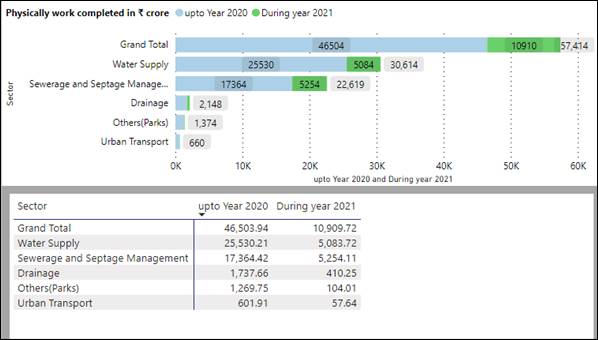
  • Against total SAAP size of ₹77,640 crore, 5818 projects worth ₹80,713 crore have been grounded. Of the grounded projects, works worth ₹57,414 cr. have been physically completed (inclusive of completed projects worth ₹22,756 cr.) and expenditure of ₹50,118 cr. has been incurred so far.

  • Sector-wise progress of AMRUT projects is as below:

Sector

Projects completed

Projects ongoing

Total Projects Grounded

No.

Amount

No.

Amount

No.

Amount

Water Supply

740

11,530

586

30,320

1,326

41,850

Sewerage &Septage

370

8,259

483

25,074

853

33,332

Storm Water Drainage

612

1,114

187

1,829

799

2,943

Non-motorised urban transport

218

397

131

626

349

1,023

Parks & Green spaces

1,943

1,130

548

435

2,491

1,565

Total

3,883

22,430

1,935

58,284

5,818

80,713


  • AMRUT 2.0 was launched by the Hon’ble Prime Minister on 1st October 2021 with the aim of making the cities ‘water secure’ and providing functional water tap connections to all households. The total indicative outlay for AMRUT 2.0 is ₹2,77,000 Cr including central share of ₹ 76,760 Cr for the period from 2021-22 to 2025-26.In the water supply sector, contracts for 1,326 projects worth ₹41,850 crore have been awarded of which 740 projects worth ₹11,530 crore have been completed. In addition, 18 projects worth ₹358 crore are at various stages of tendering.  The target is to provide 139 lakh water tap connections to achieve universal coverage. So far 118 lakh water tap connections have been provided through AMRUT and in convergence with schemes.


Swachh Bharat Mission- Urban (SBM-U)

            Swachh Bharat Mission (Urban) was launched on 2nd October 2014, with the vision to make India open defecation free. Under the mission, 31 cities have been self-declared as ODF and 58 have been certified as ODF since 1st January 2021. ODF+ certified cities increased by 1,828 and ODF++ certified cities increased by 472 since 1st January 2021. Number of Individual Household toilets constructed increased by 20,892 and Community/ Public Toilets constructed increased by 17,866 till date. Under solid waste management, 100% Door to door collection has increased to 86,403 wards and 100% Source Segregation has increased to 77,415 wards resulting in increase of the total waste processing to 70% as against 68% till 1st January 2021.

Swachh Bharat Mission-Urban 2.0: Hon’ble Prime Minister launched the second phase of Swachh Bharat Mission-Urban 2.0 on 1st October, 2021 with an outlay of about ₹ 4.4 Lakh Crore to adopt ‘Universal Approach’ and make a move towards ‘Saturation’ in sanitation and water availability in all Urban Local Bodies (ULBs). 


Deendayal Antyodaya Yojana –National Urban Livelihoods Mission (DAY-NULM)


The DAY-NULM is a flagship scheme which aims towards alleviating urban poverty through building strong community institutions, providing skill training, access to affordable credit for self-employment, support for street vendors and shelters for the urban homeless. Since inception, it has covered 28 states, 7 UTs and 3,806 Towns creating 25.60 livelihoods. Under the scheme, 1.30 lakhs shelter spaces were created for urban homeless and 66.70 lakhs women members were mobilised into 6.4 lakh Self Help Groups (SHGs). 


Memorandum of Understandings (MoUs) were implemented with e-commerce giants like Amazon & Flipkart for selling over 2,000 products made by 5,000 SHG members on e-commerce portals across 25 States/ UT.‘SonChiraiya’ brand was launched with the aim to provide increased visibility and wider market access to the local ethnic products viz. handicrafts, food, apparel, decorative, etc.The Mission has provided 26.50 lakh Certificate of Vending (CoV) to urban street vendors to safeguard their rights. Mission has streamlined the process for payments of training fees to skill training providers through PAiSA Portal, which is centralized electronic platform for processing payments to the beneficiaries under the Mission. 


AZADI KA AMRUT MAHOTSAV: As a part of the ongoing “AzadikaAmritMahotsav”  of MoHUA, Revolving Fund (RF) support to Area Level Federation (ALF) i.e. federation of Self Help Groups through PAiSA Portal was operationalised on 30.09.2021.


PM Street Vendor’s AtmaNirbhar Nidhi (PM SVANidhi)

            The PM SVANidhi was launched to empower street vendors, making them independent and self-sustainable. Under “SwadishtVyanjankiAadhunikDukaan (SVAD)”, MoHUA has signed MOU with Swiggy and Zomato providing a digital platform for Street Food Vendors (SFVs). Presently, over 8,486 SFVs have been onboarded and have generated sales of over ₹4.9 Crores.

            Tie up with Digital Payment Aggregators (DPAs) like BharatPe, Mswipe, PhonePe, Paytm, Aceware were done to issue UPI ids, QR codes and digital training to the beneficiaries. Around 24.5 Lakh Street Vendors (SVs) have been onboarded digitally out of which 9.8 lakh vendors are Digitally active who have conducted 10.9 Crore Digital Transactions till date.


More than 42 Lakhs Eligible Loan Application under 1st Tranche and 773,986 Eligible Loan Application under 2nd Tranche were submitted. Out of these, more than 30 Lakhs loans under 1st Tranche and 46,931 loans under 2nd Tranche were sanctioned and more than 27 Lakhs loans under 1st Tranche and 33,471 loans under 2nd Tranche were disbursed. The loan total amount disbursed under 1st Tranche is ₹2656.97Crores and under 2nd Tranche is ₹66.62 Crores.

Urban Transport 

            One metro project i.e. Bangalore Metro Rail Project Phase 2A & 2B of length 58.19 kms at the completion cost of ₹14,788 Cr has been sanctioned in June, 2021. 31 kms of metro rail lines have been commissioned in the cities of Delhi, Bangalore, Chennai, Kolkata and Nagpur.Under Make-in-India initiatives, the Ministry, in January, 2021, has issued a list of items where public procurement shall be done only from local suppliers. With driverless train operation on 94 km on Delhi Metro’s network, India is at 4th position in the elite league of world’s metro systems which operate drives less trains. 

************

Swachh Bharat Mission (Urban) 2.0 and AMRUT 2.0 to make the cities garbage free and water secure in 2021-2026

 The major focus of Swachh Bharat Mission (Urban) 2.0 [SBM (U) 2.0] and AMRUT 2.0 launched on 1st October, 2021 is to make the cities garbage free and water secure during the mission period of five years (2021-2026).

The highlights of SBM (U) 2.0 are as under:

  1. all households and premises segregate their waste into “wet waste” (from kitchen and gardens) and “dry waste” (including paper, glass, plastic, and domestic hazardous waste and sanitary waste wrapped separately);
  2. 100% door to door collection of segregated waste from each household/ premise;
  3. 100% scientific management of all fractions of waste, including safe disposal in scientific landfills;
  4. all legacy dumpsites remediated;
  5. all used water including faecal sludge, is safely contained, transported, processed and disposed so that no untreated faecal sludge and used water pollutes the ground or water bodies, in cities with less than one lakh population;
  6. phased reduction in use of single use plastic.

The highlights of AMRUT 2.0 are as under:

  1. Universal coverage of water supply from 500 cities to about 4,800 statutory towns.
  2. Focus on making the cities ‘self-reliant’ and ‘water secure’.
  3. Universal coverage of sewerage and septage management in 500 AMRUT cities.\
  4. Target to provide 2.68 crore drinking water tap connections and 2.64 crore sewer connections.
  5. Focus on financial sustainability of Urban Local Bodies (ULBs) through enhanced credit worthiness and market borrowing.
  6. ‘Pey Jal Survekshan’ will be undertaken in cities to promote healthy competition among them and function as monitoring tool and Mission accelerator.
  7. Technology sub-Mission under AMRUT 2.0 will help in identifying proven and potential global technologies in water sector.
  8. Entrepreneurship/ start-ups involved in low-cost indigenous equipments and processes will be encouraged.

All the cities of Uttar Pradesh including Firozabad arecovered under SBM (U) 2.0 and are eligible to avail all components as per operational guidelines.


Out of 4,372 ULBs, 4,371 ULBs including Firozabad of the country except one in West Bengal (city of Purulia) have been declared Open Defecation Free (ODF) under SBM (U).SBM (U) 2.0 & AMRUT 2.0 cover all the cities in the country and their aim is to make them garbage free and water secure during the Mission Period 2021-2026.


DAIRY DEVELOPMENT SCHEMES

 1. Rashtriya Gokul Mission:

Breed Development:

The Livestock sector, besides contributing to the national economy, plays a key role in providing livelihoods to 80 million rural households. India is a global leader amongst dairying nations and produced 198.48 million tonnes of milk in the current year valued at more than Rs 8.32 lakh crore. However, productivity of Indian dairy animals is low as compared to most of the dairy countries in the world.  Due to low productivity farmers are not getting remunerative income from rearing of dairy animals. 

New Initiatives of the Department:

a)         Implementation of Rashtriya Gokul Mission from 2021-22 to 2025-26

In order to improve productivity and enhance milk production, thereby making dairying more remunerative to the farmers Rashtriya Gokul Mission for genetic upgradation  of bovine population and development and conservation of indigenous bovine breeds has been   extended for implementation with an allocation of Rs 2400 crore over duration of 5 years.  Several new technologies have been accessible to the farmers at their doorstep under the Mission such as sex sorted semen, IVF technology, genomic selection etc. 

Focus of the implementation of the scheme has been shifted from creating cattle and buffalo breeding infrastructure in the States to bringing quality breeding services including artificial insemination services, IVF technology and sex sorted semen at farmer’s doorstep. The scheme also focuses on facilitating private entrepreneurship to improve access and affordability. 

With implementation of proposed programme milk production in the country will be increased from 198.4 million metric tonnes in 2019-20 to 300 million metric tonnes in 2024-2025.  8 crore farmers engaged in dairying will get direct benefit in the form of increased milk production on an average 1200 kg per animal per year.

New Components under Rashtriya Gokul Mission:

i)          Accelerated Breed Improvement programme: Under the component, IVF technology and artificial insemination with sex sorted semen is being leveraged to produce female calves female calves for the dairy farmers. IVF is important tool for genetic upgradation of bovine population at rapid rate, work which is done in 7 generations (21 years in case of cattle and buffaloes) can be done in 1 generation (3 years in case of cattle and buffalo) through IVF.  The technology has huge potential in enhancing farmers’ income through production of only female calves with genetic potential of producing 4000 kg of milk per lactation thus increasing farmers income by many fold. Under the Accelerated Breed Improvement programme 2 Lakh IVF pregnancies will be established in next five years. Subsidy at the rate of Rs 5000 per assured pregnancy will be made available to farmers. The programme has already been initiated in the country.

Sex sorted semen production has been introduced in the country for production of only female calves upto 90% accuracy.  Use sex sorted semen will be game changer not only enhancing milk production but also limiting stray cattle population. During the next five years 51 lakh pregnancies will be established and subsidy of Rs 750 or 50% of the cost of sorted semen on assured pregnancy is  available to farmers. 

ii)        Establishment of Breed Multiplication Farms: A major constraint for aspiring dairy farmers is the difficulty of procuring high quality heifers or milch animals from their local areas. To address this issue and to attract investment including entrepreneurship for the dairy sector,  and to simultaneously create the opportunity for developing a hub and spoke model of dairy farming where small and marginal dairy farmers can thrive with the help of a local hub of reliable dairy services, a subsidy of 50% (up to Rs 2 crores per farm) on capital cost (excluding land cost) is being provided to private entrepreneurs under this component for establishment of breed multiplication farms of minimum herd size of 200 heads of bovines. The entrepreneur will obtain bank finance for the remaining capital cost and sale high quality heifers, conceived through sorted sex semen/ IVF, to farmers in the region. 

Awards and new launches

a)         Gopal Ratna Award 2021

Gopal Ratna Award has been launched by the Department in 2021 and is one of the highest National Awards in the field of livestock and dairy sector. Objective of the award is to encourage all individual farmers, artificial insemination technicians nicians and Dairy cooperative societies working in this sector. Awards are conferred in three categories, namely (i) Best Dairy Farmer Rearing Indigenous Cattle/buffalo Breeds; (ii) Best Artificial Insemination Technician (AIT) and  best Dairy Cooperative. Award consists of a Certificate of merit, a memento and following  cash amount in each category: Rs. 5,00,000/-(Rupee five lakh)  for 1st rank holder;  Rs. 3,00,000/- (Rupee three lakh )     to 2nd rank holder  and  Rs. 2,00,000/- (Rupee two lakh)  to 3rd rank holder. For the first time, applications were invited on self nomination basis through online application portal https://gopalratnaaward.qcin.org from 15.07.2021 to 15.10.2021. Total 4401 applications were received and were evaluated by the Department and 4 beast dairy farmers, 3 best AI technicians and 3 best dairy cooperatives in the country were felicitated on 26th November 2021.

b)        Launching of Breed Multiplication farm Portal

Breed Multiplication Farm Portal has been launched on 26th November 2021 to receive online application from interested private individuals/ Entrepreneurs, FPOs, SHGs, FCOs, JLGs, and Section 8 companies for breed multiplication farm.

c)         Launching of Dairy mark

Dairy mark has been launched by Hon’ble Prime Minister on 23rd December 2021, this unified logo is featuring the earlier respective logos BIS-ISI mark & NDDB-Quality Mark  and Kamadhenu Cow, for ‘Product–Food Safety Management System–Process’ certification under one umbrella. With the dairy mark our consumers will be ensured about the quality of milk and milk products and will be easy for milk producers/processor to obtain quality certification by applying online to BIS through portal. 

Ongoing Programmes

Nationwide Artificial Insemination Programme: 

Nationwide AI Programme has been initiated in September 2019 and under the programme AI services delivered free of cost at farmers’ doorstep.  As on date 2.20 crore animals have been covered, 2.6 crores Artificial Insemination have been performed and 1.4 crores farmers benefitted under the programme.  Income of the participating farmers is expected to increase with the enhancement in productivity. During the next five years Nationwide AI programme will be extended to 15 crore breedable bovines benefitting 7.5 crore farmers.

Genomic selection:  

Advanced dairy nations are using DNA based selection called genomic selection for proving genetic merit of the bulls at birth against 6- 7 years taken in traditional method to prove genetic merit of the bulls. DNA chip for genomic selection has been developed, Indus chip and Buff chip by NDDB and Low density chip for cattle and buffalo by NBAGR. This chip has been converged with the chip developed by NBAGR for undertaking genomic selection of indigenous breeds. Cost of production of bulls will be reduced substantially.

e-GOPALA app: 

A comprehensive breed improvement marketplace and information portal for direct use of farmers in the form of the e-GOPALA app (Generation of Wealth through Productive Livestock) has been launched by Hon’ble PM on 10th September 2020.  e- Gopala app the digital platform is helping farmers in managing livestock including buying and selling of disease free germplasm in all forms (semen, embryos, etc); availability of quality breeding services (Artificial Insemination, veterinary first aid, vaccination, treatment etc) and guiding farmers for animal nutrition, treatment of animals using appropriate ayurvedic medicine/ethno veterinary medicine. 

Establishment of MAITRIs:

In order to meet the demand of AI technicians project has been sanctioned under Rashtriya Gokul Mission for induction of 90958 Multi Purpose AI technicians in Rural India (MAITRIs) as on date 11,000 MAITRIs have been trained and inducted. With the establishment of MAITRIs Artificial insemination coverage will be available at farmer’s doorstep.

2. DAIRY DEVELOPMENT SCHEMES:

1.)  National Programme for Dairy Development (NPDD) :-

The Department is implementing Central Sector Scheme- “National Programme for Dairy Development (NPDD)” across the country since Feb-2014 with an objective of creating/strengthening of infrastructure for Production of quality milk, Procurement, Processing and Marketing of Milk & Milk Products through State Implementing Agency (SIA) i.e State Cooperative Dairy Federation. 

The scheme has been restructured/realigned in July 2021. The restructured NPDD Scheme will be implemented from 2021-22 to 2025-26 with a budget allocation of Rs.1790 crore. The scheme the aims to enhance quality of milk and milk products and increase share of organised procurement, processing, value addition and marketing. This scheme has two (2) components:- 

(i)        The Component ‘A’ focuses towards creating/strengthening of infrastructure for quality milk testing equipment as well as primary chilling facilities for State Cooperative Dairy Federations/ District Cooperative Milk Producers’ Union/SHG run private dairy/Milk Producer Companies/Farmer Producer Organisations. 

(ii)       The Component ‘B’ provides financial assistance from Japan International Cooperation Agency (JICA) as per project agreement already signed with them. The central Government share in this project is proposed to be funded through NPDD (Component A). 

Progress/Achievements (Jan-Dec 2021):

12 new projects in 8 States were approved under NPDD scheme during January 2021 to December 2021 at a total outlay of Rs. 361.67 crore (Central Share Rs.236.94 crore). These projects primarily aims for creation of additional milk processing capacity of 60 thousand litres per day and strengthening of village level milk chilling, collection and testing infrastructure by installation of 788 bulk milk coolers (with a capacity of 2201.9 thousand litres), 5172 automatic milk collection units and 3921 electronic milk adulteration testing machines.

Physical achievements (January to December 2021)

S. No.

Parameter

Achievement

1

Milk Processing Capcity created (TLPD)

381

2

Incremental Daily Milk Procurement (TKgPD)

368.66

3

Dairy Cooperative Society organised/revived (Number)

1914

4

Farmer members enrolled (in lakh)

1.43

5

Bulk Milk Coolers installed (Number)

291

6

Automatic Milk Collection units installed (Number)

4251

7

Electronic Milk Adulteration Testing Machine installed (Number)

511


“Dairying through Cooperatives” Component B of National Programme for Dairy Development (NPDD) scheme

Cabinet  Committee on Economic Affairs (CCEA) has approved restructuring of National Programme for Dairy Development (NPDD) under Central Sector Scheme (CSS) umbrella Scheme “Development Programmes” on 14.07.2021 as “Dairying through Cooperatives” Component B of National Programme for Dairy Development (NPDD) scheme.”Dairying through Cooperatives” Component B of National Programme for Dairy Development (NPDD) scheme has the aims to increase sales of milk and dairy products by increasing farmer’s access to organised market, upgrading dairy processing facilities and marketing infrastructure and enhancing the capacity of producer owned institutions, thereby contributing to increase in return to milk producers in the project area with an outlay of Rs.1568.28 crore including in the form of Loan of Rs.924.56 crore (JPY 14,978 million) by Japan International Cooperation Agency (JICA), RS. 475.54 crore as Grant by Govt. of India and participating Institutes’ (PI)share of Rs.168.8 crore for the period of 5 year from 2021-22 to 2025-26. Eligible States are Uttar Pradesh and Bihar. The scheme provides employment generation opportunities in the field of procurement, processing, marketing etc under the project area of the scheme.

2) Dairy Processing and Infrastructure Development Fund (DIDF) Scheme:-

Launched: 21st December 2017

Objectives: To modernize the milk processing & chilling plants including value addition

Scheme Outlay: Rs. 11,184 Cr; Total project outlay: Rs. 10,005 Crore (Loan: Rs. 8004 Crore, End Borrowers’ contribution: Rs. 2001 Crore); NDDB & NCDC Contribution: Rs. 12 Crore, Interest subvention (Government of India): Rs. 1167 Crore

Components of DIDF:

  • Milk processing, Chilling and Value added Products plants
  • Milk Chilling infrastructure
  • Electronic milk testing kit

New Components added in June 21

  • Cattle feed/ feed supplement plants
  • Milk transportation system (Refer van/insulated tankers etc)
  • Marketing infrastructure
  • Commodity and Cattle feed go-downs
  • ICT infrastructure
  • R&D (lab & equipment, innovations, product development etc)
  • Renewable energy infrastructure/ plants, trigen/ energy efficiency infrastructure
  • Pet bottle/packaging material manufacturing units for dairy purposes

End Implementing Agency (EIA): State Milk federation. District Milk Union, Multi-state dairy cooperative, Milk producer Companies, Subsidiaries of NDDB,

Newly Added EIA: Registered FPOs & SHGs.


Funding:

    • Interest subvention [DAHD to NABARD]: 2.5% (with effect from 11.09.2020), Any increase in cost of funds, shall be borne by the Eligible End Borrowers (EEB).
    • NABARD to keep the cost of borrowing to the minimum and ensure that interest subvention does not exceed 2.5%. NABARD will not charge more than 0.6% towards fund management cost.
    • Loan [NABARD to NDDB / NCDC]: At not more than 6% interest rate
    • Fund management and loan risk cost. : Not more than 0.5% by NDDB/NCDC
    • Loan [NDDB / NCDC to EEB]:
    • At present interest rate is ranging between 5.07%  to 5.36% as informed by NABARD
    • Direct funding by NDDB allowed in Dec, 2021. NDDB proposed effective rate 5.30%

Progress under DIDF:

Financial Progress (Jan-Dec 2021)

During 2021, 8 projects from 4 states with total outlay of Rs 750.82 Cr with loan component of Rs 519.26 Crore have been sanctioned by NDDB and NCDC. Rs 101.91 Cr of laon has been disbursed.

On cumulative basis, as on 21.12.2021, under DIDF, 48 Projects from 13 States with a total outlay of Rs. 6216.15 Crore with a loan component of Rs. 4101.82 Crore have been sanctioned by NDDB and NCDC Further, Rs. 1256.68 Crore of loan has been disbursed. DAHD, GoI has released Rs. 54.59 Crore to NABARD as interest subvention.

Physical ProgressOn cumulative basis, 45 LLPD Milk Processing Capacity, 113 BMCs with 3.54 LLPD capacity, 165 MTPD Drying capacity and 6.76 LLPD Value added Processing (VAP) capacity has been established. Around 23 thousand villages have been covered under the scheme

3) Supporting Dairy Cooperatives and Farmer Producer organizations engaged in dairy activities” (SDC&FPO)

INTEREST SUBVENTION ON WORKING CAPITAL LOANS FOR DAIRY SECTOR

Department of Animal Husbandry and Dairying has introduced a new
component “interest subvention on Working capital loans for Dairy sector” as one of
the component under its scheme “Supporting Dairy Cooperatives and Farmer
Producer organizations engaged in dairy activities” (SDC&FPO). Under the interest
subvention component of SDCFPO scheme so far Rs 146.57 Cr has been provided as interest subvention amount against eligible total working capital loan amount of
Rs 10588.64 Cr for milk unions as on 13.12.2021.

KISAN CREDIT CARD (KCC) FOR ANIMAL HUSBANDRY & DAIRYING
FARMERS

A Special drive has been undertaken to provide concessional credit to Animal Husbandry & Dairying farmers through Kisan Credit Cards during 01.06.2020 to 31.12.2020. This has enabled such farmers to gain access to institutional credit at concessional interest rate for working capital expenditure. Under this drive 14.25 fresh KCC were issued to Animal Husbandry and Dairy Farmers.

In order to provide Kisan Credit Card facility to all eligible Animal Husbandry and Fishery Farmers, Ministry of Fisheries, Animal Husbandry and Dairying in association with Department of Financial Services have launched a “Nationwide AHDF KCC Campaign from 15 th November 2021 to 15 th February 2022. During this Campaign, District Level KCC Camps are being organized in every week for on the spot scrutiny of applications. Under this campaign 50,454 KCC were sanctioned as on 17.12.2021.

3. Livestock Health and Disease Control Programme (LHDCP):

Livestock Health and Disease Control (LH & DC) scheme and National Animal Disease Control Programme (NADCP) are merged under Disease Control Programme renamed as Livestock Health and Disease Control (LH & DC) Programme.

  1. National Animal Disease Control Programme (NADCP)

National Animal Disease Control Programme for control of Foot & Mouth Disease and Brucellosis (NADCP) is a Central Sector Scheme, with an outlay of Rs 13,343 Cr for five years and was launched inSeptember 2019. The main aim of the Scheme is to control FMD and Brucellosis by 2025 with vaccination and eventual eradication of FMD. Also, the objective of the scheme is to vaccinate all Livestock including cattle, buffalo, sheep, goat and pig biannually against Foot and Mouth Disease (FMD) and to vaccinate all Female Bovine Calves (4-8 months old) annually against Brucellosis.

The programme envisages 100% ear tagging of the eligible animal population and their registration on the INAPH (Information Network for Animal Productivity and Health portal), in order to enhance the traceability, monitoring and control of animal diseases. So far, approximately 21.93 crore cattle and buffaloes have been ear tagged; 16.91 crore cattle and buffaloes have been vaccinated in FMD round-1; 4.46 crore cattle and buffaloes have been vaccinated in the ongoing FMD round-2; and 0.27 crore female bovine calves (between 4-8 months of age) have been inoculated in the ongoing Brucellosis vaccination phase. 

  1. Livestock Health & Disease Control (LH&DC) Scheme

The Livestock Health & Disease Control scheme with the aim of reducing risk to animal health by prophylactic vaccination against diseases of animals, capacity building of Veterinary services, disease surveillance and strengthening veterinary infrastructure. The major activities supported are: Critical Animal Disease Control Programme (CADCP) for eradication and control of two major diseases namely Peste des Petits Ruminants (PPR) and classical swine fever (CSF); establishment and strengthening of mobile veterinary units (ESVHD); and Assistance to States for control of other economically important, exotic, emergent and zoonotic animal diseases (ASCAD). The funding pattern is 100% central assistance for the CADCP and the non-recurring components of ESVHD, and 60:40 between Central and State for the other components as well as for ASCAD, with 90:10 for hilly and NE States and 100% for UTs. 

Livestock Health and Disease Control Programme (LHDCP) include both NADCP and LHDC, with budget allotment (BE Rs.1470.00 crore and RE Rs. 886.00 crore). Out of this Rs. 886 crore already Rs. 678.51 Crore have been released to the states/UTs under LH&DC during current financial year, including the sanction of MVUs to different states as per the action plan/proposal.

4. Various Developments /Achievements in AHS Division during 2020-21: –

  • There is a Centrally Sponsored Scheme namely “Livestock Census & Integrated Sample Survey Scheme” under the development programmes category with two components, (i) Livestock Census (LC) & (ii) Integrated Sample Survey (ISS). The main objective of Livestock Census is to provide information on livestock population, species-wise and breed-wise along with age, sex-composition etc. up to household level in rural and urban areas.

As per 20th Livestock Census report, the Total Livestock Population and total poultry in the country is 536.76 million and 851.81 respectively showing an increase of 4.8% and 16.8% respectively over Livestock Census-2012. 

  • Publication work of Breed-wise Report of Livestock and Poultry (based on 20th Livestock census) is at final stage and is going to be published soon.
  • On the other hand,Integrated Sample Survey(ISS) is an annual survey,main objective of ISS is to estimate of the production of milk, egg, meat and wool at National, State and district level. Activities of the survey were not digitised and compiled manually till 2020-21.In order to digitize all activities under ISS Survey the Division has developed a software, in collaboration with IASRI, consisting development of a web portal and an android application namely “eLISS” for collection of MLP data from Households. From 2021-22, the data are being collected through the android application only, so that data collected through Integrated Sample Survey can made available on time with ensured reliability.
  • The latest Publication of Basic Animal Husbandry Statistics-2020 is published in year 2020.

Estimate of MLPs for the year 2019-20

Product

Milk

(Million Tonnes)

Egg

(Billion Nos)

Meat

(Million Tonnes)

Wool

(Million Kg)

Production

198.4

114.38

8.60

36.76

Growth Rate (%)

5.69%

10.19%

5.98%

-9.05%


MV/MG                                                       *************

SCHEMES BY MODI GOVERNMENT

Hello readers I am the intern of HARYALI organisation and today I want to share the contribution of Modi government to us through the various schemes .The Modi government has started many welfare schemes which include; Beti Bachao-Beti Padhao, Swachchh Bharat Mission, PM Mudra Yojna, Atal Pension Yojna, Smart city scheme, and Make in India etc. Read this article to know the list of important welfare schemes started by Narendra Modi.

Pradhan Mantri Jan Dhan Yojana

The financial inclusion scheme launched in August 2014 aims to provide universal access to banking facilities with at least one basic banking account for every household, and increasing financial literacy, access to credit, insurance and pension.There are 20 crore women Jan Dhan beneficiaries across the country.

 Make in India: PM Narendra Modi launched the ‘Make in India’ campaign that will facilitate investment, foster innovation, enhanced protection for intellectual property and build best in manufacturing infrastructure.

‘Make in India’ has identified 25 sectors in manufacturing, infrastructure and service activities and detailed information is being shared through interactive web-portal and professionally developed brochures.

 Swachh Bharat Mission: Swachh Bharat Mission was launched in the entire country as a national movement. The campaign aims to achieve the vision of a ‘Clean India’ by 2nd October 2019. The Swachh Bharat Abhiyan is the most significant campaign with regards to sanitation by the Government of India.

Beti Bachao Beti Padhao: The goal of this scheme is to make girls socially and financially self-reliant through education.

Atal Pension Yojna: Atal Pension Yojana is a pension scheme mainly aimed at providing a universal pension scheme for those who are a part of the unorganized sector such as maids, gardeners, delivery boys, etc. This scheme replaced the previous Swavalamban Yojana which wasn’t well-received by the people.

Digital India Mission: The Digital India programme is a flagship programme of the Government of India with a vision to transform India into a digitally empowered society and knowledge economy.

Stand Up India Scheme

Government of India launched the Stand Up India scheme on 5th April, 2016. The Scheme facilitates bank loans between Rs.10 lakh and Rs.1 crore to at least one Scheduled Caste/ Scheduled Tribe borrower and at least one Woman borrower per bank branch for setting up greenfield enterprises. This enterprise may be in manufacturing, services or the trading sector. The scheme which is being implemented through all Scheduled Commercial Banks is to benefit at least 2.5 lakh borrowers. The scheme is operational and the loan is being extended through Scheduled Commercial Banks across the country.