

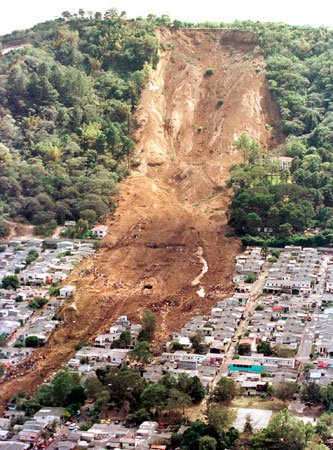
The subject of the article pertains to the landslides with reference to the Himachal Himalayas. Himachal Pradesh due to its location, foots of the Himalayas is extremely vulnerable to landslides – the reason for the same being both natural and anthropogenic. The article explores the frequency of landslides in the state, bringing out the vulnerable districts based on secondary sources, discusses about few life-threatening landslides and the prevention plans along with some recommendations.
Landslides is a type of mass movement which involves, in simple words, downslope movement of rock wastes including soil and ice under the influence of gravity. Some of the reasons for the same among many includes – slope saturation by water is a primary cause of landslides. Flooding can also cause landslides by undercutting banks of streams and rivers and by saturation of slopes by surface water. Human activities tend to disturb the slope by removing of vegetation or by excessive loading of the slope and as such.
Himachal Pradesh is situated in Western Himalayas between 30-degree 22 N to 33-degree 12 N latitude and 75-degree 45 East to 79-degree 4 East. Given its location in the Western Himalayas, it is one of the most multi – hazard prone states – spanning over the area 55673 sq. Km and population of 68,64,602 (Himachal Pradesh State Disaster Management plan, 2017). Vulnerable roadways, human settlements and hydroelectric power plants are most at risk of landslides. About 22% of built-up areas are in high-risk zone; 32% in medium risk zone and 3% in low-risk zone. Almost all the urban areas of the state are prone to the risks of landslides. The reason for the same might be the unscientific land use and unplanned expansion of urban areas leading to overloading and destabilising the slopes.
A large chunk of areas in all the districts fall in High-risk zone followed either by Moderate or Severe risk zone. There are areas which do fall in No Risk Zone but it does not cover large extent. The state has a large network of State Highways and village roads with total length of 2178.988 Kms, of which 1111.552 kms fall in Highly vulnerable zone. Most of the tourist spots in the state are well connected by roads – but many of these roads have recurring problems of landslides which often disrupt flow of tourist traffic.
If we analyse the trend of landslides between 1971-2010, it will be observed that since 1970s, the frequency has only been increasing. Nearly 525 people were killed during 1971-2010. In terms of human casualties, Kullu district is the most affected where 142 people were killed by landslides followed by Shimla (119 people). Bilaspur, Mandi, Chamba, Kinnaur and Kangra were other major landslides affected districts in terms of human casualty.
Post 2010, if we take up the landslide in Kullu district in 2015, it will come to view that the effects are still severe. The landslide in Kullu district was majorly due to excessive rainfall. After a building adjoining the historic Manikaran Sahib Gurdwara caved in due to a massive landslide – it led to the death of 8 persons and 10 injured, the source states (NDTV news). In 2020, in the landslides in Manali, five family members were buried, as per the news article released by Times of India. Yet another landslide case in 2021 in Kinnaur left many people stranded, damaging transport and communication lines severely.
various newspaper clippings point out that the locals are very detestable when it comes to development project. In one of the clippings (The Statesman, 2018), the locals are questioning why is there a need for highway which destabilize hills in the state – after all hills are meant to be climbed. The people are not very in favour of such projects because according to them these tend amplify the adverse effects if natural calamity. So, the government need to go for more inclusive planning with regard to development.
One of the ways through which involvement of local community can be ensured is by bringing them into decision making process – which in turn can be ensured by adopting suitable policies. Transparency in the process of taking suitable steps is extremely necessary; co-operation between local communities, local government and NGOs and other such agencies can be very helpful in proper implementation of government’s plan. It will allow to bridge the gap in communication between various stakeholders. One of the most important suggestions forwarded by many is the implementation of education programme regarding hazard management, specially landsides among the residents.
Various article highlights the need to rethink the model of development being followed – particularly with regard to the exploitation of its hydroelectric potential. For instance, an article published by Down to Earth, 2021 highlights that Erratic rainfall due to climate change or de-glaciation are exacerbated by several anthropogenic factors. According to State Disaster Management Authority – most of Himachal Pradesh hydroelectric power projects in operation or under constitution fall in areas highly-vulnerable to various hazards like landslides. Another article by The Citizen, 2021 too highlights that if reserved forests or Eco sensitive zones are used for hydropower dams and multi-lane roads then this area of the state could be devastated like Uttarakhand. It has been suggested that government need to consider and seek the pinion and advice of geologists, meteorologists, environmentalist and people who live in the affected area before embarking on the projects.
Note: The article is based on secondary sources and has taken the perspectives and viewpoints of various articles and due credit has been ensured.
Image Credit: Google


 Eduindex
You must be logged in to post a comment.