11 July is observed as world population day every year. It’s main focus is on the various problems arising due to surging population. Growing population is a major concern for developing countries and india is also having the same concerns. With population around 1.39 billion approximately India is inching towards overtaking china as most populous country.
China had adopted one child policy to control it’s growing population but due to demographical reasons it ended this policy in 2015. Aging population was the reason presented,but decline in fertility rate was another reason. China’s communist government is very strict in implementing it’s policies and citizens also abide by the rules.
India’s five year plans gave emphasis to population control. Ministry of health and family welfare covers the population control policy. Main strategy is to persuade people to accept the small family norm by way of various advertisment and educational efforts.
A scene from web series ‘panchayat’ depicting slogan
In 2019, ‘Population Control Bill’ was introduced into Rajya sabha and was signed by 125 MP’s. This bill was about imposing penalties for couples not adhering to the two-child policy.
A Postage stamp issued by the Indian government
Later, in 2020 ‘Constitution Amendment Bill’ was introduced into Lok sabha. It’s main objective was to amend the Article 47A of the Constitution of India. This amendment was to introduce a two-child policy per couple and provide incentives like tax, educational benefits etc.
Two-child policy in Indian states
States of Assam and Uttar Pradesh have initiated to bring in two-child policies, this will limit government benefits to people with only two children. people with more than two children are barred from contesting elections in Gujarat, Rajasthan,Maharashtra, Uttarakhand, Odisha, Telangana and Andhra Pradesh.
Few more States are eyeing to bring these type of policies in upcoming future for betterment of the citizens. Government and few NGO’s are working towards educating people about these policies. Task ahead is tough,but not impossible.
On the occasion of World population day on 11th July, 2021, Chief Minister of Uttar Pradesh, Yogi Adityanath announces a new policy on population control for 2021-2030. It aims to incentivize people to help in population control.
Population of Uttar Pradesh
India’s one-sixth population lives in Uttar Pradesh, which make it India’s most populous state in India. The population in Uttar Pradesh is grown 3.5 times from 46 million in 1901 to 166 million in 2001.The first census recorded was in the year 1901 with a population of 46,647,804 by British India. The population is constantly increasing its growth rate from 6.56 to 25.85% till 2001 and with decreasing growth rate from 25.85 to 20.23% in 2001 to 2011. The Uttar Pradesh population by 2021 will be 236 million and the report of census has been proven right as according to UID, Uttar Pradesh population in 2020 is estimated to be 237 million. And the current population of Uttar Pradesh is approximately 241 million. Which is more than the estimate.
So here we see how rapidly the population of Uttar Pradesh is increasing and that is why it has become necessary to control the population of Uttar Pradesh.
In view of this, the Chief Minister of UP launching the new policy of population control. Chief minister Yogi Adityanath said that rising population is the root cause of major problems including inequality. “Increasing population can be a hurdle in way of development. Every community has been taken care of in Population Policy 2021-2030,” CM Yogi Adityanath said. Let us, on this ‘World Population Day’, take a pledge to make ourselves and the society aware of the problems arising from the increasing population,” Yogi Adityanath said in a statement.
Objectives of this policy
Under this policy, government will adopt five-pronged approach to control population.
The Policy will focus on comprehensive arrangements for the care of elderly and will also focus on improved management of education, health, and nutrition for adolescents between 11 and 19 years.
The policy will look at different strategies and work towards a convergence of existing schemes to streamline population control efforts and improvement in health.
Health clubs will be set up in schools and digital tracking will be done for newborns, adolescents and elderly people.
Efforts will be made to increase accessibility of contraceptive measures issued under the Family Planning Programme and provide a proper system for safe abortion.
Efforts will also be made to maintain demographic balance across different communities and ensure easy availability of advanced health facilities.
Also a population control bill has been prepared by Uttar Pradesh government’s law commission, which promises perks and incentives to government employees and general public who will follow population control measures. The commission has released the final draft of the ‘UP Population (Control, Stabilization and Welfare) Bill, 2021’ and invited suggestions by July 19. According to the draft bill, those people who have more than two children will be debarred from contesting local body polls, applying for government jobs or receiving any kind of subsidy. The draft says it is necessary to control and stabilize the population of the state for the promotion of sustainable development with more equitable distribution.
With this policy, Yogi Adityanath urged for community-centric approach to population control to provide better facilities. People should also take seriously the problem of rising population because without their awareness and help the problem is not possible to overcome. Both on state level and central level should also adopt some measure to control population growth, keeping in mind rising population.
Today, 11th July has been recognized as World Population Day and the main significance of this day is to draw attention to the alarming global population issues. Among the 195 countries in the entire world, China tops the list recording the highest population and further India stands in the second position.
The day was established by the United Nations Development Programme in 1989 and was suggested by Dr. K.C.Zachariah in which the population reaches Five Billion when he worked as Sr Demographer at World Bank. On this day one should not only seek to raise awareness about the world population but also gives importance to issues like family planning, gender equality, poverty, maternal health, and human rights.
The increasing population has always been a matter of concern. At the beginning of the 1800s, the recorded population was 1 billion. Then, at the beginning of the 2000s, the population recorded was around 6 billion. As of 2019, the world population recorded is 767.35 Crores. The massive rate at which the population is increasing is very distressing. With the increase in the number of human beings, the resources to sustain human life has come to a downfall. The natural resources available are limited while their consumption is increasing every year. If this continues increasing at the same rate, the day isn’t away when everyone here would be doomed.
Individuals always advocate through words and suggest the required steps to be taken to control the increasing population but very few carry out various programs at their institution or organizational levels to make people aware of the consequences this would lead to us if not controlled. In India, most of the remote area’s population aren’t even aware of basic human rights, educating them about various policies and family planning strategies can turn out to be beneficial. If we get a close look at the stats in India, the birth rate is increasing rapidly stating 51 births each min(as of 2020) and death rates decreasing comparatively to around 19 deaths each min(as of 2020). Taking this into consideration, reproductive health of woman is a matter of concern too. Maternal health affects adversely due to multiple rebirths and if one’s sexually active with multiple partners makes her more vulnerable to deadly diseases like vaginal and cervical cancer.
While the media/ press only surges on the count of the world population, leaders, small organizations, institutions should hold hands together to create and spread awareness about reproductive health issues and advocate their voices for the basic human rights of every individual. It’s also my request to the government to come forward with effective policies and schemes to control the population. And the concern is so widespread that the results won’t show up immediately, everyone has to be patient whilst these measures become effective. But if not controlled now, human life should get prepared for some adverse repercussions.
” We do not believe in anarchy in material production and we do not believe in anarchy in human reproduction . Man must control nature and he must control his number “
Population of the world has been consistently increasing especially after world war II . In demographic terms ,the world is experiencing a period of population explosion . Population itself is not a problem . Qualitatively good population with manageable size , represents the strength of a nation but if the size becomes unmanageable, the same population invites unwanted problems . It not only halts economic progress but also innumerable challenges to the social system .
The Governing Council of The United Nations Development Programme established , ” World Population Day ” an annual event, observed on July 11 every year in 1989 , to seek and raise awareness of global population issues .
World Population Day aims to increase people’s awareness on various population issues such as the importance of family planning, gender equality, poverty, maternal health and human rights
History :-
World Population Day was established by the United Nations in 1989. It was inspired by the public interest in Five Billion Day on July 11 in 1987, the approximate date on which the world’s population reached five billion people.
A resolution was passed on July 11, 1990 by the United Nations General Assembly (UNGA) deciding to continue observing World Population Day every year to enhance awareness about population issues, including their relations to the environment.
Theme , 2021
The theme is organised by the Population Division of the United Nations Department of Economic and Social Affairs (DESA).
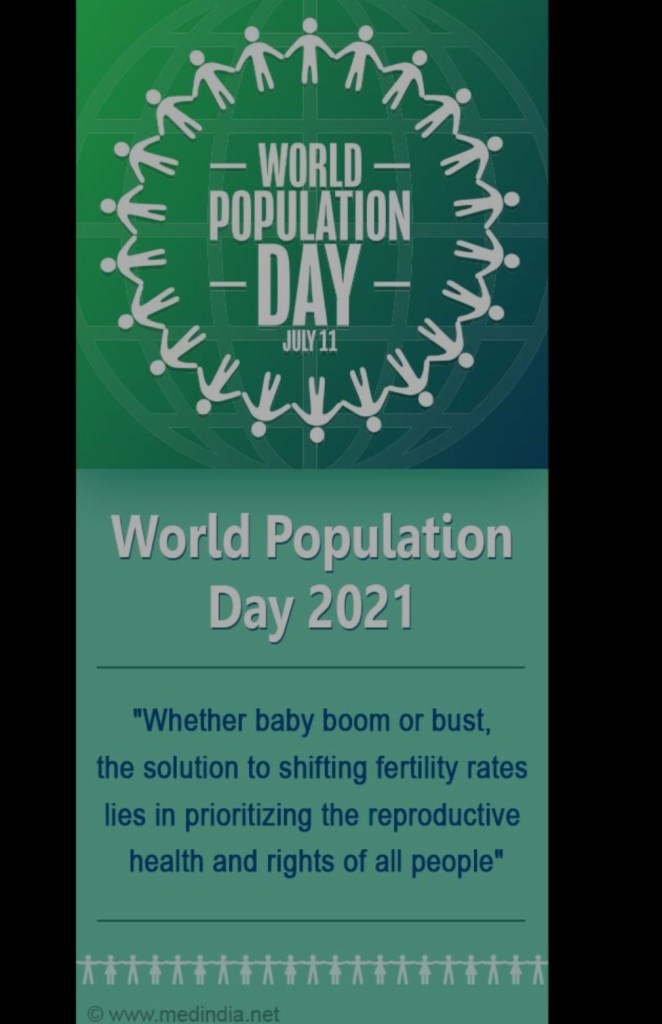
The theme for World Population Day 2021 is “Rights and Choices are the Answer: Whether baby boom or bust, the solution to shifting fertility rates lies in prioritising all people’s reproductive health and rights.”
This year’s theme raises awareness about ‘the impact of the Covid-19 pandemic on fertility i.e on sexual and reproductive health and reproductive behaviour globally.
Significance of World Population Day
World Population Day is observed every year with the aim of highlighting the unwanted problems created by overpopulation as well as raising awareness about the harmful effects of overpopulation in an ecosystem.
Through this great awareness celebration, people are encouraged to take part in the event to know about population issues like importance of family planning towards the increasing population, gender equality, maternal and baby health, poverty, human rights, right to health, sexuality education, use of contraceptives and safety measures like condoms, reproductive health, adolescent pregnancy, girl child education, child marriage, sexually transmitted infections, etc.
Sexuality related issues are very necessary to solve among youth, especially those between 15 to 19 years of age.
This year the significance of World Population Day is about how a pandemic has compromised health care systems particularly in the area of sexual and reproductive health.
The World Population Day also spread awareness about gender-based inequities.
According to UNFPA research in March, an estimated 12 million women experienced disruptions to family planning services.
Gender-based violence as well as the sharp rise of unplanned pregnancies has increased under lockdown. The condition of the women didn’t change any better this pandemic , they are being exploited by restricting their freedom of taking decisions . Despite being empowered educationally, economically and politically women are not allowed to exercise choice over their bodies and fertility.
UNFPA lays out joint health service programmes to educate people about the fertility and reproductive health service and advises against policy which can be extremely harmful and violate rights, health and choices aiming particularly for women education regarding health service and choices.
Population growth
” No social problem is beyond human control and solution “.
The actual measure of the real problem of overpopulation has been superlatively seen during the present days of the Covid-19 pandemic.
The world population is continuously increasing . Several nations of the world are gripped by the problem of overpopulation .
The unsustainable population growth and lack of access to reproductive health care also puts pressure on human communities, reducing the facilities to save life at risk during this pandemic and making it harder for the most vulnerable communities to come out of this death threatening time .
About 95% of World population growth is occurring in developing countries. One/ third of the world’s population is under 15 and will soon enter the reproduction bracket , giving more potential for population growth . The UNFPA estimates that the world population is most likely to nearly double to 10 billion people in 2050 , peaking at 11.6 billion reaching 20.7 billion a century later . World population is currently growing at 176 people per minute .
The world population is indeed increasing at an alarming rate . This speedy growth of population is one the greatest obstacles to the economic and social advancement of the majority of people in the underdeveloped world.
“Population growth is the primary source of environmental damage.” – Jacques Yves Cousteau
Overpopulation brings down per capita income and national income , bringing down the standard of living of the people . It becomes difficult to face the challenges of poverty , unemployment and underemployment .
Celebration :-
Every year, on World Population Day , various events and activities are organized, mostly in schools and colleges like seminar discussions, educational information sessions, and essay competitions to draw attention to the issues of the growing population. They also talk about family planning, poverty, gender equality, maternal health, and human rights, and also the health issues faced by childbearing women.
The pandemic has wreaked a devastating toll on this generation. UNFPA and other United Nations agencies and civil society stakeholders are practicing programs to improve health care and social services,
There are several programs. providing detailed knowledge about sexuality and delaying marriages till they become able to understand their responsibilities , educating youths to avoid unwanted pregnancies by using reasonable and youth friendly measures.
A serious problem like “the population explosion ” requires immediate solution . Though it cannot be solved by an act of legislation or by the Presidential promulgation ,it can very well be handled skillfully and efficiently by creating general social awareness. Hence as a member of society it’s our duty to provide a lasting solution to this problem.





 Eduindex
You must be logged in to post a comment.