Labour and Ministers' Meeting begins in Indore, Madhya Pradesh (19th to 21 July)

 The fourth Employment Working Group (EWG) meeting will focus on finalizing the Ministerial Declaration and outcome documents. In this the efforts of all the three meetings will be consolidated in this meeting. The EWG delegate’s deliberations will end at the G-20 Labour and Ministers’ Meeting (LEM), where they will gather to discuss and adopt these results. This information was given by Smt. Arti Ahuja, Secretary, Ministry of Labour and Employment, in a press conference organized on the eve of the fourth Employment Working Group of G-20 and the meeting of Labour and Employment Ministers to be held in Indore today.
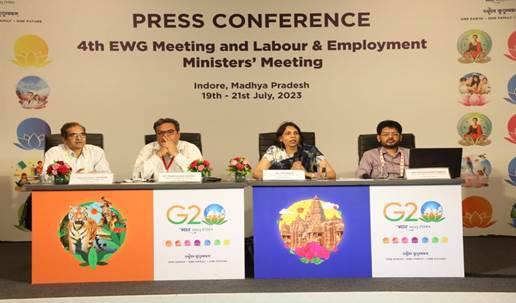
 

She said that this meeting will be presided over by the Union Minister for Labour & Employment, Shri Bhupender Yadav and 24 Ministers from different countries will attend. During this, representatives of G-20 members and guest countries, international and regional organizations and groups like Business-20, Labor-20, Startup-20, Think-20 and Youth-20 will participate.
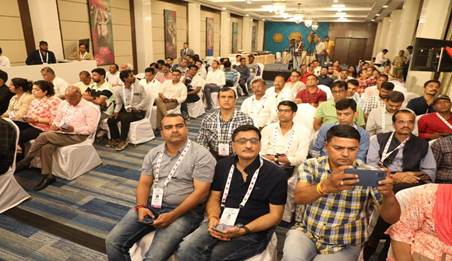
In the press conference, Smt. Ahuja told media persons that India is also keeping innovations like e-Shram portal before the working group meetings. Through this portal, complete information about the workers of unorganised sectors is available with the government, which proves helpful for taking steps towards benefitting their and their families’ interests.

Earlier, Shri Rupesh Kumar Thakur, Joint Secretary, Ministry of Labour and Employment informed through a presentation that while 86 delegates are participating in the 4th EWG meeting, 165 delegates including 24 Ministers will participate in the LEM meeting. Heads of international organizations and employers’ associations, including the ILO, OECD and the World Bank, will also attend the meeting.
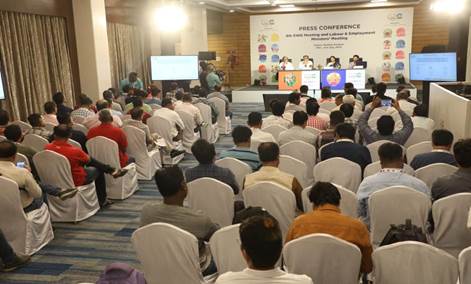
He said that it has been planned to showcase the grand natural, cultural and historical beauty of Indore and Madhya Pradesh during the event. In these, a visit to Mandu Fort and Chappan Dukan, the famous food street of Indore has been planned for the delegates. Apart from this, there will also be a heritage walk and cycle ride to see the important historical places in the city of Indore. He informed that traditional folk performing arts (music and dance) and handicrafts will also be displayed for the visiting dignitaries.

In the press conference, Dr. Pawan Kumar Sharma, Divisional Commissioner, Indore said that elaborate arrangements have been made to make the event a grand success. Apart from this, a communication plan has been also made. He outlined the measures taken by the District Administration and State Government for organizing the meeting.

****

Introduction to chameli devi public school

Chameli Devi Public school is located in Indore. It is one if the most popular school in the city. The school is from the agrawal group which had several colleges and schools in the city itself.

The school was started by Mr. Puroshtam Agrawal with a view of providing quality education to middle class students. The name of school was kept in the memory of his mother.

The school is affiliated by CBSE board and is upto class 12th. The streams offered are science,maths and commerce. The campus of school is 5.22 acres having playgrounds, computer labs,smart classes, science labs.

It is running in two shifts separately for bots and girls. Morning shift is for boys and noon for girls. But for 11th and 12th all classes are in morning. Co-ed is not Available in school. Both 11th and 12th classes run separately for boys and girls on different floors.

Upto class 8th books for school is from agrawal group i.e. learn by fun. From class 6th onwards Science ncert is taught. From class 9th onwards you will have ncert books.

CCTVs and fire extinguishers are present in school and proper guards are available. The fees of school is also affordable. For more details you can visit school.

Address is Tejpur gadbadi, keshar bagh road, Indore.

Bhopal to follow Indore waste management system

The protem speaker of Madhya Pradesh Legislative Assembly, Rameshwar Sharma (MLA from Huzur Vidhan Sabha constituency of Bhopal) and Bhopal municipal commissioner, KVS Choudhary visited the city on Thursday to know about Indore’s waste management system.They were welcomed by Indore collector Manish Singh and Indore municipal commissioner, Pratibha Pal at Regional Park. IMC additional commissioner Sandeep Soni was also present.

The duo visited the trenching ground to see the garbage management and the processing plants installed there. They were informed about the segregation of dry and wet garbage as well as the processing of garbage. IMC additional commissioner Soni told them about the door-to-door garbage collection in the city and the use of wet garbage in making manure. Also, he informed them about the dry waste plant where 12 kinds of material were segregated and then recycled into useful material. He also told them about the construction of a park at trenching ground where earlier there used to be mounds of rotting garbage.

The protem speaker and Bhopal municipal commissioner also visited the Bio-gas plant near Choithram Mandi where the wet garbage collected from the mandi is processed in the plant to make a bio-gas.

The protem speaker, Sharma told the officers about the problem of garbage in his constituency. He said that there is no garbage processing or recycling unit in his constituency due to which mountains of garbage can be seen in his area. Due to this problem, nearby water bodies have also got contaminated.

He appreciated the Indore model of garbage processing and said that he will try to replicate such a model and management system in his constituency. He instructed the Bhopal municipal commissioner Choudhary to observe the things minutely and bring similar developments in Bhopal.

TOD in India

 Indian cities face a multitude of issues such as severe congestion; deteriorating air quality; increasing greenhouse gas (GHG) emissions from the transport sector; increasing road accidents; and an exploding growth in the number of private vehicles (largely motorcycles). With the urban population projected to more than double in the next generation, the situation could easily get out of control and thwart India’s economic development efforts unless remedial measures are soon taken. 

The state of public transport in the majority of Indian cities has degraded over the years. Rising population and underdeveloped mass transport has led to a rapid rise of personal vehicles, traffic congestion and an increase in pollution levels. Moreover, the majority of people do not use public transport simply because of the lack of it and inaccessibility to the transit. Therefore, while augmenting public transport, planning for accessibility is the need of the hour. Increased density and improved connectivity through TOD can help achieve that. But one of the most important reasons for thinking about TOD for Indian cities is the recent emphasis on public transport at all levels of government. Scholars have argued that transport sector in India is extremely energy intensive and needs massive investments in mass transit to quell the rise of private motorized mobility. 

Post the announcement of mission based programs like Jawaharlal Nehru National Urban Renewal Mission (JNNURM) in 2005, Atal Mission for Rejuvenation, and Urban Transformation (AMRUT) and Smart Cities in 2015, there has been huge emphasis on investments in public transport. Transit systems like metro rail and Bus Rapid Transit (BRT) have found their way into many cities including Delhi, Mumbai, Kolkata, Chennai. Bengaluru, Hyderabad, Ahmedabad, Rajkot, Surat, Pune, Pimpri-Chinchwad, Hubli Dharwad, Lucknow, Kochi, Jaipur, Bhopal and Indore among many others. 

Some of these cities have gone on to leverage the huge potential accorded by the massive investments in public transit and prepared TOD plans for their cities. In western countries, TOD was used for densifying certain areas but in India the cities already have higher densities. Hence TOD in Indian cities should be looked at as a tool for improving quality of life and financial means to provide infrastructure facilities. India is taking steps towards achieving the TOD guidelines and designing a well-planned city for its people, making itself sustained and pedestrian friendly.