UN Biodiversity Conference, COP15 at Montreal, Canada


‘’The Goals and targets set in the Global Biodiversity Framework should be ambitious, yet realistic and practical’’

The Union Minister for Environment, Forest and Climate Change Shri Bhupender Yadav addressed the Stock taking Plenary at UN Biodiversity  Conference, COP15  at Montreal, Canada. Addressing the Plenary Shri Yadav said,

Mr. President, Excellencies, Ladies and Gentlemen,

I acknowledge the contribution of the parties for their valuable contribution and hope that this conference reaches a consensus on putting in place the Post 2020 Global Biodiversity Framework. Reversing ecosystem degradation and halting global biodiversity loss are essential for socioeconomic development, human wellbeing, and for advancing global sustainability. The goals and targets set in the Global Biodiversity Framework should be ambitious; yet realistic and practical. Conservation of biodiversity must also be based on Common but Differentiated Responsibilities and Respective capabilities as the climate change processes affect biodiversity.

Excellencies,

For the developing nations, agriculture is a paramount economic driver for rural communities, and the critical support provided to these sectors cannot be redirected.When food security is of paramount importance for developing countries, prescribing numerical targets in pesticide reductions is unnecessary and must be left to countries to decide, based on national circumstances, priorities and capabilities. Biodiversity conservation requires ecosystems to be conserved and restored holistically and in an integrated manner. It is in this context that Ecosystem Approaches for conservation of biodiversity need to be adopted rather than nature based solutions.


Excellencies

The successful implementation of the framework will squarely depend on the ways and means we put in place for an equally ambitious Resource Mobilization Mechanism. Hence there is a need to create a new and dedicated mechanism for the provision of financial resources to developing-country Parties. India is fully committed to working closely with all parties so that we are all able to bring out an ambitious and realistic Global Biodiversity Framework in COP 15.

Thank you very much.

MJPS

International Conference on Green Ship Recycling & Vehicle Scrapping and Review Meeting of Development of National Maritime Heritage Complex

Union Minister of Ports, Shipping and Waterways Shri Sarbananda Sonowal has said that Gujarat is the business gateway of India and one of the world’s preferred maritime destinations. Addressing International Conference on Green Ship Recycling and Vehicle Scrapping in Gandhinagar today he said with a coastline of 1,600 km, Gujarat handles over 40% of India’s cargo throughput and contributes 18% of the total cargo transported using coastal shipping. He said Gujarat was the first state in the country to privatise the port sector, and by virtue of its strategic location, proactive policies, and robust infrastructure has emerged as the flag bearer of India’s maritime success story. Shri Sonowal said India is a leading destination for ship recycling and the planned doubling of capacity of Alang-Sosiya shipyard in Gujarat will create a large number of employment opportunities and bring in more economic prosperity to Gujarat and the country. 
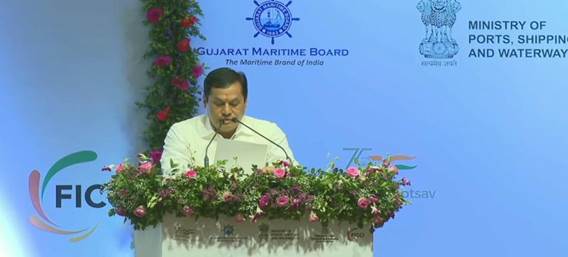


Taking about the Sagarmala Programme, Shri Sonowal  said it has given impetus to the thriving maritime sector in Gujarat with projects such as port modernisation, rail, road, cruise tourism, RO-RO & passenger jetties, fisheries, coastal infrastructure, skill development, etc. There are 74 projects worth Rs. 57,000 crore under Sagarmala Programme in Gujarat, of which 15 projects worth Rs. 9,000 crore have been completed, 33 projects worth over Rs. 25,000 crore are under implementation and 26 projects worth Rs. 22,700 crore are under development, he said.

Speaking on the occasion Chief Minister Shri Bhupendra bhai Patel said under the leadership of Prime Minister Narendra Modi, Gujarat is now moving towards port-led development. Gujarat is India’s coastal gateway. He said the state is home to Alang, the largest ship-breaking yard in the world. Just as Gujarat has been dominant in ship breaking-recycling sector, it will also be in green recycling. He said Gujarat has the potential and the political will to become a hub for green ship recycling. The Gujarat government is committed to making Gujarat a global centre for green recycling. He said Alang also has a well-developed ecosystem and capacity for vehicle scrapping and will contribute majorly to the vehicle scrapping policy.
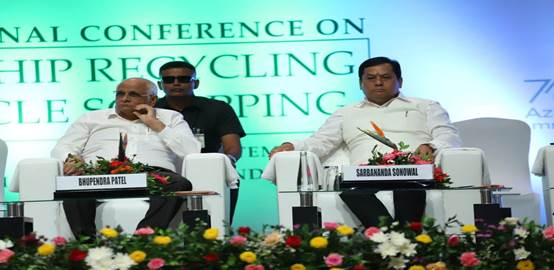
The International Conference on Green Ship Recycling and Vehicle Scrapping is showcasing the current status of ship recycling industry in Gujarat and the adoption of HKC Convention compliances. The conference is also facilitating discussion on how the EU shipping industry can take advantage of ship recycling facilities in Gujarat, and explore partnerships with EU member countries.

Highlighting the significance of the conference, MK Das, Additional Chief Secretary of Ports and Transport Department, Government of Gujarat, said the conference will put Alang on the global map as a preferred destination for sustainable ship recycling that has safe and environmentally sound ship recycling best practices in place. He said the conference will also help in exploring synergies between Alang’s ship recycling industry with the vehicle scrapping industry, and enable Alang to emerge as a vehicle scrapping hub.
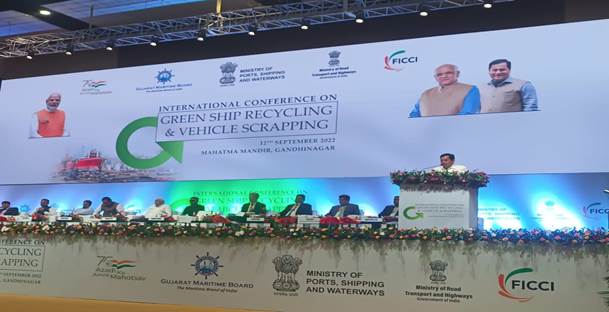
    

Two sessions were also organised as a part of the conference. The first session on “Ship Recycling Industry in India and Compliances” focused on the Ship Recycling Act, the role of GMB, compliance with HKC and EU Ship Recycling Regulation (EUSRR), and safe and sustainable recycling.

The second session was on Vehicle Scrap Policy and saw an overview of the policy. It also showcased Alang’s capabilities as a hub of vehicle scrapping.

Representatives from the Ministry of Ports, Shipping & Waterways, CEOs, and national and international industry representatives from the shipping sector including shipping lines, ship recyclers, ship owners, etc. participated in the conference. The conference will be followed by a visit to the Alang ship breaking yard on September 13.

Shri  Sonowal also visited the site of proposed National Maritime Heritage Complex near Lothal and reviewed the progress of the project in presence of senior officers of Government of Gujarat and Ministry of Ports, Shipping and Waterways. The project is being developed by the Government of India through MoPSW for an estimated amount of Rs.3500 crore. The proposed Complex would showcase India’s rich and diverse maritime heritage and will be the first of its kind in the country and one of the world’s largest maritime museums dedicated to the legacy of maritime heritage of India.

Life size architecture of the Lothal will be depicted in the museum. The various components like, lower town, middle town, Citadel, cemetery, houses, pattern of the street, sanitation system, wells, industries/workshop and marketplace, etc. will be depicted in the museum. To provide First-Hand Experience to visitors, a working model of the Lothal dockyard, functioning of the warehouse etc. will also be showcased along with typical Harappan house with components like, oven, etc. The museum will portray renowned Harappan Water Harvesting and Management system excavated at the site of Dholavira.

Renowned architecture firm Ms. Architect Hafeez Contractor has been appointed as the Project Management Consultant of the project and have already prepared Concept Design & Plan for following 5 Galleries of phase 1A:

a) Gallery- 1 Orientation and oceanic mythology

b) Gallery-2 Harappans: The Pioneer Seafarers

c) Gallery- 3 Post Harappan Trajectories: The Impact of Climate change

d) Gallery- 4 India’s contact with the Greco-Roman world

e) Gallery- 5 Special exhibitions

The work on concept design of Gallery 6 (Emergence of Indian Navy) is in progress by Ms. Architect Hafeez Contractor in consultation with the officials of Indian Navy and consolidated list of artefacts for the galleries has been finalized.

The EPC work of the NMHC phase 1A has been awarded to Tata Projects Ltd. in Mar 2022 and is targeted to be completed by Mar 2024.

The project will boost the tourism in the state of Gujarat in turn developing the economy of the region including the nearby villages namely Saragwala and Utelia. The proposed six galleries planned in the NMHC project will focus on different time periods of the Maritime history to the visitors.

Speaking after the visit Shri Sonowal stated that the project will be developed as a new international destination for tourist and to stand at par with other renowned international museums of the world under the Sagarmala program of the Ministry of Shipping. He said It will also create an opportunity of employment for the local people and help them develop a number of cottage industries thus materializing the vison of Atmanirbhar Bharat of Prime Minister Shri Narendra Modi.


Benefits of attending Virtual conferences

In-person events such as international conferences, seminars, lectures, debates, symposia, and the like, have long served members of the academic community and professionals from industry, by serving as platforms where the latest knowledge can be acquired. Anyone wishing to update themselves on the most recent developments and advancements in their fields of interest can do so easily by taking part in such events. 

However, over the past few years, a new alternative to these in-person events have emerged in the form of virtual conferences that are conducted online. These online events as most people are aware of, are events that are conducted through the internet. Participants take part in the event by logging into websites or portals where the entire conference is being broadcast. While a lot of conference-goers are skeptical about such events, doubting their efficacy, many (including those who don’t normally take part in conferences) are finding these modern alternatives incredibly convenient and equally, if not more effective than their in-person counterparts. 

Listed below are all the various benefits that virtual conferences have to offer participants.

  • Being Able To Enjoy The Conference Experience From Home

This is perhaps one of the biggest advantages that taking part in an online academic conference has to offer conference-goers. Whereas for an in-person event, one would have to spend money on traveling to the venue of the conference, taking pains to navigate through a city and find the exact location of the venue, partaking in online conferences only requires people to simply sign up and log in, much like they would for an email or social media account. 

Aside from not having to spend money or waste time on traveling, finding accommodations and meals, participants of a virtual academic conference also needn’t worry about dressing conventions and rules. One can dress in the most comfortable attire possible for online conferences and not have to bother about formal wear. 

  • One Can Enjoy The Conference Experience On The Go

Yes! With the rapid advancement of smartphone technology, there’s no reason why one should only take part in an online conference from their home or any other static location. Participants can simply login to the website where the conference is taking place, from their mobile phones while they’re travelling and take part in while travelling from place to place. 

  • Participants Have More Time To Collect Their Thoughts

Unlike in-person conferences and symposia, where attendees are plagued by several distractions, including disturbances by other participants, noises (both from outside the venue and inside), lingering thoughts and worries about food, accommodation, and travel, participants of virtual academic events can devote their entire focus and attention to the virtual events that they’re attending with ease. This unwavering focus and attention that participants of virtual academic conferences are able to devote to these events helps them grasp remarkably more insights, retain more knowledge, understand concepts better, and ask more questions (to gain clarity on complex theories), than those who take part in in-person conferences. 

  • Gaining The Most Bang For Your Buck

Those who take part in conferences that are conducted virtually, also find that they have far more fulfilling experiences for lesser money than they do taking part in in-person academic events. This is because not only are the registration fees for such events far less than for conventional, in-person events, there is also no need for participants to waste their precious money on accommodation, food, and travel. This means that they can learn, network, develop their skills, and do everything else that they would in an in-person event, for much cheaper by taking part in a virtual academic event such as a conference, seminar, debate, lecture, or symposium.  

If you’re someone who has been thinking about taking part in a virtual academic event for a while now but has been putting it off, in the pursuit of better in-person events, you will find that international virtual conference from ARDA Conferences offers far more opportunities for career growth and enhancement, skill development, networking and forming profound collaborative partnerships and association than the former.