GNSS technology enhances navigation and positioning, playing a crucial role in modernizing toll collection systems, ensuring seamless travel, and reducing congestion on our roads

 To provide seamless and barrier-free tolling experience on National Highways, Indian Highways Management Company Limited (IHMCL), a company promoted by NHAI organised a day-long international workshop in New Delhi on ‘Global Navigation Satellite System (GNSS) based Electronic Toll Collection in India’. The international workshop provided a unique platform to both industry and global experts to deliberate various aspects related to smooth implementation of the free-flow tolling system based on GNSS technology in India.

 
Union Minister for Road Transport and Highways Shri Nitin Gadkari was the Chief Guest on the occasion. Shri Ajay Tamta, Union Minister of State, MoRTH; Shri Harsh Malhotra,Union Minister of State, MoRTH & Corporate Affairs; Shri Anurag Jain, Secretary, MoRTH; Shri Santosh Kumar Yadav, Chairman NHAI; Shri Vishal Chauhan, Member (Administration) NHAI & CMD IHMCL; Shri S.P. Singh, Joint Secretary (Logistics) MoRTH and senior officials from Ministry of Road Transport & Highways, NHAI, IHMCL along with international industry experts from the US and Europe and representatives from IITs, NIC, NPCI, C-DAC, HOA(I), NHBF, IRF, SIAM, Financial institutions and leading global technology companies were present on the occasion.
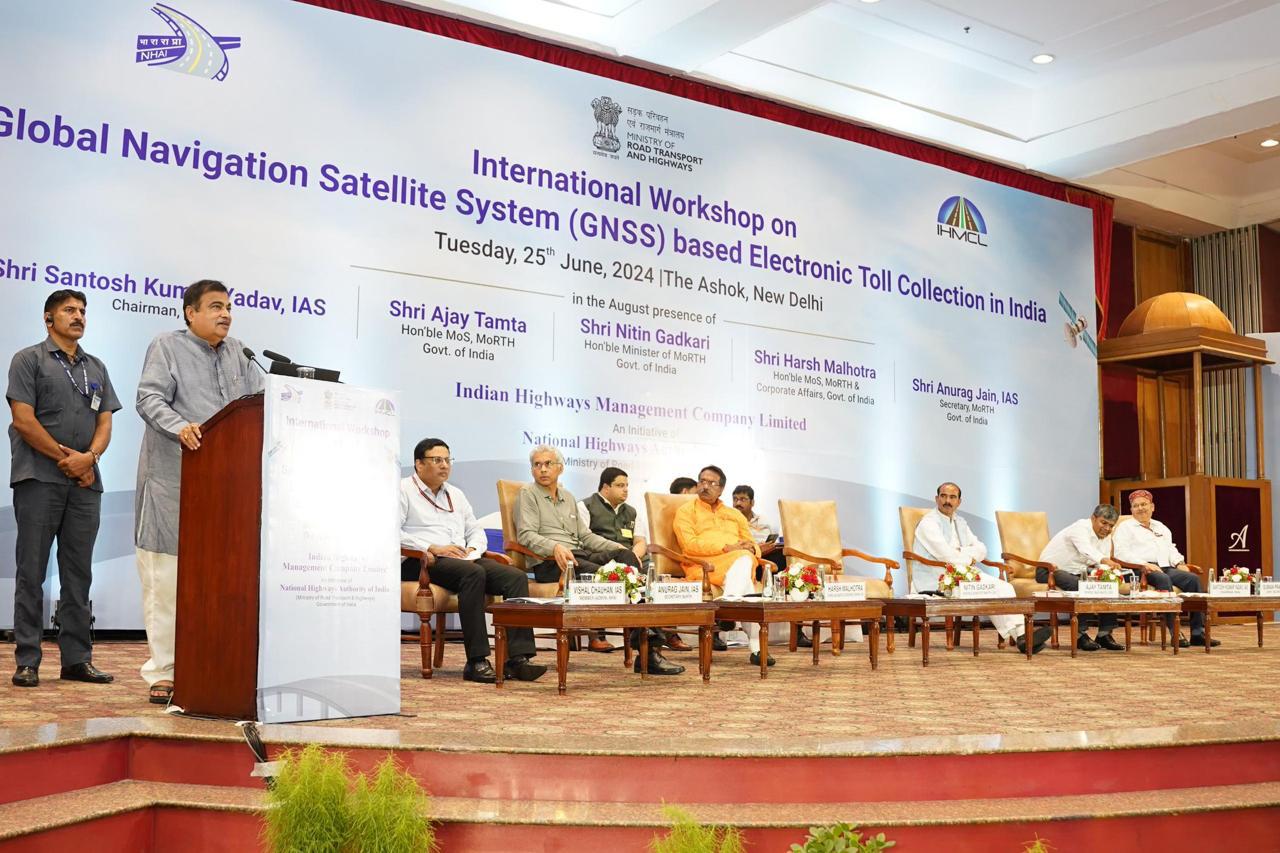
Multiple panel discussions were held at the daylong workshop, where varied industrial and technical professionals along with global GNSS experts deliberated upon different aspects that included On-Board Units (OBU), Commercial vehicles and NH fee rules, Toll Charger Software, Role of issuer entity and Essentials of road infrastructure for successful implementation of multi-lane free flow Global Navigation Satellite System (GNSS) based Electronic Toll Collection in India.

Speaking on the occasion, Union Minister for Road Transport and Highways, Shri Nitin Gadkari said, “GNSS technology enhances navigation and positioning, playing a crucial role in modernizing toll collection systems, ensuring seamless travel, and reducing congestion on our roads. We are continuously working towards easing citizens’ lives, making governance more transparent, and providing faster services.“

Shri Anurag Jain, Secretary, MoRTH said, “Participation from many global experts on GNSS in today’s workshop which is a testimony of the belief that the world has in India’s growth story. We are working to realize the vison of a developed India by 2047 and implementation of GNSS will be one of the important steps towards that goal.”
 
Shri Santosh Kumar Yadav, Chairman NHAI “Over the past decade, road network has expanded manifolds and National Highways carries over 70% of country’s freight along with the passenger traffic. Implementing GNSS will immensely contribute not only towards growth of our economy but will also make barrierless tolling a reality for our citizens.”
 
Shri Vishal Chauhan, Member (Admin), NHAI & CMD, IMHCL summarized the key takeaways and outlined the way forward from the panel discussions held during the daylong International Workshop on GNSS-based Electronic Toll Collection in India.
 
Global Navigation Satellite System (GNSS) based Tolling is a barrier free method of Electronic Toll Collection wherein the road users are charged on the distance they have travelled on the tolled Highway stretch.
 
NHAI plans to implement the GNSS-based Electronic Toll Collection (ETC) system within the existing FASTag ecosystem, initially using a hybrid model where both RFID-based ETC and GNSS-based ETC will operate simultaneously. Dedicated GNSS lanes will be available at toll plazas, allowing vehicles using the GNSS-based ETC to pass through freely. As GNSS based ETC becomes more widespread, all lanes will eventually be converted to GNSS lanes
 
Implementation of GNSS based Electronic Toll Collection in India will facilitate smooth movement of vehicles along the National Highways and is envisaged to provide many benefits to highway users such as barrier less free-flow tolling leading to hassle-free riding experience and distance-based tolling. The GNSS based Electronic Toll Collection will also help to plug leakages and check toll evaders resulting in more efficient toll collection system across the country.
DRDO holds XVIII International Workshop on High Energy and Special Materials

 he Defence Research and Development Organisation’s  (DRDO)  High Energy Material Research Laboratory (HEMRL), Pune  is organizing the XVIII International Workshop on High Energy and Special Materials (HEMs-2023) in association with Tomsk State University & Federal Research & Production Centre, Russia on 2nd & 3rd November 2023 at Dr APJ Abdul Kalam DRDO Golden Jubilee Auditorium, Pashan, Pune. The workshop was inaugurated by Dr Samir V Kamat, Secretary Department of Defence R&D and Chairman DRDO.

 HEMRL is organizing  this international workshop for  the first time in India, which provides a platform to the scientists, technocrats and researchers to share knowledge, experience and technological advancements made in recent past. About 250 delegates from countries like Russia, Germany, France, India etc., are attending the workshop. Various DRDO and ISRO laboratories, academic institutes and industries are participating in the workshop.

 HEMs-2023 is being held to discuss, deliberate and share new developments in recent past in High Energy Materials and allied technologies. The theme of this workshop is ‘Emerging Trends in High Energy and Special Materials’. The workshop is aimed at strengthening the collaboration of scientists and researchers across the globe on the development of new articles based on High energy and special materials. Focused areas for deliberations and discussions at the workshop are synthesis, characterization & evaluation of new energetic materials for various applications, insensitive & green HEMs, advanced high explosive formulations and devices, advanced pyrotechnics, nano materials for HEMs application, demilitarization, waste management, environmental studies and disposal technologies for HEMs, advances in special materials and allied technologies.

The International Workshop on HEMs was started in the year 2004 and thereafter regularly organized by Russia with International Collaborators like Politecnico di Milano, Italy; Airbus Safran Launchers (Ariane Group) and Universite Lyon 1, France; JAXA, Japan.

*****

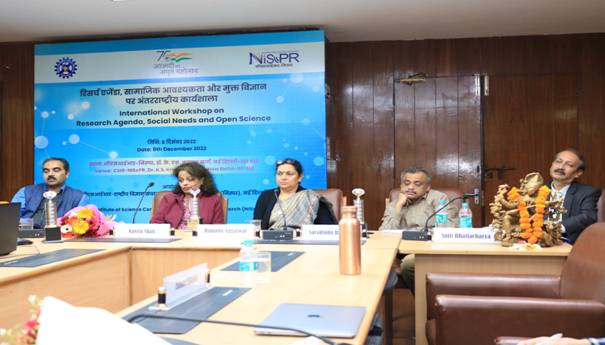
International Workshop on Research Agenda, Social Needs and Open Science

  by Shashikant Nishant Sharma 

CSIR-NIScPR (National Institute of Science Communication & Policy Research) is involved in creating livelihood and foster skill development in rural areas through CSIR technologies. Recent cutting-edge fields are being worked on by various R&D divisions of the lab. Scientometric has been one of the institute’s strongest areas and CSIR-NISTADS (which was one of the laboratory which together with CSIR-NISCAIR merged to became NIScPR) was instrumental in bringing this area as a focus area of research and input to policy making in India. These were the words of Prof. Ranjana Aggarwal, Director, CSIR-NIScPR who was delivering a welcome address in an International Workshop on ‘Research agenda, Social needs and Open science’ organized by CSIR-NIScPR.


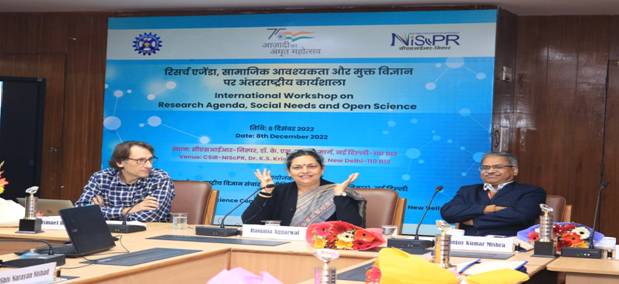
Prof. Ranjana Aggarwal, Director, CSIR-NIScPR addressing the workshop

Prof. Aggarwal highlighted that CSIR-NIScPR is the largest government organization in the nation that publishes more than 15 journals in a variety of research fields in an open access mode as there is no APC involved for publishing along with popular science magazines publications to bridge the gap between science and society. An online repository National Open Periodicals Repository (NOPR) of CSIR-NIScPR also provides to access of older papers from anywhere in the world. She concluded by emphasizing that CSIR-NIScPR is working towards solving problems under the motto “One Earth, One Family, and One Future.”

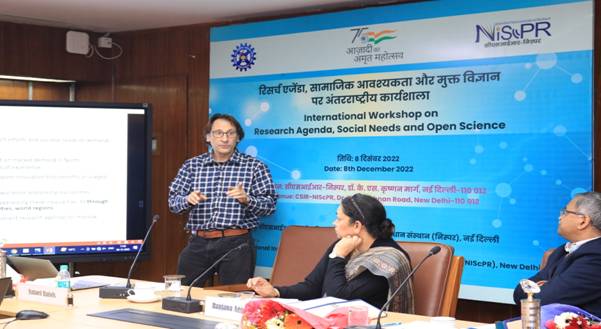
The global challenges have called for scientific research to increasingly reshape their agenda to focus more on societal problems. The reshaping can be seen prominently in the STI (Science-Technology-Innovation) policy framing of different countries and funding bodies. Responsible research and innovation, open science, open innovations are some of the key terms of new era that get space in policy articulations of different countries. Innovation System is also paying serious attention to informal, grass root and frugal innovations as they intervene to address unmet societal challenges. Cross-disciplinary interactions across different stakeholders have become important in this environment. The policy interactions need to be more evidence based to reshape the agenda and design pathways for implementation. In this context, an International Workshop on Research Agenda, Social needs and Open Science was organized on 8 December 2022 at CSIR-NIScPR. The conference was addressed by eminent scholars and policy makers from India and abroad.


Dr. Ismael Rafols, UNESCO Chair, Leiden University, Netherlands delivering keynote address

Dr. Sanjay Kumar Mishra, Sr. Advisor, Department of Biotechnology, put forward his initial remark about the subject of workshop as putting three oceans of knowledge set into one go, namely bibliometrics, scientometrics and infometrics. Dr. Mishra urged to take into consideration social needs of societies, countries and on global level in research and research agenda to extract maximum benefit out of scientific research to mankind. He also opined that science advisory role is as important as research output. Usually science research is in general pro urban, pro affluent, there is need to be new focus on society oriented and need for synchronization of science and society. Bibliometrics and scientrometrics tool can be used to understand the gap in the research for society by scientific communities.

Speakers of the second session focused on ‘Frugal Innovations and Openness

Dr. Sujit Bhattacharya, Chief Scientist & Dean-Policy Research, CSIR-NIScPR and Coordinator of this Workshop began his talk by giving a brief overview of STS (Science, Technology and Society), innovation studies and Scientometrics research, drawing upon the strong linkages among these fields of research. He stressed that the contemporary global challenges have called for science-technology-innovation agenda be shaped by societal needs and user driven approach.


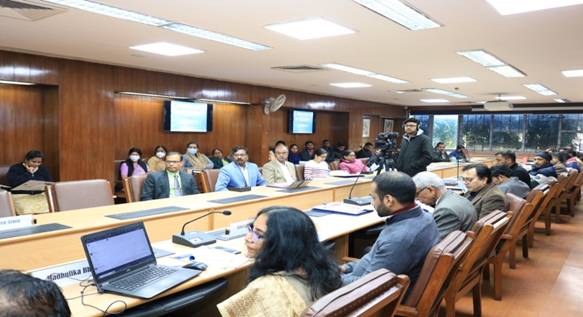
Scientists, staff members and audience of the workshop

Dr. Ismael Rafols, UNESCO Chair, Diversity and Inclusion in Global Science Centre for Science and Technology Strategies (CWTS), Leiden University, Netherlands delivered the keynote address. Dr. Rafols reinforced UNESCO recommendation of diverse and inclusive matter for research agenda for benefit of whole human kind. He brought forth the usual notion that research agenda tends to favour elite and rich though not universal but true to a greater extent. He justified his argument by describing concentration of research in global north, being driven by market demands and incentivized by few narrow academic goals and social groups. Dr. Rafols highlighted that research agendas are not in sync with SDG goals in higher and middle income countries. Evidence indicates better alignment in least developing countries of research with SDGs. He emphasized upon the need for more open access to science and having more open infrastructure so that maximum benefit can be achieved by mankind. He concluded by highlighting need for inclusion of citizen in sciences to lessen the misalignment.

Prof. Saradindu Bhaduri, Associate Professor, Centre for studies in Science Policy, Jawaharlal Nehru University, New Delhi and coordinator of the Trans-Disciplinary Research Centre on frugality studies (a joint initiative of JNU with Leiden University) gave his presentation on how research agenda, innovation, regulation, and user driven research conflict with each other. He highlighted some interesting engagements between policymakers and stakeholders. He highlighted how useful and widely used appliances such as stove suffer from agencies not giving standard certification.

Dr. Vivek Kumar Singh, Professor and Head of the Computer Science Department, Banaras Hindu University (BHU), Varanasi provided an overview of open access and its various forms, such as Gold, Platinum, and Diamond open access. He highlighted the open archive available at India such as the IndiaRxiv, eprints by the Indian Institute of Science, Krishikosh by the ICAR etc. Dr. Singh correctly emphasized the need for making research accessible to society because there is a gap in knowledge access in India, and we need to seek for effective policy implementation to address this.

Dr. Kavita Shah, Professor, Purdue University, USA gave a brief insight of the changing environment she has been observing in India now. The infrastructure, and support to research and many institutions now are in India which is bringing a positive change for doing high end research. She felt that this opportunity calls for students and researchers to make their research more aligned to the challenges faced by the society.

Dr. Madhulika Bhati, Principal Scientist, CSIR-NIScPR and Dr Anurag Kanojia, Policy Fellow, Department of Computer Science, BHU as discussant drew upon the important learning from this workshop. They stressed upon the important argument and key issues that linked the different presentations together.

Dr. Shiv Narayan Nishad, Scientist, CSIR-NIScPR gave a broad overview of the ongoing project on Social Network Analysis by CSIR-NIScPR. This study led by Dr. Sujit Bhattacharya and team in which he is the Co-Principal Investigator is exploring how social network analysis can be developed as a resource material for its application in different fields of studies. The project intends to impart training and provide the resources developed in open access.

The interactive session led to many questions and comments that enriched the workshop. The large number of young researchers who were among the attendee raised many important issues related to their research and how this workshop has benefitted them to think of Open access, aligning their research in proper direction, etc. At the end of the workshop, Dr. Sandhya Lakshmanan, Scientist CSIR-NIScPR proposed vote of thanks. Dr. Kasturi Mandal, Principal Scienctist, CSIR-NIScPR anchored the whole event and young researchers who acted as rapporteurs.