

This year world is facing the wrath of nature in every possible way from a deadly pandemic to extreme heat waves and what not. It has been tough year for many of us because suddenly all these disaster taking place did not gave any time for recovering, and above all this people are facing loss and losing their hopes.
Specifically talking about India, the COVID waves made Indians witness the worst medical emergencies and people losing life Infront of the eyes. The situation was horrific and shook everyone deep inside. The ongoing situation is all about reducing the chances to enter into the second wave. In the month of May cyclone Taut hit the western shore, the reason behind cyclone formation was increased surface temperature due to global warmimg, even after taking several measures this high intensity cyclone created loss. The continues Cloud burst in the hilly areas is posing another threat , for both hilly and plain areas, cloud burst have further increased the risk of landslides and flash floods. The force has been deployed to rescue people safely out of such areas Jammu and Kashmir and Himachal Pradesh are worst effected. The rescue process is hampered by bad climatic conditions and hilly terrain due to lost of connectivity it has become difficult to reach people. moreover, this can work as a catalyst for spreading COVID.
The Indian Space Research Organisation has planned to launch a geo imaging satellite this year. the launch is delayed due to COVID 19 situation but, as per Dr. Jitendra Singh the minister of state for science and technology the launch will take place soon. EOS -03 is a geo imaging satellite is specialised in monitoring the geographical changes and climatic movements on regular bases, it will be monitoring the country on regular bases. This will be helpful in keeping an eye upon the natural disasters like landslide, flood etc and for monitoring any climatic situation. Before this ISRO has announced about successful testing of Vikas engine that is for upcoming Gangayaan Mission. The satellite is bild with latest technology to ensure better and reliable results in future. This will add another satellite into the solar system strengthening the satellite network of India, and will further help in preparation of the unforeseen disasters. As now India is facing trouble in terms of the bad climatic condition in the hilly areas and other part of the country. Indian Space Research Organisation has made extensive development in past one year, ISRO play a significant role in India’s Development in space science and technology, it is widely recognised space agency. Such development will help secure better future and enhance the working operations. ISRO has even contributed at the time when COVID was at its peak and ventilators were not available to the people as they were either occupied or unavailable ISRO developed cost effective ventilators and the production was did at large scale to support the people in difficult times. Natural disaster don’t come with warning thus its better to make arrangements before hand.
Tag: isro
China wants to launch asteroid-deflecting rockets to save Earth from Armageddon
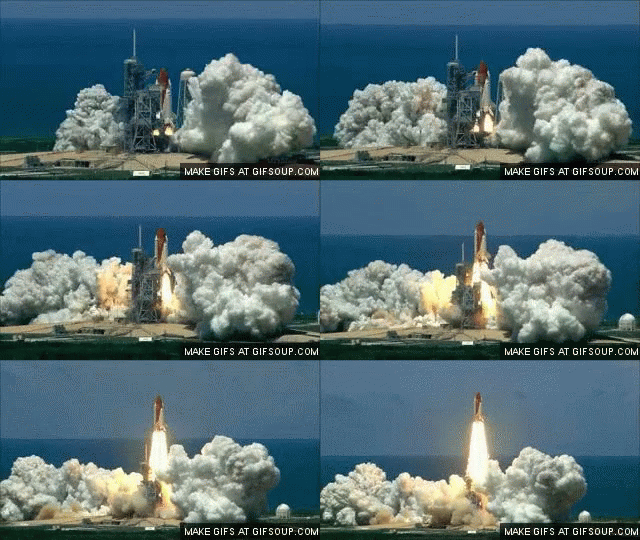
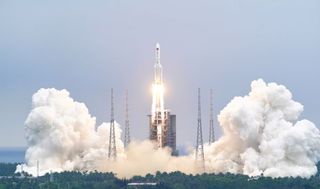
Chinese scientists are planning to fire more than 20 rockets into space to divert an asteroid impact that has a small chance of one day ending life on Earth.
Their target is an asteroid named Bennu, a 85.5-million-ton (77.5 million metric ton) space rock that is on track to swoop within 4.6 million miles (7.5 million kilometers) of Earth’s orbit between 2175 and 2199. Although Bennu’s chances of striking Earth are slim — at just 1 in 2,700 — the asteroid is as wide as the Empire State Building is tall, meaning that any collision with the Earth would be cataclysmic.
The estimated kinetic energy of Bennu’s impact with Earth is 1,200 megatons, which is roughly 80,000 times greater than the energy of the bomb dropped on Hiroshima. For comparison, the space rock that wiped out the dinosaurs delivered about 100 million megatons of energy.
Scientists at China’s National Space Science Center calculated that 23 Long March 5 rockets, each weighing 992 tons (900 metric tons), pushing against the rock simultaneously would be necessary to divert the asteroid away from a fatal course by nearly 6,000 miles (9,000 km) — 1.4 times the Earth’s radius. Their calculations are detailed in a new study published in the forthcoming Nov. 1 issue of the journal Icarus.

“Asteroid impacts pose a major threat to all life on Earth,” Mingtao Li, space science engineer of the National Space Science Center in Beijing and lead author of the new study, wrote in the paper. “Deflecting an asteroid on an impact trajectory is critical to mitigating this threat.”
The Chinese scientists’ plan would sidestep the need to stop the asteroid by more direct, yet riskier, means — like the atomic bomb method popularized by Bruce Willis in the film “Armageddon.” In reality, nuking the incoming space rock would break it into multiple smaller chunks that could still collide with Earth, leading to devastating consequences.
The Chinese plan follows a similar, yet slightly more costly, past proposal made by the United States. The NASA plan, called Hypervelocity Asteroid Mitigation Mission for Emergency Response (HAMMER), would send a fleet of 30-foot-tall (9 meters) spacecraft with battering rams to bump the asteroid off course. NASA simulations suggest that 34-53 blows from HAMMER spacecraft, launched 10 years before Bennu collides with Earth, would be needed to shift the asteroid.
NASA and the ESA (European Space Agency) will be the first to test a novel asteroid nudging method in two joint missions launching November 24 of this year. The DART mission (Double Asteroid Redirection) will send a spacecraft to arrive a year later at the 7 million mile (11 million kilometer) distant Didymos asteroid system. Once there, the NASA spacecraft will slam into Didymos’s moonlet — a rock in orbit around the asteroid. The ESA’s mission, Hera, will then monitor how DART has budged the moonlet off-course.
Bennu is a B-type asteroid, which means that it contains high amounts of carbon and, potentially, many of the primordial molecules present when life emerged on Earth. NASA already sent a spacecraft, called Osiris-Rex, in pursuit of samples from the asteroid. Osiris-Rex arrived above Bennu in October 2020, floating above it for long enough to collect loose pieces from its surface with its 10-foot (3 m) arm. Osiris-Rex is expected to return to Earth with its spoils in 2023.
Long March 5 rockets are the workhorses of China’s space program, completing most of the deliveries to China’s space station and launching Chinese probes to Mars and the moon. The rockets have caused concern in the past due to their uncontrolled reentry to Earth. In May, the 22-ton (20 metric ton) section of a Long March 5 rocket fell to Earth, either burning up or landing in the sea near the Arabian peninsula. In May 2020, fragments from a previous March 5 rocket were believed to have crashed into two villages in the Ivory Coast.
Long March 5 rockets are the workhorses of China’s space program, completing most of the deliveries to China’s space station and launching Chinese probes to Mars and the moon. The rockets have caused concern in the past due to their uncontrolled reentry to Earth. In May, the 22-ton (20 metric ton) section of a Long March 5 rocket fell to Earth, either burning up or landing in the sea near the Arabian peninsula. In May 2020, fragments from a previous March 5 rocket were believed to have crashed into two villages in the Ivory Coast.
Virgin Galactic’s SpaceShipTwo Unity 22 launch with Richard Branson: Here’s when to watch and what to know.
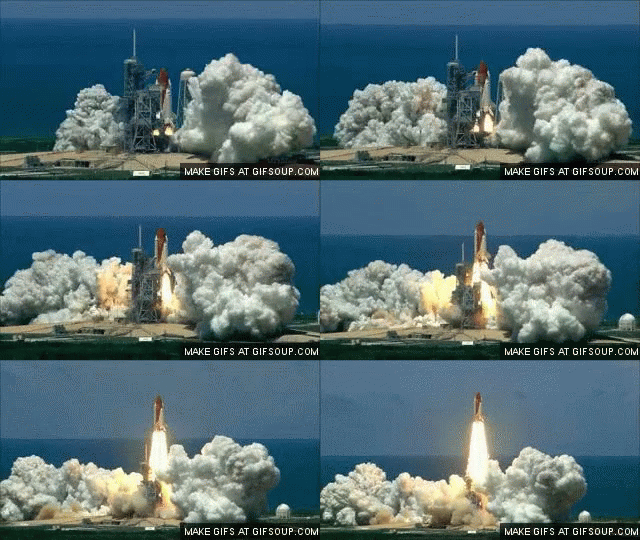
On July 11, Virgin Galactic will make a giant leap toward commercial suborbital spaceflight. The company will launch its first fully crewed flight of its SpaceShipTwo space plane Unity with a special passenger on board: the company’s billionaire founder Richard Branson.
Branson, three crewmates and two pilots will launch on the historic flight after being carried into launch position by Virgin Galactic’s carrier plane VMS Eve. They will take off from the company’s homeport of Spaceport America in New Mexico, with a live webcast chronicling the flight. Here’s everything you need to know about the mission, which Virgin Galactic has dubbed Unity 22.
Related: How to watch Virgin Galactic launch Richard Branson to space
More: How Virgin Galactic’s SpaceShipTwo works (infographic)
WHAT TIME IS VIRGIN’S GALACTIC LAUNCH & AND CAN I WATCH?
Virgin Galactic has not released a specific time for the actual Unity 22 launch, but the company has announced it will begin webcasting the mission at 9 a.m. EDT (1300 GMT). And it looks like it’s going to be fun. The crew will walk out to the ship about an hour earlier.
Stephen Colbert, host of The Late Show on CBS, will host the webcast along with singer Khalid (who will debut a new single during the launch), former Canadian Space Agency astronaut Chris Hadfield and future Virgin Galactic astronaut Kellie Gerardi, who will launch on a research flight in 2022.
The webcast will begin with the Unity spacecraft and its carrier plane taking off from its runway at Spaceport America, which is located 55 miles (88 kilometers) north of Las Cruces, New Mexico.
Branson has stated that the entire flight will take about 90 minutes, including the ascent up to launch position, release, flight to space and glide back to Earth for a runway landing at Spaceport America.
Virgin Galactic will launch six people on the Unity 22 flight, although the spacecraft is designed to carry up to eight people (two pilots and six passengers).
Unity 22’s crew includes four mission specialists:
- Sirisha Bandla, Vice President of Government Affairs and Research Operations at Virgin Galactic. She will evaluate the human-tended research experience via an experiment from the University of Florida that requires several handheld fixation tubes to be activated at various points in the flight profile.
- Colin Bennett, Lead Operations Engineer at Virgin Galactic. He will evaluate cabin equipment, procedures and the experience during the boost phase and weightless environment inside Unity.
- Sir Richard Branson, founder of Virgin Galactic. Branson will evaluate the private astronaut experience. He will receive the same training, preparation and flight as Virgin Galactic’s future ticket-buying astronauts and use the flight to fine ways to enhance the experience for customers.
- Beth Moses, Chief Astronaut Instructor at Virgin Galactic. She will serve as cabin lead and test director in space. Her tasks include overseeing the safe execution of the test flight objectives. Moses has launched on Unity before.
Two veteran Virgin Galactic pilots will be at the helm of Unity during the launch. They have both launched to space on Unity before and are:
- Dave Mackay: Mackay is Virgin Galactic’s chief pilot and grew up in the highlands of Scotland. He is a former Royal Air Force pilot and flew for Branson’s airline company Virgin Atlantic before joining Virgin Galactic.
- Michael Masucci: Michael “Sooch” Masucci is a retired U.S. Air Force colonel who joined Virgin Galactic in 2013 who racked up over 9,000 flying hours in 70 different types of airplanes and gliders during more than 30 years of civilian and military flight.
Two other pilots will fly the VMS EVE carrier plane that will carry SpaceShipTwo into launch altitude. They are:
- Frederick “CJ” Sturckow: A former NASA space shuttle commander who joined Virgin Galactic in 2013 with Masucci. A retired Marine Corps colonel, he was the first NASA astronaut to join the company and flew four space shuttle missions.
- Kelly Latimer: Latimer is a test pilot and retired lieutenant colonel in the U.S. Air Force who joined Virgin Galactic’s pilot corps in 2015. She was the first female research test pilot to join what is now NASA’s Armstrong Flight Research Centre.
The primary objective for Unity 22 is to serve as a test flight for future passenger flights by Virgin Galactic. As its number suggests, this will be the 22nd flight of Unity, but only its fourth launch to space.
The four mission specialists will each evaluate different experiences that Virgin Galactic has promised its future customers, many of whom have already reserved trips to space with the company at $250,000 a seat.
Bandla, for example, will test the experience of performing experiments aboard Unity during different phases of the flight, including the weightless period. Branson will take note of the flight as a paying passenger to look for ways to enhance the trip for ticket holders looking for the experience of a lifetime.
Related: The long road to spaceflight for Virgin Galactic and Blue Origin
Moses is Virgin Galactic’s Chief Astronaut Trainer and will ensure everyone is safe in their tests while Bennet will examine Unity’s cabin performance to look for potential enhancements.
This mission is a critical flight or Virgin Galactic, which Branson founded in 2004. VSS Unity is the company’s second SpaceShipTwo after the first, VSS Enterprise, broke apart during a 2014 test flight, killing one pilot and seriously injuring another. Virgin Galactic has made numerous safety upgrades to prevent such an accident from happening again.
The mission will begin with takeoff from Spaceport America, where Virgin Galactic has built its “Gateway to Space” terminal to serve its future customers. The crews of Unity and Eve will walk out to their vehicles at about 8 a.m. EDT (6 a.m. local time, 1200 GMT). They’ll be wearing custom Under Armour flight suits made for Virgin Galactic.
After takeoff, the carrier plane VMS EVE will haul the SpaceShipTwo VSS Unity (short for Virgin Space Ship) to an altitude of about 50,000 feet (15,000 meters), when it will drop the the spacecraft.
In Photos: Virgin Galactic’s Sleek Under Armour Spacesuits for Space TouristsAdvertisement

After separation, Unity will ignite its hybrid rocket motor, which uses a mixture of solid and liquid propellant, to begin the boost phase. This will carry Unity to its target altitude above 50 miles (80 kilometers), where the pilots and crew can expect up to 4 minutes of weightlessness. They will exist their seats and enjoy sweeping views of the Earth below through the many round windows that dot the space plane’s fuselage.
After that short encounter with weightlessness, the crew will climb back into their seats as Unity prepares to return to Earth. Pilots Mackay and Masucci will have “feathered” the spacectraft’s twin tail booms to provide stability during atmospheric reentry.
The feathered tail will then be locked back into place for the glide back to Earth, which will end with a runway landing at Spaceport America. The entire flight, from takeoff to landing, should last about 90 minutes, Branson has said.
WILL VIRGIN GALACTIC REALLY REACH SPACE WITH UNITY 22?
Virgin Galactic will launch Unity to an altitude above 50 miles (80 km), which NASA, the Federal Aviation Administration and the U.S. military classify as space. They will earn astronaut wings for reaching that height.
Another widely recognized boundary of space, the Kármán line, is at an altitude at 62 miles (100 km) above Earth. The SpaceShipTwo VSS Unity won’t reach this milestone, which has led Virgin Galactic’s competitor Blue Origin (which does fly higher than 62 miles) to call out Virgin Galactic for missing that mark.
Richard Branson has downplayed that criticism and saying that “the actual difference in experience is going to be almost non-existent,” in an interview with NPR’s Leila Fadel.
WHERE DOES VIRGIN GALACTIC LAUNCH SPACESHIPTWO FROM?
Click here for more Space.com videos…Sorry, the video player failed to load.(Error Code: 101102)Advertisementhttps://e42edf55977935dba9fbedb9fb4dde49.safeframe.googlesyndication.com/safeframe/1-0-38/html/container.html
Virgin Galactic initially launched SpaceShipTwo test flights from the company’s facilities at Mojave Air and Space Port in California. However, in 2020 the company moved Unity and its carrier craft to its permanent home at Spaceport America, where it plans to fly regular passenger flights beginning in 2022.
Spaceport America is located near Las Cruces, New Mexico and is home to Virgin Galactic’s “Gateway to Space” terminal, a welcome center and waiting room for ticketed passengers preparing for trips to space. It also sports a large hangar designed to fit multiple SpaceShipTwo spaceplanes and the VMS Eve. Virgin Galactic has also built a new vehicle, the SpaceShip III VSS Imagine.
WHEN COULD I LAUNCH TO SPACE WITH VIRGIN GALACTIC?
Click here for more Space.com videos…Sorry, the video player failed to load.(Error Code: 101102)
If you booked a trip with Virgin Galactic early and have one of the first reservations, you may get your chance to fly in space as early as 2022. If not, there’s a long wait ahead. And that’s assuming you can afford the $250,000 ticket price.
Virgin Galactic has said it plans to begin passenger launches in 2022 after a series of final test flights in 2021. The company does have hundreds of reservations for customer flights in backlog from eager would-be astronauts that have been waiting for over 17 years (since Richard Branson first announced Virgin Galactic in 2004) for the SpaceShipTwo to finally fly. The company paused taking new reservations after the 2014 accident.
Virgin Galactic is expected to resume taking reservations for “a limited number of tickets for future spaceflights” sometime this year, according to its website.
Alpha Centauri, Star System Closest To Our Sun
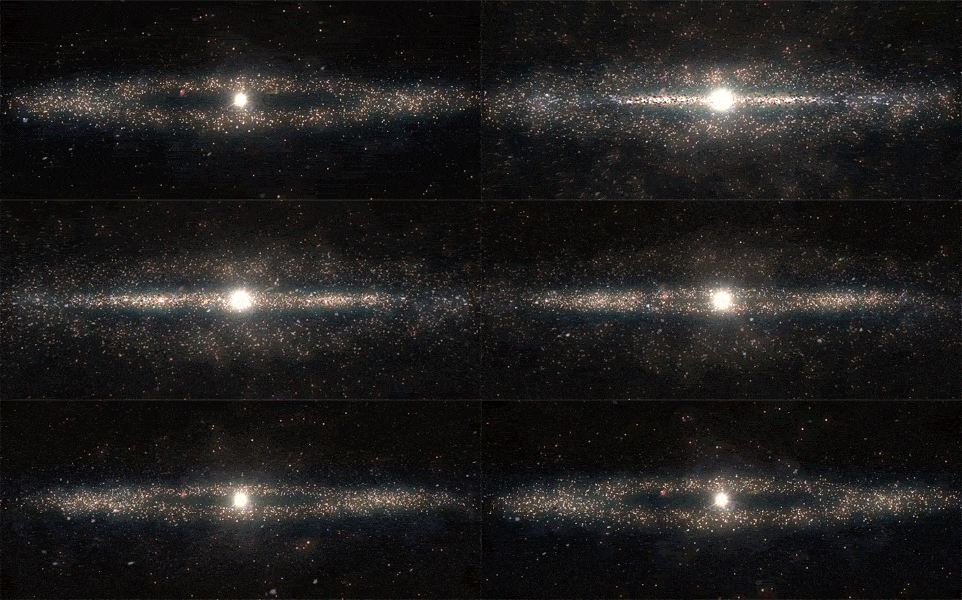
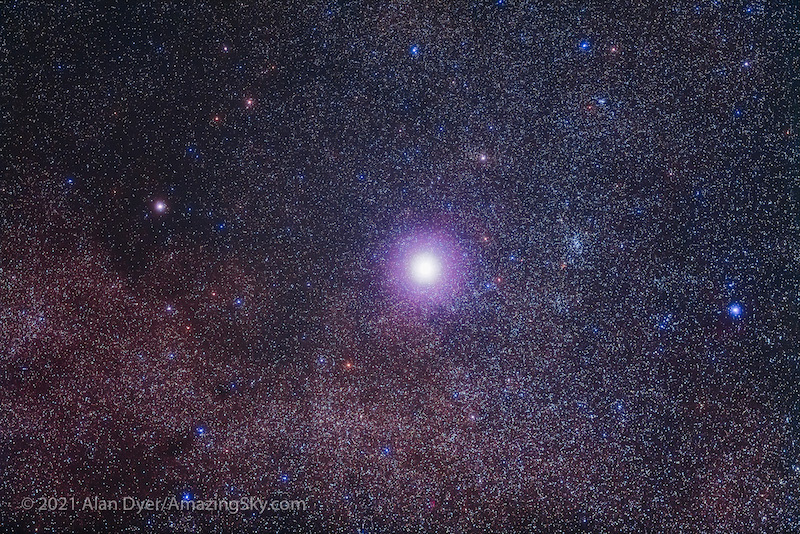
Science of the Alpha Centauri system. The two stars that make up Alpha Centauri, Rigil Kentaurus and Toliman, are quite similar to our sun. Rigil Kentaurus, also known as Alpha Centauri A, is a yellowish star, slightly more massive than the sun and about 1.5 times brighter. Toliman, or Alpha Centauri B, has an orangish hue; it’s a bit less massive and half as bright as the sun. Studies of their mass and spectroscopic features indicate that both these stars are about 5 to 6 billion years old, slightly older than our sun.
Alpha Centauri A and B are gravitationally bound together, orbiting about a common center of mass every 79.9 years at a relatively close proximity, between 40 to 47 astronomical units (that is, 40 to 47 times the distance between the Earth and our sun).Must Watch Sky Events in 2021
In comparison, Proxima Centauri is a bit of an outlier. This dim reddish star, weighing in at just 12 percent of the sun’s mass, is currently about 13,000 astronomical units from Alpha Centauri A and B. Recent analysis of ground- and space-based data, published in 2017, has shown that Proxima is gravitationally bound to its bright companions, with a 550,000-year-long orbital period.
Proxima Centauri belongs to a class of low mass stars with cooler surface temperatures, known as red dwarfs. It’s also what’s know as a flare star, where it randomly displays sudden bursts of brightness due to strong magnetic activity.
In the past decade, astronomers have been searching for planets around the Alpha Centauri stars; they are, after all, the closest stars to us so the odds of detecting planets, if any existed, would be higher. So far, two planets have been found orbiting Proxima Centauri, one in 2016 and another in 2019. A paper published in February 2021 reported tantalizing evidence of a Neptune-sized planet around Alpha Centauri A, but so far, it has not been definitively confirmed.

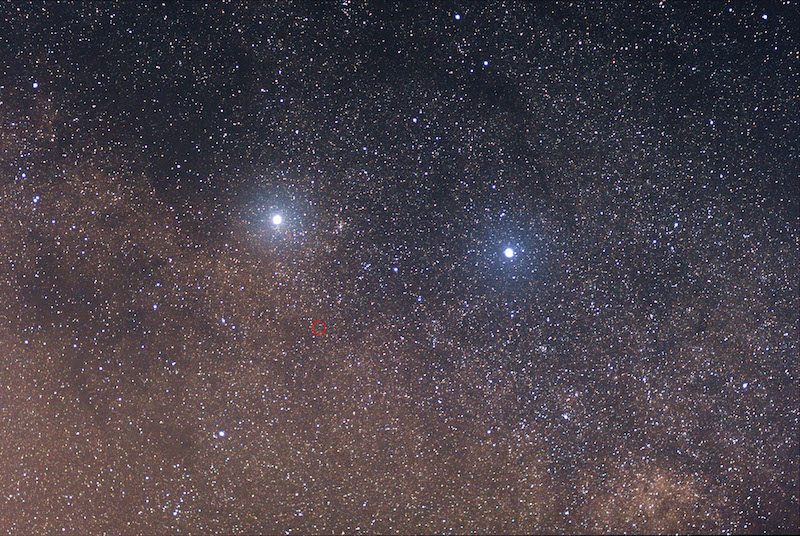
How to see Alpha Centauri. Unluckily for many of us in the Northern Hemisphere, Alpha Centauri is located too far to the south on the sky’s dome. Most North Americans never see it; the cut-off latitude is about 29° north, and anyone north of that is out of luck. In the U.S. that latitudinal line passes near Houston and Orlando, but even from the Florida Keys, the star never rises more than a few degrees above the southern horizon. Things are a little better in Hawaii and Puerto Rico, where it can get 10° or 11° high.
But for observers located far enough south in the Northern Hemisphere, Alpha Centauri may be visible at roughly 1 a.m. (local daylight saving time) in early May. That is when the star is highest above the southern horizon. By early July, it reaches its highest point to the south at nightfall. Even so, from these vantage points, there are no good pointer stars to Alpha Centauri. For those south of 29° N. latitude, when the bright star Arcturus is high overhead, look to the extreme south for a glimpse of Alpha Centauri.
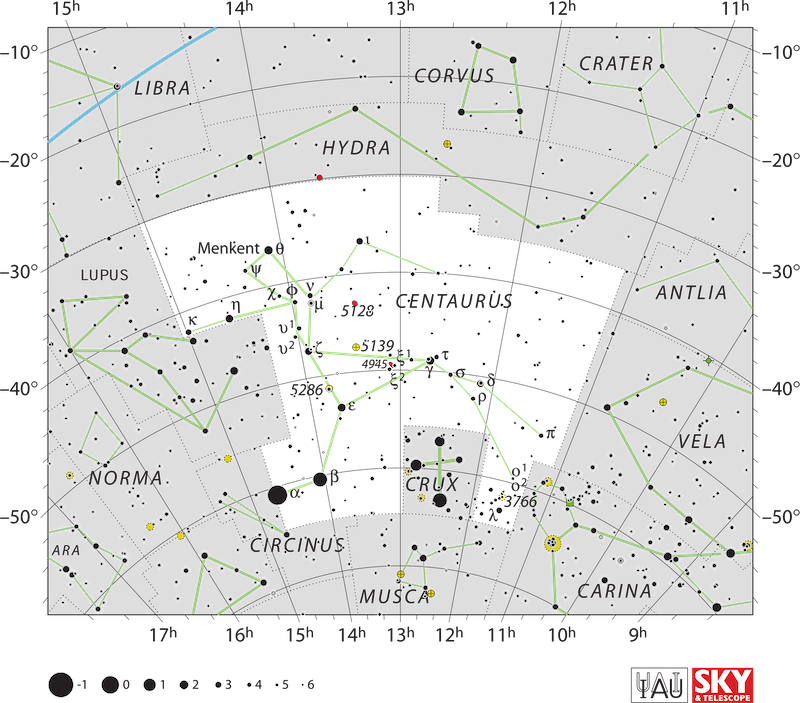
Observers in the tropical and subtropical regions of the Northern Hemisphere can find Alpha Centauri by first identifying the distinctive Southern Cross. A short line drawn through the crossbar (Delta and Beta Crucis) eastward first comes to Hadar (Beta Centauri), then Alpha Centauri. Meanwhile, in Australia and much of the Southern Hemisphere, Alpha Centauri is circumpolar, meaning that it never sets.

Alpha Centauri in mythology. Alpha Centauri has played a prominent role in the mythology of cultures across the Southern Hemisphere. For the Ngarrindjeri indigenous people of South Australia, Alpha and Beta Centauri were two sharks pursuing a sting ray represented by stars of the Southern Cross. Some Australian aboriginal cultures also associated stars with family relationships and marriage traditions; for instance, two stars of the Southern Cross were through to be the parents of Alpha Centauri.
Astronomy and navigation were deeply intertwined in the lives of ancient seafaring Polynesians as they sailed between islands in the vast expanse of the South Pacific. These ancient mariners navigated using the stars, with cues from nature such as bird movements, waves, and wind direction. Alpha Centauri and nearby Beta Centauri, known as Kamailehope and Kamailemua, respectively, were important signposts used for orientation in the open ocean.
For ancient Incas, a llama graced the sky, traced out by stars and dark dust lanes in the Milky Way from Scorpius to the Southern Cross, with Alpha Centauri and Beta Centauri representing its eyes.
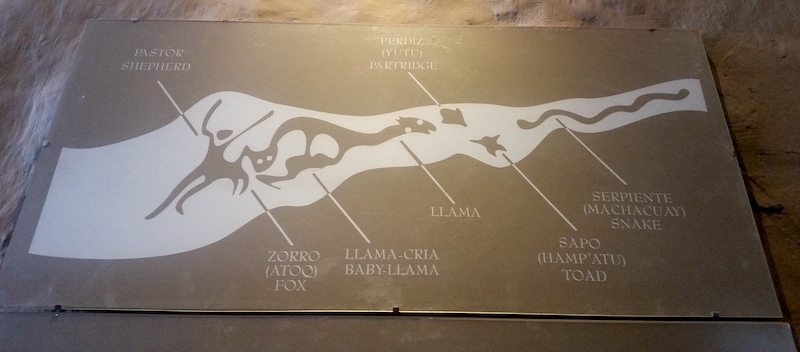
Ancient Egyptians revered Alpha Centauri, and may have built temples aligned to its rising point. In southern China, it was part of a star group known as the South Gate.
Alpha Centauri is the brightest star in the constellation Centaurus, named after the mythical half human, half horse creature. It was thought to represent an uncharacteristically wise centaur that figured in the mythology of Heracles and Jason. The centaur was accidentally wounded by Heracles, and placed into the sky after death by Zeus. Alpha Centauri marked the right front hoof of the centaur, although little is known of its mythological significance, if any.

Alpha Centauri’s position is RA: 14h 39m 36s, Dec: -60° 50′ 02″
Bottom line: Alpha Centauri is actually two binary stars that are quite similar to our sun. A third star that’s gravitationally bound to them is Proxima Centauri, the closest star to our sun.
TIME DILATION-That makes you age faster

Time Dilation
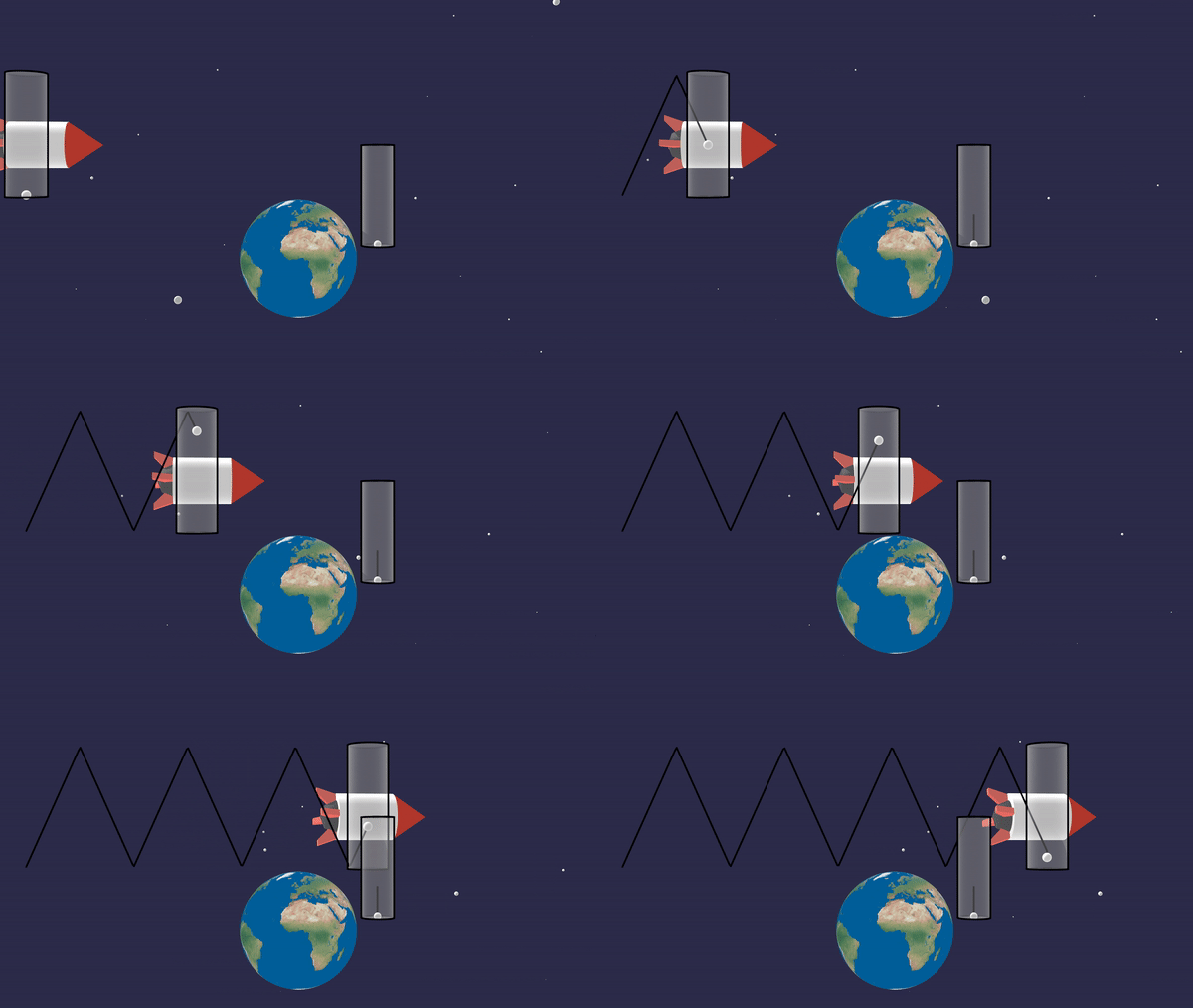
It turns out that as an object moves with relativistic speeds a “strange” thing seems to happen to its time as observed by “us” the stationary observer (observer in an inertial reference frame). What we see happen is that the “clock” in motion slows down according to our clock, therefore we read two different times. Which time is correct??? well they both are because time is not absolute but is relative, it depends on the reference frame. Let’s look at the following classic example. There is a set of twins, one an astronaut, the other works for mission control of NASA. The astronaut leaves on a deep space trip traveling at 95% the speed of light. Upon returning the astronauts clock has measured ten years, so yhe astronaut has aged 10 years. However, when the astronaut reunites with his earth bound twin, the astronauthe sees that the twin has aged 32 years! This is explained due to the fact that the astronaut’s twin is traveling at relativistic speeds and therefore his “clock” is slowed down.
Let’s see how we can calculate the time “difference”. The equation for calculating time dilation is as follows:
t = t0/(1-v2/c2)1/2
where: t = time observed in the other reference frame
t0 = time in observers own frame of reference (rest time)
v = the speed of the moving object
c = the speed of light in a vacuum
so in our problem we will let v = .95c, t0 = 10 years and we will solve for t which is the time that the earth bound brother measures.
t = 10/(1- (.95c)2/c2)1/2
t = 10/(1- .952)1/2
t = 10/ .312
t = 32 years
(the time the earth bound brother measures)
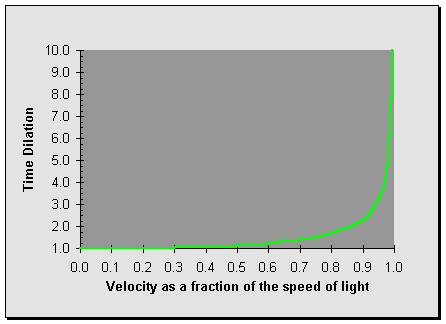
Now let’s have a closer look at the equation and determine just what impact the speed of the object has on time dilation. We can see that is the velocity is small compared to the speed of light the quantity v2/c2 approaches 0 and the equation simplifies t0: t = t0/1 which is simply t. So at relatively slow speeds (our everyday speeds) time dilation is not a factor and Newton’s Laws are still applicable. Now let’s look at high speeds (close to the speed of light), from the equation that as velocity increases the quantity v2/c2 approaches 1 (but will never quit reach it), causing the quantity(1-v2/c2)1/2 t0 become smaller and smaller….therefore causing the time measured by the other observer t0 become greater thus making our time appear slower (refer back to the example). I know its so confusing!!! read it again, think about it, then study the graph below. As one can see in the graph time dilation starts t0 “show up” between .4c and .5c. Also notice that the closer one gets to the speed of light the greater impact speed has on time dilation (notice how steep the curve gets towards the end)..
 Eduindex
You must be logged in to post a comment.