Jobs Creation

 With the global labour market amidst a ‘disruption,’ and constantly being reshaped by the fourth industrial revolution, the Economic Survey 2023-24 tabled in Parliament by Union Minister for Finance and Corporate Affairs Smt. Nirmala Sitharaman, recognizes that India would also not remain immune to the transformation caused by it.

REQUIREMENT OF JOB CREATION UNTIL 2036

The Economic Survey 2023-24 notes that Indian economy needs to generate an average of nearly 78.5 lakh jobs annually until 2030 in the non-farm sector to cater to the rising workforce.
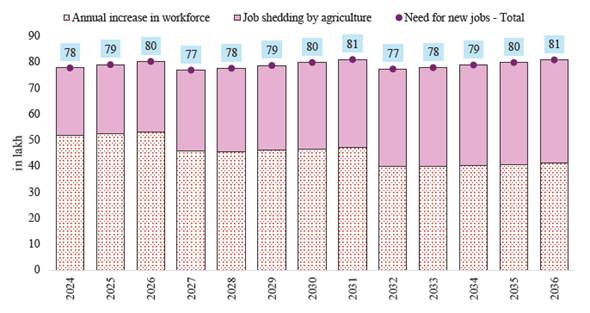
Annual requirement for non-farm job creation during 2024-2036

The Survey mentions that there is a scope to supplement the existing schemes of Production Linked Incentive (PLI) (60 lakh employment generation over 5 years), MITRA Textile scheme (20 lakh employment generation), MUDRA, etc., while boosting their implementation.

AI: THE BIGGEST DISRUPTOR

While attributing the biggest disruption in the future of work to the accelerated growth in AI, the Economic Survey 2023-24 says that India, with its vast demographic dividend and a very young population, is uniquely situated as AI poses both risk and opportunity. A particular risk is the BPO sector, where GenAI is revolutionising the performance of routine cognitive tasks through chatbots, and employment in the sector is estimated to decline considerably in the next ten years.

In the following decade, however, gradual diffusion of AI is expected to augment productivity.

But given the affinity of India’s population to work with technology, as seen with the digital public infrastructure, proactive interventions by the Government and industry can position India as a key player in the AI age, the Economic Survey notes.

MAKING THE MOST OF AI IN INDIA

Highlighting the need for research and development in this sector, the Economic Survey 2023-24 mentions a policy brief which suggests a need for an Inter-Agency Coordination Authority for AI which would act as a central institution guiding the research, decision-making, policy planning on AI and job creation.

The Government has launched several initiatives to ensure an AI enabled ecosystem and to connect AI to the youth of the country. Some of these include ‘Future Skills Prime’, ‘YUVAi: Youth for Unnati and Vikas with AI’ a national programme for school students and ‘Responsible

AI for Youth 2022’. A budget of ₹10,300 crore has been provided in 2024 for the India AI Mission, a significant move to strengthen the AI ecosystem.

A SHIFT TOWARDS GIG ECONOMY

According to NITI Aayog’s indicative estimates based on national labour force survey data, in 2020–21, 77 lakh (7.7 million) workers were engaged in the gig economy and as per the Economic Survey 2023-24, the gig workforce is expected to expand to 2.35 crore (23.5 million) and form 6.7 per cent per cent of the non-agricultural workforce or 4.1 per cent of the total livelihood in India by 2029–30. 

The Survey mentions that the significant contribution in the Indian context and globally has been the creation of effective social security initiatives for gig and platform workers. The Code on Social Security (2020) marks a significant advancement by expanding the scope of social security benefits to encompass gig and platform workers.

CLIMATE CHANGE AND GREEN ENERGY TRANSITION

Recognizing the climate change as a hard reality of the present times and projections pointing towards an increase in the frequency and intensity of extreme weather events, the Survey mentions its concomitant outcome as the possible loss of jobs and productivity.

Another aspect of climate change is the efforts to mitigate its impact by adopting green technologies and transitioning to greener energy alternatives. This trend is leading to businesses witnessing a strong job-creation effect driven by investments that facilitate the green transition of businesses and the application of ESG standards.

INDIA’S CORPORATE SECTOR ON RISE

The Economic Survey says that India’s corporate sector’s profitability is at a 15-year high in FY24 with profits quadrupling between FY20 and FY23.

It mentions that businesses have an obligation to themselves to strike the right balance between deployment of capital and deployment of labour. In their fascination for AI and fear of erosion of competitiveness, businesses have to bear in mind their responsibility for employment generation and the consequent impact on social stability.

AGRO-PROCESSING AND CARE ECONOMY FOR QUALITY EMPLOYMENT

The Economic Survey 2023-24 says that India can utilise the range of products on offer by its different agro-climatic zones and productively engage the sizeable rural workforce, comprising women who seek remunerative part-time employment and educated youth who can be technically skilled to handle small to medium scale agro-processing units.

There remains ample scope for shifting MGNREGS labour to more productive and less fiscally straining ventures. Low value-addition in agriculture and rising demand for diverse and local food products also provides a good opportunity for India to create more jobs in this sector. There are also more avenues for captive demand of agro-processed output and the sector can benefit from the synergies between the multiple existing programmes such as Mega Food Park, Skill India, Mudra, one district-one product, etc., for labour, logistics, credit, and marketing.

The care economy holds great importance for a young country like India, which has both demographic and gender dividends to reap. Highlighting the need to prepare for future care requirements of an ageing population, the Economic Survey 2023-24 says that defining care work is the first step towards acknowledging care as ‘work’.

It mentions that India’s care needs are slated to expand significantly in the next 25 years, as an ageing population follows the ongoing demographic transition while the population of children stays relatively sizeable. By 2050, the share of children is estimated to decline to 18 per cent (i.e., 30 crore persons), while the proportion of elderly persons would rise to 20.8 per cent (i.e., 34.7 crore persons). Thus, compared to 50.7 crore persons in 2022, the country would need to care for 64.7 crore persons in 2050.

Recognising the disproportionate burden of care on women being consequential to the low Female Labour Force Participation Rate (FLFPR) across the world, including India, the Survey also lays emphasis on ensuring equal opportunity for females by decoupling gender and unpaid care work.

The economic value of developing a care sector is twofold – increasing FLFPR and promoting a promising sector for output and job creation. The Survey mentions that in case of India, direct public investment equivalent to 2 per cent of GDP has the potential to generate 11 million jobs, nearly 70 per cent of which will go to women.

Senior care reforms in India

The care responsibility associated with an increasingly older population necessitates formulating a future-ready wholesome elderly care policy with the Survey mentioning the care economy as a top-tier entry in India’s to-do list for becoming a developed nation by 2047. According to the Asian Development Bank report, utilising this ‘silver dividend’ of untapped work capacity of population aged 60-69 years is estimated to increase GDP by an average of 1.5 per cent for Asian economies.

*****

Job for Urban Planners

Hi all,
We are looking for candidates with:
A Bachelor’s degree (4 years) in Planning, Architecture or CIVIL 
With 
M.Plan or MBA (Finance) 
1 to 2 years of experience.
Requirements:
Understanding of Urban Planning and Urban Infrastructure 
Financial model 
Experience in managing bid processes (EoI, RfP GFR rules etc. )
Proficient report writing skills
Please share your CV at the given email address.
ankur.dwivedi1@crisil.com
Location: Mumbai (Panvel Municipal Corporation)
Engagement nature: Retainership
Thanks

Benefits of Private Jobs

  Private jobs offer various benefits, which contribute to their popularity among job seekers. Here are some common advantages associated with private sector employment:

  1. Higher Salaries: Private companies often provide competitive salaries and performance-based incentives. Employees may have the potential to earn more than their counterparts in similar roles in the public sector.

  2. Career Advancement Opportunities: Private companies typically have more fluid organizational structures, allowing employees to climb the career ladder more quickly based on merit and performance.

  3. Innovative Work Environment: Private sector organizations often focus on innovation and efficiency to stay competitive. This can create a dynamic and challenging work environment that encourages employees to think creatively and stay up-to-date with industry trends.

  4. Flexible Work Arrangements: Many private companies are more open to flexible work schedules, remote work options, and other work-life balance initiatives, providing employees with greater flexibility in managing their professional and personal lives.

  5. Employee Benefits and Perks: Private sector employers often offer comprehensive benefits packages, including health insurance, retirement plans, and various other perks such as gym memberships, wellness programs, and more.

  6. Merit-Based Compensation: Performance and merit are often key factors in salary increases, bonuses, and promotions in the private sector. Employees who consistently perform well may see faster career progression and financial rewards.

  7. Diverse Job Opportunities: The private sector encompasses a wide range of industries and job roles, offering employees the chance to explore diverse career paths and industries throughout their working lives.

  8. Investment in Training and Development: Private companies tend to invest in the continuous training and development of their employees to keep them updated with the latest skills and technologies, benefiting both the individual and the company.

  9. Innovative and Dynamic Industries: Private sector companies are often at the forefront of technological advancements and market innovations. Working in such industries allows employees to be part of groundbreaking developments.

  10. Job Security through Performance: While private sector jobs may not offer the same level of job security as some public sector roles, strong performance and adaptability to changing market conditions can contribute to long-term job security and career stability.

It’s important to note that the specific benefits can vary widely depending on the industry, company size, and individual circumstances. Additionally, job satisfaction is subjective, and what may be considered a benefit for one person may not be the same for another.

Top Skills and Training for Youths in 2024

  I can provide some general insights into skills that were considered valuable for youth. However, keep in mind that the landscape of skills can evolve rapidly due to technological advancements, economic changes, and other factors. Here are some skills that were deemed important, and they might still be relevant or have evolved by 2024:

  1. Digital Literacy and Coding:
    Understanding digital technologies and being able to code were increasingly seen as essential skills. Programming languages such as Python, JavaScript, and others were in demand across various industries.

  2. Critical Thinking and Problem Solving:
    The ability to analyze information critically, solve complex problems, and make informed decisions remains crucial in many professions.

  3. Communication Skills:
    Effective communication, both written and verbal, was highly valued. This includes the ability to collaborate with diverse teams and present ideas clearly.

  4. Adaptability and Resilience:
    The pace of change in the job market and technology requires individuals to be adaptable and resilient. This includes a willingness to learn new things and adapt to new situations.

  5. Emotional Intelligence:
    Understanding and managing one’s emotions and the ability to navigate social complexities were considered important for personal and professional success.

  6. Creativity and Innovation:
    Creativity is essential for problem-solving and driving innovation. This includes creative thinking, design thinking, and the ability to generate new ideas.

  7. Data Literacy:
    As data continues to play a significant role in decision-making, understanding how to work with and interpret data becomes increasingly important.

  8. Entrepreneurial Mindset:
    Encouraging an entrepreneurial mindset involves fostering traits like initiative, risk-taking, and the ability to identify and pursue opportunities.

  9. Financial Literacy:
    Basic financial literacy, including understanding budgeting, investing, and financial planning, is important for personal and professional life.

  10. Cybersecurity Awareness:
    With the increasing reliance on digital technologies, knowledge of cybersecurity best practices is essential to protect personal and organizational data.

  11. Health and Well-being Skills:
    Focusing on physical and mental well-being, including stress management, mindfulness, and a healthy lifestyle, contributes to overall personal success.

Remember that the specific skills in demand can vary depending on regional and industry-specific factors. It’s advisable to stay updated with the latest trends in education and job markets to ensure that training efforts align with current demands.

Program Associate at NUIA


National Institute of Urban Affairs (NIUA):

Established in 1976, the National Institute of Urban Affairs (NIUA) is a premier institute of the Ministry of Housing and Urban Affairs, Government of India, for research and capacity building for the urban sector in India. NIUA’s broad objective is to bridge the gap between research and practice on issues related to urbanization. For more than 40 years now, NIUA has been the vanguard for contributing to and building the urban narrative for a fast evolving urban India. The Institute has been actively working on bringing forth key areas of concern for urban India in order to build the urban discourse at various urban scales. It has utilized its competencies in research, knowledge management, policy advocacy and capacity building to address urban challenges and continuously striving to develop sustainable, inclusive and productive urban ecosystems in the country. It has emerged as a thought leader and knowledge hub for urban development in India and is sought after by both Indian and international organizations for collaborations and partnerships in India’s urban transforming journey. NIUA is committed towards aligning its efforts towards achieving Sustainable Development Goals (SDGs) through all its initiatives and programmes.

About the Center for Digital Governance (CDG):

The Ministry of Housing and Urban Affairs (MoHUA) has formulated the National Urban Innovation Stack (NUIS) strategy and approach with the vision to unlock urban innovation and promote collaboration across the entire urban ecosystem. The objective is to create an open digital public good which can enable co-creation and collaboration across the “quadruple helix” of government, industry, academia, and civil society and citizens’ groups in urban India.

With the goal to facilitate adoption and put technology as the core of operations for digital transformation across the ecosystem, the need for an anchor was felt to tie the strengths of all stakeholders together. Responding to this pressing necessity, Centre for Digital Governance (CDG) was institutionalised under the ambit of National Institute of Urban Affairs (NIUA). Envisioned to function as a trusted partner for distributed governance, CDG envisages establishing five practice areas on Research and Advocacy, Digital Advisory, Partnerships, Engagement Advisory and Digital Governance. The aspiration of CDG is to allow digital forces to enable the ease with which citizens, industry and government can connect, collaborate, transact, and share information; State and city administrators can increase productivity by automating routine tasks; and facilitate data-based decision making to drive governance and policy making.

The Urban Platform for deliverY of Online Governance (UPYOG), as one of the flagship programs of the CDG, will identify or create a number of the building blocks and governance mechanisms envisaged by NUIS.

Role & Responsibilities:

The Program Associate will support in the execution of in the operationalisation of the CDG and its programs. The Program Associate will provide input to the design, planning, and management of the Centre and NUDM.

Responsibilities:

  • Assist in implementing the programs and policies of the operationalising the CDG Program, coordinating with stakeholders at NIUA and MoHUA, in states, and across the urban ecosystem.
  • Manage strategy, implementation, and optimization of processes associated with the implementation of NUDM.
  • Follow up on performance indicators/ success criteria, targets and milestones, and the preparation of reports.
  • Analysis of the situation in the program, identification of operational and financial problems, and development of solutions.
  • Work with key stakeholders to create efficient practices and provide insights for the program.
  • Develop and maintain relationships with program partners at the Central, State and city levels.
  • Identify and communicate opportunities and plans for partners.
  • Travel to monitor program implementation at state and city levels on need basis.

Skills, Qualifications, and Experience:

  • Qualification: Bachelor’s in Urban Planning or Urban Management or equivalent degrees in public policy, law, commerce or others in a closely related field from a premier institute. 
  • Experience: 2-4 years in implementing programs related to technology / product management, public policy or government consulting
  • Excellent communication and Writing skills including the ability to communicate with and manage expectations of senior executives/experts and their staff.
  • Strong analytical, conceptualization and communication skills, good understanding of market research techniques and data analytics, outstanding attention to detail.
  • Skilled at stakeholder management, and coordinating teams and multi-party processes
  • Experience of working at Central/State/PSU/NGO level in the urban sector
  • Excellent verbal communication skills, including the ability to communicate with and manage expectations of senior executives/experts and their staff.
  • Experience in developing preliminary communications strategies and campaigns for government stakeholders
  • Entrepreneurial spirit, including ability to work independently and autonomously

Location: Based out of the office at NIUA, New Delhi, with travel to various Indian states as and when required.

Duration: 12 Months – extendable

Reporting Officer: Chief Program Officer, National Urban Digital Mission/Centre for Digital Governance, NIUA

Application process: Submit your application through the NIUA Job Portal

No. of Positions: 

1

Last Date to Apply: 

Wednesday, 10 January 2024

How to prepare for a technical interview | 6 Topics to prepare for your Interview

How to prepare for a technical interview

How to prepare for a technical interview which will help you to get placed? The syllabus of computer science is very vast in that case Preparation tips for Technical Interviews will definitely help you to focus on the target topics. It is impossible to cover every topic in depth especially when you have less time left for the interview. If you start covering everything little by little and with the correct strategy, you can gain what most students can lack.

Please take reference fromhttps://www.freecodecamp.org/news/interviewing-prep-tips-and-tricks/

Qualifying technical round is not tough and if done with proper planning, everything can be achieved. Let us look at the most important topics:

6 Topics to prepare for your Interview:

Interview Image

  1. C- Programming:

C-Programming is a very basic programming language to start coding.  Mostly it is taught in 1st year of your college. It can be an advantage if you have already covered this language during your schooling and then college provides you enough time to revise the topics. But if you are doing it for that first time do not worry it is still not late to get started with C programming.


Where should you start learning C programming:

I myself started learning C programming when I took admission in an engineering college, and this is how I started:

  • C programming tutorials on Naresh IT channel with instructor Shriniwas on Youtube.
  • C programming with Sourabh Shukla on Youtube.
  • Many practice question sites are better, to begin with.
  • Online portals like Sololearn, Geekforgeek are awesome with their educational material.

These resources really helped me, and I will be glad if you too can be helped with these.

C Programming Interview questions: 

  • Chances of mostly tricky questions to check how and what logic will you apply for the real-world problem.
  • Don’t forget to revise basic concepts and all the definitions, the inventor name, loop, if-else, pointers, strings, recursion, and application along with Tower of Hanoi problems.
  • Also, check for Interview Questions in C https://www.tutorialspoint.com/cprogramming/cprogramming_interview_questions.htm
  1. Data Structures:

    1. This is the most important area where you can expect a guaranteed question,
    2. Algorithms like Sorting, Time and Space Complexities of algorithms.
    3. Dynamic Allocation of Memoryusing malloc( ) and calloc( ) functions.
    4. Tree traversals
    5. Stacks and Queues and their operations and applications.
    6. Linked lists and their Operations performed(ex: insertion, deletion, searching).

Algorithms:

  1. Dynamic Programming and usage of it in various problem statements. (ex: Travelling salesperson,0/1 Knapsack, etc).
  2. Calculation of Time and Space Complexitiesof algorithms.
  3. Sorting
  4. Databases:

Mainly DBMS is taught in the 2nd year or after they cover C Programming & Data Structure. SQL (or Oracle) will help you to generate a large database along with queries.

What topics are important in DBMS:

  • DDL, DML, DCL, and TCL commands.
  • SQL constraints like JOIN, NOT NULL, UNIQUE, CHECK.
  • NORMALIZATION (1 NF, 2NF, 3NF, BCNF, 4NF, 5NF)
  • All the keys: primary key, candidate key, super key, and foreign key.
  • Transaction and its types i.e ACID properties.
  • Also, don’t forget to cover the basic interview question of DBMS from google and you can cover them from the trusted education websites.


  1. Computer Networks:

  • Also called Data Communications. Pure theoretical topics which discuss many networking techniques.
  • OSI model and TCP/IP models.
  • IPV4, IPV6, TCP, UDP, Routers, Modems, knowledge about.


  1. Operating Systems:

This could increase your confidence as most of the Operating system topics are theoretical and you can easily cover them all by hand in less than a week.

  • The basic definition of OS, advantages, application, types, etc.
  • All scheduling algorithms PROCESS and CPU scheduling algorithms.
  • MEMORY MANAGEMENT
  • DEADLOCK, deadlock prevention, deadlock avoidance, deadlock ignorance, and deadlock detection & recovery
  • SYSTEM CALLS


  1. Java(J2SE and J2EE):

  • Difference between C++ and Java.
  • OOPS concepts
  • Types of Overloading.
  • Exception Handling and Multi-tasking (Multiprocessing & Multi-Threading).
  • Collection framework.
  • Servlets and JSP’s.
  • Applet

Revise these all topics as mentioned also check the resources through youtube and many helpful education sites which are doing great in giving students ease to easily read the topics online without notes.


Preparation tips for Technical Interview

These tips helped me so much and I will want you to follow these steps to get well with your topics:

  • Don’t wait for last-minute study for placement rather cover the topic together with your university.
  • Make notes, this is key to success point, how you understand your handwritten notes, you can never understand the same way from any other resource.
  • Keep revising topics in your semester break that will build your concepts more and will make it easy for you in your 4th year of college.
  • If you are unclear with any topic, don’t wait for the instructor to teach you or visit many sites offering you all the materials for free. They are: Geeksforgeeks, Sololearn, Tutorialspoint, Javapoint, etc

If still you remain unclear then watch tutorials from youtube on the topic you are interested in. I hope this helps you, comment below for any further queries/doubt will be happy to help you.

All the Best!

How to prepare for a technical interview | 6 Topics to prepare for your Interview


How to prepare for a technical interview

How to prepare for a technical interview which will help you to get placed? The syllabus of computer science is very vast in that case Preparation tips for Technical Interviews will definitely help you to focus on the target topics. It is impossible to cover every topic in depth especially when you have less time left for the interview. If you start covering everything little by little and with the correct strategy, you can gain what most students can lack.

Please take reference fromhttps://www.freecodecamp.org/news/interviewing-prep-tips-and-tricks/

Qualifying technical round is not tough and if done with proper planning, everything can be achieved. Let us look at the most important topics:

6 Topics to prepare for your Interview:

Interview Image

  1. C- Programming:

C-Programming is a very basic programming language to start coding.  Mostly it is taught in 1st year of your college. It can be an advantage if you have already covered this language during your schooling and then college provides you enough time to revise the topics. But if you are doing it for that first time do not worry it is still not late to get started with C programming.


Where should you start learning C programming:

I myself started learning C programming when I took admission in an engineering college, and this is how I started:

  • C programming tutorials on Naresh IT channel with instructor Shriniwas on Youtube.
  • C programming with Sourabh Shukla on Youtube.
  • Many practice question sites are better, to begin with.
  • Online portals like Sololearn, Geekforgeek are awesome with their educational material.

These resources really helped me, and I will be glad if you too can be helped with these.

C Programming Interview questions: 

  • Chances of mostly tricky questions to check how and what logic will you apply for the real-world problem.
  • Don’t forget to revise basic concepts and all the definitions, the inventor name, loop, if-else, pointers, strings, recursion, and application along with Tower of Hanoi problems.
  • Also, check for Interview Questions in C https://www.tutorialspoint.com/cprogramming/cprogramming_interview_questions.htm
  1. Data Structures:

    1. This is the most important area where you can expect a guaranteed question,
    2. Algorithms like SortingTime and Space Complexities of algorithms.
    3. Dynamic Allocation of Memoryusing malloc( ) and calloc( ) functions.
    4. Tree traversals
    5. Stacks and Queues and their operations and applications.
    6. Linked lists and their Operations performed(ex: insertion, deletion, searching).

Algorithms:

  1. Dynamic Programming and usage of it in various problem statements. (ex: Travelling salesperson,0/1 Knapsack, etc).
  2. Calculation of Time and Space Complexitiesof algorithms.
  3. Sorting
  4. Databases:

Mainly DBMS is taught in the 2nd year or after they cover C Programming & Data Structure. SQL (or Oracle) will help you to generate a large database along with queries.

What topics are important in DBMS:

  • DDL, DML, DCL, and TCL commands.
  • SQL constraints like JOIN, NOT NULL, UNIQUE, CHECK.
  • NORMALIZATION (1 NF, 2NF, 3NF, BCNF, 4NF, 5NF)
  • All the keys: primary key, candidate key, super key, and foreign key.
  • Transaction and its types i.e ACID properties.
  • Also, don’t forget to cover the basic interview question of DBMS from google and you can cover them from the trusted education websites.


  1. Computer Networks:

  • Also called Data Communications. Pure theoretical topics which discuss many networking techniques.
  • OSI model and TCP/IP models.
  • IPV4, IPV6, TCP, UDP, Routers, Modems, knowledge about.


  1. Operating Systems:

This could increase your confidence as most of the Operating system topics are theoretical and you can easily cover them all by hand in less than a week.

  • The basic definition of OS, advantages, application, types, etc.
  • All scheduling algorithms PROCESS and CPU scheduling algorithms.
  • MEMORY MANAGEMENT
  • DEADLOCK, deadlock prevention, deadlock avoidance, deadlock ignorance, and deadlock detection & recovery
  • SYSTEM CALLS


  1. Java(J2SE and J2EE):

  • Difference between C++ and Java.
  • OOPS concepts
  • Types of Overloading.
  • Exception Handling and Multi-tasking (Multiprocessing & Multi-Threading).
  • Collection framework.
  • Servlets and JSP’s.
  • Applet

Revise these all topics as mentioned also check the resources through youtube and many helpful education sites which are doing great in giving students ease to easily read the topics online without notes.


Preparation tips for Technical Interview

These tips helped me so much and I will want you to follow these steps to get well with your topics:

  • Don’t wait for last-minute study for placement rather cover the topic together with your university.
  • Make notes, this is key to success point, how you understand your handwritten notes, you can never understand the same way from any other resource.
  • Keep revising topics in your semester break that will build your concepts more and will make it easy for you in your 4th year of college.
  • If you are unclear with any topic, don’t wait for the instructor to teach you or visit many sites offering you all the materials for free. They are: Geeksforgeeks, Sololearn, Tutorialspoint, Javapoint, etc

If still you remain unclear then watch tutorials from youtube on the topic you are interested in. I hope this helps you, comment below for any further queries/doubt will be happy to help you.

All the Best!

Vacancy for Faculty Positions at National Institute of Technology (NIT) | Calicut, Kerala | Architecture, Planning


Vacancy for Faculty Positions at National Institute of Technology (NIT) Calicut

The National Institute of Technology Calicut (NIT Calicut or NITC) is a premier technical institution in India located in Calicut, Kerala. It is one of the 31 National Institutes of Technology in the country and was established in 1961 as the Regional Engineering College Calicut. It was later granted Institute of National Importance status and renamed as the National Institute of Technology Calicut in 2002.

Here are some key points about NIT Calicut:

  1. Academic Programs: NIT Calicut offers undergraduate, postgraduate, and doctoral programs in various engineering, technology, and science disciplines. These programs include B.Tech, M.Tech, M.Sc, MBA, and Ph.D. degrees.

  2. Campus: The campus is spread over a vast area and provides facilities like hostels, sports complexes, academic buildings, laboratories, and a library.

  3. Research and Development: NIT Calicut is involved in cutting-edge research and development activities. The institute encourages faculty and students to engage in research projects and publish their findings in reputed journals.

  4. Departments: The institute has various departments, including departments of Engineering, Sciences, and Humanities. Each department offers specialized courses and conducts research in its respective field.

  5. Placements: NIT Calicut has a strong placement record, and its graduates are sought after by leading companies in the industry. The institute’s placement cell facilitates interactions between students and potential employers.

  6. National Importance: Being an Institute of National Importance, NIT Calicut receives funding and support from the Government of India, allowing it to maintain high academic standards and infrastructure.

  7. Cultural and Technical Festivals: The institute hosts various cultural and technical festivals, providing students with opportunities to showcase their talents and interact with peers from other institutions.

  8. Notable Alumni: NIT Calicut has produced many successful professionals and entrepreneurs who have made significant contributions in various fields.

It’s important to note that specific details about academic programs, admission procedures, and other relevant information may change, so it is recommended to check the official website of NIT Calicut for the latest and most accurate details.

Positions: Assistant Professor (Grade II)
Institution: National Institute of Technology (NIT)
Department: Architecture and Planning/Civil Engineering
Qualification: ✔️ Detailed educational qualifications, experience, and other criteria for selection shall be according to the recruitment rules for Faculty in NITs as per Schedule E of the first statutes of the NITs (amendment statutes 2017) issued vide Gazette of India dated 24th July 2017, and clarification issued by Ministry of Education dated 16th April 2019.
Experience: ✔️ Details Provided Below.
Job Description: ✔️ Details Provided Below.
Type: Full Time
Location: Calicut, Kerala
Salary: ✔️ Pay level: 10 (AGP 6000)
Apply at: ✔️ Apply Link
Last Date: 30 November 2023

Vacancy for Assistant Architect at Himachal Pradesh Public Service Commission (HPPSC) | Himachal Pradesh


Vacancy for Assistant Architect at Himachal Pradesh Public Service Commission (HPPSC)

The Himachal Pradesh Public Service Commission (HPPSC) is a constitutional body that conducts recruitment examinations and interviews for various posts in the state of Himachal Pradesh, India. The commission is responsible for advising the state government on matters related to the recruitment, promotion, and transfers of civil servants. Its main objective is to ensure the fair and transparent selection of candidates for various government positions.

Key functions and responsibilities of the Himachal Pradesh Public Service Commission include:

  1. Recruitment: Conducting examinations and interviews to select candidates for various posts in the state government.

  2. Advisory Role: Advising the state government on matters related to recruitment, promotions, and disciplinary actions.

  3. Conducting Examinations: Designing and conducting competitive examinations for various services and posts.

  4. Promotions and Transfers: Recommending candidates for promotions and transfers based on their performance and eligibility.

  5. Disciplinary Matters: Advising the state government on disciplinary matters related to civil servants.

  6. Rule-Making: Recommending rules and regulations related to recruitment and other personnel matters.

The commission is headed by a chairman and consists of members appointed by the Governor of Himachal Pradesh. The members hold office for a fixed term as specified by the state government.

Positions: Assistant Architect (Grade I)
Institution: Himachal Pradesh Public Service Commission (HPPSC)
Department: DEPARTMENT OF HOUSING (HIMUDA)
Qualification: i) Degree in Architecture from a recognized University or an Institute duly recognized by the Central /State Government.
ii) Atleast two years experience in the field of Architecture after qualifying for the Degree in Architecture.
iii) Preference will be given to those Architects who get Registration under the Architect Act, 1972.
Experience: ✔️ Min. 02 Years.
Job Description: ✔️ Details Provided Below.
Type: Full Time
Location: Himachal Pradesh
Salary: ✔️ Pay Band Level – 18 (Rs. 56100 – 177500)
Apply at: ✔️ Apply Link
Last Date: 01 December 2023

Vacancy for Assistant Manager at National Capital Region Transport Corporation (NCRTC)

 National Capital Region Transport Corporation (NCRTC) is a government agency in India responsible for implementing the Regional Rapid Transit System (RRTS) in the National Capital Region (NCR). The NCR includes Delhi and its surrounding areas.

The primary objective of NCRTC is to develop a high-speed, high-capacity rail-based transport system to connect various satellite towns around Delhi and ease the commuting challenges in the NCR. The RRTS is envisioned to be a fast, reliable, and comfortable mode of transportation to reduce congestion on roads and enhance connectivity in the region.

Key features and goals of the NCRTC and the RRTS project include:

High-Speed Connectivity: The RRTS aims to provide high-speed rail connectivity between different cities in the NCR, making it possible for people to travel quickly between key locations.

Integration with Other Modes of Transport: NCRTC is working towards integrating the RRTS with other modes of public transportation, such as metro rail, buses, and suburban railways, to create a seamless and efficient transportation network.

Environmental Sustainability: The project focuses on environmentally sustainable practices, and the use of public transportation is expected to contribute to reducing air pollution and traffic congestion in the NCR.

Smart Infrastructure: The RRTS is designed to incorporate modern technologies for efficient operations, safety, and passenger convenience.

Economic Development: The improved connectivity is expected to spur economic development in the NCR by facilitating easier movement of people and goods.

Positions: Assistant Manager / TOD
No. of Vacancy: 01(UR)
Institution: National Capital Region Transport Corporation (NCRTC)
Qualification: ✔️ Essential Qualification – B.E./ B. Tech./ B. Arch. or its equivalent
✔️ Preferable Qualification – MBA/Master/ PG Diploma in Management/ Urban Planning/ Urban Design or its equivalent.
Experience: – Minimum 05 years post qualification experience
– Experience in handling infrastructure assignments related to extensive research.
– Benchmarking studies of Infrastructure assignments.
– Proficiency in presentation documents,
– Preparation of Financial Models is preferable.
– Prior experience in the areas of TOD/ Real Estate for Transit Projects is preferable.
Job Description: ✔️ Details Provided Below.
Type: Full Time / Contractual
Location: New Delhi
Salary: ✔️ Consolidated Remuneration – Rs. 16 LPA.
Apply at: ✔️ Apply Link
Last Date: 30 November 2023

Vacancy for Transportation Planner at AECOM, USA

 AECOM stands out as a globally recognized infrastructure consulting firm, providing a comprehensive range of professional services across the entire project lifecycle. From offering advisory services, strategic planning, and innovative design to executing engineering solutions and managing programs and construction projects, we consistently deliver excellence. Our expertise extends across diverse sectors, including transportation, buildings, water, new energy, and environmental initiatives.

Clients, both in the public and private sectors, choose AECOM for our proven ability to tackle their most intricate challenges. Our dedicated teams are united by a shared mission: to contribute to a better world. This commitment is manifested through our unparalleled technical and digital proficiency, a culture that values equity, diversity, and inclusion, and a steadfast dedication to environmental, social, and governance (ESG) priorities.

At AECOM, we take pride in our role as a Fortune 500 company, exemplifying success and stability in the professional services domain. In the fiscal year 2022, our Professional Services business recorded substantial revenue of $13.1 billion. This financial strength underscores our capacity to deliver impactful and sustainable solutions.

We invite you to explore how AECOM is actively shaping sustainable legacies for future generations. Visit our official website at aecom.com to witness firsthand the transformative projects and initiatives that reflect our unwavering commitment to building a resilient and prosperous future.

ECOM is seeking a Transportation Planner to be based in Austin, TX .

The responsibilities of this position include, but are not limited to:

  • Supports technology division in performing feasibility studies focused on emerging technology solutions
  • Collects a variety of statistical data and prepares reports and maps on topics such as census information, land use, origin, and destinations, etc.
  • Performs research on connected and autonomous vehicle (CAV) technology and emerging infrastructure technology to assist with project alternatives and solutions
  • Assists project team with data analysis and alternative development
  • Assists with developing presentation material such as PowerPoints to present project status, alternative development, stakeholder presentations, etc.
  • Developing a comprehensive understanding of smart mobility solutions and strategies to improve safety and mobility

Qualifications

Minimum Requirements:

  • BA/BS + 2 years of relevant experience or demonstrated equivalency of experience and/or education

​ Preferred Qualifications:

  • Bachelor’s degree in Urban Planning, Traffic Engineering, Transportation Planning or 2+ years of related experience or demonstrated equivalency of experience and/or education
  • Strong written and oral communications skills
  • Ability to work in a collaborative team setting
  • Familiarity with Microsoft Word, Excel, PowerPoint
  • Familiarity with ArcGIS
  • Experience in demographic and economic analysis
  • Experience with graphic design

Additional Information

  • Relocation assistance is not offered for this position
  • Sponsorship is offered for this position
  • AECOM is proud to offer a comprehensive benefits program to meet the diverse needs of our employees. Depending on your employment status, AECOM benefits may include medical, dental, vision, life, AD&D and disability benefits, paid time off, leaves of absence, voluntary benefits, perks, wellness and global well-being, and global EAP, Business Travel and Service Awards programs.
  • Offered rate of compensation (Texas locations only) will be based on individual education, qualifications, experience, and work location. The salary range for this position is $56,000 – 95, 000/yr.

Vacancy for Consultant at Department of School Education & Literacy (DoSEL) | New Delhi

Vacancy for Consultants at the Department of School Education & Literacy (DoSEL)

Department of School Education and Literacy (DoSEL) is a part of the Ministry of Education in India. It is responsible for formulating and implementing policies and programs for the development of school education and literacy in the country.

The key functions of the Department of School Education and Literacy include:
  • Policy Formulation: Developing policies related to school education and literacy to ensure the overall improvement of the education system.
  • Program Implementation: Implementing various educational programs and initiatives aimed at enhancing the quality of education and increasing literacy rates.
  • Curriculum Development: Working on the development of school curricula to meet the changing needs of students and society.
  • Teacher Training: Focusing on the training and professional development of teachers to improve the quality of teaching in schools.
  • Infrastructure Development: Planning and implementing measures for the improvement of school infrastructure to create a conducive learning environment.
  • Monitoring and Evaluation: Monitoring the progress of educational programs and evaluating their effectiveness to make necessary improvements.
  • Promotion of Literacy: Undertaking initiatives to promote literacy and adult education across the country.

1. Senior Consultant

Positions: Senior Consultant (Access & Infrastructure Development)
No. of Vacancy: 01 Nos.
Institution: Department of School Education & Literacy (DoSEL)
Qualification: ✔️ Master’s Degree in Civil Engineering / Architecture/ B.Tech. (Civil) with MBA or 2 years PG Diploma in Management with at least 60% from a recognized university
Experience: ✔️ Min. 05 years
Job Description: ✔️ Details Provided Below.
Type: Full Time / Contractual
Location: New Delhi
Salary: ✔️ 80,000 – 1,20,000/- Consolidated
Apply at: ✔️ Apply Link
Last Date: 28 November 2023

2. Consultant

Positions: Consultant (Access & Infrastructure)
No. of Vacancy: 01 Nos.
Institution: Department of School Education & Literacy (DoSEL)
Qualification: (a) Master’s degree in Civil Engineering / Architecture / B. Tech (Civil) with MBA or 2 years PG Diploma in Management with at least 60% from a recognized university
(b) 3 years post qualification experience in the relevant fields of Infrastructure Development / Civil Works
Experience: ✔️ Min. 03 years
Job Description: ✔️ Details Provided Below.
Type: Full Time / Contractual
Location: New Delhi
Salary: ✔️ 80,000 – 1,00,000/- Consolidated
Apply at: ✔️ Apply Link
Last Date: 28 November 2023

Vacancy at School of Planning and Architecture, New Delhi

  The School of Planning and Architecture, Delhi (SPA Delhi), is a prestigious institution of higher education in India that specializes in architecture and urban planning. Established in 1941 as the Department of Architecture at Delhi Polytechnic, it has since evolved into a full-fledged autonomous institution. SPA Delhi is known for its excellence in architecture and planning education and research, and it holds a prominent place in the academic and professional realms of the country.

APPLY NOW 𝐍𝐎𝐖!!
✅ 𝐏𝐨𝐬𝐢𝐭𝐢𝐨𝐧: – Project Associates (Ad-hoc) December 2023-February 2024(initially)
✅ 𝐓𝐨𝐭𝐚𝐥 𝐧𝐨 𝐨𝐟 𝐏𝐨𝐬𝐢𝐭𝐢𝐨𝐧𝐬: – 02 positions
✅ 𝐐𝐮𝐚𝐥𝐢𝐟𝐢𝐜𝐚𝐭𝐢𝐨𝐧𝐬: M.Arch / M. Urban Design
✅ 𝐄𝐱𝐩𝐞𝐫𝐢𝐞𝐧𝐜𝐞: Nil
✅ 𝐒𝐚𝐥𝐚𝐫𝐲: Fixed Remuneration Rs45,000 pm
✅ 𝐋𝐨𝐜𝐚𝐭𝐢𝐨𝐧: New Delhi
✅ 𝐌𝐨𝐝𝐞 𝐨𝐟 𝐒𝐞𝐥𝐞𝐜𝐭𝐢𝐨𝐧 : Online/Offline Interview
✅ 𝐇𝐨𝐰 𝐭𝐨 𝐚𝐩𝐩𝐥𝐲 : Send CV on or before 10.11.2023 to the O/o PA of HOD, Urban Design Department or mail at spaurbandesign@gmail.com

𝐋𝐚𝐬𝐭 𝐃𝐚𝐭𝐞 : 𝟏𝟎𝐡 𝐍𝐨𝐯𝐞𝐦𝐛𝐞𝐫 𝟐𝟎𝟐𝟑
𝐂𝐥𝐢𝐜𝐤 𝐨𝐧 𝐭𝐡𝐞 𝐥𝐢𝐧𝐤 𝐟𝐨𝐫 𝐝𝐞𝐭𝐚𝐢𝐥𝐞𝐝 𝐚𝐝𝐯𝐞𝐫𝐭𝐢𝐬𝐞𝐦𝐞𝐧𝐭 𝐚𝐧𝐝 𝐭𝐨 𝐚𝐩𝐩𝐥𝐲:
http://spa.ac.in/User_Panel/UserView.aspx?TypeID=5656

School of Planning and Architecture, Delhi

 The School of Planning and Architecture, Delhi (SPA Delhi), is a prestigious institution of higher education in India that specializes in architecture and urban planning. Established in 1941 as the Department of Architecture at Delhi Polytechnic, it has since evolved into a full-fledged autonomous institution. SPA Delhi is known for its excellence in architecture and planning education and research, and it holds a prominent place in the academic and professional realms of the country.

Here are some key aspects of the School of Planning and Architecture, Delhi:

Academic Programs: SPA Delhi offers undergraduate, postgraduate, and doctoral programs in architecture, urban planning, and design-related fields. It is renowned for its Bachelor of Architecture (B.Arch.) program, which is highly competitive and sought after by students aspiring to become architects. Additionally, the institution offers Master’s and Ph.D. programs in various specializations.

Research and Innovation: SPA Delhi has a strong focus on research and innovation in the fields of architecture, urban planning, and design. Faculty members and students are often engaged in research projects that contribute to the development of sustainable and innovative solutions for urban and architectural challenges.

Campus and Facilities: The campus of SPA Delhi is equipped with state-of-the-art facilities, including design studios, workshops, a library, and other resources necessary for architectural and planning education. The campus provides an environment conducive to creative and academic pursuits.

Architectural Design and Planning Competitions: SPA Delhi students often participate in and excel at national and international architectural design and planning competitions, showcasing their talent and skills.

Collaborations and Partnerships: The institution collaborates with government bodies, industry partners, and other educational institutions to work on real-world projects and research initiatives. These partnerships enhance students’ exposure to practical applications of their knowledge.

Professional Accreditation: SPA Delhi’s architecture programs are accredited by the Council of Architecture (COA), ensuring that graduates meet the necessary professional standards to become registered architects.

Alumni Network: The school boasts a strong alumni network, with many of its graduates holding influential positions in the fields of architecture, urban planning, and design. They often contribute to the institution’s growth and development.

Heritage and Tradition: SPA Delhi has a rich heritage and a tradition of producing architects and urban planners who make significant contributions to the built environment of India. Its legacy is a source of pride for the institution.

Community Engagement: The institution often engages with the local community through various outreach programs and initiatives aimed at improving the urban environment and promoting sustainable development.

SPA Delhi is known for nurturing talent, fostering creativity, and preparing students to address the complex challenges of urbanization and architectural design. Its contributions to the field of architecture and urban planning are significant, and it continues to play a vital role in shaping the future of the built environment in India.

Vacancy at Department of School Education & Literacy


The Department of School Education & Literacy is a critical government entity responsible for shaping and overseeing the educational landscape in many countries, including India. Its primary focus is on the development and improvement of school education, literacy, and educational infrastructure, with the ultimate goal of providing quality education to the masses.

Key responsibilities of the Department of School Education & Literacy typically include:

Policy Formulation: This department plays a pivotal role in developing and implementing educational policies at the national and state levels. These policies encompass a wide range of aspects, including curriculum development, teacher training, educational technology integration, and more.

Implementation of Programs: The department is responsible for implementing various educational programs and schemes aimed at enhancing the quality and reach of education. This may include initiatives to improve school infrastructure, provide scholarships, enhance teacher training, and promote digital literacy.

Monitoring and Evaluation: Ensuring the effectiveness of educational programs is crucial. The department typically conducts regular monitoring and evaluation to assess the impact of policies and programs. This helps in making necessary adjustments and improvements.

Universalization of Education: A major objective of the Department of School Education & Literacy is to work towards the universalization of elementary education. This means ensuring that all children, regardless of their background or location, have access to quality primary education.

Promoting Literacy: In addition to school education, promoting literacy among adults and underprivileged sections of society is a key focus. The department often collaborates with other agencies to run literacy programs and campaigns.

Teacher Training and Development: The quality of education heavily depends on the quality of teachers. Therefore, the department is typically involved in developing and implementing teacher training programs to enhance the skills and knowledge of educators.

𝐀𝐏𝐏𝐋𝐘 𝐍𝐎𝐖!!
✅ 𝐏𝐨𝐬𝐢𝐭𝐢𝐨𝐧: – Consultant (Access & Infrastructure Development)
✅ 𝐓𝐨𝐭𝐚𝐥 𝐧𝐨 𝐨𝐟 𝐏𝐨𝐬𝐢𝐭𝐢𝐨𝐧𝐬: – 01 positions
✅ 𝐐𝐮𝐚𝐥𝐢𝐟𝐢𝐜𝐚𝐭𝐢𝐨𝐧𝐬: M.Arch
✅ 𝐄𝐱𝐩𝐞𝐫𝐢𝐞𝐧𝐜𝐞: 3 years
✅ 𝐒𝐚𝐥𝐚𝐫𝐲: 80,000 – 1,00,000 /-
✅ 𝐋𝐨𝐜𝐚𝐭𝐢𝐨𝐧: New Delhi
✅ 𝐀𝐠𝐞 𝐥𝐢𝐦𝐢𝐭: 35 years
✅ 𝐌𝐨𝐝𝐞 𝐨𝐟 𝐒𝐞𝐥𝐞𝐜𝐭𝐢𝐨𝐧 : Based on educational qualification / professional experience. Writing skills test / PPT presentation depending on the number of candidates.
✅ 𝐇𝐨𝐰 𝐭𝐨 𝐚𝐩𝐩𝐥𝐲 : https://edcilindia.co.in/TCareers

𝐋𝐚𝐬𝐭 𝐃𝐚𝐭𝐞 : 𝟖𝐭𝐡 𝐍𝐨𝐯𝐞𝐦𝐛𝐞𝐫 𝟐𝟎𝟐𝟑
𝐂𝐥𝐢𝐜𝐤 𝐨𝐧 𝐭𝐡𝐞 𝐥𝐢𝐧𝐤 𝐟𝐨𝐫 𝐝𝐞𝐭𝐚𝐢𝐥𝐞𝐝 𝐚𝐝𝐯𝐞𝐫𝐭𝐢𝐬𝐞𝐦𝐞𝐧𝐭 𝐚𝐧𝐝 𝐭𝐨 𝐚𝐩𝐩𝐥𝐲:
https://edcilindia.co.in/TCareers