Central University in Ladakh

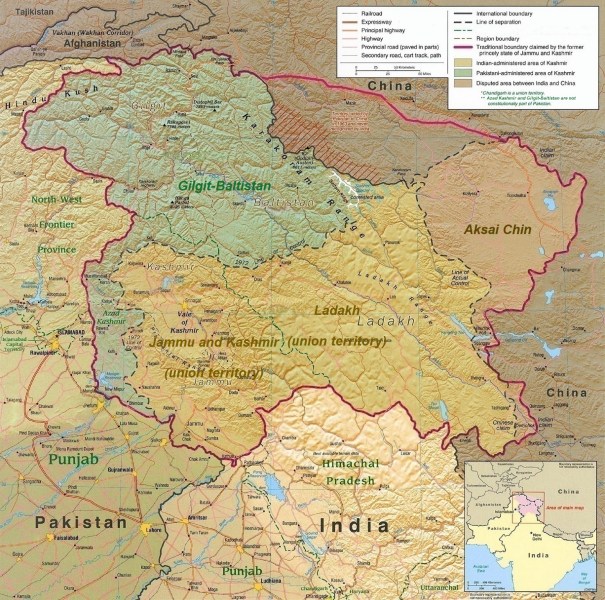
Ladakh – Ladakh is a region administered by India as a union territory, and constitutes a part of the larger Kashmir region, which has been the subject of dispute between India, Pakistan, and China since 1947.It was established on 31 October 2019, following the passage of the Jammu and Kashmir Reorganisation Act. Ladakh is bordered by the Tibet Autonomous Region to the east, the Indian state of Himachal Pradesh to the south, both the Indian-administered union territory of Jammu and Kashmir and the Pakistan-administered Gilgit-Baltistan to the west, and the southwest corner of Xinjiang across the Karakoram Pass in the far north. It extends from the Siachen Glacier in the Karakoram range to the north to the main Great Himalayas to the south. The eastern end, consisting of the uninhabited Aksai Chin plains, is claimed by the Indian Government as part of Ladakh, and has been under Chinese control since 1962.

The largest town in Ladakh is Leh, followed by Kargil, each of which headquarters a district.
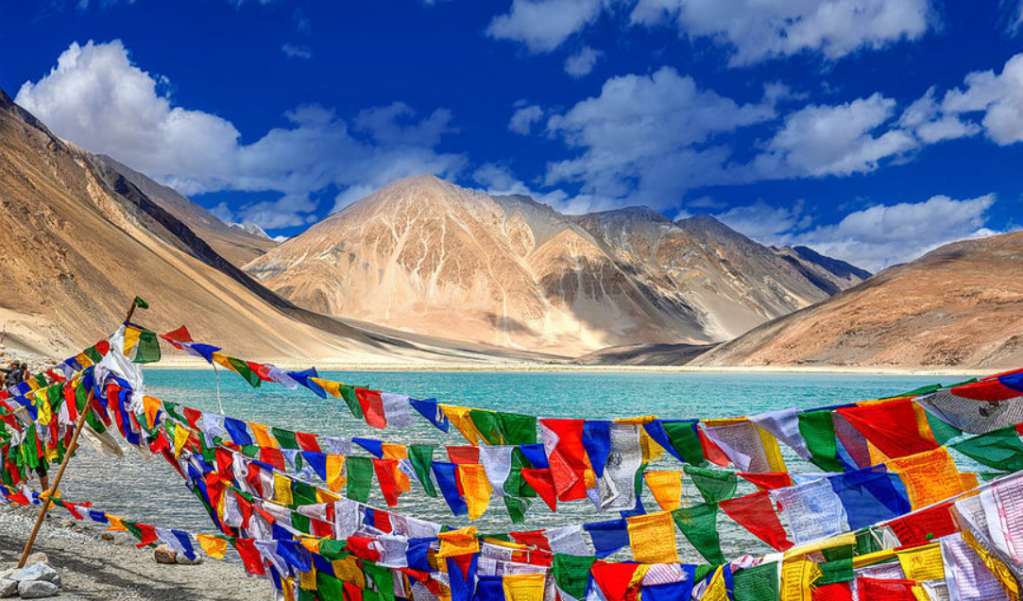
Image coutesy – Northlines

State to UT

In February 2019, Ladakh became a separate Revenue and Administrative Division within Jammu and Kashmir, having previously been part of the Kashmir Division. As a division, Ladakh was granted its own Divisional Commissioner and Inspector General of Police.

Leh was initially chosen to be the headquarters of the new division however, following protests, it was announced that Leh and Kargil will jointly serve as the divisional headquarters, each hosting an Additional Divisional Commissioner to assist the Divisional Commissioner and Inspector General of Police who will spend half their time in each town.

In August 2019, the Government of India barred all broadband as well as mobile internet services in the region to prevent the deliberately fabricated falsehood on social media. In January 2020, 2G internet was resumed with no access to social media.

The lockdown started on 5 August 2019 following Revocation of the special status of Jammu and Kashmir via scrapping of the Article 370 of the Constitution of India, Article 35A of the Constitution of India and the introduction of Jammu and Kashmir Reorganisation Act, 2019. Since 5 August, no foreign journalists have been granted permission from the Indian government to report in Kashmir.

According to a September 6 report of the Indian government, nearly 4,000 people have been illegally arrested and detained in the disputed region. Among those arrested were more than 200 politicians, including two former chief ministers of Jammu and Kashmir (J&K), along with more than 100 leaders and activists from All Parties Hurriyat Conference.

The lockdown ended with the resumption of all communication services, allowing 4G and 3G Internet services, in early February 2021.

Central UNI

The Union Cabinet has given its approval of the formation of a Central University in Ladakh. This project cost for the formation of this university will be Rs 750 crore.

  • In four years the first phase of the university will be completed.
  • To facilitate the formation of Central University in Ladakh the bill for amending Central Universities Act, 2009 will be introduced.
  • Establishing this university will aid the propagation of higher education in this region.
  • The jurisdiction of this Central University will cover the entire region of Ladakh including Kargil and Leh

Other important announcements

  • The formation of an integrated multipurpose corporation was also announced by the cabinet. This corporation will shoulder development projects in Ladakh.
  • This corporation will also look after the development of tourism, industries, and various transport services in Ladakh as well as marketing of the regions handicrafts and local products.
  • This corporation will also aid in the development of infrastructure in this region and will as Ladakh’s the primary infrastructure construction agency.
  • This corporation will be formed under the Companies Act and will have an authorised share capital of Rs 25 crore with an annual outlay of Rs 2.42 crore.
  • This corporation will also create job opportunities in this region.
India’s Kashmir Conflict

The Conflicted Map Of J&K with Ladakh

With over seven decades crossed since 1947 followed a continuous stretch of never-ending bloodsheds in the Kashmir valley or for the reason of it.  Just in past 27 years, around 41,000 lives have been lost due to this Indo-Pak dispute. The Indian army had lost many of its brave soldiers who sacrificed themselves for the safety and security of people in the valley and rest of India. With more than 950,000 soldiers deployed in Kashmir, making it world’s most strongly guarded place, shows the threat level in the valley. The current Kashmir when compared to the Maharaja Hari Singh’s Kashmir is divided into 3 major parts. Two pieces of territory are illegally occupied by the Pakistan (30%) and China (15%). The regions under Pakistan are Gilgilt, Baltistan and the Pakistan occupied Kashmir (POK) and the region under China is Aksai-Chin which is vastly inhabited by humanity.

The Indian controlled Kashmir (55%) owns 60 per cent of the population of Kashmir in total. The Jammu and Kashmir initially under the Sikh Empire of Maharaja Ranjit Singh, saw a shift in powers with arrival of east India company and british. The empire then switched into the Dogra Empire which was overtaken by Maharaja Gulab Singh and this continued until the independence of India in the year 1947. It was this time, when the britishers before leaving Indian territory kept an opportunity for all the 565 princely states of Indian peninsula to either join an Islamic state named Pakistan or a democratic republic of India. This stretched the long run tensions between the communities of muslims (in favour of an Islamic state) and the rest of people into a massacre of centuries. A bloodshed that no one in the world saw before, it is estimated that up to one million people were killed during the violence in 1947, and around 50,000 women were abducted. Some 12 million people were displaced from their homes in the divided province of Punjab alone, and up to 20 million in the subcontinent as a whole. Few princely states opt to merge with Islamic state of Pakistan and majority of them joined the republic of India. Kashmir on the other side chose to remain an independent state under Maharaja Hari Singh. He decided to stay independent because he expected that the State’s Muslims would be unhappy with accession to India, and the Hindus and Sikhs would become vulnerable if he joined Pakistan. On 11 August 1947, the Maharaja dismissed his prime minister Ram Chandra Kak, who had advocated independence. Observers and scholars interpret this action as a tilt towards accession to India. Pakistanis decided to pre-empt this possibility by wresting Kashmir by force if necessary. Pakistan made various efforts to persuade the Maharaja of Kashmir to join Pakistan. In July 1947, Mohammad Ali Jinnah is believed to have written to the Maharaja promising “every sort of favourable treatment,” followed by the lobbying of the State’s Prime Minister by leaders of Jinnah’s Muslim League party. Faced with the Maharaja’s indecision on accession, the Muslim League agents clandestinely worked in Poonch (west territory of Kashmir) to encourage the local Muslims to an armed revolt, exploiting an internal unrest regarding economic grievances. The authorities in Pakistani Punjab waged a ‘private war’ by obstructing supplies of fuel and essential commodities to the State. Later in September, Muslim League officials in the Northwest Frontier Province, including the Chief Minister Abdul Qayyum Khan, assisted and possibly organized a large-scale invasion of Kashmir by Pathan tribesmen. Several sources indicate that the plans were finalised on 12 September by the Prime Minister Liaquat Ali Khan, based on proposals prepared by Colonel Akbar Khan and Sardar Shaukat Hayat Khan. One plan called for organising an armed insurgency in the western districts of the state and the other for organising a Pushtoon tribal invasion. Both were set in motion.

With Pakistan’s tribesmen invasion, the Kashmir was set on fire, loot, and atrocities to Kashmiris by the Pathan’s were so grieve that it could be hardly penned down. The pathan’s did whatever they could to terrorize Kashmiri’s, they abducted, raped and murdered thousands of girls and women of all ages. This was being done to scare Kashmir and its ruler for their indecision for accession into Islamic state of Pakistan. The Pakistan’s muslim league and its military knew this for sure, that newly formed independent nation of Jammu & Kashmir is heavily outnumbered with its line of defence and weapons. The Maharaja made an urgent plea to Delhi for military assistance. Upon the Governor General Lord Mountbatten’s insistence, India required the Maharaja to accede before it could send troops. Accordingly, the Maharaja signed an instrument of accession on 26 October 1947, which was accepted by the Governor General the next day.

While the Government of India accepted the accession, it added the proviso that it would be submitted to a “reference to the people” after the state is cleared of the invaders, since “only the people, not the Maharaja, could decide where Kashmiris wanted to live.”; it was a provisional accession. The largest political party, National Conference, headed by Sheikh Abdullah, endorsed the accession. In the words of the National Conference leader Syed Mir Qasim, India had the “legal” as well as “moral” justification to send in the army through the Maharaja’s accession and the people’s support of it. The Indian troops, which were airlifted in the early hours of 27 October, secured the Srinagar airport. The visiting journalist at Srinagar city witnessed an incredible sight where volunteers of National Conference (Local political party of Kashmir) was patrolling the city from tribal Pakistani invaders and Minority Hindus, Sikhs were moving freely among Kashmiri Muslims. This was a true example of community harmony in Kashmir.

After securing Sri Nagar, the Indian army troops were set to retrieve other portions of Kashmir, captured by the Pakistani tribesmen and military. Yet, in the meantime the then prime minister of India, Mr J. L. Nehru made an announcement over all India radio, that India would seek United Nation’s (UN) mediation into this matter. This was greatly opposed by the then home minister of India, Sardar Vallabhbhai Patel. Later, with intervention of United Nations group under Sir Owen Dixon (UN mediator) who came up with a plan of seizing the military conflict by mapping a stamp on territories already under control. This led regions already secured by the two countries under their jurisdictions and UN formed a Line of Control between the western and Eastern parts of Kashmir. To this day, India claims the entire region of Kashmir as per the legal instrument of accession signed by the Maharaja of Kashmir, making the whole of Kashmir an integral part of Republic Of India.

Later in the year of 1962, another war broke but this time it was between India and China. The war zone was the regions of Ladakh province to the east of Kashmir. After this Indo-China war of ’62, China captured another part of Maharaja Hari singh territory, the Aksai-Chin. India to this date demands both of its territories and had raised its voice into United Nations Security Council from time to time in the recent past. Whatever is good for Kashmir and safe for Kashmiri dreams should be implemented, to make sure that no more innocent lives are lost, no more brave soldiers are sacrificed for the love of their motherland.

How India’s Rising Political Presence Led China’s Backpedal.

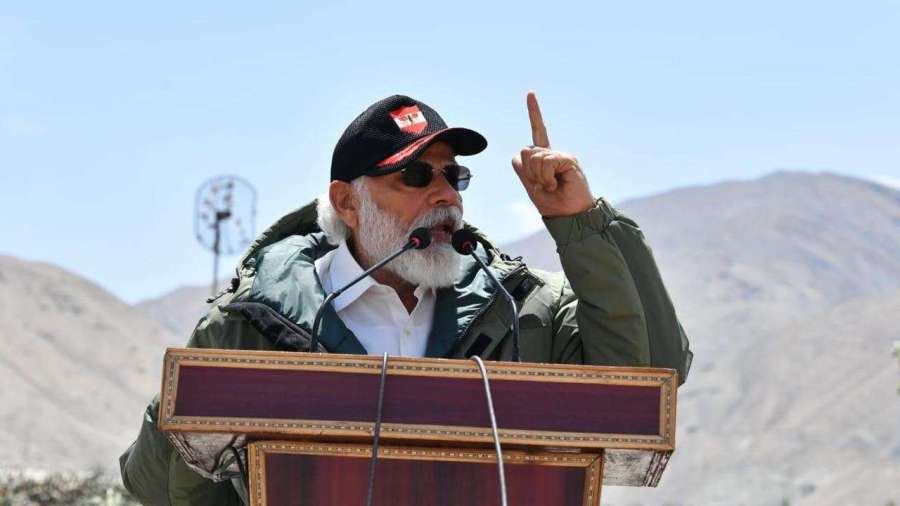
PM Modi addressing soldiers in Ladakh

Making an apparent hit at china, Prime Minister Narendra Modi on Friday said the age of expansionism is over and added that the new age of development is here.

“Age of expansionism is over and this is the age of development. History is witness that expansionist forces have either lost or were forced to turn back,” Modi said addressing soldiers in Ladakh’s Nimmoo. However, the Prime Minister did not mention China at all in his address to the soldiers.

The remark comes amidst the on-going tension between India and China at Line of Actual Control in the eastern Ladakh. In a violent brawl between forces almost 20 Indian soldiers were martyred in the Galwan Valley on June 15 midnight when Chinese troops attempted to unilaterally change the status quo during the de-escalation.

The Prime Minister also said that the people of Ladakh have rejected every attempt to create separatism in the region.

“Ladakh is the head of the country. This is the symbol of pride for the 130 crore citizens of India. This land belongs to the people who are willing to make the ultimate sacrifice for the country… Every attempt to create separatism in the region was rejected by the nationalist people of Ladakh,” Modi said.

He further added, “We are the same people who pray to the flute playing Lord Krishna, but we are also the same people who idealise and following the same Lord Krishna who carries the Sudarshan Chakra”. The two countries, India and China have been involved in talks to ease the on-going border dispute since last month.

Praising the bravery displayed by the soldiers, the Prime Minister said: “The bravery that you and your compatriots showed, a message has gone to the world about India’s strength.”

“Your courage is higher than the heights where you are posted today,” he added.

“Atmanirbhar Bharat ka sankalp aapke tyag, balidan, pursharth ke karan aur bhi mazbut hai,”(The vision of self-dependent India gets strengthened from your sacrifice and courage),” the Prime Minister said.

During Prime Minister’s address the soldiers were observed maintaining social distance amid pandemic.

PM Modi on Friday made a surprise visit to Ladakh and was briefed by senior officers at Nimmoo amid ongoing tension with China. The Prime Minister was accompanied by Army Chief General Manoj Mukund Naravane and Chief of Defence Staff (CDS) General Bipin Rawat.

He reached Nimmoo, early in the morning and interacted with Army, Air Force and ITBP personnel. Located at 11,000 feet, this is among the tough terrains, surrounded by Zanskar range and on the banks of the Indus. Prime Minister Modi Also performed Prayer rituals at the Holy Indus River.

The idea of India started its journey with high moral values (non-violence, democracy, people rights) and since 1947 we’ve indulge into many wars, conflicts being internal or external both resolved with democratic path. This path of Democracy is extremely hard, to pass one reform bill in the parliament of India could take years, as we all (Indians) know it’s quite hard to please the majority, though for good things. This does make progress of India slow but what wonder it does is the trust and believe it seeds among the rest of the Nations in the world. World would definitely prefer a democratic nation when compared to a communist country. Democracy has always been a safer place to live in and contributes zero threat to the world’s security and safety. This further boosts India’s take on becoming a reliable superpower to which world can trust.

The days of expansionism are apparently turning fade with the rising support for India’s stand at border disputes with China. The world now knows that the new India would never compromise on its national integrity and would never step back from its own territory. The recent aggressive response of Indian Army at the Galwan with close to 43 casualties on the Chinese side was a true representation of its new mood of hitting harder. The government of India following a straight path of “No Compromise” shows its rising diplomatic presence at global politics.

Indeed, a lot has changed since 1962’s Indo-China war. India in 2020 is much technically advanced than ever before. India is the biggest influencer of information technology, it is Indians who are providing software strength to major Chinese IT firms since China so far had focused only on manufacturing leading into a hardware oriented industry.

Apart from IT, India’s military might had boosted exponentially with more weapon, warheads and war machine imports, India is also focused on indigenous weapons, thus reducing the foreign imports and reliability.

Taking military strength, China does seem upper handed while looking at numbers. India has an approximate of 1.3 Million active armed personnel and China has close to 2.1 Million of armed personnel. Yet, strategically China is helpless. Surrounded with 14 neighbouring nations China could never risk putting all of its force on to the west, this will leave East China (China’s Densely Populated and Economy Region) in a huge threat from Japan, USA and other Nations.

India with complete command over Indian Ocean reflects threat to China’s trade route to the Gulf countries. India is able to improve its political position in the global community by making more of friends and forming strong business ties that works two ways, equally.