Traditionally, schools and colleges have been cloistered enrollments where students only acquire knowledge. They then move to the next stage of their lives – into work places – where they may or may not apply the knowlege they have.
This separation has ensured that young people who join the work force have no idea about the exigencies of the work environment and are completely unprepared to deal with this situation.
However, future workplaces are likely to be far removes from conventional or current experiences.
In fact, it is estimated that most of tomorrow’s workforce may be contractual. In fact, already many large organizations are tapping into on-demand talent of the gig economy.
Increasingly, these new economy workers will be required to rely on their own knowledge and the skills to provide services and produce products that solve businesses’ and society’s pressing problems.
Our children, therefore, must learn how to acquire relevant knowledge that can be applied in different domains and circumstances. They must discover the joy learning so that they can become learners for life as well as independent learners, capable of handling uncertainty with flexibility.
Schools must therefore re-engineer their systems, curricular and pedagogies to ensure that students have agency over their own learning and lives and learn to learn, unlearn and re-learn with agility.
Schools, therefore, must teach children to be entrepreneurs, expose them to real life work and social environments through projects and experiences so that they know how to tackle challenges that lie ahead and are capable of solving problems independently.
Hello fellas, the following are some of the things that are created accidentally by the creators when they wanted to do something else.
The Microwave Oven :
The engineer was doing his job as usual when he noticed that the candy bar in his pocket had melted.
Quickly Spencer realized that it was the magnetrons that were causing this phenomenon.
By 1945, he had filed a patent for his metal cooking box powered by microwaves.
2. Chocolate Chip Cookies :
Ruth Graves Wakefield, co-owner of the Toll House Inn, was preparing some chocolate cookies for her guests when she realized that she was out of baker’s chocolate.
Thinking on her feet, Wakefield decided to chop up a block of Nestle semi-sweet chocolate, assuming that it would melt and spread evenly throughout the batter.
Instead, what came out of the oven was the very first batch of chocolate chip cookies.
3. Matches:
In 1826, chemist John Walker he accidentally scraped a stick coated in chemicals across his hearth and found that it caught fire.
Walker’s “Friction Lights,” as he called them, were originally made out of cardboard, but eventually he switched over to using wooden splints and sandpaper.
4. Vaseline:
Robert Augustus Chesebrough decided to head to the town where the product had been discovered to play around with it a bit.
While there, Chesebrough observed that the men drilling the petroleum would use a byproduct of the process on their skin to soothe and heal cuts and burns.
Later, he turned this observation into the product known today as Vaseline.
5. Bubble Wrap:
Engineers Alfred Fielding and Marc Chavannes did invent bubble wrap on purpose. But when they made it, the intended use for the product was all wallpaper, not as packing material.
when their bubbly wallpaper proved to be unsuccessful the two entrepreneurs decided to pivot and market their product instead as greenhouse insulation and later in 1960 as protective packaging.
Another essential office in the Government of India is that of the Comptroller and Auditor- General who controls and checks the financial operation of the entire country [Article 148], at the Union as well as State levels. As observed by Dr. Ambedkar, the Comptroller, and Auditor General of India shall be the most prominent officer under the Constitution of India. For he, is to be the guardian of the public purse and he must look after expenditures out of the Consolidated Fund of India or if a state without the authority of the appropriate Legislature. To discharge his duty properly, his office must be independent of any control of the Executive. The office of the Comptroller and Auditor General, in the Constitution, is substantially modeled upon that of the Auditor General under the Government of India Act, 1935.
Conditions of Service:- The independence of the Comptroller and Auditor General has been protected by the following provisions of the Constitution—
Though appointed by the President, the Comptroller and Auditor General may discard only on the ground of ‘proved misbehavior’ or ‘incapacity’, on an address from both the Houses of the Parliament. He thus excepted from the general rule that all civil servants of the Union hold their office at the pleasure of the President [Article 310(1)].
His salary and conditions of service shall be statuary and shall not be liable to variation to his disadvantages during his term of office. Under this power, Parliament has enacted the Comptroller and Auditor General’s Act 1971, as amended, provides as follows:
(i) The term of office of the Comptroller and Auditor General shall he six years from the date on which he presumes office, but—
• he shall vacate office on attaining the age of 65 years if either than the expiry of the six-year term;
• he may, at any time, resign his office, by writing under his hand, addressed to the President of India;
• he may be removed by impeachment [Article 148, 124(4)].
(ii) His salary shall be equal to that of the Judge of the Supreme Court.
(iii) On retirement, he shall be eligible for an annual pension as per the High Court and Supreme Court Judges.
(iv) In order matters his conditions of service shall be determined by the rules applicable to a member of the IAS, holding the rank of a Secretary of the Government of India.
(v) he shall disqualify for any further Government office after retirement.
(vi) the salaries, etc of the Comptroller and Auditor-General, his staff, and administrative expenses of his office shall be charged upon the Consolidated Fund of India and shall be non-votable [Article 148].
Duties and Powers:- The Comptroller and Auditor General shall perform such duties and exercise such powers about the accounts of the Union and the States as may be prescribed by Parliament. In exercise of this power, Parliament has enacted the Comptroller and Auditor General’s duties, powers, and conditions of services Act, 1971 which relieves him of his pre- Constitution duty to compile the accounts of the Union; and the States may enact similar legislation with the prior approval of the President — to separate accounts from audit at the State level, and to relieve the Comptroller and Auditor General of his responsibility in the matter of preparation of accounts, either of the States of the Union.
“Only if we understand, will we care. Only if we care, will we help. Only if we help, shall all be saved.”
– Jane Goodall
Introduction
Every year July 28th is celebrated as World Nature Conservation Day. This is to raise awareness to protect the planet we live on, our Mother Earth. The meaning of conservation is carefully using valuable natural substances that exist in limited amounts to make certain that they will be available for as long a time as possible. The practice of not using resources carefully has also led to the extinction of many species. Conservation will help in the growth of biological, economic, cultural, and recreational values. Non-conservation for so many years has also resulted in Climate change which we know is affecting the planet in many negative ways.
Significance
It is important to recognize that we need nature for our survival, if we let that go, it will disturb the environment which will then disturb the climate harming the harvests and the well-being of all humans. Not just that, we also need nature for all the non-renewable resources we keep using for our industries. Celebration of this day recognizes the importance of a healthy environment which is the foundation of a stable and productive society, it ensures the well-being of present and future generations. The aim of this day is to introspect on how we Homo sapiens are exploiting nature and the effects we are facing because of it, such as global warming, natural disaster, increased temperature, and various diseases.
Theme for this year
The theme for this year’s World Nature Conservation Day is “Forests and Livelihoods: Sustaining People and Planet”. This theme highlights the importance of co-existing with nature.
Forests are often underestimated and looked upon as just a source of wood, but it is important to know their importance. We greatly depend on forests for our survival, be it the air we breathe or the wood we use. Forests provide habitat for animals and also a livelihood for humans, it also offers watershed protection. Forests help in preventing soil erosion and help in the mitigation of climate change. Over 2 billion people rely on forests for shelter, livelihoods, water, food, and fuel security. Forests are home to over 80% of the world’s terrestrial biodiversity and 60 million indigenous people. Forests provide jobs for more than 13 million people across the world. They are the second-largest storehouses of carbon which is very important to solve the issue of global warming and to reach the goals described in the Paris Agreement.
Things to do to Conserve Nature
Cut Down on plastic use – Although the use of plastic is convenient for us, it is non-biodegradable and leaves its trace for a very long time, it not only stays in the environment but also impacts other species, like choking animals and birds because of plastic.
Save Electricity – Electricity is produced by using non-renewable resources. If we control how much electricity we use, and don’t waste it, less non-renewable resources will be used. The creation of electricity produces extra carbon waste which increases global warming.
Save Water – Wasting water is resulting in decreasing levels of drinking water. Not only that but it also creates a lot of energy to treat, pump, and heat water. We should use water judiciously.
Recycle-Reuse – Following the practice of recycling and reusing will help in reducing the amount of waste we create.
Conclusion
We have learnt about the importance of nature and its conservation above. It is high time to realize the importance of following this practice as we are in deep waters already. This summer the world has experienced nature’s wrath all across, floods in China and Europe, high temperatures in Canada, the US, and the UK. The last few years have seen a rise in forest fires and if this isn’t warning enough of the damage we have caused, then we’re just waiting for a big disaster to hit us.
The Social Novel may be defined as a fictional narrative that focuses on the varieties of human behavior in society and the way in which the characters reflect or contradict the values of that society.
In this genre, the characters are seen in the background of their social milieu and culture. The inner life of the characters find the place in such novels, greater importance is given to their conflicts and collisions with classes and believes. The essence of a social novel is the conflict between the individual and the society that surrounds him based on different concepts of values.
Two Groups of Social Novel:
Social novels can be divided into two groups.
The novel of Manners.
The novel of Civilization.
The novel of Manners:
The novel of manners is concerned with social behavior and its correctness in a given society. The concept of behavior achieves some grant moral effect as we find in the novels of Jane Austen “Pride and Prejudice” and Emma are the best examples. The novelist is preoccupied with the niceties of social conduct and often, commerce by the employment of Irony and satire exposes undesirable passions like arrogance, hypocrisy, and snobbery. Henry James’ novel ‘The ambassador’ is a successful social novel of manners. It depicts with great humor and delicacy the reaction of different American types to a European environment. Evelyn Waugh’s “A handful of dust” is a social novel of manners that presents The vision of sin and guilt in the modern world. The social novel of manners has a satiric structure as we find in Jane Austen. Even modern novelists make use of the same formula. For instance, Philip Roth satirizes the self-protective attitude of the modern middle class in his novel ‘Goodbye Columbus’.
The novel of Civilization:
The social novel of Civilization takes a comprehensive view of the whole Civilization. The best examples are Charles Dickens’s “Little Dorrit” and Tolstoy’s “War and Peace” the novel Civilization aims at revealing the meanings, principles, and social styles that govern people’s lives. The action of individuals is examined in the light of the Civilization that surrounds them. In “Little Dorrit” Dickens explores the English society dominated by the corrupt business class. In the novel Civilization characters or viewed as part of the developing environment. The splendor or shame of their past is exploding. The significance of the character’s behavior becomes clear only in the background of the Civilization which he represents. In “War and Peace” Tolstoy presents the different stages in the development of each character. The novel Civilization, sometimes, depicts the different stages in the growth of the writer’s consciousness as in Marcel Proust’s ‘Remembrance of Things Past’. Sometimes it uses our family story as in Faulkner’s ‘Sartoris’ or Galsworthy’s ‘Forsyte Saga’.
The Social Novel is a technique in literature. In which the authors express and illustrate society, ethics, etiquette, and protocols. Nowadays, various authors are following this technique in their writings. Especially, to illustrate the Epic society, Dynasty, and fictional Mythologies. This literary form serves as a device to illustrate society.
Nature of the powers of thePresident:- The Constitution says that “executive powers of the Union shall be vested in the President”. The President of India shall thus be the head of the “Executive Powers” of the Union. The ambit of the executive powers has been thus explained by our Supreme court— it may be possible to frame an exact definition of what executive function means and implies. Ordinarily, the executive powers connote the residue of governmental functions that remain after legislative and judicial functions are taken away, subject, of course, to the provisions of the Constitution or of any law.
Limitations on President’s Powers:- Firstly, he must exercise these powers according to the Constitution [Article53(1)]. Thus, Article 75(1) explicitly requires that Ministers can be appointed by the President only on the advice of the Prime Minister. If the President violates any mandatory provisions of the Constitution, he will be dismissed by impeachment. Secondly, the executive powers shall be exercised by the President of India only on the advice of the Council of Ministers [Article 74(1)].
Executive powers of the President arediscussed under the following heads:-
(1) The Administrative Powers:- The President is the formal head of the administration. He shall not have any administrative function to discharge or to control or supervise the Department of Government. Though the President shall have the power to appoint —
• The Prime Minister of India
• Other Ministers of the Union
• The Attorney General of India
• The comptroller and Auditor General of India
• The Governor of a State
• The Finance Commission
• The Election Commission
• The judges of the Supreme Court
• The judges of the High Court
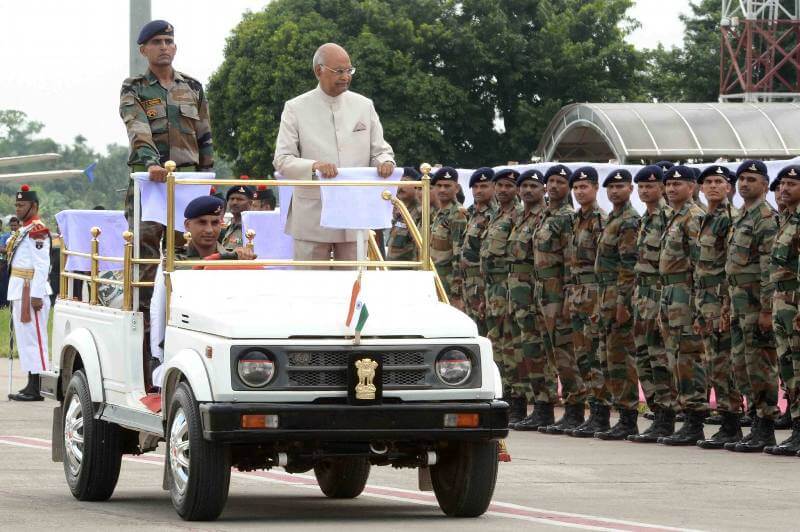
(2) The Military Powers:- The supreme command of the Defense Forces vested in the hand of the President of India, the powers regulated by [ Article 53(2)]. The President may have the powers for declaration of any war or peace or the employment of the Defense Forces.
(3) The Diplomatic Powers:- The task of negotiating treaties and agreements with other countries are subject to ratification by parliament, therefore belong to the President. The President of India represents India in International Affairs and has the powers to appoint Indian representatives for other countries and receiving diplomatic representatives of the other states, acknowledged by the Parliament.
(4) The Legislative Powers:- The Legislative powers of the President, indeed according to Ministerial advice [Article 74(1)] and may discuss in the following heads:
• Summoning, Prorogation, and Dissolution
• The Opening Address
• The right to Address and to send Messages
• Nominations of the members of the Houses
• Laying reports before the Parliament
• Previous sanction to Legislation
• Assent to Legislation and Veto power
• Disallowance of State Legislation
• The Ordinance-making power
(5) Pardoning Power:- The President of India has the power to grant a pardon in case of :
• Punishment by a court-martial.
• Offence against the laws made under the Union and Concurrent Lists.
• Pardoning a sentence of death.
(6) Emergency Powers:- The President of India shall have certain extraordinary powers to deal with emergencies, which deserve a separate treatment. These extraordinary powers of the President arise at the time of:
• “Proclamation of Emergency” on the ground of threat to the security of the Nation or any part thereof by war, external aggression, or armed rebellion.
• Break down of the Constitutional machinery may take place either as a result of a political deadlock or the failure by a state to carry out the directions of the Union [Article356,365].
• Financial stability or credit of India or any part thereof is threatened [Article 360].
An internship is the position of a student or trainee who works in an organization, sometimes without pay, in order to gain work experience or satisfy requirements for a qualification. A good degree with good marks will not take you to an organization , but internship will . you need the experience to get hands-on knowledge in your career field. In today’s labour market, employers rely heavily on CVs that demonstrate relevant work history, whether it is from actual job experience, volunteer work, or interning at a company. According to NACE’s Class of 2019 Student Survey, “More than half of all graduating seniors who applied for a full-time job (53.2%) received at least one job offer. Within this group, 57.5% of students who had an internship and 43.7% of graduating seniors who did not have an internship received a job offer.”
An internship is an official program offered by organizations to help train and provide work experience to students and recent graduates. The concept of working as an intern began a long time ago but has drastically evolved over the years. Internships first started as a labourer who would take on young individuals and teach them their art or trade. In exchange for being taught a skill, the trainee would agree to work for the labourer for a specific time. The skill taught there will help you in the real market scenarios , which will help you to solve real market problems .
Getting job experience is very important in today’s life . You can get an internship at a small company or get experience by freelancing. Any experience where you use skills that you can transfer to your future career is an excellent addition to your CV. It can help you demonstrate your commitment and capabilities to an employer while highlighting the skills that are both appropriate and transferable to the post you are applying for. An internship will give you the best experience regarding the job .
FIVE IMPORTANCE OF INTERNSHIP
You will get an experience of the real market , the things which you have learnt in books , the things which you are having the book knowledge of , that book knowledge is used in the practical form .
You will learn skills that will help you in your future jobs & these skills will let you fit in a better organization
Internship allows you to learn about yourself , the more you will discover the job , the more you will get to know about yourself , your qualities & abilities.
Internship allows you to gain competitive edge over others , those who have not done any internship will not get the exposure that you have received & will for sure lack the direction to do a specific work
Internship helps you to build critical network connections because you are involve with them who are expert in that field .
Children are great at learning languages, they learn a language quickly and gain fluency in a matter of years but at what age should they start learning English?
There is no age bar for learning but the children need to start learning English as early as possible. Over 840 million people speak English as a first or second language, which makes it the second most-spoken language. It is considered to be the language of success. To be very honest, if someone wants a decent job anywhere in the world, he/she needs to be proficient in this language. Children have a higher grasping power as compared to an adult. Developing a habit of speaking, writing, listening, and reading should be inculcated in a child from the very beginning.
Let’s look at the advantages of being a young learner and how parents can help their children to learn, grow and succeed.
Learn and Lead
Being able to communicate in English is one of the most important life skills. Communication skills take a lifetime to master, if not mastered at an early age. According to a 2018 survey conducted by the National Association of Colleges and Employees, communication skills are ranked first among ‘must have’ skills. The most important aim should be to ignite young minds and unleash the dormant energy by providing an opportunity for children to learn to communicate effectively in English. It is the duty of the parents and teachers to help broaden a child’s perspective, think critically, speak fluently, participate in public speaking and tap their leadership potential.
Invest time in learning
Communication skills would make them stand strong on their feet.
Poor Communication has been considered as one of the greatest barriers to confidence. If a child has not developed the skill of speaking, he might lose the confidence to take his place among others.
Communicating daily will help to sharpen their skill.
How is the current situation beneficial for students?
In current situations, schools are closed and students are not able to participate in co-curricular activities, thus considering the situation it is the best time to grab the opportunity and master the skill of communicating in English. Every child deserves to learn and we as an older generation should give them the right opportunity and platform.
In today’s world, let’s make sure that our younger generation does not have to face any hesitation.
We must ensure that children develop skills that classrooms can’t teach. A personalized curriculum should be developed which caters to the need of the students. Thus, making them learn in a more conceptualized way.
Let them learn and lead the world
Beneficial for higher studies
Like job applications, one of the best benefits of learning English is an educational opportunity. If you wish your child should access the best colleges like Harvard, Stanford, Oxford, Cambridge, or any college, knowing English provides them an incredible edge. Writing SOP’s (Statement of Purpose) is not an easy task; therefore, writing English is very important for the students. Thus, it will ensure them to get the best education in the future. If your child wishes to study abroad or within India itself, learning English is one of the most important factors which should be kept in mind.
Learn, grow and communicate.
Develop the habit of writing
Who knows your child might be the next Shakespeare?
One of the best ways to understand a language is to write. The more your child writes the more exposure he receives. This eventually increases their creativity.
Schools must provide the students with exposure to writing and make them understand the essence of writing. Students should start learning with simple words that later on turn into more complex and afterward the students must learndescriptive words needed to become creative writers. Much like becoming a musician, one might not understand his/her instrument until they try it out. The same goes for English. It requires consistent practice.
Start learning today, see the benefits soon.
Improve focus
To correctly become a well-rounded English speaker requires focus and determination. A child must develop such a thought process that helps her to remain focused and dedicated. Educators should give personal attention to students. During the course, students need to focus on the four core pillars of learning -:
Thus, this will provide them amazing exposure and some invaluable experience of learning.
Children are the terra firma upon which the future is built. The impact of learning will bring out their individuality. They deserve to know the world, let’s not keep them confined.
Let’s nurture their leadership qualities because we can foresee a nation run by them.
Feminism is the advocacy of the equality of the sexes. It does not seek exploitation and harassment of men by women in any field as many ‘intellectuals’ think! It only seeks to eradicate the violence against women and their poor treatment by their male counterparts wherever it is happening. People think feminism is giving women another superpower through which they can rule others , but this is not the true side , Feminism means equality in education & professional fields , equality in terms of rights , & this equality is not only for women but for men also . Feminism seeks to achieve the political, economic, personal, and social equality of BOTH the sex & not just females. Societies around the world often give exclusive rights and privileges to men (like standing up for themselves without being branded as being ‘loud’ and ‘bossy’, doing what they love to do, not being responsible for bringing up the kids and many more!) while women, in general, are treated unfairly. Feminism fights against gender stereotypes and seeks equal educational and professional opportunities for women. Feminists work for women’s rights, like the right to work, to remove the gender pay gap, to get an education, to have equal rights and respect within marriage, and to have paid maternity leave , to do what ever they want to , etc.
FIVE REASON WHY FEMINISM IS STILL A NEED OF THE HOUR ARE :
Gender inequality is very bad for women health : Gender inequality is bad for women health , it makes them think that they are not superior to others , which leads to bad mental health . Further mental health leads to many diseases like PCOD, heart diseases, etc.
Equal pay for all genders : Since work hours are same , so should be the pay range is the moto of feminism. Women are often paid less as compare to men & gives the reason that they work less , this belief should be removed & females should be paid equal to men .
Education : Girls are pressurized to marry , then what about their dreams & education ? This is why we need feminism , just like men are asked to study so do women should have been asked too .
Right to work : Still there is this stereotype in our brain that women can not do this job or this job is not meant for women . to remove this thinking from the society , feminisms is the need of the hour.
Have equal rights & respect within the marriage .
At last i would like to conclude this article with a quote , ” Feminism is not a dirty word. It does not mean you hate men. It does not mean you hate girls that have nice legs and a tan, and it does not mean you are a bitch or a dyke, it means you believe in equality.”
Whatever we are doing in our life at this time is directly or indirectly related to only one ultimate goal and that is we all want to be happy in our life. But, are we really happy? Or why we are not happy? And how to become happy?? There are so many lots of questions that are searched on the internet related to happiness? Funny thing is that we are asking from the machines that how we become happy in our life?
We are the people of the generation that are unhappy so that they become happy. Everyone in one of his/ her childhood faces a question from someone that what do you want to become? And we gave so many options like maybe this or that but neither of us told us nor we realized that before become specialist in a different field first we become happy in our life. After reading this I am sure a question arises in your mind that before achieved financial independence how do we become happy? for one moment think that how you perform well when you are so much depressed? First, you should understand that being successful or being happy is two different goals so don’t mix two in one. Success is a goal but happiness is the thing that you need in this process.
People thought that if they become happy all the time, are they achieve success or not, so I think till now I have not read anywhere or heard from anyone that if you are happy you are not eligible for attaining success. So please don’t become so serious be punctual, be dedicated towards your goal.
And there are so many people in this world that are already trapped in the web of complex things and become unhappy so don’t try to become one of them, be happy for yourself, this is one of the best gifts that you give yourself. Whatever the situation of life is be happy and face that like a warrior,
If you are struggling in your life currently, please don’t become depressed, be happy because this happiness add some power to your confidence so that you face your struggle more valiantly,
There are lots of people in your nearby area they say that when this or that thing will complete they become so much happy, and after that, you saw that after goal achieved they become so much depressed and after asking they say that, this is not that thing what they want in their life, so don’t to be happy it is free of cost in every country. So please be happy,
Because this is a chain reaction when one person is happy, he/ she will never make someone’s life unhappy. So ultimately if you are happy you not only uplift your life you also provide little contributions towards the world’s happiness.
Life is a struggle, so accept it and enjoy your single moment on this planet. And before becoming anyone in any field, become happy in your life. And don’t depend on anyone for your happiness.
Being happy is a need that is required to achieve all the purposes of our life.
Here is some good news for all the watersport lovers in Vizag. A scuba diving academy will be coming up soon in the district, at Chintapalli. The city of beaches has been into the watersports trend, with activities like kayaking, snorkeling, jet skiing and scuba diving. Among these four, scuba diving is the more popular watersport. This watersport is not available at places in India such as Goa, Pondicherry, and the Andaman and Nicobar Islands. But fortunately, Vizag has adopted this highly thrilling and mesmerising underwater activity.
Taking a big step towards promoting tourism in Vizag, a scuba diving academy at Chintapalli village in Visakhapatnam District. The academy will be started by Livein Adventures, a Vizag-based adventure sports firm, which operates water sports activities in the city with the support of the Andhra Pradesh Tourism Development Corporation (APTDC). This will be a first-of-its-kind scuba diving academy in Andhra Pradesh and one among very few such academies in India. The academy will come up on four acres of land at chintapalli and will be built at an estimated budget of Rs 2 crore.
Speaking to Yo! Vizag, Balaram Naidu, of Livein Adventures, revealed, “The academy will have courses on basic diving, kayaking, and boating from October 2021. The courses will range from two days to 6 months in duration. Interested individuals, swimmers and non-swimmers, will be able to take globally certified courses on open water diving, rescue diving and advanced diving.”
“Time and tide wait for no one,” as the saying goes. To be successful in all parts of life, a person must grasp the value of time. People who waste time are those who have not developed their own personality.
What is Time Management ?
Time management is the process of properly managing time so that the appropriate amount of time is allotted to the appropriate task.
Individuals who use effective time management can assign particular time slots to tasks based on their value.
Time management is the process of making the best use of one’s time, which is constantly finite.
Consider which activity is more essential and how much time should be devoted to it. Determine which tasks should be completed first and which may wait a bit longer. Time Management plays a very important role not only in organizations but also in our personal lives.
Time management includes the following:
Planning that works:- Make a detailed plan for your day. Make a To-Do List or a “TASK PLAN.” Make a list of the key tasks that must be completed in a single day, together with the amount of time that should be allotted to each task. High priority tasks should be prioritised first, followed by those that do not require much of your attention at the present. Complete all outstanding chores one by one. Do not start new work until you have completed your prior assignment. Tick the ones you’ve already finished. Make certain that you complete the assignments within the time period specified.
Establishing goals and objectives:- Working in an organisation without goals and aims is like to the captain of a ship being disoriented at sea. Yes, you’d be lost. Set goals for yourself and make sure they are reasonable and attainable.
Establishing deadlines:- Set deadlines for yourself and work hard to do projects ahead of time. Don’t wait for your bosses to ask you every time. Learn to accept responsibility for your job. You are the only one who has the authority to establish deadlines. Consider how much time and how many days you need to commit to a specific activity. Use a calendar to keep track of crucial dates and deadlines.
Responsibilities are delegated:- Learn to say “NO” at work. Don’t try to accomplish everything on your own. There are others as well. Accepting something that he knows is tough for him is not a good idea. Employees’ roles and duties must be allocated based on their interests and specialisations in order for them to complete assignments on time. A person who is unfamiliar with something requires more time than someone who is well-versed in the subject.
Organizing tasks according to their importance:- Sort the jobs according to their significance and urgency. Understand the distinction between significant and urgent tasks. Determine which chores should be completed within a day, which should be completed within a month, and so on. The most critical tasks should be completed first.
Investing the appropriate amount of time in the appropriate activity:- Make it a habit to do the right thing at the right time. Work completed at the wrong time is of little value. Don’t squander a whole day on something that can be completed in an hour or two. Also, set aside some time for personal calls or monitoring Facebook or Twitter updates. After all, a human is not a machine.
For Effective Time Management one needs to be:
Organized:- Keep piles of files and mounds of paper away from your desk. Throw away whatever you don’t need. Make folders for crucial papers. Keep the files in their designated drawers, with labels on the top of each file. It saves time that would otherwise be spent on ineffective searches.
Don’t misuse time:- Do not kill time by loitering or gossiping around. Concentrate on your work and finish assignments on time. Remember your organization is not paying you for playing games on computer or peeping into other’s cubicles. First complete your work and then do whatever you feel like doing. Don’t wait till the last moment.
Be Focussed:- One needs to be focused for effective time management.
Benefits of Time Management:
Time management teaches a person to be punctual and disciplined. As a result of efficient time management, one learns to work only when necessary. Individuals should construct a “TASK PLAN” or a “TO DO” List at the start of the day to jot down tasks that need to be done in a certain day based on their significance and urgency against the precise time slots allotted to each activity. A Task Plan provides employees with a feeling of direction at work. An individual understands how his day will unfold and works appropriately, resulting in greater productivity.
As a result of efficient time management, one gets more organised. Keeping things in their appropriate placements saves time spent searching for documents, essential files, folders, stationery items, and so on. Individuals maintain their workstations, study zones, cubicles, and meeting places clean and tidy to improve time management. People learn to manage their time well as a result of Time Management.
Effective time management increases a person’s morale and confidence. Individuals become well-known in their organisations and among their peers as a consequence of their ability to complete assignments within the time constraints imposed by Time Management. People who appreciate the value of time are the ones who stand out in a crowd. Individuals who complete their task on time are looked up to by others and are constantly the centre of attention.
Individuals that stick to a time schedule achieve their goals and objectives in the least amount of time. Effective time management enables staff to fulfil objectives well ahead of deadlines and complete tasks just when they are needed.
Effective time management enables an individual to reach the peak of success fast and to remain there for an extended period of time. An employee who works just for the purpose of working makes no impact and is never taken seriously at work. Effective time management is critical to enhancing an individual’s productivity. When people manage their time properly, their output improves significantly.
Better time management contributes to better planning and, ultimately, better forecasting. Individuals learn to prepare ahead of time and know where they stand in five years.
According to research, those who complete activities on time are less likely to experience stress and worry. Remember that spending time and cribbing afterwards is pointless. Finish any outstanding job on time, and you’ll have enough of time for your friends, relatives, and family members.
Time management allows a person to prioritise jobs and activities at work. It is stupid to continue to be overwhelmed. You should not accept everything that comes your way.
Time management enables an individual to take a methodical approach.
“Earth provides enough to satisfy every man’s needs, but not every man’s greed.” ― Mahatma Gandhi
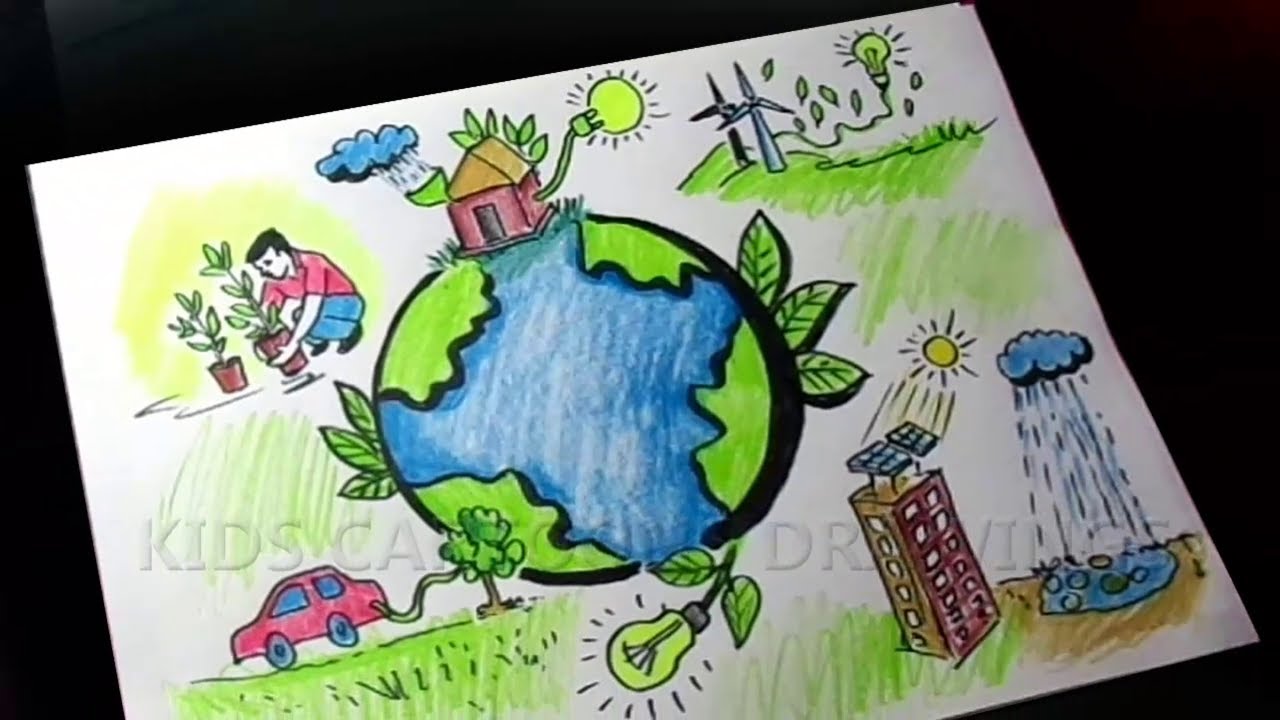
July 28 is celebrated as “World’s Nature Conservation Day” and reminds us that healthy environment is the foundation of a stable and productive society. This day is observed every year and is celebrated to educate people about the best techniques and practices adopted in different areas of the world to protect and preserve our natural resources as our planet has limited amount of resources left but the reliance on these resources is increasing day by day. This day aims to create and increase the awareness about the importance of natural resources and environment. It shows how we can live sustainably. This day encourages the people to save and protect the natural resources of earth because they are depleting in a rapid rate and are getting exploited and even misused.
This day recognizes that a healthy environment is the most vital part of stable and productive society. And sustainable practices are important for maintaining this stability and this environment for the future generations as well. The day reminds us about our responsibility as the child of the planet and urges us to be responsible and practice sustainable living practices and bring small changes in our lifestyle which can bring sustainability in our life style and lives. This day motivates us to find alternatives which could decrease our dependency on the natural resources.
This day ensures sustainability of present and future generation. How can we help in conserving the nature ? Lets have a look!
WATER CONSERVATION: Everything starts from home and can be done by using less water while showering and bathing. By practicing Rain water harvesting methods in home to reduce our dependency on other water sources and rely on rain water without wasting it. It is important to conserve water because it is estimated that 2050 we may run out of water.
PLANTING OF TREES : This helps in preventing soil erosion and promoting greenery. Home gardening, kitchen garden etc. can be practiced at home and at any scale for planting trees. Green roof is also one such initiative which helps in promoting greenery at homes. Spending few minutes in planting and amid nature can greatly promote mental well being too.
WASTE MANAGEMENT : Reduce, reuse and recycle waste. Practice rainwater harvesting and using wastewater treatment plants for treating the waste water. This waste water when treated can be used in landscaping purpose. Organics can also be used.
SUSTAINABLE COMMUNICATION : Sustainable communication can help in reducing the carbon footprint and lessen the pollution. It is good if people use public transport and sustainable modes of transport while commuting to different places as fewer vehicles will ensure lesser pollution.
Reduce your electricity consumption; switch off electrical appliances when not in use, or every time you walk out of a room.
REDUCE PAPER USE : Saving papers means saving trees and in todays digital age, all the devices are capable of taking notes which saves the need of print outs.
AVOID SINGLE USE OF PLASTIC : The plastics which we are using are getting discharged into the oceans and grasslands or forests etc. which is destroying the lifeforms, ecosystem as well as the natural resources. Single use plastic consumption has increased during the pandemic and the amount of gloves and face masks being used is also increasing. Landfills are getting filled with the large amount of plastics which is polluting the environment.
The main objective of the day is to be live, promotive consciousness and mindful living. The aim is reduce overexploitation of resources and reduce the non-essential travel and play our part of role in building a sustainable future.
Total well being in all aspects of the reproduction such as physically mentally and emotionally is called Reproductive health.
All the reproductive organs should be healthy with normal function.
Major problems associated with reproductive health
Overpopulation
Overpopulation causes a scarcity of every basic need.
It affect the well-being of reproductive health also.
To overcome the problem of overpopulation India started family planning program in 1951.
Later it was changed to reproductive and Child Health Care program in 1997.
A rapid decline in death rate, maternal mortality rate and infant mortality rate leads to overpopulation.
Small family, happy family
Steps to control population explosion
People should be educated about the advantages of smaller family.
Raising the marriageable age of male and female is an effective way to control the population.
Couples should be motivated to family planning by adopting birth control measures.
Step under reproductive and Child Health Care program
Increase in awareness about disease related to reproductive system example – sexual transmitted disease (STDs).
Increase in awareness through the audio visual media.
Increase in awareness about different contraceptive methods.
Increase awareness about sex education.
Female foeticide
Female foeticide can affect reproductive and sexual health of a Woman.
Due to the use of amniocentesis cases of female foeticide increases.
Amniocentesis is the technique in which amniotic fluid is studied for any type of enzyme disorder, chromosomal disorder or other bio-chemical disorder.
Amniocentesis method is misused to know the sex of an Unborn baby.
Sex education
Due to lack of education, people are not concerned about safe and hygienic sexual practice.
Introduction of the education in school and colleges its another step to provide right information to the youth.
Sex education can save the young youth people from myths and misconceptions about sex related issues.
Should provide knowledge about birth control methods and care of mother and child.
Our health is in our own hand…
Sexually transmitted disease
Chlamydiasis
Caused by Gram Negative bacteria Chlamydia trachomatis.
Causes urethritis which result in painful urination and pus discharge.
In male, it causes infertility by causing oligospermia.
It increases the chance of ectopic pregnancy.
Treatment –
Treated by antibiotics.
Gonorrhea
Causes by negative bacteria Neisseria Gonorrhea.
Causes inflammation of reproductive tract, urinary tract infection, and urethritis.
Treatment
Newly born child is given 1% AGNO3 dose to prevent eye. infection
Genital herpes
Causes by herpes simplex virus
Causes painful blisters
In male – glans penis and foreskin
In female – external genitalia
There is no proper treatment
Treatment is only to extend life.
Genital warts
Caused by human papiloma virus.
Causes Cancer of different organs such as-
cervical cancer
penile cancer
vaginal cancer
vulvar cancer
anal cancer
Treatment
Alpha interferon
cryotherapy
electrocautery
Sexually transmitted disease
It is very important to provide information to the couple or who are in marriageable age group about birth control methods, care of pregnant women, important of breastfeeding, equality to the gender and equal opportunity to the male and female child, reproductive tract infections etc.
The education of reproductive health should be provided to all
The man I admire most is M. K. Gandhi. His full name is Mohandas Karamchand Gandhi. He was attributed ‘Mahatma’ for his glorious life. He was born at Porebandar in Gujarat (India) on 2 October, 1869. His father, Karamchand Uttamchand Gandhi (1822–1885), served as the diwan of Porbandar state. Gandhi’s mother name was Putlibai. In May 1883, the 13-year-old Mohandas was married to 14-year-old Kasturbai Makhanji Kapadia (her first name was usually shortened to “Kasturba”), in an arranged marriage, according to the custom of the region at that time. His wedding was a joint event, where his brother and cousin were also married. Recalling the day of their marriage, he once said, “As we didn’t know much about marriage, for us it meant only wearing new clothes, eating sweets and playing with relatives.” As was prevailing tradition, the adolescent bride was to spend much time at her parents’ house, and away from her husband.
In an interview Gandhi said about his lustful feelings he felt for his young bride” even at school I used to think of her, and the thought of nightfall and our subsequent meeting was ever haunting me. He later recalled feeling jealous and possessive of her, such as when she would visit a temple with her girlfriends, and being sexually lustful in his feelings for her.”
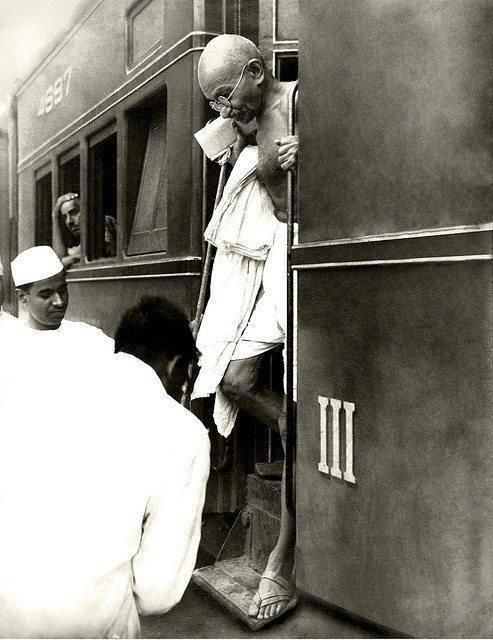
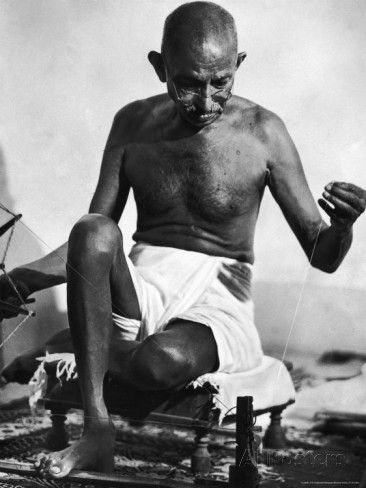
In 1921, Gandhi adopted the use of an Indian dhoti and a shawl (in the winter) and only (dhoti in the summer) woven with yarn hand-spun on a traditional Indian spinning wheel (charkha) as a sign of identification with India’s rural poor.
After completing education in India he went to England in order to study Law. He obtained the degree in Law and returned to India and began to practise in Mumbai High court at first and then in South Africa. While he was there, he started a new era of non-violence movement to reduce the oppression of the Europeans against the natives of South Africa. The movement became famous as Satyagraha and when he came to India again he used this method against the British rule. It was strengthened in Non-cooperation Movement in 1921 and Quit India Movement in 1942. He became the leader of the people giving his clarion call-“Do or die’. After a long struggle under his leadership India won her independence on 15 August in 1947.
Gandhi did many experiment like experiment with food, non-violence, and the freedom fight but the experiment which has made him a villain in everyone’s eye was “The experiment of Gandhi’s Brahmacharya” which was criticised by various senior leaders like- Jawaharlal Nehru, Sardar Vallabhbhai Patel had called it a “terrible blunder”, and had asked him to stop it.
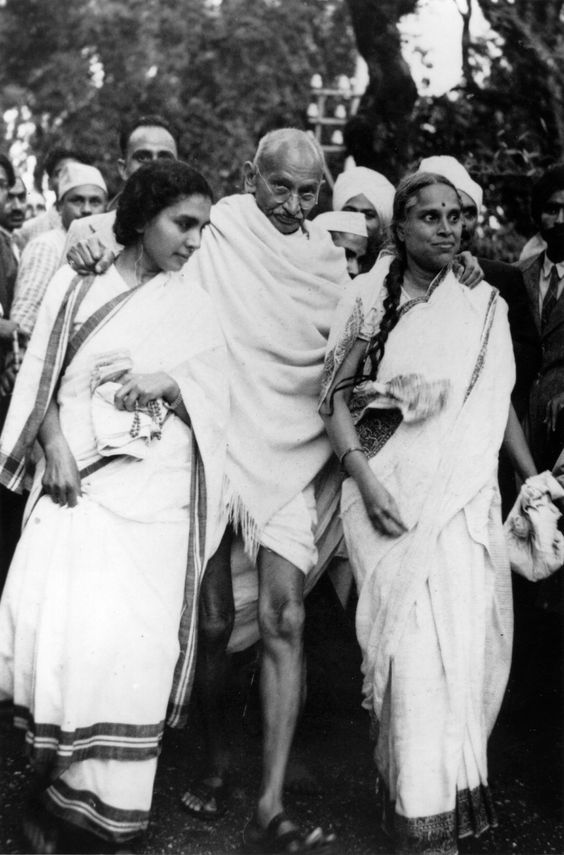
Gandhi tried to test and prove to himself his brahmacharya. The experiments began some time after the death of his wife in February 1944. At the start of his experiment, he had women sleep in the same room but in different beds. He later slept with women in the same bed but clothed, and finally, he slept naked with women. In April 1945, Gandhi referenced being naked with several “women or girls” in a letter to Birla as part of the experiments.
According to Gandhi he asked his grandniece Manu when she was 18 years old if she wanted to help him with his experiments to test their “purity”, for which she readily accepted. Gandhi slept naked in the same bed with Manu with the bedroom doors open all night. Manu stated that the experiment had no “ill effect” on her. Gandhi also shared his bed with 18-year-old Abha, wife of his grandnephew Kanu. Gandhi would sleep with both Manu and Abha at the same time. None of the women who participated in the brahmachari experiments of Gandhi indicated that they had sex or that Gandhi behaved in any sexual way. Those who went public said they felt as though they were sleeping with their aging mother.
He was shot dead on 30 January, 1948 by a derailed young man named Nathuram Godse. But his life and message are still the source of inspiration not only in the national field, but also in the international field.
























 Eduindex
You must be logged in to post a comment.