The Genius of da Vinci- 3

Leonardo and Science                                                                       

Leonardo’s genius went beyond art and paintings, he shared just as much of a connection with science as he did with his art if not more. His contribution to science and scientific inventions were most probably a result of his artistic abilities.             

Leonardo studied anatomy, botany, light, chemistry, astronomy, mathematics, to name a few without receiving any sort of formal education.                                                    

Leonardo kept a log of his ideas, observations, and scientific drawings. According to him science and art shared a resemblance with each other which is quite evident from his journals that seem to blend art and science together.

FACTOID  Leonardo sometimes wrote from right to left because he was a lefty. Therefore most of his writing is in mirror image.

Leonardo learned the basics of anatomy and the human body when he was working for Verrocchio. Leonardo dissected about 30 human corpses in his lifetime. The hospitals in Italy let him continue his studies for research purposes after he established himself as a great artist.

In his dissection studies, he would pull on different muscles to see the effect it would have on the movement of other muscles. His anatomy research also included his studies of facial features. He studied the changes that different emotions caused in the facial features and those of people with a facial deformity or a sickness as well. He studied the human skeleton and pointed out that the sacrum (a bony structure in the vertebral column) is a fusion of 5 bones, which now holds to be true. He did all of this back then, when relatively close to no resources existed.

He studied the human heart and figured out how the valves of the heart work but couldn’t figure out the whole circulation system. In 2005, a heart surgeon in The UK took aid from Leonardo’s journals of the human heart. His studies are being used by top surgeons in the 21st century, over 500 years later.

Leonardo da Vinci was granted the permission to perform his experiments and do all this research after establishing himself as a profound artist during that time. The hospital gave him corpses to dissect and so he did.

Leonardo’s journals contain drawings of some flying machines that he was working on at that time. One such machine had wings that resembled the wings of a bat. Though his drawings were not fully correct and would not have worked in practicality, it is still exceptional that a man like him without major resources could do so much. 

His journals contain much more than whatever has been mentioned so far and will probably remain alien to the world or even if someone is able to somehow get their hands on said journal will also need the intellect to understand it.

Leonardo was much more than an artist but sadly that’s exactly what most people know him as. His ability to blend art and science made him extremely special. Imagine the things he could have achieved if he were born in today’s time. We would know so much more about the things unknown to mankind. He was an artist ahead of his time and needs to be recognized not just for his art but his true genius.
The genius of da Vinci 1

Leonardo da Vinci, a Renaissance man born in Italy in 1452, considered as one of the greatest painters the world has ever witnessed, was not just a painter but a man of great intellect. His scientific journals and studies way ahead of their time are to this date used by scientists to get a better understanding of them . In addition to being a painter, a sculptor, he was an anatomist and was well known in the field of engineering, architecture and astronomy as well. da Vinci was unmatched, the only artist who was able to get close to his art was the sculptor of the statue David Michelangelo. The fascinating thing is that he was able to do all this without being exposed to a speck of formal education or training in any field except in painting. He was taught how to read and do basic mathematics all the rest was his own creation.

Leonardo was a genius to say the least, he possessed curiosity ever so great. Maybe, this is what made him so great, his desire for knowledge.                                                                   

His scientific evaluations and anatomic studies are very much evident in his paintings. He used his scientific knowledge to better himself as an artist, and so he did.                                     

Here, we are going to take a look at a few of his paintings and some of his contributions in the milieu of science.

Leonardo da Vinci was born in a town in Vinci, Florence. His father was a Florence based legal notary and his mother belonged to a lower class. Not much is known about his family.

PAINTINGS

Leonardo is undoubtedly one of the greatest artists to have ever lived, but where did he start his artistic journey from?

Leonardo worked as an apprentice under Andrea del Verrocchio, an Italian painter, and sculptor of the 15th century. Leonardo first got introduced to Verrocchio at one of his workshops. He learned a plethora of skills by working for Verrocchio and later also collaborated with him for a painting called The Baptism of Christ around 1475.

Baptism of Christ was a collaborative effort of Andrea del Verrocchio and his student Leonardo da Vinci. This painting depicts Jesus being baptized (the Christian act of sprinkling water on someone, symbolizing purification), with two angels beside him, kneeling. The one performing Jesus’ baptism is John the Baptist, who can be seen with a golden cross and a halo over his head. The pair of hands shown above Jesus’ head is God’s representing approval and acceptance. A dove can also be seen above Jesus’ head as well, symbolizing the Holy Spirit.

Saint Jerome in the Wilderness Another unfinished yet wonderful piece by da Vinci portrays Saint Jerome, a Latin priest in the Christian Church, in the middle of the desert, kneeling, looking fixedly upwards with his arm extending outwards. A lion can be seen resting on the ground looking at the Saint. The lion’s presence can be accounted for by the fact that Saint Jerome helped a lion that entered the monastery where he stayed once, by removing a thorn from the lion’s paw.                                                                                                              

Leonardo used a method called tempera for this painting, which involves mixing of painting pigments with water-soluble emulsions, along with classic oil painting techniques.                                                                                     

This painting is currently present at the Vatican museum in Rome.

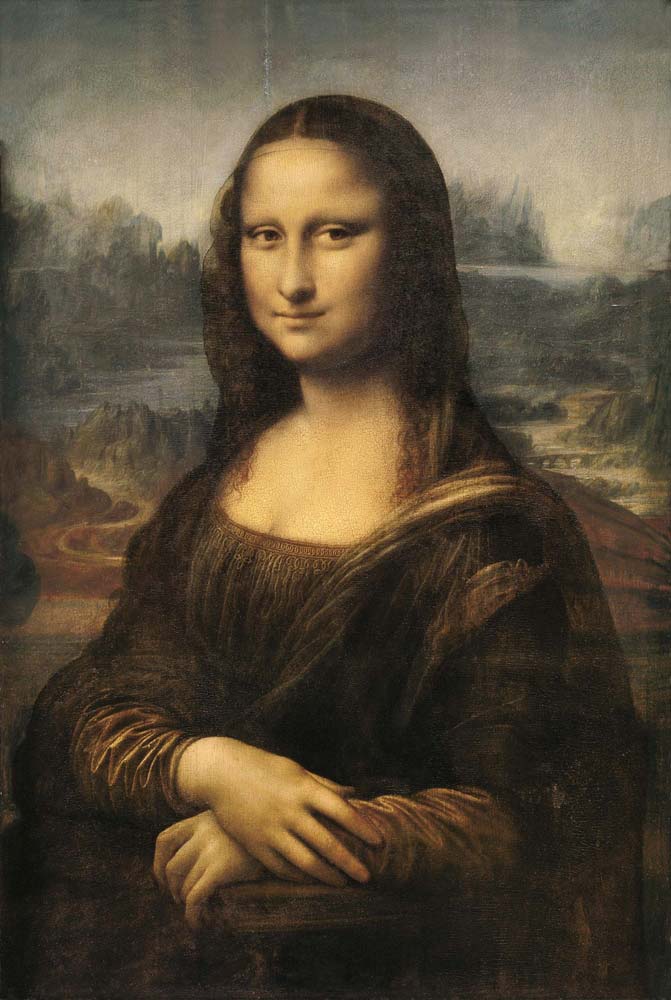
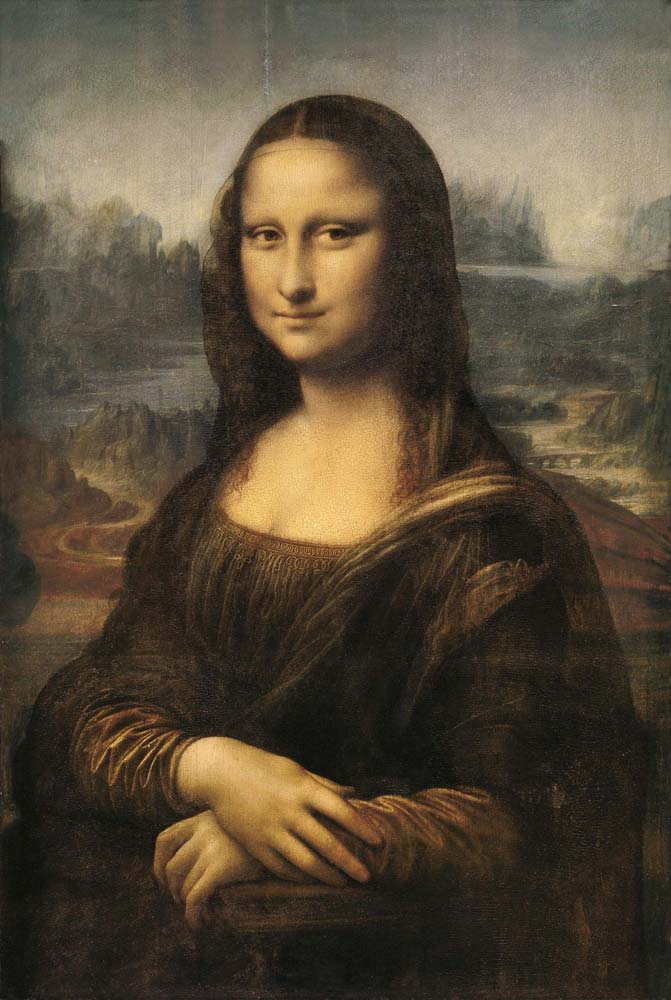
What’s special about Mona Lisa?

Most people feel disappointed when they see the most famous painting in the world “Mona Lisa”. Questions like ‘Why is this painting famous?’, ‘Is it worthy enough to be called a masterpiece?’, ‘What makes her unique?’ arise in the minds of hundreds. But if we ignore it all and just look at the painting, we see the greatest psychological portrait ever painted. A portrait that is much more ahead of time that we are still trying to figure out.

Leonardo da Vinci in his sixties moved to the Chateau of Amboise in France with his sketchbooks and one painting “The Mona Lisa”. Because he knows how important the painting was for him.

Leonardo is one of the greatest inquisitive minds in history, a self-made man with an unquenchable appetite for knowledge, and dedicated his life to studying anatomy, geology, and philosophy.

Leonardo da Vinci

The Painting

Mona Lisa was painted on a thin-grained piece of a poplar tree and a layer of lead white. He used glazes that have a very small amount of pigment mixed with the oil. This brought depth and luminosity as the white undercoat of lead reflects the light through the glazes. He used tiny brushstrokes applied super slowly over years. Leonardo pioneered many brushing techniques which brought the paint to life.

Mona Lisa

Clothes and Jewelry

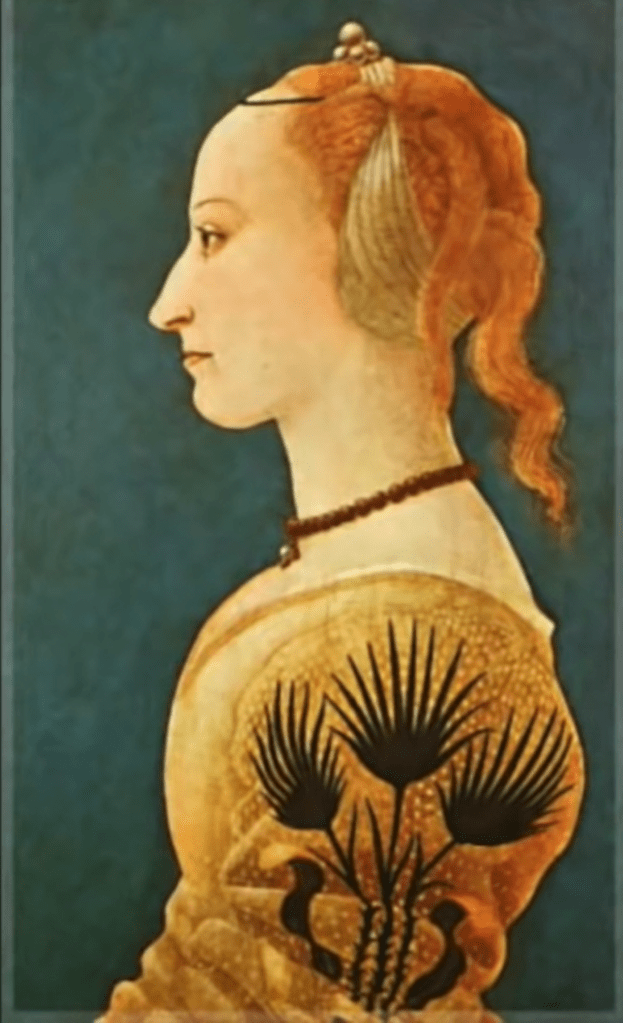
Unlike any other commissioned portraits of the aristocracy we usually see with expensive outfits, Mona Lisa is a pretty simple wealthy woman with no jewelry, clothes that are nothing special, and simple hair.

Leonardo uses the classic pyramid-shaped composition that was introduced during the renaissance. The structure provides stability and provides a central focus. In this painting, the focus is directed towards her face.

What makes her different?

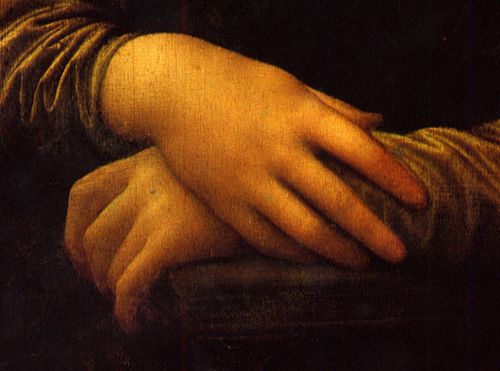
Instead of a full-length pose, Leonardo had painted Mona Lisa in a three-quarter length to cut down the distractions. Today this pose is normal but on those days it was groundbreaking. Previously the people in the portrait are erect, but Mona Lisa is relaxed with hands resting gently.

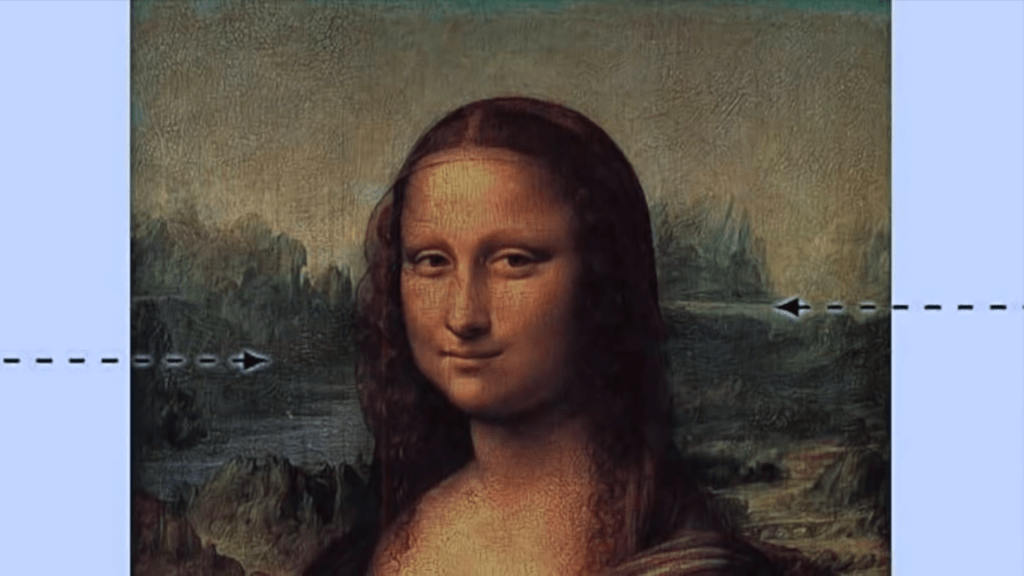
If you look at Mona Lisa’s eyes you see they are staring at you, but women in paintings never did that. The background of any other portrait has a simple background of either an open sky or a room but the background of the Mona Lisa is a complex aerial perspective of a landscape. The curves of her hair and clothing reflect the valleys and river flowing connecting humanity and nature. If you look at the background and compare the horizons on both sides you see it is not lined up. This visual trick gives an illusion of movement.

level of horizons

Her eyes and smile follows you

Leonardo has used the Sfumato technique to paint Mona Lisa’s eyes. It creates a depth near the eyes of Mona Lisa which is unusual in the case of other paintings and sculptures. Leonardo has studied human anatomy, the structure of a human face, and smiles exposing the muscles and nerves. He started researching how a smile works and analyzed every possible movement of the face. Artists never painted a smiling face before, portraits are generally serious. When you look into her eyes first she smiles then she is not. The smile comes and goes as we look deep into her face. When we look away smile stays.

Leonardo from his optic studies observed that the light comes and hits the whole retina instead of hitting at one point. This was the key to her mysterious smile.

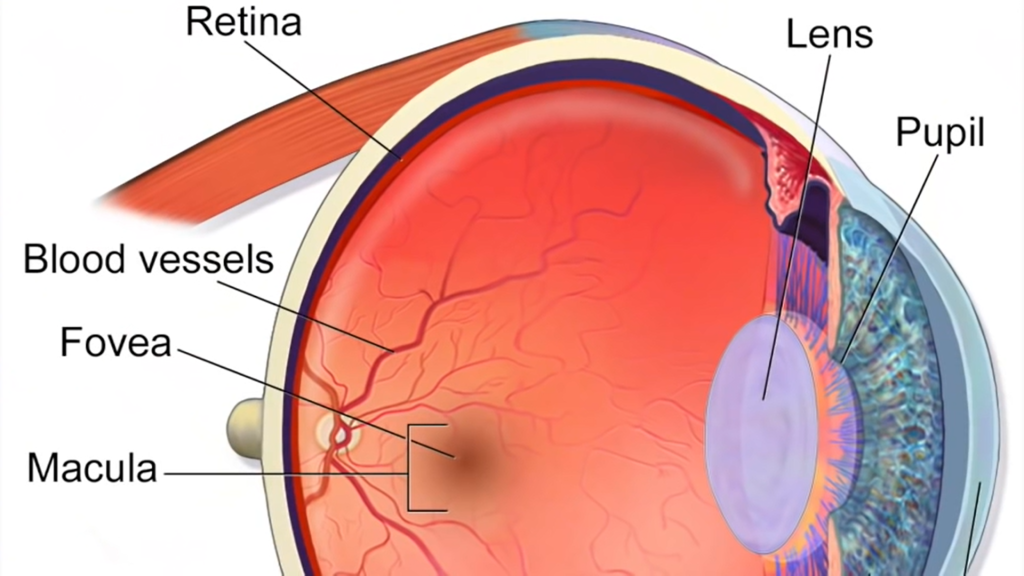
The human eye has two different regions for seeing the world one is a central area called the fovea(to read colors) and the other is the peripheral area(to see the black and white motion and shadows). When we focus on the eyes the peripheral vision is on the smile and pick up the shadows from her cheekbones. When you look at her smile directly you cannot see the shadows, and she isn’t smiling but smirking. This is not your imagination, but it is about how you see.

Her eye’s on you!
Inner part of the eye

Sfumato technique

Sfumato is a blending technique for softening the transition between colors to make sure there are no sharp lines, layer by layer he blended everything in Sfumato style.

Chiaroscuro

chiaroscuro is an effect of contrasted light and shadow that gives a 3D effect.

These styles were never seen before Mona Lisa. Hence, seeing Mona Lisa for the first time must have been astonishing. How genius Leonardo da Vinci is that he understood this 500 years ago.

credits to the right owners of the pictures used.

Leonardo Da Vinci’s Human Powered Helicopter Becomes Reality

Leonardo Da Vinci's Aerial Screw

It would be hard to call Leonardo Da Vinci anything other than a man ahead of his time.  Between 1452 and 1519, Leonardo did just about everything. He is most famous today for his skills as a painter, where he painted some small works- like the Mona Lisa and The Last Supper. His sketches of man were the most anatomically correct to date (The Vitruvian Man). He was also a famed sculptor, musician, architect, anatomist, geologist, cartographer, botanist, writer mathematician, engineer and inventor. He conceptualized things far beyond his time, including concentrated solar power, a calculator, the double hull for ships, a tank and, most interesting to those of us in the aviation industry, a helicopter.

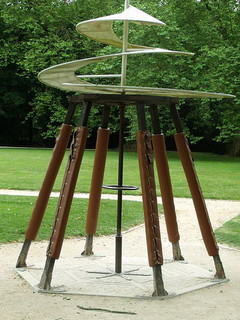
Over 420 years before the first helicopter was built, Leonardo Da Vinci sketched out what he called the Aerial Screw. This aerial screw was a man powered helicopter that required four men to spin cranks fast enough to generate enough lift to get off the ground.

Now, fast forward to 1980, 461 years after Leonardo passed away.  The American Helicopter Society sought to finally see the first human powered helicopter take flight. To win the prize money, which started at $10,000, the helicopter needed to reach at least 3 meters in the air (9.8 feet) for 60 seconds while being stable enough to have the center of the helicopter stay within a 10 x 10 meter box (32.8 x 32.8 feet). It would take 9 years from then before the first human powered helicopter even got off the ground when students at Cal Poly San Luis Obispo got their human powered helicopter 8 inches off the ground for all of 7.1 seconds. In the next 20 years, not much progress would be made so the Sikorsky Aircraft Corporation pledged additional prize money to try to see if that would inspire more innovation.

Sure enough, it did. Two teams, one from the University of Maryland and the other AeroVelo, were locked in a tight race to win. The university of Maryland got their man powered helicopter to fly for 65 seconds but it only reached 8 ft (about 1.8 feet short of where they needed to be) in August of 2012.

Finally, this July in Toronto, Aerovelo took the $250,000 in prize money with this flight:

While we don’t expect to see these Atlas human-powered helicopter’s flying around a city near you soon, this was a remarkable achievement. Congratulations to the Aerovelo team! And, over 480 years later, Leonardo Da Vinci’s vision of a human powered helicopter came to fruition.

An orb and Leonardo da Vinci: The Salvator Mundi Painting Solved

Leonardo da Vinci, the artist of the famous Mona Lisa and Salvator Mundi painting, is a man of mysteries. He was more than a painter. He was an avid engineer, scientist, sculptor and an architect with deep knowledge about science and astronomy. The alien theories, the striking symbolism theories and more out-of-the world speculations about his work are being debated up till now. One such puzzle is the Salvator Mundi painting

The Salvator Mundi Painting

Salvator Mundi
The Salvator Mundi painting

The Salvator Mundi painting was created by da Vinci somewhere between 1490-1500. It is the world’s most expensive painting, priced at 450 million US dollars. No, Mona Lisa isn’t the most expensive one. Deep search can tell you that. The image depicts a man, presumably Jesus Christ, holding in his hand a spherical ball like structure. Nothing mysterious about the painting as of now. Okay. So what was solved?

To understand how scientists solved the puzzle, we have to look up the problem. As I had already stated, da Vinci was a man of science and had genuine knowledge about it. It can be proved by looking at his works which deceivingly represent scientific facts. Salvator Mundi means ‘savior of the earth’. So it can be interpreted that the glass orb that Jesus is holding symbolizes the earth.

The problem behind

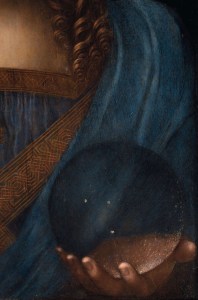
What is wrong about this painting is that, any 10th grader would know that a convex lens would provide an inverted, magnified, reversed image of an object placed behind it. The glass orb must act like a convex lens and thus do the same. But if you observe carefully, you can see that it appears as if those properties are defied and a clear, non-reversed image of Jesus’ hand and clothing is visible behind the glass orb.

You may argue that any painter would be ignorant of the science behind a convex lens. But Leonardo da Vinci was not ‘any painter’. He was a polymath of the High Renaissance! He has portrayed much more complex scientific principles in his work than that of a convex lens. There is no plausible way that da Vinci couldn’t have known the laws of optical physics. So why did he do that?

Solved

The puzzle was solved by computer scientists from the University of California, Irvine. The painting was 3d virtualized to study about how the various material orbs would appear under different refractive conditions. Many materials with which orbs could be designed were taken into consideration. At last it was concluded that the spherical orb was not a solid mass, instead a hollow orb. Hollow orb does not behave like a convex lens. It displays the image as it is, thus adhering with the painting. They predicted that the glass of the orb in Salvator Mundi was a fraction of an inch thick thus accounting for the quality.

Did Leonardo da Vinci actually paint it?

Many critics claim that the painting is not actually da Vinci’s. They point that da Vinci is more of a scientist to commit such trivial errors and thus proving that he did not paint it at all and that it was painted by a ‘lesser’ painter. But many say that, such a clever installation of the orb itself is a proof of authenticity. In order to think about hollow orbs and paint it during the 1500s would take immense intellect, which can only be done by the polymath himself.

Leo constellation?


three dots
The three dots in the glass orb

Orange iris
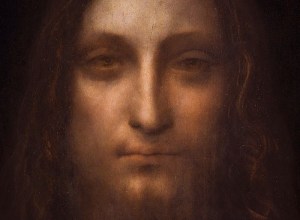
The orange iris of Jesus in the painting

As if the Salvator Mundi has not enough controversies, one more intriguing detail is the three dots painted in the glass orb giving it a mystical appearance. The three dots are said to represent the constellation of the sign Leo. What does it have to do anything with this painting? Well, if you observe the iris of Jesus, a faint orange glow emanates from within. The orange iris imitates Lion’s eyes. And thus the constellation, many say. Some also relate to the fact that his name Leonardo is the reason behind. However there is no concrete explanation behind.

Hope I kindled some curiosity within you today. I leave you with one of my favorite da Vinci’s quote:

To develop a complete mind:

Study the science of art;

Study the art of science.

Learn how to see. Realize that everything connects to everything else.

-Leonardo da Vinci