Lolita: The Book Review

Introduction

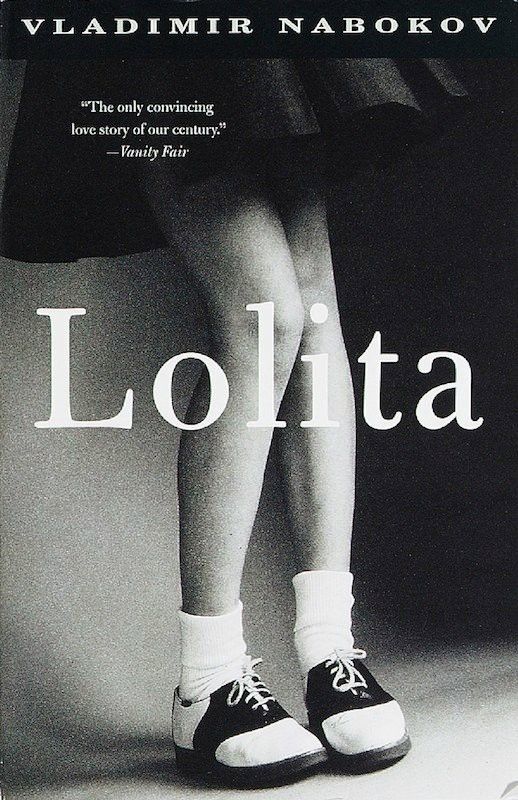
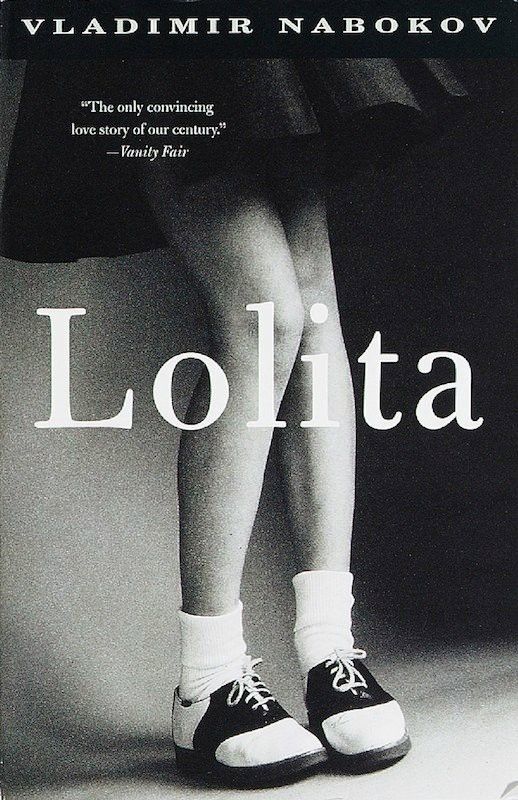
The cover of Lolita (1955)

Lolita  is a 1955 novel written by Russian-American novelist Vladimir Nabokov. The novel is notable for its controversial subject, which engages an unethical relationship between a middle aged man and a minor girl. First issued in 1955 by an unorthodox Paris press after being rejected by a string of American publishers; banned by the French government, presumably out of solicitude for immature English-speaking readers (the ban was later quashed by the French High Court); pronounced unobjectionable by that blue-nosed body, the U. S. Customs office; and heralded by ovations from writers, professors, and critics on both sides of the Atlantic, became a near-instant bestseller in the US, shifting over 100,000 copies in its first three weeks alone. The shocking subject matter, gleefully punning unreliable narrator, and Nabokov’s spellbinding sentence-level prowess combined to create a book as repulsive as it was inviting—comic and horrific and utterly absorbing. The novel was later adapted in two movies with the same name of the novel, Lolita(1962) and Lolita(1997) .
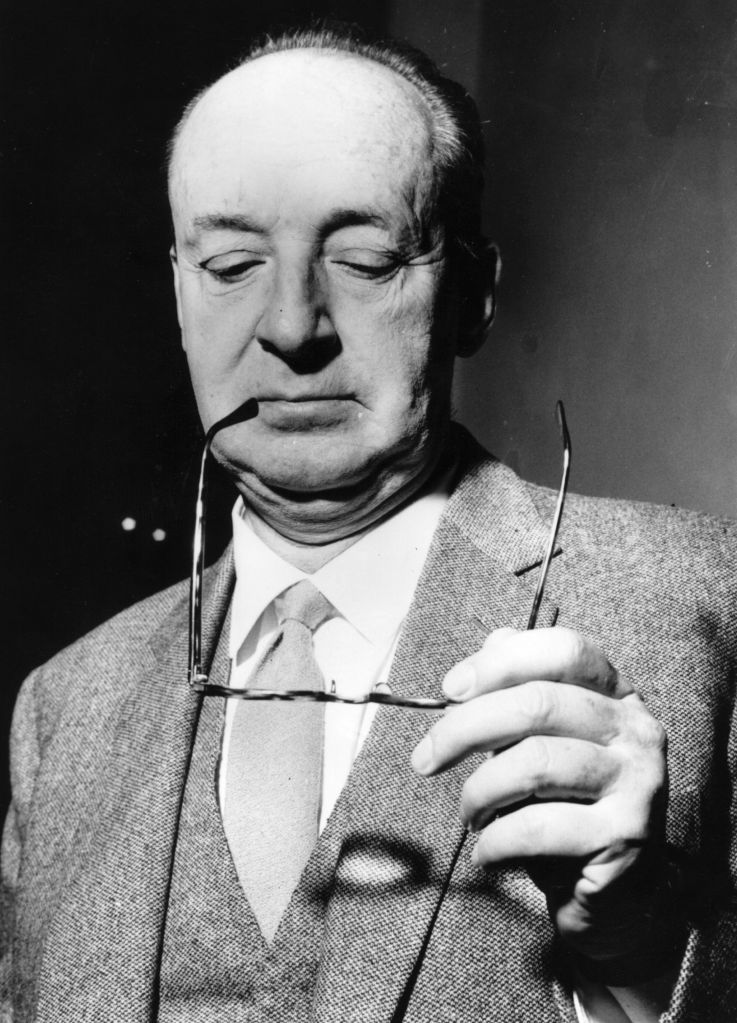
Russian writer Vladimir Nabokov (1899 – 1977) in Rome to work on the film screenplay of his most famous book, ‘Lolita‘.

About The Author

Vladimir Vladimirovich Nabokov , also known by the pen name  Vladimir Sirin, was a Russian-American novelist, poet, translator, and entomologist. Born in Russia, he wrote his first nine novels in Russian (1926–1938) while living in Berlin. He achieved international acclaim and prominence after moving to the United States and beginning to write in English. Nabokov became an American citizen in 1945, but he and his wife returned to Europe in 1961, settling in Montreux, Switzerland.

Nabokov’s Lolita  (1955) was ranked fourth in the list of the Modern Library 100 Best Novel  in 2007, Pale Fire  (1962) was ranked 53rd on the same list; and his memoir, Speak Memory (1951), was listed eighth on publisher Random House list of the 20th century’s greatest nonfiction. He was a seven-time finalist for the National Book Award for Fiction.
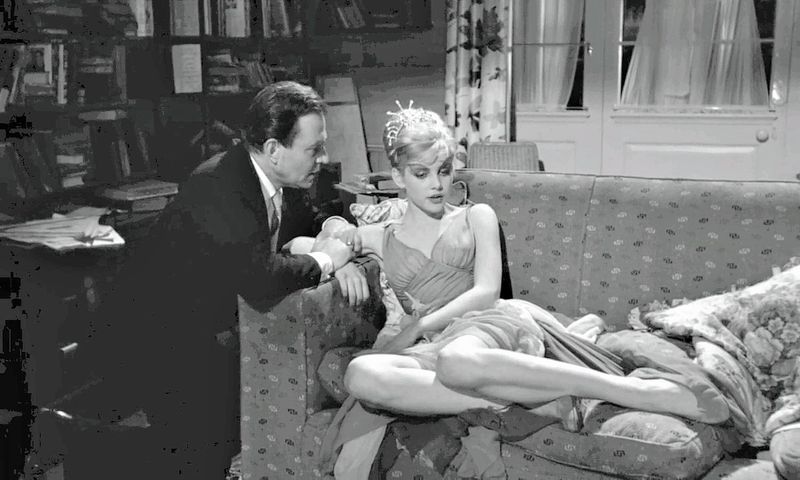
Cinematic Adaptation of Lolita (1962), starring James Mason as Humbert Humbert and Sue Lyon as Lolita

Storyline of The Novel

Lolita, Vladimir Nabokov’s immaculate and disturbing masterpiece, is the story of middle-aged paedophile man Humbert Humbert—a handsome, French-born intellectual on the one hand, and unapologetic sexual predator on the other and his tragic love affair with his 12-year-old, bubble-gum popping stepdaughter Dolores Haze, who is fondly called Lolita by Humbert. It’s a post-war road novel, the odyssey of a venerable European man and a prepubescent American girl bouncing across the United States, trying to outrun the past and find a future that doesn’t exist.
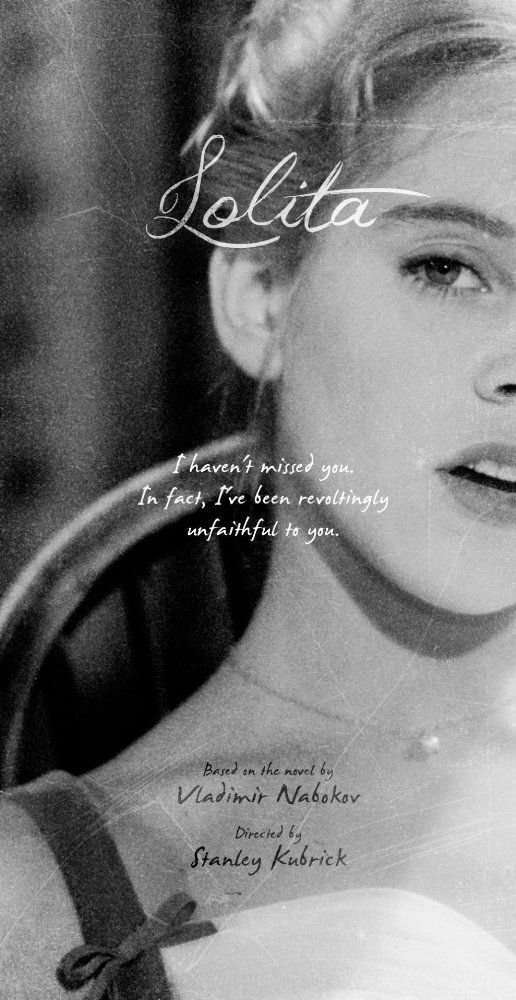
Lolita (1962)

Humbert’s sociopathic behaviour might be traced back to a sexual experience when he was 13, when he meets his “first love” Annabel—a 12-year old girl who is travelling with her parents. They lust for each other fervently, with an intensity that leaves a permanent impression on Humbert. He describes his passion with a cannibalistic “frenzy of mutual possession [that] might have been assuaged only by our actually imbibing and assimilating every particle of each other’s soul and flesh.” Their failure to complete the dirty deed leaves an indelible, unresolved tension in Humbert—an impoverished thirst for early-pubescent girls that carries through to adulthood, which he is forced to lie about . He gets married to a widow who he physically abuses to get his own way. He constantly admits himself to sanatoriums, but finds the doctors ridiculous and uses his intelligence to mislead them. He swings from “ashamed and frightened” to “recklessly optimistic,” craving hedonistic intercourse with 11 to 14 year-old girls, but living in the wrong country and century. He tries to justify his urges by recounting accepted paedophilia throughout history, but even his vindications are half-hearted and remorseless—he’s a grown man who wants to have intercourse with children, and there’s nothing to be done about it. He’s an “artist and a madman, with a bubble of hot poison in his loins.” His anguish is illustrated beautifully by Russian-born Nabokov, whose mastery of English is mind-blowing. The animalistic language that he uses is both shocking and enthralling, and some sentences are appalling in their vividness.
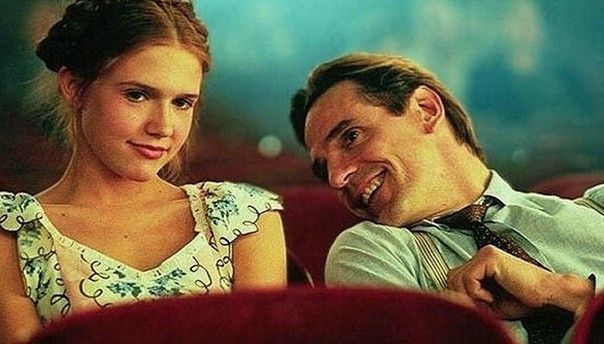
Cinematic Adaptation of Lolita (1997), starring Jeremy Irons as Humbert Humbert and Dominique Swain as Lolita

Humbert understands the precariousness of his attachment to Dolores. She’s a hostage who he appeases with countless and expensive bribes, spawning a crippling jealousy that his nymphet will run away with someone else, especially because of her flirtatious nature. The juvenile sensuality of Dolores Haze makes a paedophile and a green-eyed monster of Humbert, who becomes more and more paranoid as the story unfolds. 

Analysis of The Novel

To be sure, this novel isn’t for the faint of heart, but neither should prospective readers retreat to any kind of moral high ground. Nabokov, in fact, threads an unexpected and affirming emotional serenity through his portrait of obsession. His enigmatic narrator leaves us in spellbound rapture. Because for all of its linguistic pyrotechnics — as Humbert confesses, “you can always count on a murderer for a fancy prose style” — and for all its controversial subject matter, Lolita is one of the most beautiful love stories you’ll ever read. It may be one of the only love stories you’ll ever read. This is the most thrilling and beautiful and most deeply disturbing aspect of the novel — and it’s what most persuasively recommends the book — that in addition to finding Humbert’s soul on the page, we also find, like it or not, a little of our own.

Lolita (1997)

The Author has afflicted poor Humbert with a special and taboo variety for a couple of contradictory reasons. In the first place, its illicit nature will both shock the reader into paying attention and prevent sentimentally false sympathy from distorting his judgment. Contrariwise, I believe, Mr. Nabokov is slyly exploiting the American emphasis on the attraction of youth and the importance devoted to the ‘teen-ager’ in order to promote an unconscious identification with Humbert’s agonies. 

Criticism of The Novel

The art that palliates Humbert’s misery has not notably relieved the distress of reviewers, most of whom have felt obliged to ask themselves, how the author could come up with such horrific storyline. Some have concluded, rather desperately, that he hasn’t done it at all. According to one interpretation, Mr. Nabokov has merely written an allegory of a European intellectual who falls in love with America and discovers, to his gentle sorrow, that the country is still a trifle immature. Aside from the difficulty of assigning roles, the fact that the author is obviously capable of writing such a story without the aid of a nympholeptic allegory throws considerable doubt on the argument. It has also been suggested, ingeniously, that Mr. Nabokov really wanted to write a tale of romantic passion in the grand, or nineteenth-century, manner, and found that the only way to make such a passion interesting to the contemporary reader was to disguise it as psychopathology. If this interpretation is correct, one can only say that Mr. Nabokov has beautifully concealed his disappointment at having to portray his heroine as a child.
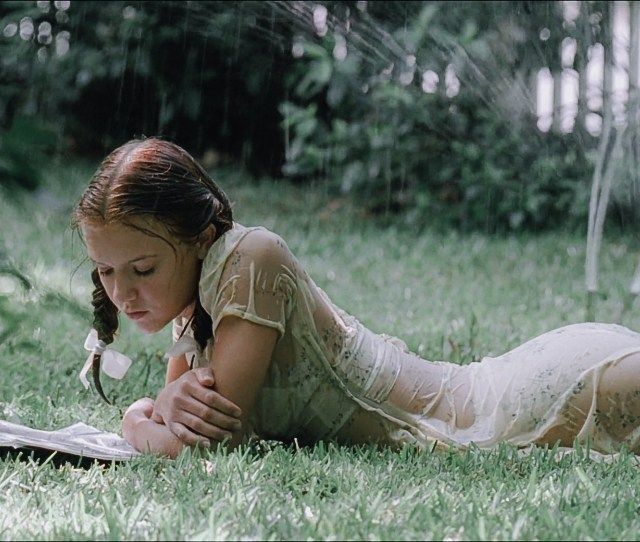
Lolita (1997)

Despite Humbert’s evil, the fallout from the relationship is heartbreaking. Our empathy for the odious rogue is Nabokov’s greatest achievement in the novel. We both detest and sympathise with him, leaving us feeling confused and perhaps a little guilty. Humbert’s vile actions and fantasies, in which he dreams of painting a mural and re-live hopelessness of falling in love with a girl who could never love him back. Like Humbert’s love for DoloresLolita felt like a forbidden fruit, breaking the sturdiest of taboos to illuminate the mind of an infatuated, sociopathic paedophile, which is a mind we rarely get to see. 
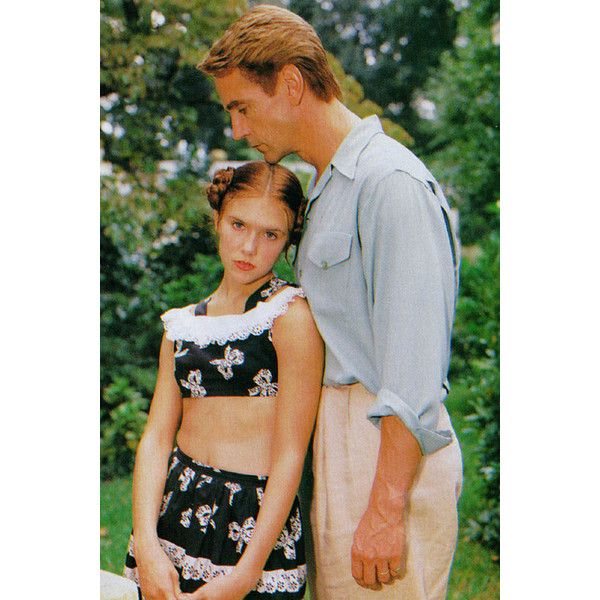
Lolita (1997)

Conclusion

Lolita is old enough and infamous enough to be known as a story of unhinged paedophilia. But it’s also a beautiful and depressing love story, with a tortured antagonist who despite his crimes, and due to the skill of the book’s author Vladimir Nabokov, we can eventually empathise with.

The Perks of Being A Wallflower: The Book Review

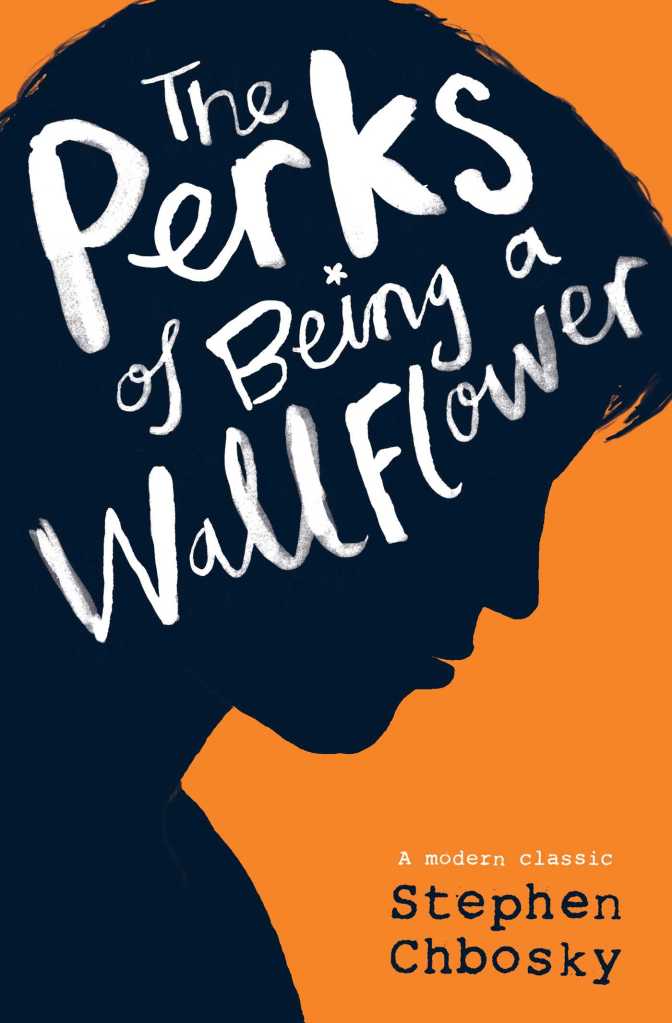
Cover of Perks of Being A Wallflower (1999)

Introduction

The Perks of Being A Wallflower(1999), is a modern age novel written by Stephen Chbosky. The novel is about the dilemma of passivity vs passion that marks the stunning debut of a provocative new voice in contemporary fiction. Stephen Chbosky has created this deeply affecting coming-of-age story, a powerful novel that would spirit the readers back to those wild and poignant roller coaster days known as growing up. The novel is later adapted to a movie under the same title in 2012.

About The Author

Stephen Chbosky is an American screenwriter, film producer, film director, novelist, television writer, and television producer. He is best-known for writing the bestseller The Perks of Being A Wallflower(1999), as well as for writing and directing the 2012 film adaptation of the book. Most recently, he directed the 2017 drama Wonder and the 2021 film adaptation of Dear Evan Hansen. His first psychological horror novel, Imaginary Friend, was published in October 2019.

Stephen Chbosky

Storyline of The Novel

The Perks of Being a Wallflower by Stephen Chbosky is narrated by fifteen-years-old Charlie, the titular ‘wallflower’, in a series of letters that he writes to a stranger, beginning the night before he starts his freshman year of high school in 1991. These letters catalogue Charlie’s attempts to “participate”, as he wanders wide eyed through a series of house parties and Rocky Horror Picture Show productions with his new, older friends. Along the way, Chbosky intelligently explores stock Young Adult themes such as mental health, substance abuse and sexuality, whilst simultaneously reminding the reader about how exciting it is to be young and idealistic.

Logan Lerman as Charlie in Perks of Being A Wallflower (2012) movie

           Though shy and sensitive in nature, Charlie is an intelligent boy with unconventional thinking capabilities. His first letters starts with Charlie mentioning about suicide of his Middle School’s friend and death of his favourite aunt Helen and how these tragic incidents have took toll in his life. Charlie befriends two seniors Patrick and Sam and ends up indulging in alcohol and other drugs with Sam. In the meantime, Charlie also learns about his sister having relationship with an abusive guy and eventually getting pregnant. The flashback of his aunt dying in car crash stops haunting Charlie, as he starts enjoying company of his friends and Sam. While playing Truth and Dare, he is asked to kiss the prettiest girl in the room; he kisses Sam for which he faces neglect from the group. Overall this is a story filled with drama and lots of emotions, including, friendship, first love and teenage sexuality.

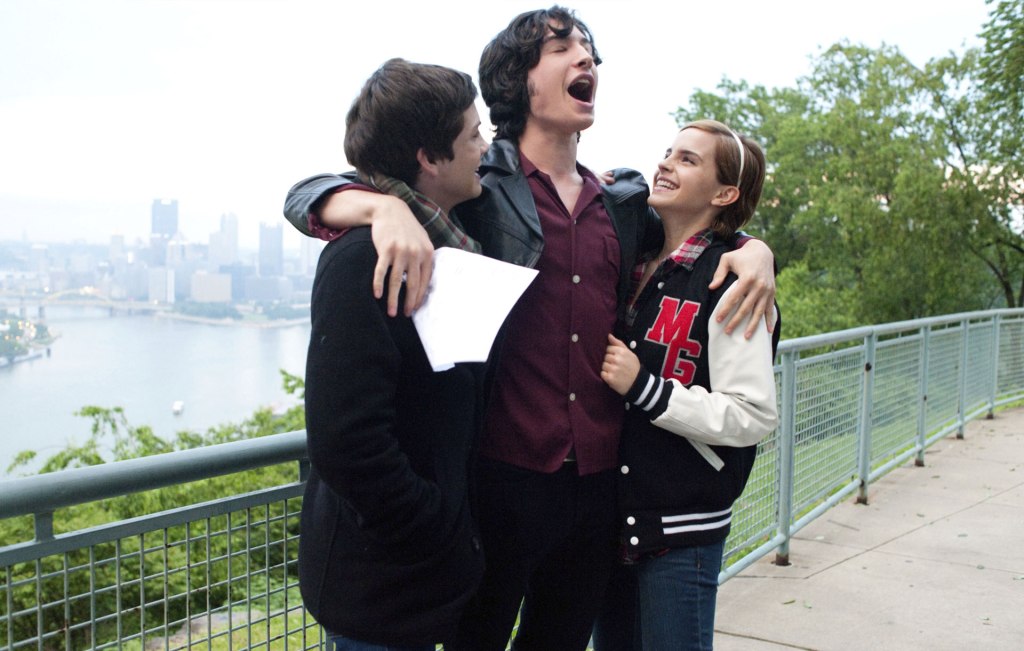
Logan Lerman as Charlie, Emma Watson as Sam and Ezra Miller as Patrick in Perks of Being A Wallflower movie

Analysis of The Storyline

Throughout the book, through the characters, the author seems to be attempting to answer some of the questions we all face at some time in our life. The author seems to be trying to find the reason why some good people chose bad people to love. This question is raised by Charlie to Mr. Bill and the answer he gives seems to be the central theme of the book “We accept the love we think we deserve”. This can be seen in various characters. Sam is in a relationship with a guy, who seems to consider that everything that is good about her, is good because of him. She seems to have gone through some tough times in her life, and the fact that she didn’t consider herself worthy, seems to have played a role in this.

Scene from Perks of Being A Wallflower movie

The whole book seems to be asking the reader to love themselves. The author, by writing the story as a series of letters, seems to be trying to speak to the readers, as if speaking to a friend, a friend he sees in high regard, no matter how they see themselves.

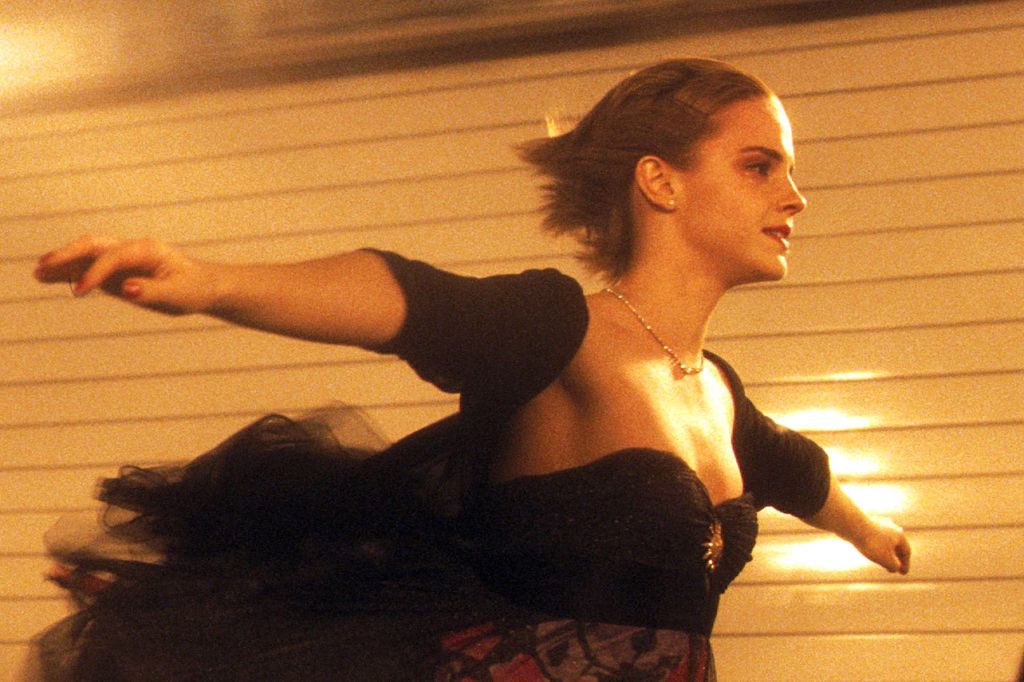
Iconic scene of Emma Watson in Perks of Being A Wallflower movie

Criticism of The Storyline

Charlie, the protagonist of the novel suffers extreme teenage crisis that sometimes breaks the readers’ hearts that all he had to handle alone inside his head. The book shows all the sides of being a teenager and isn’t afraid to cover mature themes. The book uses its more mature situations in order to relate to teenagers. Many teenagers have experienced these hardships either first hand or by hearing about them. The characters partake in activities that some may see as unwise. These are in the book however to add realism not to encourage or promote these acts. This book will most likely only be fully appreciated by older teenagers due to its unflinching depiction of teenage life. Before reading this book readers should know there are themes of sexual abuse and those that are sensitive to that topic should be cautious about reading this book. 

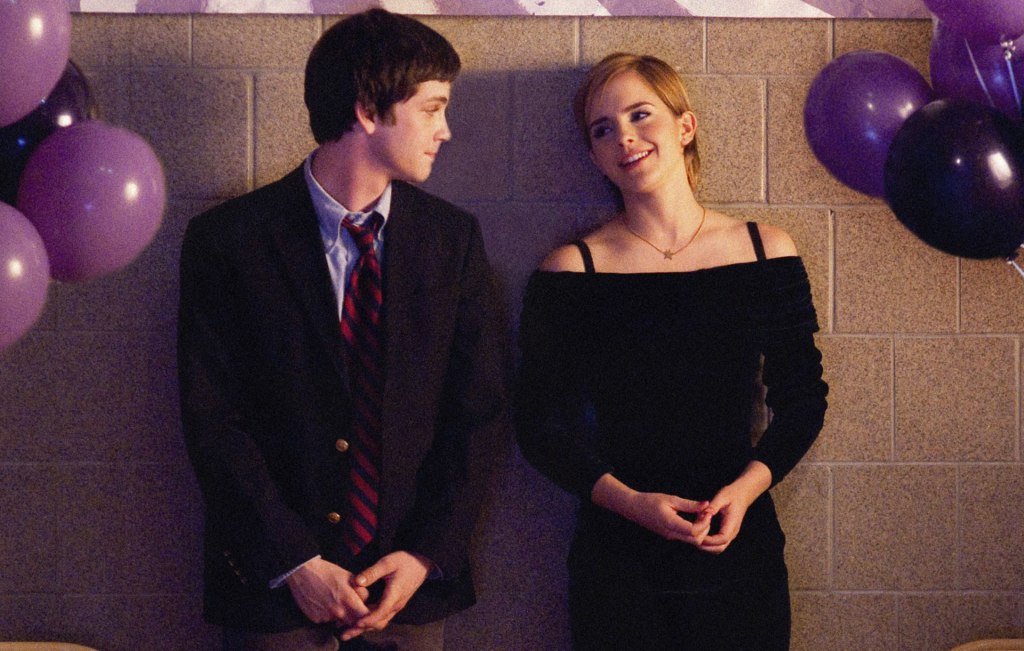
Logan Lerman and Emma Watson in Perks of Being A Wallflower (2012)

Conclusion

The book has received love all over from many of its readers for its very realistic portrayal of teenage life, complex characters, and thought-provoking commentary from Charlie. This book displays a wide range of emotions. Its relatable and complex characters allow the readers to feel the same emotions the characters are feeling. The book’s use of journal entries to tell its story helps the reader connect to Charlie and it adds to the realism, which makes this book an absolute winner.

Call Me By Your Name: The Book Review

Call Me By Your Name, Cinematic Adaptation

Introduction

Call Me By Your Name is a book that throbs with desire. André Aciman’s 2007 novel (and the basis for the film of the same franchise in 2017) is a portrait of adolescent love and lust, experienced for the first time with an intensity that’s almost frightening in how all-consuming it feels. And Aciman devotes himself to chronicling every fleeting fantasy, every caress, with a fervour that matches what his characters are feeling.

About The Author

André Aciman is an Italian-American writer. Born and raised in Alexandria,Egypt, he is currently distinguished professor at the Graduate Center of City University of NewYork, where he teaches the history of literary theory  and the works of Marcel  Proust.

He is the author of several novels, including Call Me By Your Name and a 1995 memoir, Out of Egypt, which won a Whiting Award.  Although best known for Call Me by Your Name, Aciman stated in an interview in 2019 that his best book is the novel Eight White Nights.

André Aciman

Storyline of The Novel

It tells the story of a blooming romance between 17-year-old Elio Perlman, and 24-year-old visiting scholar Oliver, who comes to the summer home of Elio’s parents in Italy, 1983.

The story is told in retrospect, with grown-up Elio recalling the events of that fateful summer. He always resented his parents’ tradition of taking a doctorate student into their home for six weeks each year, forcing him to vacate his bedroom (that sacred space of a teenage boy) to make room for their guest. That all changed when Oliver, a Harvard graduate student comes to stay with the academic expat family in the Italian Riviera, where he will oversee the translation of his dissertation on Heraclitus. As he wins the family over with his breezy charm and preppy insouciance, Oliver also inspires the adoration of the professor’s teenage son, Elio, who relays to us each stage of his infatuation.

Elio catalogues every aspect of Oliver—his gazes, his phrases—and even augurs meaning from his clothing: “He had, it took me a while to realize, four personalities depending on which bathing suit he was wearing.” Elio, in turn, dazzles Oliver with his precocity—he’s a virtuoso on piano and on an enviously easy footing with literature from Ovid to Celan. But he is unsure and untested in carnal matters. His desire for Oliver literally false-starts when he accidentally (and discreetly) ejaculates in his presence (the scene recalls Marcel’s embarrassing tussle with Gilberte). But when Oliver starts sleeping with a local girl, it seems that Elio’s fantasies of consummation will never be realized. He muses about killing, or at least crippling, Oliver: “If he were in a wheelchair, I would always know where he was, and he’d be easy to find.”

But then, just as Elio has given up hope, it happens: He slips into Oliver’s room one night and so begins their five-week love affair. They have adventurous, almost incessant sex, during which, at Oliver’s prompting, they call each other by the other’s name. As a strategy for subsuming the other’s self, this verbal masquerade is strikingly successful. At first shameful for Elio, their passion quickly becomes all-consuming. The lovers revel in their sameness—they are both young Jews, “brothers in the desert”; they experience the same sexual pains and pleasures; their minds travel along the same currents to catch the right literary references.

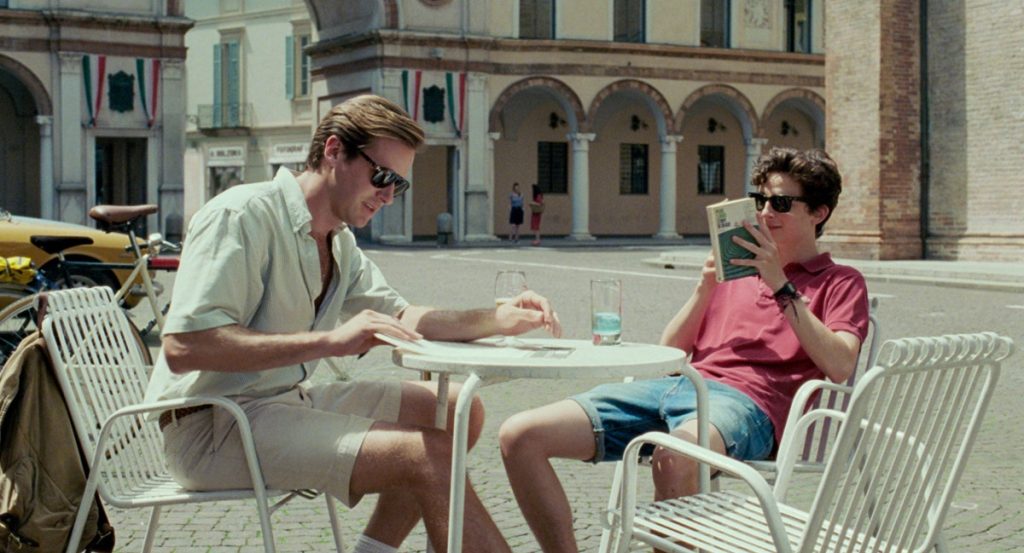
Timotheé Chalamet as Elio Perlman and Armie Hammer as Oliver, in Call Me By Your Name (2017)

Analysis of The Story

Call Me by Your Name is the story of a sudden and powerful romance that blossoms between an adolescent boy and a summer guest at his parents’ cliff-side mansion on the Italian Riviera. Unprepared for the consequences of their attraction, at first each feigns indifference. But during the restless summer weeks that follow, unrelenting buried currents of obsession and fear, fascination and desire, intensify their passion as they test the charged ground between them. What grows from the depths of their spirits is a romance of scarcely six weeks’ duration and an experience that marks them for a lifetime. For what the two discover on the Riviera and during a sultry evening in Rome is the one thing both already fear they may never truly find again: total intimacy.

The psychological manoeuvres that accompany attraction have seldom been more shrewdly captured than in André Aciman’s frank, unsentimental, heartrending elegy to human passion. Call Me by Your Name is clear-eyed, bare-knuckled, and ultimately unforgettable.

Timotheé Chalamet as Elio Perlman

Criticism of The Story

Despite the fact that it’s a coming-of-age story, Call Me By Your Name is hardly a young adult book. For one, it’s quite erotic, albeit in a highly literary way. All of the sexual encounters (including one truly smutty incident with a peach) are depicted in detail, but not to titillate. It feels more like Aciman is simply demonstrating the depth and desperation of Elio and Oliver’s desire.

Call Me by Your Name ends with a series of unsatisfactory but still charged meetings between Elio and Oliver later in life. They have a rendezvous in New England, where Elio is traveling and where Oliver teaches and lives with his family. The novel, despite its melancholy send-off, ultimately holds out an extremely un-Proustian, optimistic promise: Love and understanding can endure hand in hand. Elio can still say of Oliver, “This was my favourite Oliver: the one who thought exactly like me.” Twenty years later, when they return to one of their cherished spots in Italy, Elio asks only to be called once more by the name Oliver—as if to imply that nothing has changed. For Proust, such naming is inevitably fraught with failure (Marcel at one point wishes he could give a different name to each of the Albertines he knows). The notion that the past could ever obey such a summons, that anyone could ever be so static, suggests that Elio has breached, but finally resisted, Proustian knowledge. This shying away leaves us with something less than we might have expected from Aciman’s previous reckonings with time.

Scene from the Movie Call Me By Your Name

Conclusion

Even with all the critical analysis, the storyline wins millions of hearts with the sweet message of love, that can happen to anyone under any circumstance. The story broke some stereotypes about how the meaning of Love is mostly depicted in society. It normalizes the simplicity, the beauty and the agony of love between two men, in a never seen before way. And that makes the book an ultimate winner for its modern day readers.

Dante Aligheiri: Connecting His Life, Love and Literature

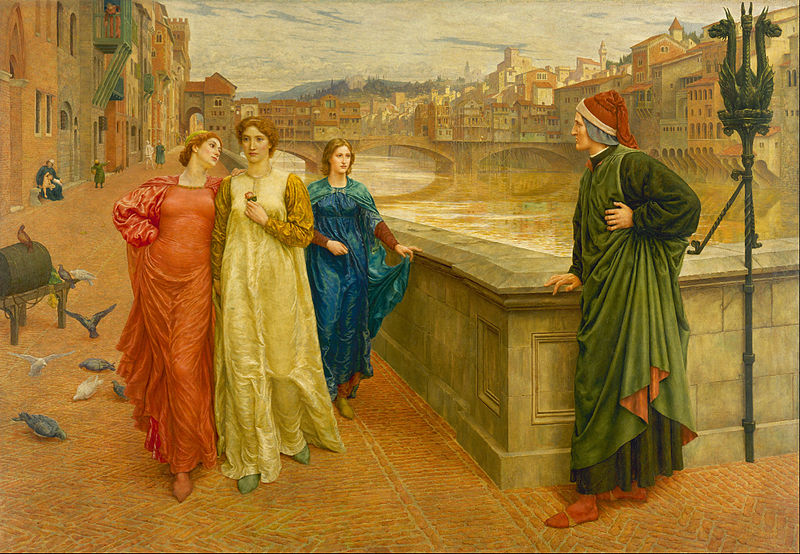
Dante, looking at Beatrice passing by (Art Work)

Introduction

Dante Aligheiri, the famous Italian poet, is without any debate, one of the most passionate poets of all time who believed in and lived by the true meaning of Love through his exceptional writings . His works are still considered as the Canvases of Human Mind, sparkling and expressing love through words. Though, the love of his own life remained unrequited and that agony fueled his journey of writing as a neverhealed wound, creating some masterpieces of Romantic Literature.

Early Life of Dante

Born in Florence, Italy around 1265, Dante was the son of Alighiero di Bellincione Alighieri and Bella di Abati, and he grew up among Florentine aristocracy. Scholars surmise that he received formal instruction in grammar, language, and philosophy at one of the Franciscan schools in the city. 

Dante’s Love : Beatrice Portinari

Dante first met Beatrice Portinari, daughter of Folco Portinari, when he was only nine years old and he claimed to have fallen in love with her “at first sight”, apparently without even talking with her. He would later write about his instant love for her in “Vita Nuova”, saying “Behold, a deity stronger than I; who coming, shall rule over me.”

When he was 12, however, he was promised in marriage to Gemma di Manetto Donati, daughter of Manetto Donati, member of the powerful Donati family. Contracting marriages for children at such an early age was quite common and involved a formal ceremony, including contracts signed before a notary. Dante claimed to have seen Beatrice again frequently after he turned 18, exchanging greetings with her in the streets of Florence, though he never knew her well.

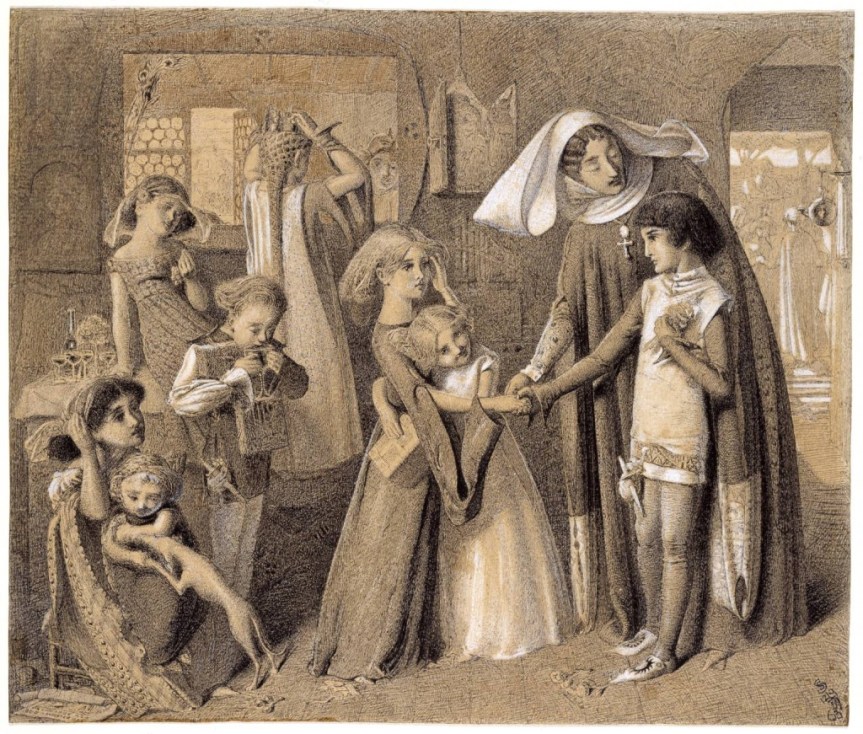
Dante meeting Beatrice for the first time (Art work)

Beatrice’s Death: Presence in Dante’s work

Beatrice died in 1290 at age twenty four. Beatrice probably never had any idea of the depth of his passion for her, yet she was to become one of literature’s most famous figures.

After Beatrice’s death, Dante withdrew into intense study and began composing poems dedicated to her memory. The collection of these poems, along with others he had previously written in his journal in awe of Beatrice, became La Vita Nuova, a prose work interlaced with lyrics.
Dante describes his meetings with her, praises her beauty and goodness, describes his own intense reactions to her kindness or lack thereof, tells of events in both their lives, and explains the nature of his feelings for her. She represents an idealized love, the kind of love that transcends physicality. Alighieri included her in both La Vita Nuova and Divine Comedy. She is his salvation; the “gentilissima” (most kind) and “benedetta”(blessed). It is Beatrice who serves as his guide in Heaven in Divine Comedy. La Vita Nuova also relates of the day when Dante was informed of her death and contains several anguished poems written after that event. In the final chapter, Dante vows to write nothing further of Beatrice until he writes “concerning her what hath not before been written of any woman.”

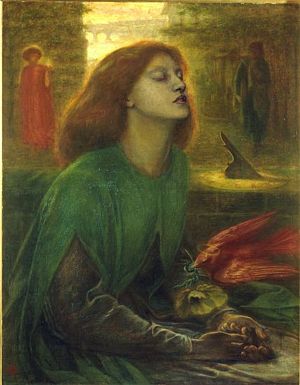
Portrait of Beatrice

Analysis of Dante’s Love and Literature

The promise is fulfilled in the epic poem The Divine Comedy, which he composed many years later. In that poem, he expresses his exalted and spiritual love for Beatrice, who is his intercessor in the Inferno, his purpose in traveling through Purgatorio, and his guide through Paradiso.

Beatrice addresses Dante, the author and a character himself, for the first time in Canto 2 of Dante’s “Inferno”: she descends into Limbo and prays that the poet Virgil can rescue Dante. She then reappears in Canto 30 of Purgatorio, when Virgil disappears.

At first sight of her in Purgatorio, he is as overwhelmed as he was at the age of nine and is dazzled by her presence throughout the journey until she ascends again to her place in heaven, the point closest to God that he is allowed to reach.
This expression of sublimated and spiritualized love ends with Dante’s total absorption into the divine.
Their last meeting is set among the blessed in Heaven at the end of their journey into the afterlife.

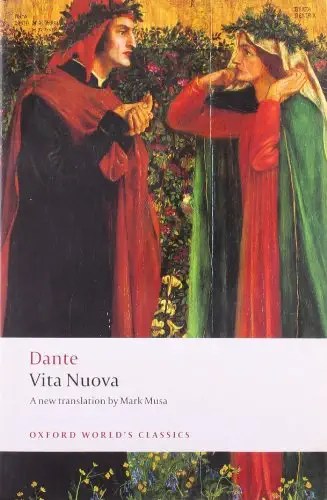
Dante’s work Vita Nuova, heavily influenced by Beatrice

Conclusion

Dante’s love for Beatrice may have been idealized and unattainable, but at the core of that love is admiration, goodness, and respect. That’s a type of love that we don’t see much of in the media of today’s world. We prize the scintillating and love has become synonymous with physical lust.Dante’s love transcends the physical. It is a love of the heart and the intellect. She represented the ideal of beauty and grace, but was also a real woman.
Beatrice appeared to Dante as the woman/angel that guides him through Paradise, but also remained a real woman who made his heart beat in the streets of Florence.

What are Differences Between Eastern and Western Cultures

Eastern world refers to countries in the Asia and Middle East whereas Western world refers to North and South America, Europe, Australia and New Zeeland. East and West may have numerous differences based on culture. These differences can be noted mainly in people’s behavior and attitudes. However, since east and west refers to various countries and cultures scattered across the globe, only a broad generalization can be made to compare the two cultures. The main difference between eastern and western culture is that people in the east are more traditional and conservative than the people in the west.
Eastern culture includes Asia and the Middle East, while the western world includes South and North America, European countries, New Zealand and Australia. The East and West have many differences based on their culture which is reflected in people’s attitude and behaviour.
When a comparison between eastern and western culture is made, one of the key differences between western and eastern culture is that countries in the West are more liberal than countries in the East. Western culture allows people to be more open and critical. They discuss subjects that are considered taboo in eastern cultures and they are allowed to show their emotions and vent anger if they think they should. This sort of behaviour wouldn’t take place in eastern cultures. People prefer to approach difficult situations by using good manners and tact, not aggression.
A second eastern and western culture comparison is a person from the West is more free and flexible to reach decisions on his/her own, unlike what happens in the East where families make more decisions collectively. Thirdly, arranged marriages are not a key feature of western cultures, as love is considered to be the way that people tie the marital knot.
Can there ever be similarities between eastern and western culture?
Many schools of thought believe that there is not enough common ground between eastern and western cultures for them to ever share similar characteristics. There are some features that are so different, like the types of religions in eastern cultures, such as Islam, Hinduism, Shenism, Buddhism, Jainism and Taoism. Clothing and rituals are so different in eastern cultures, like Indians paying respect to parents or elders by touching his/her feet. East Asians bow down as a gesture used when welcoming guests, saying thank you and apologizing. When it comes to ideologies and beliefs, eastern cultures find it difficult to question them despite what they might really feel. In contrast, most people can forsake religion and no one will think anything of it.
Elders are the decision-makers in eastern cultures
The difference between western and eastern culture can be seen by looking at the role of elders. In eastern cultures, elders are the leaders in the home, so children do what the elders say without questioning them. Any important decisions to do with a child are generally made by an elder. When parents grow old, children are often the ones who take on the responsibility for caring for them. Often in western cultures, an elderly person’s welfare becomes the responsibility of the state in collaboration with children or other close relatives.
Arranged marriages commonly take place in eastern cultures. They are usually arranged by a couple’s parents or another elder. They believe that love follows marriage, not the other way round.
Education has few similarities between eastern and western cultures
The comparison between eastern and western culture shows that western education focuses on creativity and allows individuals to develop as much as they can. In Eastern education, achievement is linked to struggle and hard work. This means you can achieve anything if you work hard enough. Students from eastern cultures often excel academically when in a western educational environment because they work harder than western children.
Students in western culture are encouraged to actively participate in debates and ask questions. This is not so much the case in eastern cultures where what the teacher says is always right. Added to this is the extra effort in western cultures to integrate children who are classified as special needs. They sit in classrooms alongside other students. This doesn’t often happen in eastern cultures where special needs children are taught separately.
Eastern Culture
Eastern world refers to countries in Asia and Middle East. The people in eastern countries are more traditional than people in the West when we consider their rituals, customs, clothing, etc. For example, Indians pay respect to their elders by touching their feet; East Asians use bows as greetings, apologizing and thanking. People in the East are rigid in their ideologies and beliefs; they are often reluctant to challenge and question the long practiced traditions and customs.
In eastern countries, elders are considered as the head of the home and children respect and obey them in all decisions. The important decisions regarding children’s future are usually taken by elders. When parents grow old, the children are expected to look after them.
Arranged marriages are a common phenomenon in eastern countries. They are usually arranged by parents or elders. Factors like education, social status, and family background are considered in these marriages. The concept that love comes after marriage is also promoted by these marriages. Moreover, public displays of affection are often frowned upon in Eastern countries.
Islam, Hinduism, Buddhism, Jainism, Shenism, and Taoism are some common religions in these countries. Rituals and customs of different communities may also differ according to these religions.
Western Culture
Western World mainly refers to Europe and North America. Judaism, Christianity, and Islam are some of the most common religions practiced in the Western world.
People in the west are more open-minded than those in the east. The westerns are more open and forthright. For example, topics such as the birth of a child and sex are still taboo in some eastern countries.
People in the west are also more open about their feelings. If they are angry, they might express. But people in the east might cover it for the sake of diplomacy and politeness. Westerns may also display their feelings and emotions in public.
Moreover, the individual is given preference over family, so a person has more freedom and power to take decisions on his own, unlike those in the east. Therefore, concepts like arranged marriages are not common in the west; they marry for love.
In western culture, relationships are not hierarchical and everyone is considered to be equally important and respected irrespective of their age or professional qualification, whereas, in eastern culture, people who are older or have higher professional qualifications are considered to be more respectful and important.
Moreover, in the west, people are more task-focused when it comes to spending time, that is, they see time as money and want to get their tasks done without wasting any time, whereas, in the east, people are more event focused and love to spend their time on building relationships.
When it comes to speech, people in the west are honest, whereas people in the east value harmony over honesty, that is, they would rather speak the lie and maintain harmony in the relationship than speak the truth.
Also, the westerners are independent and do things themselves, on the other hand, the eastern culture has different levels of society, and people in a higher level of society hire people from a lower level of society and help them monetarily.
Considering food, eastern culture is famous for its hospitality, whereas westerners view the same hospitality as ostentatious and prefer to be efficient which easterners view as inconsiderate.
Then there is a difference in ethics, how something is considered to be right or wrong. In eastern culture, ethics are based on honor and shame. If something brings honor to your society then it is considered to be right and if something brings shame to your society then it is considered to be wrong. Such is not the case in western culture. In western culture, ethics are strictly based on law. If something follows the law it is considered to be right and if something breaks the law it is considered to be wrong.
Another good cultural model that will help you paint a clear picture of the cultural differences is the Hofstede’s Cultural Dimensions Theory

What are the main characteristics of Pre-Raphalite poetry?

The Pre-Raphaelites were a loose and baggy collective of Victorian poets, painters, illustrators, and designers whose tenure lasted from 1848 to roughly the turn of the century. Drawing inspiration from visual art and literature, their work privileged atmosphere and mood over narrative, focusing on medieval subjects, artistic introspection, female beauty, sexual yearning, and altered states of consciousness. In defiant opposition to the utilitarian ethos that formed the dominant ideology of the mid-century, the Pre-Raphaelites helped to popularize the notion of ‘art for art’s sake’. Generally devoid of the political edge that characterized much Victorian art and literature, Pre-Raphaelite work nevertheless incorporated elements of 19th-century realism in its attention to detail and its close observation of the natural world. Those poets who had some connection with these artists and whose work presumably shares the characteristics of their art include Dante Gabriel Rossetti, Christina Rossetti, George Meredith, William Morris, and Algernon Charles Swinburne.

They were inspired by Italian art of the 14thand 15th centuries, and their adoption of the name Pre-Raphaelite expressed their admiration for what they saw as the direct and uncomplicated depiction of nature typical of Italian painting before the High Renaissance and, particularly, before the time of Raphael. The Pre-Raphaelite movement during the Victorian era was an idealistic reaction against the didacticism moral fervor and pre-occupation of poets and novelists with contemporary society. In the reign of Queen Victoria, there was a growing tendency to make literature a handmaiden social reform and an instrument for the propagation of moral and spiritual ideas. Literature became the vehicle of social, political, and moral problems confronting the Victorian age. Ruskin, Carlyle, Dickens were engaged in attacking the evils rampant in the society of their times. So the movement was against this pre-occupation of poets, prose writers, and novelists with the mundane problems of their times, that a set of high souled artists formed this group.

Main Characteristics of Pre-Raphaelite

  • Like the Romantics, the Pre-Raphaelite was inspired by the art of the Middle Ages. The romance, chivalry, superstition, and mysticism of the Middle Ages inspired them. They gave a touch of modernism to the medieval concepts and vivified them.
  • The Pre-Raphaelite poets gave extreme attention to realistic details. This pictorial quality is noticeable in Pre-Raphalelite paintings. The Pre-Raphaelite poets transposed this into poetry. Rossetti’s ‘The Blessed Damozel’ and ‘Silent Noon’ and Morris’s ‘The Haystack in the Flood’ give several instances of beautiful word painting.
Silent Noon by Rossetti
  • Pre-Raphaelite poetry was free from any didactic zeal. It aimed at the perfect form and finish. Precise delineation, lavish imagery, and wealth of details are its distinguishing features. For the Pre-Raphaelite, art was for art’s sake.
  • Pre-Raphaelite poetry is rich in melody and music. The most melodious among the Pre-Raphaelite was Swinburne in whose poetry the musical language is so swift and effortless that it sometimes obscures the meaning. His famous poem ‘Atlanta in Calydon’ is an example. The Pre-Raphaelite poets used alliteration and musical words profusely.
  • Some critics attack the Pre-Raphaelite for their so-called sensuality. The love poetry of Rossetti and others is indeed outspoken, rich, and sensuous. But to call it sensual is to under-estimate Rossetti’s subtle imagination and artistic devotion to the beauty of the human body.
  • The Pre-Raphaelite had an affinity with the Romantics. Saintsbury thinks that this new school of poetry is a direct development of the Romantic Revival. Rossetti himself was greatly influenced by Keats. The Pre-Raphaelites were also the forerunners of the Aesthetic movement led by Oscar Wilde.

The Pre-Raphaelite Poetry’s characteristics are very rich and very vast. It focuses on the glorification of art, escape from the darkness, and the ugliness of contemporary society, a continuation of Romantic poetry, and gives a strong conception of scenes and situations, precise delineation, lavish imagery, and metaphor. By these characteristics, the Pre Raphaelite Poetry leaves a lasting impression in English Literature.

The Pre-Raphaelite Poetry

The Pre-Raphaelite movement was started by two German painters based in Rome in 1810. The movement drew inspiration from Italian painters before Raphael such as Giotto, Bellini, and Fra Angelico. The movement was concerned with the art of painting. The Pre-Raphaelite Brotherhood was a group of English painters, poets, and art critics. It was formed in England in 1848 by William Holman Hunt, John Everett Millais, Dante Gabriel Rosetti, William Michael Rosetti, James Collinson, Frederic George Stephens, and Thomas Woolner who formed a seven-member “Brotherhood” modeled in part on the Nazarene movement. The Brotherhood was only ever a loose association and their principles were shared by other artists of the time, including Ford Madox Brown, Arthur Hughes, and Marie Spartali Stillman. Later followers of the principles of the Brotherhood included Edward Burne-Jones, William Morris, and John William Waterhouse.

The Pre-Raphaelite Brotherhood, founded in September 1848, is the most significant British artistic grouping of the nineteenth century. Its fundamental mission was to purify the art of its time by returning to the example of medieval and early Renaissance painting. Although the life of the brotherhood was short, the broad international movement it inspired, Pre-Raphaelitism, persisted into the twentieth century and profoundly influenced the aesthetic movement, symbolism, and the Arts and Crafts movement.

Firstly, Dante Gabriel Rossetti’s Girlhood of Mary Virgin (1849), in which passages of striking naturalism were situated within a complex symbolic composition. Already a published poet, Rossetti inscribed verse on the frame of his painting. In the following year, Millais’s Christ in the House of His Parents (1850) was exhibited at the Royal Academy to an outraged critical reception. The master of a brilliantly naturalistic technique, Millais represented biblical figures with closely observed portrayals of the features of real, imperfect models. In 1850 the Pre-Raphaelites also produced a literary and artistic magazine, the Germ, which was something of a manifesto for their artistic concerns and ran for only four issues.

The Girlhood of Mary Virgin by Dante Gabriel Rosetti

From the first, the Pre-Raphaelites aspired to paint subjects from modern life. In The Awakening Conscience (1854), Hunt represented a kept woman realizing the error of her ways, and in 1852 Madox Brown began the most ambitious of all Pre-Raphaelite scenes from modern life, Work (1852–1865). Although the brotherhood included no women, Christina Rossetti, sister of Dante and William, pioneered a Pre-Raphaelite style in poetry, and Elizabeth Siddall-model, muse,
and eventually wife of Dante Gabriel Rossetti-produced distinctive watercolors and drawings that went unrecognized in her lifetime but received critical attention after the advent of feminist art history in the late 1970s.

The Awakening Conscience by Hunt

Another element in Pre-Raphaelite poetry is perceived in love for beauty. The Pre-Raphaelite poets are lovers of beauty. Here they are the followers of the great poetic creed of Keats. In their rich sensuousness, they are also found to carry on the tradition of great romantic poetry. They are also found to be medievalistic in their attachment to the medieval past. This also constitutes another romantic aspect of Pre-Raphaelitism. Their attempt to follow Byron’s revolutionary spirit and Shelley’s inspiration for loveliness does not appear to have much succeeded, yet these elements are not ignorable in them. Pre-Raphaelite poetry, in this respect, appears to be the second phase of Romanticism in the nineteenth century. This, however, appears to lack in humanism and the idealistic vision of human life, so much marked in romantic poetry. The Pre-Raphaelite poets aimed at infusing the art and spirit of the Pre-Raphaelite painters into poetry.


Kinds Of Essay

An essay is a short composition in prose. It discusses, either formally or informally, one or more topics. This term was first applied to Montaigne’s volumn of informal pieces. This volume was first published in 1580. After seventeen years, Francis Bacon used the English word ‘essay’ to describe his brief philosophic discourses. With the development of periodicals, the essay become a popular form. Addison, Steel, Lamb, Hazlitt, and Pater made it their major concern.

The Aphoristic Essay Bacon was the first to write proper essays in English. Though he was inspired by the French writer Montaigne, his essays are more objectives and impersonal than those of the French master. Bacon’s essays are written in an aphoristic style. They contain mostly short, crisp sentences with a didactic bent. Bacon called his essay’s ‘counsels civil and moral’ and ‘dispersed meditations’. Aphoristic essays are known for their precision of style and balancing structure. No superfluous words are used and sentences flow rapidly. They seem abrupt and rugged but express the ideas directly and clearly. As a critic says, the sentences in an aphoristic essay are in a state of ‘literary undress’

The Character Essay In the earlier part of the 17th century, the essay took the form of character sketches in the writings of Joshep Hall, John Earle, and Sir Thomas Overbury. They were inspired by the Greek philosopher Theophrastus and the Roman Seneca. The early character essays were marked by minute details and were often presented in a humorous and satirical manner. Such essays were almost like pen pictures of various types of men and women. Some traits of the character essay can be seen even in Addison’s essays on Sir Roger de Coverley.

The Critical Essay Dryden introduced this type of essay during the Restoration period. Though the critical essay retained the traditional form, its theme was literary criticism. Dryden’s Prefaces and other prose writings can be included in this category. The critical essay is the main objective. However, it often exhibits traits of the personal essay because critical opinions are generally colored by the personality of the writer. In the 19th century, the critical essay flourished in the writings of Emerson, Hazlitt, Arnold, Carlyle, and Ruskin. The 20th century has seen a host of critics who made valuable contributions to the critical essay. Among them, T.S.Eliot and F.R.Leavis are the most important.

The Periodical Essay The periodical essay became popular in the 18th century especially with the publication of the ‘Tatler’ and the ‘The Spectator’. The essay that began to appear in the periodicals drew their inspiration from the social life of the people. The periodical essay was adapted for literary criticism and the delineation of character. Addison’s essay delineating the character of ‘The Spectator’ and the several essays by Steele and Addison on the imaginary character Sir Roger de Coverley is the examples of how journalistic writings could attain artistic perfection.

The Personal Essay In the Personal Essay, the personal element predominates. Charles Lamb is known as the greatest writer of the personal essay in English Literature. There is no formal or logical development of thought in an essay. The various points are mentioned haphazardly. Its author likes to enjoy the freedom of conversation. So, he is informal and often chatty. Hazlitt, De Quincey, and Charles Lamb brought the personal essay to a level that has remained unsurpassed. George Orwell, E.M. Forster, James Thurber, and E.B. White are excellent model practitioners of the personal essay.

Twentieth Century Essay In the 20th century, the development of the essay is encouraged by a large number of periodicals and newspapers. Many of the modern essays appear in the form of articles and are often collected and published in book form. In the modern essay, the distinction between the personal and the objective is hardly noticeable. It is at once expository, reflective, and descriptive and one of its main elements is humor. Some of the important modern essayists are G.K.Chesterton, A.G.Gardiner, F.L.Lucas, Max Beerbohm, and Hilaire Belloc

https://track2training.org/2022/01/11/what-is-an-essay/

The Characteristics of Metaphysical Poetry

Metaphysical poetry is a group of poems that share common characteristics; they are all highly intellectualized, use rather strange imagery, use frequent paradox, and contain extremely complicated thought. The most common characteristic is that metaphysical poetry contained large doses of wit. Although the poets were examining serious questions about the existence of god or whether a human could perceive the world, the poets were sure to ponder those questions with humor. In addition, many of the poems explored the theme or carpe diem(seize the day) and investigated the humanity of life.

Delight in novel thought and expression The metaphysical poet deligthed in novel thoughts and expression. As Scott said, they played with thoughts. There is a fusion of passionate feelings and thought in their poems. Instead of the Elizabethan splendor of sound and imagery, the metaphysical employed subtlety of thought and verbal fancies.

conceit Metaphysical poetry uses conceit. A conceit is a far-fetched simile, an ingenious parallel between two highly dissimilar things. It is the ingenuity of a conceit rather than its justness that invites the reader’s attention. A metaphysical conceit is used to prove or define a point. In ‘A Valediction: Forbidding Mourning’, Donne compares two lovers to the two legs of a compass. In ‘The Ecstay’ he compares the eye beams of the lovers to a twisted thread that connects the lover’s eyes. This is exemplified in Cowley’s comparison of the experience of loving different women with traveling through different countries.

Concentration Metaphysical poetry is noted for its concentration. The reader is not allowed to pause and muse over the poem; he is required to pay attention and read on. A metaphysical poem tends to be brief. Words and thoughts are compressed. Length of line and rhyme scheme enforces the sense. Hence the reader is expected to concentrate.

Affectation, Hyperbole and Obscurity Metaphysical poetry is characterised by affectation and hyperbole, and occasional obscurity. The metaphysical poets had the license to say something unexpected and surprising. Their fancy and amplifications have no limit. In the task of finding verbal equivalents for their thoughts and feelings, the metaphysical poets often become obscure. As Dr. Johnson said, dissimilar ideas are yoked by violence together leading to obscurity. In Donne’s A Valediction of Weeping’, the use of geographical conceits makes it a little difficult to understand.

A Valediction of Weeping by John Donne

Argument and persuasion Argument and persuasion are two of the elements of a metaphysical poem. Every poem two is based on the memory of the experience. A need to argue arises out of it. The argument is done with help of conceit and dramatic presentation of thought and feelings.

The Scholarship of author Metaphysical poetry shows the scholarship of its authors. As Dr. Johnson pointed out they drew their similes and conceit from the recesses of learning unfamiliar to an average reader. The poems of Donne, Marvell, and Cowley especially show their vast learning in philosophy, literature, science, astronomy, and geography.

Love Metaphysical poetry includes the most impassioned love poetry in English. Donne’s poems like ‘The Anniversarie’, ‘The Good Morrow’, ‘The Canonisation’ and ‘The Extasie’ are love poems that raise the great metaphysical question of the relation of the spirit to the senses. Similarly is Marvell’s ‘To His Coy Mistress’. Some of the finest religious poems in English are also metaphysical poems. The poems of Herbert, Vaughan, and Marvell are examples.

The Good Marrow

https://track2training.org/2022/01/12/the-metaphysical-school-of-poetry/

The Metaphysical School of poetry

The term ‘metaphysical’ was first applied to Donne by Dryden and later extended to a group of poets by Dr. Johnson. It has been used to describe the special characteristics of the poetry of John Donne and his followers in the 17th century. John Dryden first used this term in connections to the poetry of John Donne and the same was confirmed by Dr. Samuel Johnson. At the beginning of the 17th century, there appeared a group of poets who reacted against the conventions of Elizabethan love poetry and wrote more colloquial, witty, passionately intense, and psychologically probing poetry. This group came to known as the metaphysical poets. They include John Donne, Andrew Marvell, George Herbert, Abraham Cowley, Richard Crashaw, and Henry Vaughan. They were men of learning, but wrote colloquial and often metrically irregular lines filled with unusual metaphors, similes, and conceits.

Dr. Samuel Johnson

Dr. Johnson thought that from the Aristotelian point of view they were not poets at all. Though their learning and subtlely were high, they were wholly concerned with something unexpected and surprising. Johnson says that their attempts were analytic and they broke every image into fragments. “The most heterogeneous ideas are yoked by violence together; nature and art are ransacked for illustrations, comparisons, and allusions”. Dr. Johnson was certainly not impressed by them. However, T.S. Eliot in the present century discovers several beauties in the metaphyscial. He sees in their Poetry “a direct sensuous apprehension of thought, or a recreation or thought into feeling”. Eliot places them in the direct current of English poetry and points to their ‘quaint and pleasant taste’.

John Donne, Founder of Metaphysical poetry

The metaphysical style was established by John Donne. Dryden pointed out that Donne ‘affects the metaphysics not only in his satires but in his amorous verses’. Donne inspired a host of others like Suckling, Cleveland, Crashaw, and Cowley.

Metaphysical poetry resolves itself into two broad divisions amorous verse and religious verse. The amorous verse was generally written by the courtly poets like Carew, Suckling, and Lovelace and religious verse by Herbert, Crashaw, and Vaughan. Donne wrote amorous, devotional, and satirical poems. In his poetry sensuality and cynical wit mingle at times. He excelled in reflective imaginations and sober meditation. Herrick wrote amorous and religious verses and several epigrams. Crashaw was best in his religious verse. Abraham Cowley’s lyrics were sweet and graceful.

In conclusion, the age of metaphysical poetry successfully presented great educational benefits and presented significant value to English literature. The significance of this age is quite clear as it presented new aspects of value and new methods of expression that were not known before the seventeenth century, the language and concepts used in metaphysical poetry are unique and present significant cleverness. It also focuses on driving the audience to imagine what they have not thought of before and capture their imaginations. Most metaphysical poets suffered from different struggles, but the one they almost all had in common was self anxiety, presented in the fear of the future of the human soul, which is what lead them to speak and express their thoughts on the journey of life and turning points. Also, most of the metaphysical poets were born in the seventeenth century and raised into religious families and therefore carried out a religious mindset, and some of them even held religious positions during his lifetime, which explains the majority of religious poetry over other types of poetry, other topics such as love was also present, and it shared the common point of desiring reciprocity results whether from God or the loved one.

SHAKESPEAREAN COMEDY

A Shakespearean comedy has a happy ending, usually involving marriages between the unmarried characters, and a tone and style that is more light-hearted than Shakespeare’s other plays. Shakespeare started to write comedies by the year 1600. Shakespeare wrote more comedies than any other kind of play. Shakespeare comedies (or rather the plays of Shakespeare that are usually categorised as comedies) are generally identifiable as plays full of fun, irony and dazzling wordplay. They also abound in disguises and mistaken identities, with very convoluted plots that are difficult to follow with very contrived endings. But Shakespeare’s plays are not in the rigorous sense either pure tragedies or pure comedies. 

Shakespeare’s comedies represented a significant departure from the classical comedy that had dominated the stage before he arrived in London. Whereas classical comedies were fairly straightforward, Shakespearean comedies introduced several elements that made for more complicated plots. Classical comedies typically opened with an already established pair of lovers, and they told of how these lovers had to overcome some obstacle or another to confirm the legitimacy of their union. Shakespeare, however, did not write comedies with already established lovers, and instead emphasized the plot on the process of wooing itself.

Some of the chief characteristics of Shakespearean comedy:

Love and Marriage as motif:

Love and marriage are the main themes in Shakespeare’s comedies. The preoccupation of the noble characters is love. Sometimes love leads to intrigue but is happily resolved at the end. The course of true love never runs smooth and thus conflict arises. But sighers and lovers live side by side. Love is mingled with sighs and even sorrow in some cases, but finally it converges into laughter. Love is treated as a divine passion and life is a pilgrimage towards its realisation.

Love and Marriage in Twelfth Nigth

Supernatural:

Shakespeare uses the supernatural in some of his comedies like ‘A Midsummer Night’s Dream’. However, the supernatural acts as a foil to human actions and errors.

The supernatural element in A Midsummer Night’s Dream

Women Characters:


Shakespeare’s comedies are dominated by women characters. As Gordon says “his comedies are a riot of feminine supremacy, a feminine revel”. Shakespeare’s men love and remain idle; his women characters use their brain, wit, and grace to enlarge the progress of love. Such are Rosalind, Viola, Portia, and Beatrice. They are guided by a certain clear-headedness and frankness in facing facts.

Clown:

Clowns and fools are a part of Shakespeare’s comedies. They provide fun and laughter. they are the satiric commentators on life and correctors of the excesses of the urbane characters. Falstaff, Malvolio, and Jaques provide laughter of a high order whereas characters like Dogberry, Verges, Bottom, and Touchstone provide a good deal of farcical mirth by their vanity, stupidly and complacency.

Realism and Fantasy:

In Shakespeare’s comedy, there is a fine blending of observation and imagination, fact and fiction, realism and fantasy. The story and the plot move between the real and the illusory. The forest of Arden assumes a realistic existence due to Shakespeare’s imagination and fancy. In his comedies, the base is real but the superstructure deal.

Laughter:

Shakespeare’s philosophy of laughter is tolerance. His comedies bring together different points of view and contrasts. The end is the realization of perfect order through laughter. Dowden says “Shakespeare made laughter wise and taught seriousness how to be winning and gracious”.

Music:

Shakespeare uses music in most of his comedies. As Orsino says, music is the food of love. It enhances the romantic atmosphere of the play and relieves the tension. There is music in As You Like It, Twelfth Night, A Midsummer Night”s Dream, and The Merchant of Venice.

Disguise:

In most comedies, Shakespeare has used disguise. This takes the action to several funny situations and complications as in As You Like It, Twelfth Night, and The Merchant of Venice. Disguise brings to focus the incongruities and irrationalities of life’s endeavors.

Voila disguise as Cesario in Twelfth Nigth

SHAKESPEAREAN ROMANCES

Romance” was not a generic classification in Shakespeare’s time. The plays of Shakespeare’s final period (1608-12) are called Romances. In Shakespeare’s own time they were simply classified as tragedies or comedies. These plays are Pericles, Cymbeline, The Tempest, and The Winter’s Tale. Perhaps another play The Two Noble Kinsmen also may be included in this group. They are called romances because they exhibit several characteristics of romance literature. 

Shakespeare must have written these plays under the influence of his younger contemporaries Beaumont and Fletcher whose tragic comedies were becoming very popular. The masques at the court of James 1 also must have influenced Shakespeare. Shakespeare’s romances are, in fact, neither tragedies nor comedies but are a mixture of both.
Dowden has pointed out that the last plays of Shakespeare reveal sobriety, serenity, and sanity as contrasted with the storm and strain of the tragedies. They supplement the tragedies with their more relaxed atmosphere and are marked by great forbearance, a sense of reconciliation, and forgiveness. However, Lytton Strachey thinks that these plays express a mood of boredom rather than serenity.

Romance is a natural step in describing the human experience after a tragedy. In Romance, time seems to be “reversible”; there are second chances and fresh starts. As a result, categories such as to cause and effect, beginning and end, are displaced by a sense of simultaneity and harmony. The tragedy is governed by a sense of Fate (Macbeth, Hamlet) or Fortune (King Lear); in Romance, the sense of destiny comes instead from Divine Providence.
Tragedy depicts alienation and destruction, Romance, reconciliation, and restoration. In tragedies, characters are destroyed as a result of their actions and choices; in Romance, characters respond to situations and events rather than provoking them. Shakespeare had made use of romance material throughout his career The Two Gentlemen of Verona is based on a famous romance, for instance, and small-scale masques are performed in many plays, while others contain masque-like elements.

The romances of Shakespeare have certain common characteristics. They have motifs common in romance literature such as improbable happenings, separation, wanderings, reunion, and reconciliation. They contain several elements of the tragicomedies made popular by Beaumont and Fletcher. There are only a few memorable characters in these plays Shakespeare has returned to his lyrical style of the earlier plays.

The main characteristics of the Shakespearean romances:

  • The scene of these plays is unknown, remote and the setting is imaginary. Cymbeline is set in early Britain and the setting of The Tempest is somewhere in the Mediterranean.
  • The happenings are fanciful. There is no logical cause-and-effect relationship. In the light of reason, the events may appear absurd. The feats of magic in The Tempest, the concealment of Hermione for sixteen years in The winter’s Tale, and the abduction of the two sons of Cymbeline would appear unnatural. But in Shakespeare’s world of imagination, these events are delightful.
  • Characters are types. They do not have the marked personalities of the characters in the great comedies or tragedies. However, heroines are more memorable than heroes. Miranda, Perdita, and Imogen are lovely but weak. Villains like Iachimo in Cymbeline and Leontes in The Winter’s Tale are not hardened, villains. Even Ferdinand in The Tempest is no match for Benedick or Orlando.
  • The supernatural element is predominant in romances. The Tempest and Cymbeline are examples. The Tempest also shows Prospero’s magic and the elusive character Ariel. In The Winter’s Tale, the Delphic Oracle is introduced and in Pericles, the King’s wife Thaisa becomes a priestess in the temple of Diana. 
  • In romance’s sea is dominant. There is a shipwreck in Pericles and The Tempest. Sea voyages are mentioned in all of them. Sea is the symbol of regeneration.
  • The romances are marked by a spirit of reconciliation and forgiveness. In The Tempest, Prospero forgives his wicked brother Antonio; in Cymbeline posthumous reconciles with Hermione.

The 9 Elements of a Shakespearean Tragedy

In Shakespeare’s tragedies, the main protagonist generally has a flaw that leads to his downfall. There are both internal and external struggles and often a bit of the supernatural thrown in for good measure (and tension). Often there are passages or characters that have the job of lightening the mood (comic relief), but the overall tone of the piece is quite serious. Below we are going to take a more in-depth look at each of the elements of Shakespearean tragedy, as well as explore a few examples

  • The Tragic Hero
    A tragic hero is one of the most significant elements of a Shakespearean tragedy. This type of tragedy is essentially a one-man show. It is a story about one, or sometimes two, characters. The hero may be either male or female and he or she must suffer because of some flaw of character, because of inevitable fate, or both. The hero must be the most tragic personality in the play.
    An important feature of the tragic hero is that he or she is a towering personality in his/her state/kingdom/country. This person hails from the elite stratum of society and holds a high position, often one of royalty. Tragic heroes are kings, princes, or military generals, who are very important to their subjects. In the classic Romeo and Juliet, Romeo Montague is the tragic hero, whose undoing is his obsession with Juliet Capulet. Juliet’s fake death triggers his emotions, leading him to take poison and die right beside his sleeping love.
Romeo and Juliet, two of Shakespeare’s tragic characters
  • Good vs. Evil
    Shakespearean tragedies play out the struggle between good and evil. Most of them deal with the supremacy of evil and suppression of good. Evil is presented in Shakespearean tragedies in a way that suggests its existence is an indispensable and ever-enduring thing. For example, in Hamlet, the reader is given the impression that something rotten will definitely happen to Denmark (foreshadowing). Though the reader gets an inkling, typically the common people of the play are unaware of the impending evil.
    In Julius Caesar, the mob is unaware of the struggle between good and evil within King Caesar. They are also ignorant of the furtive and sneaky motives of Cassius. Goodness never beats evil in the tragedies of Shakespeare. Evil conquers goodness. The reason for this is that the evil element is always disguised, while goodness is open and freely visible to all.
  • Hamartia
    Hamartia is the Greek word for “sin” or “error”, which derives from the verb hamatanein, meaning “to err” or “to miss the mark”. In other words, hamartia refers to the hero’s tragic flaw. It is another absolutely critical element of a Shakespearean tragedy. Every hero falls due to some flaw in his or her character.
    Once again, Hamlet comes into focus as a perfect illustration of hamartia and its role in the tragedy. His indecisiveness and overthinking lead him to overreact, killing Polonius thinking that he was Claudius, his father’s murderer. His obsession with vengeance leads to the senseless murder of the innocent man stirring up tragedy after tragedy. He could have killed Claudius when he was praying at the church but could not act due to his overthinking.
  • Tragic Waste
    In Shakespearean tragedies, the hero usually dies along with his opponent. The death of a hero is not an ordinary death; it encompasses the loss of an exceptionally intellectual, honest, intelligent, noble, and virtuous person. In a tragedy, when good is destroyed along with evil, the loss is known as a “tragic waste.” Shakespearean tragedy always includes a tragic waste of goodness. Hamlet is a perfect example of tragic waste. Even though Hamlet succeeds in uprooting the evil from Denmark, he does so at the cost of his death. In this case, the good (Hamlet) gets destroyed along with evil (Claudius). Neither of them wins. Instead, they fail together.
Tragic waste in Hamlet.
  • Conflict
    In Shakespearean tragedies, two types of conflict take place:
    • External conflict – The hero faces conflict from his antagonists.
    • Internal Conflict – The hero faces conflict in their mind.
    Macbeth struggles internally, wondering whether to take power by force. He has to choose to either remain loyal to Duncan or heed his wife’s advice. He faces an external conflict when Banquo and Macduff rise to challenge his illegitimate rule.
  • Catharsis
    Catharsis is a remarkable feature of a Shakespearean tragedy. It refers to the cleansing of the audience’s pent-up emotions. In other words, Shakespearean tragedies help the audience to feel and release emotions through the aid of tragedy. When we watch a tragedy, we identify with the characters and take their losses personally. A Shakespearean tragedy gives us an opportunity to feel pity for a certain character and fear for another, almost as if we are playing the roles ourselves. The hero’s hardships compel us to empathize with him. The villain’s cruel deeds cause us to feel wrath toward him. Tears flow freely when a hero like Hamlet dies. At the same time, we feel both sorry for Hamlet and happy that Claudius has received his proper punishment.
  • Supernatural Elements
    Supernatural elements are another key aspect of a Shakespearean tragedy. They play an important role in creating an atmosphere of awe, wonder, and sometimes fear. Supernatural elements are typically used to advance the story and drive the plot. The ghost Hamlet sees plays an important role in stirring up internal conflict. It is the ghost who tells Hamlet his father was killed by his uncle Claudius and assigns him the duty of taking revenge. Similarly, the witches in Macbeth play a significant role in the plot. These witches are responsible for motivating Macbeth to resort to murder to ascend the throne of Scotland.
Supernatural Element in Shakespeare: The three witches in Macbeth
  • Lack of Poetic Justice
    Shakespeare’s tragedies share a strikingly similar trait; the lack of poetic justice. Poetic justice occurs when both good and evil characters experience justice. In the real world, good deeds do not always beget rewards, and evil may go unpunished. King Lear’s benevolent daughter, Cordelia, dies while trying to rescue her father. Her tragic end depicts the unfairness of life, which is relatively common and relatable to most people.
  • Fate
    Othello is a tragedy that depicts the powerlessness of man when it comes to the destiny. His love for Desdemona elicits disapproval from her father due to his black skin. He never chose to be born black and cannot change his appearance. His black skin feeds his insecurities, and the fact that he is commonly referred to as the Moor makes it worse. His insecurities eventually lead him to kill Desdemona and stab himself.

What Is a Shakespearean Tragedy?

A Shakespearean tragedy is a play penned by Shakespeare himself or a play written in the style of Shakespeare by a different author. Shakespearean tragedy has got its own specific features, which distinguish it from other kinds of tragedies. Traditionally Shakespeare play types are categorized as Comedy, History, and Tragedy, with some additional play categories proposed over the years. The plays grouped as Shakespeare tragedies follow the Aristotelian model of a noble, flawed protagonist who makes a mistake and suffers a fall from his position before the normal order is somehow resumed. It must be kept in mind that Shakespeare is mostly indebted to Aristotle’s theory of tragedy in his works.

Aristotle’s Theory of Tragedy
A tragedy is the imitation of an action that is serious and also, as having magnitude, complete in itself; in appropriate and pleasurable language; in a dramatic rather than narrative form; with incidents arousing pity and fear, wherewith to accomplish a catharsis of these emotions.”
— Aristotle

What Is a Tragedy?

A tragedy is a play which when adequately acted before an audience can produce a complete cleansing of the emotions. To effect such a catharsis the dramatist much move the audience; he must have a capacity to feel the patho of human suffering, a strong moral sense, and great craftsmanship. The word tragedy was derived from the Greek word tragoidia, which means ‘the song of the goat.’ It is called “the song of the goat” because in ancient Greece the theater performers used to wear goatskin costumes to represent satyrs. Today in theater and literature a tragedy is a work that has an unhappy ending. The ending must include the main character’s downfall.

List of Shakespeare Tragedy Plays

Shakespeare wrote eleven tragedies beginning with ‘Titus Andronicus’. They include the four great tragedies ‘Hamlet’, ‘Othello’, ‘Macbeth’ and ‘king Lear’, the two great Roman tragedies ‘Julius Caesar’, and ‘Antony Cleopatra’ and the lyrical tragedy ‘Romeo and Juliet’.

The Origin of Shakespearean Tragedy

One of the main features of Renaissance art is that it was inspired by classical art and philosophy. This is evident in the work of such artists as Michelangelo who, caught up in the spirit of Humanism that was sweeping across Europe, focused on the human form. Focusing on the human form during Mediaeval times would have been impossible as it would have been a distraction from the necessary focus on God.

The essence of Humanistic art was that human beings were created in God’s image so it was possible for Michelangelo even to portray God – as a beautiful and physically powerful man with realistic human features, presented as perfection – in fact, the human form at its most beautiful. Artists became anatomists, going as far as buying human bodies for dissection. The result was a new realism in the representation of human beings in art.

Shakespeare is, in a way, the Michelangelo of literature. That he could, in one play, Othello, written four hundred years ago, represent what we can recognize as a modern psychopath and a modern alcoholic, in Iago and Cassio respectively, is incredible. Iago is a fully realized psychological character just as David is a fully realized man physically.

Greek drama was an important model for Renaissance drama after the flat, unrealistic morality plays of the medieval centuries. The Greek philosopher, Aristotle, defined tragedy and asserted that it was the noblest and most serious, dignified, and important form of drama. Many of the plays of the Renaissance resembled those Greek tragedies. In several of Shakespeare’s plays, there is a central protagonist who undergoes a harrowing experience as he is brought down from his lofty height, ending up dead.

There is also a special feeling created in an observer of those Shakespeare dramas, similar to the feeling described by Aristotle as the effect of tragedy on an observer. Critics thus thought of those Shakespeare plays as tragedies and that notion has remained with us to this day, although many of those interested in Shakespeare are now thinking differently about the plays from this ‘Shakespearean tragedy’ label. There are still teachers, though, who teach the ‘tragedies’ as though they were Aristotelian tragedies and miss a great deal of what those plays are doing.

EXAMPLES OF SHAKESPEARE’S TRAGIC CHARACTERS

Using the term ‘Shakespeare tragedy’ about any of Shakespeare’s plays invites attempts to fit them to the Aristotelian pattern but none of them fits exactly. Othello seems to conform to the pattern but when one thinks about it, Othello, superficially resembling a tragic hero, doesn’t even seem to be the main character in the play. It can be seen as a modern psychological drama about a psychopath who manipulates every one around him just for fun – just because he has nothing better to do – and destroying other human beings gives him pleasure or is necessary because they get in his way.
Othello may seem to have a fatal flaw – too trusting, gullible – but so do all the other characters, because Iago has deceived them all with his psychopathic charm and a deliberate effort of making himself appear trustworthy. Every misjudgment Othello makes is the hard work of Iago. Easily manipulated? Jealous? Does he have all those ‘tragic flaws’ as well? The feeling at the end is not quite Aristotle either. Perhaps it is more of disgust for Iago than pity for Othello, who comes across as more stupid than tragic. And to make things more complicated, our feeling of pity is directed more to, Desdemona. And yet some teachers miss the meaning of this play by their insistence on teaching it as an Aristotelian tragedy.
Antony and Cleopatra are sometimes called a ‘double tragedy’. While Othello appears to fit the Aristotelian pattern because of the huge charisma of Othello at the beginning of the play Antony and Cleopatra cannot fit it in any shape or form. In tragedy, the focus is on the mind and inner struggle of the protagonist. The emotional information comes to the audience from that source. In comedy the information comes from a variety of sources and the comic effect is produced by a display of many different points of view, coming at the audience from different angles. That is exactly what happens in Antony and Cleopatra, so we have something very different from a Greek tragedy. What we have is a miracle – a tragic feeling coming out of a comic structure.
So what is Shakespearean tragedy? Perhaps there is no such thing. And yet we can identify tragic moments, feelings, and even a cathartic effect in some of the plays. We must be very careful not to insist on fitting them to any pattern because that wouldn’t help us understand the plays. We must look elsewhere for our understanding of them. Moreover, all of Shakespeare’s plays have elements of both tragedy and comedy, sometimes very finely balanced, creating effects that Aristotle could never have dreamt of.

Ministry of Culture help generate indirect employment for people associated with Indian Art, Literature and Culture

 The mandate of the Ministry of Culture is preservation & conservation of cultural heritage, protection, development & promotion of literature, music, dance, visual arts and drama. However, the activities carried out through various organizations under the Ministry generate indirect employment for a large number of people associated with Indian Art, Literature and Culture. There are several academic, fellowships, scholarships and training programmes organized by the autonomous bodies of the Ministry of Culture which help the artists to find an employment in their field of expertise. 

Centre for Cultural Resources and Training (CCRT), another autonomous organization under Ministry of Culture, is running a scholarship scheme called “Award of Scholarships to Young Artistes (SYA) in different cultural fields (18-25 Years)”.

Kalakshetra Foundation (autonomous body under the Ministry of Culture) has a unit named Rukmini Devi College of Fine Arts where training is imparted in the different classical art forms of South India like Bharatanatyam, Carnatic music and fine arts. This helps students to establish themselves in the respective fields. 

Lalit Kala Akademi provides scholarships to 40 young artists every year. All these academic programs help the youth to find employment in their area of interest. Government of India organizes several programs to promote women in the field of art, culture and literature. Women are engaged as writers, translators and resource persons in various events. 

The preservation of ancient and medieval literature of the country in Indian languages attracts the youth of the country. This is evident in the academic programs on ancient and medieval literature of Kalakshetra Foundation, wherein the youth are enrolled. 

Sahitya Akademi carries a number of programs for youth and confers several awards to promote literature, local dialects among the young generation. Some of the awards are: Sahitya Akademi Award, Yuva Puruskar, Bal Sahitya Puruskar, Translation Prize, and Bhasha Samman. Sahitya Akademi also runs programs titled, Yuva Sahiti & Avishkar, to encourage young writers writing in different Indian languages. The Akademi offers travel grants to young writers for traveling to other states to get acquainted with literary ambience of another language. These programs attract youth in large numbers.