
Labour and Ministers' Meeting begins in Indore, Madhya Pradesh (19th to 21 July)

 The fourth Employment Working Group (EWG) meeting will focus on finalizing the Ministerial Declaration and outcome documents. In this the efforts of all the three meetings will be consolidated in this meeting. The EWG delegate’s deliberations will end at the G-20 Labour and Ministers’ Meeting (LEM), where they will gather to discuss and adopt these results. This information was given by Smt. Arti Ahuja, Secretary, Ministry of Labour and Employment, in a press conference organized on the eve of the fourth Employment Working Group of G-20 and the meeting of Labour and Employment Ministers to be held in Indore today.
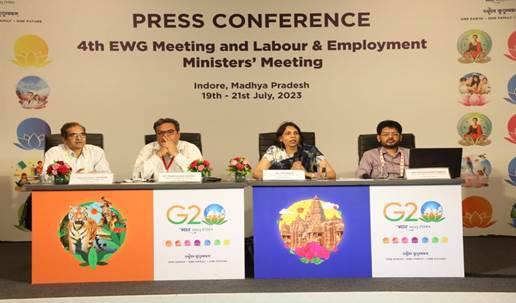
 

She said that this meeting will be presided over by the Union Minister for Labour & Employment, Shri Bhupender Yadav and 24 Ministers from different countries will attend. During this, representatives of G-20 members and guest countries, international and regional organizations and groups like Business-20, Labor-20, Startup-20, Think-20 and Youth-20 will participate.
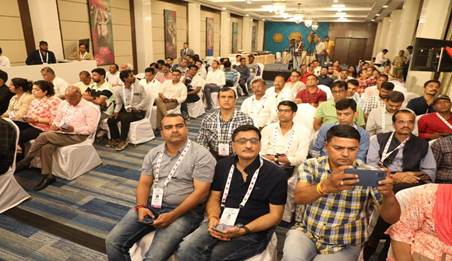
In the press conference, Smt. Ahuja told media persons that India is also keeping innovations like e-Shram portal before the working group meetings. Through this portal, complete information about the workers of unorganised sectors is available with the government, which proves helpful for taking steps towards benefitting their and their families’ interests.

Earlier, Shri Rupesh Kumar Thakur, Joint Secretary, Ministry of Labour and Employment informed through a presentation that while 86 delegates are participating in the 4th EWG meeting, 165 delegates including 24 Ministers will participate in the LEM meeting. Heads of international organizations and employers’ associations, including the ILO, OECD and the World Bank, will also attend the meeting.
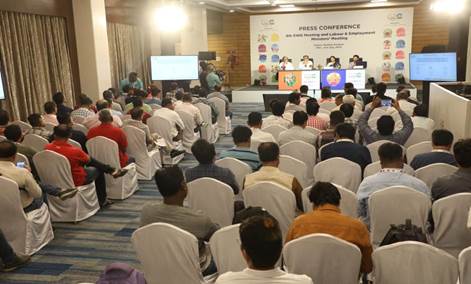
He said that it has been planned to showcase the grand natural, cultural and historical beauty of Indore and Madhya Pradesh during the event. In these, a visit to Mandu Fort and Chappan Dukan, the famous food street of Indore has been planned for the delegates. Apart from this, there will also be a heritage walk and cycle ride to see the important historical places in the city of Indore. He informed that traditional folk performing arts (music and dance) and handicrafts will also be displayed for the visiting dignitaries.

In the press conference, Dr. Pawan Kumar Sharma, Divisional Commissioner, Indore said that elaborate arrangements have been made to make the event a grand success. Apart from this, a communication plan has been also made. He outlined the measures taken by the District Administration and State Government for organizing the meeting.

****

CHITRAKOOT: ABODE OF THE GODS

Chitrakoot, “the hill of many wonders, nestles peacefully in the northern spurs of the Vindhyas, a place of tranquil forest glades and quiet rivers and streams where calm and repose are all- pervading. This loveliest of Nature’s gifts is also hallowed ground, blessed by the gods and sanctified by the faith of pilgrims. For Chitrakoot’s spiritual legacy stretches back to legendary ages: it was in these deep forests that Rama and Sita spent eleven of their fourteen years of exile: here, that the great sage Atri and Sati Anusuya meditated; and here where the principal trinity of the Hindu pantheon, Brahma, Vishnu and Mahesh took their incarnations. Sufferers and seekers, poets and visionaries, princes and noblemen have, through the ages, sought and found solace in Chitrakoot, drawn inspiration from its sublime natural beauty, gained spiritual strength from its serene temples and, in turn, become part of the hallowed legend that is Chitra koot.

PLACES TO VISIT

RAMGHAT
The ghats that line the banks of the river Mandakini reveal a constantly moving and changing kaleidoscope of religious activity. Here, amidst the chanting of hymns and the sweet fragrance of incense, holy men in saffron robes sit in silent meditation or offer the solace of their wisdom to the countless pilgrims who converge here. With the very first rays of dawn that gleam upon the river, Ramghat stirs into life as the devout of all ages take the ritual, purifying dip in the waters and invoke the blessings of the gods. The activity builds up in a crescendo of colour and spontaneous expressions of faith through the day, past high noon, gently diminishing as the setting sun picks out the bright colours of flower petals floating down the river, while the evening ‘arti’ lends its melodious cadences to the deepening dusk. 

KAMADGIRI 
Kamadgiri, the original Chitrakoot, is a place of prime religious significance. A forested hill, it is skirted all along its base by a chain of temples and is venerated today, as the holy embodiment of Rama. The Bharat Milap temple is located here, marking the spot where Bharat is said to have met Rama to persuade him to return to the throne of Ayodhya. Many are the faithful who perform the ritual circuit (parikrama) of the sacred hill, to ask for a boon or a blessing.

SATI ANUSUYA 
Sati Anusuya is located further upstream, set amidst thick forests that resound to the melody of birdsong all day. It was here that Atri Muni, his wife Anusuya, and their three sons (who were the three incarnations of Brahma, Vishnu and Mahesh), are said to have meditated. The Mandakini is believed to have been created by Anusuya through her meditation. Sati Anusuya lies about 16 km. from the town and can be reached by road.
SPHATIK SHILA
A few kilometers beyond Janaki Kund is again a densely forested area on the banks of the Mandakini. One can climb up to the boulder which bears the impression of Rama’s footprint and where Sita was pecked at, by Jayant in the form of a crow. There are large fish in the river here, easily visible in the pellucid water and a few temples.
HANUMAN DHARA 
Located on a rock-face several hundred feet up a steep hillside is a spring, said to have been created by Rama to assuage Hanuman when the latter returned after setting Lanka afire. A couple of temples commemorate this spot which offers a panoramic view of Chitrakoot. There is an open, paved area here in the shade of a massive peepal tree, a lovely halting place after the long climb up.
ALSO VISIT: Janaki Kund, Gupt-Godavari, Deep Daan, Bharat Koop and Bharat Milap.

SHIVPURI: MADHYA PRADESH

Shivpuri is steeped in the royal legacy of its past, when it was the summer capital of the Scindia rulers of Gwalior. And earlier, its dense forests were the hunting grounds of the Mughal emperors when great herds of elephants were captured by Emperor Akbar.
Much later, it was the tiger that roamed the wooded hills and many a magnificent beast was ‘bagged’ by royal shikaris. And, with its luxuriant forests and undulating hills, Shivpuri was a natural choice as the summer resort capital of the Scindias. Shivpuri’s royal ambiance lives on in the exquisite palaces and hunting lodges and graceful, intricately-embellished marble chhatris (cenotaphs) erected by the Scindia princes.
A sanctuary for rare wildlife and avifauna, Shivpuri has transformed a royal past into a vibrant, hopeful present.

MADHAV NATIONAL PARK
Madhav National Park is 156 sq km in area, the park is open throughout the year. With a varied terrain of wooded hills, the forests being dry, mixed and deciduous, and flat grasslands around the lake, it offers abundant opportunities for sighting a variety of wildlife. The predominant species that inhabits the park is the deer, of which the most easily sighted are the graceful little chinkara, the Indian gazelle and the chital. Other species that have their habitat in the park are nilgai, sambar, chausingha or four-horned antelope blackbuck, sloth bear, leopard and the ubiquitous common langur.
The National Park is equally rich in avifauna; the artificial lake, Chandpatta is winter home of migratory geese, pochard, pintail, teal, maillard and gadwall. A good site for bird watching is where the forest track crosses the wide rocky stream that flows from the Waste Weir. Species that frequent this spot are red-wattled lapwing, large-pied wagtail, pond heron and white breasted kingfisher. The avifauna also includes the cormorant, painted stork, white ibis, laggar falcon, purple sunbird, paradise flycatcher and golden oriole.
BARADARI
It is a building of Maratha style, built in 1921 as a night dancing hall. It has a gallery of paintings depicting real life and fantasized themes. The hall was also used for entertainment and religious purpose.

CHHATRIS
Set in a formal Mughal garden, with quiet nooks under flowering trees, intersected by pathways with ornamental balustrades and illuminated by Victorian lamps, is the complex in which the cenotaphs of the Scindias are set. Facing each other across a water tank are the chhatris of Madho Rao Scindia and the dowager queen Maharani Sakhya Raje Scindia, synthesising the architectural idioms of Hindu and Islamic styles with their shikhara-type spires and Rajput and Mughal pavilions.
The gittering white marble surface of Madho Rao Scindia’s cenctaph is inlaid in the pietra dura style, with lapis lazuli and onyx to create a spectacularly rich effect, heightened by the delicacy of the trellis work on the sides. The dowager queen’s cenotaph has a noble dignity of line and superb strucuctural harmony. Both memorials contain life-size images of the Scindias and these are tended to with extreme devotion by ceremonially-dressed retainers who perform the rituals of placing flowers and incense before the statues each day. In the evenings, the hush is broken by the sound of music as artists of the Gwalior gharana render classical ragas before the statues.

MADHAV VILAS PALACE
Standing upon a natural eminence, the elongated rose-pink summer palace of the Scindias is built in truly royal proportions. A fine example of colonial architecture, the Mahal, as it is called, is remarkable for its marble floors, iron columns, graceful terraces and the Ganapati Mandap. From the turrets, the view is a spectacular one of Shivpuri town and the park beyond.

SAKHYA SAGAR BOAT CLUB
Edging the forests of the Madhav National Park is the Sakhya Sagar lake, habitat of a variety of reptiles. Species that can be seen here are the marsh crocodile or mugger, Indian python and the monitor lizard. On the shores of the lake and connected to it by a broad pier is a Boat Club, an airy, delicate structure with glass panels.

BHADAIYA KUND
A scenic picnic spot by a natural spring. The water here is rich in minerals, supposedly of a curative nature.
ALSO VISIT: George Castle, Sultan Hotel, Kothi No.17, Madhav Vilas Palace and Sakhya Lake and Boat Club.

PANNA

Panna, the erstwhile capital of the Bundela Kingdom in Madhya Pradesh is famous for the Panna National Park. Panna Town, the administrative headquaters of Panna District, is the hub of many religious monuments, which showcases the architectural Marvel’s of Hindu and Islamic styles. Adorned with greenish meadows dotted with evergreen trees, undulating forests, hills and rocks, Panna serves as a perfect place for holiday tours.
Panna National Park was created in 1981. It was declared as a Project Tiger Reserve in1994. The National Park consists of areas from the former Gangau Wildlife Sanctuary created in 1975. The sanctuary compromised of territorial forests of the present North and South Panna Forest Division to which a portion of the adjoining Chhatarpur forest division was added later. The reserved forests of the Park in Panna district and some protected forests bordering Chhatarpur were the hunting reserves of the erstwhile rulers of Panna, Chhatarpur and Bijawar princely states in the past. The location of the National Park is crucial as it is situated at a point where the continuity of the forest belt, which starts from Cape Comorin in the south is broken and from there beyond, the great Gangetic plains begin. This area is also the northern most tip of the natural teak forests and the eastern most tip of the natural Kardhani forests. The Ken river, which flows through the reserve from south to north, is home for Gharial and Mugger.
Tiger, the king of the jungle, roams freely in the secure habitat along with his fellow creatures like leopard, wild dog, wolf, hyena and caracal and smaller cats. Sloth bear has his most favorite home in the rock escarpments and undistributed vales. The wooded areas are dotted with sambar – the largest of Indian deers, chital and chowsingha. Other animals that can be found are nilgai, chinkara, snakes and reptiles.
There are more than 200 species of birds including migratory birds. One can see White Necked Stork, Bar-Headed Goose, Honey Buzzard, King vulture, Blossom Headed parakeet,etc.
Panna has dry and hot climate and has shallow Vindhyan soil which give rise to dry Teak and dry mixed forest. The dominating vegetation type is miscellaneous dry deciduous forest inter spread with grassland areas. The characteristic floral species of this area include tree species such as Tectona fransis, Diospyros melanoxylon, Madhuva indica, Buchnania latifolia, etc.
OTHER PLACES TO EXPLORE 

Fort of Ajaygarh 
Built in 1765 AD by the nephew of the Maharaja of Jaitpur, the fort is situated at a height of 800 ft. However by 1809 the Britishers overpowered it.
Gatha Falls
The height of Gatha fall measures up to 91 meters.The Gatha falls are at their prime during the rainy season, when the river water swells to the maximum. River Ken is the water source of Gatha Falls.
Mahamati Prannathji Mandir 
It is one of the most revered pilgrim places for the Pranami sect followers the world over. The temple was completed in 1692. Other than this Padmavati temple, Jugal Kishore Temple and Kalinjir Fort are with a visit.
National Museum 
It was established in 1988. It has a remarkable collection of icons and coins. 

BANDHAVGARH: National Park With a Rich Historical Past

Bandhavgarh is a small National Park ; compact, yet teeming with wildlife. The density of the tiger population in Bandhavgarh is the highest known in India. This is also White Tiger country. These have been found in the old state of Rewa for many years. The last known was captured by Maharaja Martand Singh in 1951. This white tiger, Mohun, is now stuffed and on display in the palace of the Maharajas of Rewa.
The terrain is of great Rocky hills rising sharply from the swampy and densely-forested valley bottoms. The finest of these hills in Bandhavgarh, sided with great cliffs and eroded rocks and on its highest point stands Bandhavgarh Fort, and particularly around the fort, are numerous caves containing shrines and ancient Sanskrit inscriptions.
Prior to becoming a National Park, the forests around Bandhavgrah had long been maintained by as a Shikargah, or game reserve, of the Maharajas of Rewa. Hunting was carried out by the Maharajas and their guests – otherwise the wildlife was relatively well-protected. 
In 1947 Rewa State was merged with Madhya Pradesh; Bandhavgarh came under the regulation of Madhya Pradesh. The Maharaja of Rewa still retained the hunting rights of Bandhavgarh and no special measures were taken until 1968, when the areas were constituted as a National Park, since then, numerous steps have been taken to retain Bandhavgarh Bational Park as an unspoilt natural habitat. 

What to see 

The Fort 
The Fort is estimated to be 2000 years old. Various dynasties have ruled the fort : the Maghas from the 1st century AD, the Vakatakas from the 3rd century AD, the Sengars from the 5th century AD, the Baghela took over, ruling from Badhavgarh until 1617, when Maharaja Vikramaditya Singh moved hi capital to Rewa. The last inhabitants deserted the fort in 1935.
Flora 
The vegetation is chiefly of Sal forest in the valleys and on the lower slopes, gradually changing to mixed deciduous forest on the hills and in the hotter, drier areas of the park in the south and west. Bamboo is found throughout.
Wildlife
There are more than 22 species of mammals and 250 species of birds. Common langurs and rhesus macaque represent the primate group. Carnivores include the Asiatic jackal, Bengal Fox, sloth bear, ratel, grey mongoose, striped Hynes, jungle cat, leopard and tiger. The artiodactyls frequently sighted are wild pig, spotted dear, sambar, chausingha, nilgai and chinkara. Mammals such as dhole, the small Indian civet, palm squirrel and lesser bandicoot rat are seen occassionally. The vegetation along streams and marshes is rich in birdlife. The common ones are little grebe, egret, lesser adjutant, saris crane, black kite, crested peafowl, red jungle fowl, dove, parakeet, kingfisher and Indian roller. Reptilian fauna include cobra, Krait, viper, ratsnake, etc.

Wildlife viewing 
The main way of getting about in the park is motor vehicle. Jeep safaris timing are from 10 am to 4 pm, as the animals are most active during these periods. A Forest Department guide must always accompany you. This guide will able to direct you and point out wildlife. 

THE PENCH

Pench lies in Madhya Pradesh. Nestled in the southern sloes of the satpura ranges of central India, Pench Tiger Reserve(757.90 sq.kms)lies in southern Madhya Pradesh , bordering Maharashtra. The Pench National Park which constitutes the core of the Park is 292.86 sq.kms , and comprises the Indira Priyadarshini Pench National Park and the Mowgli Pench Sanctuary. Pench was brought under Project Tiger in 1992 .
Pench National Park gets its name from the Pench river that flows through it, dividing it into the western Chhindwara Block (141.61 sq kms) , and the eastern Seoni Block (145.24 sq kms).
Over 1,200 species of plants have been recorded in the area including several rare and endangered plants as well as plants of ethnobotanical importance.
Pench National Park is the original setting of Rudyard kipling’s famous work, The Jungle Book. The character, Mowgli, was inspired by Sir William Henry Sleeman’s pamphlet, ‘An Account of Wolves Nurturing Children in Their Dens’ which describes a jungle boy captured in Seoni district near the village of Seoni district near the village of Sant Baori in 1831. 
Pench being situated in Central India is subjected to extreme and tropical weather. Month of January may also witness sub-zero temperatures and frost. Monsoon arrives in the second week of June. 
The forests found in Pench Tiger Reserve are divided into three parts as follows:-
1.Southern Tropical Wet Deciduous Forest
2.Southern Tropical Dry Teak Deciduous Forest
3.Southern Tropical Dry Mixed Deciduous Forest
Dry mixed forest spreads in about one-third area of the protected area. Whose main species are salai, pickle, moyan, tendu etc. Kahua (Arjuna), Jamuna, Guular and Saja are found along the banks of river streams. Trees of Mahua, Palash, Plum etc. are found scattered around the open forests of displaced areas of old villages. Teak forests are found in about one quarter area. There are about 82 types of grass species and Bamboo found in this forest area.
Pench is prime tiger country. The area has always been rich in wildlife. Pench Tiger Reserve has the highest density of herbivores in India, 90.3 animals per square kilometre. The area is especially famous for its huge population of gaur (Indian bison), cheetal, sambar, neelgai, wild dog and wild pig. Other animals in the Park include the sloth bear, chousingha, chinkara, barking deer, jackal, fox, palm civet, small Indian civet, jungle cat, hyena and porcupine.
Pench Tiger is also among the best area for bird watching. Over 285 species of resident and migratory birds including the Malabar pied hornbill, Indian pitta, osprey, grey headed fishing eagle, white-eyed buzzard are found here. Four species of the endangered vulture, white-rumped, long billed, white scavenger and king vulture can be seen in good numbers in these forests. In winter, thousands of migratory birds come to this reserve. 
Jungle safaris are a major attraction of the park. A dawn safari, when animals are out in the open looking for food and water, is an unforgettable experience. Tigers and leopards can be seen near water bodies and even on the roads in summer. Cheetal, sambar and neelgai are found grazing in the forests and the banks of the river. Large herds of gaur are often spotted in the bamboo patches. Jackals, wild dogs and rhesus monkeys can be seen foraging for food in the densely-wooded jungles.

Introduction to chameli devi public school

Chameli Devi Public school is located in Indore. It is one if the most popular school in the city. The school is from the agrawal group which had several colleges and schools in the city itself.

The school was started by Mr. Puroshtam Agrawal with a view of providing quality education to middle class students. The name of school was kept in the memory of his mother.

The school is affiliated by CBSE board and is upto class 12th. The streams offered are science,maths and commerce. The campus of school is 5.22 acres having playgrounds, computer labs,smart classes, science labs.

It is running in two shifts separately for bots and girls. Morning shift is for boys and noon for girls. But for 11th and 12th all classes are in morning. Co-ed is not Available in school. Both 11th and 12th classes run separately for boys and girls on different floors.

Upto class 8th books for school is from agrawal group i.e. learn by fun. From class 6th onwards Science ncert is taught. From class 9th onwards you will have ncert books.

CCTVs and fire extinguishers are present in school and proper guards are available. The fees of school is also affordable. For more details you can visit school.

Address is Tejpur gadbadi, keshar bagh road, Indore.