Doctor and a stethoscope are synonymous with each other. A stethoscope is doctor’s best buddy. Hung around one’s neck, it gives doctor his identity. It is basically an instrument used to listen sounds made by heart, lungs or intestines and blood flow in veins and arteries. Let’s read how a young doctor’s shyness led to its invention which proved to be path breaking in field of medical diagnosis.
Born in 1781, a young French doctor, Rene Laennec got inspired to become a doctor when his mother passed away due to tuberculosis. He was a learnt man who studied medicine under famous physicians Dupuytren and Joan Nicholas Corvisat.
Corvisat strongly believed in diagnosing a patient by listening to heart sounds. In those days (early 1800s), it was common for a doctor to listen one’s heart beat by pressing his head directly on patient’s chest or back.
In 1816, as a part of his training, Laennec was told to examine a young overweight woman who was having heart problem. Laennec felt shy as well as uncomfortable thinking about using the traditional method. At that moment, he thought of a way. He rolled a quire of paper into a cylinder and placed one end on the chest of the patient and other end to his ear. And much to his surprise, he perceived sounds better than the other traditional method.
Successful in his impromptu experiment, Laennec devised a wooden version. It was 25 cm by 2.5 cm and could be carried around. He named it STETHOSCOPE which was derieved from a greek word sthethos( meaning chest) and scopos (meaning examination). Gradually, its use spread across Europe and US. But unfortunately Laennec died in 1826 at the age of 45 due to the same disease, as of his mother, tuberculosis.
Till date, various refinements have been made to original one. The major changes were brought by a Harward Professor, David Littmann in 1960s. He made a lighter version with better acoustics.
Littmann stethoscope are no doubt, the gold standard and used worldwide by doctors. But Laennec’s invention proved to be major milestone in the history of medical sciences.
Many of us must be unaware about this but have a knowledge always pays of.
The Covid-19 pandemic has hit all the countries hard but as far as the legal system is concerned, it has shown us how the coming times and the future shall be and also how things in the ‘new normal’ would be.
But there is always a Silver lining in these tough times which is the Virtual Court Hearings which has ensured that Justice isn’t delayed for the one’s who seek it inspite of these tough times as Justice delayed is Justice denied.
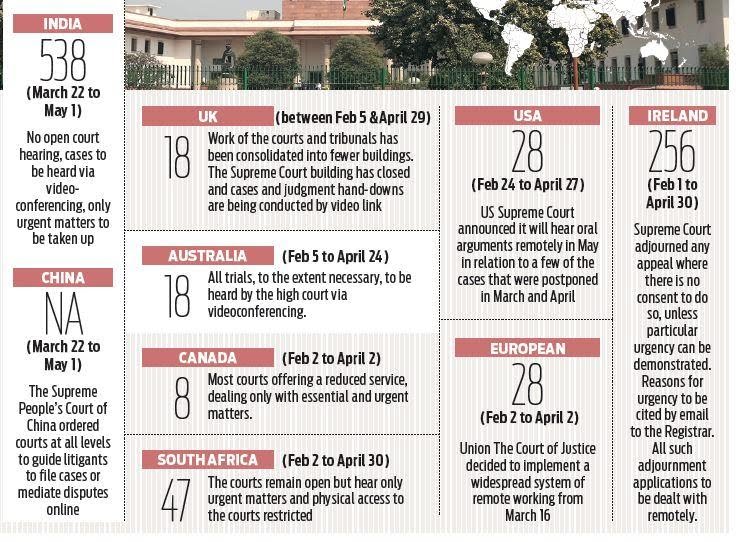
The lockdown has affected the functioning of courts across the globe, but the Hon’ble Supreme Court of India has done much better than the top courts in countries like the UK, the US, Singapore and Canada.
The Apex Court began the hearing of urgent matters virtually till May 1st and heard them for 22 days via video conferencing in March after the imposition of lockdown in order to curb the spread of COVID-19.
ABOUT VIRTUAL HEARINGS
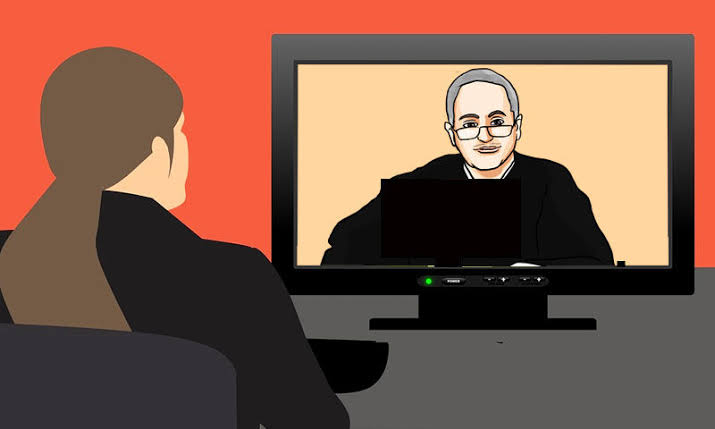
Virtual hearings are court hearings conducted by audio-visual means, where cases are progressed without the need for participants to attend the Court in person. It also shows how the distance becomes immaterial when one has to appear before the court to argue the case.
FOR THE FIRST TIME
The Hon’ble Supreme Court of India held its first Constitutional bench sitting and this is the first time since March 5 that five judges sat together in a single court hall ever since the lockdown forced the apex court to stop physical court hearings and begin hearing cases through videoconferencing from March 25 this year.
It was for the first time on Tuesday, the 14th July, 2020 that a Constitutional Bench (comprising five judges) held a virtual hearing. A bench of justices Arun Mishra, Indira Banerjee, Vineet Saran, MR Shah and Aniruddha Bose appeared wearing masks and maintaining nearly two-feet distance between them on the bench.
The first case that was heard by the five-judge bench was a legal tussle on whether Centre or States have the power to provide reservation to in-servicecandidates in post-graduatemedical degree courses. The plea was brought up by Tamil Nadu Medical Officers Association.
Opening the argument, Senior Advocate Arvind Datar exchanged the extensive compilation of his arguments including cases to be referred through Google drive with all Lawyers. One of the Lawyers, Senior Advocate Vikas Singh appearing for Medical Council of India (MCI) complained about being unable to access Google Drive.
He objected to Datar referring to the same, the first hiccup encountered by the Court in the virtual proceeding. The problem was sorted as Hon’ble court asked Senior Advocate Arvind Datar to give case law citations.
As the virtual hearing proceeded the Senior Advocate Arvind Datar was inaudible to the Hon’ble Court. Hon’ble Justice MR Shah commented in a lighter vein that, “Don’t keep social distancing with your mike.” Datar heard ‘mike’ as “wife”, leaving the bench in splits.
SUCCESS STORY: DATA THAT MATTERS
The Hon’ble Supreme Court of India shared the ‘success story’ of virtual court proceedings. At the beginning of June as many as 2,893 lawyers appeared in the hearings via video-conferencing, it said in the data release.
According to the data, 538 matters were taken up by the SC during the lockdown period, besides 297 connected cases. Judgment was delivered in 57 matters. Besides, 49 special leave petitions, 92 writ petitions, 138 review petitions and 58 pleas for interim relief were also taken up.
HOW THE COURTSFAREDAND PERFORMED?
India has fared the best as per the above data as many other countries have been using the virtual system but their top courts that have lagged way behind in the hearing or disposal of cases.
It conducted proceedings via video-conferencing from March 25 as it has suspended the entry of lawyers and other staff into its premises and also the apex court decided to explore the feasibility of ‘physical appearance’ of advocates in real courtroom hearings after strictly adhering to the guidelines of the COVID-19 triggered lockdown and resorting to virtual hearings since March 25.
Data available on other judicial websites indicate that in the nations hit hard by the pandemic like the US, the UK, France, Italy, Germany, China, Canada, Australia etc., The organs of that state which carried out the administration of justice are mostly relying on the virtual court methodologies and online case management.
CONCLUSION
Hence after going through the above facts and circumstances it’s certainly a grand success yet there is always room and scope for improvement.




 Eduindex
You must be logged in to post a comment.