ASI Carrying Out Cleanliness Drive at 400 Sites Nationwide including Monuments & World Heritage Sites

 During second week of Implementation Phase of Special Swachhata Campaign 3.0, Ministry of Culture (MoC) along with its Attached, Subordinate and Autonomous Organizations is actively carrying out all identified activities regularly with an objective to minimize the pendency and institutionalizing Swachhata.

The cumulative achievements of the Ministry during this period are given below. Further, Ministry has freed aprox.1050 Sq. Ft. of area by disposing of scrap and generated revenue of Rs.3,57,999. Besides, 2058 Physical files and 80 files out of 15,969 physical files & 2133 E-files, respectively, have been reviewed and closed.

S.No.

Items

Target

Achievements

1.

MP References

176

31

2

PMO References

33

9

3

State Government References

28

4

4

Parliamentary Assurance

41

1

5

Public Grievances

412

82

6

Public Grievances Appeals

465

21


Best Initiatives: As part of best initiatives some of the Organisations under MoC have undertaken the following initiatives:-

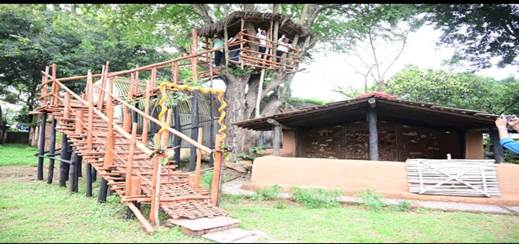
Anthropological Survey of India (AnSI), Regional Office, Jadgalpur has set up a vibrant “Tree House” with the help of local tribal youths for promoting sustainability and creativity.
IMG_20231011_142459.jpg           

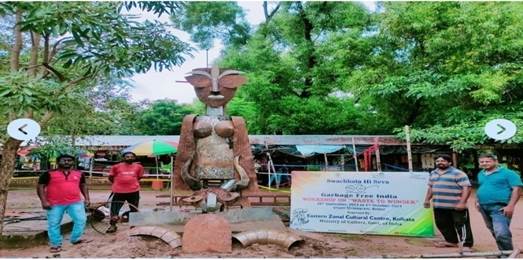
Eastern Zonal Cultural Centre(EZCC), Kolkata has also organized a workshop ‘Waste to Wonder’ on the theme of “Garbage Free India” at Srijani Shilpagram, Shanti Nikentan, West Bengal during Special Campaign 3.0.  A Sculpture of Goddess Maa Durga has been crafted using broken and discarded waste materials.  An attempt has been made to spread the message of destroying demon like plastic in public.
IMG_20231011_143155.jpg

(Sculpture of Goddess Maa Durga crafted with waste material)


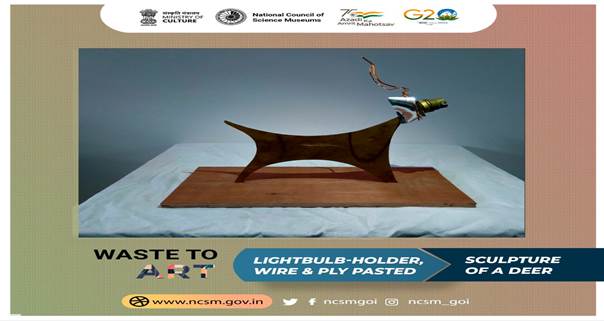
National Council of Science Museums (NCSM), has created an amusing sculpture of a deer crafted from waste materials like plywood board, lightbulb-holder and wires as a part of ‘Waste to Art’ creations.
 Image

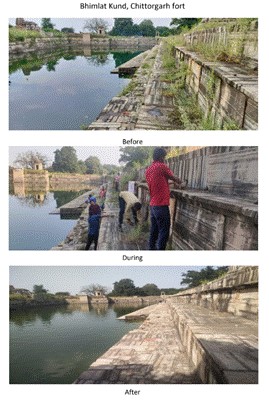
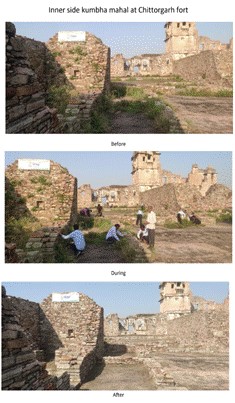
Archaeological Survey of India (ASI) is also carrying out cleanliness drive enthusiastically at 400 sites out of 449 sites identified by Ministry including Monuments & 25 World Heritage Sites.
ImageImage

(Cleanliness drive conducted at sites of Chittorgarh Fort, a UNESCO, World Heritage Site)

National Archive of India(NAI) has planned to launch a Mass Conservation Drive to provide restorative conservation of approx 2.25 crore pages of records in its collections. This requires a working space for 1,000 conservators who would work in two shifts of 500 hundred persons each.   Besides, an Orientation Course in Record Management is scheduled to be held from 18th to 20th October,2023 during the Special Campaign 3.0 period involving of Group ‘B’ & above and equivalent level officers from various Ministries/Departments, Attached/Subordinate Offices and PSUs etc.

Daily progress is being monitored and uploaded on the SCDPM portal at https://scdpm.nic.in.

***

Top Ten Monuments of India

India is home to numerous ancient and modern architectural marvels that attract tourists from all over the world. Here are the top ten monuments of India:

Top Ten Monuments of India

Taj Mahal – A mausoleum in Agra, Uttar Pradesh, built by Mughal Emperor Shah Jahan in memory of his wife Mumtaz Mahal.

Red Fort – A historic fort in Delhi, built by Mughal Emperor Shah Jahan in the 17th century, featuring intricate architecture and beautiful gardens.

Qutub Minar – A 73-meter-high tower in Delhi, built in the 13th century, featuring intricate carvings and inscriptions.

Hawa Mahal – A palace in Jaipur, Rajasthan, known for its distinctive honeycomb architecture and 953 small windows.

Ajanta and Ellora Caves – A group of Buddhist, Jain, and Hindu caves in Maharashtra, featuring some of the most exquisite rock-cut sculptures and paintings.

Gateway of India – An arch monument in Mumbai, built in the early 20th century to commemorate the visit of King George V and Queen Mary.

Charminar – A mosque and monument in Hyderabad, Telangana, built in the 16th century, featuring four minarets and intricate Islamic architecture.

India Gate – A war memorial in Delhi, built in the early 20th century, featuring a towering gate and sprawling lawns.

Victoria Memorial – A museum and monument in Kolkata, West Bengal, built in the early 20th century, featuring stunning architecture and lush gardens.

Lotus Temple – A Bahai temple in Delhi, known for its unique lotus-shaped design and serene atmosphere.

These monuments not only showcase India’s rich history and culture but also represent the country’s architectural diversity and innovation. They are essential cultural and tourism assets that attract millions of visitors every year, making them an integral part of India’s tourism industry.

Red Fort (Lal Quila) in Delhi

The Red Fort, also known as Lal Qila, is a historic fort complex located in the heart of Old Delhi, India. It is one of the most iconic monuments of India and is a popular tourist attraction, attracting millions of visitors each year.

The construction of the Red Fort began in 1638 under the Mughal Emperor Shah Jahan and was completed in 1648. The fort was built as the royal palace for Shah Jahan and served as the seat of the Mughal Empire for nearly 200 years. The fort is surrounded by a massive red sandstone wall that stretches for over two kilometers and has several gates, including the Lahori Gate, the Delhi Gate, and the Turkman Gate.
The Red Fort complex covers an area of approximately 254 acres and includes several buildings, gardens, and courtyards. The most notable structures within the complex include the Diwan-i-Am (Hall of Public Audience), the Diwan-i-Khas (Hall of Private Audience), the Rang Mahal (Palace of Colors), the Khas Mahal (Private Palace), the Mumtaz Mahal (Jewel Palace), and the Moti Masjid (Pearl Mosque).
The Diwan-i-Am is a large hall where the emperor would meet with the public and hear their grievances. The hall is supported by a series of red sandstone pillars and has a large marble throne on which the emperor would sit. The Diwan-i-Khas is a smaller hall used for private audiences with dignitaries and ambassadors. It is decorated with intricate carvings and inlaid with precious stones.
The Rang Mahal is the palace where the emperor’s wives and concubines lived. It is decorated with intricate paintings and carvings and has several private chambers for the women. The Khas Mahal is the private palace of the emperor and was used for personal and family functions. It is built on a raised platform and has a beautiful marble pavilion in the center.
The Mumtaz Mahal is a small palace located near the Rang Mahal and was named after Shah Jahan’s beloved wife, Mumtaz Mahal. It was built in her memory after her death and is adorned with beautiful paintings and carvings. The Moti Masjid is a small mosque located near the Diwan-i-Khas and is made of white marble. It was built by Aurangzeb, the son of Shah Jahan, and is known for its exquisite architecture and beauty.
The Red Fort has played a significant role in the history of India. It was the site of many important events, including the coronation of Emperor Bahadur Shah Zafar, the last Mughal emperor. It was also the site of the famous Indian rebellion of 1857, which was led by Indian soldiers against the British East India Company. After the rebellion, the British took control of the fort and used it as a military base until India gained independence in 1947.
Today, the Red Fort is a UNESCO World Heritage Site and is a popular tourist destination. Visitors can explore the various buildings and structures within the complex and learn about the rich history of India. The fort also hosts a famous annual event, the Independence Day celebration, where the Indian Prime Minister hoists the national flag and delivers a speech from the ramparts of the fort.
In conclusion, the Red Fort is a remarkable monument that showcases the architectural and cultural heritage of India. Its intricate designs, beautiful carvings, and exquisite paintings make it a must-visit destination for anyone interested in history and culture. The fort’s rich history and significance in the Indian freedom struggle also make it a symbol of India’s struggle for independence and its rich cultural legacy.

WATSON HOTEL

Watson’s Hotel, currently acknowledged as the Esplanade Mansion, is India’s oldest sustaining cast-iron building. It is located in the Kala Ghoda area of Mumbai (Bombay). Named after its original owner, John Watson, the building was fabricated in England and built on-site between 1867 and 1869.

The hotel closed in the 1960s and the building was sold to a private owner. It was later divided and partitioned into smaller cubicles that were let out on rent as homes and offices. Negligence of the building has resulted in corrosion and, despite its listing as a Grade II–A heritage structure, the building is now in a rundown state.

Design:

Watson’s hotel was planned by the civil engineer Rowland Mason Ordish, who was also linked with the St Pancras Station in London. The structure was fabricated in England from cast iron components and was congregated and constructed on-site. The external cast-iron frame closely resembles other high-profile 19th century buildings such as London’s Crystal Palace. The main façade of the hotel is characterized by building-wide open balconies on each floor that connected the guest rooms, which were constructed around the atrium in a courtyard arrangement.

History:

John Watson opened the hotel as an exclusive whites-only hotel, and it was the most expensive hotel in the city in those days. The five-storied building housed 130 guest rooms, as well as a lobby, restaurant, and a bar at the ground level. The hotel also had a 30 by 9 meters (98 ft × 30 ft) atrium, basically used as a ballroom, with a glass skylight. At its peak, Watson’s hotel employed English hostesses in its restaurant and ballroom, sparking a common joke at the time: “If only Watson had imported the English weather as well.”

After Watson’s death, the hotel lost its fame to the rival Taj Hotel. In the 1960s the hotel was closed and sold to a private owner. Sometime after this, it was subdivided and partitioned into small cubicles with independent access and let out on rent. Over the years, indifference toward the building by the residents has resulted in the structure decaying, and it is now in a neglected state. The atrium was consequently used as a dumping area and has various unauthorized constructions. In 2005, the building had 53 families and 97 commercial establishments. Most of the business enterprises are chambers of advocates attached to the nearby Bombay Civil & Session Courts and the nearby Bombay High Court.

  • Notable guests:

Among the hotel’s notable guests was Mark Twain who wrote about the city’s crows he saw outside his balcony in Following the Equator. It was also the first place in India to screen the Lumière Brothers’ Cinematograph invention in 1896. However, this was witnessed only by Europeans.

A popular myth surrounds the hotel was that the staff at Watson’s Hotel denied Indian industrialist Jamsetji Tata access to the hotel. In retaliation, he opened the Taj Hotel, a hotel that stands near the Gateway of India, in 1903. However, author and historian Sharada Dwivedi debunks this legend. She points out a lack of evidence to prove that Tata was a man of vengeance.

  • Current state:

The building’s poor state of affairs has been commonly remarked, and efforts by heritage activists to persuade its present owner to invest in restoration have been unsuccessful. One of the possible reasons proffered for apathy is the fact that the rent collected is low as it has been frozen by government legislation. The condition of the building was publicized by Italian architect Renzo Piano, and as a result of his efforts, the building was listed in June 2005 on the list of “100 World Endangered Monuments” by the World Monuments Fund, a New York-based NGO. Just a few days after its proposal, part of the building’s western façade, originally galleries evolved into small offices, collapsed, killing one person and crushing several cars and motorcycles parked in the street below. The building is currently listed as a Grade II–A heritage structure.

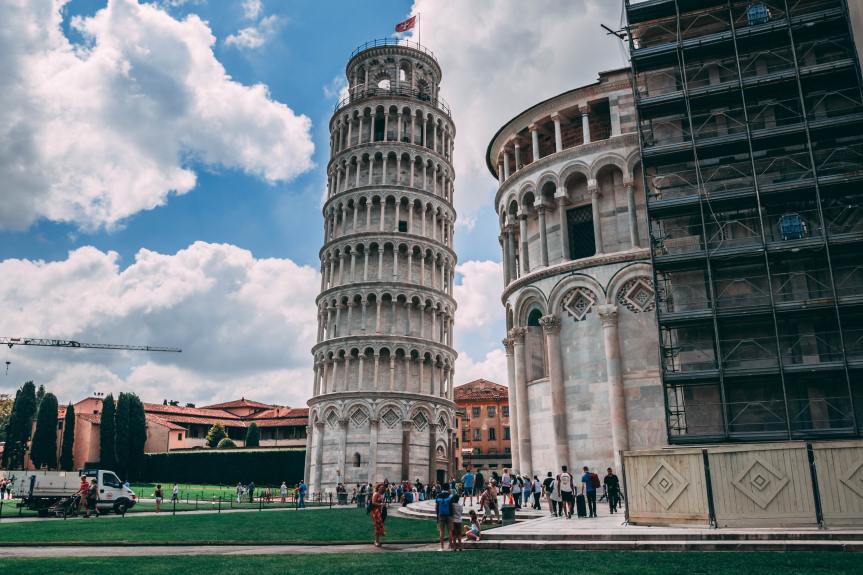
A brief look at the history of the Leaning Tower of Pisa

Monuments, a reminder of proud heritage or history as well as architectural wonders, they are present throughout the world. These sites are also a source of revenue for their respective cities or towns. Most of the monuments that fall under the category of architectural wonders are tourist places with a lot of monetary value, people tend to visit them to gaze upon the marvelous creations of man. One such monument is the leaning tower of Pisa. In 1990, the Italian government enlisted the help of the world’s finest engineers to stabilize the famous leaning tower. There have been many attempts in its 800-year history but this one was a race against time as the tower had already leaned on to a 5.5 degree whereas it had been projected that the tower would topple should it reach an angle of 5.44. It was a miracle that the tower was still standing but the crisis was still imminent.  

In the 12th century famous maritime town of Pisa, set about to turn its cathedral square to a magnificent landmark. So, in 1173, construction began on a free-standing campanile or bell tower and while the engineers and architects of the time were masters of their craft, they knew far less about the soil that they stood on. Pisa’s name had a Greek origin which meant “marshy land”, which clearly describes the clay, mud, and wet sand composition below the city’s surface. With a three-meter foundation to support the structure, it was no surprise that within less than five years the tower’s southern side began to sink beneath the surface. Such a mistake should normally have been a fatal flaw however, the construction halted for nearly a century while the tower was at the fourth story due to prolonged warfare that descended onto Pisa.  This long pause allowed the soil beneath the tower to settle and when the construction resumed in 1272, the workers saw the structure to be on slightly more stable ground. Under the guidance of architect Giovanni de Simone, the workers compensated the minor tilt by making the southern side slightly taller. But due to the extra weight of the masonry, the southern side continued to tilt even further. And by this time the tilt had increased to 1.6 degrees. For centuries engineers tried numerous strategies to address the lean, they even tried to dig a walkway to examine the sunken foundation but the removal of the supporting sand only worsened the problem, and thus with many such failed attempts all the engineers managed to do was worsen the ever-increasing tilt. However, in the years following WWII, researchers developed tests to examine the problem whereas, in 1970, engineers finally managed to calculate the center of gravity of the tower. Thus, with the modern tools at hand, the engineers could finally address the real problem and calculate different ways in order to stabilize the monument. They finally calculated the amount of excavation needed to stop the tilting of the monument and in 1992, a team drilled diagonal tunnels to remove 38 cubic meters of soil from underneath the tower’s north end, and temporarily balanced its weight with 600 tonnes of lead ingots and subsequently anchoring the base with steel cables. Thus, nearly six centuries after the completion of the tower, it had finally been straightened…to a tilt of about 4 degrees. The Italians didn’t want the tower to fall but they also didn’t want to lose the landmark’s most iconic feature. Today the tower stands at about 56 meters height and according to the estimates made by the engineers of the project, it should remain standing for another 300 years or so.

This is the tale of the monument that stands to show the beauty in imperfection. As Haruki Murakami wrote, “Don’t pointless things have a place too, in this far-from-perfect world”.