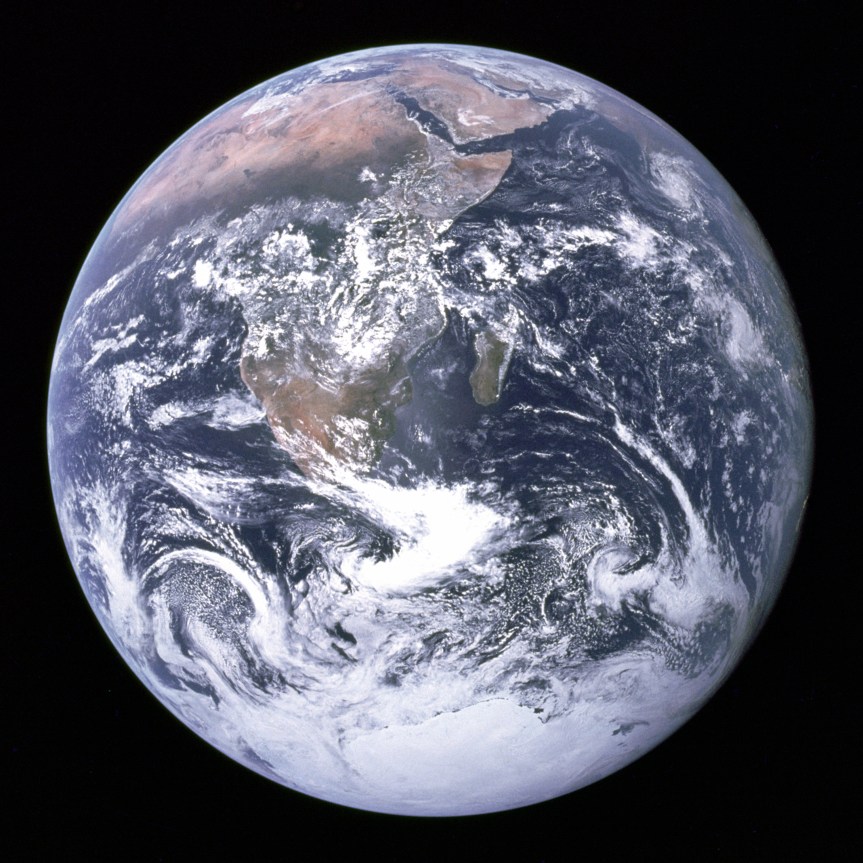
Our planet Earth, which is also known as the Blue planet because 75% of this planet is covered in the ocean and also it has pleasant humanity surviving on this planet. As we know this is the only planet where we are aware of life existence since the very beginning and is currently the only place where we can live in this Universe. There are interesting facts about our mother earth that we dint know about, and that is:-
Moon is probably a part of the Earth
According to the scientist, approximately 4 billion years ago earth dint has a moon at that point until a big space rock probably the size of Mars collided with our planet which resulted in a big part of the earth broke away and later formed into Moon which we see today in the night time.
Our planet’s days are increasing
When our planet was formed approximately 4.6 billion years ago, the day was roughly about 6 hours long buy by 620 million years ago it had increased to 21.9 hours long. Today, the average period of a day is 24 hours long but the time is increasing by 1.7 milliseconds every century. The reason may be the moon is slowing down the earth’s rotation through the tides. The spin of our planet results in a position of tidal ocean bulges to be pulled a little ahead of the Moon and earth axis, which makes a twisting force that slows down the Earth’s rotation.
Exploding lakes
Well on the border of the Democratic Republic of the Congo and Rwanda as well as in Cameroon there are three deadly explosive lakes Nyos, Lake Monoun and Lake Kivu are crater Lakes that are located over volcanic Earth this means that magma lurking below the surface emits carbon dioxide into the waters of the lake this carbon dioxide builds up in a thick layer at the bottom of the lakes until pressure gives way and it’s released in an explosion. It doesn’t happen often but if anyone is unlucky enough to be passing by at that moment they’ll be asphyxiated with the gas.
The Earth’s changing magnetic field
Our planet has a very strong magnetic field because of two reasons first is Nickel – Iron core and a pretty fast axial rotation, the magnetic field is significant for earth since it protects the planet from the solar winds. We think about our plant’s magnetic field as something constant and stable but the fact is it’s changing. According to some researches, they say that since the 19th century the northern magnetic pole has shifted approximately 685 miles moving towards North West across the Canadian arctic. The southern magnetic pole is also continuously roaming, scientists have known about the migration of the poles for a long time. James Ross an explorer and British naval officer pinpointed the northern magnetic pole for the first time in 1831 he discovered it during his exhausting voyage to the Arctic where his ship got trapped in the ice forcing the crew to spend a harsh 4 years after that nobody went back to that place until the next century in 1904 Roald Amundsen a polar regions Explorer from Norway reached the North Magnetic Pole again and was surprised to find that it had shifted 31 miles since Ross’s discovery.
Gravity is not the same everywhere
Despite our common belief, our planet isn’t perfectly round it’s more like a sphere, for example how a human head is shaped. So its mass is irregular and differs in various places which causes wobbles of gravity in different areas of the planet one of these gravitational anomalies is found in Canada’s Hudson Bay where the gravity is much weaker than anywhere else on the planet. A 2007 study found the reason for such a phenomenon is melted glaciers that area was once covered with a thick layer of ice when that ice later melted the imprint of this glacier partially pushed aside some of the Earth’s mass in that region is exactly this slight deformation of the crust that can explain the 25 to 45 per cent weaker gravity. Perhaps it’s somehow connected with the movement of magma in the planets mantle, what researchers have predicted in a science journal.
Earth may have a second moon
According to some scientists, they believe that our planet used to have an additional satellite. According to their research, a smaller celestial body about 750 miles wide orbited the earth just like a second moon it most likely crashed into our main satellite later on such a collision could explain why the two sides of the moon look so different from each other one being heavily cratered in ruff scientists also don’t rule out the probability that one day earth will get another satellite. Even today there are tons of celestial bodies that follow the planet they’re mostly temporary companions though but scientists believe that the gravitational field of our planet occasionally captures even quite big asteroids that spin around the earth for several months or about three rotations after that they move on in their journey across the expanses of the cosmos.


 Eduindex