Faster economic growth requires increased share of the manufacturing sector in GDP, particularly of MSMEs.

Faster economic growth requires a significant contribution from the manufacturing sector, particularly from Micro, Small, and Medium Enterprises (MSMEs).

The manufacturing sector has the potential to drive economic growth, create employment opportunities, and increase productivity. However, the share of the manufacturing sector in India’s GDP has remained stagnant at around 15-16% for several years.

To address this issue, the Government of India has implemented various policies to boost the growth of the manufacturing sector, particularly MSMEs. Some of the key policies include:
1. *Make in India Initiative*: Launched in 2014, this initiative aims to promote India as a global manufacturing hub. It focuses on easing regulations, improving infrastructure, and providing incentives for businesses to set up manufacturing units in India.
2. *MSME Development Act, 2006*: This Act provides a framework for the growth and development of MSMEs. It offers various benefits, including priority sector lending, technology upgradation, and marketing support.
3. *GST Reforms*: The Goods and Services Tax (GST) introduced in 2017 has simplified the tax structure and reduced the burden on MSMEs.
4. *Ease of Doing Business*: The Government has taken several steps to simplify regulations, reduce bureaucratic hurdles, and improve the business environment.
5. *Startup India Initiative*: Launched in 2016, this initiative aims to support startups and entrepreneurs, particularly in the manufacturing sector.
6. *Atmanirbhar Bharat Abhiyan*: Launched in 2020, this initiative aims to promote self-reliance and boost domestic manufacturing.
7. *Production Linked Incentive (PLI) Scheme*: This scheme offers financial incentives to businesses that invest in specific sectors, such as electronics, pharmaceuticals, and automobiles.
8. *Credit Guarantee Scheme*: This scheme provides credit guarantees to MSMEs, enabling them to access loans without collateral.
9. *Technology Upgradation*: The Government has established several technology centers and incubators to support MSMEs in upgrading their technology and improving productivity.
10. *Skill Development*: The Government has launched several initiatives to develop skills and provide training to workers in the manufacturing sector.
While these policies have shown positive results, there is still a need for more focused efforts to address the challenges faced by MSMEs, such as:
– Access to credit and finance
– Regulatory hurdles
– Infrastructure constraints
– Competition from larger industries
– Limited access to technology and innovation
To further boost the growth of MSMEs and increase their share in GDP, the Government could consider:
– Simplifying regulations and reducing compliance burdens
– Improving access to credit and finance
– Enhancing technology support and innovation
– Providing targeted incentives and subsidies
– Strengthening market linkages and export support
By addressing these challenges and building on existing policies, India can unlock the potential of its MSME sector and drive faster economic growth.
3 lakh MSME units were benefitted

 On the occasion of ‘National Small Industries Day’, Union Minister for Micro, Small and Medium Enterprises Shri Narayan Rane took to Twitter to announce that 16 lakh youth have been trained subsequently benefiting over 3 lakh MSME units in the last 9 years, through 18 tool rooms and technology centres run by the Ministry of MSME across the country.

Shri Rane said that the Tool Rooms and Technology Centres working under the Ministry of MSME are making a significant contribution in realizing Hon’ble Prime Minister Shri Narendra Modi’s dream of a self-reliant India. These tool rooms and technology centres are also providing step by step support in manufacturing state of the art products.

Shri Rane said these tool rooms design and manufacture medium and small-size equipment as per international standards which are being used in industries related to sports goods, plastic, automobile, footwear, glass, perfume, foundry and forging, electronics and space sector. In the recently launched Chandrayaan-3 mission, Bhubaneswar Tool Room manufactured around 54,000 aero-space components of 437 types. Tool rooms have also played an important role in fulfilling the domestic needs of PPE kits, sanitizer machines, oxygen concentrators as well as in their exports to foreign countries in the difficult times of the Corona pandemic.

MSME Minister informed through his tweet that 15 more technology centres are being set up to further strengthen the MSME units of the country.

*****

KVI activities in Tamil Nadu

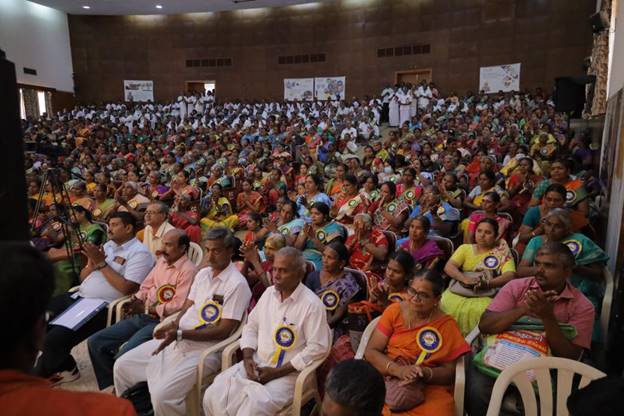
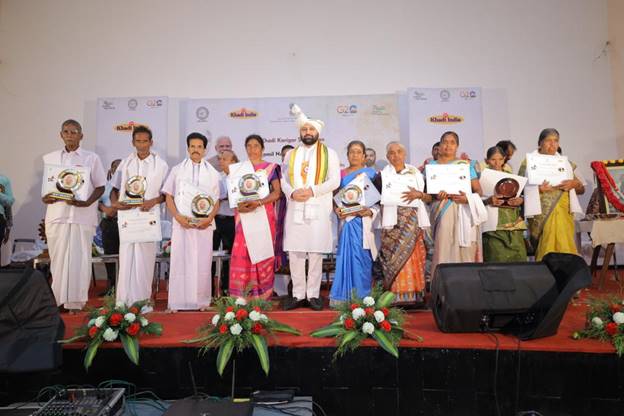
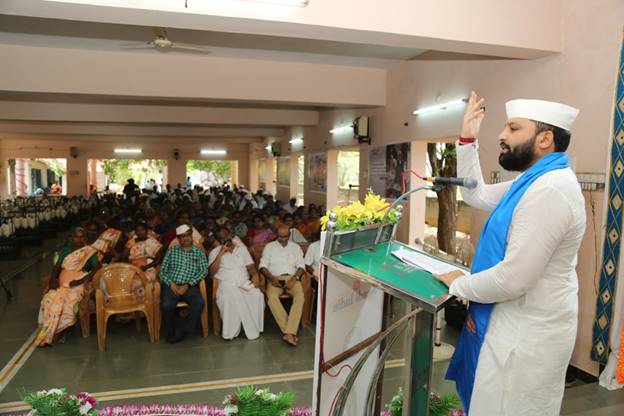
 Chairman, KVIC Shri Manoj Kumar inaugurated several KVI activities during  Tamil Nadu visit  and interacted with Khadi workers during this visit. Presiding over a Khadi Karigar Sammelan held on August 19, 2023, at SITRA, Coimbatore,  he  expressed gratitude for the love and care extended by the Tamil people over the last 2 days. He emphasized that this event is not only a Khadi Karigar Sammelan but also a heartfelt interaction (“Man Ki Baat”) between him and the rural artisans. He said  Khadi serves as a weapon against poverty, starvation, and unemployment, while also contributing to development in villages and promoting women’s empowerment.

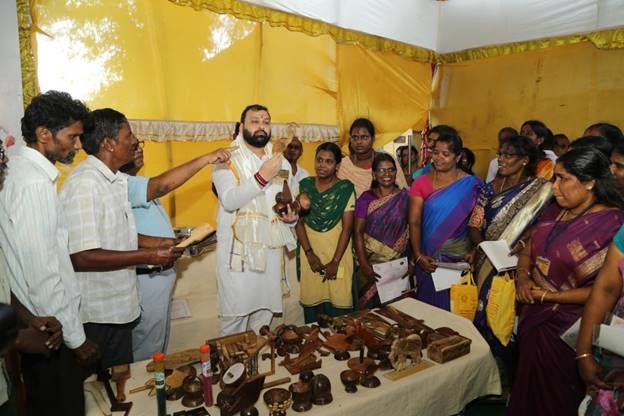
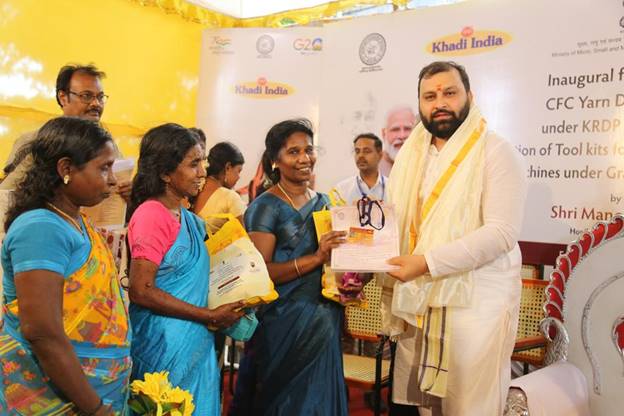
The Chairman honored the best-performing spinners and weavers by presenting them with certificates and momentum awards, in addition to distributing tool kits and equipment to around 40 Wood Craft artisans who have successfully completed the Training Programme on Waste Wood Craft which was attended by 800 rural artisans. During the event, a booklet showcasing success stories of the PMEGP beneficiaries was unveiled by the  Chairman.

In his  address Shri Kumar said according to data released by Niti Ayog, 13.05 Crore people have been lifted from poverty, and the dreams of the people are turning into reality under the leadership of Prime Minister Shri Narendra Modi.

While Khadi was the pride of the national movement under the leadership of Mahatma Gandhi, it now stands as the symbol of ‘Atmanirbhar Bharat’ under the guidance of Prime Minister,Shri Kumar said. “Like Gandhiji who used Khadi as a powerful weapon against the British rule, Prime Minister Modi has transformed Khadi into a potent and successful weapon for eradicating poverty, empowering artisans, ensuring food security, uplifting social status of women, and overcoming unemployment,” he said.

The Chairman said Prime Minister Shri Narendra Modi has called on many occasions from national and international forums to buy Khadi and Village Industries products and has mentioned about promoting this sector which since 2014 has seen tremendous growth. He said for the last 9 years, production of Khadi has augmented 260%, while sales of Khadi has increased 450%.  He said that the Khadi Institutions in Tamil Nadu have registered a production of Rs.262.55 Crore and sales of Rs.466.77 Crore during the year 2022-23, which has helped to provide continuous employment to 14,396 artisans.  Further, he informed that it has been proposed to increase the production to Rs.303.39 Crore and sales to Rs.477.02 Crore.   He said KVIC through various schemes such as Khadi Vikas Yojana, Gramodyog Vikas Yojana, PMEGP, Scheme of Fund Regeneration of Traditional Industries (SFURTI) has generated more than 9.5 Lakhs employment. Chairman.


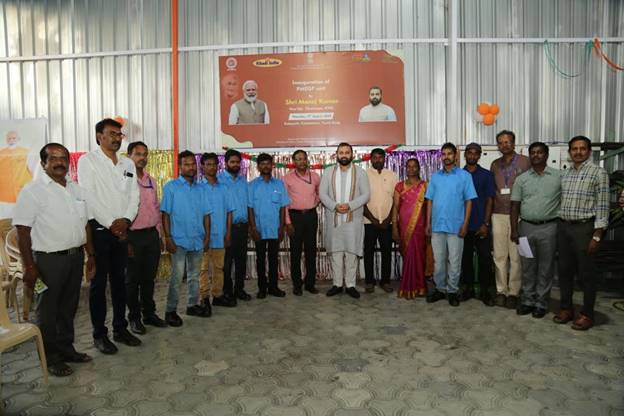
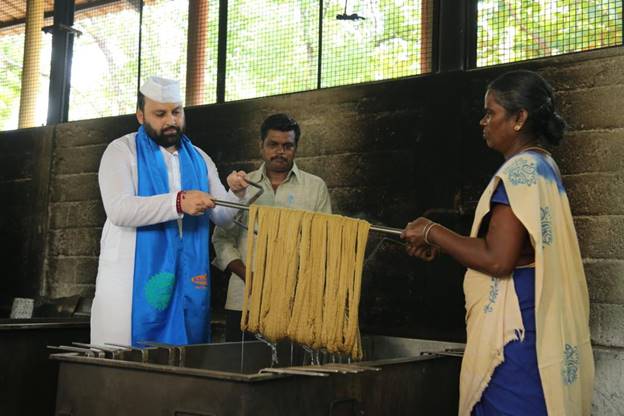
Earlier in his visit  Chairman, KVIC inaugurated the PMEGP unit at Kalapet, the newly Renovated Sales outlet at Gandhigram Khadi Village Industries Public Charitable Trust at Gandhigram, Dindigul and  a Common Facility Centre (CFC) of Yarn dying unit under KRDP Scheme of KVIC at the newly constructed workshed of Ramanathapuram District Sarvodaya Sangh, Srivilliputhur . He distributed tool kits and equipment to 25 Waste Wood Craft artisans and Pedal Operated Agarbathi Machines to 10 artisans under Gramodyog Vikas Yojana on 17th august 2023 and 18th August, 2023 respectively.  The Chairman interacted with Khadi spinners and weavers during the Khadi Artisans’ meet, and visited Khadi Gramodyog Bhavan of Madurai District Sarvodaya Sangh at Madurai.

            The Prime Minister Employment Generation Programme is a flagship scheme of Ministry of MSME, Govt. of India, providing sustainable employment both in Rural and Urban areas in setting up of micro and small units. The Scheme provides subsidy ranging from 15% to 35% depending upon the social category of the applicant and location of the unit with total project cost of Rs.50.00 Lakhs for manufacturing activity and Rs.20.00 Lakhs for Service activity.

*****

Role of 'MSME' sector in Indian Economy.

MSME has introduced in the year 2006 in India. There are still some service sector that was not yet included in this sector was included in the definition of the Micro, Small and Medium-sized Enterprises making a historic change to this Act. 

The MSME sector in India gave a major boost to the economy. Over 63 million MSMEs spread across the country contributed 30.5% to India’s GDP in FY19 and 30% in FY20. It also created many employment opportunities. Based on a study conducted by the Ministry of Statistics & PI between July 2015 and June 2016, the MSME sector employed 111 million workers. Compared with large-scale companies, MSMEs aided in the industrialisation of rural areas at minimal capital cost. The sector has made significant contributions to the country’s socio-economic growth and complemented major industries as well. MSMEs account for approximately 40% of India’s total exports, 6.11% of GDP from the manufacturing sector and 24.63% of GDP from the services sector.

The significance of the MSMEs sector can be noted from the fact that it is the second-largest employment provider, after agriculture in India. This sector has proven the instrumental in the growth of the nation, leverage exports, creating huge employment opportunities for the unskilled, fresh graduates, and the underemployed. It also extended the opportunities to banks for giving more credit to enterprises to MSME Sector. The government should take the special care by addressing the importance of MSME in terms of providing more and more MSME Registration advantages by implementing better regulations and enable financial institutions to lend more credit at less interest rate for sustainability of this sector.

To ensure that MSMEs continue to lead the country towards economic growth, the Government of India has from time to time announced various schemes to support the development of this sector. Recently, in view of the economic hardship caused by covid 19, the government has announced few schemes under ‘Aatmanirbhar Bharat’ i.e. Self-reliant India initiative. Accordingly, the criterion for classifying MSME has also been revised. Under the revised criterion, the combined factors of ‘Investment in plant and machinery’ and ‘Turnover’ are required to be considered to determine whether a business should be classified as a micro, small or a medium enterprise. In contrast, earlier the classification of an MSME unit was based only its investment in plant and machinery; and also depending on whether the enterprise was in the manufacturing sector or in the services sector.

FINANCIAL ASSISTANCE TO MSMEs DURING COVID

 The  Government of India has launched Self Reliant India (SRI) Fund, a fund of funds which aims to extend growth funding to MSMEs.   

The highlights of SRI Fund are as under:-  

  • To provide funding support to Daughter Funds for onward provision as growth capital through equity, quasi-equity and debt (as permitted under relevant SEBI guidelines).
  • To support faster growth of MSMEs and thereby ignite the economy and create employment opportunities.
  • To support MSMEs to graduate beyond the MSME bracket and become National/International Champions.
  • To support MSMEs which help making India self-reliant by producing relevant technologies, goods and services.
  • Daughter Funds which are interested in investing in MSMEs shall be empanelled.
  • 20% of the funds invested in MSMEs shall be provided by SRI Fund.
  • MSMEs as per the definition given in the MSMED Act shall be eligible provided, after assessment, they are found viable, have a positive growth trajectory, and have a defined business plan for growth. Previous 3 years CAGR will be considered.
  • Non Profit institutions, NBFCs, financial inclusion sector, micro credit sector and other financial intermediaries shall not be eligible for consideration.

Assuming an average investment of Rs. 10.00 Crore per MSMEs, approximately 5000 MSME are likely to be benefited.   

The financial support under this scheme intends to increase the financial capacity of viable MSMEs for growth to expand their business and become National/International Champions.   

The scheme is being implemented by a special purpose vehicle named “NSIC Venture Capital Fund Limited”. As informed by NSIC Venture Capital Fund Limited, a Commitment of Rs.1,080 crore has been approved so far.   

EXPANSION OF MSME SECTOR

 Promotion and development of enterprises is a State subject. The Central Government supplements the efforts of the State/UT Governments through various schemes, programmes and policy initiatives for promotion, development and enhancing the competitiveness of MSMEs and to increase employment opportunities in the country.         

            The Ministry of MSME implements various schemes and programmes for growth and development of MSME Sector in the country. These schemes and programmes inter-alia include Prime Minister’s Employment Generation programme (PMEGP), Scheme of Fund for Regeneration of Traditional Industries (SFURTI), A Scheme for Promoting Innovation, Rural Industry & Entrepreneurship (ASPIRE), Credit Guarantee Scheme for Micro and Small Enterprises, Micro and Small Enterprises Cluster Development Programme (MSE-CDP) etc. Benefits under these schemes are available to all eligible MSMEs throughout the country. Ministry of MSME has also been implementing a special scheme viz. ‘Promotion of MSMEs in North Eastern Region and Sikkim’ which focuses on improving the condition of MSME Sector in North Eastern States including Assam. The Scheme-wise Budget allocation of these schemes is given below:-


 Budget Allocation (Rs. in crore)

S.No.

Name of the Scheme

2019-20

2020-21


2021-22

(As on 31.12.2021)

1

Prime Minister’s Employment Generation Programme

(PMEGP)

2,327.10

2,500.00

2,000.00

2

Scheme of Fund for Regeneration of Traditional Industries (SFURTI)

125.00

464.85

170.00

3

A Scheme for Promoting Innovation, Rural Industry & Entrepreneurship (ASPIRE)

50.00

30.00

15.00

4

Credit Guarantee Scheme

597.00

100.00

0.04

5

Micro and Small Enterprises Cluster Development Programme (MSE-CDP)

227.90

390.69

156.60

‘Vocal for Local’: A Good Slogan Needing Proactive Policies

On 12 May, 2020, Prime Minister Narendra Modi in his address to the nation raised this important and attractive slogan. The immediate spark was to call for support to the local Indian brands which are facing terrible crisis due to the pandemic and the subsequent lockdown. The broader goal was to provide a rallying point for his idea of Atmanirbharata— self-reliance. The timing could not be better for such appeal. If not now, then never— one may argue. The Prime Minister who has great oratory skill, also justified his favour for the local by reminding ‘every Indian’ that what are now the distinguished and coveted global brands were local in their origin. True, because brands do not enter the world from the blue sky. They firmly originate in the rugged soil of the countries of their origin. But the question is, such slogan can only materialize when it is backed up by appropriate and proactive policies.

To establish legitimacy of the local products is not an easy task. It involves huge arrangement of human, financial and material resources. India is an exceptionally large country with rural-urban divide and steep social and economic inequality. One may argue that closer home China has managed to make use of the local production efficiently and has been able to spread local products throughout the world. But we have to remember that China has been able to systematically establish supportive policies to promote local production. It is true that China has less problems in formulating such policies because of her authoritarian political system which dictates public policies from the top of the ruling Communist Party. But that does not take away China’s credit in making her local products global. Today, with China’s infiltration in Ladakh there is a shrill cry for boycott of Chinese goods and Chinese apps. But even when one acknowledges the justification of patriotic emotion in such cry the fact remains that Chinese products and services have penetrated the Indian market too deeply to be removed by the sleight of the hand. We may, for instance, remove fifty nine Chinese apps but the Chinese phones remain. The irony evident in the joke that China has started supplying India with millions of ‘Boycott Chinese Products’ stickers cannot be underestimated. It is also an open secret that China’s aggressive presence in consumer goods market, including electronics industry, and in pharmaceutical industry, is to a great extent due to her ability to decentralize production.

Let us agree that basically lack of supportive financial and developmental policies has crippled the ‘local’ in post-independent India. India always had wonderful local production hubs— with immaculate artistic and engineering skills— the list is too long to mention here. But lack of support compelled them to either remain confined to dingy kiosks or to down their shutters. Our rulers were not wrong in emphasizing industrial development but they faltered in privileging large scale industries at the cost of medium, small and cottage industries. We sought to be global by neglecting the local. In underestimating local knowledge and local skill India is lagging far behind in creating micro-entrepreneurs. Take the case of textile industry. We have mega textile industries, some of which connect with the local but we have not been able decentralized it. One should also learn a lesson from the next door neighbour, Bangladesh. The small neighbour of ours has made global progress in garment manufacturing and has a staggering growth in garment exports. If Bangladesh can do it, why not India?— the question begs serious attention and scrutiny.

The issue is not just being vocal about local but to follow it up with the right kind of local-friendly policies to lend it first national and then global status. With the onset of the “Make in India’ policy there have been some progress in policy circle to cater to the MSME (Micro, Small and Medium Enterprises). It is needed because this sector’s contribution is 37.5% of the GDP. India also has a dynamic minister in charge of MSME, Mr. Nitin Gadkari. But lot more needs to be done without delay. New technology is to be introduced with vigour in local production shops, and taxes and tariff should be substantially reduced to generate competitiveness in them. Local producers should be freed from the tangled web of red-tapism and indifference when they come up with new ideas. National and foreign collaborators should also be encouraged to have tie-up with local entrepreneurs. In doing so we, Indians, have nothing to lose but our indifference and contempt for the anything local. The road to the global after all lies through the local. Thus, the local has to be in the loop beyond the realm of words.