To MARS, Or Not To MARS ?

Strap yourself in, we are going on a trip in our favorite rocket ship, steering through the clouds like little Einsteins. Climb aboard and get ready to explore, the Red Planet- Mars. From hostile deserts, to lonely islands and the highest mountains, wherever there is space to expand into, humans do so.

Hence it is hardly surprising that we are all ready to set foot into Mars and create the first permanent colony outside of Earth maybe even terraform another planet and turn it into a second blue home.

If you don’t know who is Elon Musk, then you better start googling his name and get to know him. Not only is he the billionaire founder of Tesla Motors, this a.k.a. Iron man superhero Tony Stark has ambitious plans to send humans to Mars by 2025.

If this is a trip then like any other, there is a need for a checklist with list of items to be taken to Mars and items we can conveniently leave back on Earth. Let’s get started fellow Martians.

A MARS COLONY CHECKLIST :

  • PORTABLE OXYGEN GENERATOR- You need to breathe. In case of emergency, a standby kit to generate oxygen is required. But considering humans, we might need a mask too because air is our favourite natural element to pollute.
  • PORTABLE SOLAR POWER KIT- Low battery and no charger sounds as scary as the trip itself. Whatever electronics you are bringing, as long as there is no electricity, forget about your entertainment. You don’t want to die of boredom.
  • PORTABLE WATER FILTER- We know there is frozen water on the planet. But we dont know if ita drinkable. All the ice deserves a drink, so bring a filter and soda-making machine if excess luggage permits (check with your airline)
  • PLANT SEEDS- Once you run out of your snacks you should look into farming. Be prepared, bring some seeds and check some tutorials on gardening (preferably in space).
  • LONELINESS- Self isolation might be needed to avoid radioactive exposure, well looks like the year 2020 is indeed a good practice for it. Also aren’t we all lonely from inside (No? just me? Okay…. *crawls back into my hole*)
  • NUCLEAR REACTORS- For creating a safe atmosphere and not the nuclear weapons that Nations own for “defense purposes” Let those weapons stay on Earth along with the people who threaten to use them because there isn’t much spice in their lives.
  • MULTIMILLION DOLLAR SPACESHIP – So large that it could fit the 150 Million homeless around the world, people who have been disappointed by the Politicians and their promises.
  • A HIGH TOLERENCE – A tolerance level higher than what we have to everything on social media and to the lifestyle of new generations.
  • MAA KE HAAT KA KHANA – A nice Tupperware tiffin box with food made by your Moms because, The M.O.M on Mars doesn’t cook or do ALL your work. (M.O.M –Mars Orbiter Mission also called Mangalyaan)

Lastly a desire to get away from it all. Elon Musk is not crazy, but a visionary, a modern adventurer who dares to dream. NASA is behind him by committing to send the first batch of astronauts on his mission. More than 200,000 people have signed up for the one-way ticket to Mars including Leonardo DiCaprio. Musk hopes to send 1 million people to the Red Planet and a ticket is estimated to cost around USD200,000 for each passenger (Hefty I know, but you get to travel with Leo as your travel buddy, hopefully this space- SHIP doesn’t sink).

Well as scary and uncertain as everything sounds it all comes down to one very important factor, Does Mars have Wi-Fi?

Accidently Created Radiation Shield around Earth in Deep Space : EMI Test Exclusive …………..//

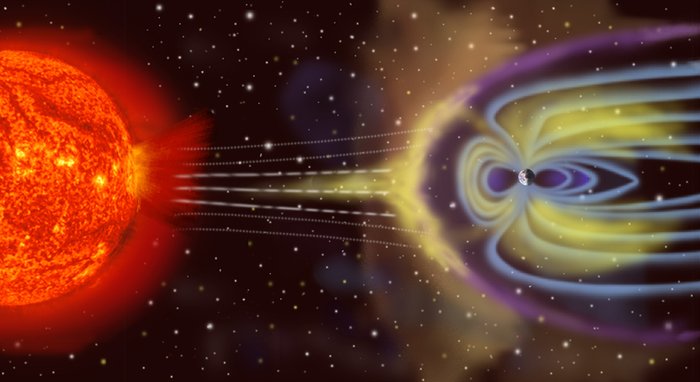
NASA spends a lot of time researching the Earth and its surrounding space environment. One particular feature of interest are the Van Allen belts, so much so that NASA built special probes to study them! They’ve now discovered a protective bubble they believe has been generated by human transmissions in the VLF range.

VLF transmissions cover the 3-30 kHz range, and thus bandwidth is highly limited. VLF hardware is primarily used to communicate with submarines, often to remind them that, yes, everything is still fine and there’s no need to launch the nukes yet.  It’s also used for navigation and broadcasting time signals.

It seems that this human transmission has created a barrier of sorts in the atmosphere that protects it against radiation from space. Interestingly, the outward edge of this “VLF Bubble” seems to correspond very closely with the innermost edge of the Van Allen belts caused by Earth’s magnetic field.

Credit : Third Party Reference

What’s more, the inner limit of the Van Allan belts now appears to be much farther away from the Earth’s surface than it was in the 1960s, which suggests that man-made VLF transmissions could be responsible for pushing the boundary outwards.

Overall, this seems like an accidental, but potentially positive effect of human activity – the barrier protects the Earth from potentially harmful radiation. NASA’s YouTube video on the topic suggests that understanding this mechanism better could enable us to protect our satellites and space vehicles from some of the harmful effects of the space environment.

A week or two ago we featured a research paper from NASA scientists that reported a tiny but measurable thrust from an electromagnetic drive mounted on a torsion balance in a vacuum chamber. This was interesting news because electromagnetic drives do not eject mass in the way that a traditional rocket engine does, so any thrust they may produce would violate Newton’s Third Law.

Credit : Third Party Reference

Either the Laws Of Physics are not as inviolate as we have been led to believe, or some other factor has evaded the attempts of the team to exclude or explain everything that might otherwise produce a force.

As you might imagine, opinion has entrenched itself on both sides of this issue. Those who believe that EM drives have allowed us to stumble upon some hitherto undiscovered branch of physics seized upon the fact that the NASA paper was peer-reviewed to support their case, while those who believe the mechanism through which the force is generated will eventually be explained by conventional means stuck to their guns. The rest of us who sit on the fence await further developments from either side with interest.

Over at Phys.org they have an interview from the University of Connecticut with [Brice Cassenti], a propulsion expert, which brings his specialist knowledge to the issue. He believes that eventually the results will be explained by conventional means.

But explains why the paper made it through peer review and addresses some of the speculation about the device being tested in space. If you are firmly in one of the opposing camps the interview may not persuade you to change your mind, but it nevertheless makes for an interesting read.

Reference – https://divyanshspacetech.wordpress.com

Cigar Shaped Interstellar ‘Oddball’: Big Exclusive Report >>>>>>>>>

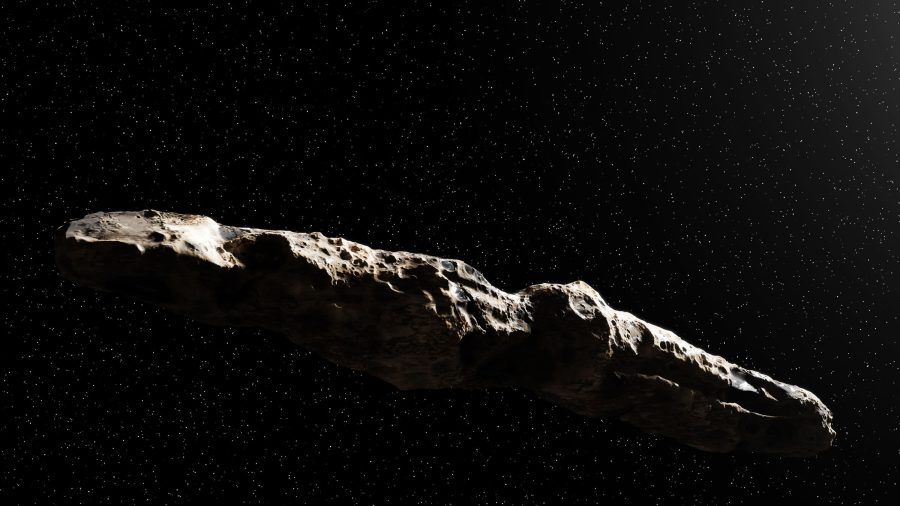
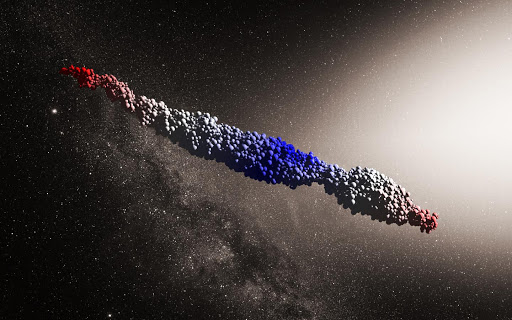
First known interstellar visitor is an ‘oddball’, with a very odd and highly unusual aspect ratio.

FROM THE ASSOCIATION OF UNIVERSITIES FOR RESEARCH IN ASTRONOMY (AURA):

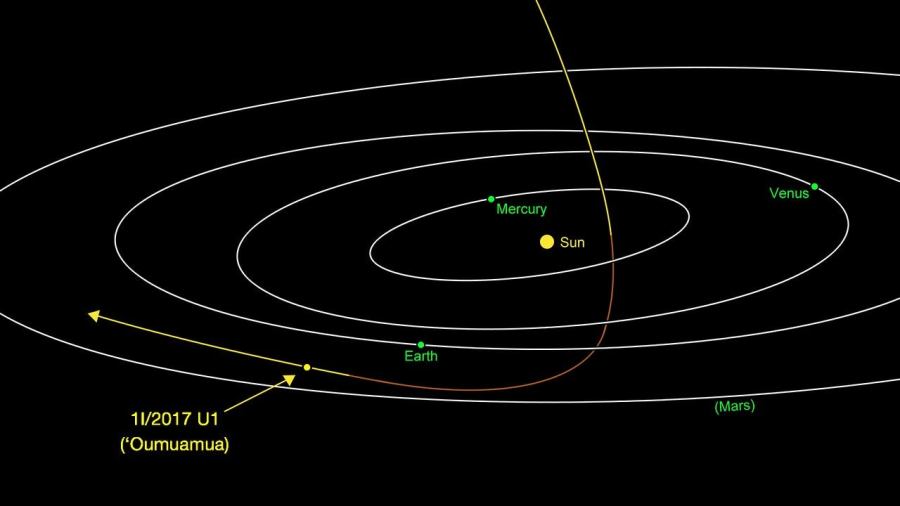
In October astronomers were surprised by a visitor that came racing into our Solar System from interstellar space. Now, researchers using the Gemini Observatory have determined that the first known object to graze our Solar System from beyond is similar to, but definitely not, your average asteroid or comet. “This thing is an oddball,” said Karen Meech of the University of Hawaii’s Institute for Astronomy who leads an international team studying this interstellar interloper.

Originally denoted A2017 U1, the body now goes by the Hawaiian name ‘Oumuamua, in part because of its discovery by Meech’s team using the Pan-STARRS1 survey telescope on Haleakala in Hawai’i. When discovered in mid-October ‘Oumuamua was only about 85 times the Earth-Moon distance away and its discovery was announced in early November.

Credit : Third Party Reference

Since its discovery ‘Oumuamua has faded from view. The object’s rapidly increasing distance from the Earth and Sun now makes it too faint to be studied by even the largest telescopes.

“Needless to say, we dropped everything so we could quickly point the Gemini telescopes at this object immediately after its discovery,” said Gemini Director Laura Ferrarese who coordinated the Gemini South observations for Meech’s group.

“What we found was a rapidly rotating object, at least the size of a football field, that changed in brightness quite dramatically,” according to Meech. “This change in brightness hints that ‘Oumuamua could be more than 10 times longer than it is wide – something which has never.

‘Oumuamua’ shares similarities with small objects in the outer Solar System, especially the distant worlds of the Kuiper Belt – a region of rocky, frigid worlds far beyond Neptune.

“While study of ‘Oumuamua’s colors shows that this body shares characteristics with both Kuiper Belt objects and organic-rich comets and trojan asteroids,” says Meech, “its orbital path says it comes from far beyond.”

The research led by Meech is published in the November 20th online issue of the journal Nature.

‘Oumuamua was visible from Chile and Hawai’i so both Gemini North and South telescopes were on high alert and ready to track the visitor from outer space. “We observed from both sites for three nights, before it sped away and faded from view,” said Ferrarese. Two additional teams obtained data from Gemini North and their results are currently pending publication.

Credit : Third Party Reference

According to our current understanding of planetary system formation, our Solar System ejected comets and asteroids due to interactions with the larger outer planets. It is presumed that other planetary systems do the same and that these visitors might be more common than previously thought.

“We estimate that there is always one of these objects of similar size as ‘Oumuamua between the Earth and the Sun at any given time, so up to about 10 per year,” says Robert Jedicke also on Meech’s team.

“These observations allow us to reach into another planetary system to learn about one of its rocky bodies, and compare this object with the asteroids we know throughout our own Solar System”, says Faith Vilas, the solar and planetary research program director at the National Science Foundation who helped support this research.

Credit : Third Party Reference

Surveys like Pan-STARRS and the future Large Synoptic Survey Telescope (LSST, currently under construction near the Gemini South telescope in Chile) will undoubtedly increase the detections of these interstellar wanderers.

“The discoveries of rare surprises like ‘Oumuamua from outside our Solar System will be greatly accelerated by the power and grasp of the LSST,” said Richard Green of the US National Science Foundation (NSF).

“LSST is going to produce a torrent of data and revolutionize this sort of time domain astronomy when it begins operations early in the next decade,” adds Green. LSST is funded by a partnership with the NSF, the Department of Energy, and the LSST Corporation.

‘Oumuamua loosely means “a messenger that reaches out from the distant past,” fitting the nature of the object’s interstellar origin. In Hawaiian ‘ou means “to reach out for,” while mua means “first” and is repeated for emphasis.

Reference – https://divyanshspacetech.wordpress.com

Extreme Space Weather : Bigger Threat than Global Warming in the Context of Earth >>>>>>>>>

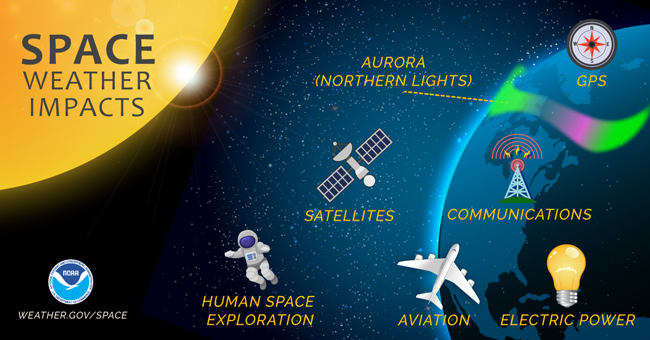
Extreme space weather has a global footprint and the potential to damage critical infrastructure on the ground and in space. A new report from the European Commission’s Joint Research Centre (JRC) calls for bridging knowledge gaps and for better coordination at EU level to reduce the potential impact of space weather events.

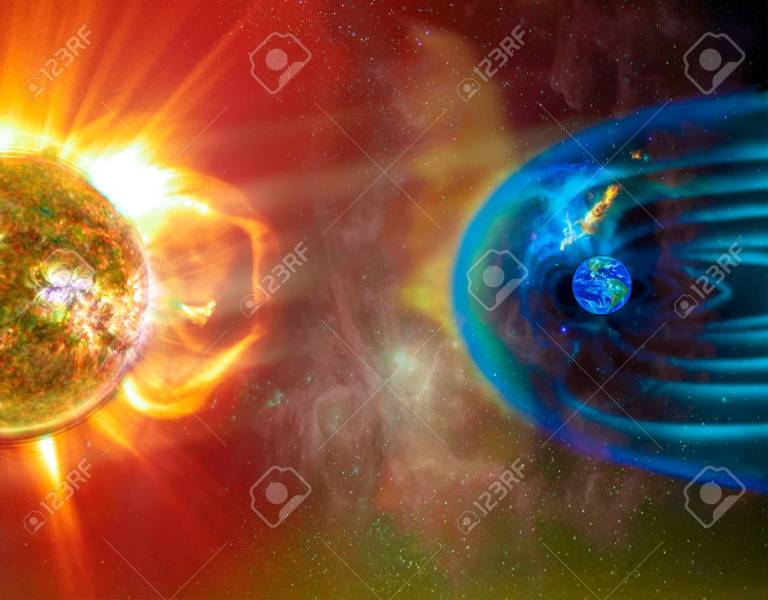
The sun shapes the space environment around the Earth. This so-called space weather can affect space assets but also critical infrastructure on the ground, potentially causing service disruptions or infrastructure failures. Numerous space weather events affecting the power grid, aviation, communication, and navigation systems have already been documented.

Credit : Third Party Reference

The impact of severe space weather can cross national borders, which means that a crisis in one country can affect the infrastructure in the neighbouring countries. This raises concerns due to the increasing reliance of society on the services that these infrastructures provide.

NEW REPORT IDENTIFIES KNOWLEDGE GAPS

The JRC has investigated the impacts of space weather on critical infrastructure in the EU. A new report identifies the gaps in reducing risks linked to space weather and makes recommendations for policy, industry and science on how to close these gaps.

The report summarises the results of a summit organised in partnership with the Swedish Civil Contingencies Agency and the UK Met Office, with the support of the US National Oceanic and Atmospheric Administration (NOAA) in November 2016. Representatives from European infrastructure operators, insurance, academia, ESA, and European and US government agencies attended the event.

INTERDEPENDENCIES AND CRISIS RESPONSE

The potential failure of critical infrastructures during extreme space weather can lead to cascading effects impacting other sectors.

New methodologies and tools, as well as a multi-risk governance approach are needed to assess these interdependencies and to enable the coordination of the many different actors that often manage risks in isolation from one other.

Credit : Third Party Reference

A pan-European vulnerability assessment of the power grid should be carried out to identify critical issues and transboundary effects in case of extreme space weather. Infrastructure operators should also assess whether their systems could be indirectly vulnerable to space weather, for instance due to dependencies on timing and positioning information provided by the Global Navigation Satellite System (GNSS).

Better communication between science and industry is also needed to provide relevant and reliable information to operators for decision making.

SPACE WEATHER FORECASTING

Early warning and preparedness are essential for limiting the effects of space-weather impacts.

In Europe and the USA, 24/7 space-weather forecasting capabilities are available to support the early warning of government and industry. However, it is important that the consistency of forecasts from different service providers are ensured.

Credit : Third Party Reference

There is a need to enhance forecasting capabilities for regional or local forecasts on the severity and duration of extreme space weather to ensure appropriate response from local operators.

Currently, geomagnetic storm forecasting is hampered by the limited understanding of the magnetic field orientation of Coronal Mass Ejections (CME) before they hit the Earth, and there are still significant knowledge gaps in physical and impact modelling, which affect the early-warning capabilities and preparedness in industry.

THE ROLE OF THE EU

In the EU, the European Programme on Critical Infrastructure Protection provides a policy background for critical infrastructure protection, while the EU disaster risk management policy covers prevention, preparedness and response for all types of disasters.

The Union Civil Protection Mechanism requires EU Member States to prepare a national risk assessment and list the priority risks they are facing. Six countries have included space weather in their risk assessment.

Credit : Third Party Reference

The participants of the summit indicated that there is a need for for improving coordination between the different space weather actors and recommended the establishment of a strategic European decision-making capability to coordinate space-weather risk mitigation and response at pan-European level.

They also advised that the roles and responsibilities of the key players in Europe should be better defined and suggested that coordinated strategic investments for improving the scientific know-how in this area could be explored.

Reference- https://divyanshspacetech.wordpress.com

Surprising Arrival of UFO’s : Super Exclusive >>>>>>>>>>

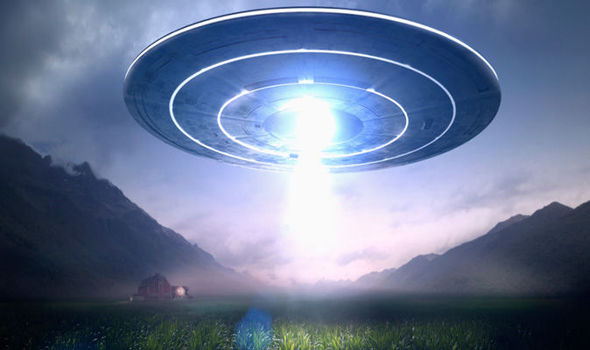
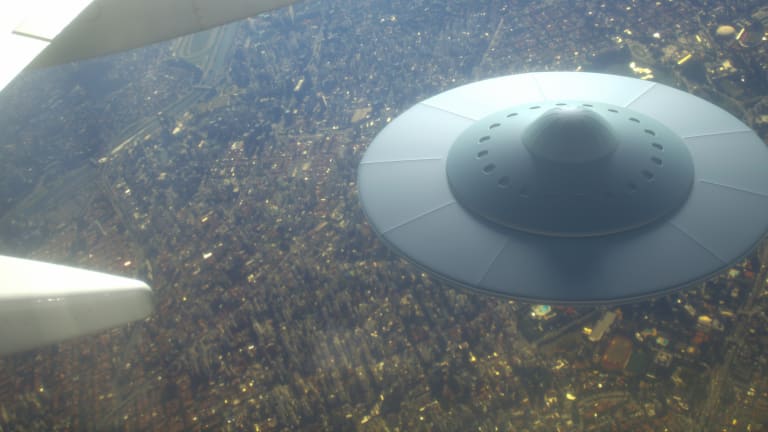
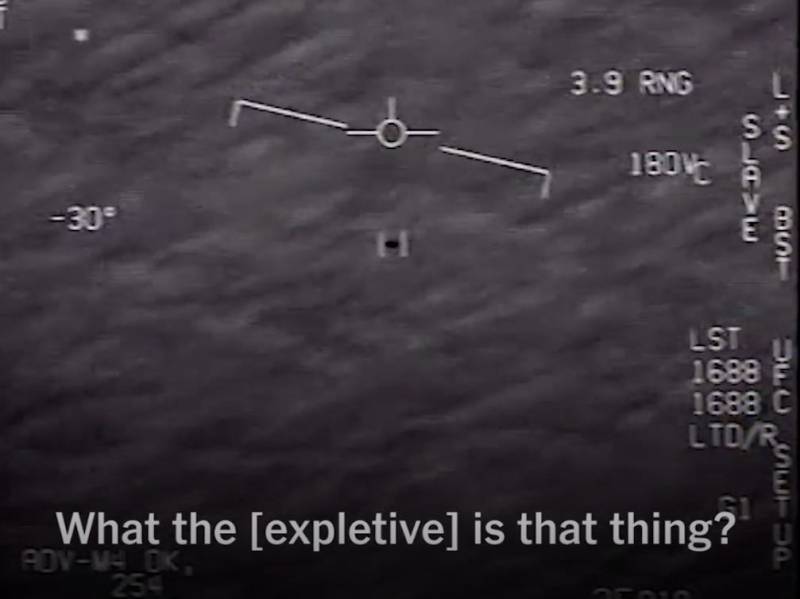
YouTube has become a video repository for UFO videos, collections of images edited as videos showing inexplicable discoveries on both the Moon, Mars and other places in the solar system.

The video-uploading Social Network has quickly lost control of what is posted on the site as hundreds of thousands of people record and upload videos of strange events they say are proof of aliens and UFOS.

Regrettably, while there may be quite a few videos which are actually the real deal and offer proof of the existence of UFOs, there is a huge amount of fake videos posted on YouTube, most of them being the product of Computer Generated images (CGI).

Credit : Third Party Reference

Now a new video uploaded to YouTube has made headlines around the world after a man from Mexico called Diego Alves uploaded a very peculiar clip on his YouTube channel. Since then, it has gained much popularity and has been reposted to several other YouTube accounts.

The ‘controversial video’ seems to show what everyone wants to see: A UFO taking off from the Moon, and shooting into space.

It must be the real deal, right?

Users rushed to comment on the video: “That UFO looks like it’s coming from a hole out of the moon. This is a great video.”

And another added: “Something is Coming, I can feel it.”

A third comment claimed: “That is the best UFO footage I have ever seen.

But hold your horses, not all is as it appears.

UFO debunkers quickly spotted that Mr. Aviles’ Facebook page was filled with CGI content (very talented he is) and that he was a graphic artist who has made a host of stunning CGI videos.

While the video may be undoubtedly awesome, and while it appears to clearly show a mystery object shooting off from the surface of the moon at great speed, the truth is that the man who uploaded the Video, Diego Aviles is a graphic artist who has made a host of stunning CGI videos.

Credit : Third Party Reference

The video is a product of two parts: the moon filmed from a telescope and a small object that was added afterward making it appear as if it was taking off from the moon, and shooting into outer space.

Earth’s moon is a mysterious place. Yes, and there are many things on the surface which are hard to explain. Dr. Robert Jastrow, the first president of NASA’s Commission of Lunar Exploration called the moon “the Rosetta Stone of the planets.” And yes, there are several theories that suggest the moon is both a massive alien base or has numerous bases on its surface whose origin remains a mystery.

Credit : Third Party Reference

In July of 1970, two Russian scientists, Mikhail Vasin and Alexander Shcherbakov, published an article in the Soviet journal Sputnik called “Is the Moon the Creation of Alien Intelligence?” The theory proposed by the two experts offers arguments that would explain the countless e

The Russian scientific duo proposed the theory that Earth’s Moon is not a natural satellite, but a planetoid that was literally hollowed out eons ago in the far reaches of the universe by super advanced intelligent beings possessing a technology far superior to ours, even today.

Anyhow, while there are numerous interesting theories worth pursuing in terms of Aliens and UFO’s, videos like the one uploaded to Mr. Avila’s YouTube channel damage serious UFO investigations.

Reference- https://divyanshspacetech.wordpress.com

Finding of 100 Earth Like Exoplanet : Kepler K2 Mission Super Exclusive

The largest haul of confirmed planets obtained since the space observatory transitioned to a different mode of observing includes a planetary system comprising four promising planets that could be rocky.

UNIVERSITY OF ARIZONA

An international team of astronomers led by the University of Arizona has discovered and confirmed a treasure trove of new worlds using NASA’s Kepler spacecraft on its K2 mission. Among the findings tallying 197 initial planet candidates, scientists have confirmed 104 planets outside our solar system. Among the confirmed is a planetary system comprising four promising planets that could be rocky.

The planets, all between 20 and 50 percent larger than Earth by diameter, are orbiting the M dwarf star K2-72, found 181 light years away in the direction of the Aquarius constellation. The star is less than half the size of the sun and less bright. The planets’ orbital periods range from five and a half to 24 days, and two of them may experience irradiation levels from their star comparable to those on Earth.

Credit : Third Party Reference

Despite their tight orbits — closer than Mercury’s orbit around the sun — the possibility that life could arise on a planet around such a star cannot be ruled out, according to lead author Ian Crossfield, a Sagan Fellow at the University of Arizona’s Lunar and Planetary Laboratory.

The researchers achieved this extraordinary “roundup” of exoplanets by combining data with follow-up observations by earth-based telescopes including the North Gemini telescope and the W. M. Keck Observatory in Hawaii, the Automated Planet Finder of the University of California Observatories, and the Large Binocular Telescope operated by the University of Arizona. The discoveries are published online in the Astrophysical Journal Supplement Series.

Both Kepler and its K2 mission discover new planets by measuring the subtle dip in a star’s brightness caused by a planet passing in front of its star. In its initial mission, Kepler surveyed just one patch of sky in the northern hemisphere, measuring the frequency of planets whose size and temperature might be similar to Earth orbiting stars similar to our sun. In the spacecraft’s extended mission in 2013, it lost its ability to precisely stare at its original target area, but a brilliant fix created a second life for the telescope that is proving scientifically fruitful.

After the fix, Kepler started its K2 mission, which has provided an ecliptic field of view with greater opportunities for Earth-based observatories in both the northern and southern hemispheres. Additionally, the K2 mission is entirely community-driven with all targets proposed for by the scientific community.

Credit : Third Party Reference

Because it covers more of the sky, the K2 mission is capable of observing a larger fraction of cooler, smaller, red-dwarf type stars, and because such stars are much more common in the Milky Way than sun-like stars, nearby stars will predominantly be red dwarfs.

“An analogy would be to say that Kepler performed a demographic study, while the K2 mission focuses on the bright and nearby stars with different types of planets,” said Ian Crossfield. “The K2 mission allows us to increase the number of small, red stars by a factor of 20, significantly increasing the number of astronomical ‘movie stars’ that make the best systems for further study.”

To validate candidate planets identified by K2, the researchers obtained high-resolution images of the planet-hosting stars as well as high-resolution optical spectroscopy data. By dispersing the starlight as through a prism, the spectrographs allowed the researchers to infer the physical properties of a star — such as mass, radius and temperature — from which the properties of any planets orbiting it can be inferred.

Credit : Third Party Reference

These observations represent a natural stepping stone from the K2 mission to NASA’s other upcoming exoplanet missions such as the Transiting Exoplanet Survey Satellite and James Webb Space Telescope.

“This bountiful list of validated exoplanets from the K2 mission highlights the fact that the targeted examination of bright stars and nearby stars along the ecliptic is providing many interesting new planets,” said Steve Howell, project scientist for Kepler and K2 at NASA’s Ames Research Center in Moffett Field, California.

“This allows the astronomical community ease of follow-up and characterization, and picks out a few gems for first study by the James Webb Space Telescope, which could perhaps provide information about their atmospheres.”

Reference – https://divyanshspacetech.wordpress.com

BLACK HOLES – The great void

WHAT ARE BLACK HOLES ?

BLACK HOLES are points in space that are so dense they create deep gravity sinks. Beyond a certain region, not even light can escape the powerful tug of a black hole’s gravity. Because no light can get out, people can’t see black holes. They are invisible. Space telescopes with special tools can help find black holes. The special tools can see how stars that are very close to black holes act differently than other stars.

HOW ARE THEY FORMED ?

The most well-understood black holes are created when a massive star reaches the end of its life and implodes, collapsing in on itself.In their final stages, enormous stars go out with a bang in massive explosions known as supernovae. Such a burst flings star matter out into space but leaves behind the stellar core. when there are no longer forces to oppose that gravity, so the star core begins to collapse in on itself.

If its mass collapses into an infinitely small point, a black hole is born. Packing all of that bulk—many times the mass of our own sun—into such a tiny point gives black holes their powerful gravitational pull.

BLACK HOLES SWIRLING WITH STARS

Researchers have long estimated that the Milky Way is home to hundreds of millions of black holes, extremely dense objects whose gravitational fields are so intense, not even light can escape. But finding these dark objects has proven extremely difficult and majority of black holes in our galaxy are invisible, so the only way to find them is by observing their gravitational effects on surrounding objects.

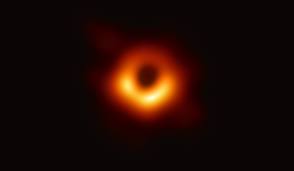
After decades of black holes being known only as theoretical objects, the first physical black hole ever discovered was spotted in 1971. Then, in 2019 the Event Horizon Telescope (EHT) collaboration released the first image ever recorded of a black hole.

Using the Event Horizon Telescope, scientists obtained an image of the black hole at the center of galaxy M87

TYPES OF BLACK HOLES

The most common types of black holes are the stellar-mass and supermassive black holes. Stellar-mass black holes are created when massive stars explode, leaving behind a black hole with the mass of just a few suns. Supermassive black holes exist in the hearts of galaxies and usually contain the mass equivalent of millions of suns.

SUPERMASSIVE BLACK HOLES- BIRTH TO GIANTS

Small black holes populate the universe, but their cousins, supermassive black holes, dominate. These enormous black holes are millions or even billions of times as massive as the sun, but are about the same size in diameter. Such black holes are thought to lie at the center of pretty much every galaxy, including the Milky Way.Almost every galaxy, including our Milky Way, has a supermassive black hole at its heart, with masses of millions to billions of times the mass of the Sun. 

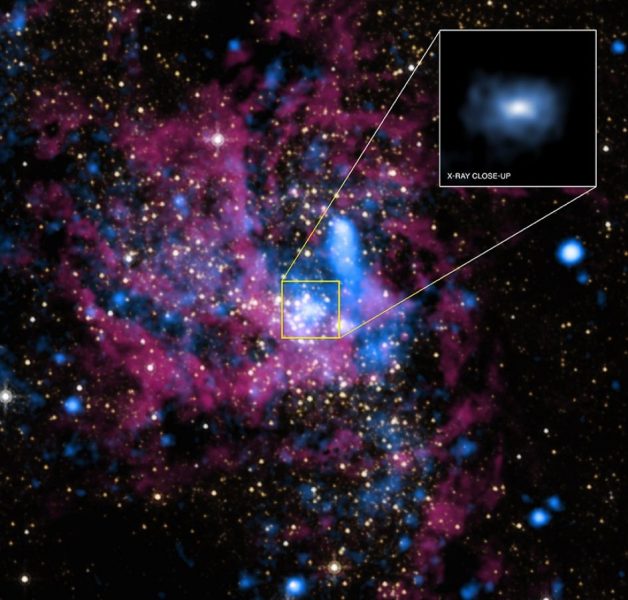
The supermassive black hole that lurks at the center of our galaxy, called Sgr A*, has a mass of about 4 million times that of our Sun. A black hole is a place in space where gravity is so strong that neither particles or light can escape from it. Surrounding Sgr A* is a dense cluster of stars. It is 26,000 light-years from the Solar System

On January 5, 2015, NASA reported observing an X-ray flare 400 times brighter than usual, a record-breaker, from Sagittarius A*. The unusual event may have been caused by the breaking apart of an asteroid falling into the black hole or by the entanglement of magnetic field lines within gas flowing into Sagittarius A*.

Sagittarius A* is the black hole at the center of the Milky Way galaxy. Credits: X-ray: NASA

FAMOUS BLACK HOLES

Cygnus X-1: a stellar-mass black hole and x-ray source that lies some 6,500 light-years away. It is a binary system that contains a blue supergiant variable star and the x-ray source thought to be the black hole.

Sagittarius A*: the supermassive black hole at the heart of the Milky Way Galaxy. It lies in the direction of the constellation Sagittarius. This black hole contains the mass of about 4 million suns.

M87: this elliptical galaxy has a 3.5 billion solar-mass black hole at its heart. The black hole is surrounded by a disk of super heated material and has a jet of super heated material streaming away from the black hole that extends across 5,000 light-years from the galaxy’s core.

Centaurus A: this galaxy, which lies in the direction of the constellation Centaurus, is a giant spiral galaxy with an incredibly active nucleus. It contains a 55 million solar-mass black hole at its heart, with two jets of material that stream away from the galaxy at about half the speed of light across a million light-years of space.

Amazing Facts :

1. Black holes will spaghettify you and everything else.

Black holes have this incredible ability to literally stretch you into a long spaghetti-like strand. Appropriately, this phenomenon is called ‘spaghettification’

2.Einstein didn’t discover black holes.

Einstein didn’t discover the existence of black holes – though his theory of relativity does predict their formation. Instead, Karl Schwarzschild was the first to use Einstein’s revolutionary equations and show that black holes could indeed form.

3. Black holes are the ultimate energy factories.

Black holes can generate energy more efficiently than our Sun.

4.Black holes slow down time

To understand why, think back on the twin experiment that is often used to explain how time and space work together in Einstein’s theory of general relativity: One twin stays on Earth while the other one zooms out into space at the speed of light, turns around, and returns home. The twin that travelled through space is significantly younger because the faster you move, the slower time passes for you. As you reach the event horizon, you are moving at such high speeds due to the strong gravitational force from the black hole, that time will slow down

5.Anything can become a black hole, in theory.

The only difference between a black hole and our Sun is that the centre of a black hole is made of extremely dense material, which gives the black hole a strong gravitational field. It’s that gravitational field that can trap everything, including light, which is why we can’t see black holes. You could theoretically turn anything into a black hole.

Space Race vs Space Rage : What is the Reality of World’s Space Exploration Program ???????

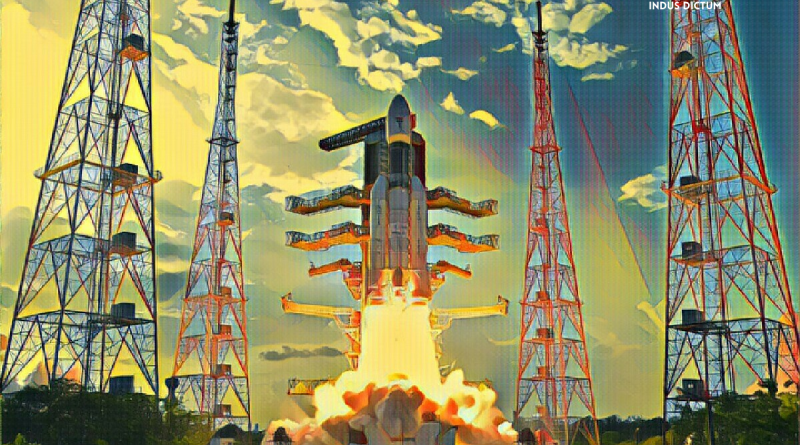
Unbeknownst to a world still reeling from the atomic catastrophe of Hiroshima, and under the crafty guise of a “peaceful nuclear explosion”, India detonated it’s first Weapon of Mass Destruction at the infamous Pokhran test range in 1974, carving for itself an irrevocable position in a community of toffee-nosed, nuclear-armed governments. The diplomatic furore that followed this tectonic shift would resound in the international nuclear coterie for decades to come, and incense totalitarian American administrations committed to crippling India’s self-defence programmes. Even the most imperious sanctions and underhanded espionage, however, could not muffle a nation of determined democracy, that tested it’s most triumphant space-technology yesterday – The GSLV Mk-III.

On June 5th, 2017, after more than 200 tests in 2 years, the Indian Space Research Organisation (ISRO) launched into orbit a three-tonne payload on a home-grown rocket of the class developed by only 5 others – Russia, China, Japan, the European Space Agency, and the United States. The Geosynchronous Satellite Launch Vehicle Mark-III (GSLV Mk-III) weighs 640 tonnes – as much as 200 fully grown elephants – and carries upto 10 tonnes to be delivered into orbit. It is a 140 foot-tall, three-stage, game-changing Launch Vehicle with a cryogenic engine, developed almost entirely using Indian components, and capable at long last of sending manned crews into space.

Credit : Third Party Reference

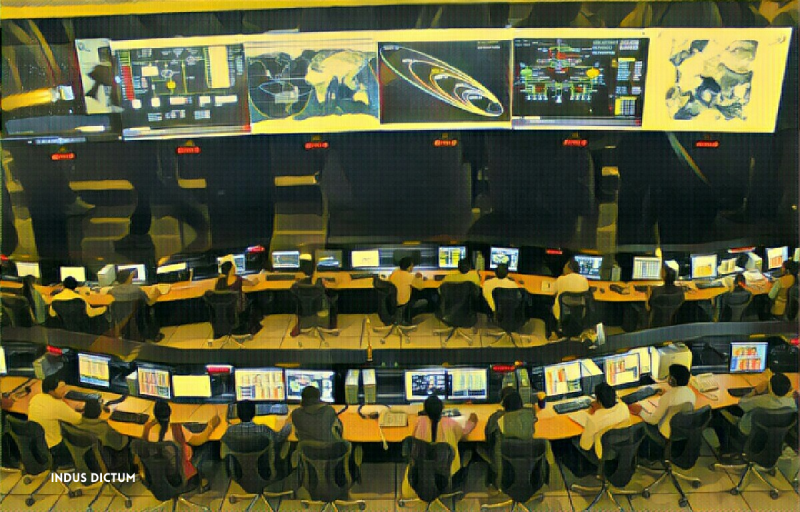
The Command Centre and Launchpad at Sriharikota, Andhra Pradesh, witnessed a turning point in the global space-race yesterday with the success of India’s GSLV Mk-III, placing the country at the heart of a space-industry valued at nearly $350 billion. Dependent on foreign agencies to launch satellites over 2,300 kilograms, India was confined to under 1 percent of this burgeoning market. Today, India has made “quantum leaps” in the words of P. V. Krishnan, Director of the ISRO Propulsion Complex, and is well on the way to launching Chandrayaan-II, slated for next year, and Aditya-I, a satellite mission designed to study the sun.

This jumbo-jet of the rocket-world, however, has a dramatic history riddled with international outrage and sabotage spanning nearly three decades. Beginning at the height of the Soviet era, India’s space and nuclear programmes have been the subject of gory eco-political power-plays between the two superpowers of our time – Russia and the United States. Yet, against all odds, and the express actions and sanctions of the US Government, Indian scientists designed by themselves a heavy-weight carrier of not only 10-tonne satellites, but also national pride and international glory.

Credit : Third Party Reference

After the successful Smiling Buddha nuclear tests at Pokhran, ISRO made enormous strides in space technology with the aid of it’s Russian counterparts, leading up to a $120 million contract in 1991 with the Soviet Space Agency Glavkosmos for seven cryogenic rocket engines, along with a complete transfer of technology. Cryogenic engines use super-cooled liquid fuels to produce massive amounts of thrust in order to lift heavy payloads into space, and the Russians were offering a secret engine, the RD-56 or KVD-1 – originally designed by the Isayev Design Bureau as part of the Soviet manned moon-landing programme of 1964 – with unparalleled thrust and capabilities that NASA could not match for years. Apprehensive of competition in the highly-lucrative commercial space industry, the US descended into a dirty game of geopolitical sanctions and espionage to disable this agreement.

Invoking the Missile Technology Control Regime (MTCR), the United States stalled the engine supply by sanctioning both ISRO and Glavkosmos. The American administration claimed that the issue was not India importing engine components from Russia, but that India was importing engines at all. The idea being that if India were forced to make those developments on their own instead of simply buying engines and the technology driving them, it would slow India’s rocket program and keep them from becoming a potential military threat.

The two-faced Americans, however, continued to import engines from Russia, simultaneously strong-arming India to sign the Non-Proliferation Treaty. India refused on the grounds that all signatories – except members of the UN Security Council – are required to unilaterally destroy their nuclear weapons, and could not afford to oblige given that the country is neighboured by two nuclear armed states, both of whom are hostile. Crippled but not killed, ISRO began the formidable task of developing indigenously a cryogenic rocket.

Credit : Third Party Reference

America views launch vehicles as weapons and components of ballistic missiles, as opposed to a commercial service. That is why it is acceptable when European nations, America, or other such countries purchase engines from each other, because they are allies and have advanced propulsion capabilities of their own, but a less developed, non-allied nation buying the same engines is not. This is, however, a remarkably flawed perspective.

In fact, there are no ballistic missiles in the world that use cryogenic engines. Because it takes several critical hours to fuel up a cryogenic rocket, such an engine could never be used in a ballistic missile. The fear mongering about using or selling these engines, then, is an outright farce and strawman fallacy.

Unblushing and wholly devoid of shame, the Machiavellian Americans turned around to sell banned WMD technologies to Pakistan, disobeying both US as well as international non-proliferation protocols. When US aid to Pakistan tapered off after the withdrawal of the Soviet Union from Afghanistan, the unscrupulous and impoverished Pakistani military responded in 1987 by selling it’s nuclear hardware and know-how for cash, pitching south Asia into three near-nuclear conflagrations, and enabling the nuclear weapons programmes of Iran, Libya and North Korea, which might never have got off the ground were it not for the duplicitous Americans. This hypocritical subterfuge is detailed in the account of CIA Agent and Pakistan-specialist Rich Barlow, reported by the Guardian almost a decade ago.

In defiance of ruthless international oppression and embargo, ISRO advanced swiftly and surely to counter America’s tyrannical throttling of the industry and reserve a seat at the space-table. Earlier this year, the triumphant ISRO launched a record 104 satellites on a single rocket. And now, having spurned the Non-Proliferation Treaty, this historic moment is an open-handed smack in the face of US monopoly.

India has overcome cumbrous obstacles and staunch opposition to design and launch it’s own cryogenic rocket. The GSLV Mk-III is a true testament to the ingenuity of an intrepid democracy. Resolute is the country we live in today.

Reference – divyanshspacetech.wordpress.com

Most Surprising Gravitational Waves : World Exclusive

The groundbreaking discovery of gravitational waves can open the whole new domain of cosmology. In 1915 Albert Einstein published a paper on the general theory of relativity, describes gravity as curves in the fabric of space-time by massive bodies rather than a force. The mathematical equations of the general theory of relativity predicted the existence of gravitational waves i.e formation of ripples due to distortion in the space-time fabric by the most violent astronomical phenomena such as the collision of two neutron stars, merging of two black holes, the explosion of a supernova etc.

Credit : Third Party Reference

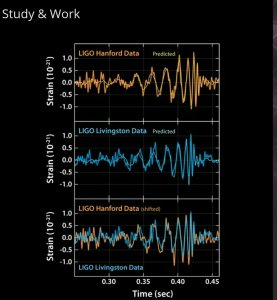
In 1974, two astronomers from Arecibo Radio Observatory in Puerto Rico observed binary pulsars orbiting each other and getting closer. Scientists were unable to examine it practically until 2015. In morning 3:50 am on September 14, 2015 LASER INTERFEROMETER GRAVITATIONAL WAVE OBSERVATORY LIGO identified waves whose characteristics were similar to gravitation waves i.e produced by accelerating the mass, travel with the speed of light, having weak interaction and cannot be absorbed. It was produced by the collision of two black holes 1.3 million light-years away.

After 100 years of Einstein’s prediction, the significance of gravitational waves was again alive unlocking deep secrets. Annihilation after big bang would have created ripples of gravitational waves carrying information.

Credit : Third Party Reference

LIGO LASER INTERFEROMETER GRAVITATIONAL WAVE OBSERVATORY:- central building shoots a laser beam and split it perpendicularly by beam splitter in L shaped tubes 4 km long and has mirrors on both the ends. The beam of light then strikes both the mirrors resulting in destructive interference due to the cancellation of their peak alignment but distortion in space-time leads to stretching and squeezing of arms until gravitational waves fully pass the earth. This sensitive equipment can detect a gravitational wave of 1/1000 width of a proton.

Credit : Third Party Reference

In 2017, three physics Rainer Weiss, Barry C.Barish and Kip throne were honoured with Nobel prize for their contribution in LIGO project. LIGO is located in Hanford and Livingston at the distance of 3,002 km to avoid abstraction of local noise.

Reference – https://divyanshspacetech.wordpress.com

SOLAR ECLIPSE, 21st June 2020

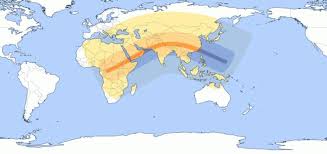
The Earth will witness an annular solar eclipse on Sunday, 21 June and the people in India will be able to catch this annual celestial event in action. It is not a regular one as it falls on the summer solstice, i.e. the longest day and the shortest night of the year.

What is solar eclipse?

A solar eclipse occurs when the moon passes between the sun and the earth. When this happens, the moon blocks the light of the sun from reaching the earth. The shadow of the moon is then cast on the earth.

There are three types of solar eclipses:

First, there is a total solar eclipse — which is only visible from a small area on earth. For the phenomenon to occur, the sun, moon and earth must be in a direct line.

Second is the partial solar eclipse when the sun, moon and earth are not exactly lined up.

The solar eclipse of 21 June, however, is an annular eclipse and is the third type. This happens when the moon is farthest from the earth, according to NASA blog. Since the moon is farther away from the earth, it seems smaller and does not block the entire view of the sun. The moon is in front of the sun and looks like a dark disk on top of an even larger disk which appears like a ring of fire.

The eclipse will be annular in some parts of the country, where sky gazers will get an opportunity to observe the “ring of fire” during the phenomenon. However, for most parts of the country, the eclipse will be partial.

On June 21, the annular eclipse will first start for the people of Congo in Africa and progress through South Sudan, Ethiopia, Yemen, Oman, Saudi Arabia, the Indian Ocean and Pakistan, before entering India over Rajasthan. It will then move on to Tibet, China, Taiwan, before ending at the middle of the Pacific Ocean.

This will be the last eclipse to be seen from India for the next 28 months as the next eclipse will be seen in India on October 25, 2022.

In India, the solar eclipse of June 21 with begin at 9:15 am and will end at 3:03 pm. The sun will be seen as a ‘Ring Of Fire’ to the skygazers which is a rare event. The partial eclipse will begin at 9:15 am and it will reach its peak at 12:10 pm. The full eclipse will end at 2:02 pm and the phenomenon will end at 3:04 pm.

Some interesting facts

  1. In a year, there can be as many as five solar eclipses.
  2. A total solar eclipse is a rare sight and happens only once in every 18 months. For a total solar eclipse, the sun has to be blocked at least 90 percent by the moon.
  3. The longest duration of a total solar eclipse is 7.5 minutes
  4. The total solar eclipse cannot be seen from the North and South Poles

Astro-Evaders Super Exclusive : A Phenomenal Journey to Universe >>>>>//

Credit : Third Party Reference

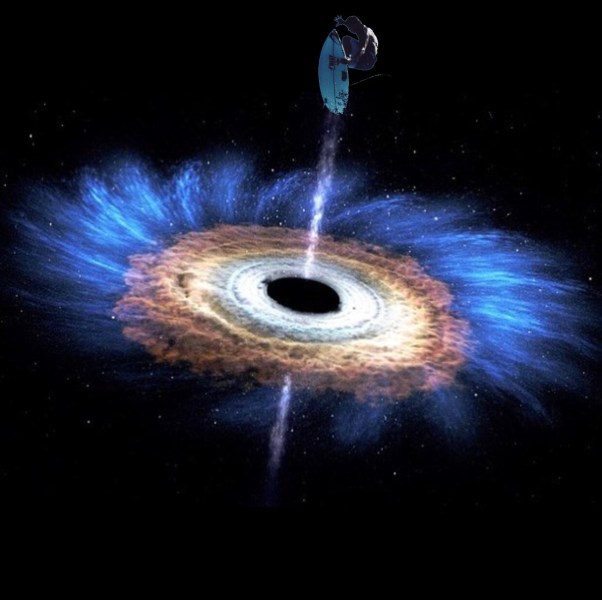
SHREDDING A SUPERNOVA.  

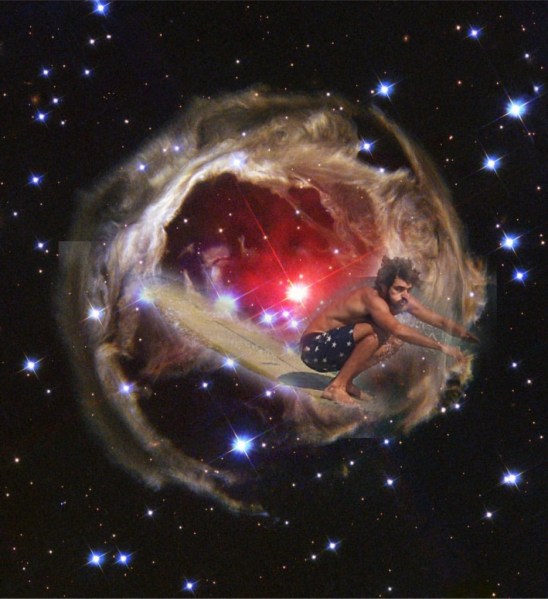
Surfing on a distant star in a galaxy far, far, away.  Walking out on the nose of your board for a cheater-five, riding a nebulous cloud through the infinite darkness of space. Getting spit out of a black hole, executing a grab-rail, carving cut-back.  Ripping a hole in the space-time continuum. Finessing the very fabric of the Universe.

Credit : Third Party Reference

WATER IS COSMIC.

All of the water on Earth came from space in exactly the form it is in now: H2O.  Water not only came from space it was created out in space.  Hundreds of millions (or even billions) of years before the solar system itself, the world’s Ocean came from an interstellar cloud somewhere in the Milky Way galaxy—formed one molecule at a time.  All of the water on Earth was delivered here when Earth was formed (within the first 100 million years or so) and what we have is what we’ve got.  There is no geological mechanism on Earth to create or destroy H20.  The Ocean (and all of Earth’s water) has literally been here forever.

Credit : Third Party Reference

The Ocean—all the water on Earth—began as the finest mist, tiny ice crystals drifting around inside an interstellar cloud. However, scientists don’t actually know how all that water gets from the interstellar cloud to our Ocean, nor do they know how much water is actually on Earth.

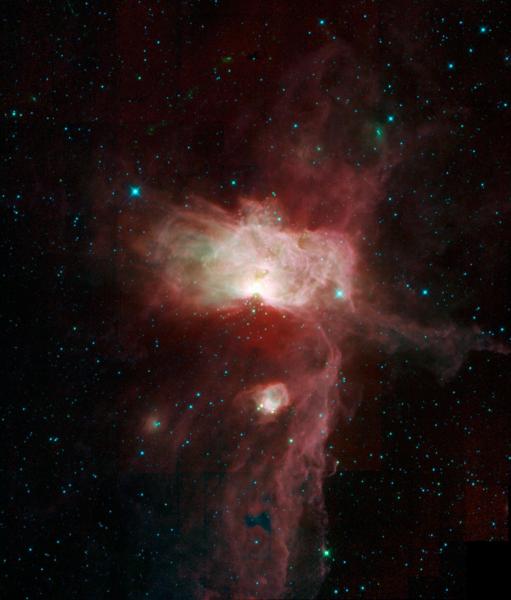
THE ORION MOLECULAR CLOUD.

DISTANCE FROM EARTH: A MERE 1400 LIGHT YEARS (1 LIGHT YEAR = 5.88 TRILLION MILES)

The OMC is an interstellar spring of water. This massive glowing cloud of hydrogen gives birth to thousands of stars at once.  As the stars coalesce and collapse in on themselves, they send shockwaves out through the clouds of gas which contain lots of loose hydrogen and oxygen.  When the shock waves slam the hydrogens and oxygens into each other, they often form water. There is enough water being formed in the OMC to fill all of Earth’s Oceans every 24 minutes.  Surf’s up!

Credit : Third Party Reference

The Orion Molecular Cloud is making 60 Earth Oceans every 24 hours but it is doing it across a span of space 420 times the size of our entire solar system—so even the dustiest (most dense, with the most particles) parts of the cloud are emptier than any vacuum that people can create on Earth.

VENUS

DISTANCE FROM EARTH: 162 MILLION MILES

Venus may have been our solar system’s first Ocean world —a supercritical carbon dioxide Ocean of a bubbly sort of fluid that flowed a bit more like a liquid, with bubbles that behaved more like a gas popping up where the temperature and pressure varied a bit. Here on Earth, International Surfing Day is celebrated in the Summer on the longest day of the year.  Venus boasts an endless summer—with an average surface temperature of 864° Fahrenheit (462° C)—and a single day on Venus is equal to 243 Earth days.  That’s a lot of time to surf each day!

 Venus is so hot, though, that the atmospheric pressure (92 bar or 1334 pounds per square inch pressing down on you) would be the equivalent of being 3000 feet deep in the Ocean—you would be crushed before you ever had a chance to catch a bubbling hot wave.

Credit : Third Party Reference

It’s this extreme Venusian pressure and heat that initially may have created a supercritical carbon dioxide Ocean.  Scientists are still in debate on what type of liquid—water or lava—etched Venus’ surface features which look very much like canyons, lake beds, and broad plains that may have once been sea floors. Venus no longer has liquid on its surface, the planet is dry and is not currently hot enough to melt its carbons (which make up 96% of its atmosphere).  While the surface rotates slowly, the winds blow at hurricane force, sending clouds around the planet every five days.

 Venus lacks a strong global magnetic field, which on Earth helps protect our atmosphere.  If there ever was an Ocean of water here, then Billions of years ago, a runaway greenhouse effect began raising temperatures enough (over 1340° F or 727° C) on Venus to boil off all of the water in the Ocean ( a small amount of water vapor still exist on Venus, something like 20 parts-per-million), which escaped into space due to the unrelenting solar wind.

Credit : Third Party Reference

“Should’ve been here billions of years ago, the surf was firing—before the wind got on it.” -Surfer on Venus

MARS

DISTANCE FROM EARTH: 34 MILLION MILES

Mars was once much more Earth-like, with a thick atmosphere, abundant water, and an Ocean covering nearly a third of the Red Planet.  Imagine surfing huge, slow-motion barrels. Mars has only 10% the mass of Earth and its gravitational field is only one-third of Earth’s so less gravity would produce larger yet slower moving waves compared to Ocean swells of Earth. Aerial surfing maneuvers would be extra lofty.  

Credit : Third Party Reference

However, Mars lost its protective atmosphere billions of years ago and has since lost approximately 87% of its water. Most of its remaining water is frozen in ice caps or trapped beneath the soil, but a small amount of muddy, brackish water can be seen moving down the side of Martian hills in the local summer.

Reference – https://divyanshspacetech.wordpress.com

Next Generation Space Communication Powered by AI : Super Exclusive

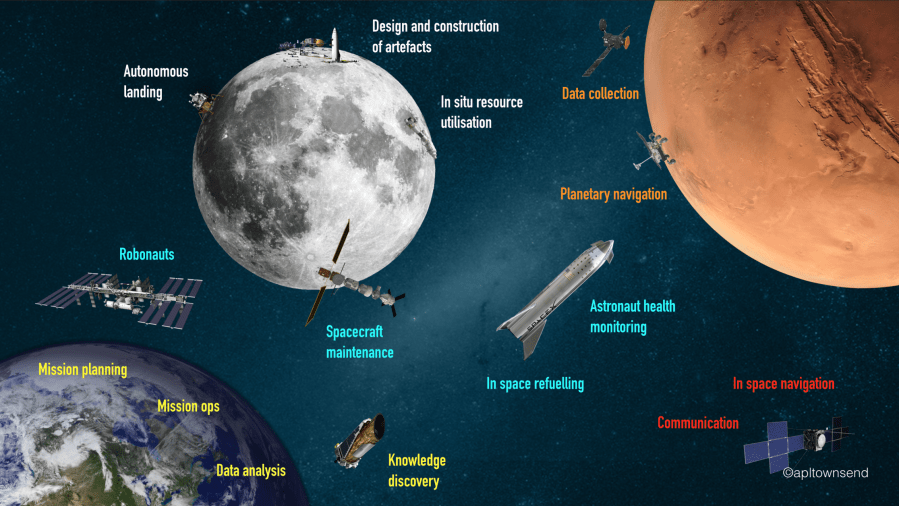
Space may be the final frontier, but it continues to pose myriad technical challenges as commercial and government-driven space investment continues. One of those challenges is developing more effective space-based communication systems for the increasing number of satellites and spacecrafts that need to interact with one another in the void. A team of researchers has developed an algorithm to enable cognitive radio functions on satellite communications systems to adapt themselves autonomously.

Current space communication systems deploy radio-resource selection algorithms, but they are rudimentary and work with a pre-programmed look-up table. Furthermore, they have little flexibility regarding the various parameters for the performance goals the system needs to achieve. Researchers from Worcester Polytechnic Institute, Pennsylvania State University and NASA’s John H. Glenn Research Center, have designed a new algorithm that allows autonomous parameter selection for radio resource allocated using a novel artificial intelligence architecture.

Credit : Third Party Reference

Autonomous space communication is critical because space is a harsh environment. A number of things can go wrong in space, which why space communications systems should be able to operate without human intervention. The team’s algorithms could serve as the core of a new cognitive engine (CE) used as a baseline for developing communication systems for the next generation of spacecraft and satellites.

The team developed a CE design that autonomously selects multiple radio transmitter settings while attempting to achieve multiple conflicting goals in a dynamically changing communications channel.  It accomplishes this by leveraging reinforcement learning (RL) and “virtual exploration” structures studied in the author’s previous research. The CE integrates these with a novel artificial neural network ensemble design and new algorithms to implement the exploitation aspect of multi-objective reinforcement learning (MORL).

Credit : Third Party Reference

Through RL, the artificial neural network can be trained to adapt to the dynamic conditions of space through multiple trials and experiments, as the algorithm is set up to learn in a manner similar to the human brain by weighing inputs to achieve a goal. In the researchers’ CE, the system can learn how to adapt to achieve multiple goals for satellite communication.

The proof-of-concept design was created through computational simulations as well as ground- and spaced-based experiments. It successfully addresses the limitations of current technology by enabling:

  • Table-free state-action mapping with fixed memory size;
  • Operation over dynamically changing channels;
  • Decoupling of states from actions &
  • Usage of continuous action and state spaces.

As space exploration continues to develop with trips to the moon and Mars, cognitive radio and communication systems will be essential for space flight. There will be a need for space “internetworking” to manage the interaction of user spacecrafts, relay spacecrafts and ground stations. This new CE could be a needed progression for space communication to be more efficient and reliable for any situation encountered during space travel.

Reference- https://divyanshspacetech.wordpress.com

Discovery of God Particle : Super Exclusive >>>>>>>

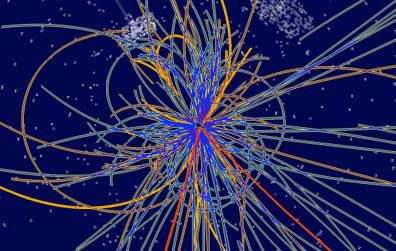
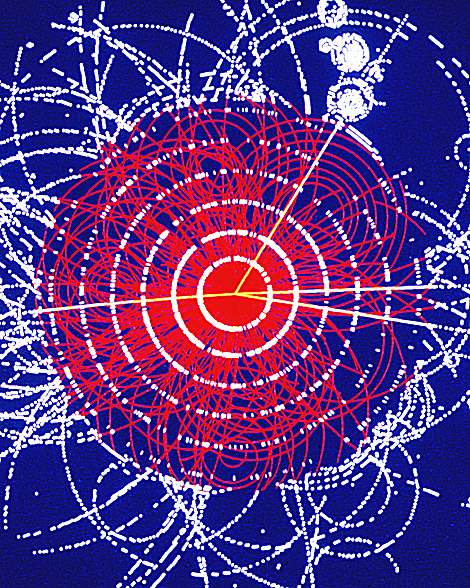
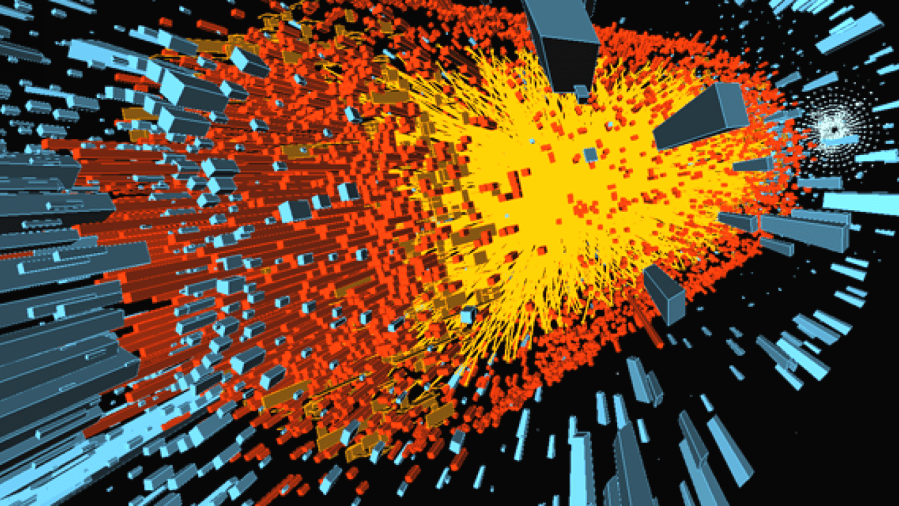
The two largest experiments at the Large Hadron Collider (LHC), ATLAS and CMS, have observed a previously undetected way that the Higgs boson can decay — into an elementary particle called the bottom quark, and its antiparticle.

The same experiments, based at CERN, the European particle-physics laboratory outside Geneva, Switzerland, first discovered the Higgs in 2012. The boson, which is a key part of the mechanism that gives other particles their masses, put in place the final piece of the standard model of particle physics.

LHC researchers have accumulated evidence of the particle decaying into a variety of products, following theoretical predictions, including into two photons and an electron–antielectron pair.

Credit: Third Party Reference

In June, researchers revealed that they had also seen the Higgs interact with the top quarks, the most massive known elementary particle. The bottom-quark decay, announced on 28 August is expected by theory but the signal had been hiding in the data, because the interaction is difficult to single out from the many other processes that can also produce those particles.

Geneva, 28 August. Six years after its discovery, the Higgs boson has at last been observed decaying to fundamental particles known as bottom quarks. The finding, presented today at CERN by the ATLAS and CMS collaborations at the Large Hadron Collider (LHC), is consistent with the hypothesis that the all-pervading quantum field behind the Higgs boson also gives mass to the bottom quark. Both teams have submitted their results for publication today.

The Standard model of particle physics predicts that about 60% of the time a Higgs boson will decay to a pair of bottom quarks, the second-heaviest of the six flavours of quarks. Testing this prediction is crucial because the result would either lend support to the Standard Model – which is built upon the idea that the Higgs field endows quarks and other fundamental particles with mass – or rock its foundations and point to new physics.

Credit: Third Party Reference

Spotting this common Higgs-boson decay channel is anything but easy, as the six-year period since the discovery of the boson has shown. The reason for the difficulty is that there are many other ways of producing bottom quarks in proton–proton collisions. This makes it hard to isolate the Higgs-boson decay signal from the background “noise” associated with such processes. By contrast, the less-common Higgs-boson decay channels that were observed at the time of discovery of the particle, such as the decay to a pair of photons, are much easier to extract from the background.

To extract the signal, the ATLAS and CMS collaborations each combined data from the first and second runs of the LHC, which involved collisions at energies of 7, 8 and 13 TeV. They then applied complex analysis methods to the data. The upshot, for both ATLAS and CMS, was the detection of the decay of the Higgs boson to a pair of bottom quarks with a significance that exceeds 5 standard deviations. Furthermore, both teams measured a rate for the decay that is consistent with the Standard Model prediction, within the current precision of the measurement.

This observation is a milestone in the exploration of the Higgs boson. It shows that the ATLAS and CMS experiments have achieved deep understanding of their data and a control of backgrounds that surpasses expectations. ATLAS has now observed all couplings of the Higgs boson to 

“Since the first single-experiment observation of the Higgs boson decay to tau-leptons one year ago, CMS, along with our colleagues in ATLAS, has observed the coupling of the Higgs boson to the heaviest fermions: the tau, the top quark, and now the bottom quark. The superb LHC performance and modern machine-learning techniques allowed us to achieve this result earlier than expected,” said Joel Butler, spokesperson of the CMS collaboration.

Credit: Third Party Reference

With more data, the collaborations will improve the precision of these and other measurements and probe the decay of the Higgs boson into a pair of much-less-massive fermions called muons, always watching for deviations in the data that could point to physics beyond the Standard Model.

“The experiments continue to home in on the Higgs particle, which is often considered a portal to new physics. These beautiful and early achievements also underscore our plans for upgrading the LHC to substantially increase the statistics. The analysis methods have now been shown

Reference- https://divyanshspacetech.wordpress.com

ISRO-NASA Joint Mission “NISAR” : Super Exclusive

NASA (National Aeronautics and Space Administration) and ISRO (Indian Space Research Organisation) are one of the most admired space agencies know in today’s world (not to forget about ROSCOSMOS and ESA). While NASA is known throughout the world for its diverse missions (Voyagers, New Horizons, Cassini, Juno and many more to count on). In the meantime, ISRO is gearing up by creating the most cost-effective and marvelous launches known till date. But what if these two space agencies were to come together and work on a single project..? Well, that’s what NISAR is all about!

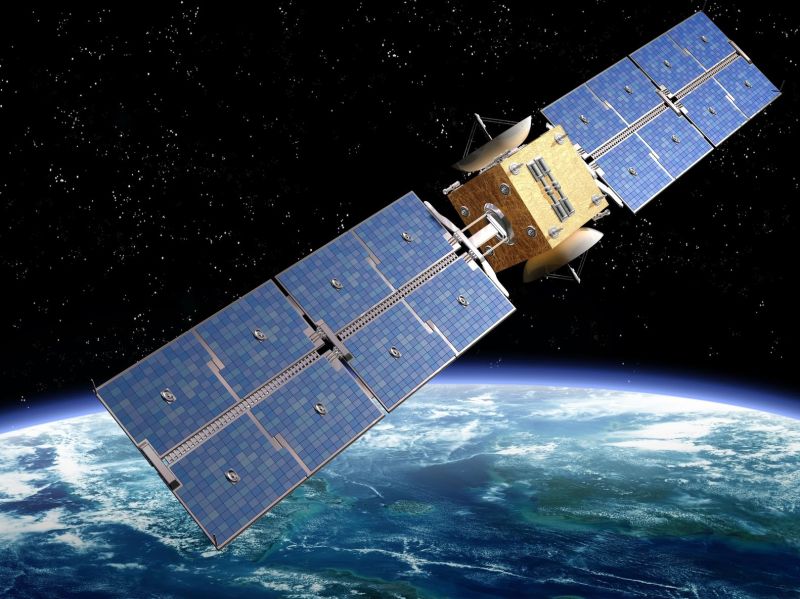
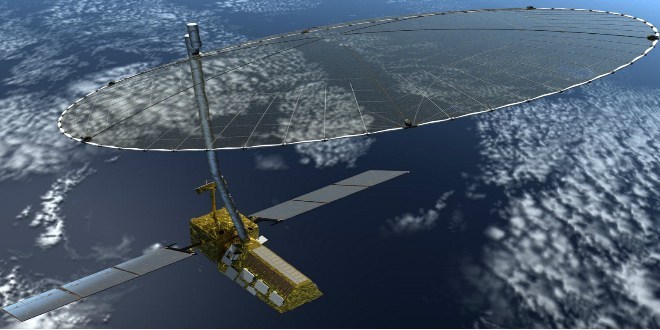
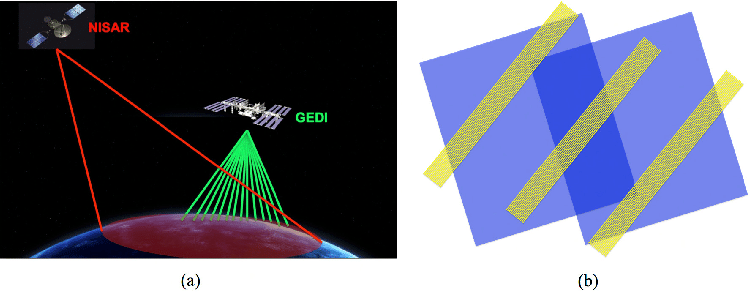
NISAR (NASA-ISRO Synthetic Aperture Radar) mission is a joint project between NASA and ISRO to co-develop and launch a dual-frequency synthetic aperture radar (SAR) satellite with the hopes of understanding our home planet in a better perspective than ever before.

Credit: Third Party Reference

KEY FACTS ABOUT NISAR:

  1. NISAR is designed to map out earth’s entire land and ice masses 4 to 6 times a month and possibly provide an explanation for planet’s most complex geological problems, including natural disasters like earthquakes, volcanoes, tsunamis and even the mysteries to their origin.

2. NISAR will use Advance Radar Imaging to provide mankind with the finest and crispier view of the earth than ever achieved, with a staggering resolution of 5-10 m/pixel(For example, Google Earth has a peak resolution of 15m/pixel!). Moreover,all the data from NISAR would be freely available within 1-2 days of any natural disaster, if any.

3. The Project has an allocated budget of over $1 Billion, making it the most expensive earth-imaging satellite till date. ISRO’s share of the project cost is about US$110 million, and NASA’s share is about US$808 million.

4. NISAR is planned to be launched by 2021 aboard a GSLV MKII (Geosynchronous Satellite Launch Vehicle Mark II) from Satish Dhawan Space center located in India. The mission will have a payload mass of 2800 kg and will be suspended in a Sun-Synchronous orbit. It has a life expectancy of about 3 years.

5. The satellite consists of a L Band and a S-Band Polarimetric Synthetic Aperture Radar (SAR), operating at the frequencies of 1.25 GHz and 3.2 GHz respectively. While NASA will be providing the L-band SAR, a payload data subsystem, a solid state recorder, and GPS receiver, ISRO will provide the Launch Vehicle and S-Band SAR.

Credit : Third Party Reference

Planned Launch Date: 2022

The NASA-ISRO SAR (NISAR) Mission will measure Earth’s changing ecosystems, dynamic surfaces, and ice masses providing information about biomass, natural hazards, sea level rise, and groundwater, and will support a host of other applications.

NISAR will observe Earth’s land and ice-covered surfaces globally with 12-day regularity on ascending and descending passes, sampling Earth on average every 6 days for a baseline 3-year mission.

Reference- divyanshspacetech.wordpress.com

First American Woman to Walk in Space Reaches Deepest Spot in the Ocean

The geologist and former astronaut Kathy Sullivan, 68, is now also the first woman to reach the deepest spot on earth – challenger deep which is about about seven miles below the ocean’s surface.

She was the first American woman to walk in space and now has set another record to  become the first woman and the 8th person in the history  to reach the deepest known spot in the ocean on Sunday 7th June.

Kathryn Dwyer Sullivan (born October 3, 1951) is an American geologist and a former NASA astronaut. A crew member on three Space Shuttle missions, she was the first American woman to walk in space on October 11, 1984. She was Under Secretary of Commerce for Oceans and Atmosphere and Administrator of the National Oceanic and Atmospheric Administration 

Dr.sullivan always had a longing fascination for oceans and has participated in several oceanographic expeditions that studied the floors of the Atlantic and Pacific oceans.

In 1988, Sullivan joined the U.S. Naval Reserve as an oceanography officer, retiring with the rank of captain in 2006. Sullivan joined NASA in 1978 and was part of the first astronaut groups to include women.

Sullivan served as Payload Commander on STS-45, the first Spacelab mission dedicated to NASA’s Mission to Planet Earth. During this nine-day mission the crew through constant experiments obtained a vast array of detailed measurements of atmospheric chemical and physical properties, which will contribute significantly to improving our understanding of our climate and atmosphere.

After leaving NASA, Sullivan served as chief scientist of the National Oceanic and Atmospheric Administration (NOAA). Sullivan became Acting Under Secretary of Commerce for Oceans and Atmosphere and Acting NOAA Administrator on February 28, 2013, following the resignation of Jane Lubchenco. President Obama nominated Sullivan to serve as the Under Secretary of Commerce for Oceans and Atmosphere and NOAA Administrator on August 1, 2013 and she was confirmed by the Senate on March 6, 2014.

The challenges faced while getting to the challenger deep

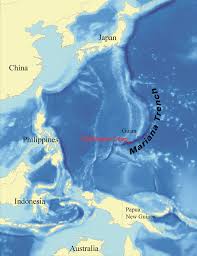
Challenger Deep — the deepest point in the Mariana Trench, which is itself the deepest part of the ocean — is therefore the deepest point on Earth, more than 36,000 feet below the ocean’s surface. For scale, if Mount Everest, the highest point on Earth, were dropped into Challenger Deep, its summit would still not breach the surface

Dr. Sullivan and Victor L. Vescovo, an explorer funding the mission, spent about an hour and a half at their destination, nearly seven miles down in a muddy depression in the Mariana Trench, which is about 200 miles southwest of Guam.

It took four hours to descend to the crushing depth of 35,810 feet (10,941 metres). They spent 1 1/2 hours on the ocean floor, then another four hours ascending. At those depths, the water is perpetually dark and barely above freezing. The pressure is a skull-crushing 8 tons per square inch – about 1,000 times the pressure at sea level.

After capturing images from the Limiting Factor, a specially designed deep-sea research submersible, they began the roughly four-hour ascent. Upon returning to their ship, the pair called a group of astronauts aboard the International Space Station, around 254 miles above earth.

As a hybrid oceanographer and astronaut this was an extraordinary day, a once in a lifetime day, seeing the moonscape of the Challenger Deep and then comparing notes with my colleagues on the ISS about our remarkable reusable inner-space outer-spacecraft

Dr. Sullivan said in a statement released by EYOS Expeditions on Monday.

What interests scientists in deep ocean areas ?

“Ocean exploration, however, is not randomly wandering in hopes of finding something new. It is disciplined and organized and includes rigorous observations and documentation of biological, chemical, physical, geological, and archaeological aspects of the ocean,” the NOAA website says.

Further, finding out more about the deep ocean areas can potentially reveal new sources for medical drugs, food, energy resources and other products. Significantly, information from the deep oceans can also help to predict earthquakes and tsunamis, and help us understand how we are affecting and getting affected by the Earth’s environment.