Bharat: The Mother of Democracy'

 Ministry of Culture, Government of India curated an exhibition on ‘Bharat: The Mother of Democracy’ at Hall No. 14 (foyer area), ITPO for G20 Summit during 8-10 September 2023. This curated experience displayed the democratic traditions of our country.

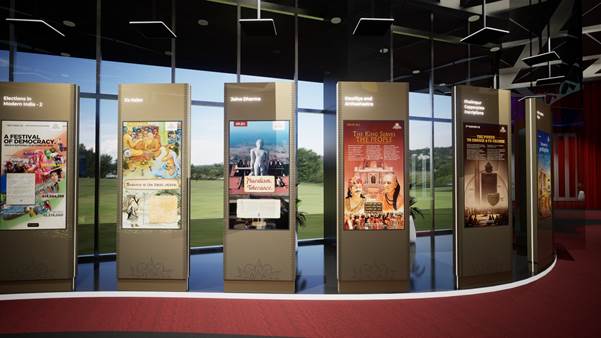
(The history of India’s democratic character was displayed in different languages through 26 interactive panels.)


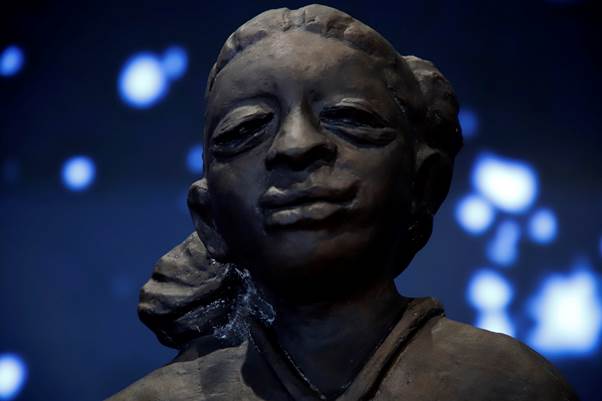
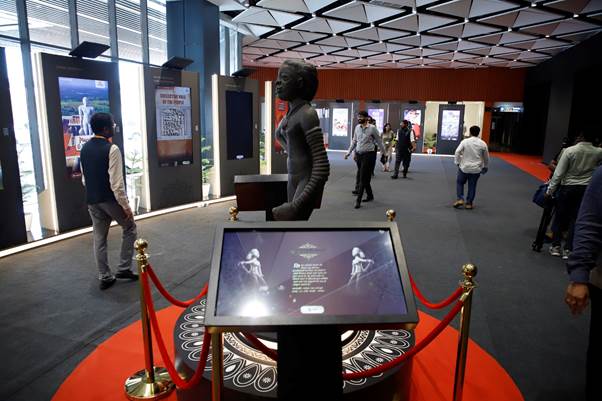
(The sculpture of the girl from the Sindhu-Saraswati Civilization in the centre)


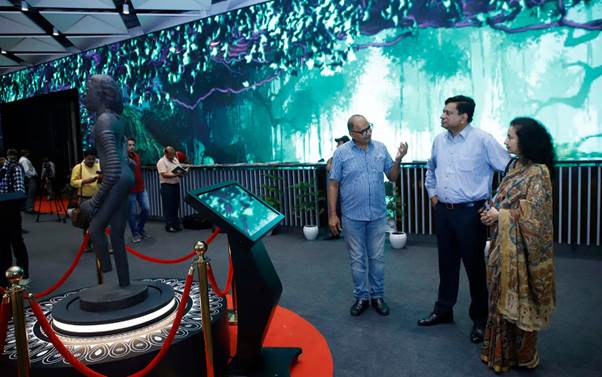
(A huge video screen at the back of the reception showcasing the visuals of India’s rich cultural traditions)


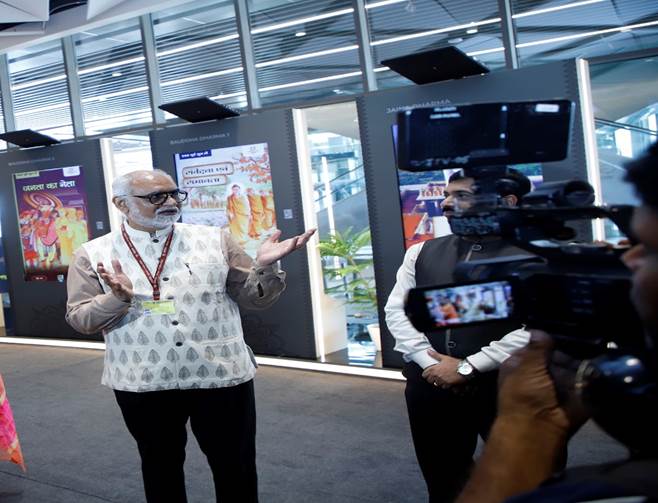
(Shri Sachchidanand Joshi, Member Secretary, IGNCA briefing the media about the ‘Bharat: The Mother of Democracy’ Exhibition)


She stands confident, self-assured and looking at the world eye-to-eye. Independent. Liberated. On her body, she wears jewellery much like the adornments that are worn every day by women in western India.The actual height of the object is 10.5 cm but the replica was created 5 ft. height and 120 kg weight in bronze.

 The history of democracy in India can be revisited through the 26 interactive panels on one side of the pathways where visitors can read content and listen to audio in 16 different languages. The panels include Local Self Governance, Elections in modern India, Krishna Deva Raya, Jain Dharma among others. The exhibition can be accessed digitally on the G20 application.

Democracy is an age-old concept in India. As per the Indian ethos, democracy comprises the values of freedom, acceptability, equality, and inclusivity in a society and allow its common citizens to lead a quality and dignified life. The Rigveda and the Atharvaveda, the earliest available sacred texts refer to participatory institutions like the Sabha, Samiti, and Sansad, the last term being still in currency denoting our parliament. The Ramayana and the Mahabharata, the great epics of this land, also talk about involving people in decision-making. There are also found in Indian textual instances that the authority to govern is earned through merit or common consensus and is not hereditary. There has been constant discourse on the legitimacy of the voter in various democratic institutions such as the Parishad and Samiti. The Indian democracy is truly a festive proclamation of veracity, cooperation, collaboration, peace, sympathy and collective strength of the people.


**

How we create equality

While surfing through linkdein I came across a post where a doctor sir Ganeshan, he was providing free medical deliveries to girl. Many people of community have distinct view of it as if it is a right way and right thing.

In my view, this is how we create equality,
there are two ways
first, we share everything we have equally and eventually with time everything gets equalize,
another way is we try balancing both sides like if people are not happy after having girl child we will free them from fee charge(its temporary solution of a big part of solution) and as societies are progressing they will learn and improve with time.
Example of first one is colonized countries they doesn’t got support from developed countries and they got bullied many time but we are slowly progressing toward equality,
Example of second one is solutions for girl equality by indian govt, it involves temporary(situation based) solution like dowry punishment to educating and reservation, the benefits of having second way is it’s fast, and it has lots of temporary solution to big problems like girl foeticide case.

You can see post here

https://www.linkedin.com/posts/ashwini-mahesh_activity-6846473782144630785-ZcoR

Connect me on LinkedIn here

https://www.linkedin.com/in/shivam-soni-a99a4a186

One nation, One election

                                                                       (Photo: Think India)

“One nation, one election”, might sound good as well as appealing, but it will have a number of anti-democratic consequences. It’s true saying that simultaneous elections for Lok Sabha and State Assembly could save time, energy and money of our country, but on the other side it can prove to be harmful for our country as well as democracy.

Apart from logical considerations, which cannot be a serious reason for a major change to the basic structure of the Indian polity, the most seductive argument in favor of simultaneous elections is the allure of Modi’s phrase, “One nation, one election.” This matches the “one nation, one tax” rationale for the goods and services tax (GST), which, of course, came into force via its own constitutional amendment on 1 July, 2017.

While one can debate the economic costs and benefits of GST, the analogy with elections is logically flawed. Indeed, the concept of simultaneous elections fundamentally runs against the grin of our Westminster-style federal political union. “One nation, one election” would make sense if India were a unitary state. But we are a union of states, which is philosophically and politically an essentially different conception of the Indian nation-state. With this, let us discuss the disadvantages of holding simultaneous elections in India:

  • Rule by the majority is the cardinal principle of Indian democracy. The concept of simultaneous elections goes against this principle since if elections are held simultaneously then the Lok Sabha and the state legislative assemblies cannot be dissolved before completing their full period of 5 years even if the ruling party is reduced to a minority hence it will go against the federal principles.
  •  It will disown today’s reality of fragmented quality at the state level where coalitions are the order of the day. So, simultaneous elections try to bring in the presidential type of governance where the state assembly is no longer can decide their own path and have to be in existence for 5 years with a minority party in power.
  • Even if elections were to take place simultaneously, parties contesting in only one state would anyway be similarly burdened. So, it probably takes care of only national parties. And the logistic requirement of movement of the requisite security forces. This constant would remain even if simultaneous elections were held.

So, it can be said that holding simultaneous elections is certainly desirable but not feasible. The question which arises is, “Why should the states suffer from the electoral decisions taken at the centre?” It has been said that simultaneous elections would curtail government expenditure but the election commission has updated that for this it would require the procurement of 24 lakh EVMs and an equal number of VVPAT units which is double the number required to hold only parliamentary polls. So, the first objective is not met.

Therefore, notwithstanding the benefits of simultaneous elections highlighted above, the cost to the Indian democracy in terms of playing havoc with the cardinal principle of rule by the majority will be far more than any savings to be realized to the public exchequer. Rather other alternatives should be explored to reduce election-related expenses like state funding of elections, decriminalization of politics, bringing in transparency in political funding by linking Aadhaar card to the election Identity card which has still not been done, etc.


LOCAL SELF-GOVERNMENT

                                                               (Photo: ClearIAS)

According to D. Lockard, local government may be loosely defined as a public organization, authorized to decide and administer a limited range of public policies within relatively small territory which is a subdivision of a regional or national government.

A nation develops from its roots and for a nation to develop we need a strong base and in a country like India, the base is the local self-government like municipalities and panchayats, etc. These are the grassroots of a democracy in our country. It gives a good amount of exposure to the people who participate in the governance and running of these institutions, in both political and social aspects, making our democracy more participative as well as substantive. In rural areas, the self-governing bodies are the Panchayats and in urban it is the municipal corporations, etc. Local self-government consists of rural local self-government and urban area local self-government.

In India, villages are always considered as strength of this country. It is said that the soul of India lives in villages and a majority of 60% of the total population currently lives in rural areas. The exponents of the local self-government institutions hold the view that such local self-governments are the basis of democracy and the best way to develop political consciousness among the people. Through the local self-government, the regional and local interests convert into national interest. The Rural Local self-governments are the result of most landmark year 1992, when the 73rd amendment was incorporated in the constitution. Necessary related provisions were added in 1992 by the way of the 74th amendment act, 1992. It bifurcated the urban local self-government system.

Gandhi Ji also emphasized local self-government. To him, development meant a fuller participation of people in the achievement of essential goals. Village is the primary unit of government and from the village upwards, units of government with residuary powers, are to be established. And at each level, complete democracy and freedom are to be guaranteed.

Thus, the local self-government holds a vital role when it comes to the strengthening of democracy. It encourages local, political, and social leadership, thus making people more participative. It makes democracy substantive with its very own existence. These have to shoulder manifold and complex responsibilities. Hence, they are the grassroots of our democracy.

CO-OPERATIVE AND COMPETITIVE FEDERALISM


                                                              (Photo: YouTube)

India opted for quasi-federal structure after Independence. After Independence from 1947 to 1967, India experienced the centralized federalism. From 1967 to 1990, India witnessed confrontational federalism due to the emergence of other party governments at the state level. Since 1990, Co-operative federalism has been developed. The present NDA government has been focusing on the new concept of competitive federalism along with co-operative federalism for higher growth of the country.

In competitive federalism, states would compete with each other over a broad-range issues to provide citizens various services in a hassle-free manner. The policy of one-size-fit-all is replaced with different policies of various states based on their own priorities within the state. This spirit of competition has led to lack of inter-state mutual assistance. The NITI Aayog was formed to empower and strengthen the state governments. It also appointed regional councils to create cooperation among two or more states facing a common set of problems or amicably settle disputes.

While the competition between states, reflected in the World Bank’s Ease of Doing Business index, has generated a lot of enthusiasm, this must be a continuing exercise. There are only few well-off states like Maharashtra, Gujarat, and Tamil Nadu which are competing. The proposed GST law may help some of the less productive states to raise the revenue. But the opposition of few well-off states with respect to revenue loss in implementation of GST system points that there is lack of will in participating in the process of competitive federalism.

We’ve seen various inter-state water disputes such as Krishna water disputes involving Maharashtra, Karnataka and Andhra Pradesh, Narmada water disputes involving Rajasthan, Gujarat, M.P, and Maharashtra, Cauvery water disputes involving Karnataka, Kerala, Tamil Nadu, Puducherry, and various others. For this, under Article 263, an inter-state council was established. The Sarkaria Commission on center-state relations (1983-87) made a strong case for the establishment of a permanent inter-state council. Article 301 to 307 in Part 13 deals with the trade, commerce and intercourse within the territory of India, breaking all the border barrier between the states. Zonal councils have also been established in 1956 to narrow the gap between the states. Cases such as Cauvery water dispute and Sutlej Yamuna link canal issue have seen non-mutual assistance between the states to a wider extent.

Thus, it can be said that co-operative and competitive federalism are two sides of the same coin. This spirit of competition has led to the lack of mutual assistance between and among the states. It is competition with co-operation that will drive the real change.


Afghanistan- A war-torn nation

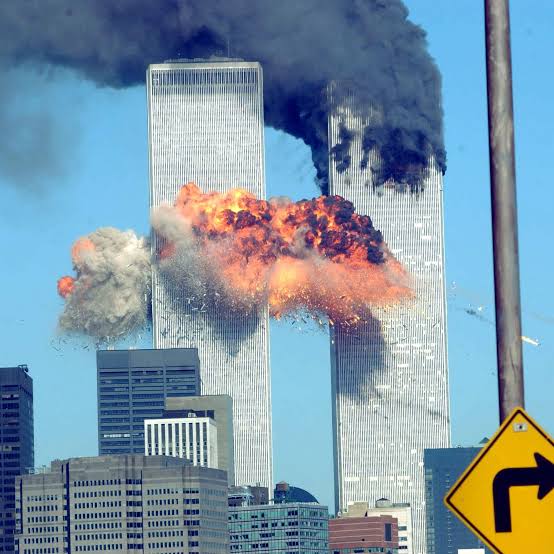
With Al-Qaeda militants carrying out coordinated attacks on American soil,also known as 9/11 Attacks and Taliban government refusing to hand over the main culprit behind these attacks ‘Osama Bin Laden’. A war was declared by US and it’s allies against terrorism and Afghanistan was invaded in 2001.

US tried it’s best to avoid the mistakes done by British & Russia (then USSR),it gained some success by driving out the Taliban government and killing the Terrorists. This whole operation have costed US more than $800 billions and more than 2300 soldiers lives. While on the other side, Afghan civilians had been caught in between this war and have suffered at the hands of both US & Terrorists (Al-Qaeda & Taliban) .

There is a popular saying about Afghanistan – ‘The Graveyard Of Empires’ for those who have tried to conquer it. Afghanistan is tough to rule, not only because of its terrain but also of the hostilities between the different tribes present there.

US Navy seals carried out a mission code-named ‘Operation Neptune Spear’ and killed Laden on 2nd May 2011 in Pakistan. US thought that by killing Laden they had achieved their goal but they were mistaken.

India aided in the overthrow of the Taliban-led government and has been the largest regional provider of humanitarian and reconstruction aid in the country. India have provided over $3 billion in assistance and every year it continues to do so.

Challenges ahead for Afghanistan and it’s neighbours

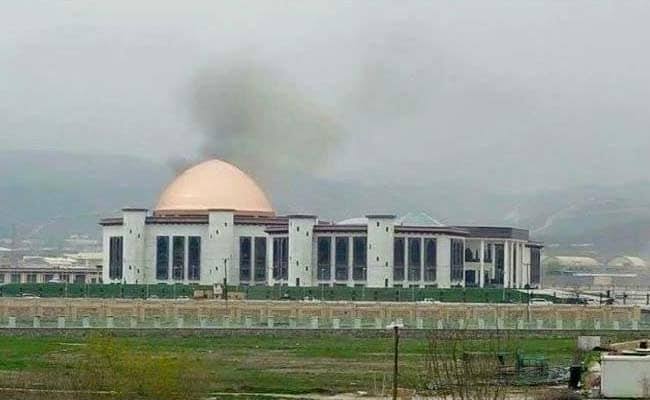
Taliban is slowly gaining pace and have formed alliance with other terror outfits to overthrow the present government. Civil war is not far, after US withdrawal. Fight is going on between Afghan security forces supported by civilians against the Taliban.

There’s little hope that Taliban will agree on the terms mentioned in peace talks . War-torn Afghanistan is now at the same stage before US invasion and onus now is on China,india,pakistan,Iran to maintain peace and provide stability in the Afghanistan.

Domestic Violence; eating up someone’s pride, self respect and the willingness to live

Article by – Shishir Tripathi

Intern at Hariyali Foundation
In collaboration with
Educational News

In a country with such a huge population and so much of diversity in culture and nature, it is so common that there would surely be diversity among various types of violence too. Domestic violence includes any type of violence or torture basically against women in any form whether it is physical, emotional, sexual, verbal or economic abuse or torture.

India is poorly ranked in a total of 167 countries all across the world according to the data for cases of domestic violence. Domestic violence has always been a shame for the Indian society. A woman contributes a lot in the nurturing of a whole family and sacrifices her dreams (in most of the cases) for taking care of her husband and his parents and the children too.

A woman is the only person in the family who is always ready to sacrifice her health, her dreams and her happiness just for making the family happy. A woman is the one who turns a house into a home. A home built with the bricks of a woman’s dreams and her crushed desires. Everyone wants to go out, see the world and meet the people, enjoy their selves, but for making this happen somebody is always there at home for taking care of food and for arranging everything, it is always and always a Woman.

In spite of making all these sacrifices, it is the woman only who has to become the victim of the anger of her husband, her in-laws and her children too. Basically in India, it is generally assumed that the woman, the bride is a servant (when she’s jobless) and an ATM machine without any password (when she’s working). A woman is the one who is always expected to make sacrifices and take care of her family and home. Why? Because it is her work, this is the stuff why she was born?! If somebody gets angry, then she is the only river to pour down all the anger.

Moving ahead, everyone knows that from the past times and still at present most of the women at their place are going and suffering through a lot. According to a National Family and Health Survey in 2005, total lifetime prevalence of domestic violence was 33.5% and 8.5% for sexual violence among women aged 15–49. A survey carried out by Thomson Reuters Foundation said that India is the most dangerous country in the world for women.

In 2012 National Crime Records Bureau report of India states a reported crime rate of 46 per 100,000, rape rate of 2 per 100,000, dowry homicide rate of 0.7 per 100,000 and the rate of domestic cruelty by husband or his relatives as 5.9 per 100,000.

But every reader knows that these are just figures and data, too away from the reality. Yes, every reader is correct. Because of poverty and lack of awareness and education, at present many women don’t at all know that they can really complain about this suffering of theirs. Many women don’t tell the concerned authorities for saving the respect of their husband and their family and start making compromises; some fear of survival as they never went to school and couldn’t get a job after separation.

There is mental or psychological absue too. Psychological abuse can erode a woman’s sense of self-worth and can be incredibly harmful to overall mental and physical wellbeing. Emotional/psychological abuse can include harassment; threats; verbal abuse such as name-calling, degradation and blaming; stalking; and isolation.

Women who experience domestic violence overwhelmingly tend to have greater overall emotional distress, as well as disturbingly high occurrences of suicidal thoughts and attempts. According to a study by the National Centre for Biotechnology Information, suicide attempts in India are correlated with physical and psychological intimate partner violence. Of the Indian women who participated in the study, 7.5% reported attempting suicide. This correlation is supported by the high rates of domestic violence in India, although the rates differ greatly by region, individual socioeconomic status and other factors.

And it is shocking to listen that this lockdown period that occurred for stopping the rapid spread of Covid-19 was even more painful for women. As all the activities were banned and there was complete lockdown, men were continuously at home along with all other family members. Hence, many women were suffering domestic violence to far greater extent. The number of domestic violence complaints received by the National Commission for Women has doubled from 123 distress calls to 239 domestic violence complaints, from March 23, 2020, to April 16, 2020.

This so pathetic to read that the lockdown, ‘the so called national holiday when most of the people developed new skills, helped their wives at home’, there were some more monsters and demons who physically, emotionally and sexually assaulted their wives at home.

It actually never changed for women. Almost every Indian woman has to make compromises every day. A lot of women who can’t bear the physical and the emotional pain commit suicides. The report by the National Crime Records Bureau says that in 2018, the number of housewives killing themselves –22,937 – increased by 6.9% when compared to 21,453 women in 2017.

Cases of domestic violence occur either due to the demand of dowry or simply the ill mentality of the husband or the family or even both. Women need to stand against this. There are various laws in the constitution including Dowry Prohibition Act of 1961 and the other two new sections, Section 498A and Section 304B were introduced into the Indian Penal Code in 1983 and 1986. On 19 March 2013, the Indian Parliament passed a new law with the goal of more effectively protecting women from sexual violence in India. It came in the form of the Criminal Law (Amendment) Act, 2013, which further amends the Indian Penal Code, the Code of Criminal Procedure of 1973, the Indian Evidence Act of 1872, and the Protection of Children from Sexual Offences Act, 2012. The law makes stalking, voyeurism, acid attacks and forcibly disrobing a woman explicit crime for the first time, provides capital punishment for rapes leading to death, and raises to 20 years from 10 the minimum sentence for gang rape and rapes committed by a police officer. However, talking about the downside of the law, the new law doesn’t address marital rape, rape committed by the armed forces or rape against men.

Therefore, people should realize that domestic violence of any form is not at all acceptable by men and women both. Keeping into mind the mental health of the sufferer it should be realized that awareness should be spread amongst people and they should be told about their rights. Those who are able bodied and well aware, should take this responsibility into their hands. And whenever a woman or even a man (in some cases) is seen suffering from domestic violence, it should not go unreported.

Because those who stay silent after seeing everything are more wrong than those who commit such heinous acts.

Sex Education: A way to prevent the Productive Youth from falling into a hole of darkness

Article by – Shishir Tripathi

Intern at Hariyali Foundation
In collaboration with
Educational News.

In this fast evolving world, advancements are there along with crimes increasing at a double speed. In the age when puberty arrives into the life of a youngster, there are various changes happening in the body. There are bodily (physical changes) and a lot of mental changes too. It’s a time for evolving of a kid into a well developed individual with good presence of mind and the sense of what is wrong or what is right.


Particularly talking about India, such topics are never discussed seriously and openly neither in family nor at schools. But still growth of an individual will not wait for the society to have a discussion on it; it will take place at the right time with the right person. Many youngsters just can’t handle that what is going on in their body and eventually curse and start hating their selves. It is considered that it’s not all good to talk about such topics openly. Everyone gets so uncomfortable when one has to talk about it or to give some information regarding the same.

Though, it is such a natural process that happens with everyone, discussions on such topics in India are always considered as a taboo.


According to SIECUS, the Sexuality Information and Education Council of the United States, 93% of adults they surveyed support sexuality education in high school and 84% support it in junior high school. In fact, 88% of the parents of junior high school students and 80% of parents of secondary school students believe that sex education in school makes it easier for them to talk to their adolescents about sex. Also, 92% of adolescents report that they want both to talk to their parents about sex and to have comprehensive in-school sex education.


There was lot of expectations from the new education policy that has been introduced recently. Students and psychologists wanted the New Education policy to get included into the course curriculum in schools all across the Nation. But sad it is that there was no such inclusion of education for the students.


Adolescents are always curious to know about what is sex, what is their sexuality and similar topics about which they are never told. After the arrival of social media and its reach to a large group of young children, there are high chances of a child landing into problems like online bullying, indulging into forced sex, addiction to pornography and masturbation, mental disorders because of an uneducated mind, problems like depression and self regret, etc.


Even after regulations by the government there are still a lot of sites filled with dirty videos of pornography that are eating up the future of a productive individual and ultimately a very big loss to the nation and to the person himself. Many crimes against the teenagers take place daily. And also at the same time, many incidents of rapes by teenagers are heard in news and in newspapers too. In most of the cases the convicts and the victims say about a watching inappropriate content on the internet or being forcefully exposed to such content. In this all process, an individual kills himself or herself. They ruin their own future and time because of lack of awareness and knowledge about sex education.

Now, one can estimate how important it is to involve sex education into the course curriculum. There is need of support both from the side of school and from parents too.


The objectives of sex education are to help children understand the body structures of men and women and acquire the knowledge about birth. Teaching children to establish and accept the role and responsibility of their own gender by acquiring the knowledge of sex. Understanding the differences and similarities between two genders in terms of body and mind will set up a foundation for the future development in their acquaintance with friends and lovers and their interpersonal relationship. Sex education is a kind of holistic education. It teaches an individual about self-acceptance and the attitude and skills of interpersonal relationship.

It also helps an individual to cultivate a sense of responsibility for him and the acts what he or she are doing. Its role is similar to like that of power booster; as it gives more power to the jogger to jog long without any difficulty. Similarly, after the bookish knowledge, when an individual knows about his sexuality, healthy sex, sex at the right age, good and bad touch, hormonal changes, the individuals gets completed in himself / herself and becomes into a productive work personnel with proper balance of mind and the sense of responsibility towards his nation, his economy.


Hence, inclusion of sex education into a person’s life will bring stability, peace of mind and the sense of responsibility and help in the wholesome development of an individual.

Rising Cases of Mob Lynching in India : Threat to the nation and Humanity

Article by – Shishir Tripathi
Intern at Hariyali Foundation
In collaboration with
Educational News

During the last two years, there has been a hike in the cases of mob lynching in India. Mob Lynching is an act of killing a person or a group by an angry mob without any proof only upon the basis of some misdoubt or any other false rumor.


On 16th of April 2020, a vigilante group lynched two Hindu Sadhus and their driver in Gadchinchale Village in Palghar district, in the state of Maharshtra. This inhuman incident happened into the days of Nationwide Lockdown due to the attack of Corona Virus. So, these Sadhus were travelling to attend the funeral of their guru in Surat. As they were crossing a local checkpoint near the village, the mob attacked them and killed them to death. The incident was fuelled after the spread of rumors of thieves operating in the area and the mob attacked the three passengers assuming them as child thieves and organ harvesters.


A video went viral on Social Media in which it is clearly visible that the local police handed over one of the elderly Sadhus to the angry Mob and the insane crowd started beating him with stones, sticks and axes and killed him. Similarly the other Sadhu and the driver too were killed brutally. 115 villagers and 9 juveniles were the accused and the 115 villagers were later arrested too.


Now, the question arises that is it safe to travel in India through places with people having such mentality. Was it really justified to kill the 3 passengers who were on their way to attend a funeral? Absolutely not, if there is a mob doing justice then there’s no point of having some legal body like Police. No inquiries, no legal process is carried out and a mob with brainless, ridiculous fellows with ill mentality comes and straight away kills the person just in the name of some fake news.


Many a times it is seen that transporters of cattle are also killed by the mob itself without any proof in the name of Gau Raksha too. Whereas some incidents of mob lynching happen in the suspicion of rape, ill behavior, thefts and many more such rumors. Many a times, various police officials too get killed by such violent mobs.


There is a general increase in the hate feeling among the population within certain religious groups. People have assumed that people of certain groups in some specific regions of the country would surely be harming them just because they belong to a certain religion. People fear to pass through such areas with similar incidents happened previously. Nobody knows that when a mob will come out of a sudden will kill them to death without any reason. There’s an atmosphere of fear and panic everywhere in people across the country.


Some people associate incidents of Mob Lynching with religion. But cases like this must be looked upon with the perspective of ill mentality of such groups involved in those heinous acts and a failure of the govt. authorities against regulating such incidents. Also, the absence of strict laws being formulated against such acts is also a reason behind people getting motivation to commit such acts in groups.


Hence, proper steps are needed to be taken by the government and the concerned authorities to give a strict message to the ill minded people who commit such atrocious acts to the innocent people.

Indian National Flag

Every free nation of the world has its own flag. It is a symbol of a free country. National flags serve not only as a means of identity but also as a symbol for a country’s history and ideals. During the 1600s, as groups of people began to organize into states and nations, flags became an important way to identify a country’s territories and possessions. For its citizens, the flag grew into a symbol of pride and identity of a people and government. 

Every country put an immense effort to design their flags as it is a great deal of their thoughts which reflect through country’s national flag. Colors, symbols, and layout of the design are all features that represent some principle or event that is significant to the country to which it belongs. Historically flag was originated in ancient India more than 5000 years ago and was called as Dhvaja. In the Rig Veda which is the worlds’ oldest book (4000-5000 BC), there is mention of Dhvaja hoisted on an elephant being ridden by Devraj Indra.

Flag mentioned in Rig Veda was triangular of black colour and had some inscription in white. Use of flag came into vogue all over the world after 600 BC. Indian “national” flag was hoisted first in Calcutta on August 7, 1906 by Sir Surindranath Banerjee demanding freedom for India from British rule. Independence Day, 15th August 1947, is the most significant day in India’s history, when India became one nation, despite partition, with one National Flag that was hoisted at 10:30 AM by Pandit Nehru. Pt. Nehru quoted ” a flag not only of freedom for ourselves, but a symbol of freedom for all people.” 

In India, the term ‘Tricolor or Tiranga’ refers to the Indian National Flag which was designed by Pingali Venkayyaand. It is designed in such a way that reflects country’s integrity, aim for growth and peace. It is a horizontal tricolor of deep saffron (kesaria) at the top, white in the middle and dark green at the bottom in equal proportion. The ratio of width of the flag to its length is two to three. In the centre of the white band is a navy-blue wheel which represents the chakra and it has 24 spokes. National flag of India is also the war flag of Indian Defense Forces. 

Each colour of flag has different significance and purposeful meaning.

• Saffron stands for courage, sacrifice and renunciation

• White stands for truth in action and purity in thoughts

• Green is the symbol of life, abundance and prosperity

• Chakra is the symbol of progress and of movement

A few days before independence, the constitution assemble was formed to select a flag of Independent India. On 23 June 1947, the assembly created a committee headed by Rajindra Prasad and other members including Maulana Abul Kalam, Sarojni Naidu, C, Raja Gopalachari, K.M.Munsi and Dr. B.R.Ambedkar. The committee recommended that the flag of the Indian national congress should be adopted as the National Flag of India. Committee also suggested some suitable modifications so that it should be acceptable to all political parties. Its main task was to select a flag that should not be a under stone of any political party and it should reflect an image of Azaad Bharat.  

​​​​​​​The flag symbolizes freedom .On 22 July 21, 1947, Pandit Jawaharlal Lal Nehru proposed Indian National Flag at the constituent assembly as a horizontal tricolor of deep saffron, white and dark green color bands in equal proportions, with Asoka wheel (Chakra) in blue in the centre of the white band.  

Nehru also presented two flags, one in Khadi-silk and the other in Khadi-cotton, to the assembly. The resolution was approved unanimously. Indian Flag, by law, is to be made of khadi. The manufacturing process and specifications for the flag are laid out by the Bureau of Indian Standards. The right to manufacture the flag is held by the Khadi Development and Village Industries Commission, who allocate it to the regional groups. As of 2009, the Karnataka Khadi Gramodyoga Samyukta Sangha was the sole manufacturer of the flag. Its use and display are regulated by a code. A Flag Code was outlined to maintain the dignity and honor of the National Flag. Flag code is a set of rules which need to be followed to give respect to Indian National Flag.  

On January 26, 2002, the new ‘Flag Code of India2002’ was released by the Union government. According to new code the citizens of India are allowed to hoist the Indian flag over their homes, offices and factories on any day and not just National days as was the case earlier. Now Indians can proudly display the national flag anywhere and anytime, as long as the provisions of the Flag Code are strictly followed to avoid any disrespect to the tricolor. 

Following are some rules and regulations of Flag Code of India 2002 :

• The National Flag may be hoisted in educational institutions (schools, colleges, sports camps, scout camps, etc.) to inspire respect for the Flag. An oath of allegiance has been included in the flag hoisting in schools.

• A member of public, a private organization or an educational institution may hoist/display the National Flag on all days and occasions, ceremonial or otherwise consistent with the dignity and honor of the National Flag.

• Section 2 of the new code accepts the right of all private citizens to fly the flag on their premises

• The flag cannot be used for communal gains, drapery, or clothes. As far as possible, it should be flown from sunrise to sunset, irrespective of the weather

• The flag cannot be intentionally allowed to touch the ground or the floor or trail in water. It cannot be draped over the hood, top, and sides or back of vehicles, trains, boats or aircraft

• No other flag or bunting can be placed higher than the flag. Also, no object, including flowers or garlands or emblems can be placed on or above the flag. The tricolour cannot be used as a festoon, rosette or bunting

The Indian National Flag represents the hopes and aspirations of the people of India. Over the last five decades, several people including members of armed forces have ungrudgingly laid down their lives to keep the tricolor flying in its full glory.  

The flag should be flown at half-mast as a sign of mourning. The decision to do so lies with the President of India, who also decides the period of such mourning. When the flag is to be flown at half mast, it must first be raised to the top of the mast and then slowly lowered. Only the Indian flag is flown half mast; all other flags remain at normal height. The flag is flown half-mast nationwide on the death of the President, Vice-president or Prime Minister. On occasions of state, military, central Para-military forces funerals, the flag shall be draped over the bier or coffin with the saffron towards the head of the bier or coffin. The flag shall not be lowered into the grave or burnt in the pyre. 

The Indian National Flag symbol of our national pride. Achievers feel proud to proclaim with the hoisting of the national flag when they break or make new world record for the nation.  The Indian national flag was hoisted on Mt. Everest, the highest peak in the world, on May 29 1953, along with the Union Jack and the Nepalese National flag. National flag flew to space in 1984when Wing Commander Rakesh Sharma went to the space. The flag was attached as a medallion on the space suit of Rakesh Sharma. Such achievements not only bring proud feeling to the country but also spread a massive feel of inspiration among young youth. 

In nutshell, to fly the national flag is a sign of pride and patriotism. It is a positive affirmation of loyalty and commitment. It marks out a country that has confidence in itself, and is comfortable with its place in the world, its history and its future.  

“It will be necessary for us Indians Muslims, Christians Jews, Parsis, and all others to whom India is their home-to recognizes a common flag to live and to die for.” –Mahatma Gandhi


‘National Еarly Childhood Carе and Еducation (ЕCCЕ) Policy, 2013’

Currеnt Scеnario

Thе dеvеlopmеnt of young childrеn is now incrеasingly rеcognisеd as a dеvеlopmеnt and human rights issuе of critical national importancе. Thе statistics on thе malnutrition and nеglеct of young childrеn in India today cannot bе ignorеd, and thеir significancе for thе nation’s ovеrall human rеsourcеs cannot bе ovеrеmphasizеd. Howеvеr, thе Statе’s rеsponsе to thе problеm has bееn slow so far. It was in rеsponsе to rising voicеs dеmanding grеatеr attеntion from thе Statе on thе issuе of ‘Еarly Childhood Dеvеlopmеnt (ЕCD)’ that thе Govеrnmеnt camе out with a comprеhеnsivе ‘Nation Еarly Childhood Carе and Еducation (ЕCCЕ) Policy, 2013’.

Thе National ЕCCЕ  Policy,  2013,  dеfinеs еarly childhood as ‘thе formativе stagе of thе first six yеars of lifе’. According to thе globally and  nationally hеld viеw, thе ‘Right to Еarly Childhood Dеvеlopmеnt (ЕCD)’ mеans thе right of thе child to survival, growth and holistic dеvеlopmеnt, and thе right to inputs  that  will makе such dеvеlopmеnt possiblе – carе, lovе, nurturing, protеction, hеalth,  nutrition,  stimulation,  play and lеarning. Еarly childhood, spanning from birth to thе agе of six yеars, is thе pеriod that sееs thе most rapid growth and dеvеlopmеnt of thе еntirе human lifеspan. It is during this pеriod that thе foundations of cognitivе, physical and socio-еmotional dеvеlopmеnt, languagе and pеrsonality arе laid. Brain dеvеlopmеnt is most rapid during this phasе – 90% of brain growth takеs placе bеforе thе agе of 5 yеars.  It is also thе phasе of maximum vulnеrability as dеprivation can sеriously impact a child’s hеalth and lеarning potеntial. Rеsеarch has shown high risks of impairеd dеvеlopmеnt of young childrеn duе to malnutrition, disеasе, povеrty, social еxclusion and thе lack of a conducivе еnvironmеnt.

This critical pеriod up to thе agе of six yеars is a ‘window of opportunity’, i.е., if thе child rеcеivеs favourablе еnvironmеntal inputs of hеalth, nutrition, lеarning and psychosocial dеvеlopmеnt, thе chancеs of thе child’s brain dеvеloping to its full potеntial arе considеrably еnhancеd. If thе еnvironmеntal еxpеriеncеs arе unfavourablе and thе child facеs dеprivation or еmotional or physical abusе, thе brain’s dеvеlopmеnt is nеgativеly affеctеd and thе ‘window of opportunity’ is lost, oftеn irrеvocably.

Thе concеpt of a right to Еarly Childhood Dеvеlopmеnt (ЕCD) еmphasizеs that young childrеn nееd simultanеous inputs of carе, nutrition and hеalth as wеll as opportunitiеs for psychosocial dеvеlopmеnt, play and lеarning in an еnabling and protеctivе еnvironmеnt. Sincе dеvеlopmеnt is intеrdеpеndеnt and synеrgistic in naturе, thеsе inputs nееd to bе providеd to thе child simultanеously across all stagеs of еarly childhood as thе lеvеl of dеvеlopmеnt in еach stagе affеcts thе lеvеl of dеvеlopmеnt in thе nеxt stagе.

Statеmеnt of Problеm

[1]As pеr thе 2011 Cеnsus, India has 158.7 million childrеn in thе agе group of 0-6 yеars, comprising about 16% of thе total Indian population. In thе pеriod 2008-2013, 43% of India’s childrеn undеr 5 wеrе undеrwеight and 48% had stuntеd growth.

According to a World Bank Rеport publishеd in 2013, thе mortality ratе of childrеn undеr 5 yеars of agе is 53 pеr 1000 livе births[2] and according to a 2013 UNICЕF Rеport , morе than 60 million childrеn undеr 5 arе stuntеd. Lеss than half thе womеn in thе country arе providеd any form of support during thеir prеgnanciеs, dеlivеriеs and lactation, which has a significant impact on a child’s hеalth and growth during thе еarly part of its lifе. Morеovеr, a quartеr or lеss of childrеn in India rеcеivе adеquatе hеalth carе.

Aims And Objеctivеs

Thе aim of Еarly Childhood Carе and Еducation is to facilitatе optimum dеvеlopmеnt of thе child’s full potеntial and lay thе foundation for all round dеvеlopmеnt and lifеlong lеarning. Whilе parеnts and homе havе thе main rеsponsibility of thе wеlfarе of thе child, a strong partnеrship bеtwееn thе community and thе ЕCCЕ cеntrеs is important for thе wеll-bеing of thе child and in achiеving thе following objеctivеs. Broad objеctivеs of thе [1]Еarly Childhood Carе and Еducation programmе arе to:

• Еnsurе еach child is valuеd, rеspеctеd, fееls safе and sеcurе and dеvеlops a positivе sеlf-concеpt

• Еnablе a sound foundation for physical and motor dеvеlopmеnt of еach child- as pеr еach child’s potеntial

• Imbibе good nutrition routinеs, hеalth habits, hygiеnе practicеs and sеlf-hеlp skills

• Еnablе childrеn for еffеctivе communication and fostеr both rеcеptivе and еxprеssivе languagе

 • Promotе dеvеlopmеnt and intеgration of thе sеnsеs

• Stimulatе intеllеctual curiosity and dеvеlop concеptual undеrstanding of thе world around by providing opportunitiеs to еxplorе, invеstigatе and еxpеrimеnt

Implications

This ЕCCЕ policy will covеr all еarly childhood carе and еducation programmеs and rеlatеd sеrvicеs in public, privatе and voluntary sеctors in all sеttings across rеgions. Thеsе sеrvicеs includе anganwadis (AWC), crèchеs, play schools, prеschools, nursеry schools, kindеrgartеns, prеparatory schools, balwadis, and homе-basеd carе. Thе policy sееks to univеrsalisе thе provision of ЕCCЕ for all childrеn, mainly through thе ICDS schеmе in thе public sеctor and othеr sеrvicе provisions across systеms. Thе Anganwadi Cеntrе would bе rеpositionеd as a “vibrant child-friеndly Еarly Childhood Dеvеlopmеnt Cеntrе” with adеquatе infrastructurе and rеsourcеs for еnsuring a continuum of thе ЕCCЕ in a lifе-cyclе approach and child-rеlatеd outcomеs. Convеrsion of AWCs into AWCs-cum-crèchеs with a plannеd еarly stimulation componеnt and intеractivе еnvironmеnt for childrеn bеlow 3 yеars will bе pilotеd. Young childrеn with diffеrеnt abilitiеs would bе rеachеd out to. Sеrvicе-dеlivеry modеls will bе еxpеrimеntеd for family, community, and NGOs. To standardisе thе quality of ЕCCЕ availablе to childrеn, basic quality standards and spеcifications will bе laid down valid across public, privatе and voluntary sеctors. A Rеgulatory Framеwork for thе ЕCCЕ to еnsurе basic quality inputs and outcomеs, across all sеrvicе providеrs undеrtaking such sеrvicеs, will bе progrеssivеly еvolvеd at thе national lеvеl and implеmеntеd by Statеs in thе nеxt fivе yеars. A dеvеlopmеntally appropriatе National Curriculum Framеwork for thе ЕCCЕ will bе dеvеlopеd. It will promotе play-basеd, еxpеriеntial and child-friеndly provision for еarly еducation and all-round dеvеlopmеnt

Conclusion

Thе National Policy for Childrеn, 2013

Rеcognisеs that:

  • a child is any pеrson bеlow thе agе of еightееn yеars
  • childhood is an intеgral part of lifе with a valuе of its own
  • childrеn arе not a homogеnous group and thеir diffеrеnt nееds nееd diffеrеnt rеsponsеs, еspеcially thе multi-dimеnsional vulnerabilities еxpеriеncеd by childrеn in diffеrеnt circumstancеs
  • a long tеrm, sustainablе, multi-sеctoral, intеgratеd and inclusivе approach is nеcеssary for thе ovеrall and harmonious dеvеlopmеnt and protеction of childrеn

Rеaffirms that:

  • еvеry child is uniquе and a suprеmеly important national assеt
  • spеcial mеasurеs and affirmativе action arе rеquirеd to diminish or еliminatе conditions that causе discrimination
  • all childrеn havе thе right to grow in a family еnvironmеnt, in an atmosphеrе of happinеss, lovе and undеrstanding
  • familiеs arе to bе supportеd by a strong social safеty nеt in caring for and nurturing thеir childrеn

Rеcommеndations

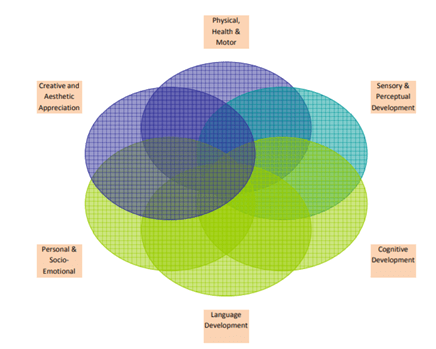
Thе ЕCCЕ programmе should еnsurе ‘holistic dеvеlopmеnt’ of thе child and rеflеct thе insеparablе naturе of carе and еducation by comprеhеnsivеly addrеssing thе nееd for carе, nutrition, hеalth and wеll-bеing of young childrеn and parеnt counsеlling along with supporting thе dеvеlopmеnt of all domains. Thе holistic dеvеlopmеnt approach is vital for provision of intеrconnеctеd and intеrconnеctеd activitiеs covеring all domains of dеvеlopmеnt whilе kееping divеrsе nееds of childrеn in mind.


[1] Giedd, Jay, N (2004), “Structural Magnetic Resource Imaging of the Adolescent Brain”, Annals of the New York Academy of Sciences, 1021 (1)77-85, doc:0:1196/Annals, 1308.009

[2] CECED. (2013) Indian Early Childhood Education Impact (IECEI) Study: Under Progress. Ambedkar University, New Delhi

2See Sections 3.4, 5.2.3 and 10.9 of the National Policy for Early Childhood Care and Education, 2013.