
SUBHASH CHANDRA BOSE

INTRODUCTION

Subhash Chandra Bose
SUBHASH CHANDRA BOSE

Subhash Chandra Bose is fondly remembered as one of the greatest freedom fighters of India, and popularly known by the name of ‘Netaji’ (Respected Leader). He was strongly influenced by Swami Vivekananda’s teachings, and also believed that the Bhagavad Gita was a great source of inspiration for the struggle against the British. Bose was an Indian nationalist, and a prominent figure of the Indian independence movement. He was superior head for Indian National Army during World War II. He always pitched for complete and unconditional independence of India from the British Rule.

CHILDHOOD

Subhash Chandra Bose was born to Prabhavati Devi and Janakinath Bose on January 23 in 1897 in Odisha. He took admission into the Protestant European School which was run by the Baptist Mission. He did B A in Philosophy from the Presidency College in Calcutta, and was later expelled for assaulting Professor for the latter’s anti-India remarks. After the incident, Bose was considered as one of the rebel-Indians.During his college days, he gradually developed nationalistic temperament, and became socially and politically aware. 

POLITICAL LIFE

18 Subhash Chandra Bose Books Which Prove Massively Impactful
THE GREAT FREEDOM FIGHTER

After a few years, Bose returned to India as he resigned from his civil service job in April 1921, and later joined the Indian National Congress to fight for the independence of India. Subhash Chandra Bose started the newspaper known as ‘Swaraj’, and took charge of publicity for the Bengal Provincial Congress Committee. In 1923, Bose was elected as the President of All India Youth Congress and as the Secretary of Bengal State Congress. He was also editor of the newspaper called ‘Forward’, founded by his mentor Chittaranjan Das, and he served as the CEO of the Calcutta Municipal Corporation. By December 1927, Bose was appointed as the General Secretary of the INC.

In November 1934, he wrote the first part of his book ‘The Indian Struggle’, which was about nationalism and India’s independence movement during 1920–1934, but the British government banned the book. By 1938, he agreed to accept nomination as the Congress President, and presided over the Haripur session. However, due to his strong differences with Mahatma Gandhi and Jawaharlal Nehru, he resigned in 1939.

ROLE IN INDIAN INDEPENDENCE
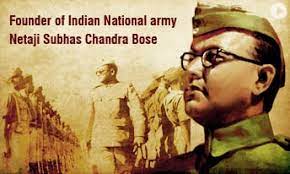
S C Bose was always in favour of armed revolution in order to expel the Britishers from India. During the time when the Second World War took place, Bose form the Indian National Army (INA) with the help of the Imperial Japanese Army, and also founded an Indian Radio Station called ‘Azad Hind Radio’.

A few years later, he travelled to Japan, where more soldiers and civilians joined the INA. Even when faced with military reverses, Bose was able to maintain support for the Azad Hind movement. In Europe, S C Bose sought help from Adolf Hitler and Benito Mussolini for the liberation of India. Bose had struck an alliance with Japan and Germany as he felt that his presence in the East would help India in the freedom struggle against the British.

MEMORIAL
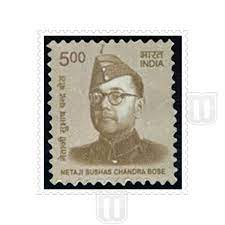
Bose was featured on the stamps in India from 1964, 1993, 1997, 2001, 2016 and 2018.Bose was also featured in ₹2 coin in 1996 and 1997, ₹ 75 coin in 2018and ₹125 coin in 2021. Netaji Subhash Chandra Bose international Airport at Kolkata, Netaji Subhash Chandra Bose Island, formerly Ross Island and many other institutions in India are named after him. On 23 August 2007,Japanese Prime minister visited the Subhas Chandra Bose memorial hall in Kolkata. Abe said to Bose’s family “The Japanese are deeply moved by Bose’s strong will to have led the Indian Independence Movement from British rule. Netaji is a much respected name in Japan.

In 2021, the Government of India declared 23 January as Parakram Divas to commemorate the birth anniversary of Subhas Chandra Bose. Political party, Trinamool Congress and the All India Forward Bloc demanded that the day should be observed as DESHPREM Divas.

*****MY HERO IS SUBHAS CHANDRA BOSE THIS ARTICLE IS DEDICATED TO YOU*****

JAI HIND” this slogan is said by Subhas Chandra Bose .
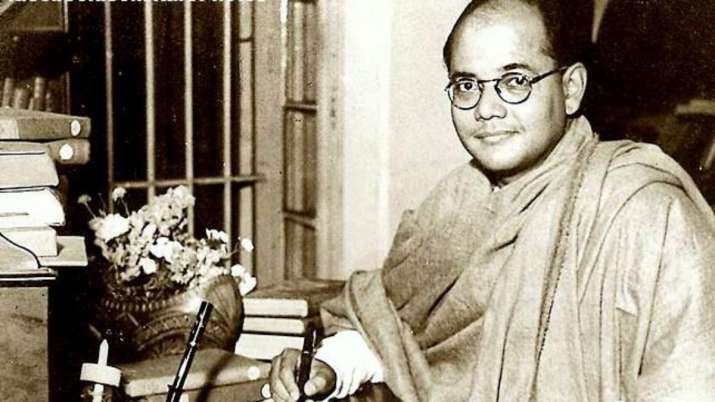
One of most visionary politician, Leader and a legend himself : Netaji Subhash Chandra Bose

Subhas Chandra Bose (Bengali pronunciation: Subhash Chondra Bosh) was the foremost and biggest leader of India’s freedom struggle. During the Second World War, to fight against the British, he formed the Azad Hind Fauj with the help of Japan. The slogan of Jai Hind given by him has become the national slogan of India. The people of India address him by the name of Netaji.

Subhash Chandra Bose gave famous slogans like ‘Give me blood, I will give you freedom’ and ‘Jai Hind’, passed the Indian Administrative Service examination, was elected President of Congress in 1938 and 1939, formed the Forward Bloc in 1939, Founded ‘Azad Hind Fauj’ to drive out the British from the country.

He was an eminent leader of the Indian freedom struggle. Although most of the credit for the contribution to the independence of the country is given to Mahatma Gandhi and Nehru, the contribution of Subhas Chandra Bose was also no less than anyone.

Early Life :

He was born on 23 January 1897 in Cuttack city of Orissa. His father Janaki Nath Bose was an eminent lawyer. His mother Prabhavati Devi was Sati and a religious woman. Prabhavati and Janaki Nath had 14 children, six daughters and eight sons. Subhash was ninth among them. Subhash was promising in studies since childhood. He had secured first position in class 10th examination and also came first in graduation. 

He earned a bachelor’s degree in philosophy from the Scottish Church College in Calcutta. At the same time, he was recruiting in the army. He also tried to join the army but was disqualified due to poor eyesight. He was a follower of Swami Vivekananda. According to the wishes of his family, in the year 1919, he went to study in England to prepare for the Indian Administrative Service.

Career :

He applied for the Indian Administrative Service in 1920 and not only got success in this examination but also secured the fourth position. He was deeply disturbed by the Jallianwala Bagh massacre and resigned from the administrative service in 1921. After coming back to India Netaji came in contact with Gandhiji and joined the Indian National Congress. He started working with Deshbandhu Chittaranjan Das as per the instructions of Gandhiji. He later described Chittaranjan Das as his political guru. 

Subhash very soon joined the main leaders of the Congress with his understanding and hard work. When the Simon Commission came in 1928, the Congress opposed it and showed black flags. In 1928, the annual session of the Congress was held in Kolkata under the chairmanship of Motilal Nehru. In this session, one year’s time was given to give ‘Dominion Status’ to the British Government. During that time Gandhiji did not agree with the demand of Purna Swaraj.

On the other hand, Subhash and Jawaharlal Nehru did not accept to back down from the demand for Purna Swaraj. In 1930 he formed the Independence League. During the ‘Civil Disobedience’ movement of 1930, Subhash was arrested and sent to jail. He was released in 1931 after the Gandhiji-Irwin Pact. Subhash opposed the Gandhi-Irwin Pact and was also not happy with the decision to stop the ‘Civil Disobedience’ movement.

Subhash was soon imprisoned again under the ‘Bengal Act’. During this he had to stay in jail for about a year and later he was released from jail due to illness. They were sent from India to Europe. There he established centers in many cities to enhance the political and cultural relations between India and Europe. Despite the ban on his coming to India, he came to India and as a result he had to go to jail for 1 year.

After the elections of 1937, the Congress party came to power in 7 states and after that Subhash was released. Shortly after this, Subhash was elected president in the Haripura session of Congress (1938). During his tenure, Subhash formed the ‘National Planning Committee’. In the Tripuri session of 1939, Subhash was re-elected as the President. This time Subhash was competing with Pattabhi Sitaramayya. Sitaramayya had full support of Gandhiji, yet Subhash won the election by 203 votes.

During this, the clouds of World War II were also starting to shake and Subhash gave an ultimatum to the British to leave the country in 6 months. This attitude of Subhash was opposed by other people of Congress including Gandhiji, due to which he resigned from the post of President and established ‘Forward Block’.

Subhash strongly opposed the use of India’s resources by the British in World War II and started a mass movement against it. His movement was getting tremendous support from the public. So he was imprisoned in Kolkata and kept under house arrest. In January 1941, Subhash managed to escape from his home and reached Germany via Afghanistan. In view of the notion of ‘the enemy is the enemy, the friend is’, he appealed to Germany and Japan for help in expelling the British Raj from India.

In January 1942, he started broadcasting from Radio Berlin, which increased the enthusiasm of the people of India. In 1943, he came to Singapore from Germany. Reaching East Asia, he took command of the ‘Freedom Movement’ from Rash Behari Bose and started preparing for the war by forming the Azad Hind Fauj. Azad Hind Fauj was established mainly by the Japanese army with the Indian prisoners of war captured from the British army. After this Subhash came to be called ‘Netaji’.

Now the Azad Hind Fauj started moving towards India and first liberated Andaman and Nicobar. Azad Hind Fauj crossed the Burma border and threatened Indian soil on 18 March 1944. With the defeat of Japan and Germany in World War II, the dream of Azad Hind Fauj could not be fulfilled.

Mysterious Demise : 

The death of Netaji, who once dusted the British by changing his mask and face, also happened in a very mysterious way. After the defeat of Japan in World War II, Netaji needed to find a new way. He had decided to seek help from Russia. On August 18, 1945, Netaji was on his way to Manchuria by plane. During this journey he went missing. After this day they have never been seen by anyone. On 23 August 1945, Japan’s Domei news organization reported to the world that on 18 August Netaji’s airplane had crashed on Taiwanese land and Netaji breathed his last in the hospital after being badly injured in that accident. But even today many doubts are raised about his death.

Our heroic great men, by sacrificing their lives, maintained the unity and integrity of the country, for which the coming generation will always remember their contribution. No one in history can match Netaji’s wisdom and courage. He had a combination of both courage and intelligence. It was because of a very intelligent mind that he was so influential that the British decided to eliminate him on sight. Frankly speaking I