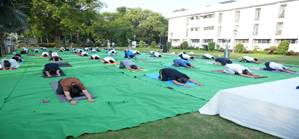
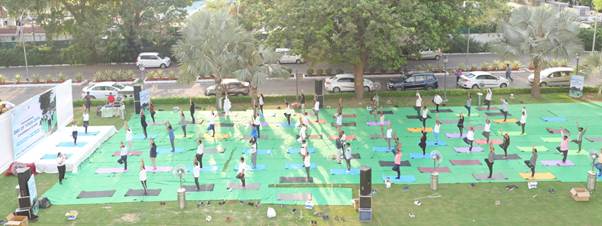
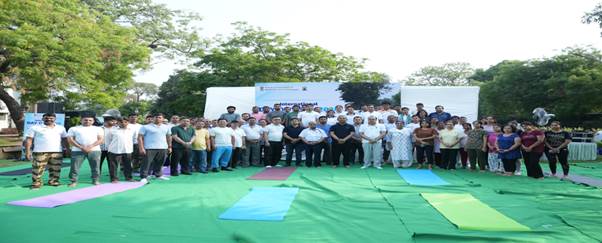
Shri Sanjay Kumar inaugurates Summer Fiesta 2024 at National Bal Bhavan, New Delhi

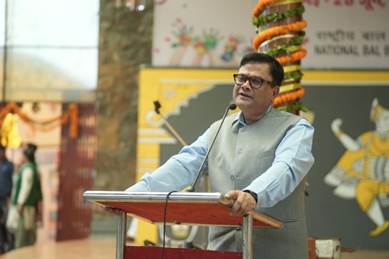
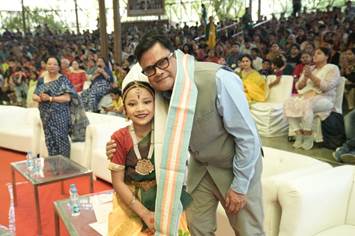
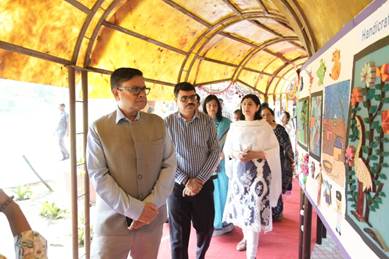
 Shri Sanjay Kumar, Secretary, Department of School Education & Literacy, Ministry of Education, today inaugurated the month-long “Summer Fiesta 2024” at the National Bal Bhavan, New Delhi. Summer Fiesta is a month-long camp comprising over 30 types of different activities for children aged between 5 to 16 years. Shri Vipin Kumar, Additional Secretary (SS-II), Department of School Education & Literacy, Ministry of Education and the Chairman of National Bal Bhavan, and senior officials from the Ministry were also present on the occasion.

Addressing the enthusiastic gathering of children and their parents, Shri Sanjay Kumar emphasized the significance of such interactive and innovative programmes in nurturing young minds. He said that along with academics, these types of extracurricular activities are equally important for children to become successful in the future. Further, he exhorted children to be curious and to explore things around them, which will help in opening their minds.

Summer Fiesta 2024, which runs from 29th May to 28th June 2024, promises a myriad of engaging and innovative activities in the fields of Creative and Performing Arts, Science, and more, ensuring that every child finds something intriguing to explore and learn. During the Summer Fiesta, special workshops and programs will be conducted weekly, including sessions on Odissi dance, Yoga, Calligraphy, Music recitals, Games etc. These workshops are designed to provide children with opportunities to develop and showcase their skills and talents.

The event will also feature eminent artists and guests who will participate in these special programmes, sharing their experiences and delivering captivating performances to inspire the children. The initiative has seen an overwhelming response, with over 2500 children already enrolled in the various workshops and programs. To facilitate easy access for all participants, transportation facilities all over Delhi have also been made available by the National Bal Bhavan.

The National Bal Bhavan, an autonomous body under the Department of School Education and Literacy, Ministry of Education, was established in 1956. It was founded with the vision of fostering learning through thinking, imagination, creativity, and entertaining activities for children.

******

MEDITECH STACKATHON 2024 in collaboration with CII at New Delhi

 Secretary, Department of Pharmaceuticals, Ministry of Chemicals and Fertilizers Dr Arunish Chawla, launched the MEDITECH STACKATHON 2024 in collaboration with CII in New Delhi today. The MEDITECH STACKATHON is a groundbreaking initiative designed to catalyze transformative change within India’s burgeoning MedTech sector by undertaking a comprehensive value chain analysis of select medical devices. Through close consultation with industry leaders, policymakers, and experts, the STACKATHON aims to address critical challenges, foster domestic manufacturing, and reduce import dependence, thereby positioning India as a global leader in medical technology. Joint Secretary, Department of Pharmaceuticals Shri RP Singh and Chairman, CII National Medical Technology Forum Shri Himanshu Baid and other senior officials of the Department and representatives of the Industry were present on the occasion.
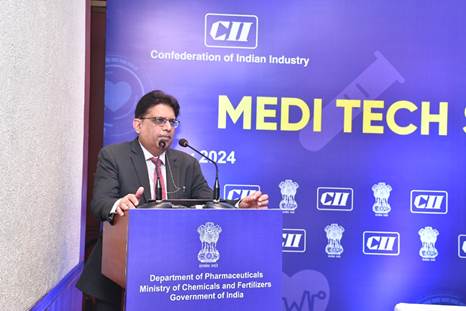
Addressing the gathering, Dr Arunish Chawla said that India’s MedTech industry holds immense potential, with projections estimating a growth rate of 28% annually, reaching a size of USD 50 billion by 2030. He said that currently, India is the 4th largest market for medical devices in Asia and among the top 20 globally. Net imports for 2022-23 stands at USD 4101 Million with import coverage ratio of 0.45.

The Secretary said that the sector has witnessed a surge in imports, driven primarily by countries like the US, China, and Germany, however, India’s robust policy ecosystem presents opportunities for export boosts and reducing import dependence through domestic manufacturing.

Pharma Secretary Shri Arunish Chawla emphasized on the importance of policymakers, industry coming together to draw up a sturdy policy stack for growth of medical devices industry in the country.

He highlighted the critical need to focus on quality to ensure that India becomes globally competitive.

Exports have overtaken imports in consumables and disposables during last year, he said, and urged the industry to continue with the momentum in other pillars of medi-tech sector.

Collaboration among stakeholders is essential to address these challenges and enhance both the ease and cost of doing business in the sector. By fostering partnerships, boosting investment in research and innovation, and streamlining value chain processes, we can achieve our shared goal of accessible and affordable healthcare for all, he added.
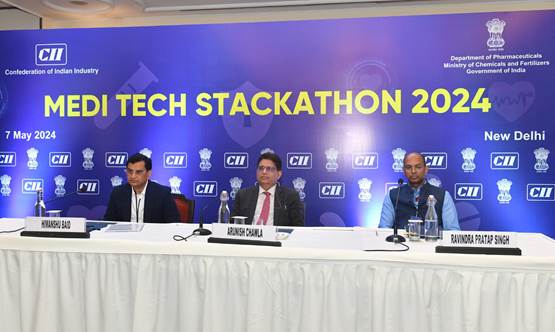
Through the STACKATHON, participants will delve into the complexities of different product segments within the medical devices industry to gain insights into their unique challenges and opportunities, analyze and map value chains across various segments of the medical devices industry to identify key stakeholders, processes, and dependencies, identify critical issues hindering the development of the medical devices industry, such as import dependence, regulatory hurdles, and technological gaps, Dr Chawla said in his address.

The STACKATHON would deliberate in eight focused groups namely Cancer Therapy, Imaging, Critical Care, Assistive Medical Devices, Body Implants, Surgical instruments and Hospital Equipment, Consumables & Disposables, and IVD Instruments and reagents, each tasked with specific objectives including segment-wise identification of important medical devices, assessment of import-export dynamics, examination of duty structures, and their implications across the entire value chain.

Preceding this workshop, group leads and members have undertaken extensive virtual discussions and preparatory work. The challenges persist in the sector, including cost competitiveness, quality assurance, and regulatory hurdles.

Shri Himanshu Baid, Chairman, CII highlighted a shared vision of collaborative excellence, wherein stakeholders unite to drive tangible outcomes and propel the MedTech industry towards unparalleled growth. He said that with India’s MedTech exports surpassing 4 billion dollars, the industry stands poised on a trajectory of remarkable expansion. However, he highlighted the need for enhanced data collation mechanisms to address gaps in product consumption and production within India. He stated that India’s MedTech landscape is brimming with promise, poised to capture 10% of the global market share over the next decade. Endowed with a robust ecosystem comprising world-class hospitals, skilled manpower, and cutting-edge resources, India is primed to emerge as a frontrunner in the global MedTech arena. He further underscored the importance of fostering industry-friendly policies, streamlining regulatory frameworks, and extending support to Micro, Small, and Medium Enterprises (MSMEs) through targeted incentives and technology funds.

Against this backdrop of immense potential, the MEDITECH STACKATHON 2024 seeks to harness the collective expertise of stakeholders to propel the industry towards unprecedented heights of innovation and self-reliance.


International Day of Yoga -2024 at Vigyan Bhawan Annexe, New Delhi

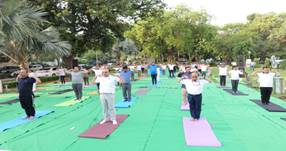
 In anticipation of the upcoming International Day of Yoga, the Ministry of Development of North Eastern Region (MDoNER) organized a countdown event at VigyanBhawan Annexe in New Delhi. Secretary and officers/officials of MDoNER and CISF officers and staff posted in VigyanBhawan Annexe, activelyparticipated under the guidance of Yoga Instructor and Demonstrators from MDNIY highlighting the timeless benefits of yoga deeply ingrained in Indian heritage.


The event featured dynamic yoga practices aimed at nurturing holistic well-being. Secretary DoNER emphasized yoga’s role in promoting physical, mental, and spiritual health

As MDoNER hosts the countdown to this transformative day, it reaffirms India’s commitment to nurturing a culture of health and wellness through yoga. The event at Vigyan Bhawan serves as a reminder of yoga’s universal appeal and its enduring relevance in addressing contemporary challenges.

A group of people doing yogaDescription automatically generated

Yoga, with its roots in ancient Indian tradition, has been widely recognized for its positive impact on physical, mental, and spiritual health. MDoNER’s event highlights the importance of incorporating yoga into daily life for a healthier and more balanced lifestyle.

A group of people standing in front of a bannerDescription automatically generated

****

Annual PhD Workshop at Indian Institute for Human Settlements (IIHS) New Delhi

 The Indian Institute for Human Settlements (IIHS) will host the tenth edition of the Annual PhD Workshop in a hybrid format (virtually and in-person) from 8 to 10 January 2024.


With a strong interdisciplinary focus, as well as an emphasis on the relationship between research and practice, IIHS nurtures research and innovation focused on the challenges and opportunities of India’s urban transition. IIHS has built a substantive on-ground presence of direct policy and programmatic engagement across India, across middle and senior administrative levels, and in multiple urban contexts in the Global South. This makes for a globally unique opportunity for scholars intending to research the Urban where it matters – at the intersection of theory and practice. IIHS’ Post-Doctoral programme and the proposed doctoral programme emphasise the institute’s wider connections into domestic and international policy, and to overlapping communities of practice. IIHS is also building an integrated programme of quality campus-based education and research, training and lifelong learning for working professionals, distance and blended learning, as well as an array of practice and advisory services.


About the PhD Workshop

The PhD Workshop is a unique educational intervention on interdisciplinary urban research designed to provide a dedicated space for PhD candidates to expand on their work. They do this by interacting with eminent urban scholars and practitioners from IIHS and leading universities, and research institutions across the world including Yale, MIT, IIT-Madras, TISS, among others.


Initiated in 2013, the PhD Workshop has had close to 200 participants from leading global and domestic institutions including University of Oxford, MIT, University of Pennsylvania, Cornell University, NUS, JNU, TISS, IIT-Bombay etc., across a wide range of disciplines such as Architecture, Planning, Sociology, Urban Health, Economics, Public Policy, Climate Change, Anthropology, Engineering, Governance and Law. The Workshop provides participants with an opportunity to explore emerging areas of urban research especially in India and other parts of the global South and give them the opportunity to theorise from both research and practice.


The Workshop aims to shape the trajectory of a doctoral career and enable participants to engage with the imperatives of the changing form of disciplines, and meet the substantive academic demands of the doctoral process. The foundational ethos of the Workshop is an interdisciplinary approach to the Urban, guided by theories of and from the Global South with an emphasis on grounded understandings. The Workshop provides scholars with a space to critically examine urban related issues of their interest, and their own position within it. This self-reflexive criticality allows participants to approach their field of inquiry as actors within, rather than as mere viewers of urban phenomena. In addition to guiding students through their work, the Workshop deals with specific processes of earning a doctoral degree. The aim is to create a space of convivial co-learning that opens conversations not only on fields of inquiry, but also on experiences of students navigating the path to a doctoral degree.


Structure of the Workshop

This iteration of the PhD Workshop is open to participants from across a wide range of disciplines, with a common thread being an interest in urban research and practice. The Workshop is designed to provide a platform for in-depth exploration and for early and mid-to-late stage PhD students and fine-tune their work. The structure of the Workshop and the modules within it are designed to be relevant to students from different disciplines and at different stages of their doctoral career. The structure also allows for specific attention to the needs of individual scholars and enables peer to peer learning.


In addition to thematic relevant to particular disciplines, the Workshop will also have a Commons track, and two specialised tracks. The Commons track will primarily involve engagement with eminent urban scholars and practitioners as they explore the possibilities of new methods and pedagogies in and around the Urban. This track provides an opportunity to learn about and understand a range of methods and data sources that are unique to urban India, ethical practices in research as well as the nuances of publishing in academia. Two specialised tracks will focus on early career students who are in the process of finalising their questions (Track 1) and late career students working on finalising their dissertation (Track 2).


The PhD Workshop will be in a hybrid format this year from 8 to 10 January 2024. Interested candidates should send in their submissions by 27 November 2023.


For queries on the Workshop, write to us at research@iihs.ac.in.

Vacancy at School of Planning and Architecture, New Delhi

  The School of Planning and Architecture, Delhi (SPA Delhi), is a prestigious institution of higher education in India that specializes in architecture and urban planning. Established in 1941 as the Department of Architecture at Delhi Polytechnic, it has since evolved into a full-fledged autonomous institution. SPA Delhi is known for its excellence in architecture and planning education and research, and it holds a prominent place in the academic and professional realms of the country.

APPLY NOW 𝐍𝐎𝐖!!
✅ 𝐏𝐨𝐬𝐢𝐭𝐢𝐨𝐧: – Project Associates (Ad-hoc) December 2023-February 2024(initially)
✅ 𝐓𝐨𝐭𝐚𝐥 𝐧𝐨 𝐨𝐟 𝐏𝐨𝐬𝐢𝐭𝐢𝐨𝐧𝐬: – 02 positions
✅ 𝐐𝐮𝐚𝐥𝐢𝐟𝐢𝐜𝐚𝐭𝐢𝐨𝐧𝐬: M.Arch / M. Urban Design
✅ 𝐄𝐱𝐩𝐞𝐫𝐢𝐞𝐧𝐜𝐞: Nil
✅ 𝐒𝐚𝐥𝐚𝐫𝐲: Fixed Remuneration Rs45,000 pm
✅ 𝐋𝐨𝐜𝐚𝐭𝐢𝐨𝐧: New Delhi
✅ 𝐌𝐨𝐝𝐞 𝐨𝐟 𝐒𝐞𝐥𝐞𝐜𝐭𝐢𝐨𝐧 : Online/Offline Interview
✅ 𝐇𝐨𝐰 𝐭𝐨 𝐚𝐩𝐩𝐥𝐲 : Send CV on or before 10.11.2023 to the O/o PA of HOD, Urban Design Department or mail at spaurbandesign@gmail.com

𝐋𝐚𝐬𝐭 𝐃𝐚𝐭𝐞 : 𝟏𝟎𝐡 𝐍𝐨𝐯𝐞𝐦𝐛𝐞𝐫 𝟐𝟎𝟐𝟑
𝐂𝐥𝐢𝐜𝐤 𝐨𝐧 𝐭𝐡𝐞 𝐥𝐢𝐧𝐤 𝐟𝐨𝐫 𝐝𝐞𝐭𝐚𝐢𝐥𝐞𝐝 𝐚𝐝𝐯𝐞𝐫𝐭𝐢𝐬𝐞𝐦𝐞𝐧𝐭 𝐚𝐧𝐝 𝐭𝐨 𝐚𝐩𝐩𝐥𝐲:
http://spa.ac.in/User_Panel/UserView.aspx?TypeID=5656

War Theatres: India’s entry into hybrid warfare

The Ministry of Defense announced the theaterisation of the Indian Armed forces under the Chief of Armed Forces (currently, Gen Bipin Rawat), the Defense Secretary and the tri-force chief council.

Indian Armed Forces - Wikipedia
The Insignia of the Indian Armed Forces

Theatres of defense would quite effectively wipe out the existing commands system in which the Indian uniformed forces work. India has 17 armed commands – 7 for the army, 7 for the airforce and 3 for the Navy. These commands are indepednent of each other and have a different officer from the corresponding service to serve as the commander. This model is the traditional one which has been followed for centuries. The British, the French, the Americans have all always had a separate command for the army and for the navy. The Mughal Empire did not have a lot of maritime enemies along its controlled regions in Bengal. However, by the time the Marathas took over, the Portugese and the French had arrived with newer war techniques and a large part of this warfare was at sea. So, the Marathas developed a strong naval force. Even then, the office of the admiral and the office of the Commander of Army were separate. Infact, even in the army, the office of the gun users and those of the cavalry and cannons were separate.

However, the first world war introduced new means of warfare. Trenches, tanks, heavier guns and soldiers – everything together. It was unlike the American Wars before 1860s where the two parties would stand on either side of the rift and shoot on orders and then jump to manual fighting. It was a new way of fighting where all forces of offense and defense needed to work together and several layers of bureaucracy and controls would hinder the effectiveness. Thus was introduced the concept of theatre of war. War office was segregated not based on the uniformed service but on the region to control. That makes orders easier, the need and procurement of weapons is simplified. The second world war only assured that the theatre warfare is better than the conventional war office. There is a commander of the theatre who addresses directly to the council of war or the defense council or the war office (As in World War 2 Britain) or to the chief of Defense forces and Defense Secretary (As in modern day USA).

China entered into the Theatrisation process very recently. Pakistan copied its model. India is probably the last large economy to change to the theatre model of warfare. And it means that Indian warfare should be more synchronized and effective now. So should be the process of weaponisation. There have been instances where the airforce and the army separately ordered jets causing the government to loose a lot on the benifits it could have had received for a bulk order. Similar is the story for missiles to be used by the army, the navy and the air force.

Unfortunately, there is a lot of drama going on in the defense forces headquarters in New Delhi about the theaterisation mechanics. However, all chiefs and the cabinet has shown commitment towards a fast and effective formalization of the new policy.

Solid Waste Compost Plant at Model Town, Delhi

The establishment of a solid waste compost plant in Model Town, Delhi, would be a significant step towards sustainable waste management and environmental conservation. Composting is an effective technique that converts organic waste into nutrient-rich compost, which can be used as a soil amendment in agriculture and horticulture. Here’s an overview of the potential benefits and considerations of setting up such a plant in Model Town.

Waste Management Solution: The compost plant would provide an efficient solution for managing organic waste generated in Model Town. Instead of sending this waste to landfills where it contributes to the production of harmful greenhouse gases, the plant would divert the organic waste for composting. This would significantly reduce the amount of waste being landfilled, thus minimizing the associated environmental and health hazards.

Resource Recovery and Circular Economy: The compost plant would facilitate resource recovery by converting organic waste into valuable compost. This compost can be utilized to enrich the soil, enhance agricultural productivity, and reduce the reliance on chemical fertilizers. By closing the loop on organic waste, the plant would contribute to the principles of a circular economy by promoting the reuse and regeneration of resources.

Environmental Benefits: The establishment of a compost plant in Model Town would yield several environmental benefits. Composting organic waste reduces the emission of methane, a potent greenhouse gas, from landfills. Moreover, compost acts as a natural soil conditioner, improving soil structure, water retention, and nutrient content. By utilizing compost, farmers can reduce their dependence on synthetic fertilizers, which can have adverse environmental impacts. Additionally, composting helps conserve water by improving soil’s water-holding capacity, leading to more sustainable agricultural practices.

Community Engagement and Employment Opportunities: The compost plant can serve as a community engagement platform, promoting waste management awareness and encouraging residents to participate in composting initiatives. Educational programs and workshops can be organized to educate residents about the benefits of composting and how to segregate organic waste at source. Moreover, the plant would create employment opportunities, both in terms of plant operations and outreach activities, contributing to the local economy.

Odor and Environmental Concerns: It is essential to address potential concerns related to odor and environmental impacts. Advanced composting techniques, such as aerobic composting or enclosed systems, can be implemented to minimize odor generation. Proper odor control measures, regular maintenance, and monitoring of the plant’s operations can help ensure that any potential negative impacts are mitigated.

Infrastructure and Regulatory Framework: Setting up a solid waste compost plant would require the necessary infrastructure, including composting units, shredders, curing areas, and quality control laboratories. Adequate space, proximity to waste generation sources, and proper waste collection and transportation systems would also be crucial considerations. Compliance with local environmental regulations and waste management policies would be essential to ensure the plant’s operations are in line with the required standards.

In conclusion, the establishment of a solid waste compost plant in Model Town, Delhi, would provide a sustainable waste management solution, contribute to resource recovery, and yield environmental benefits. It would require community engagement, proper infrastructure, and adherence to regulatory guidelines. By embracing composting as a waste management strategy, Model Town can move towards a more sustainable and environmentally conscious future.